
Role of external factors of exchange rate channel
- Slides: 10
Role of external factors of exchange rate channel of monetary transmission mechanism in countries with inflation targeting Alina Grebenkina 1
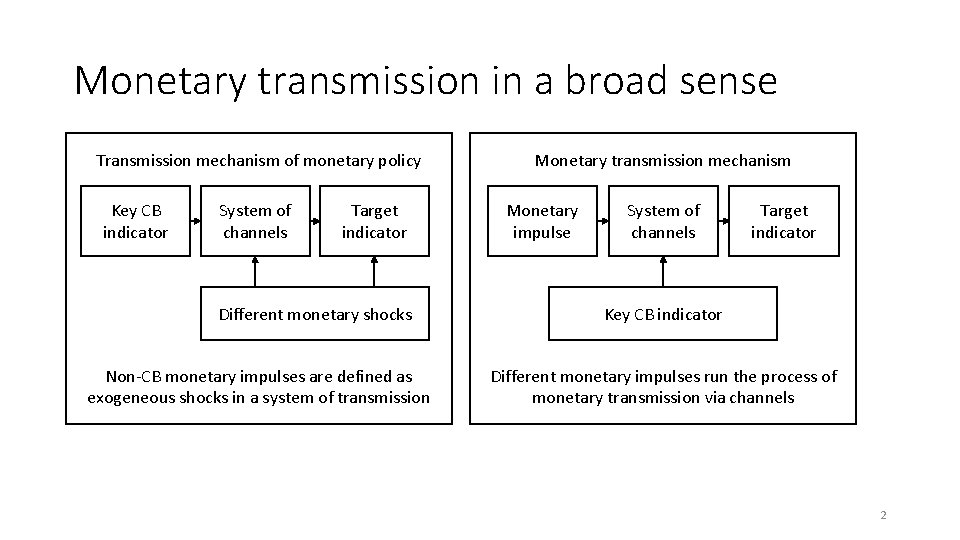
Monetary transmission in a broad sense Transmission mechanism of monetary policy Key CB indicator System of channels Target indicator Different monetary shocks Non-CB monetary impulses are defined as exogeneous shocks in a system of transmission Monetary transmission mechanism Monetary impulse System of channels Target indicator Key CB indicator Different monetary impulses run the process of monetary transmission via channels 2
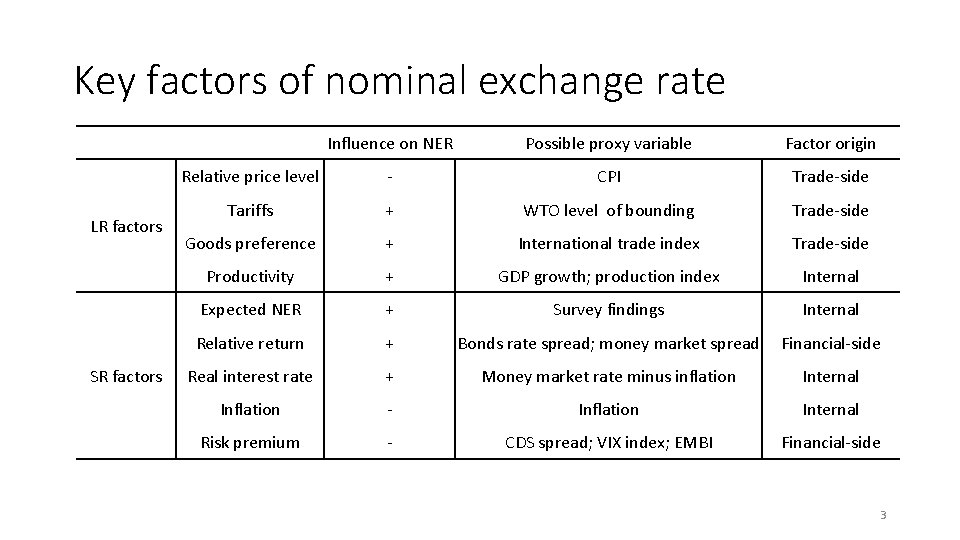
Key factors of nominal exchange rate LR factors SR factors Influence on NER Possible proxy variable Factor origin Relative price level - CPI Trade-side Tariffs + WTO level of bounding Trade-side Goods preference + International trade index Trade-side Productivity + GDP growth; production index Internal Expected NER + Survey findings Internal Relative return + Bonds rate spread; money market spread Financial-side Real interest rate + Money market rate minus inflation Internal Inflation - Inflation Internal Risk premium - CDS spread; VIX index; EMBI Financial-side 3
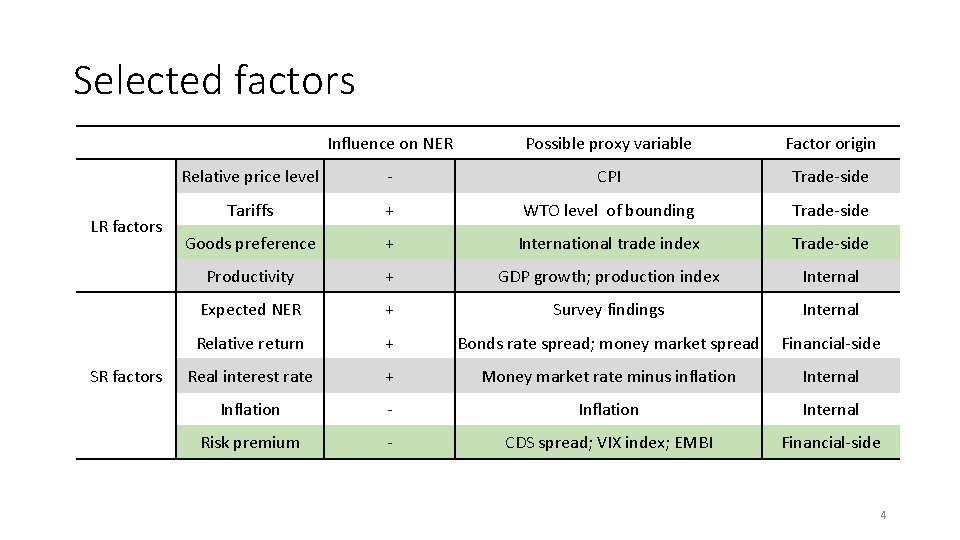
Selected factors LR factors SR factors Influence on NER Possible proxy variable Factor origin Relative price level - CPI Trade-side Tariffs + WTO level of bounding Trade-side Goods preference + International trade index Trade-side Productivity + GDP growth; production index Internal Expected NER + Survey findings Internal Relative return + Bonds rate spread; money market spread Financial-side Real interest rate + Money market rate minus inflation Internal Inflation - Inflation Internal Risk premium - CDS spread; VIX index; EMBI Financial-side 4
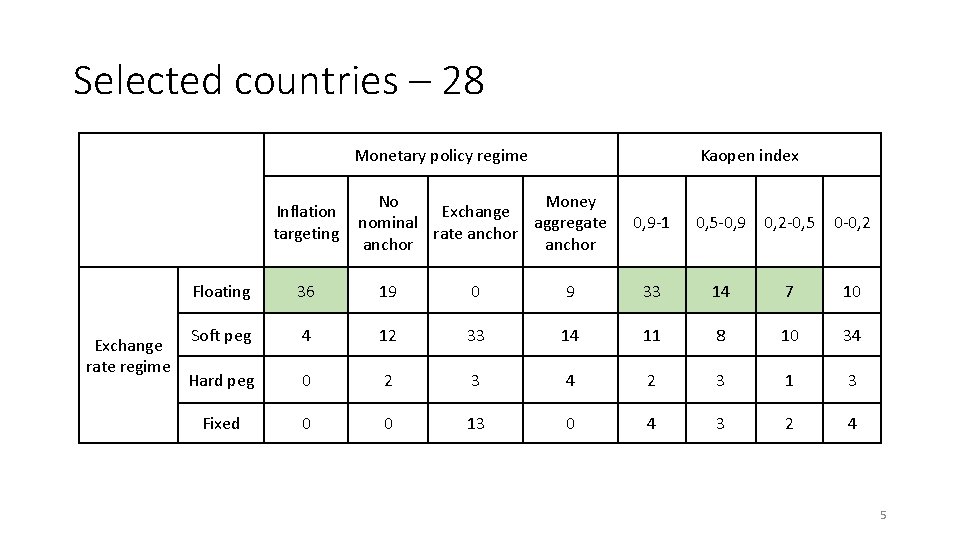
Selected countries – 28 Monetary policy regime Inflation targeting Exchange rate regime Kaopen index No Money Exchange nominal aggregate rate anchor 0, 9 -1 0, 5 -0, 9 0, 2 -0, 5 0 -0, 2 Floating 36 19 0 9 33 14 7 10 Soft peg 4 12 33 14 11 8 10 34 Hard peg 0 2 3 4 2 3 1 3 Fixed 0 0 13 0 4 3 2 4 5
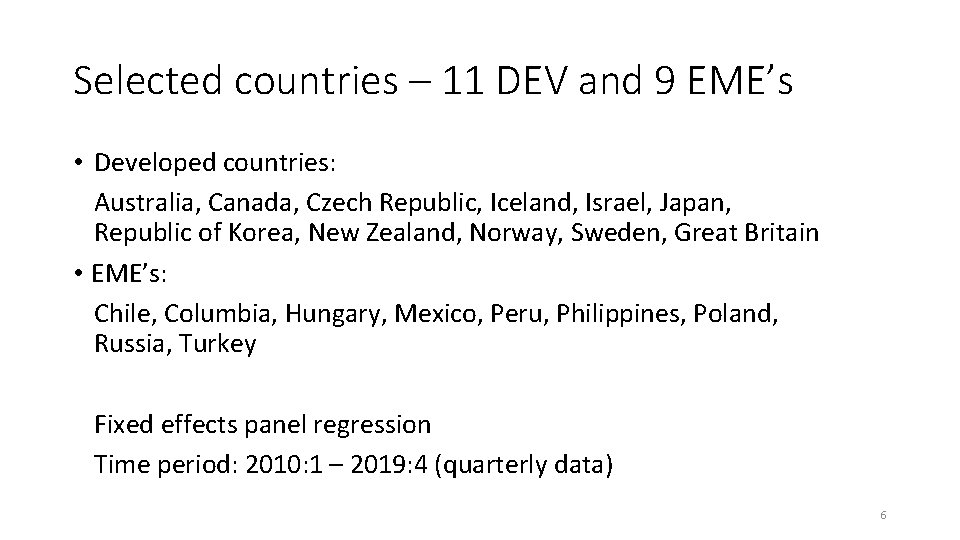
Selected countries – 11 DEV and 9 EME’s • Developed countries: Australia, Canada, Czech Republic, Iceland, Israel, Japan, Republic of Korea, New Zealand, Norway, Sweden, Great Britain • EME’s: Chile, Columbia, Hungary, Mexico, Peru, Philippines, Poland, Russia, Turkey Fixed effects panel regression Time period: 2010: 1 – 2019: 4 (quarterly data) 6
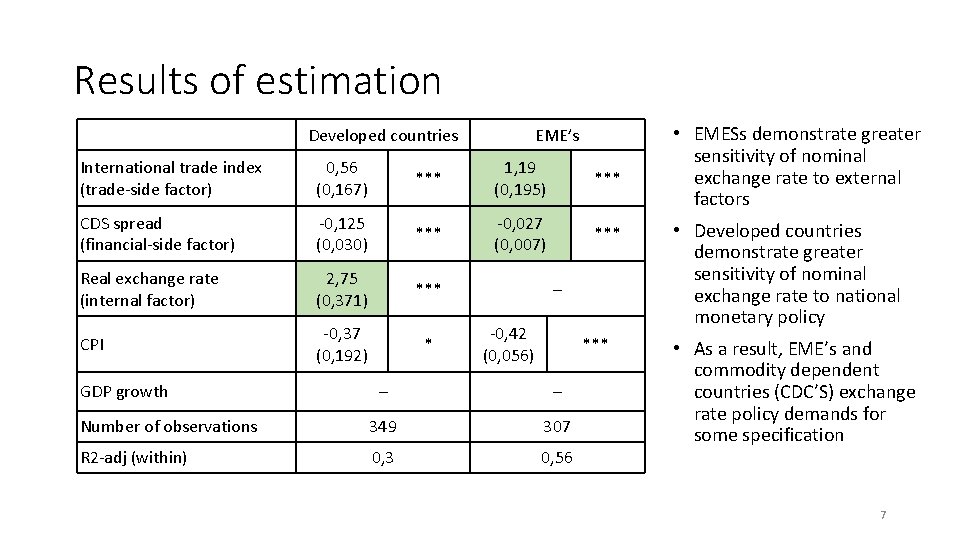
Results of estimation Developed countries EME’s International trade index (trade-side factor) 0, 56 (0, 167) *** 1, 19 (0, 195) *** CDS spread (financial-side factor) -0, 125 (0, 030) *** -0, 027 (0, 007) *** Real exchange rate (internal factor) 2, 75 (0, 371) *** CPI -0, 37 (0, 192) * GDP growth – -0, 42 (0, 056) *** – – Number of observations 349 307 R 2 -adj (within) 0, 3 0, 56 • EMESs demonstrate greater sensitivity of nominal exchange rate to external factors • Developed countries demonstrate greater sensitivity of nominal exchange rate to national monetary policy • As a result, EME’s and commodity dependent countries (CDC’S) exchange rate policy demands for some specification 7
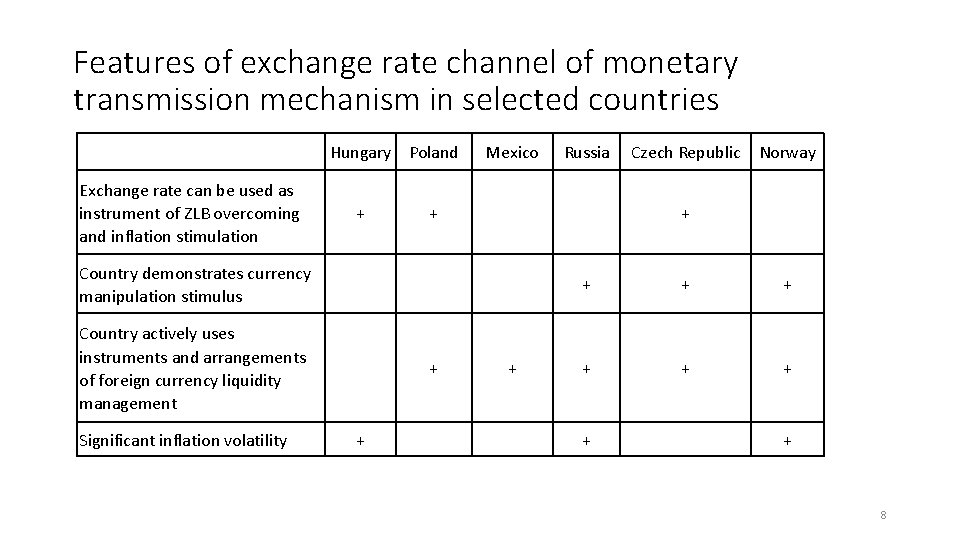
Features of exchange rate channel of monetary transmission mechanism in selected countries Hungary Poland Exchange rate can be used as instrument of ZLB overcoming and inflation stimulation + Mexico + Significant inflation volatility + + Czech Republic Norway + Country demonstrates currency manipulation stimulus Country actively uses instruments and arrangements of foreign currency liquidity management Russia + + + + + 8
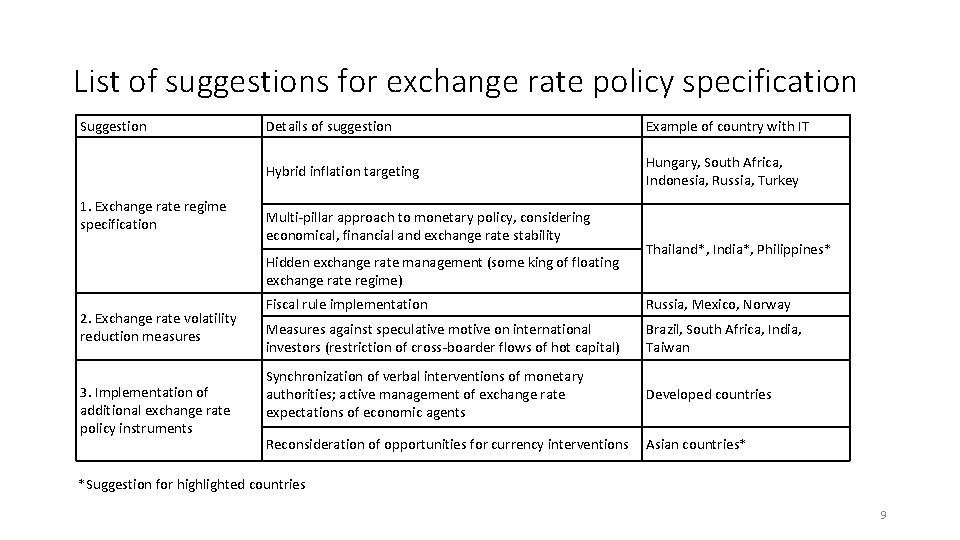
List of suggestions for exchange rate policy specification Suggestion 1. Exchange rate regime specification Details of suggestion Example of country with IT Hybrid inflation targeting Hungary, South Africa, Indonesia, Russia, Turkey Multi-pillar approach to monetary policy, considering economical, financial and exchange rate stability Hidden exchange rate management (some king of floating exchange rate regime) 2. Exchange rate volatility reduction measures 3. Implementation of additional exchange rate policy instruments Thailand*, India*, Philippines* Fiscal rule implementation Russia, Mexico, Norway Measures against speculative motive on international investors (restriction of cross-boarder flows of hot capital) Brazil, South Africa, India, Taiwan Synchronization of verbal interventions of monetary authorities; active management of exchange rate expectations of economic agents Developed countries Reconsideration of opportunities for currency interventions Asian countries* *Suggestion for highlighted countries 9
Role of external factors of exchange rate channel of monetary transmission mechanism in countries with inflation targeting Thank you! 10