
Role of Bilingual Staff in Language Access Services
Role of Bilingual Staff in Language Access Services: Bilingual Staff as Interpreters Maryvale Clinic Lunch and Learn Presentation December 4 th, 2015
Why do we need to provide language services To ensure the safety of Mountain Park patients who are unable to communicate effectively in English. To comply with Title VI of the Civil Rights Act of 1964, which prohibits discrimination in federally funded programs on the basis of intrinsic characteristics such as race, religion, age, sex, and national origin. To meet the standards outlined by the U. S. Department of Health and Human Services in Culturally and Linguistically Appropriate Services (CLAS Standards). 2
Learning Objectives Main keys of success to reach a professional level of interpreting How to build your medical terminology Resources for professional development 3
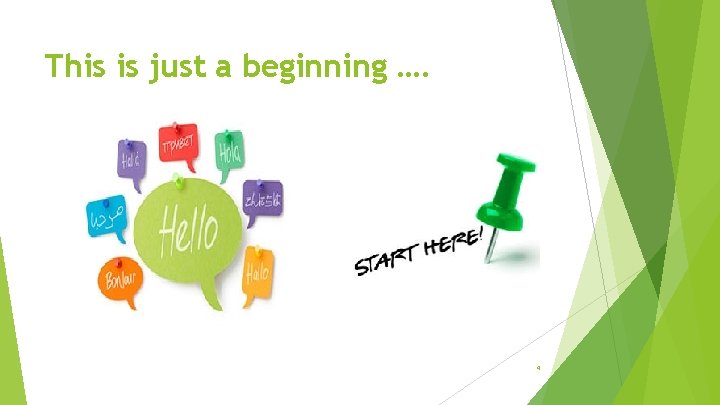
This is just a beginning …. 4

Ready? Let’s sail together! 5
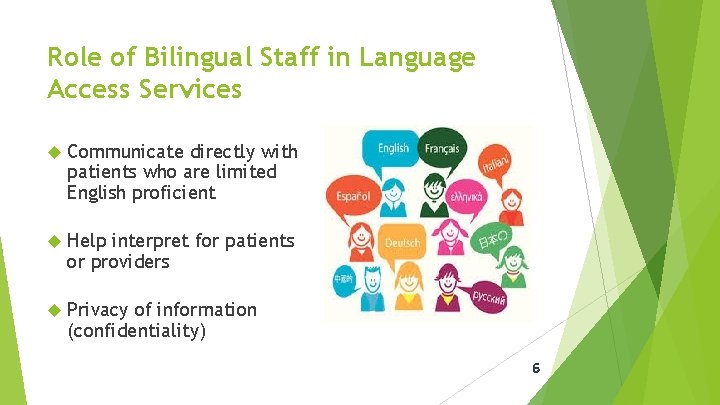
Role of Bilingual Staff in Language Access Services Communicate directly with patients who are limited English proficient Help interpret for patients or providers Privacy of information (confidentiality) 6
Basic Qualifications and Skills for Professional Interpreting Main Qualifications - High proficiency in working languages Main Skills - Interpret 2 -3 sentences without requesting repetition - Interpret with maximum accuracy (no omissions or additions) - Interpret in first person - Very good memory - Note taking (refresh the memory esp. numbers & dosages) 7
Keys of Success: Being Prepared Before the session During the session o Listen attentively o Tone of voice (calm, reassuring & audible) o Recommend optimal positioning o Manage the flow of communication After the session 8
Group Activity YAY ! Memory & Note Taking Skills 9
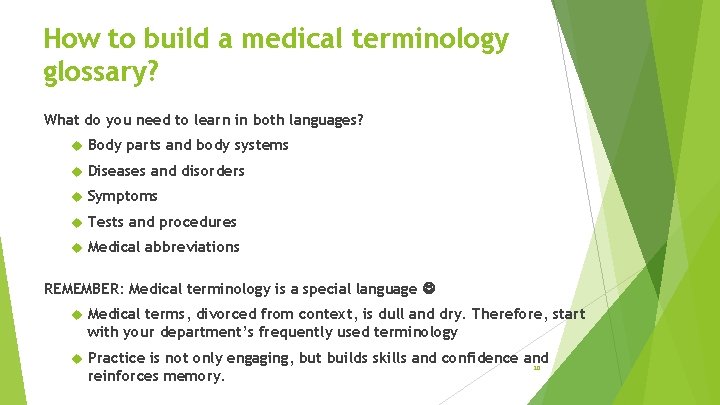
How to build a medical terminology glossary? What do you need to learn in both languages? Body parts and body systems Diseases and disorders Symptoms Tests and procedures Medical abbreviations REMEMBER: Medical terminology is a special language Medical terms, divorced from context, is dull and dry. Therefore, start with your department’s frequently used terminology Practice is not only engaging, but builds skills and confidence and 10 reinforces memory.
Remember: Practice makes perfect ! 11
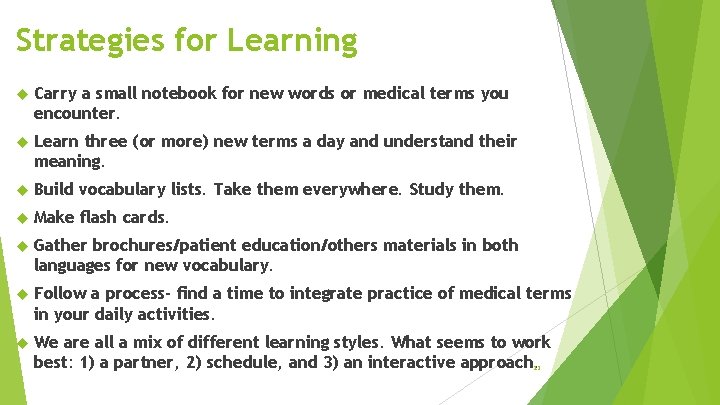
Strategies for Learning Carry a small notebook for new words or medical terms you encounter. Learn three (or more) new terms a day and understand their meaning. Build vocabulary lists. Take them everywhere. Study them. Make flash cards. Gather brochures/patient education/others materials in both languages for new vocabulary. Follow a process- find a time to integrate practice of medical terms in your daily activities. We are all a mix of different learning styles. What seems to work best: 1) a partner, 2) schedule, and 3) an interactive approach. 12
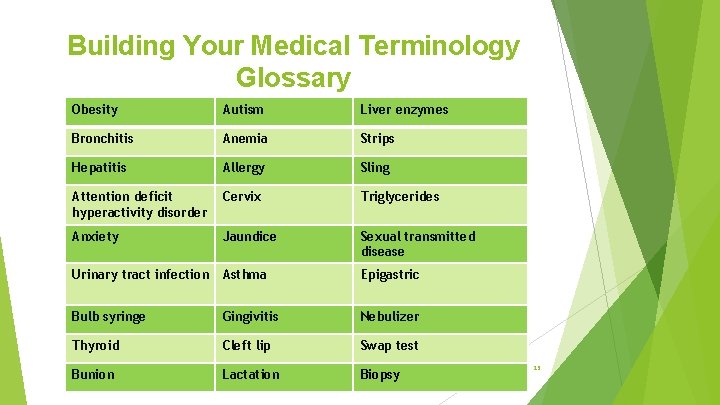
Building Your Medical Terminology Glossary Obesity Autism Liver enzymes Bronchitis Anemia Strips Hepatitis Allergy Sling Attention deficit hyperactivity disorder Cervix Triglycerides Anxiety Jaundice Sexual transmitted disease Urinary tract infection Asthma Epigastric Bulb syringe Gingivitis Nebulizer Thyroid Cleft lip Swap test Bunion Lactation Biopsy 13
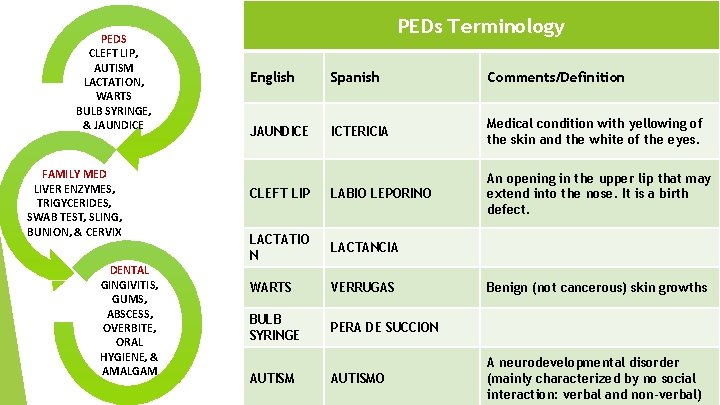
PEDS CLEFT LIP, AUTISM LACTATION, WARTS BULB SYRINGE, & JAUNDICE FAMILY MED LIVER ENZYMES, TRIGYCERIDES, SWAB TEST, SLING, BUNION, & CERVIX DENTAL GINGIVITIS, GUMS, ABSCESS, OVERBITE, ORAL HYGIENE, & AMALGAM PEDs Terminology English Spanish Comments/Definition JAUNDICE ICTERICIA Medical condition with yellowing of the skin and the white of the eyes. CLEFT LIP LABIO LEPORINO An opening in the upper lip that may extend into the nose. It is a birth defect. LACTATIO N LACTANCIA WARTS VERRUGAS BULB SYRINGE PERA DE SUCCION AUTISMO Benign (not cancerous) skin growths A neurodevelopmental disorder 14 (mainly characterized by no social interaction: verbal and non-verbal)
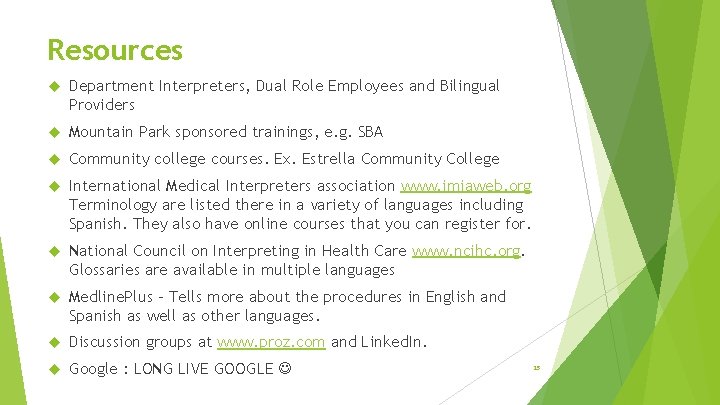
Resources Department Interpreters, Dual Role Employees and Bilingual Providers Mountain Park sponsored trainings, e. g. SBA Community college courses. Ex. Estrella Community College International Medical Interpreters association www. imiaweb. org Terminology are listed there in a variety of languages including Spanish. They also have online courses that you can register for. National Council on Interpreting in Health Care www. ncihc. org. Glossaries are available in multiple languages Medline. Plus – Tells more about the procedures in English and Spanish as well as other languages. Discussion groups at www. proz. com and Linked. In. Google : LONG LIVE GOOGLE 15
16
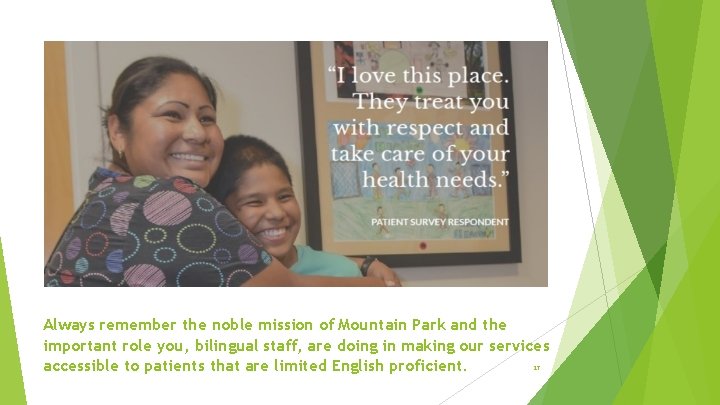
Always remember the noble mission of Mountain Park and the important role you, bilingual staff, are doing in making our services 17 accessible to patients that are limited English proficient.
Thank YOU! Rabah Radhi, Language Access Manager at rradhi@mphc-az. org Luz Torres, Department Interpreter, IM Baseline at ltorres@mphc-az. org Baldo Leon, Department Interpreter, IM Baseline at bleon@mphc-az. org 18
- Slides: 18