
ROLE OF AN ACADEMIC BOARD IN SELECTING PROGRAMMES

ROLE OF AN ACADEMIC BOARD IN SELECTING PROGRAMMES AND LEARNING MATERIALS Birchwood Hotel 22 -23 September 2011 1
1. Key mandate of DHET • NC(V) and N students - gain workplace experience (internship) • Artisans - Increase numbers • Trade tests - Improve pass rates • Learnerships - Increase numbers • Level 5 and 6 - Increase numbers in HE programmes • Others – Offer fee-for-service training 2
2. Why an Academic Board? • FET ACT, Act no. 16 of 2006 & no. 98 of 1998, NSDS III “Responsible & accountable to council for academic functions & quality of college” “Establish the programme & qualifications mix (PQM) for a FET College” 3
3. Considerations in programme selection • Establish a clear “identity” for college – determine “college flagship programmes” or “backbone” programmes • Consider the following: o Number and combination of programmes o Strategic additions taking into account: üFoundational learning üEmployability & work readiness üLinks to workplaces üHorizontal and vertical progression 4
4. Some guidelines • National trends and needs - work opportunities and/or further studies • Regional and local demands of industry & workplace based on market research & surveys • Influence of geographical location of college and campuses e. g. coastal or inland • Current and possible future contacts and partnerships with industry and workplaces • Sustainability and financial feasibility to support delivery on medium and long term – not only short term advantages • Infrastructure and expertise - available and additionally required. 5
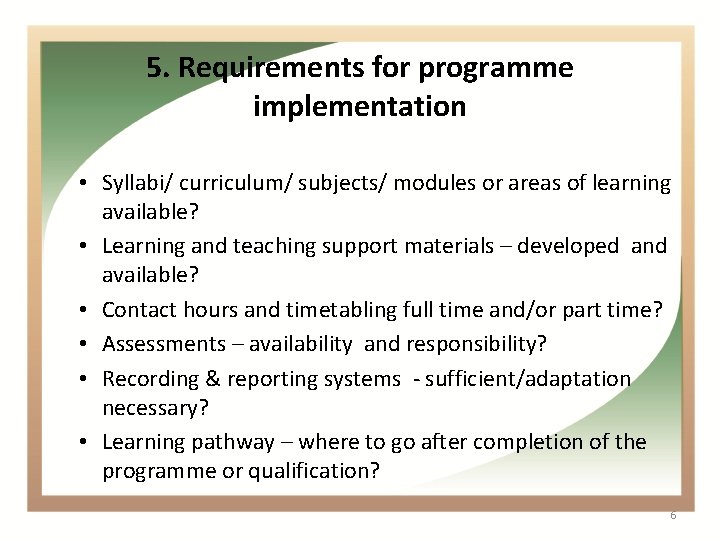
5. Requirements for programme implementation • Syllabi/ curriculum/ subjects/ modules or areas of learning available? • Learning and teaching support materials – developed and available? • Contact hours and timetabling full time and/or part time? • Assessments – availability and responsibility? • Recording & reporting systems - sufficient/adaptation necessary? • Learning pathway – where to go after completion of the programme or qualification? 6
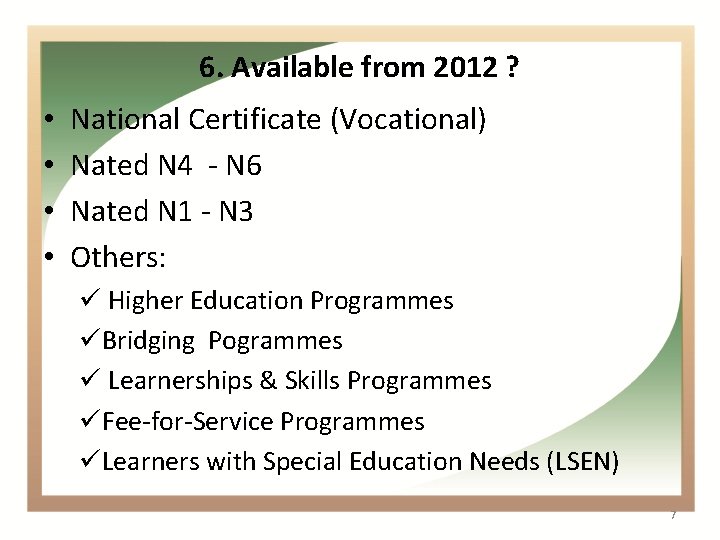
6. Available from 2012 ? • • National Certificate (Vocational) Nated N 4 - N 6 Nated N 1 - N 3 Others: ü Higher Education Programmes üBridging Pogrammes ü Learnerships & Skills Programmes üFee-for-Service Programmes üLearners with Special Education Needs (LSEN) 7

7. Key considerations for selecting National Certificate (Vocational) - NC(V)programmes Programmes available – 18 Learner profile for recruitment Opportunities identified for work experience Programme specific requirements (eg. Safety in Society, Information Technology & Computer Science) • Minimum projected number of students per programme • Trends in programme pass rates • Lecturer minimum qualification & expertise • • 8
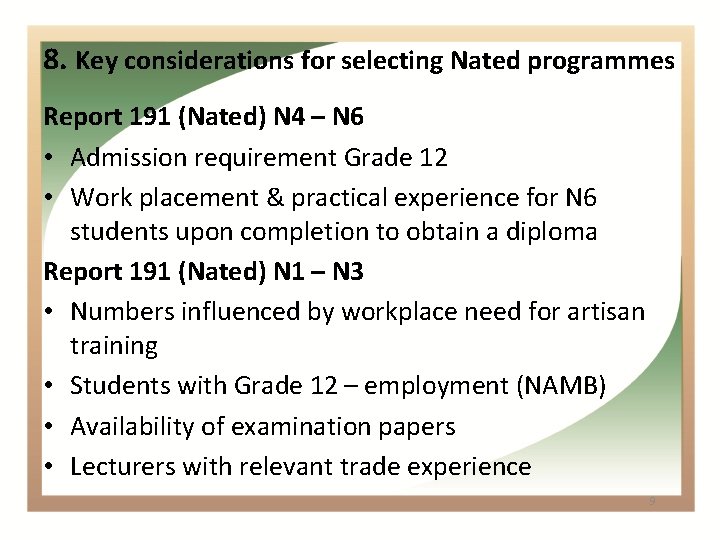
8. Key considerations for selecting Nated programmes Report 191 (Nated) N 4 – N 6 • Admission requirement Grade 12 • Work placement & practical experience for N 6 students upon completion to obtain a diploma Report 191 (Nated) N 1 – N 3 • Numbers influenced by workplace need for artisan training • Students with Grade 12 – employment (NAMB) • Availability of examination papers • Lecturers with relevant trade experience 9

9. Key considerations for selecting Higher Education Programmes Compliance criteria for possible approval by Minister: • Qualification appear in Programme & Qualification Mix of Higher Education Institution • Valid & signed Memorandum of Agreement/Understanding for the partnership with the Higher Education Institute including the following elements: ü Students - selection, academic support, data capturing, report on performance, arrangements around subsidization ü Staff - recruitment ü Conduct of assessments ü Certification of qualifications 10
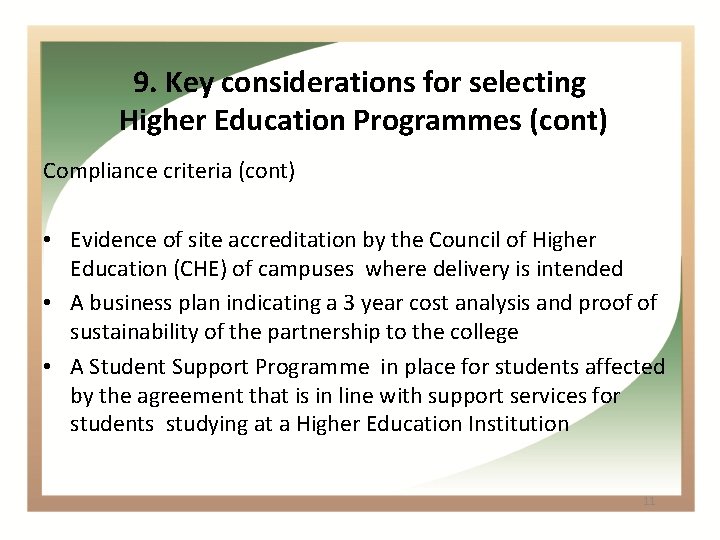
9. Key considerations for selecting Higher Education Programmes (cont) Compliance criteria (cont) • Evidence of site accreditation by the Council of Higher Education (CHE) of campuses where delivery is intended • A business plan indicating a 3 year cost analysis and proof of sustainability of the partnership to the college • A Student Support Programme in place for students affected by the agreement that is in line with support services for students studying at a Higher Education Institution 11
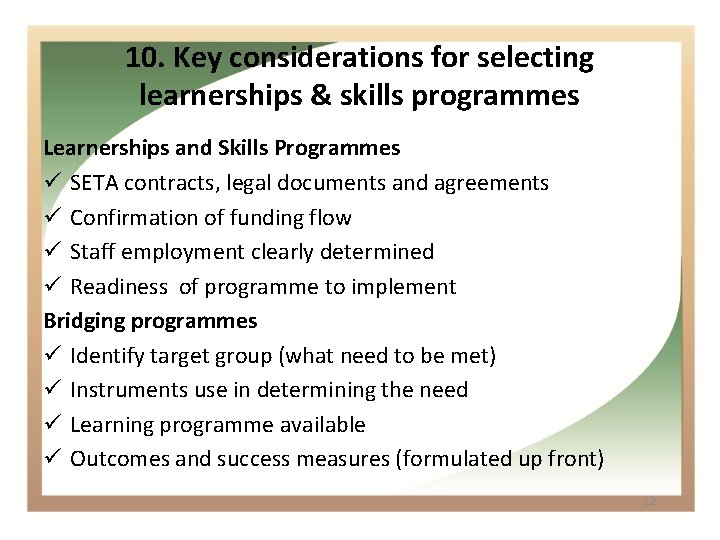
10. Key considerations for selecting learnerships & skills programmes Learnerships and Skills Programmes ü SETA contracts, legal documents and agreements ü Confirmation of funding flow ü Staff employment clearly determined ü Readiness of programme to implement Bridging programmes ü Identify target group (what need to be met) ü Instruments use in determining the need ü Learning programme available ü Outcomes and success measures (formulated up front) 12
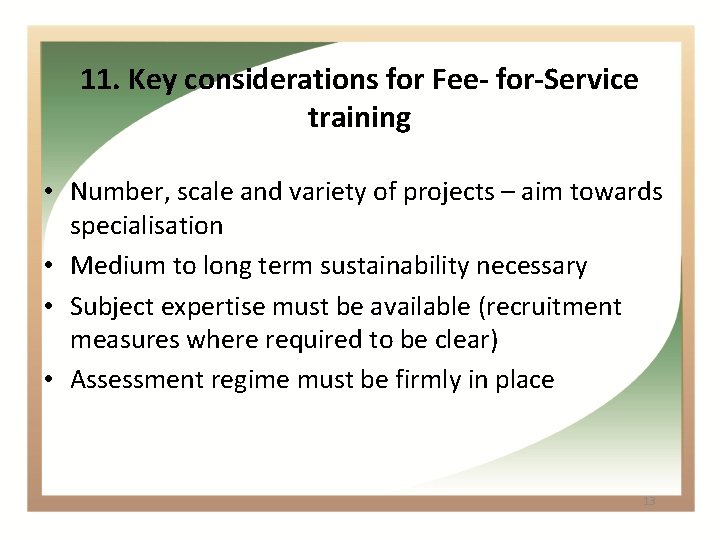
11. Key considerations for Fee- for-Service training • Number, scale and variety of projects – aim towards specialisation • Medium to long term sustainability necessary • Subject expertise must be available (recruitment measures where required to be clear) • Assessment regime must be firmly in place 13
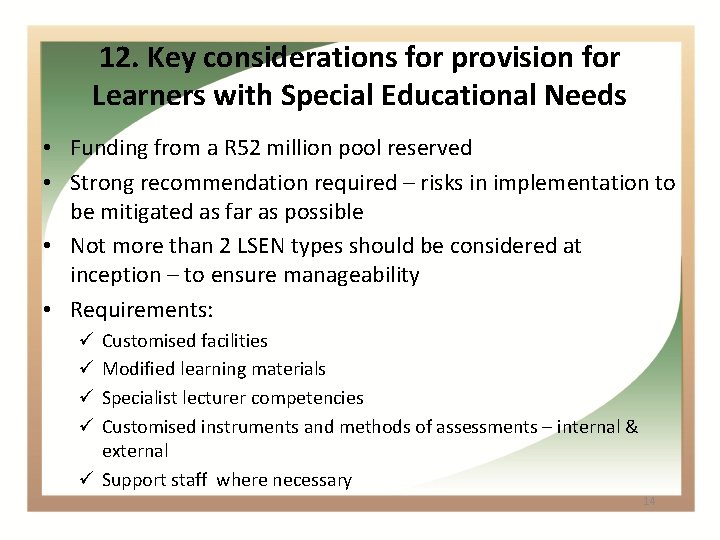
12. Key considerations for provision for Learners with Special Educational Needs • Funding from a R 52 million pool reserved • Strong recommendation required – risks in implementation to be mitigated as far as possible • Not more than 2 LSEN types should be considered at inception – to ensure manageability • Requirements: Customised facilities Modified learning materials Specialist lecturer competencies Customised instruments and methods of assessments – internal & external ü Support staff where necessary ü ü 14
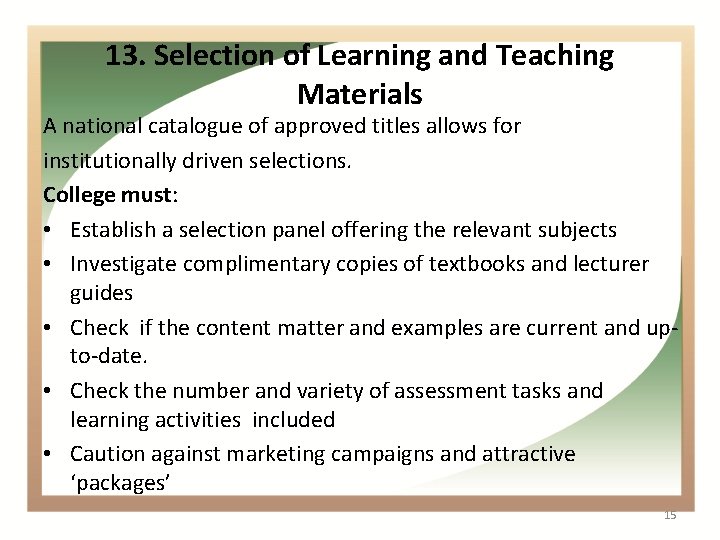
13. Selection of Learning and Teaching Materials A national catalogue of approved titles allows for institutionally driven selections. College must: • Establish a selection panel offering the relevant subjects • Investigate complimentary copies of textbooks and lecturer guides • Check if the content matter and examples are current and upto-date. • Check the number and variety of assessment tasks and learning activities included • Caution against marketing campaigns and attractive ‘packages’ 15
14. Challenges to offer the programmes Partnerships with industry and workplaces Entry requirements/ competencies of students Availability of learning materials Availability of assessments and /or examinations Competent and available expertise and human resources • Sustainable funding available • • • 16
15. Suggestion for good academic practices Academic Board could establish sub-committees to inform: • Student selection criteria • Student performance across programme specialisations • Innovation in teaching practice • Quality improvement in student assessments 17

THANK YOU 18
- Slides: 18