
Rodents and Lagomorphs Rodents and Lagomorphs Rodents are
- Slides: 134
Rodents and Lagomorphs
Rodents and Lagomorphs • Rodents are the most successful of all mammalian orders. The order contains at least 34 families, and more than 354 genera and 1685 species. • They have a worldwide distribution (excluding Antarctica), and are major components of nearly every fauna.
Rodents and Lagomorphs • Morphological diversity within the Rodentia is extreme, which makes it very difficult to discern the evolutionary relationships. This also results in a very plastic taxonomy. • Lagomorphs on the other hand have not been nearly so successful.
Rodents and Lagomorphs • The order Lagomorpha contains only 10 genera and about 63 species. • They too have a nearly worldwide distribution. However, they were introduced to Australia and the southern portion of South America by man. • Why do we consider these 2 orders together?
Rodents and Lagomorphs • Very early on, rodents and lagomorphs were considered to be part of the same order. • In fact, the Russians still consider them to be members of the same order. • We laugh at this, but Stuart Landry (SUNY and the American Museum) has noted an interesting similarity between the groups.
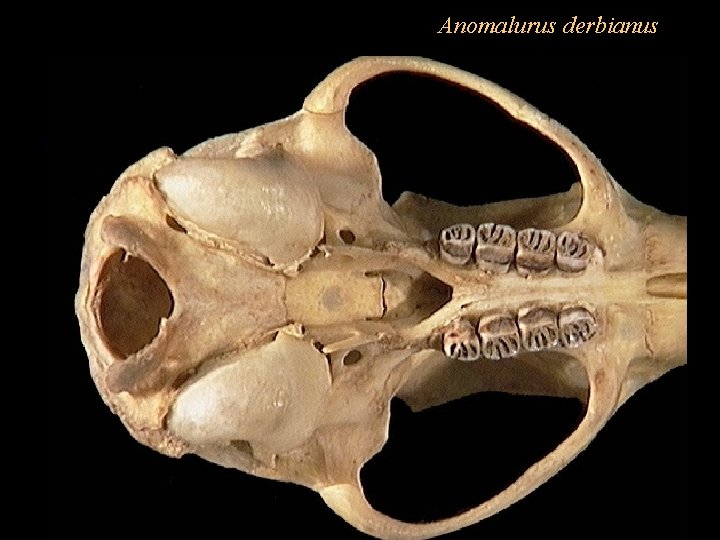
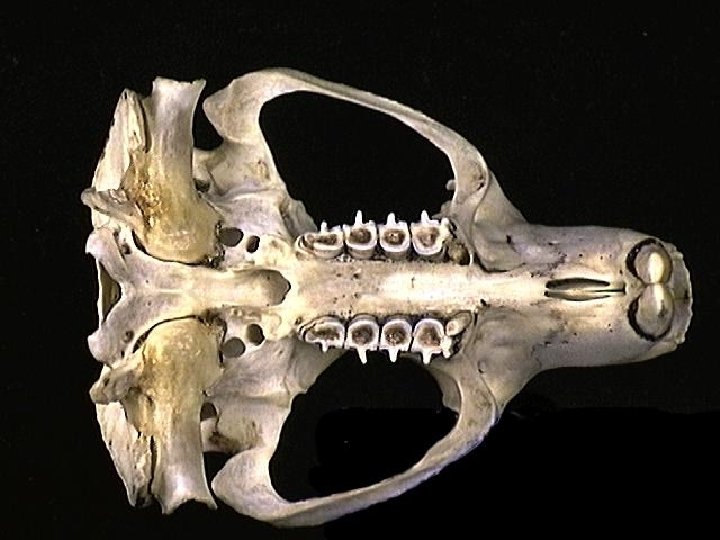
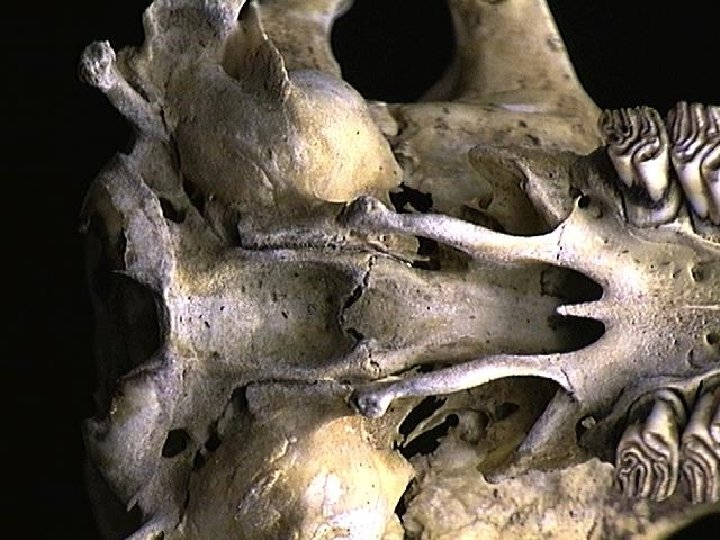
Rodents and Lagomorphs • If you look at the pterygoid in rodents, it extend so far back past the palate that it nearly touches the auditory bullae. We often don’t see this when we look at specimens because the processes are fragile and break off easily on museum specimens. • No other mammal group has this feature.
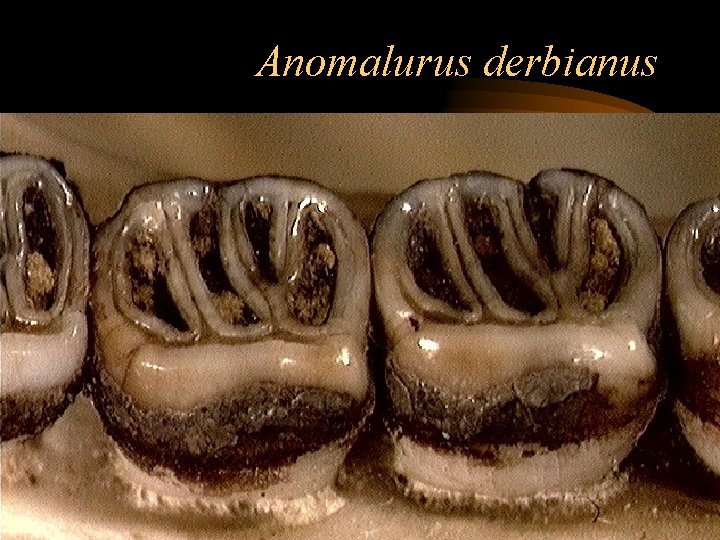
Anomalurus derbianus
Rodents and Lagomorphs • If you look at the pterygoid processes of lagomorphs, you discover that they too reach back so far they nearly touch the auditory bullae. • Clearly, there are important differences between the 2 groups, but they may be more closely related than we thought.
Rodentia • The taxonomy of the Rodentia remains uncertain. • There are 3 major groups of rodents: – Sciuromorph – Myomorph – Hystricomorph • At one time, these were considered taxonomic divisions.
Rodentia • It turns out that these are not all that useful in a taxonomic sense. • The terms refer to the structure of the skull and the organization of the masseter muscles. • Regardless of its taxonomic utility, this feature gives us an important clue about the success of the rodents.
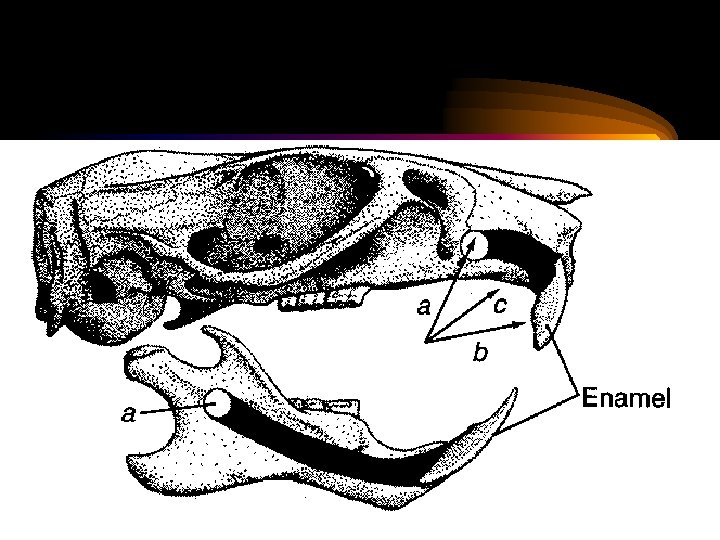
Rodent Morphology • The dental formula is usually 1/1, 0/0, 2/1, 3/3 = 22. • They have only 1 incisor in each jaw. The incisor is ever growing, and occludes with the opposite incisor to produce a sharp cutting edge. • There are no canines. Instead, they have a diastemma.
Rodent Morphology • The premolars and molars have complicated occlusal surfaces that are effective at grinding plant material. • The cheek teeth are difficult to interpret in terms of the tribosphenic tooth model. • They grow continuously, and have open pulp cavities.
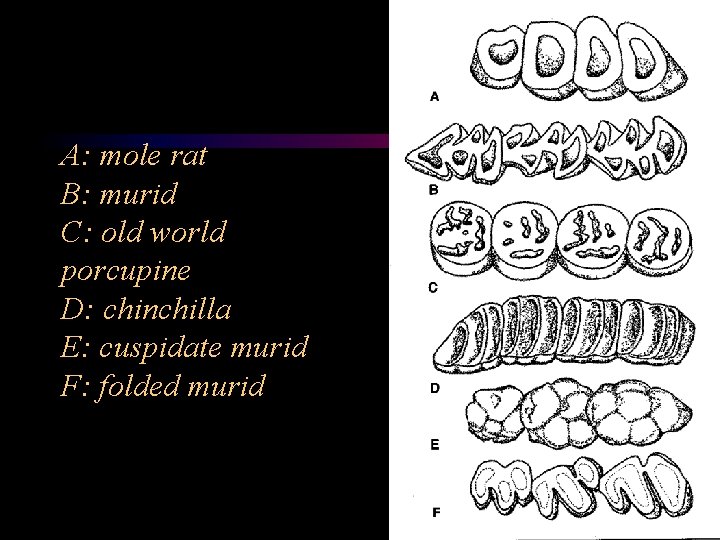
A: mole rat B: murid C: old world porcupine D: chinchilla E: cuspidate murid F: folded murid
Rodent Morphology • The glenoid fossa of the squamosal is elongate, and allows both anteroposterior movement, and lateral movement of the dentary. • The mandibular symphisis is flexible, and allows the 2 halves of the dentary to move semiindependently. Thus, using the transverse mandibular muscles, the two rami can be pulled in different directions. In fact, the tips of the front incisors can be pointed towards one another.
Rodent Morphology • The masseter muscle is subdivided, and contrary to carnivores (that emphasize the Temporalis), this muscle is the primary muscle involved in dentary manipulation. • The complexity of the 3 masseters and the dentary articulation, allows complicated rotation of the jaw, and excellent ability to masticate plant material. • These features, more than any others, are responsible for their evolutionary success.
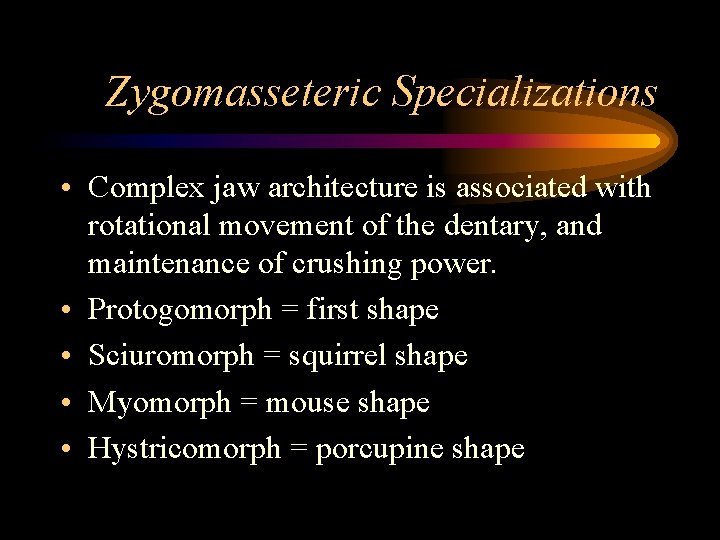
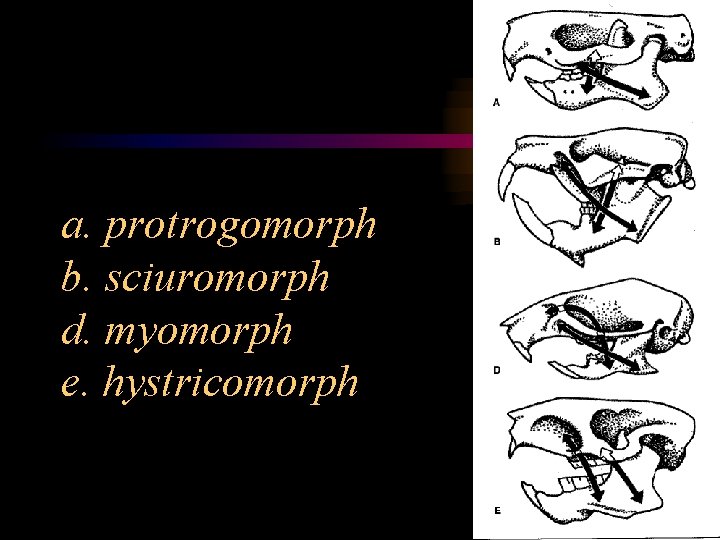
Zygomasseteric Specializations • Complex jaw architecture is associated with rotational movement of the dentary, and maintenance of crushing power. • Protogomorph = first shape • Sciuromorph = squirrel shape • Myomorph = mouse shape • Hystricomorph = porcupine shape
a. protrogomorph b. sciuromorph d. myomorph e. hystricomorph
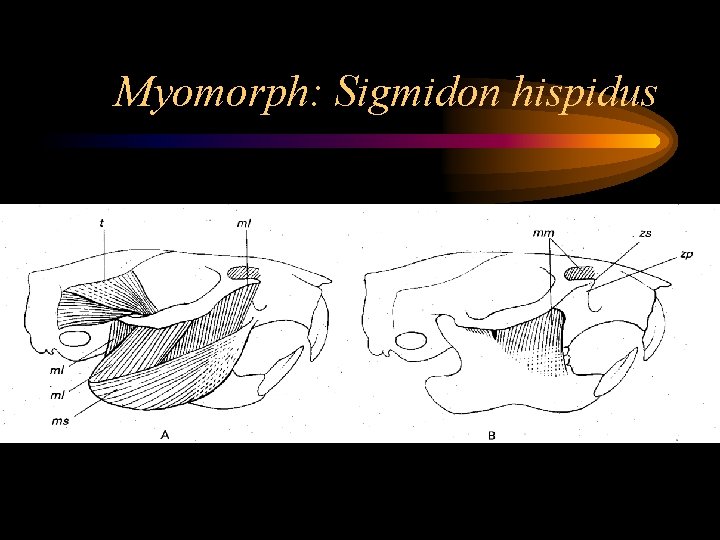
Myomorph: Sigmidon hispidus
Zygomasseteric Specializaitons • These classifications are not without controvesy. For example, the Anomaluridae have been variously classified as Sciuromorph and Hystricomorph. • Similarly, Myomorphs could be derived from either Hystricomorph or Sciuromorph.
Zygomasseteric Specializaitons • In any event, these 4 morphs represent different solutions to the problems posed by herbivory on a small scale.
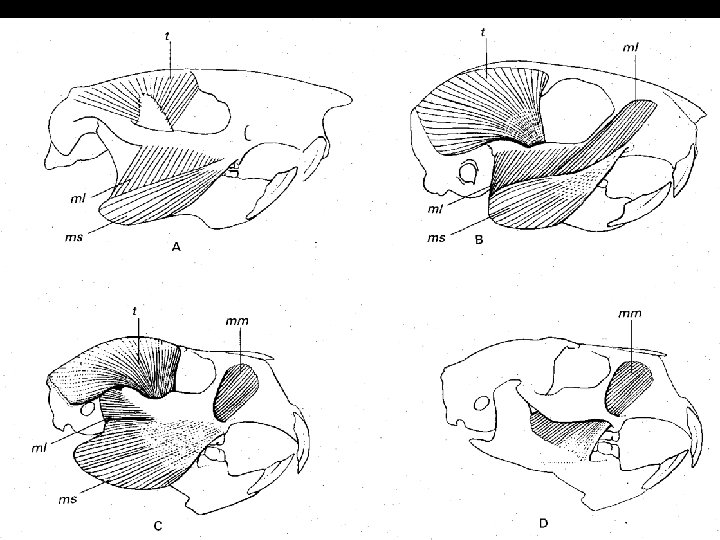
Zygomasseteric Specializaitons • Protogomorph - usually included below. • Sciuromorph – This seems to be the least derived of the 3. It is most similar to the entirely zygomatic origin of the masseters. – The masseter originates entirely from the zygomatic arch (Aplodontia = Protogomorph) or part of the masseter lateralis originates from the rostrum anterior to the zygomatic plate.
Sciuromorpha • Families: – Aplodontidae – Sciuridae – Geomyidae – Heteromyidae – Castoridae – Anomaluridae – Pedetidae
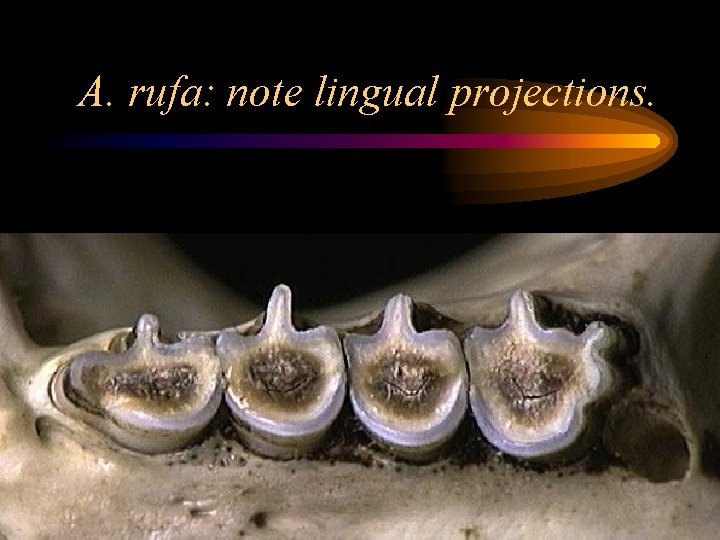
Sciuromorph Rodents • Aplodontidae – These are the ‘mountain beavers’ of the Pacific Northwest. They are not beavers as in Castor canadensis. – They are very underived morphologically. – They have a large coronoid process of the dentary. Masseters originate entirely on the zygomatic, as in paramyids. – Crown pattern on cheek teeth is unique. – Considered most ‘primitive’ of all rodents.
Zygomasseteric Specializaitons • Hystricomorphs – There is a very large infraorbital foramen. – The anterior portion of the masseter medialis passes through the large infraorbital foramen. – The masseter lateralis and the masseter superficialis originate entirely on the zygomatic arch.
Zygomasseteric Specializaitons • Hystricomorph – Able to generate a great deal of force on jaw because of mechanical advantage: efficient right angle attachment of medial masseter on dentary. – This corresponds with a shift from less efficient temporalis and masseter lateralis to medialis.
Hystricomorpha • Families – – – – Hystricidae Erethizontidae Caviidae Hydrochoeridae Dinomyidae Heptaxodontidae Dasyproctidae Chinchillidae – – – – – Capromyidae Myocastoridae Octodontidae Ctenomyidae Abrocomidae Echimyidae Thryonomyidae Pertomyidae Bathyergidae Ctenodactylidae
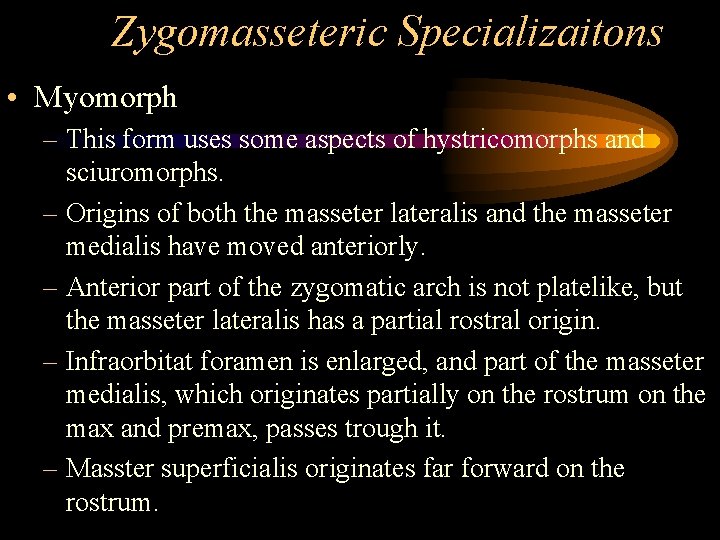
Zygomasseteric Specializaitons • Myomorph – This form uses some aspects of hystricomorphs and sciuromorphs. – Origins of both the masseter lateralis and the masseter medialis have moved anteriorly. – Anterior part of the zygomatic arch is not platelike, but the masseter lateralis has a partial rostral origin. – Infraorbitat foramen is enlarged, and part of the masseter medialis, which originates partially on the rostrum on the max and premax, passes trough it. – Masster superficialis originates far forward on the rostrum.
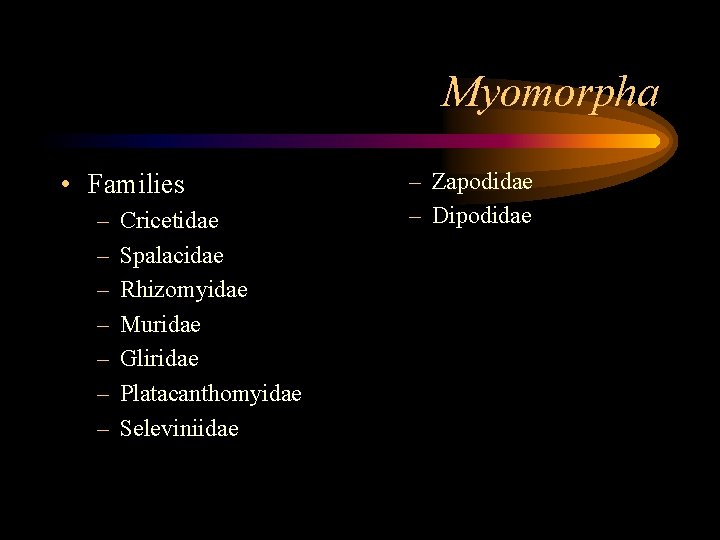
Myomorpha • Families – – – – Cricetidae Spalacidae Rhizomyidae Muridae Gliridae Platacanthomyidae Seleviniidae – Zapodidae – Dipodidae
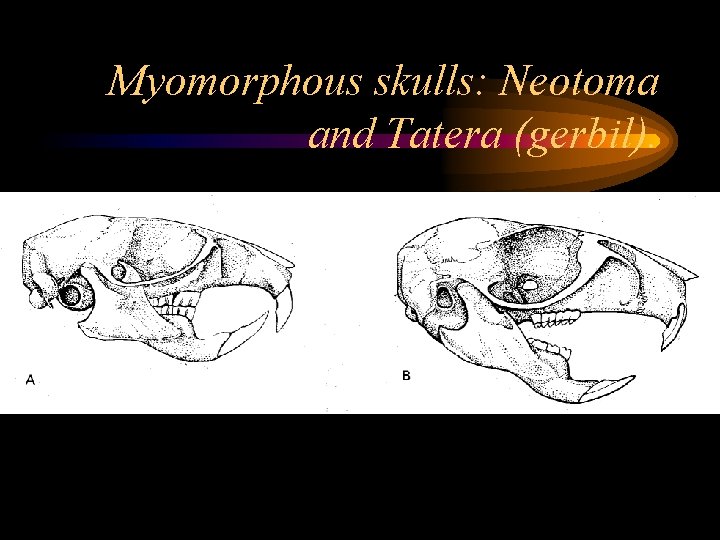
Myomorphous skulls: Neotoma and Tatera (gerbil).
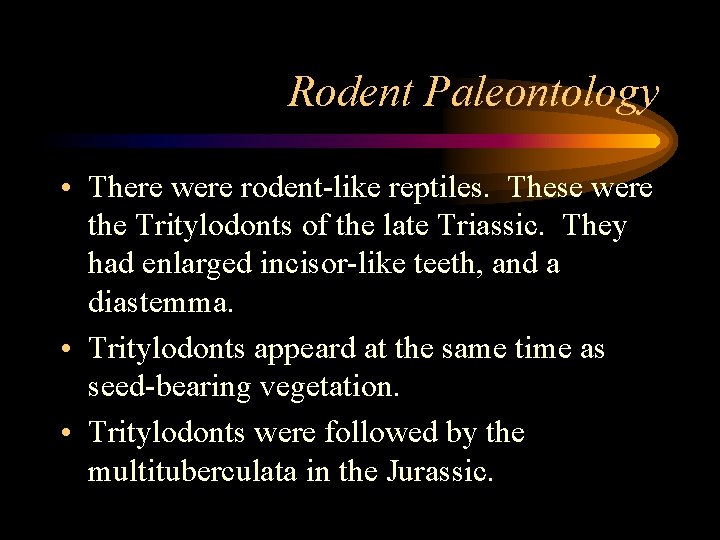
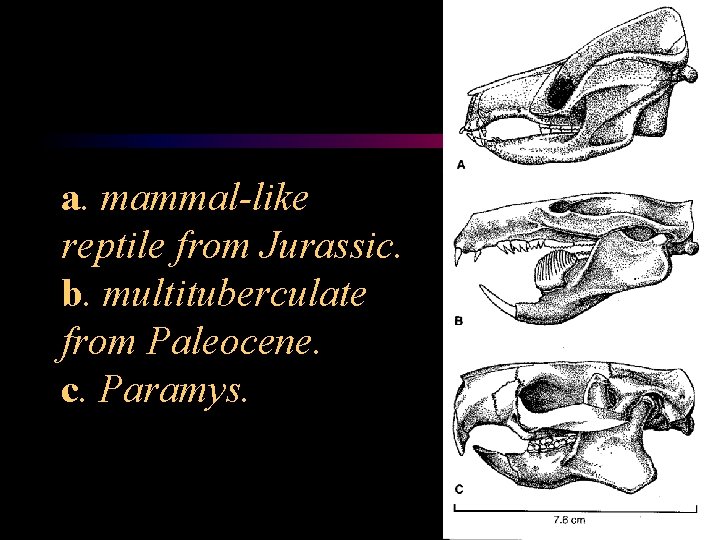
Rodent Paleontology • There were rodent-like reptiles. These were the Tritylodonts of the late Triassic. They had enlarged incisor-like teeth, and a diastemma. • Tritylodonts appeard at the same time as seed-bearing vegetation. • Tritylodonts were followed by the multituberculata in the Jurassic.
a. mammal-like reptile from Jurassic. b. multituberculate from Paleocene. c. Paramys.
Rodent Paleontology • The multituberculata of the Jurassic were also rodent-like, and prototherian-like. They had enlarged incisor, a diastemma, and cheek teeth with multiple cusps (hence the name, multituberculata). • However, neither the Tritylodonts or the Multituberculata are rodents. The first rodents are the sciuromorphic Paramyids.
Rodent Paleontology • Earliest fossils are in the family Paramyidae from the late Paleocene of N. America and Eurasia. • Are these the stem group from which all rodents evolved? • Paramyids are underived in that the temporalis was large, and the masseters relatively unspecialized. Origins of the masseters were strictly on the zygomatic.
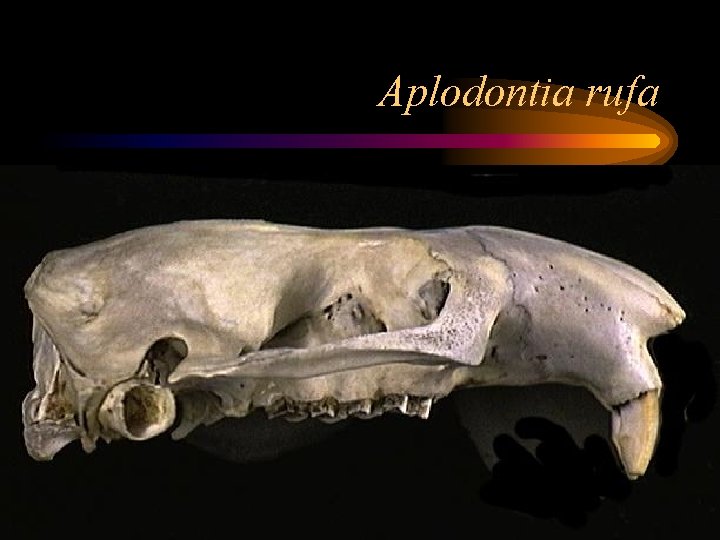
Rodent Paleontology • Example of Paramyidae is Paramys atavus. • Closest relative of Paramys is Aplodontia rufa, the mountain beaver of the Pacific Northwest.
Rodent Paleontology • Dental formula of Paramyids is 1/1, 0/0, 2/1, 3/3 = 22. • Molars and premolars are brachyodont. • Rodents underwent an adaptive radiation in the Tertiary, and suffered no mass extinction in the Pleistocene or post. Pleistocene. Consequently, today we have a rich rodent fauna.
Rodent Paleontology • Today, rodents are primarily herbivorous, but also consume: – – – insects fish reptiles birds mammals • Locomotor styles include: – – – quadrupedal arboreal fossorial saltatorial semi-aquatic.
Rodent Morphology Again • Even though rodent systmatics does not correspond to the division of Myomorph / Sciuromorph / Hystricomorph, we can divide the rodents into 2 major clades based on jaw morphology. • All rodents can be classified as Sciurognathous or Hystricognathous.
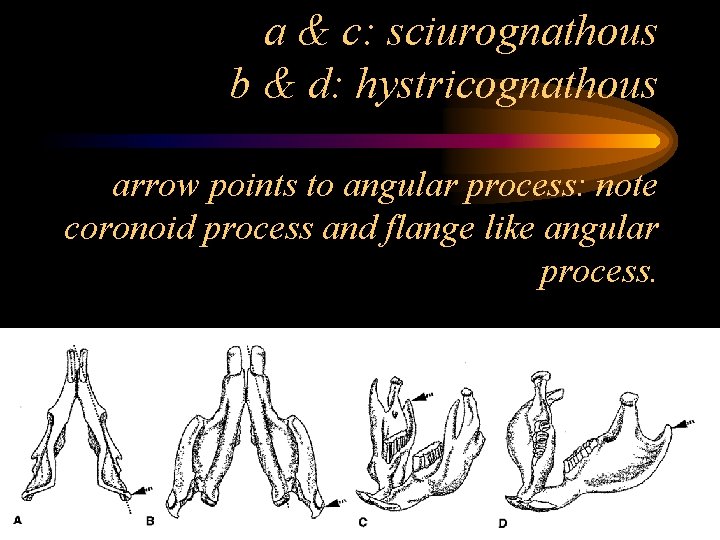
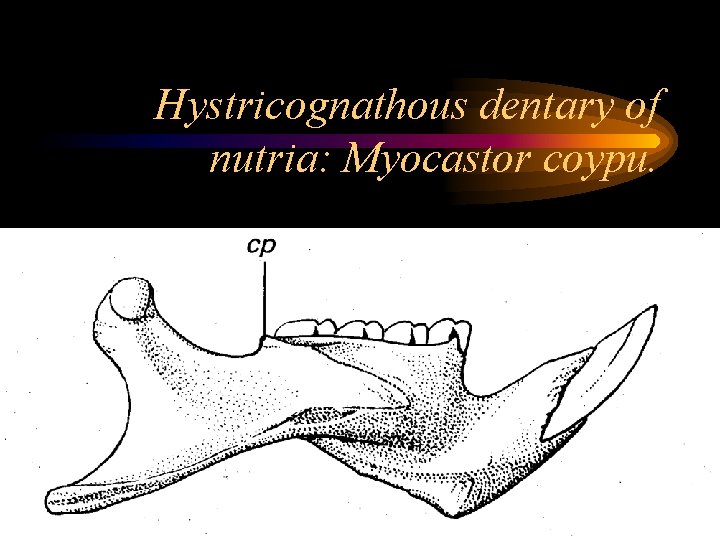
Sciurognathous and Hystricognathous Rodents • This terminology refers to the structure of the dentary gnathous refers to ‘jaw. ’ • Sciurognathous refers to dentary that are relatively simple, with insertion of the masseter directly below the molariform teeth. These rodents are in the suborder Sciurognathi. Myomorphs are considered within this group as an infraorder. • Hystricognathous rodents have a strongly deflected angular process. Insertion of the masseter is ventral and posterior to the molariform teeth. These rodents are in the suborder Hystricognathi.
a & c: sciurognathous b & d: hystricognathous arrow points to angular process: note coronoid process and flange like angular process.
Hystricognathous dentary of nutria: Myocastor coypu.
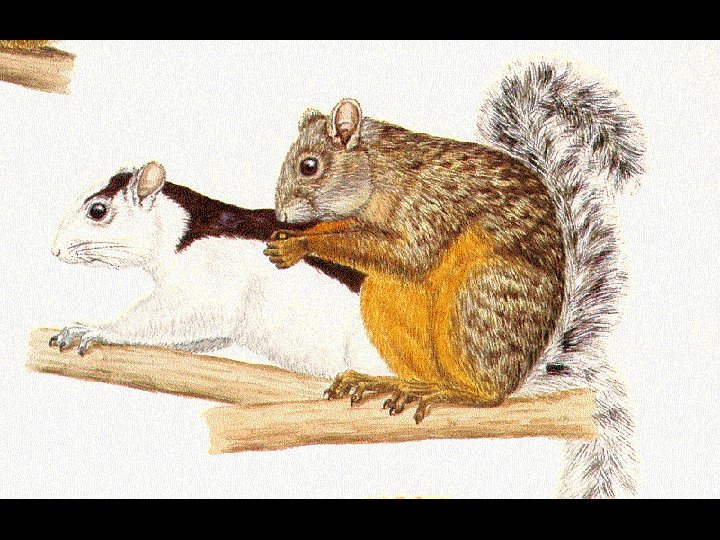
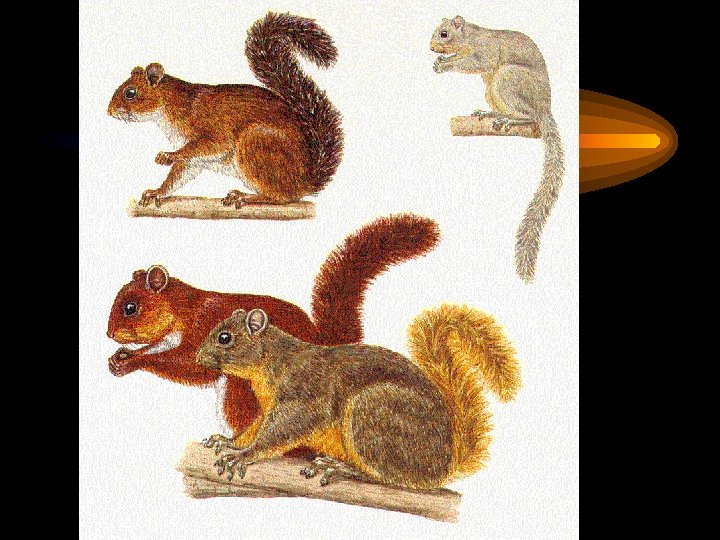
Sciurognathi • Aplodontidae – Mountain beavers • Sciuridae – 50 genera and 273 species divided into the Sciurinae and the Pteromyinae (Petauristinae). Note: the flying squirrels are convergent with the Anomaluridae, Cynocephalidae, Petauridae, Pseudocheiridae, and Acrobatidae.
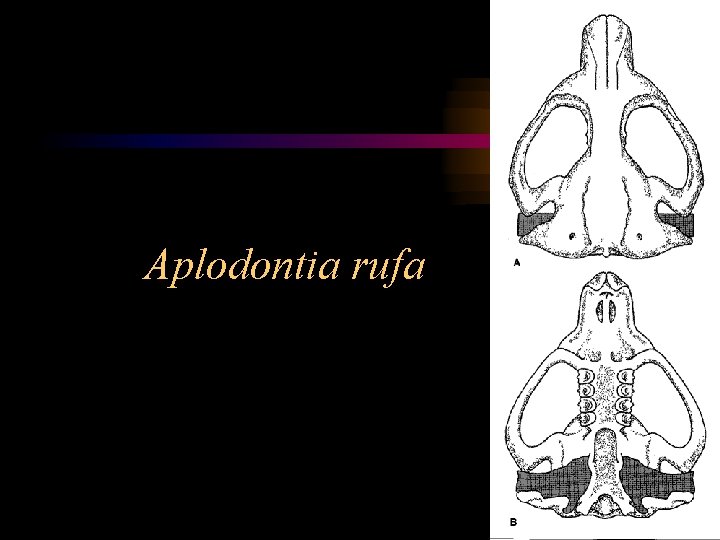
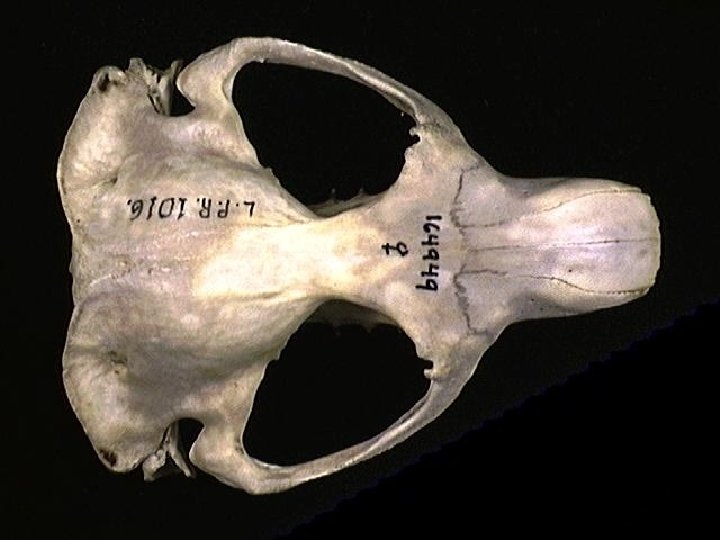
Aplodontia rufa
Aplodontia rufa
A. rufa: note lingual projections.
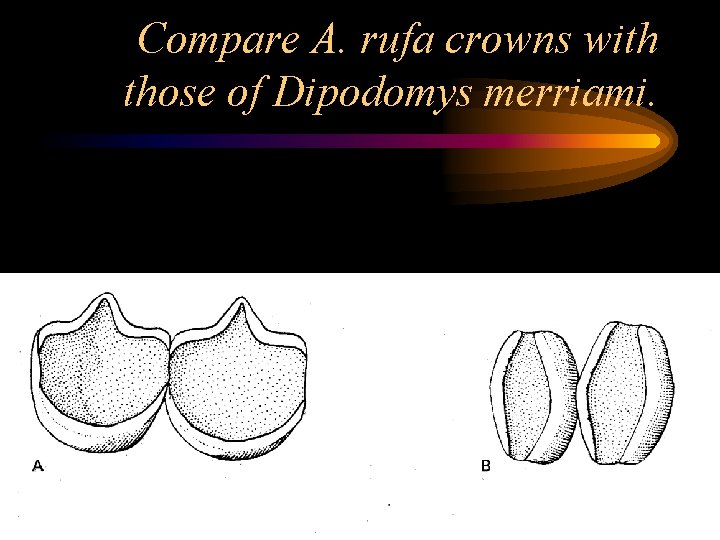
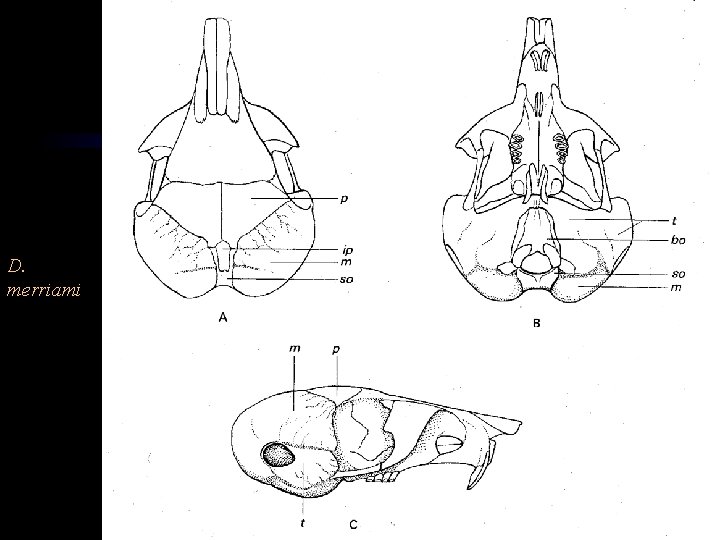
Compare A. rufa crowns with those of Dipodomys merriami.
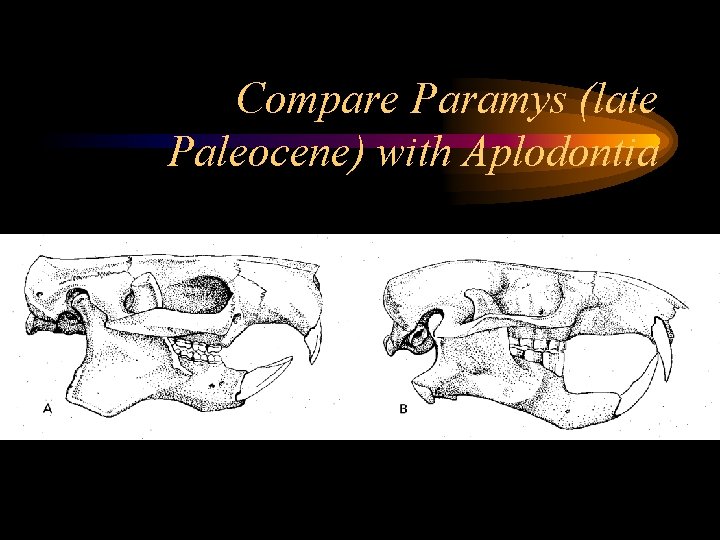
Compare Paramys (late Paleocene) with Aplodontia
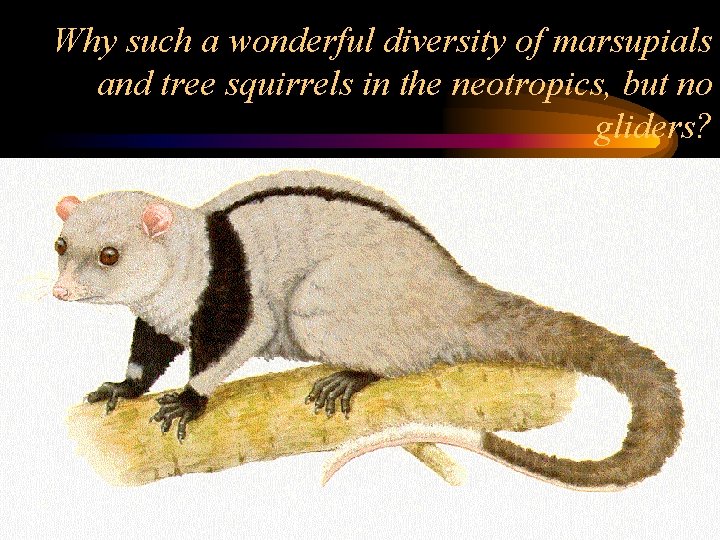
Why such a wonderful diversity of marsupials and tree squirrels in the neotropics, but no gliders?
Sciurognathi • Geomyidae – 5 genera and 35 species of pocket gophers in North and Central America. Morphologically convergent with talpids and Notoryctes. – Have external cheek pouches, as in kangaroo rats. – Mound openings are easily differentiated from those of moles.
Sciurognathi • Heteromyidae – These are the kangaroo rats, kangaroo mice, and pocket mice. 6 genera and 59 species. – Primarily in the southwest, as well as Mexico, Central America, and South America. – K-rats are saltatorial/bipedal, Perognathus and Chaetodipus are quadrupedal. – Audotory bullae are enlarged, and Loop of Henle is radically elongated. They can survive on metabolic water, and can actually drink sea water. They also becom addicted to water in captivity.
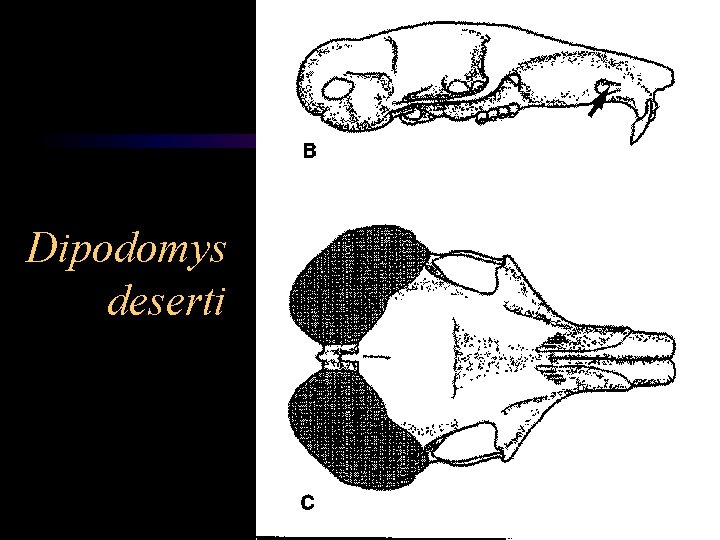
Dipodomys deserti
D. merriami
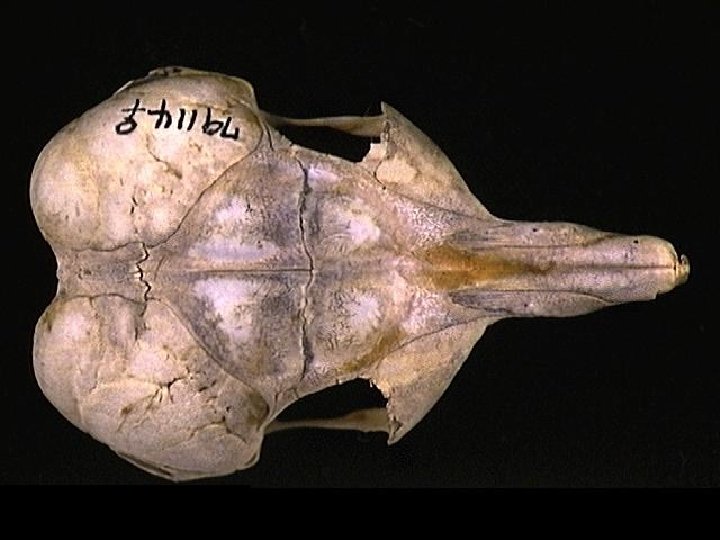
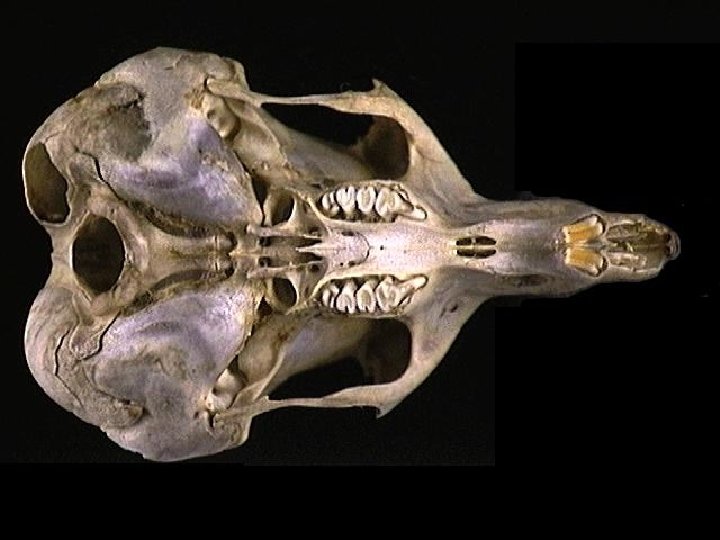
Dipodomys spectabilis
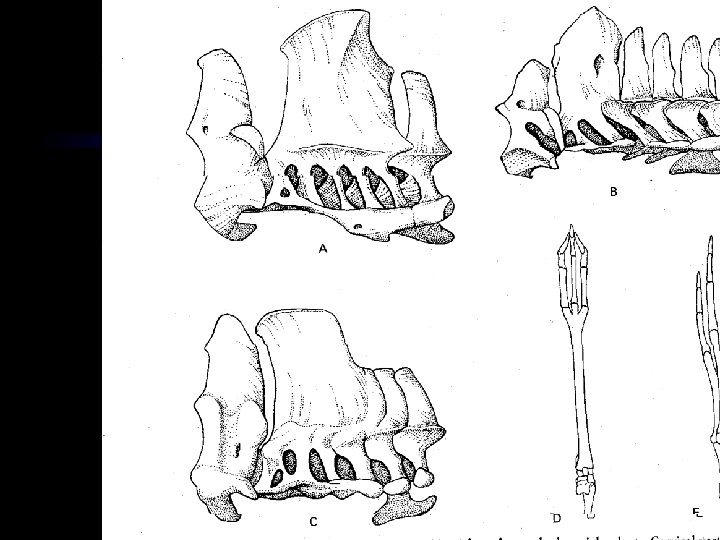
Saltatorial adaptations • Compare cervical vertebrae of the a. ) jerboa (Dipodidae), b. ) Springhaas (Pedetidae), and c. ) kangaroo rat (heteromyidae). • Compare also the hind feet of the jerboa and the k-rat.
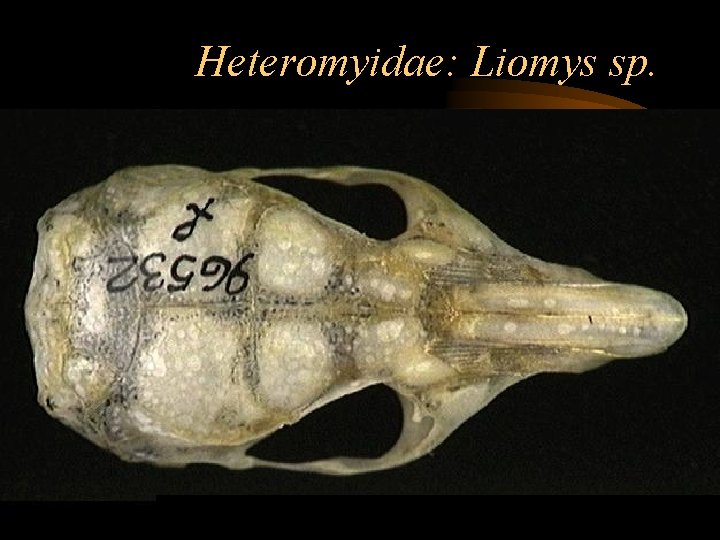
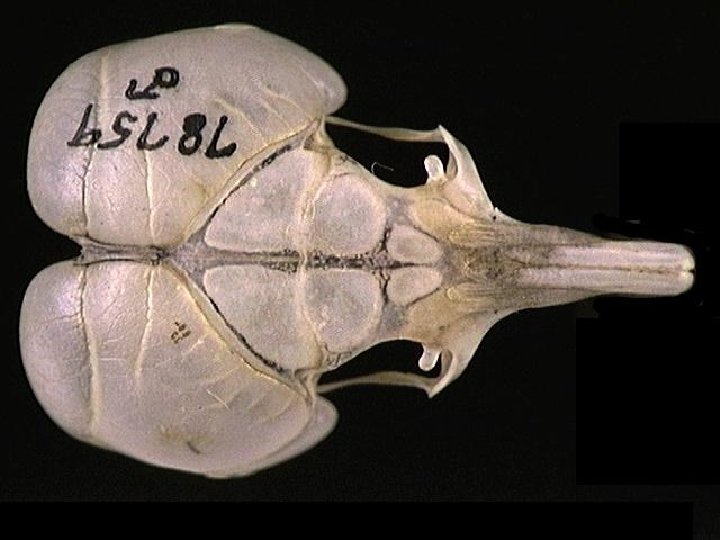
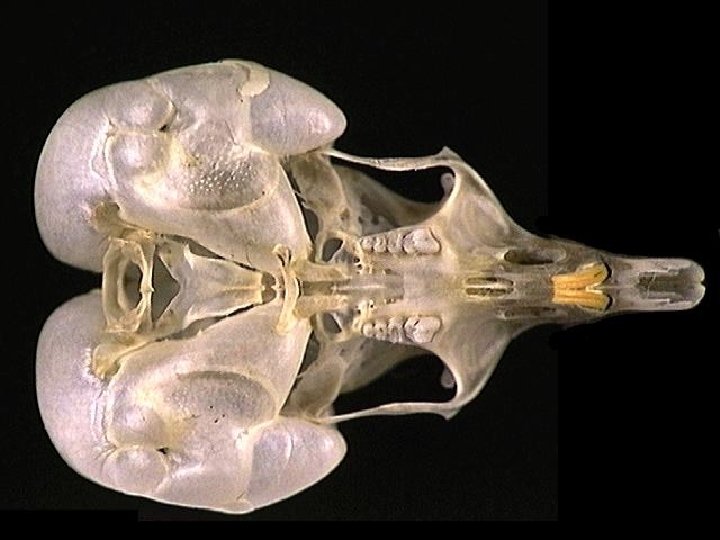
Heteromyidae: Liomys sp.
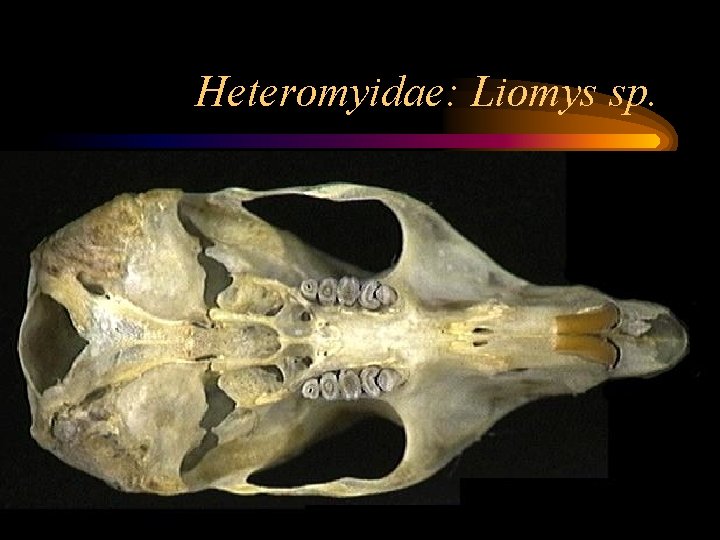
Heteromyidae: Liomys sp.
Heteromyidae: Microdipodops
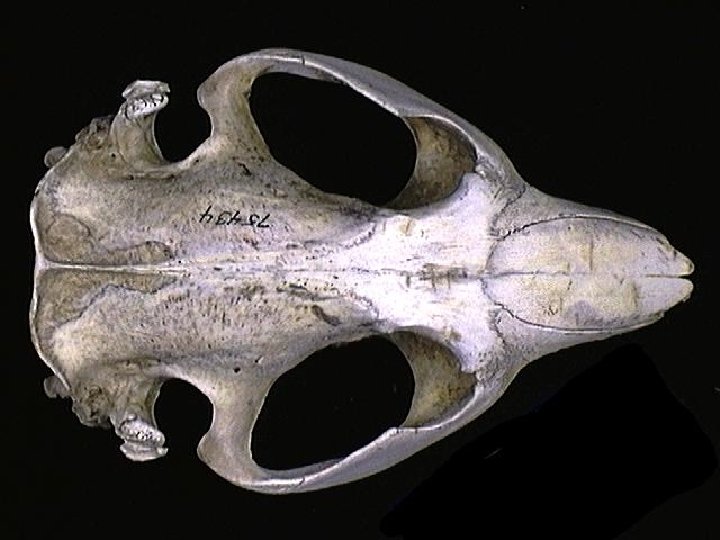
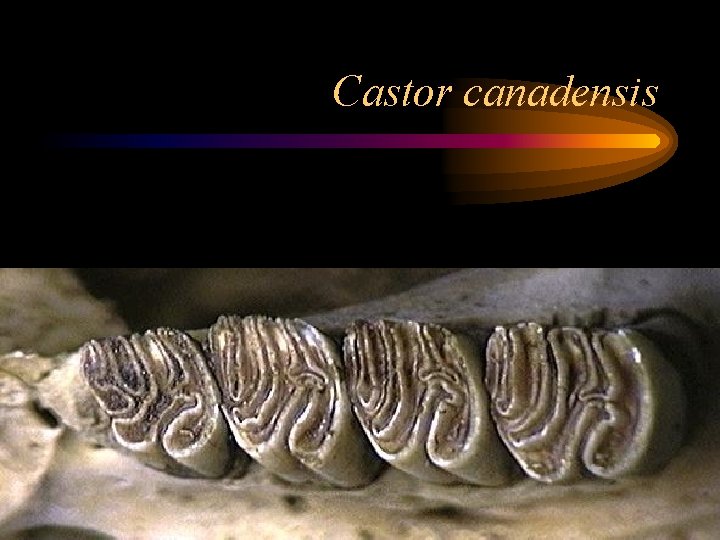
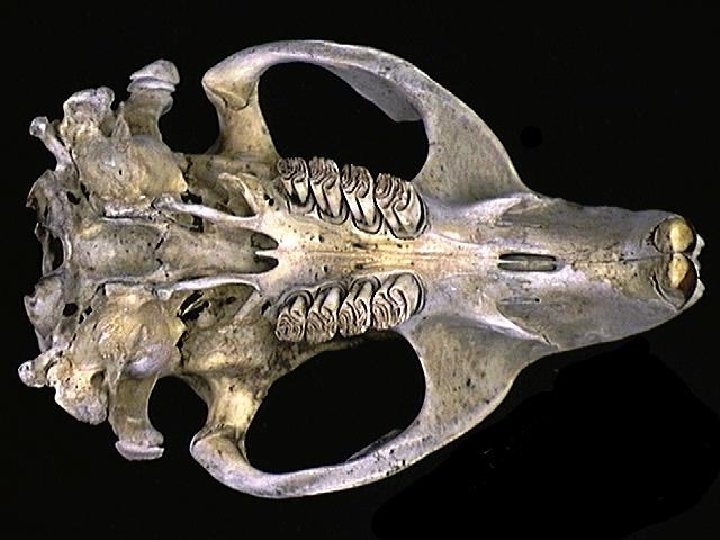
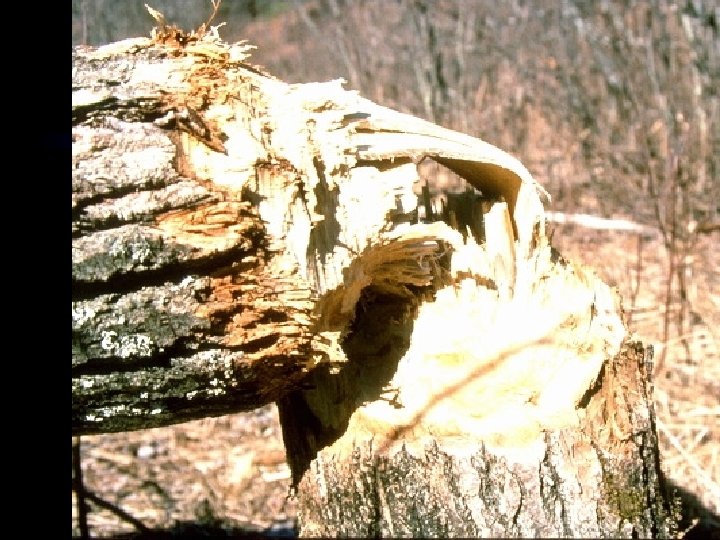
Sciurognathi • Castoridae – Only 2 species: Castor canadensis in North America and Castor fiber in Europe. – Both have ‘castor’ glands to mark territories. – Flattened tail for swimming, as well as thick pelage, nictitating membrane, valvular nostrils, and webbed hind feet. – Note also the epiglotis is above the soft palate.
Castor canadensis
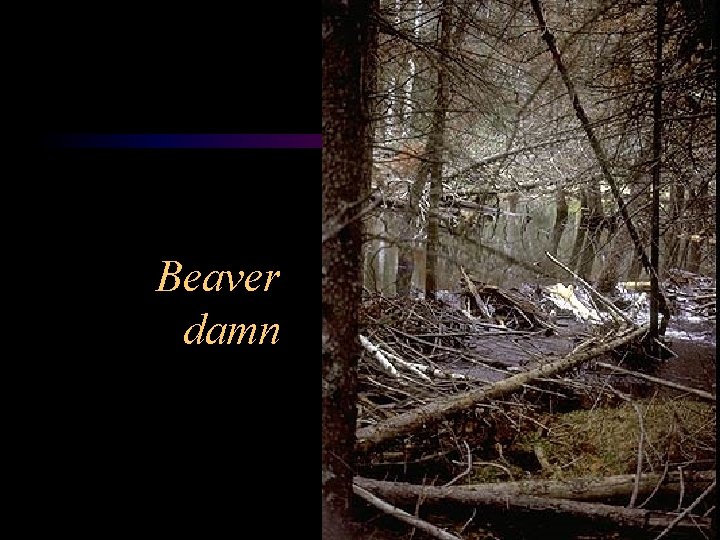
Beaver damn
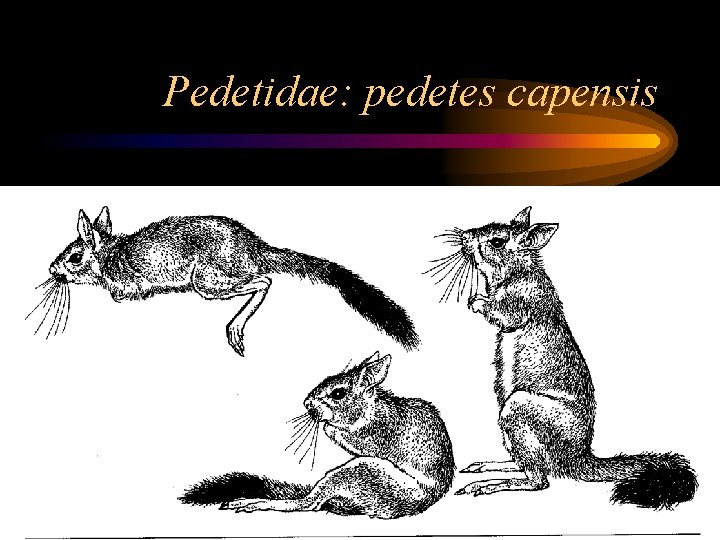
Sciurognathi • Pedetidae – Family is monotypic, including only the springhare of south Africa, Pedetes capensis. – They are hystricomorphous sciurognaths, along with the Anomaluridae. – Were considered (informally) to be closely related to the Anomaluridae, also of Africa. – They are highly saltatorial.
Pedetidae: pedetes capensis
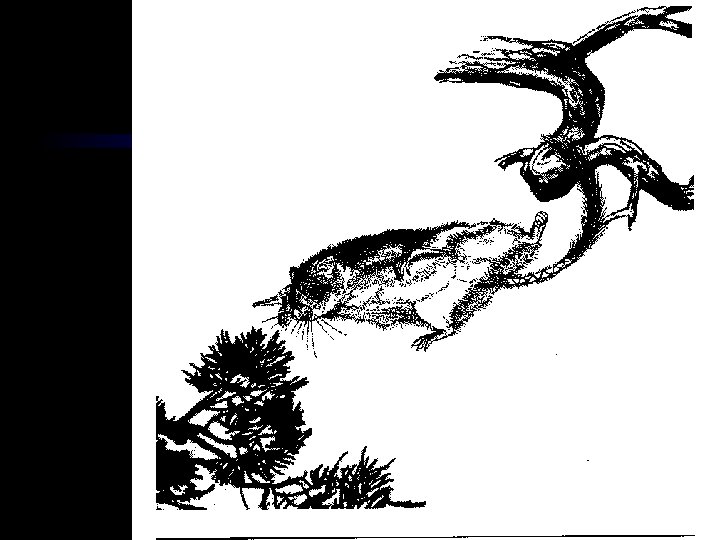
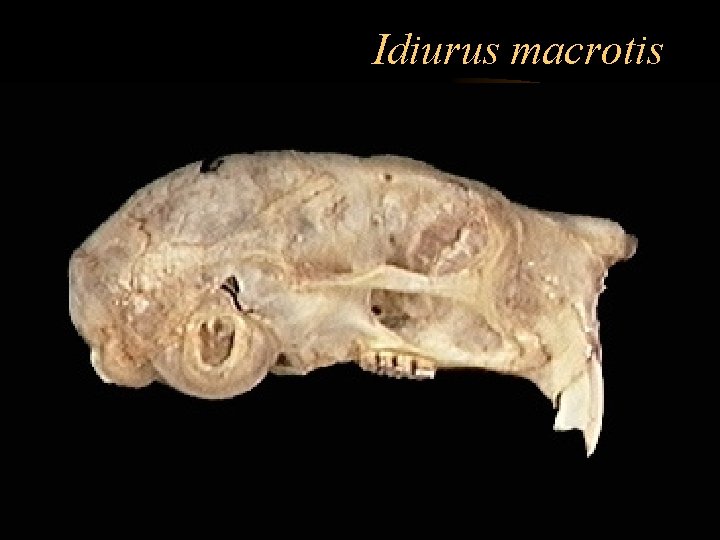
Sciurognathi • Anomaluridae – Just too cool to be true. – Restricted to equatorial western and central Africa. – Includes Anomalurus derbianus, A. beecrofti, A. pusilus, A. pelli, Idiurus macrotis, I. Zenkeri, and Zenkeralla insignis. – With the exception of Zenkeralla, all glide.
Sciurognathi • Anomaluridae cont. – They are called the ‘scaly tailed’ flying squirrels, even though they are not squirrels. They have a ‘scaly’ tail, which some claim is used in landing. I think this is hooey - and I’m never wrong.
Anomalurus derbianus
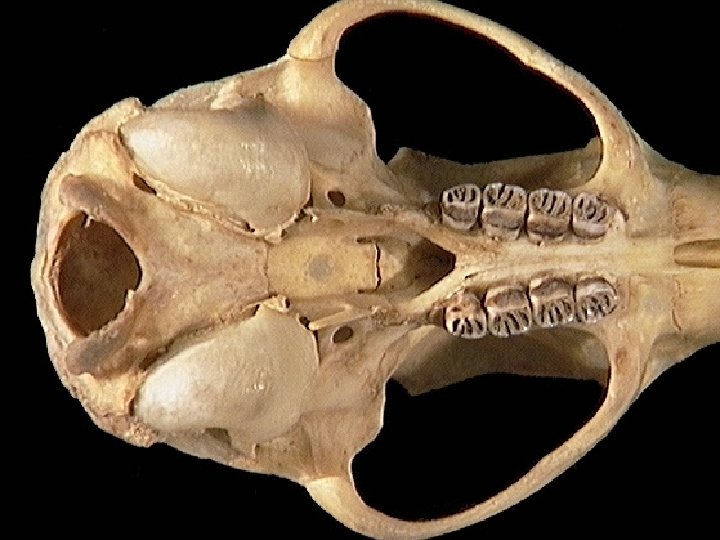
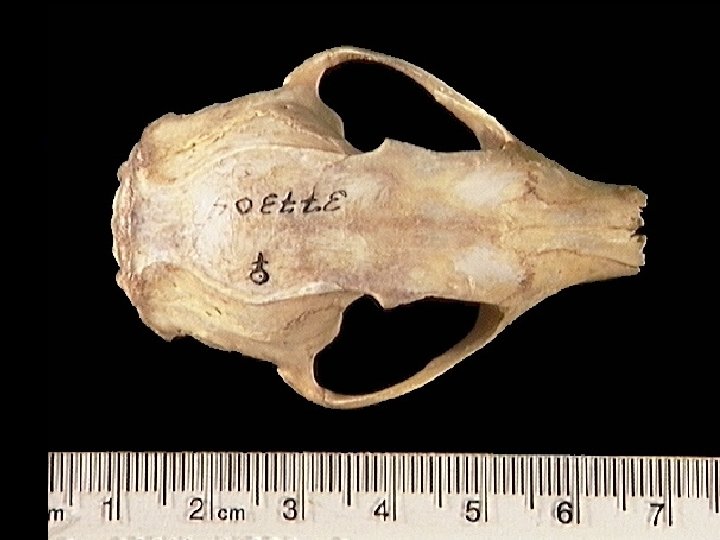
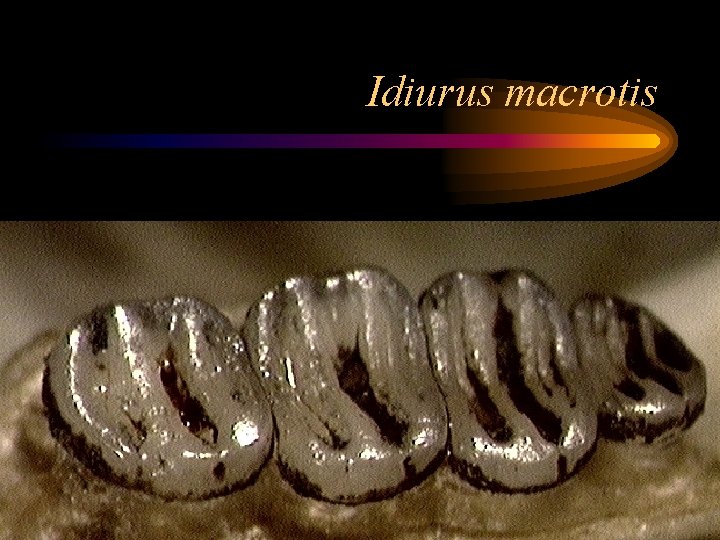
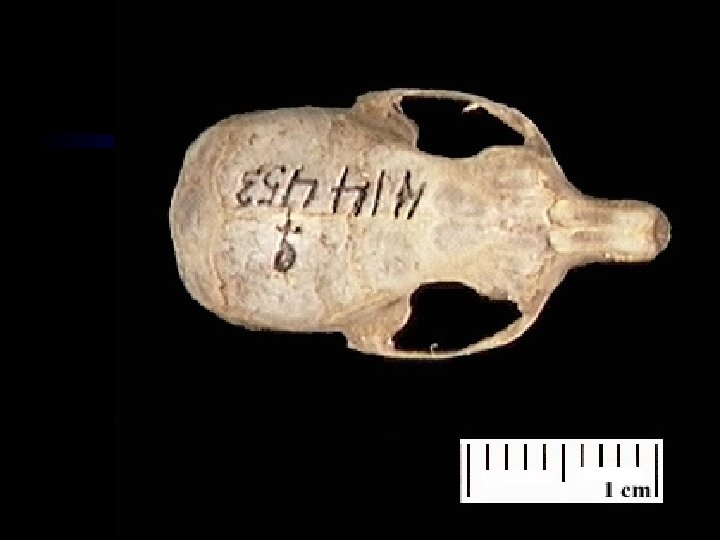
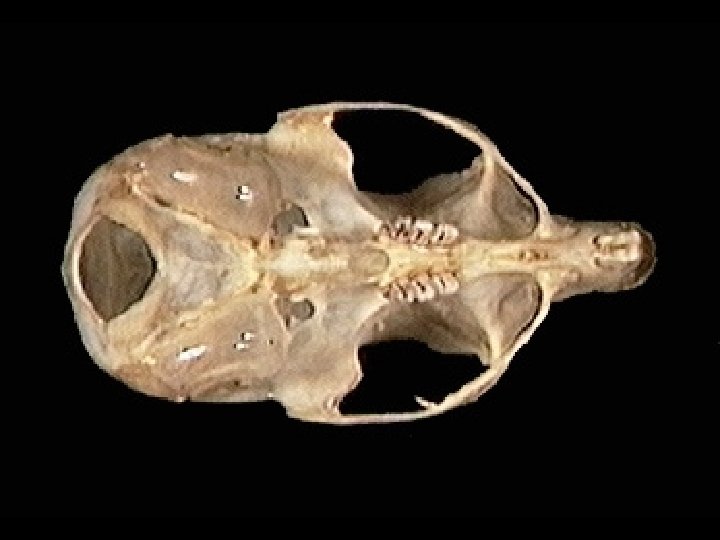
Idiurus macrotis
Idiurus macrotis
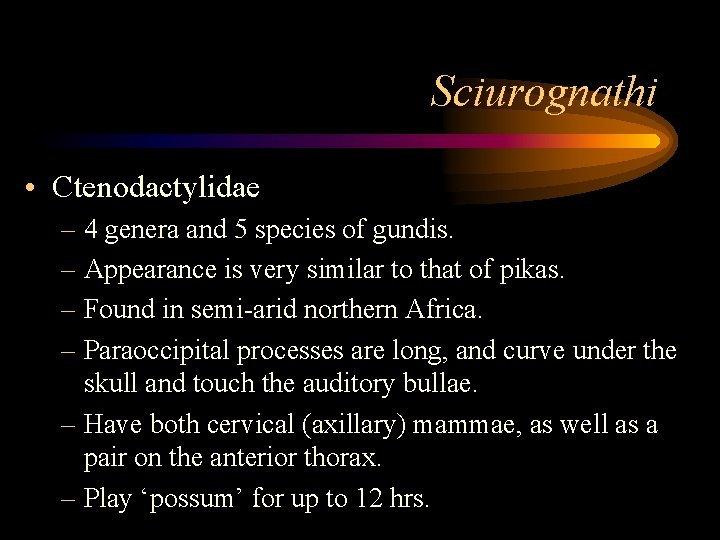
Sciurognathi • Ctenodactylidae – 4 genera and 5 species of gundis. – Appearance is very similar to that of pikas. – Found in semi-arid northern Africa. – Paraoccipital processes are long, and curve under the skull and touch the auditory bullae. – Have both cervical (axillary) mammae, as well as a pair on the anterior thorax. – Play ‘possum’ for up to 12 hrs.
Sciurognathi • Muridae – These used to be the ‘old world’ rats and mice. – Taxonomic revision resulted in group which now includes many formerly distinct families, including the Cricetidae (formeraly the ‘new world’ rats and mice). – 17 subfamilies and 1326 species.
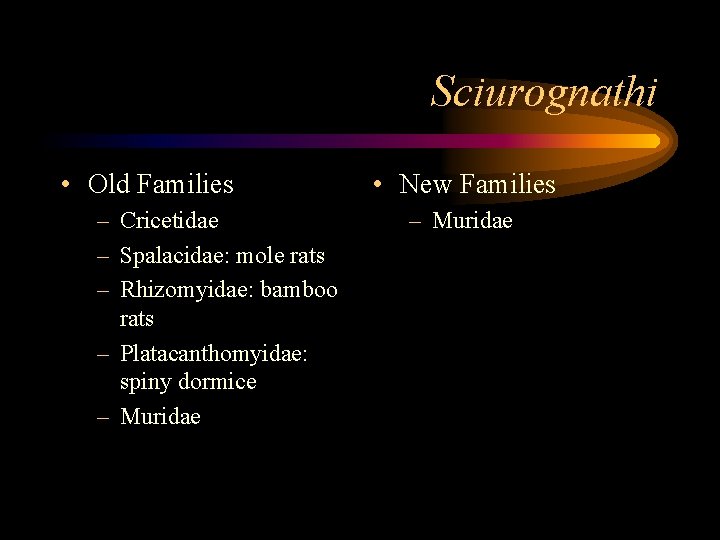
Sciurognathi • Old Families – Cricetidae – Spalacidae: mole rats – Rhizomyidae: bamboo rats – Platacanthomyidae: spiny dormice – Muridae • New Families – Muridae
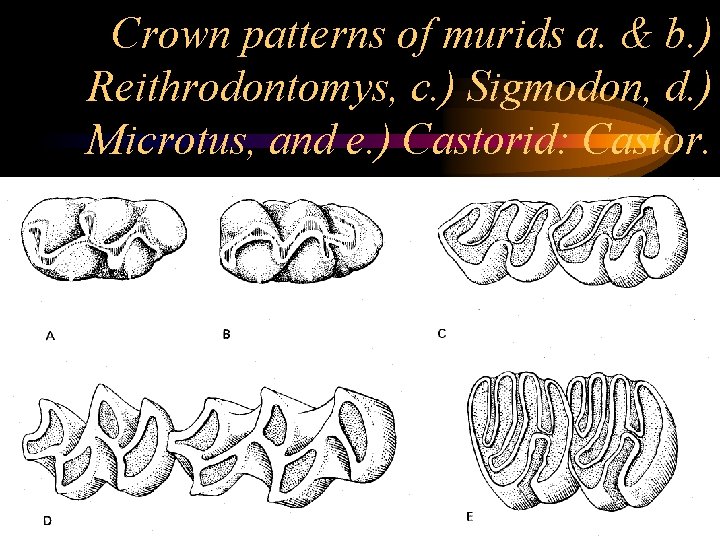
Crown patterns of murids a. & b. ) Reithrodontomys, c. ) Sigmodon, d. ) Microtus, and e. ) Castorid: Castor.
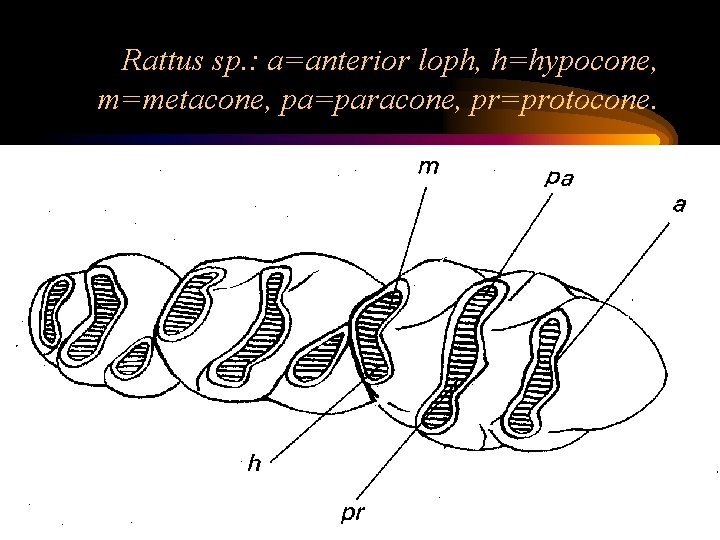
Rattus sp. : a=anterior loph, h=hypocone, m=metacone, pa=paracone, pr=protocone.
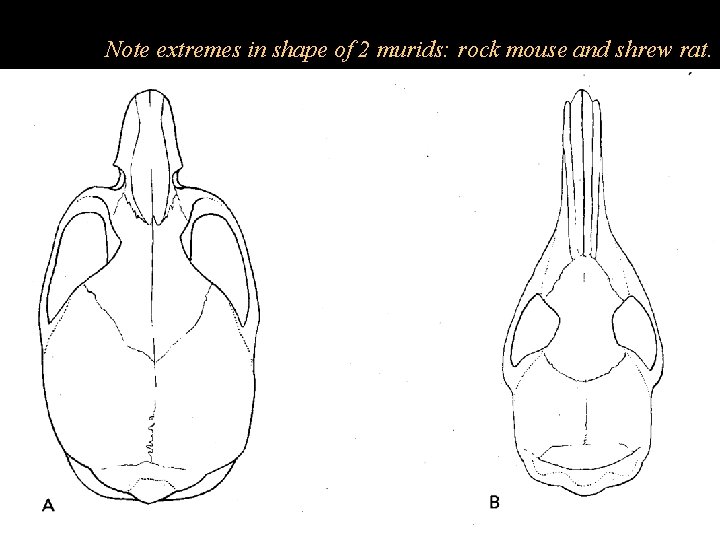
Note extremes in shape of 2 murids: rock mouse and shrew rat.
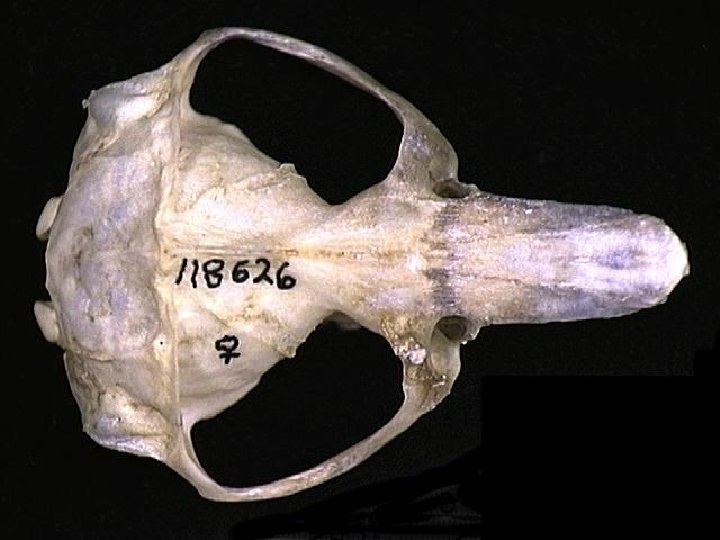
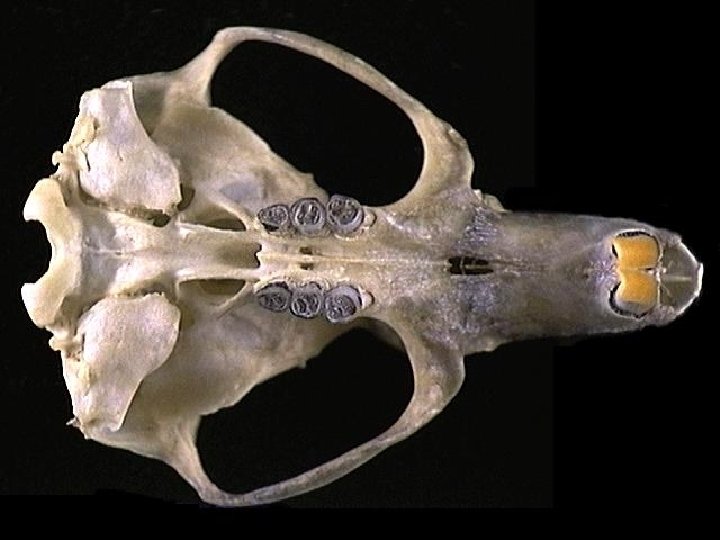
Muridae: Nanospalax
Sciurognathi • Dipodidae – 15 genera of jumping mice and jerboas, including Zapus and Napaeozapus. – Ricochetal locomotion in Zapus, while jerboas are saltatorial. – Jerboas have elongated loops of henle just as Dipodomys. – Capable of hibernation for up to 9 mo.
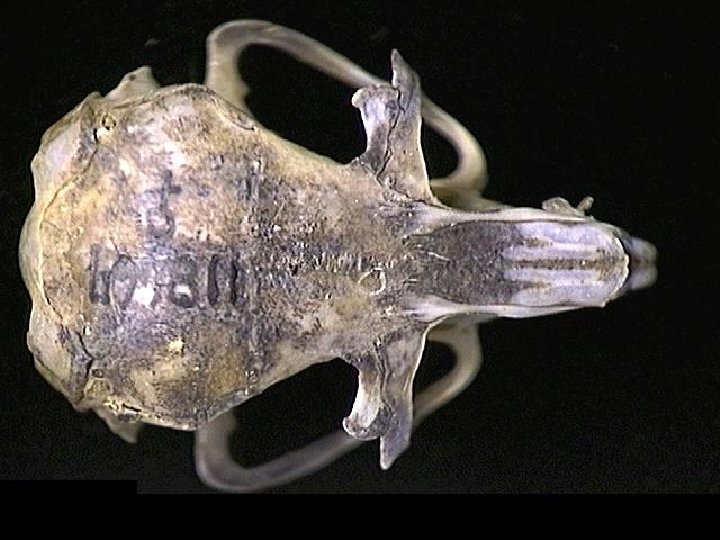
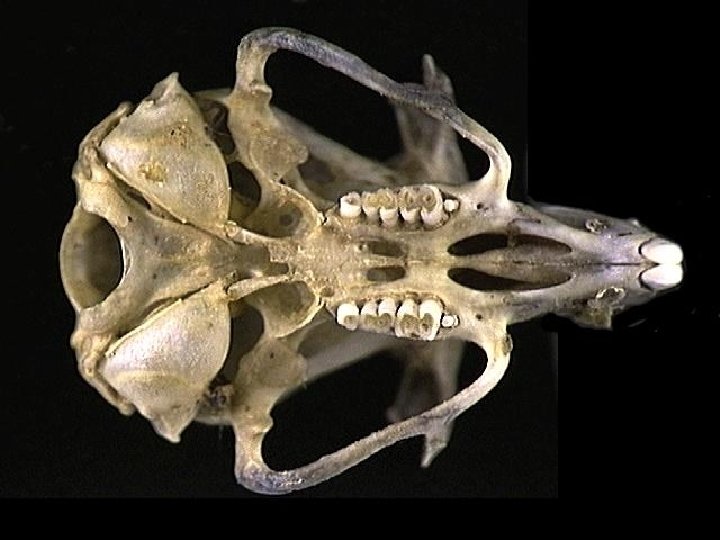
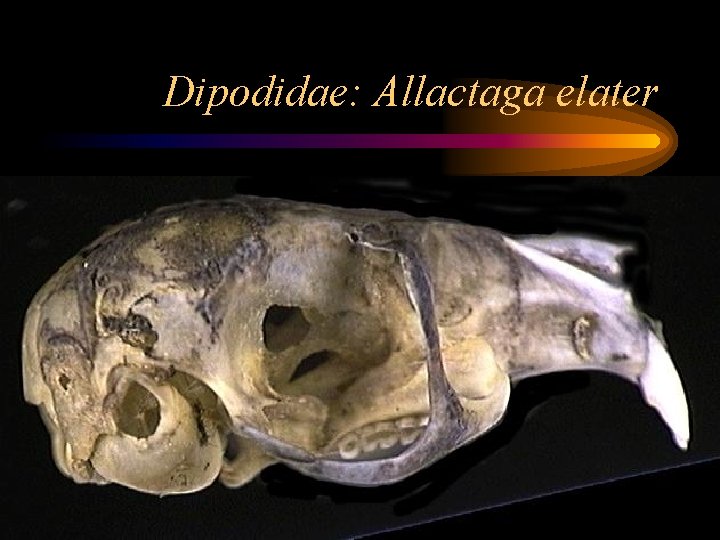
Dipodidae: Allactaga elater
Dipodidae: Allactaga elater
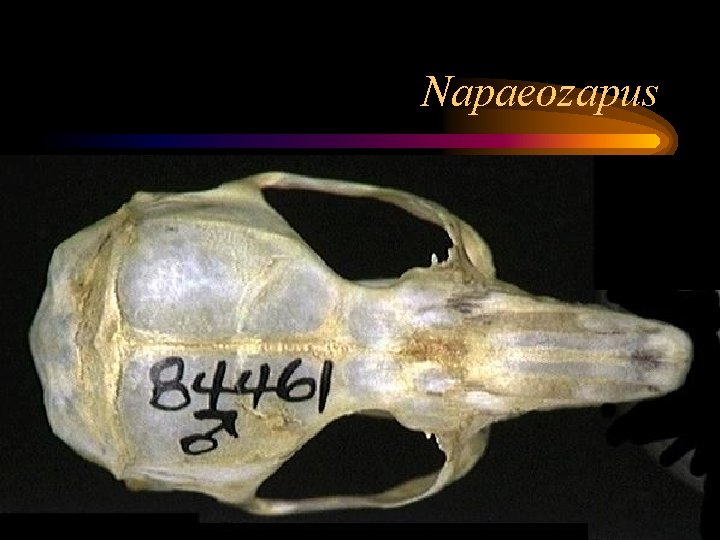
Napaeozapus
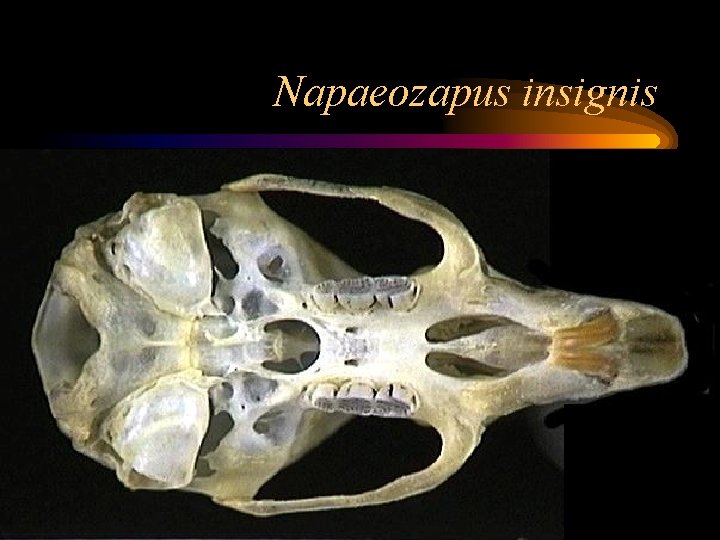
Napaeozapus insignis
Sciurognathi • Myoxidae – Includes former families Seleviniidae and Gliridae. – 8 genera and 26 species of dormice from Asia and Europe, Africa, and Japan. – Myoxus glis is eaten by people, and was consumed by the Romans. It is also called the fat dormouse.
Hystricognathi • Hystricognathus and hystricomorphous are not synonyms. Hystricognaths have a deflected angular process on the dentary, while hystricomorphous forms have a large infraorbital foramen.
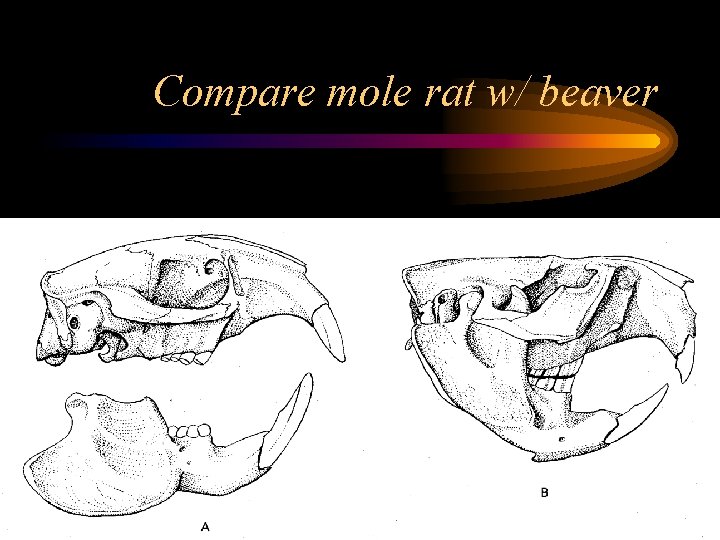
Hystricognathi • Bathyergidae: 5 genera and 12 species of mole rats and sand rats. Have small infraorbital foramen - not hystricomorphus. Includes eusocial naked mole rat • Hystricidae: 3 genera and 11 species of Old World porcupines w/o barbed quills. Indonesia, Borneo, Philippines, Asia, Africa, and the Middle East.
Compare mole rat w/ beaver
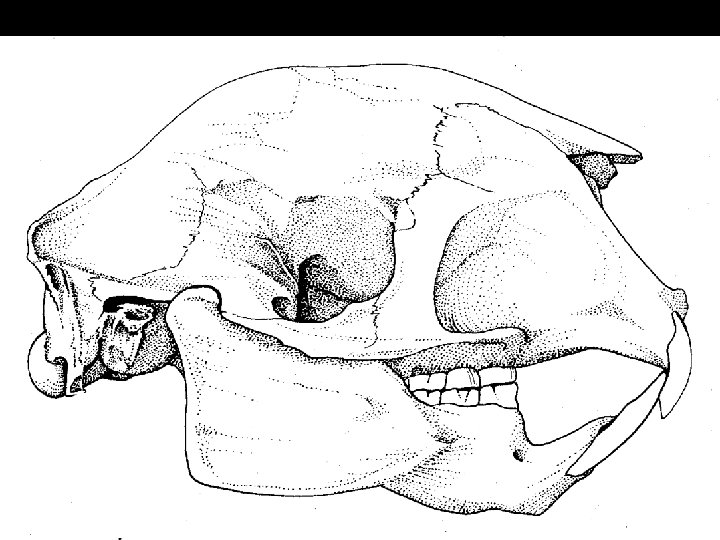
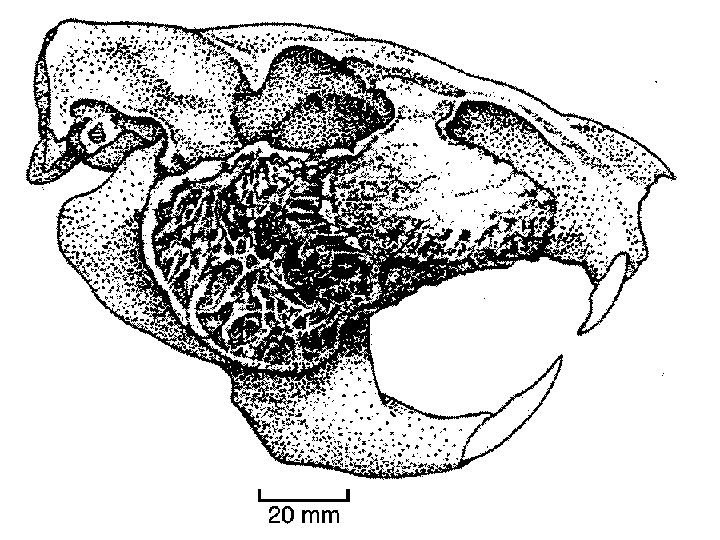
• Consider the skull of the African crested porcupine, Hystrix cristata, Hystricidae. • Why do you think the rostrum is inflated?
Hystricognathi • Erethizontidae: 4 genera and 12 species of New World porcupines w/ reverse barbs they just go deeper and deeper. • Petromuridae: monotypic Dassie Petromus typicus - Angola, Namibia, and S. Africa.
Hystricognathi • Thryonomyidae: African cane rats - 2 species, up to 10 kg. Used for food by people. • Chinchillidae: 3 large genera of S. A. chinchillas. • Dinomyidae: Montypic pacarana of S. A. (Dinomys branickii) - near extinction.
Hystricognathi • Caviidae: 14 species of guinea pigs, cavies, and patagonian hares, all S. A. • Hydrochaeridae: 1 species only of Capybara, from S. A. Semiaquatic. They often make news here as ‘ 80 lb’ rats. • Dasyproctidae: 13 sp of Agoutis and Acouchis.
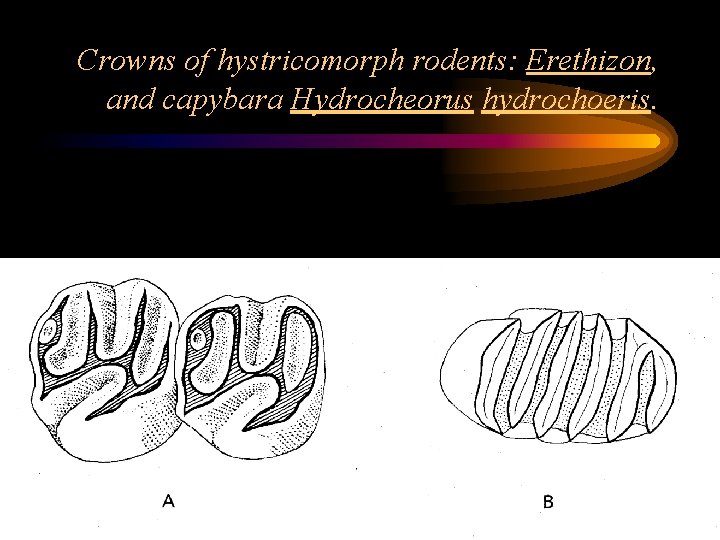
Crowns of hystricomorph rodents: Erethizon, and capybara Hydrocheorus hydrochoeris.
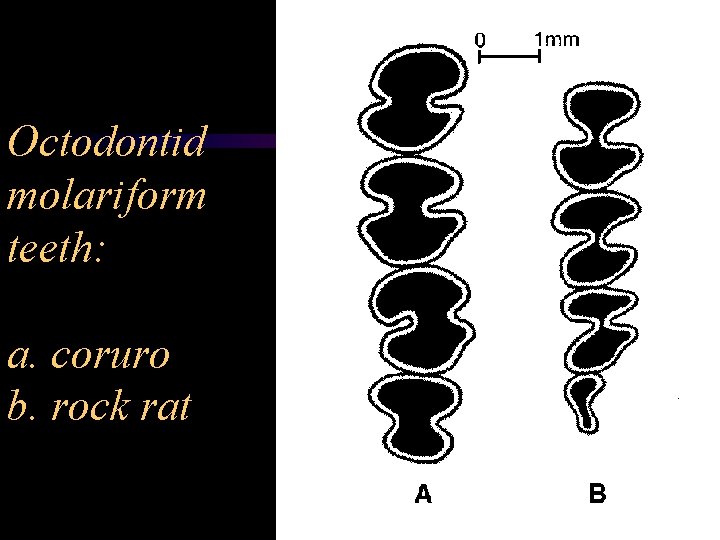
Hystricognathi • Agoutidae: 2 species of Pacas in S. A. (10 kg). They have unusual zygomatic arches that contian sinuses. They may be involved in vocalizations, including tooth grinding sounds. • Ctenomyidae: 38 species of S. A. tuco-tucos. • Octodontidae: 6 genera and 9 species of S. A. rats w/ unique molariform teeth.
Octodontid molariform teeth
Octodontid molariform teeth: a. coruro b. rock rat
Agoutidae: Agouti paca
Hystricognathi • Abrocomidae: 1 genus 3 species of S. A. Chinchilla rats. • Echimyidae: 16 genera and 71 species of spiny rats in S. A. • Capromyidae: 4 genera and 12 species of Hutias from the West Indies. Most are threatened by humans, feral cats, and introduced mongooses.
Hystricognathi • Myocastoridae: Monotypic, includes only the nutria Myocastor coypus. They S. A. Are introduced to the US because of the fur trade, and the high demand for beaver pelts by the French.
Lagomorpha Leporids and Ochotonids
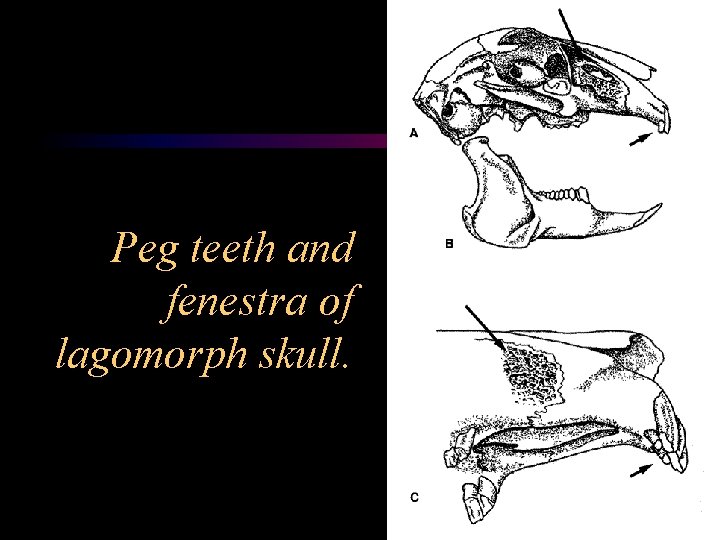
Morphology • They have peg teeth directly behind the upper incisors. They are not sharp. Thus, the dental formula is 2/1, 0/0, 3/2, 2 -3/3 = 26 -28. • Embryonically, there is a 3 rd pair of incisors lateral to the uppers. • Cheek teeth and molars are open rooted and ever growing.
Morphology • In leporids, the rostrum is fenestrated. What is the function of this? Clearly, so that mammalogists can trap them using museum specials. • The frontal has a supraorbital process. • Rabbits have a ‘cotton ball’ tail, while hares have a longer tail.
Peg teeth and fenestra of lagomorph skull.
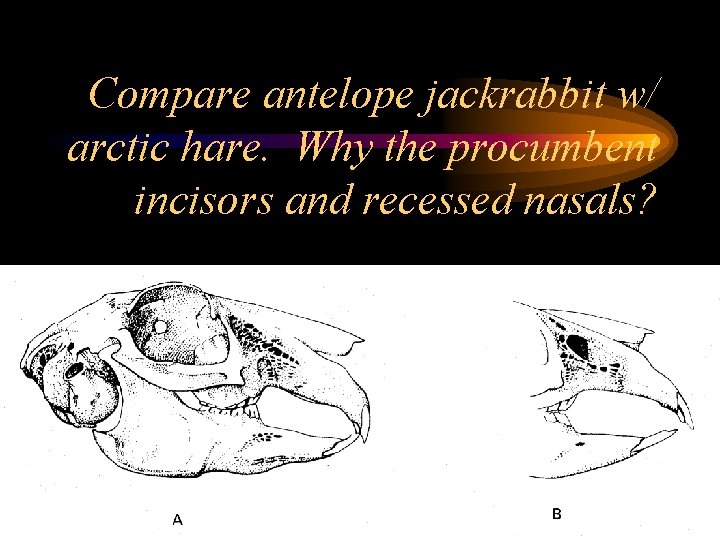
Compare antelope jackrabbit w/ arctic hare. Why the procumbent incisors and recessed nasals?
Morphology • Saltatorial (leporids). • Cloaca, duplex uterus, and unlike rodents, there is no baculum.
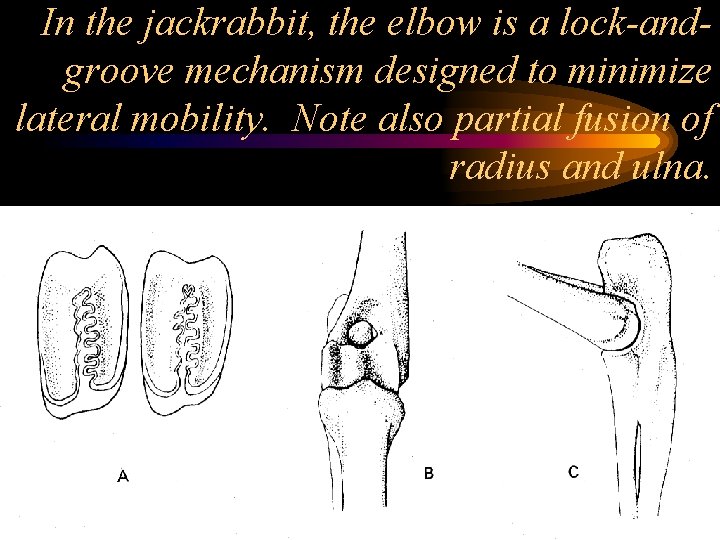
In the jackrabbit, the elbow is a lock-andgroove mechanism designed to minimize lateral mobility. Note also partial fusion of radius and ulna.
Fossil History • Fossils date to the late Paleocene of Mongolia. • New and Old World fossil leporids are known from the Eocene. • Ochotonids are known from the mid. Oligocene of Asia. • Both were much more diverse in the Tertiary than presently.
Fossil History • In the Tertiary, there were 21 genera of leporids, and 23 genera of ochotonids. • Why is their diversity so low today?
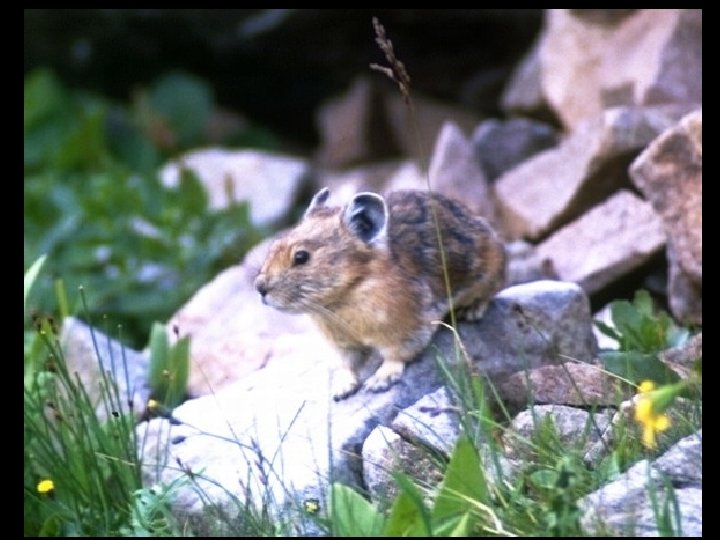
Lagomorphs • Ochotonidae – Occur primarily on talus slopes. Are relatively abundant in the great basin, and occur all the way up to Alaska. – They are territorial, and have a unique vocalization used in territoriality. – They make ‘hay’ for the winter.
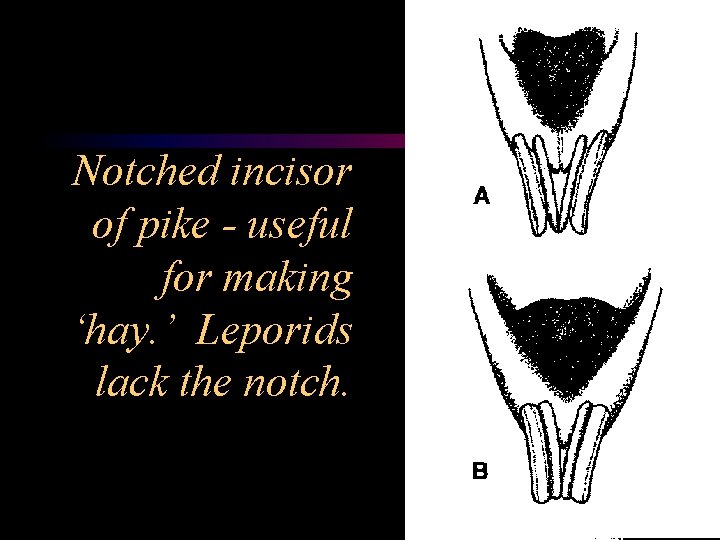
Notched incisor of pike - useful for making ‘hay. ’ Leporids lack the notch.
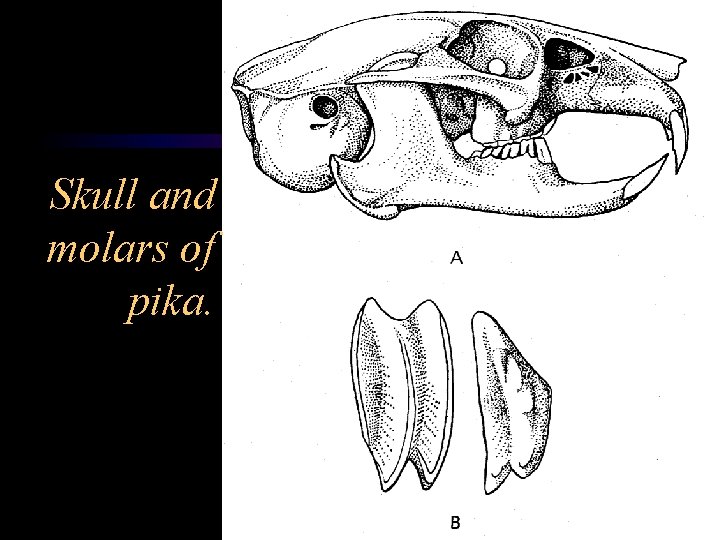
Skull and molars of pika.
Lagomorphs • Leporids – Rabbits (2 n=42) and hares (2 n=48) are not identical – Rabbits build fur lined nests and give birth to altricial young. – Hares make shallow depressions and give birth to precocial young. Their young are furred, have open eyes, and are fully formed. – Rabbits have an interparietal bone, but hares do not.
Lagomorphs • Leporids often have coat color dimorphism. • Leporids have induced ovulation, and high reproductive capacities.