
Rocks Rocks ROCKS ARE CLASSIFIED BY HOW THEY
Rocks
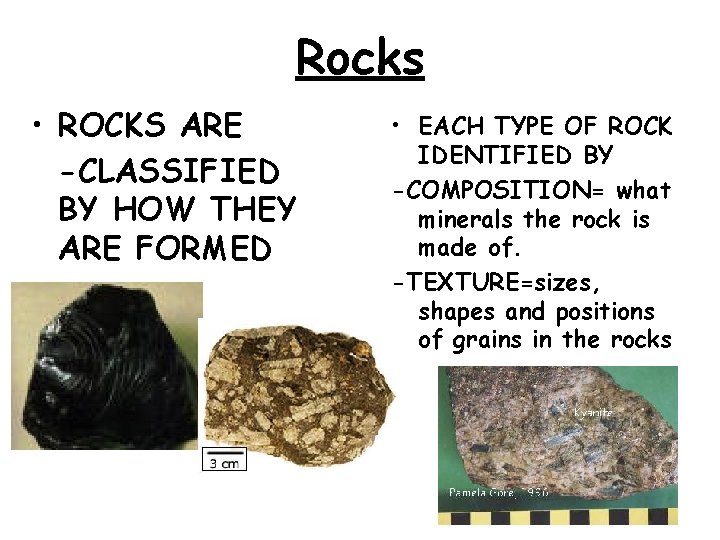
Rocks • ROCKS ARE -CLASSIFIED BY HOW THEY ARE FORMED • EACH TYPE OF ROCK IDENTIFIED BY -COMPOSITION= what minerals the rock is made of. -TEXTURE=sizes, shapes and positions of grains in the rocks

Rock Classification Geologists classify rocks into three major groups depending on how they are formed: Igneous rock, Sedimentary rock, and Metamorphic rock.
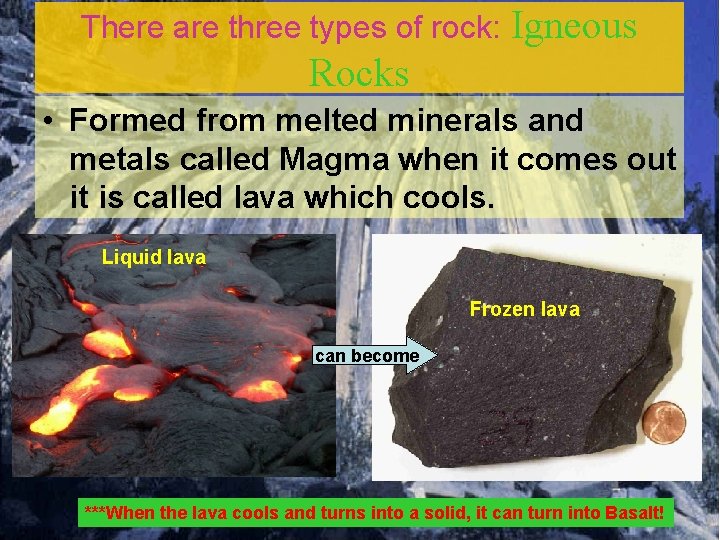
There are three types of rock: Igneous Rocks • Formed from melted minerals and metals called Magma when it comes out it is called lava which cools. Liquid lava Frozen lava can become ***When the lava cools and turns into a solid, it can turn into Basalt!
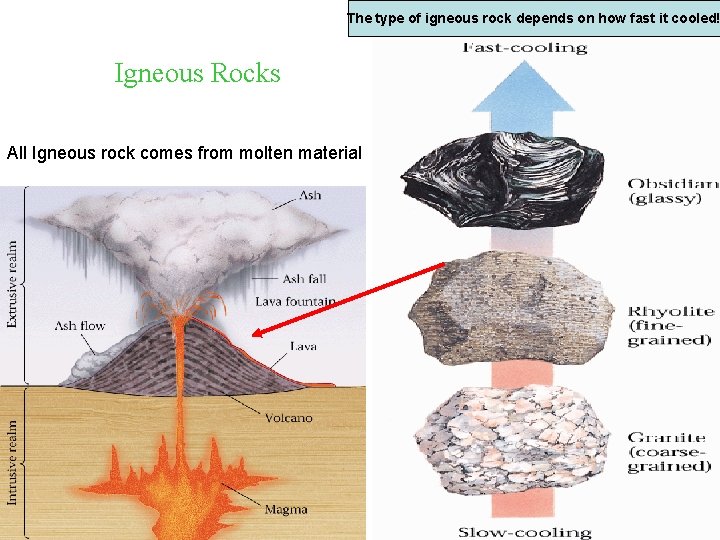
The type of igneous rock depends on how fast it cooled! Igneous Rocks All Igneous rock comes from molten material Molten material comes from volcanoes
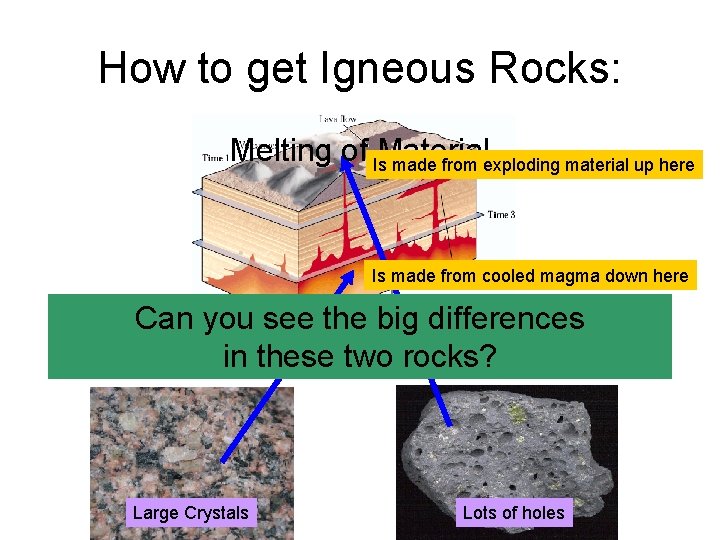
How to get Igneous Rocks: Melting of Is. Material made from exploding material up here Is made from cooled magma down here Can you see the big differences Cooling Magma Explosive Volcanism in these two rocks? Large Crystals Lots of holes
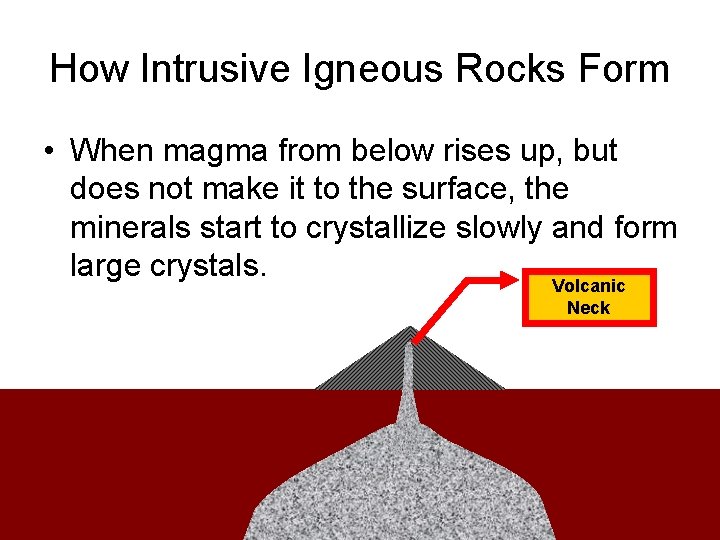
How Intrusive Igneous Rocks Form • When magma from below rises up, but does not make it to the surface, the minerals start to crystallize slowly and form large crystals. Volcanic Neck 7
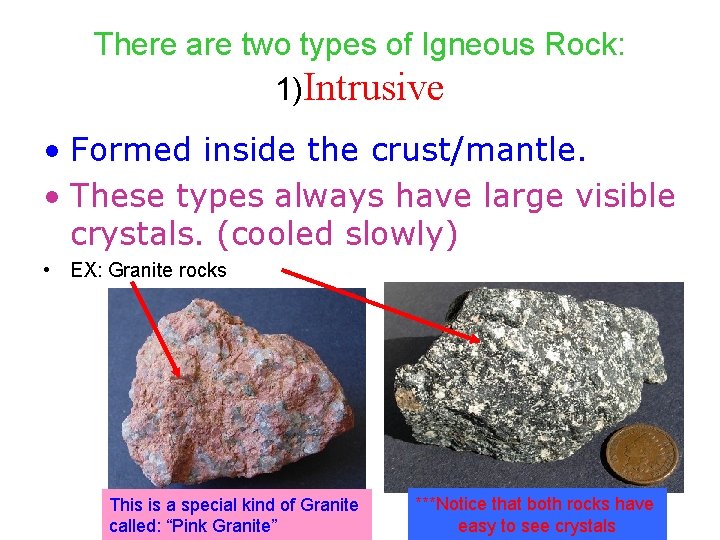
There are two types of Igneous Rock: 1)Intrusive • Formed inside the crust/mantle. • These types always have large visible crystals. (cooled slowly) • EX: Granite rocks This is a special kind of Granite called: “Pink Granite” ***Notice that both rocks have easy to see crystals

How Extrusive Igneous Rocks Form • When magma from below rises and punches through, the minerals don’t have time to crystallize – therefore, they produce rocks with small crystals. Lava Flow (Outside) Magma (inside) The lava will quickly cool into solid rock! 9
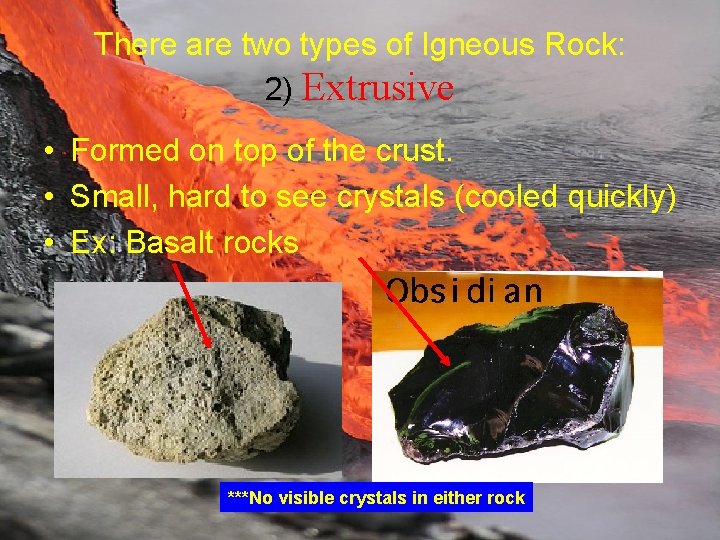
There are two types of Igneous Rock: 2) Extrusive • Formed on top of the crust. • Small, hard to see crystals (cooled quickly) • Ex: Basalt rocks ***No visible crystals in either rock
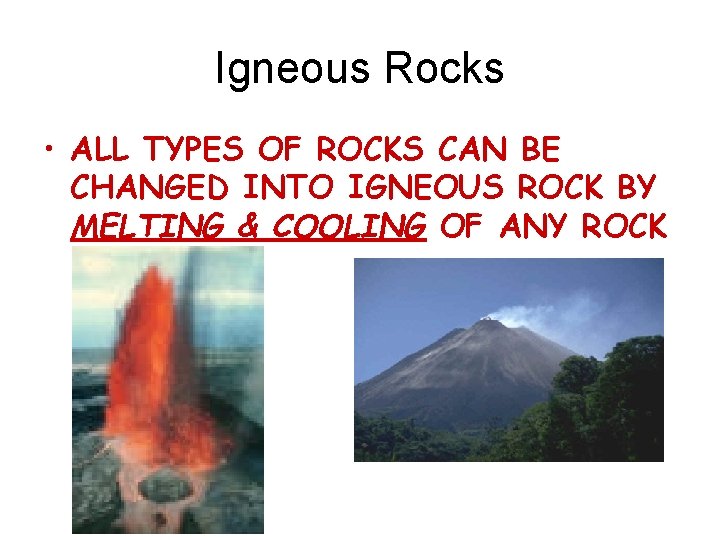
Igneous Rocks • ALL TYPES OF ROCKS CAN BE CHANGED INTO IGNEOUS ROCK BY MELTING & COOLING OF ANY ROCK
Igneous Rocks • KEY WORDS • MELTING and COOLING

Key Vocabulary • Sediments: loose materials such as rock fragments and mineral grains that have been transported by wind, water, or glacier • Weathering: the breaking of rocks into smaller pieces, either mechanically or chemically • Erosion: the process that moves weathered rocks from one location to another • Deposition: the build up of sediments on the bottoms of lakes, valleys and the ocean floor usually in layers
• Compaction: layers of sediment become compressed by the weight of layers above them • Cementation: process in which sediments are glued together by minerals deposited between the sediments (Compaction and Cementation is know as lithification)
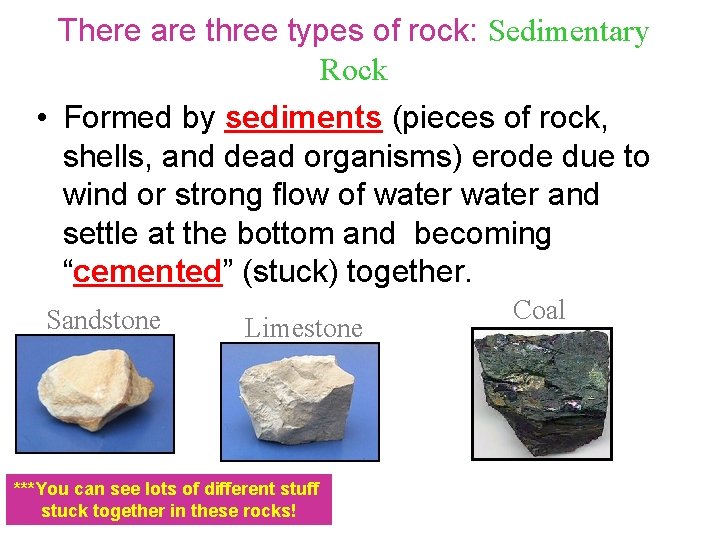
There are three types of rock: Sedimentary Rock • Formed by sediments (pieces of rock, shells, and dead organisms) erode due to wind or strong flow of water and settle at the bottom and becoming “cemented” (stuck) together. Sandstone Limestone ***You can see lots of different stuff stuck together in these rocks! Coal
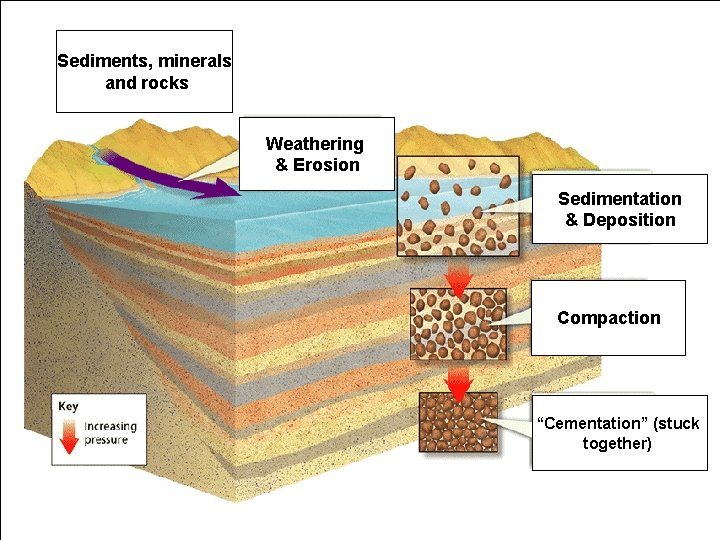
Sedimentary Rock Recipe Sediments, minerals and rocks 1. Start at the Surface 2. Weather (Break Up) Weathering & Erosion Sedimentation & Deposition 3. Erode (Carry Away) 4. Sedimentation & Deposition Layers of sand sediments Rain moves Compaction sand, dirt, and rocks down to the ocean 5. Compaction & Cementation “Cementation” (stuck together) Igneous rock Sediments worn away gather here!
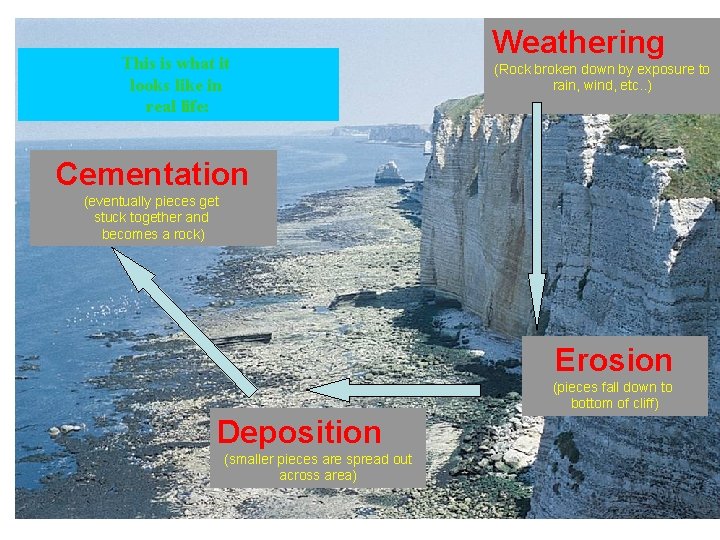
This is what it looks like in real life: Weathering (Rock broken down by exposure to rain, wind, etc. . ) Cementation (eventually pieces get stuck together and becomes a rock) Erosion (pieces fall down to bottom of cliff) Deposition (smaller pieces are spread out across area)
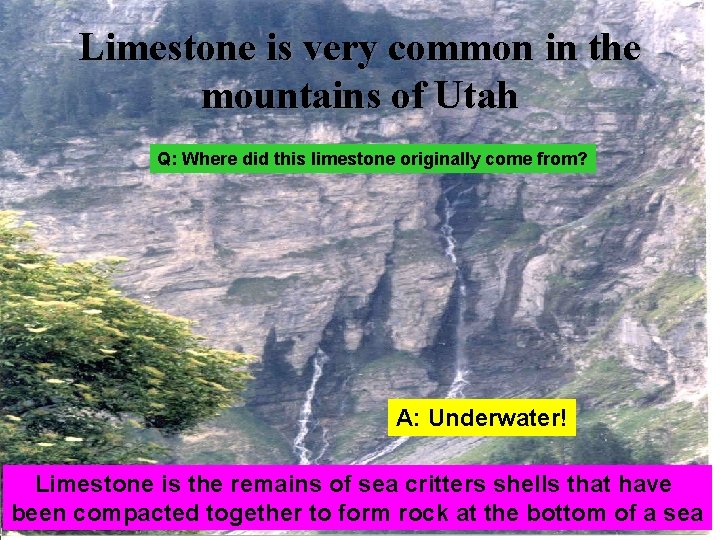
Limestone is very common in the mountains of Utah Q: Where did this limestone originally come from? A: Underwater! Limestone is the remains of sea critters shells that have been compacted together to form rock at the bottom of a sea
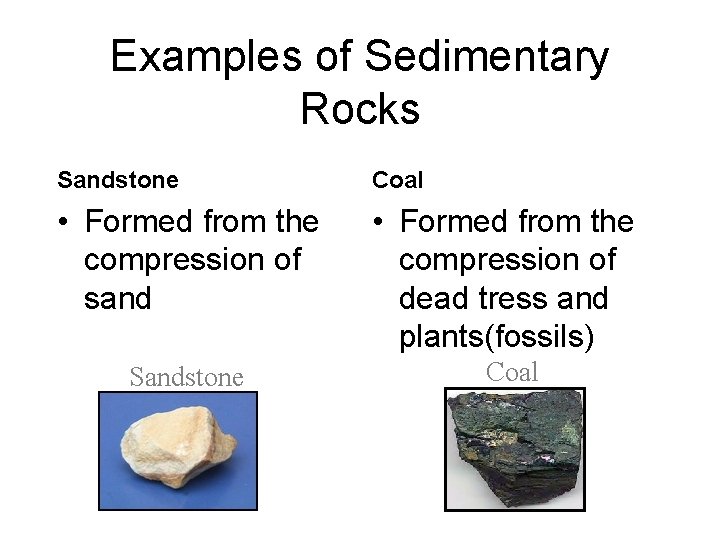
Examples of Sedimentary Rocks Sandstone Coal • Formed from the compression of sand • Formed from the compression of dead tress and plants(fossils) Sandstone Coal
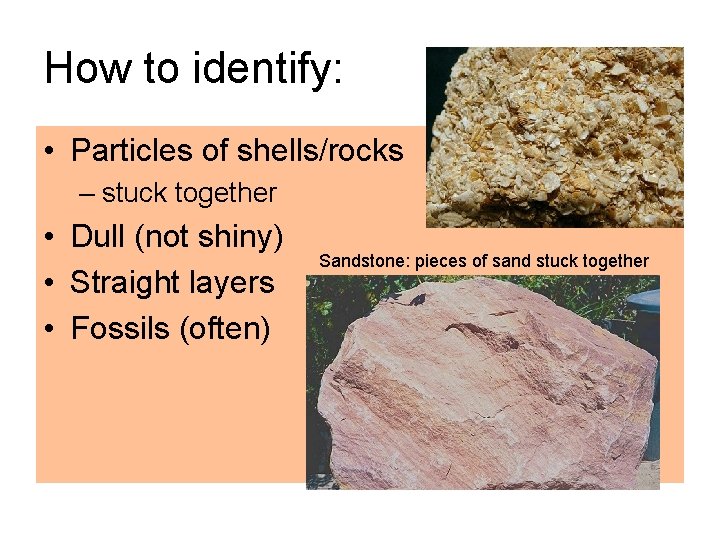
How to identify: • Particles of shells/rocks – stuck together • Dull (not shiny) • Straight layers • Fossils (often) Sandstone: pieces of sand stuck together
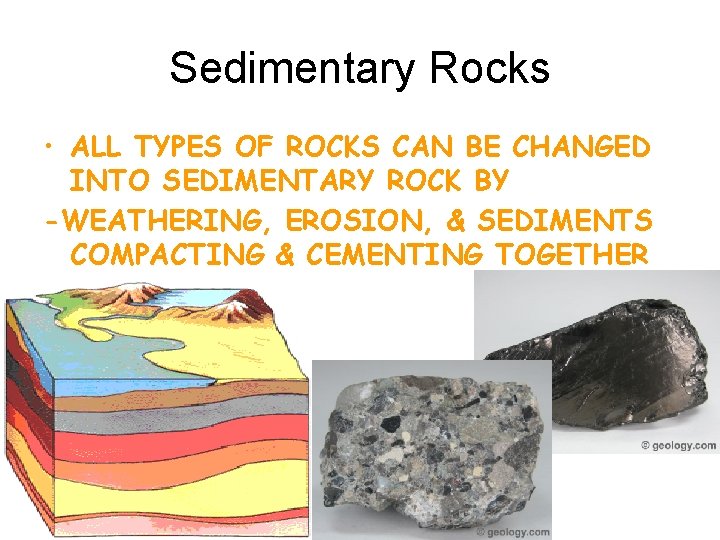
Sedimentary Rocks • ALL TYPES OF ROCKS CAN BE CHANGED INTO SEDIMENTARY ROCK BY -WEATHERING, EROSION, & SEDIMENTS COMPACTING & CEMENTING TOGETHER
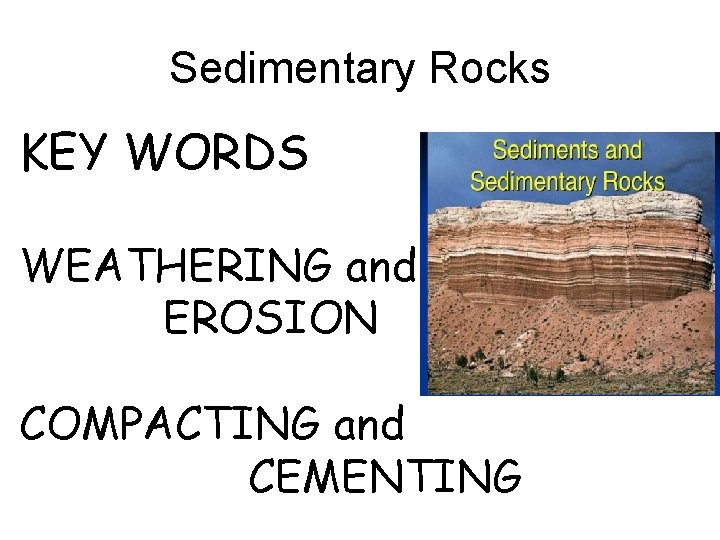
Sedimentary Rocks KEY WORDS WEATHERING and EROSION COMPACTING and CEMENTING
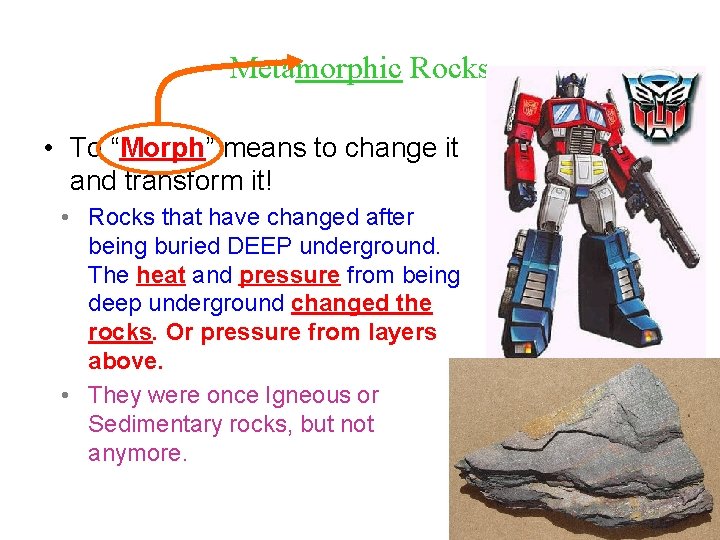
Metamorphic Rocks • To “Morph” means to change it and transform it! • Rocks that have changed after being buried DEEP underground. The heat and pressure from being deep underground changed the rocks. Or pressure from layers above. • They were once Igneous or Sedimentary rocks, but not anymore.
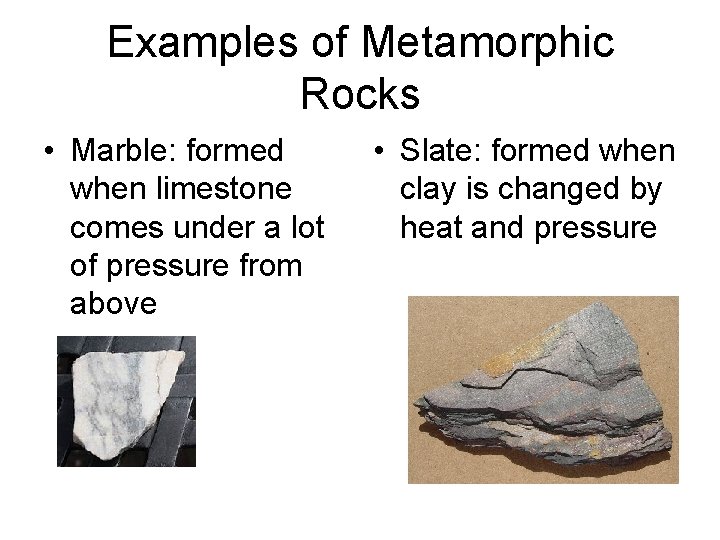
Examples of Metamorphic Rocks • Marble: formed when limestone comes under a lot of pressure from above • Slate: formed when clay is changed by heat and pressure
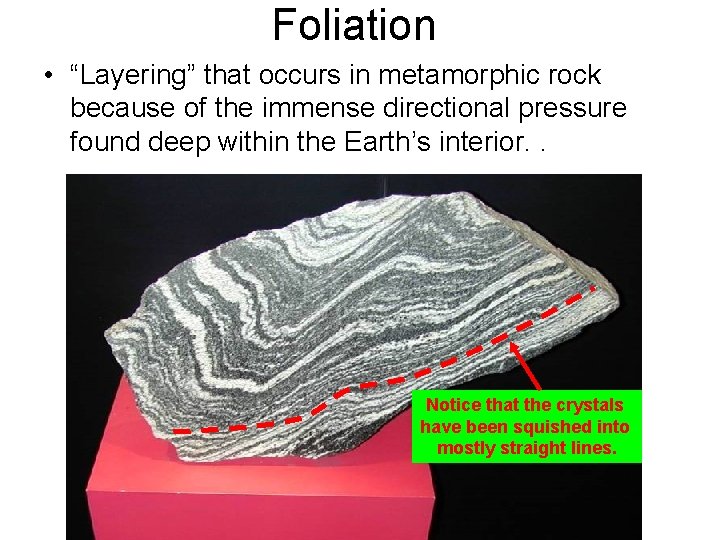
Foliation • “Layering” that occurs in metamorphic rock because of the immense directional pressure found deep within the Earth’s interior. . Notice that the crystals have been squished into mostly straight lines.
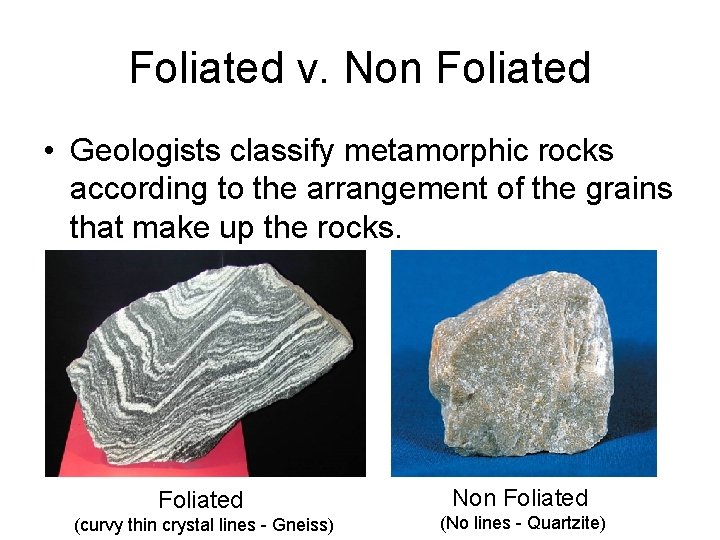
Foliated v. Non Foliated • Geologists classify metamorphic rocks according to the arrangement of the grains that make up the rocks. Foliated Non Foliated (curvy thin crystal lines - Gneiss) (No lines - Quartzite)
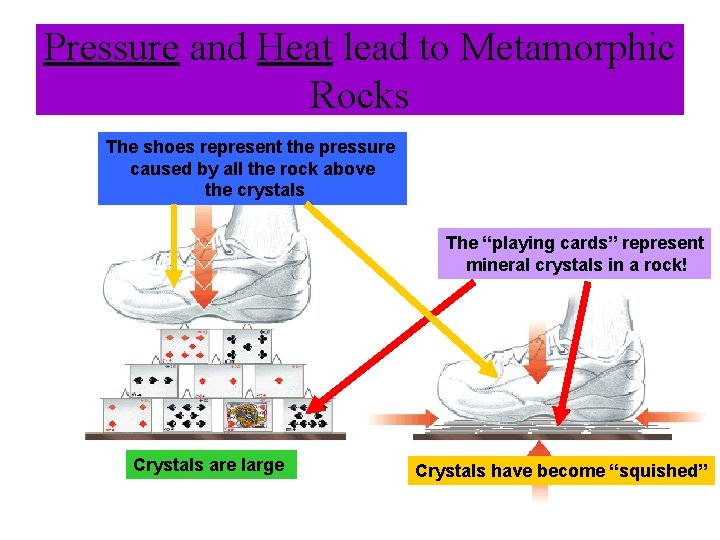
Pressure and Heat lead to Metamorphic Rocks The shoes represent the pressure caused by all the rock above the crystals The “playing cards” represent mineral crystals in a rock! Crystals are large Crystals have become “squished”
Metamorphic Rocks • KEY WORDS • HEAT and PRESSURE
Rocks
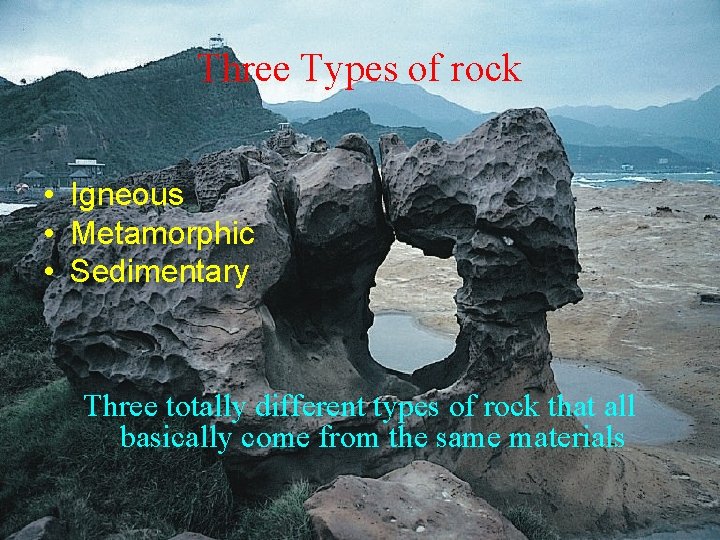
Three Types of rock • Igneous • Metamorphic • Sedimentary Three totally different types of rock that all basically come from the same materials
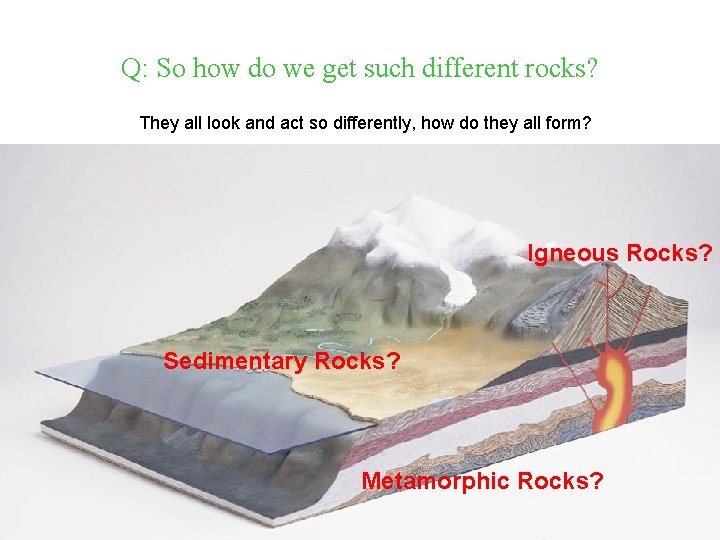
Q: So how do we get such different rocks? They all look and act so differently, how do they all form? Igneous Rocks? Sedimentary Rocks? Metamorphic Rocks?
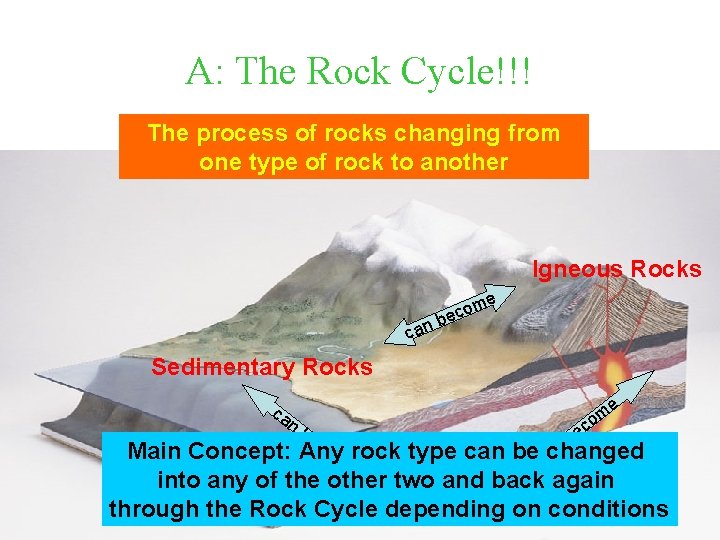
A: The Rock Cycle!!! The process of rocks changing from one type of rock to another Igneous Rocks e can om c e b Sedimentary Rocks ca n e be be c om co Main Concept: Any an m rock type can be cchanged e into any of the other two and back again through the Rock Cycle Metamorphic depending on. Rocks conditions
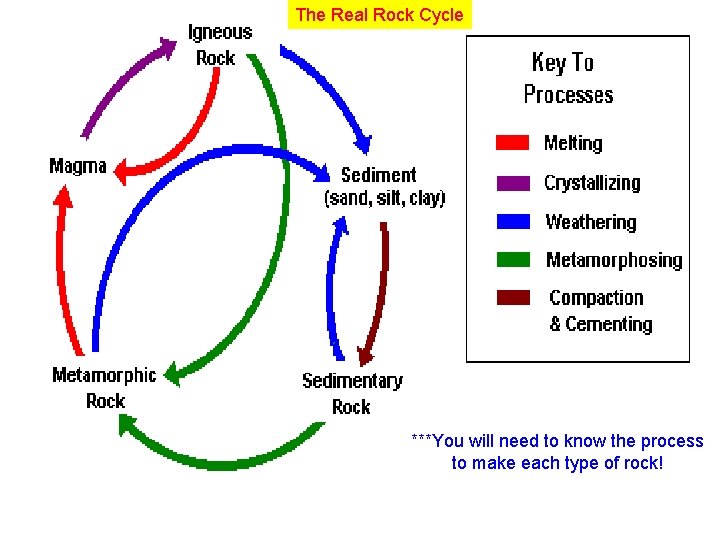
The Real Rock Cycle ***You will need to know the process to make each type of rock!
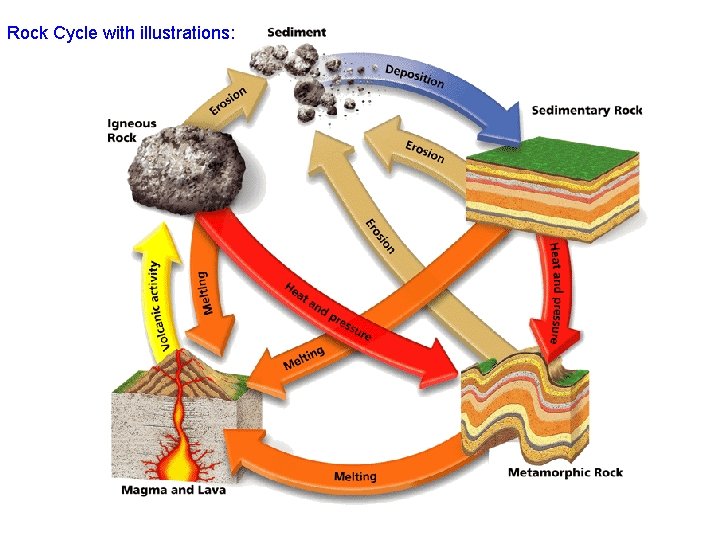
Rock Cycle with illustrations:
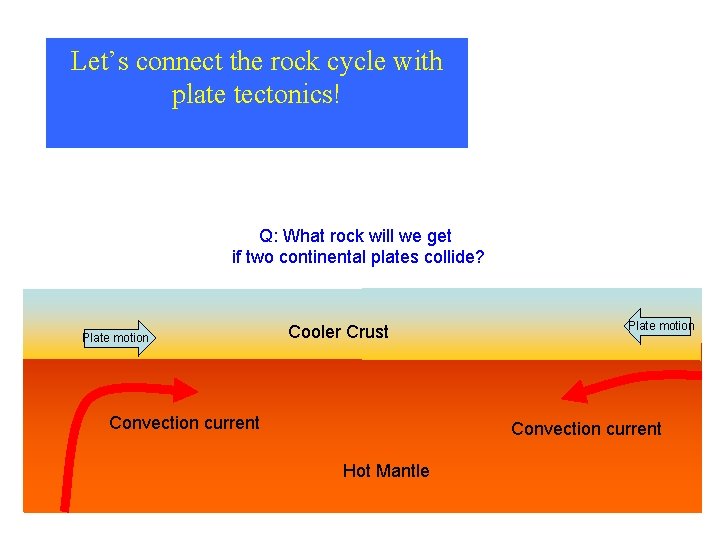
Let’s connect the rock cycle with plate tectonics! Q: What rock will we get if two continental plates collide? Plate motion Cooler Crust Convection current Plate motion Convection current Hot Mantle
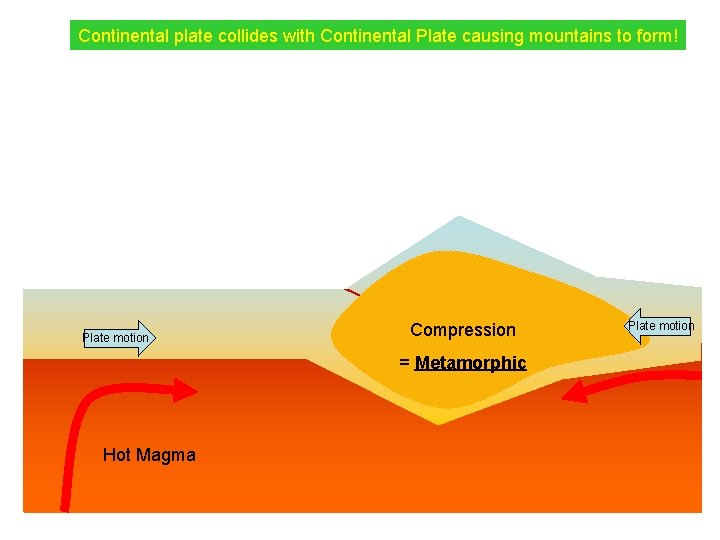
Continental plate collides with Continental Plate causing mountains to form! Plate motion Compression = Metamorphic Hot Magma Plate motion
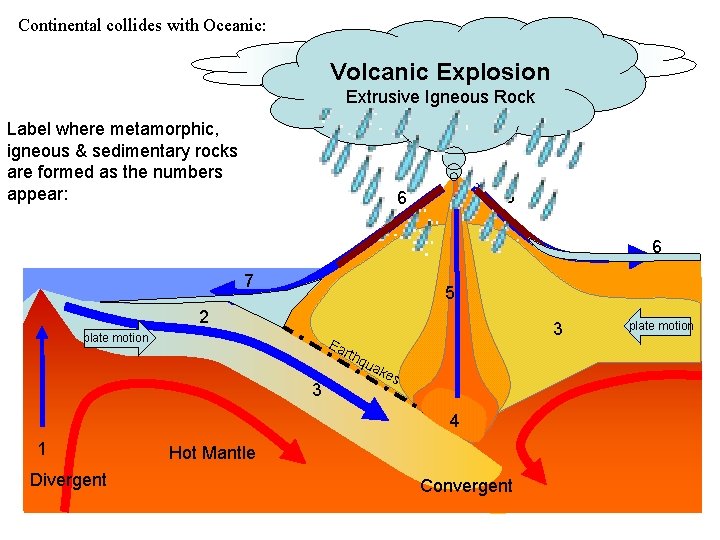
Continental collides with Oceanic: Cloud will bring. Explosion falling water Volcanic Extrusive Igneous Rock Label where metamorphic, igneous & sedimentary rocks are formed as the numbers appear: 6 6 6 7 5 2 plate motion 3 Ea rth 3 qu ak es 4 1 Divergent Hot Mantle Convergent plate motion
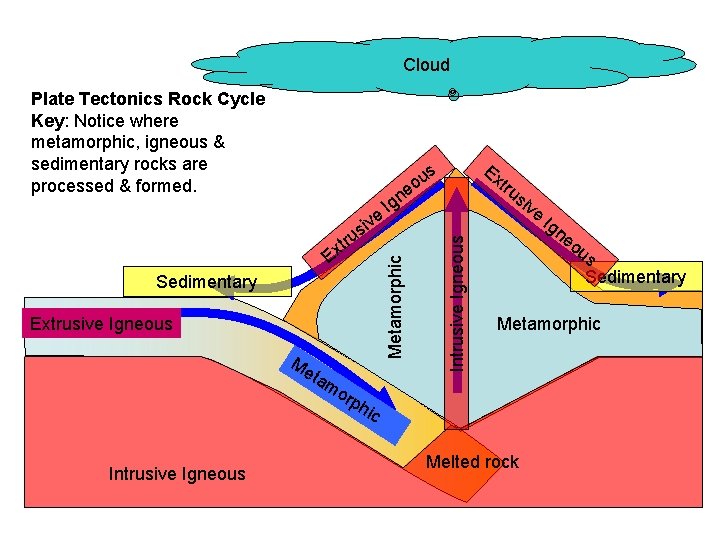
Cloud e v i s Ig Extrusive Igneous Me tam Metamorphic Sedimentary tru ne u tr x E Ex s ou siv e Intrusive Igneous Plate Tectonics Rock Cycle Key: Notice where metamorphic, igneous & sedimentary rocks are processed & formed. ou s Sedimentary Metamorphic orp hic Intrusive Igneous Ig ne Melted rock
- Slides: 38