
Rocks Minerals and Crystals By Guest Scientist Dr
Rocks Minerals and Crystals By Guest Scientist Dr. David Walker LDEO-Columbia University
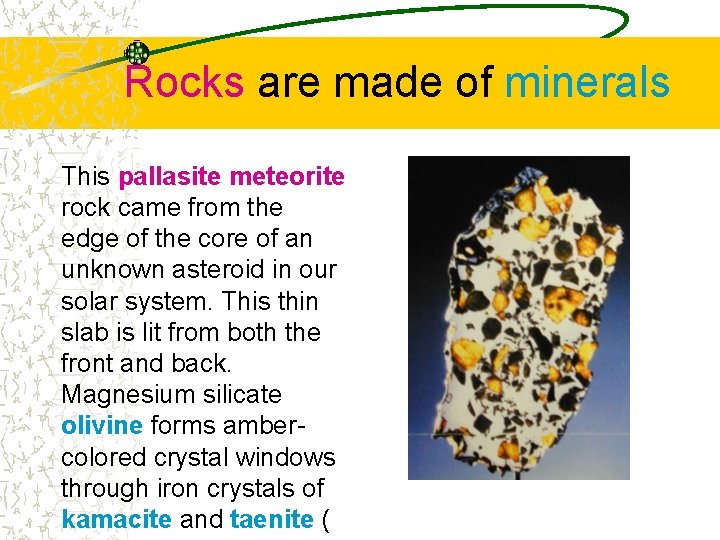
Rocks are made of minerals This pallasite meteorite rock came from the edge of the core of an unknown asteroid in our solar system. This thin slab is lit from both the front and back. Magnesium silicate olivine forms ambercolored crystal windows through iron crystals of kamacite and taenite (
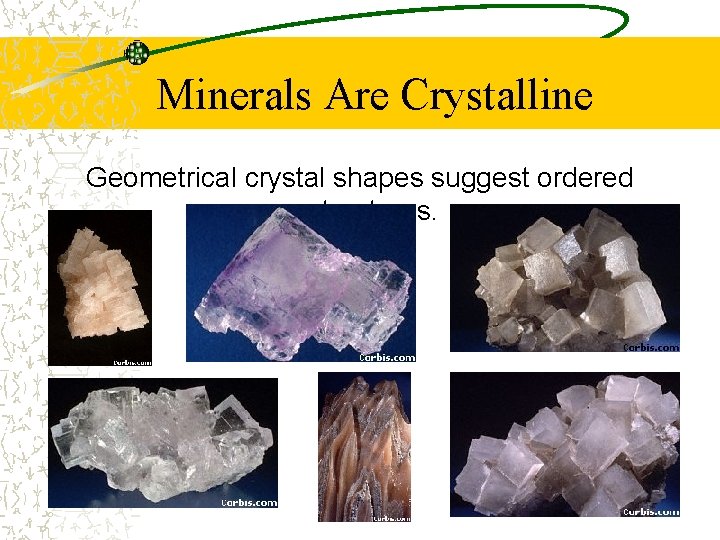
Minerals Are Crystalline Geometrical crystal shapes suggest ordered structures.
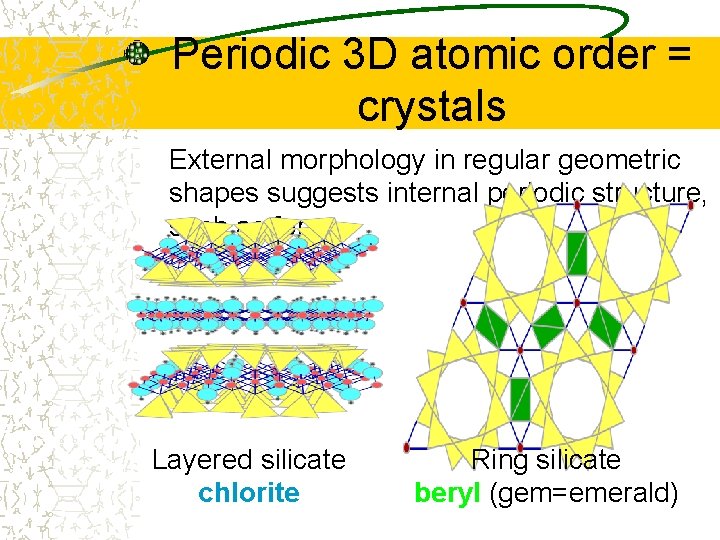
Periodic 3 D atomic order = crystals External morphology in regular geometric shapes suggests internal periodic structure, such as for: Layered silicate chlorite Ring silicate beryl (gem=emerald)
How to Learn the Atomic Order? Put X-ray beams through crystals. X-rays are short electromagnetic waves of wavelength (l) between 0. 1 and 10 Angstroms. If waves hit periodic array with spacing d l then COOPERATIVE SCATTERING occurs (= DIFFRACTION ). This is NOT the same as taking an X-ray
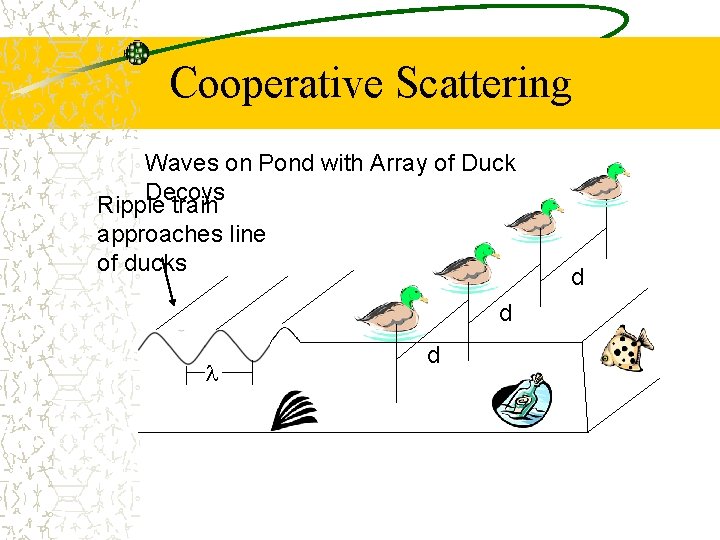
Cooperative Scattering Waves on Pond with Array of Duck Decoys Ripple train approaches line of ducks d l d d
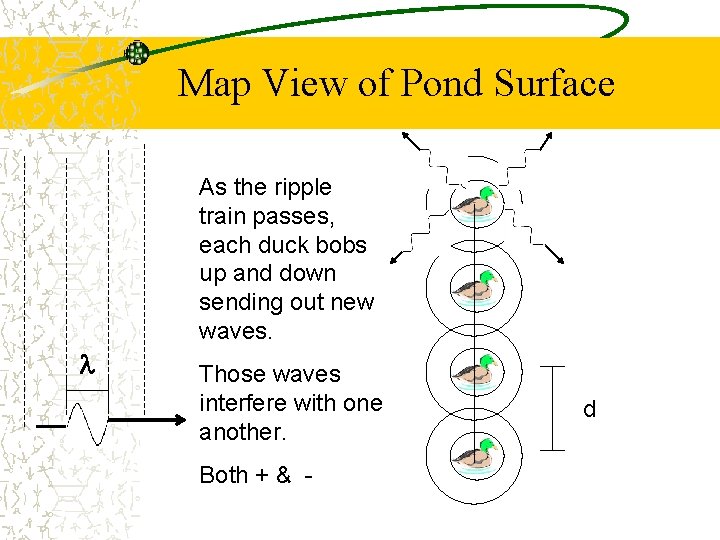
Map View of Pond Surface As the ripple train passes, each duck bobs up and down sending out new waves. l Those waves interfere with one another. Both + & - d
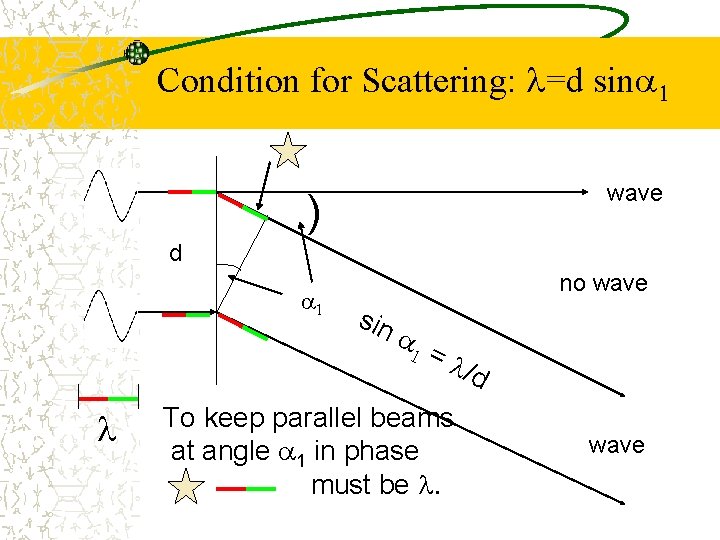
Condition for Scattering: l=d sina 1 wave ) d a 1 no wave sin a 1 l =l To keep parallel beams at angle a 1 in phase must be l. /d wave
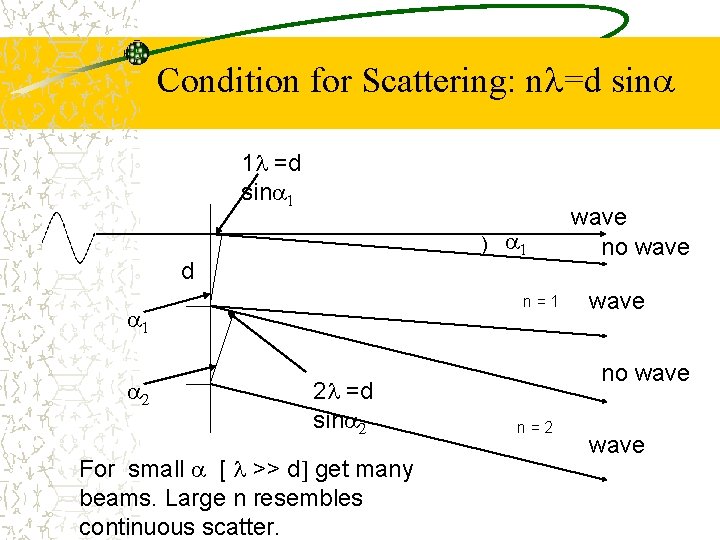
Condition for Scattering: nl=d sina 1 l =d sina 1 ) d n=1 a 2 a 1 2 l =d sina 2 For small a [ l >> d] get many beams. Large n resembles continuous scatter. wave no wave n=2 wave
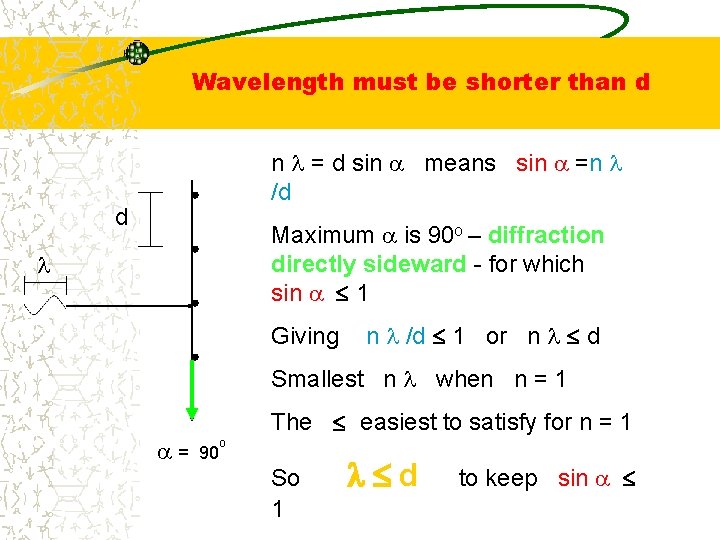
Wavelength must be shorter than d n l = d sin a means sin a =n l /d d Maximum a is 90 o – diffraction directly sideward - for which sin a 1 l Giving n l /d 1 or n l d Smallest n l when n = 1 a= The easiest to satisfy for n = 1 90 o So 1 l d to keep sin a
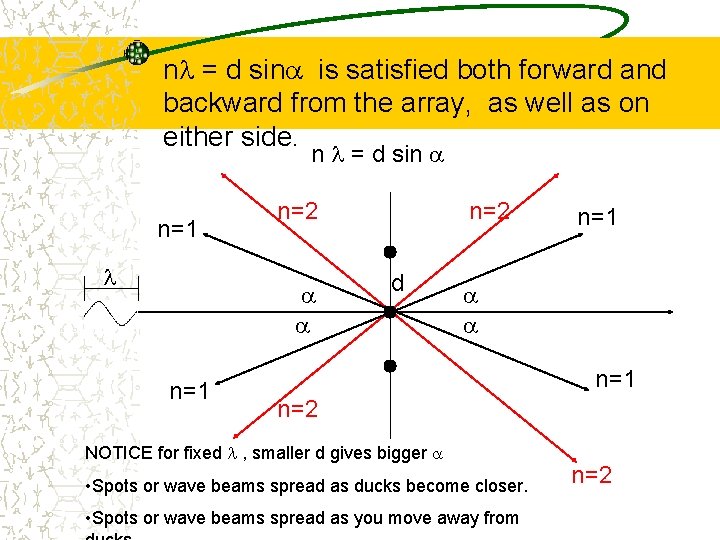
nl = d sina is satisfied both forward and backward from the array, as well as on either side. n l = d sin a n=1 l n=2 a a n=1 n=2 d n=1 a a n=1 n=2 NOTICE for fixed l , smaller d gives bigger a • Spots or wave beams spread as ducks become closer. • Spots or wave beams spread as you move away from n=2
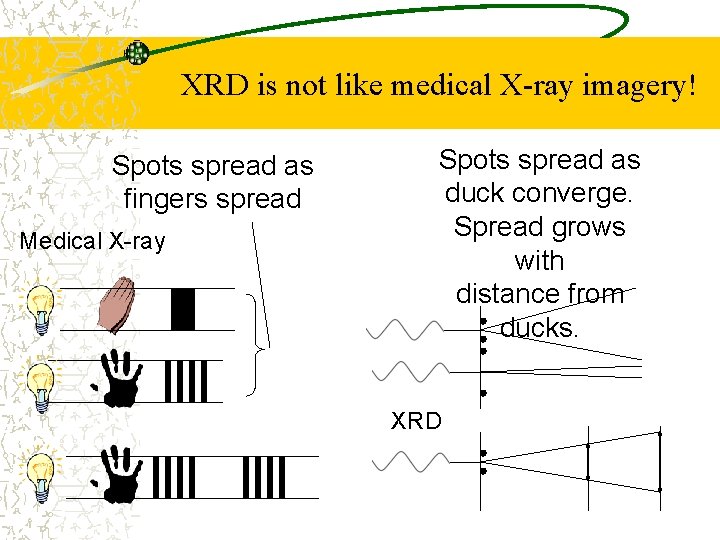
XRD is not like medical X-ray imagery! Spots spread as fingers spread Medical X-ray Spots spread as duck converge. Spread grows with distance from ducks. XRD
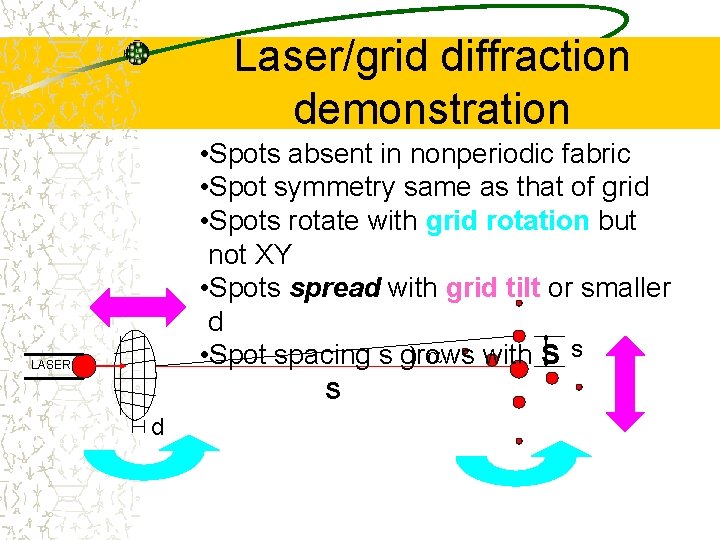
Laser/grid diffraction demonstration • Spots absent in nonperiodic fabric • Spot symmetry same as that of grid • Spots rotate with grid rotation but not XY • Spots spread with grid tilt or smaller d ) a • Spot spacing s grows with S s LASER S d
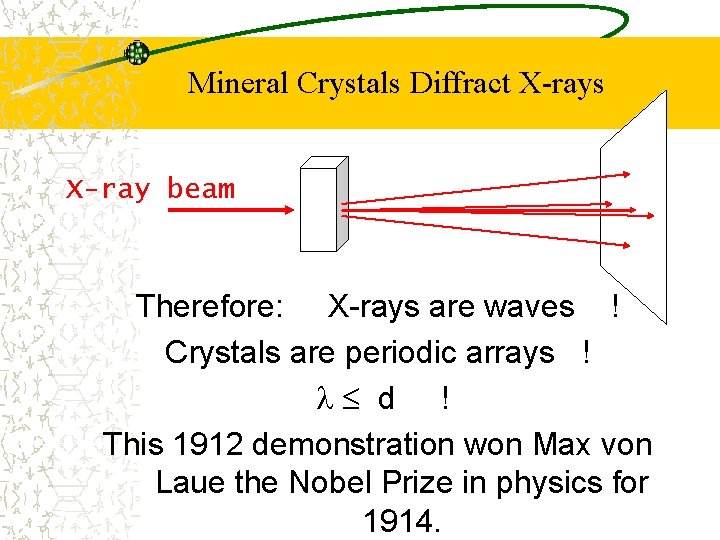
Mineral Crystals Diffract X-rays X-ray beam Therefore: X-rays are waves ! Crystals are periodic arrays ! l d ! This 1912 demonstration won Max von Laue the Nobel Prize in physics for 1914.
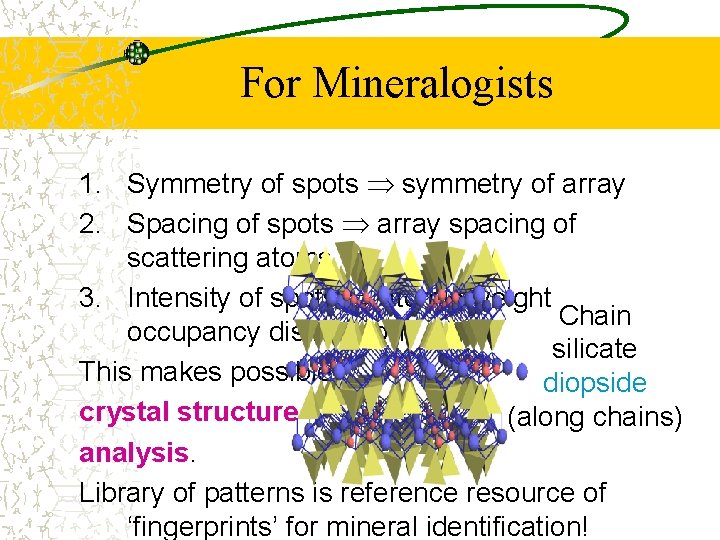
For Mineralogists 1. Symmetry of spots symmetry of array 2. Spacing of spots array spacing of scattering atoms 3. Intensity of spots atomic weight Chain occupancy distribution. silicate This makes possible diopside crystal structure (along chains) analysis. Library of patterns is reference resource of ‘fingerprints’ for mineral identification!
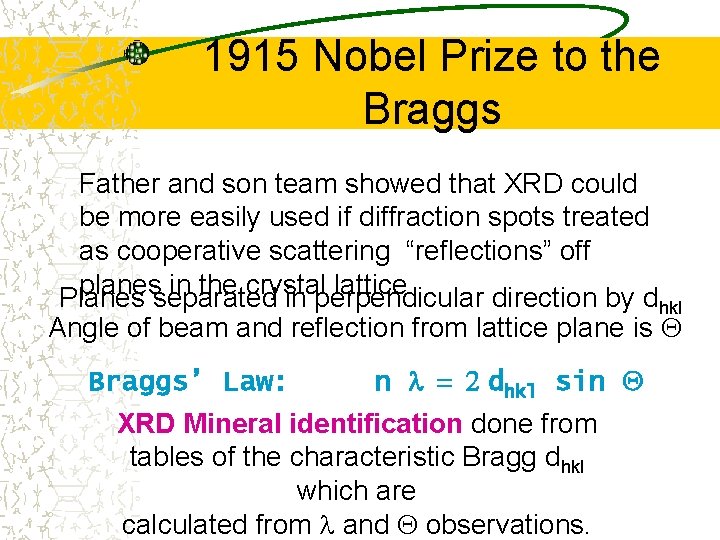
1915 Nobel Prize to the Braggs Father and son team showed that XRD could be more easily used if diffraction spots treated as cooperative scattering “reflections” off planesseparated in the crystal lattice. Planes in perpendicular direction by d hkl Angle of beam and reflection from lattice plane is Braggs’ Law: n l = 2 dhkl sin XRD Mineral identification done from tables of the characteristic Bragg dhkl which are calculated from l and observations.
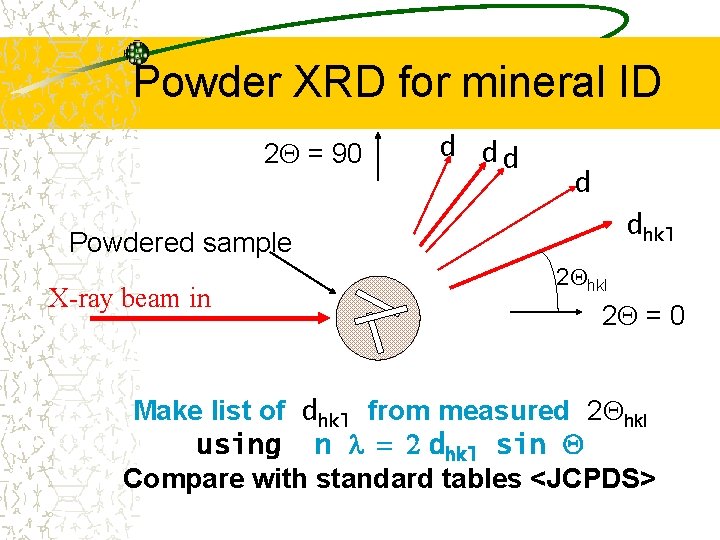
Powder XRD for mineral ID 2 = 90 d dd d dhkl Powdered sample X-ray beam in 2 hkl 2 = 0 Make list of dhkl from measured 2 hkl using n l = 2 dhkl sin Compare with standard tables <JCPDS>
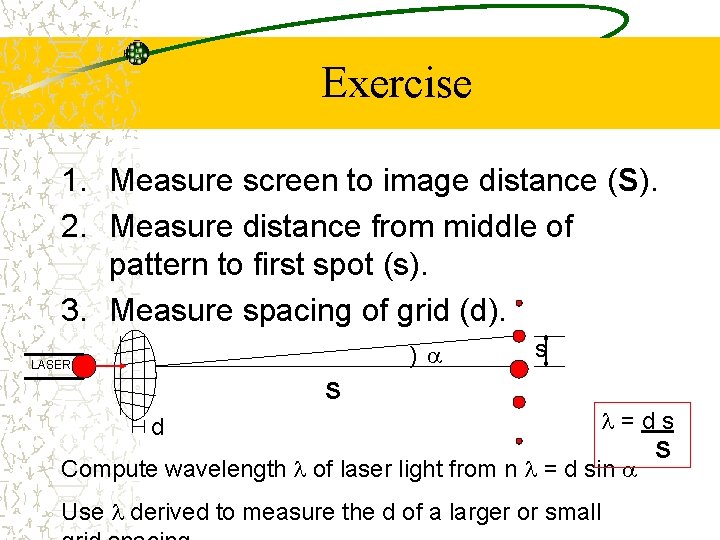
Exercise 1. Measure screen to image distance (S). 2. Measure distance from middle of pattern to first spot (s). 3. Measure spacing of grid (d). ) a LASER s S l=ds S Compute wavelength l of laser light from n l = d sin a d Use l derived to measure the d of a larger or small
Website References http: //www. icdd. com Commercial library of the JCPDS powder patterns of over 60, 000 crystal structures. http: //www. ccp 14. ac. uk XRD applications freeware and tutorials. http: //webmineral. com Fun resource for mineralogy, especially crystal shapes. http: //ammin. minsocam. org Mineralogical Society of America’s site including “Ask A Mineralogist”.
- Slides: 19