
Rocks and weathering 1 of 28 Boardworks Ltd
Rocks and weathering 1 of 28 © Boardworks Ltd 2007
Physical weathering 2 of 28 © Boardworks Ltd 2007
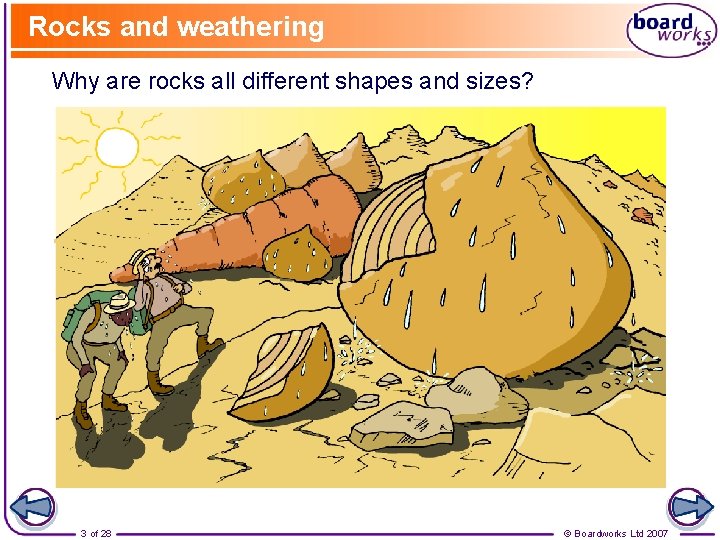
Rocks and weathering Why are rocks all different shapes and sizes? 3 of 28 © Boardworks Ltd 2007
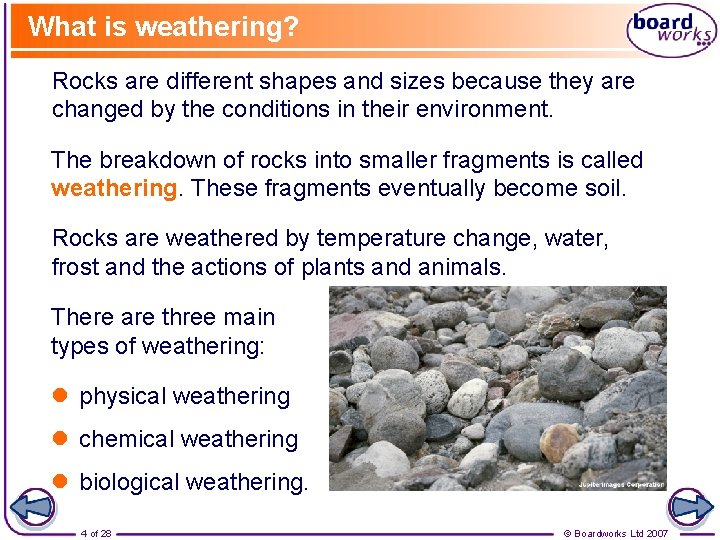
What is weathering? Rocks are different shapes and sizes because they are changed by the conditions in their environment. The breakdown of rocks into smaller fragments is called weathering. These fragments eventually become soil. Rocks are weathered by temperature change, water, frost and the actions of plants and animals. There are three main types of weathering: l physical weathering l chemical weathering l biological weathering. 4 of 28 © Boardworks Ltd 2007
Different types of physical weathering Physical weathering occurs when rock is broken down into smaller pieces by the effects of temperature and water. l Exfoliation weathering (or ‘onion-skin’ weathering) is caused by very hot weather. l Freeze-thaw weathering is caused by the melting and freezing of water. Exfoliation and freeze-thaw weathering tend to occur in very different types of landscapes. Which type of weathering do you think will primarily occur in the desert, and which will occur in the mountains? 5 of 28 © Boardworks Ltd 2007

Exfoliation weathering is common in sedimentary rocks in very hot and dry places like Uluru (Ayers Rock) in Australia. In these places the daytime temperature can rise above 40 °C. While the inner layers of the rocks stay cool, the outer layers of rocks heat up and expand in the baking heat. At night, when the temperature falls, the outer layers of rocks cool down again and contract. Eventually the repeated expansion and contraction of the rock causes the outer layers to peel like an onion skin. 6 of 28 © Boardworks Ltd 2007
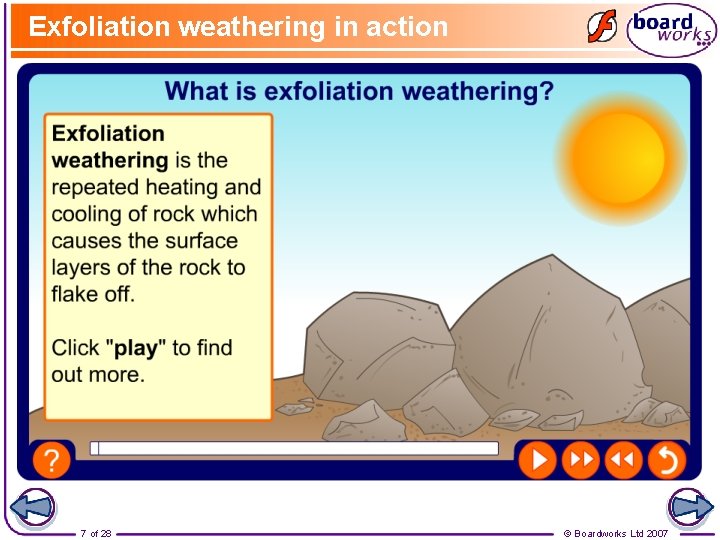
Exfoliation weathering in action 7 of 28 © Boardworks Ltd 2007
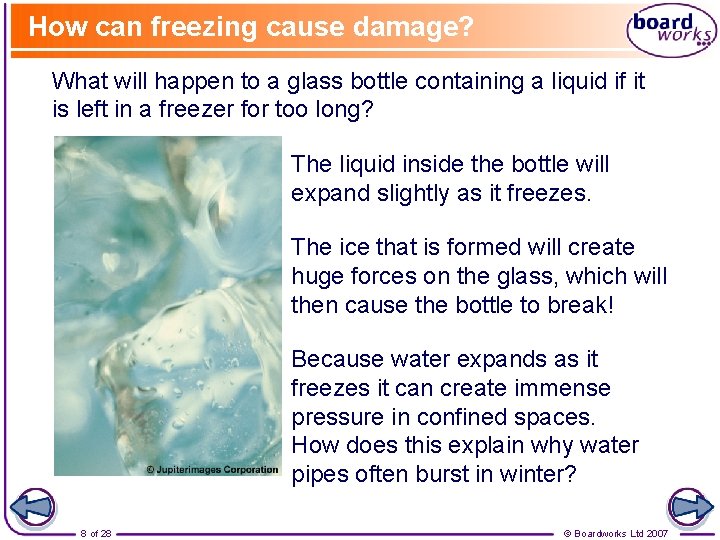
How can freezing cause damage? What will happen to a glass bottle containing a liquid if it is left in a freezer for too long? The liquid inside the bottle will expand slightly as it freezes. The ice that is formed will create huge forces on the glass, which will then cause the bottle to break! Because water expands as it freezes it can create immense pressure in confined spaces. How does this explain why water pipes often burst in winter? 8 of 28 © Boardworks Ltd 2007

Freeze-thaw weathering When rain water or melted snow seeps into the cracks in a rock and freezes, it can force the crack to expand. When the ice thaws, the rock contracts and the water moves deeper into the crack. Later when the water re-freezes the crack widens again. Over time the crack widens until the piece of rock breaks apart. This slow cycle is called freeze-thaw weathering. 9 of 28 © Boardworks Ltd 2007
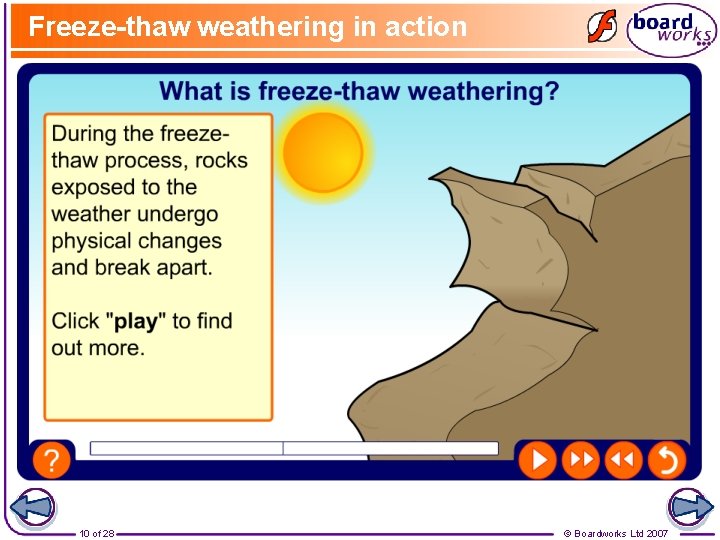
Freeze-thaw weathering in action 10 of 28 © Boardworks Ltd 2007
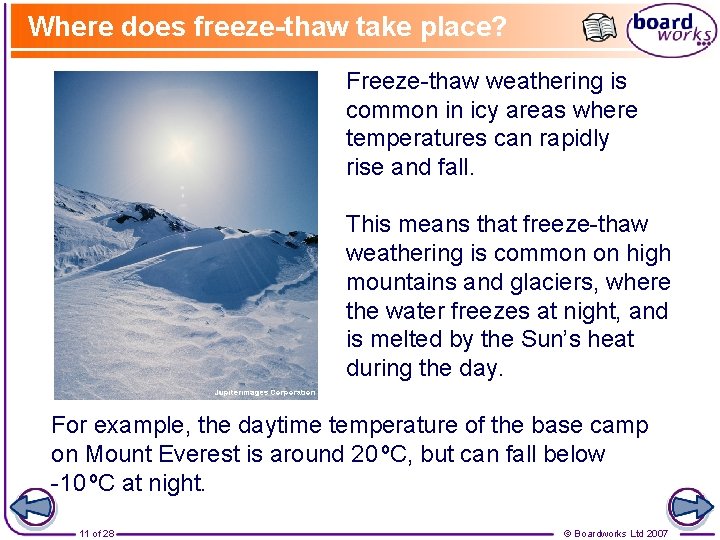
Where does freeze-thaw take place? Freeze-thaw weathering is common in icy areas where temperatures can rapidly rise and fall. This means that freeze-thaw weathering is common on high mountains and glaciers, where the water freezes at night, and is melted by the Sun’s heat during the day. For example, the daytime temperature of the base camp on Mount Everest is around 20 ºC, but can fall below -10 ºC at night. 11 of 28 © Boardworks Ltd 2007
Biological weathering 12 of 28 © Boardworks Ltd 2007
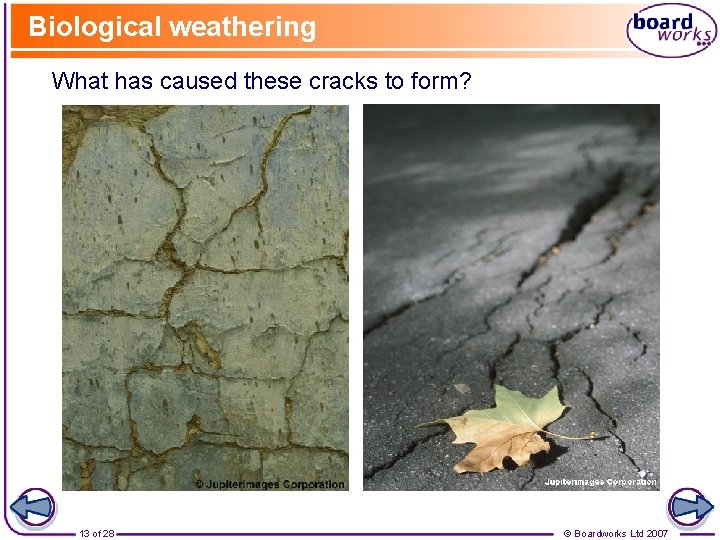
Biological weathering What has caused these cracks to form? 13 of 28 © Boardworks Ltd 2007
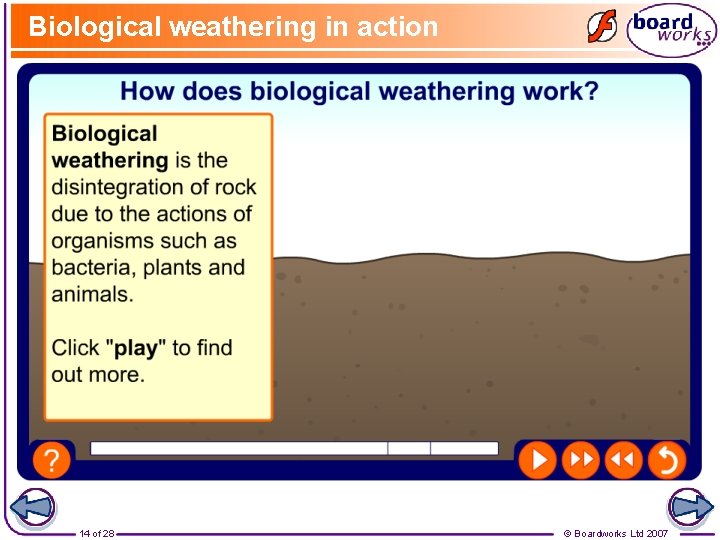
Biological weathering in action 14 of 28 © Boardworks Ltd 2007
Chemical weathering 15 of 28 © Boardworks Ltd 2007
What is chemical weathering? Slow chemical weathering Rainwater is naturally acidic because carbon dioxide in the air reacts with rainwater to form carbonic acid. This type of acid rain is weakly acidic and reacts slowly with minerals in rock. Rapid chemical weathering The burning of fossil fuels produces oxides of sulphur and nitrogen which make rainwater more acidic. This type of acid rain reacts quickly with minerals and weather rock more rapidly. 16 of 28 © Boardworks Ltd 2007
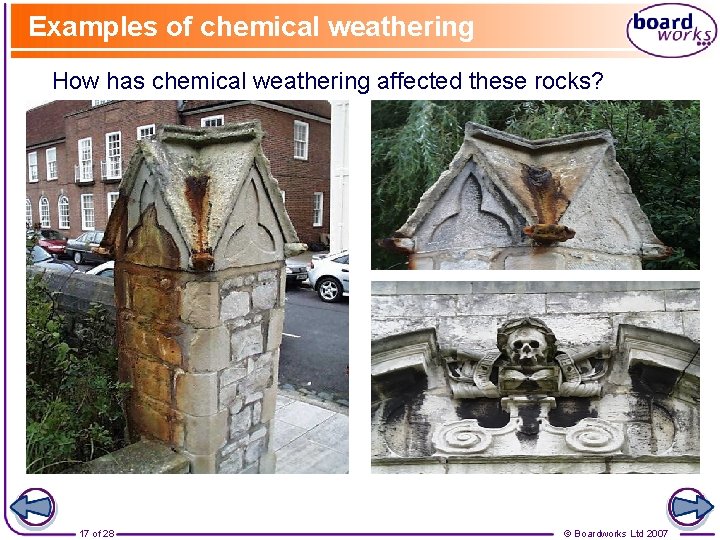
Examples of chemical weathering How has chemical weathering affected these rocks? 17 of 28 © Boardworks Ltd 2007
After weathering 18 of 28 © Boardworks Ltd 2007
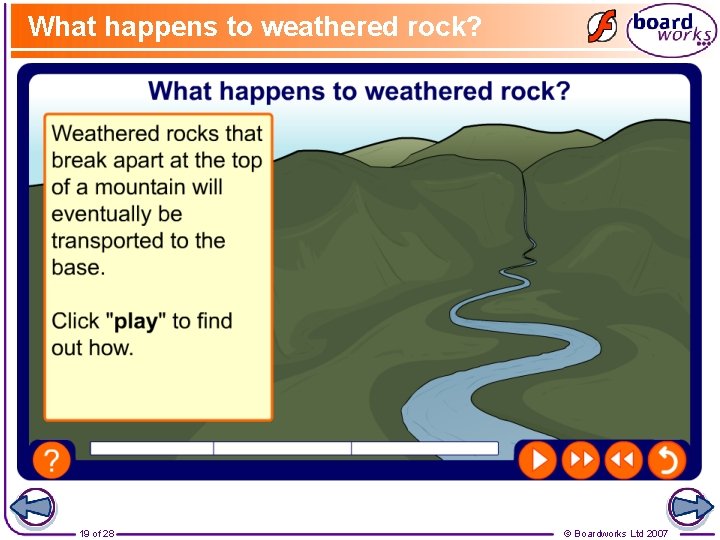
What happens to weathered rock? 19 of 28 © Boardworks Ltd 2007
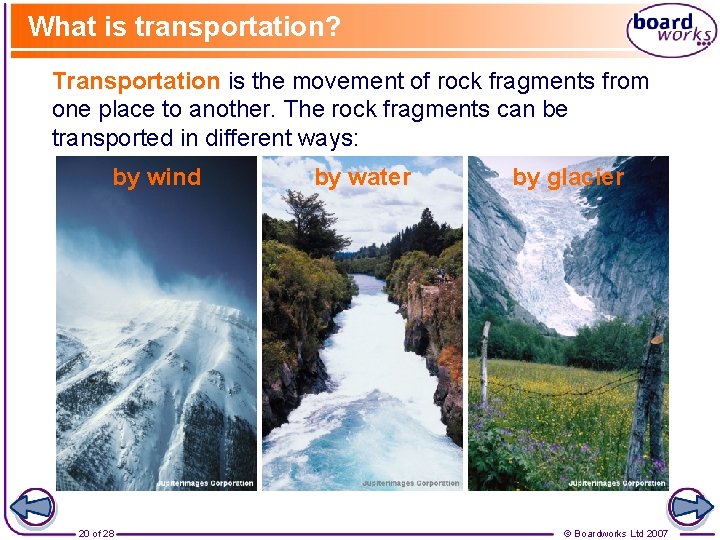
What is transportation? Transportation is the movement of rock fragments from one place to another. The rock fragments can be transported in different ways: by wind 20 of 28 by water by glacier © Boardworks Ltd 2007
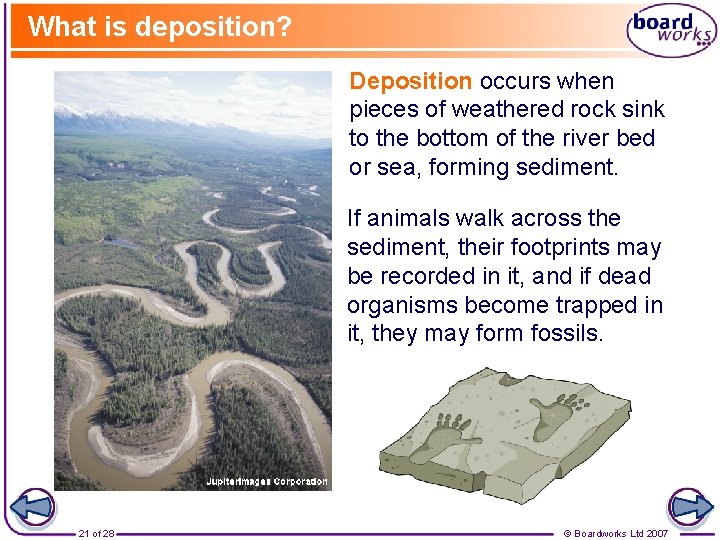
What is deposition? Deposition occurs when pieces of weathered rock sink to the bottom of the river bed or sea, forming sediment. If animals walk across the sediment, their footprints may be recorded in it, and if dead organisms become trapped in it, they may form fossils. 21 of 28 © Boardworks Ltd 2007
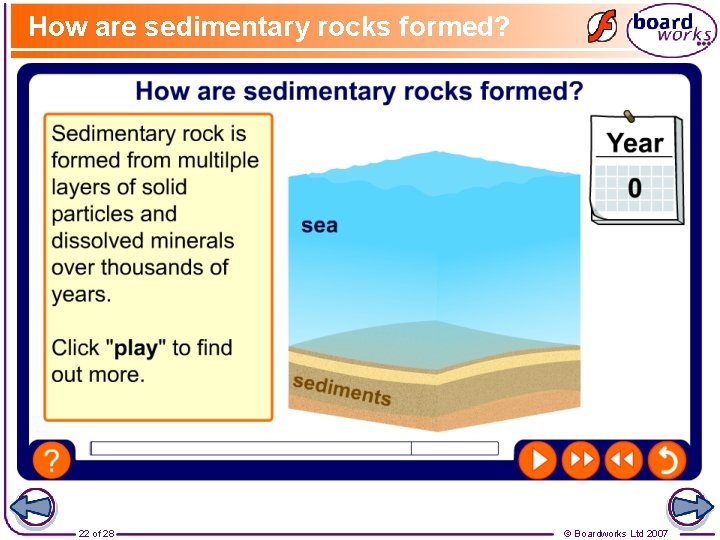
How are sedimentary rocks formed? 22 of 28 © Boardworks Ltd 2007
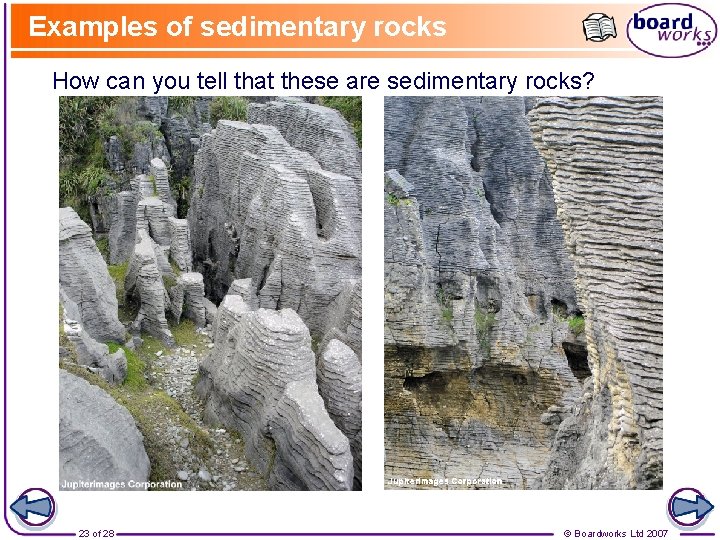
Examples of sedimentary rocks How can you tell that these are sedimentary rocks? 23 of 28 © Boardworks Ltd 2007
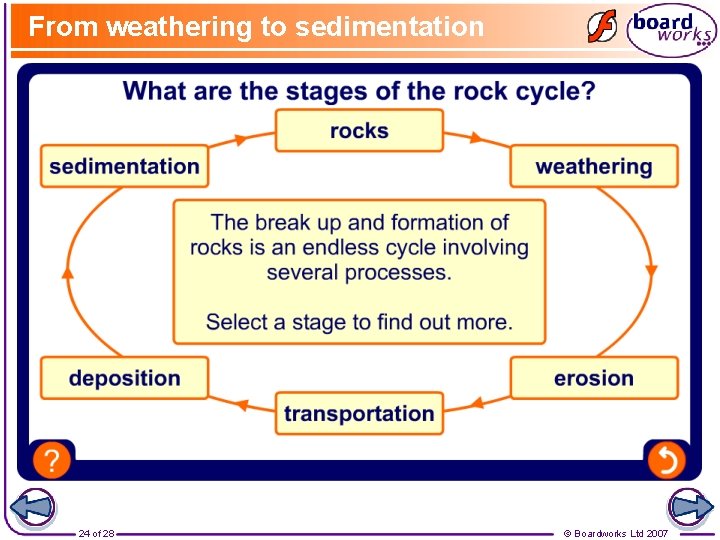
From weathering to sedimentation 24 of 28 © Boardworks Ltd 2007
Summary activities 25 of 28 © Boardworks Ltd 2007
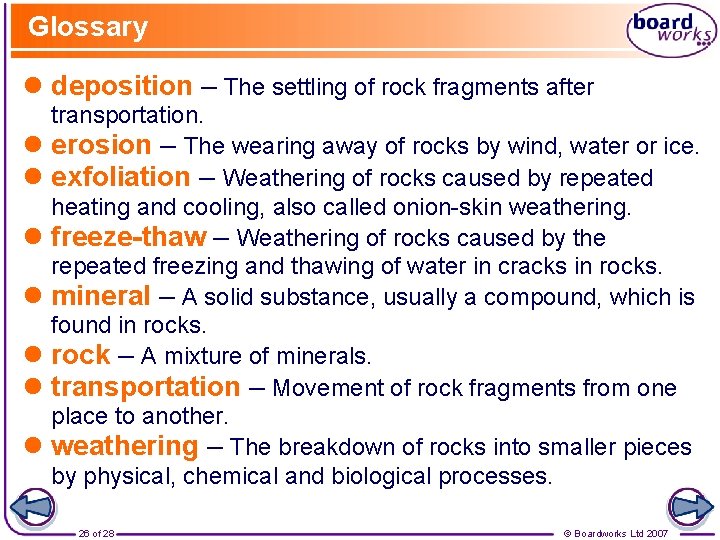
Glossary l deposition – The settling of rock fragments after l l l l transportation. erosion – The wearing away of rocks by wind, water or ice. exfoliation – Weathering of rocks caused by repeated heating and cooling, also called onion-skin weathering. freeze-thaw – Weathering of rocks caused by the repeated freezing and thawing of water in cracks in rocks. mineral – A solid substance, usually a compound, which is found in rocks. rock – A mixture of minerals. transportation – Movement of rock fragments from one place to another. weathering – The breakdown of rocks into smaller pieces by physical, chemical and biological processes. 26 of 28 © Boardworks Ltd 2007

Anagrams 27 of 28 © Boardworks Ltd 2007
Multiple-choice quiz 28 of 28 © Boardworks Ltd 2007
- Slides: 28