
ROCKS 5 2 nd Year Biology Class Faculty
ROCKS 5 2 nd Year – Biology Class – Faculty of Education – 2020 PRESENTED BY DR. MOHAMED OMRAN FACULTY OF SCIENCE
Classification of Igneous Rocks Based on the Chemical Composition • Chemical composition is the most distinguishing feature. Why? ? • Reflects the composition of the magma, and provides information on the source of the rock. • Determines the minerals that will crystallize and their proportions. • Cannot be easily determined in the field, making classification based on chemistry impractical.
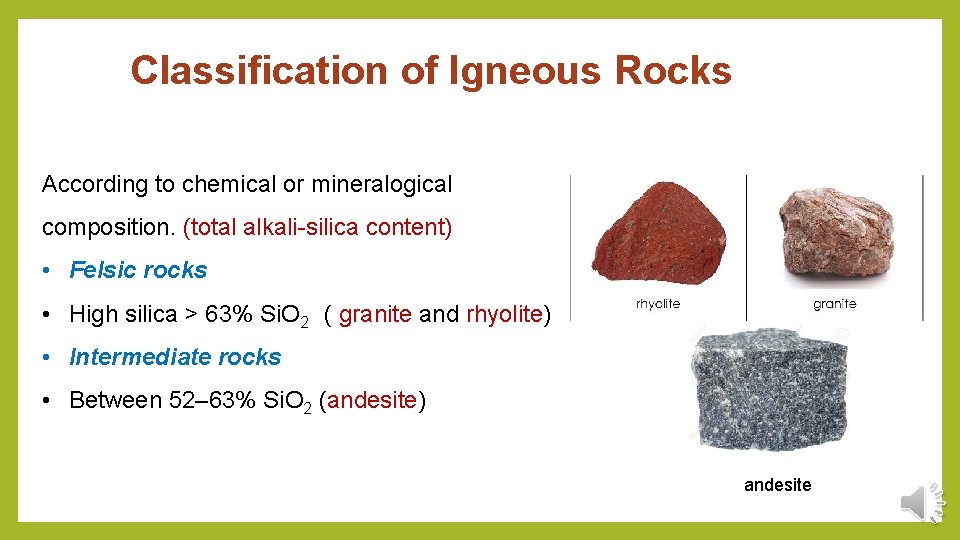
Classification of Igneous Rocks According to chemical or mineralogical composition. (total alkali-silica content) • Felsic rocks • High silica > 63% Si. O 2 ( granite and rhyolite) • Intermediate rocks • Between 52– 63% Si. O 2 (andesite) andesite
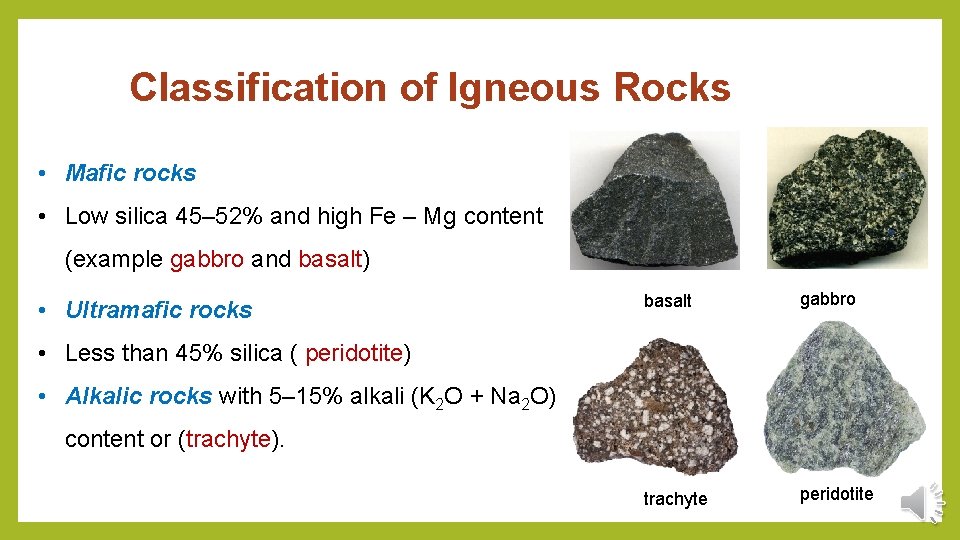
Classification of Igneous Rocks • Mafic rocks • Low silica 45– 52% and high Fe – Mg content (example gabbro and basalt) • Ultramafic rocks basalt gabbro trachyte peridotite • Less than 45% silica ( peridotite) • Alkalic rocks with 5– 15% alkali (K 2 O + Na 2 O) content or (trachyte).

Classification of Igneous Rocks Composition Occurrence Felsic Intermediate Mafic Ultramafic Intrusive Granite Diorite Gabbro Peridotite Extrusive Rhyolite Andesite Basalt Komatiite

Classification of Igneous Rocks

Next Lecture we will study the Sedimentary Rocks
- Slides: 7