
Rockabilly 2 Johnny Cash Roy Orbison Buddy Holly
Rockabilly 2 Johnny Cash, Roy Orbison, Buddy Holly, Richie Valens, Gene Vincent, Eddie Cochrane, The Everly Brothers
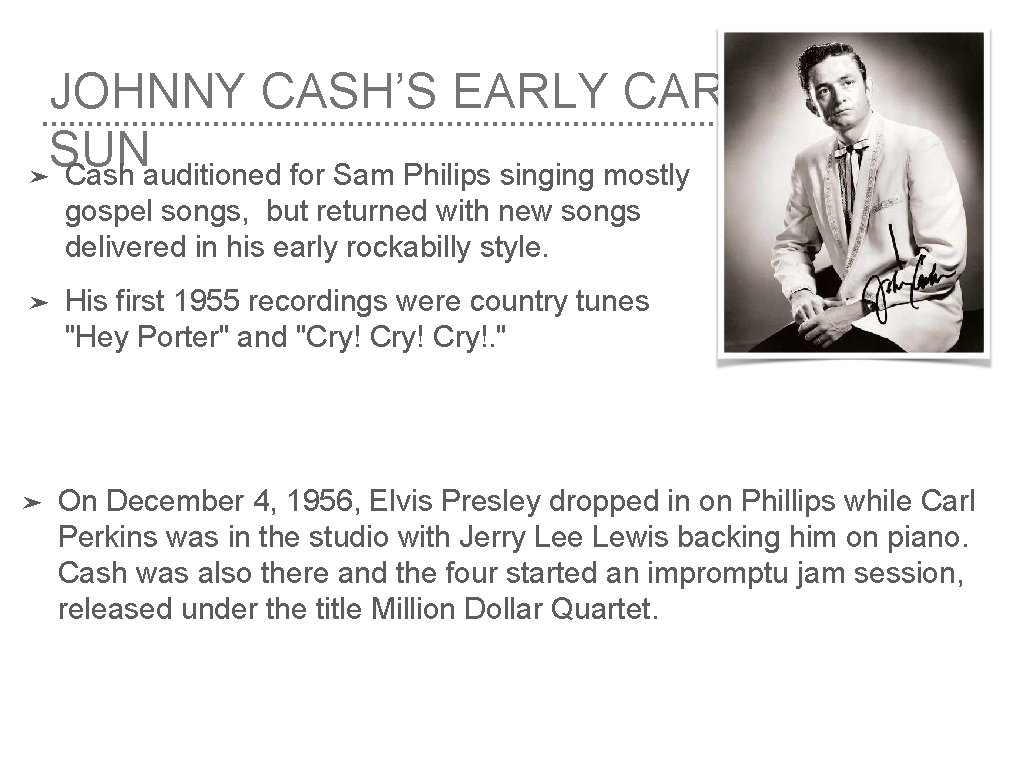
JOHNNY CASH’S EARLY CAREER AT SUN ➤ Cash auditioned for Sam Philips singing mostly gospel songs, but returned with new songs delivered in his early rockabilly style. ➤ ➤ His first 1955 recordings were country tunes "Hey Porter" and "Cry!. " On December 4, 1956, Elvis Presley dropped in on Phillips while Carl Perkins was in the studio with Jerry Lee Lewis backing him on piano. Cash was also there and the four started an impromptu jam session, released under the title Million Dollar Quartet.
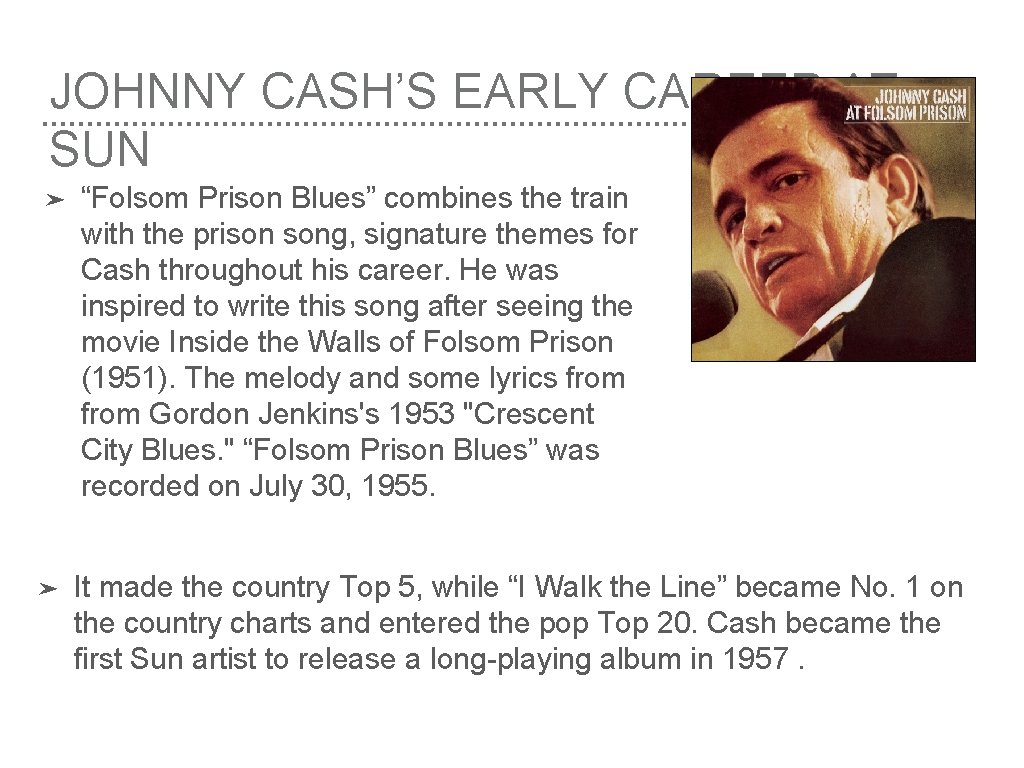
JOHNNY CASH’S EARLY CAREER AT SUN ➤ ➤ “Folsom Prison Blues” combines the train with the prison song, signature themes for Cash throughout his career. He was inspired to write this song after seeing the movie Inside the Walls of Folsom Prison (1951). The melody and some lyrics from Gordon Jenkins's 1953 "Crescent City Blues. " “Folsom Prison Blues” was recorded on July 30, 1955. It made the country Top 5, while “I Walk the Line” became No. 1 on the country charts and entered the pop Top 20. Cash became the first Sun artist to release a long-playing album in 1957.
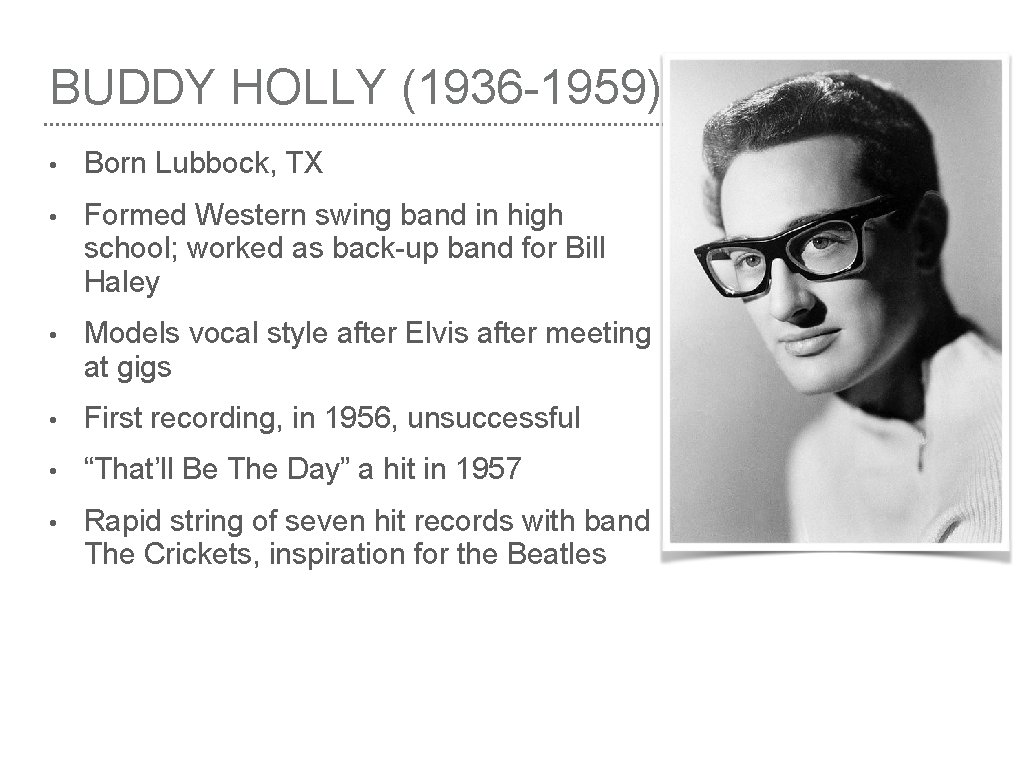
BUDDY HOLLY (1936 -1959) • Born Lubbock, TX • Formed Western swing band in high school; worked as back-up band for Bill Haley • Models vocal style after Elvis after meeting at gigs • First recording, in 1956, unsuccessful • “That’ll Be The Day” a hit in 1957 • Rapid string of seven hit records with band The Crickets, inspiration for the Beatles
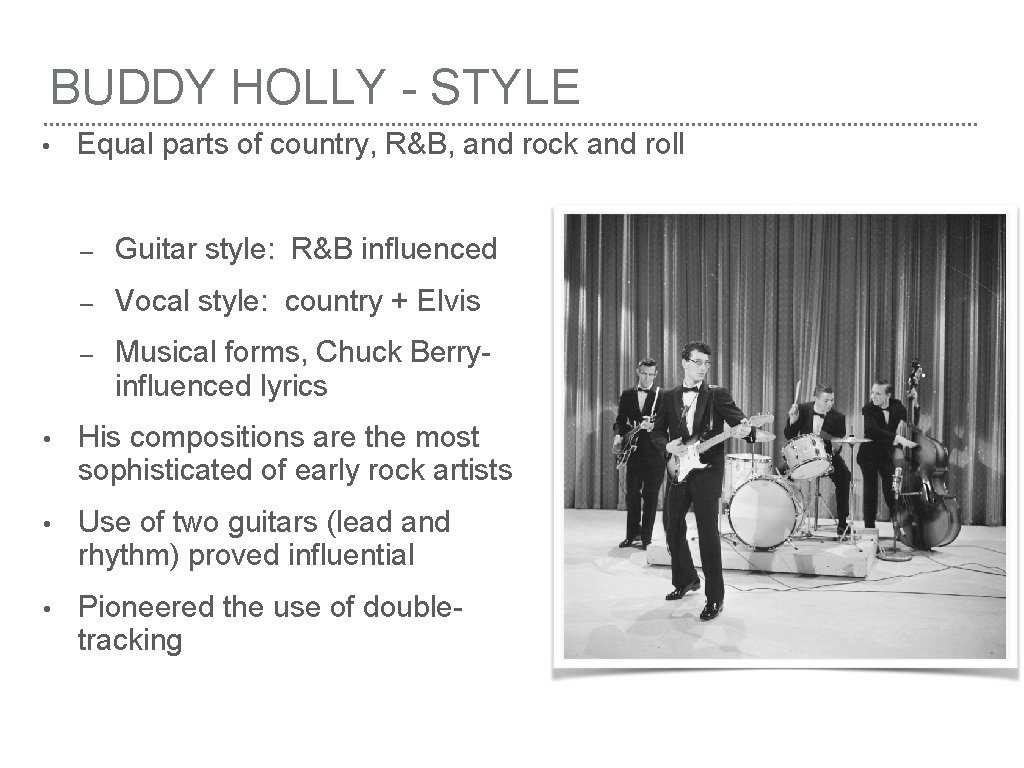
BUDDY HOLLY - STYLE • Equal parts of country, R&B, and rock and roll – Guitar style: R&B influenced – Vocal style: country + Elvis – Musical forms, Chuck Berryinfluenced lyrics • His compositions are the most sophisticated of early rock artists • Use of two guitars (lead and rhythm) proved influential • Pioneered the use of doubletracking
THAT’LL BE THE DAY, HOLLY AND JERRY ALLISON first recorded by Buddy Holly and the Three Tunes in 1956, re-recorded in 1957 by Holly and the Crickets. NOT FADE AWAY, HOLLY AND NORMAN PETTY (? ) Bo Diddley beat, with drummer Jerry Allison beating a cardboard box Riff-based, but combines with stop time Stuttering vocal style Multiple rhythmic layers
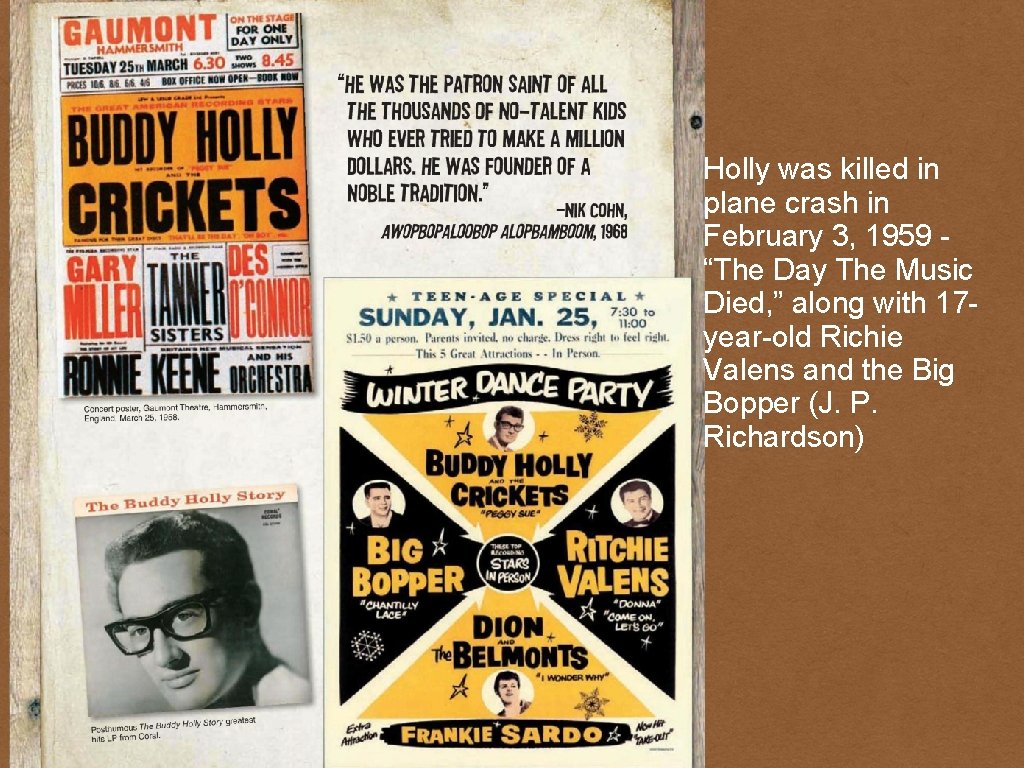
Holly was killed in plane crash in February 3, 1959 “The Day The Music Died, ” along with 17 year-old Richie Valens and the Big Bopper (J. P. Richardson)
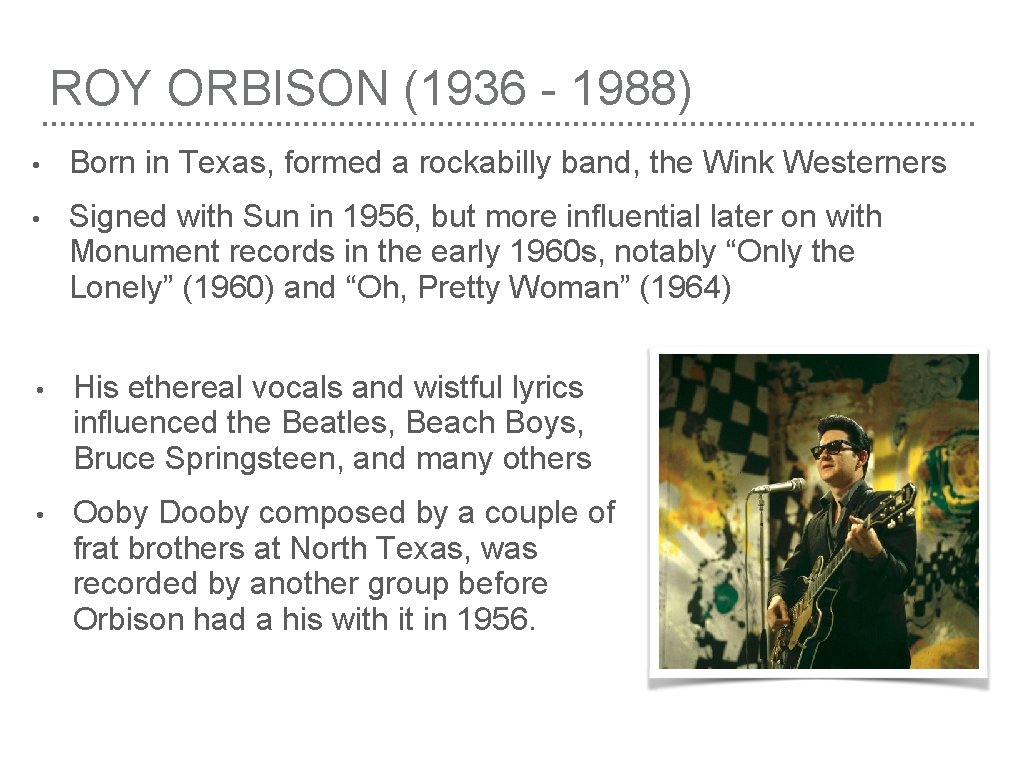
ROY ORBISON (1936 - 1988) • Born in Texas, formed a rockabilly band, the Wink Westerners • Signed with Sun in 1956, but more influential later on with Monument records in the early 1960 s, notably “Only the Lonely” (1960) and “Oh, Pretty Woman” (1964) • His ethereal vocals and wistful lyrics influenced the Beatles, Beach Boys, Bruce Springsteen, and many others • Ooby Dooby composed by a couple of frat brothers at North Texas, was recorded by another group before Orbison had a his with it in 1956.
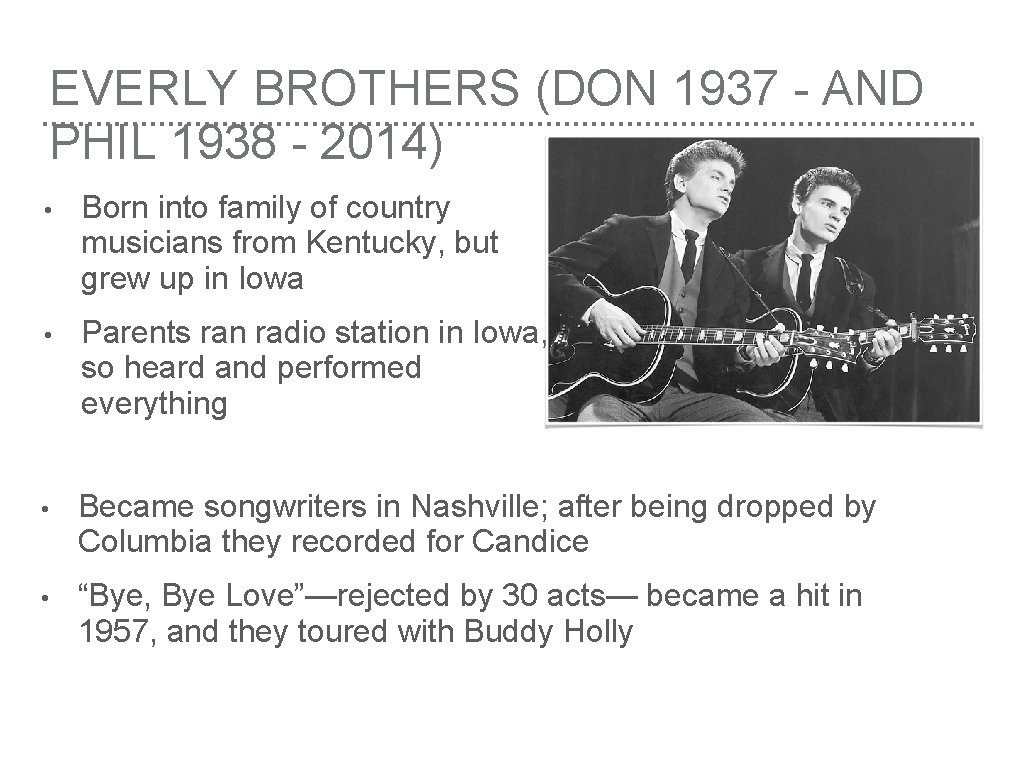
EVERLY BROTHERS (DON 1937 - AND PHIL 1938 - 2014) • Born into family of country musicians from Kentucky, but grew up in Iowa • Parents ran radio station in Iowa, so heard and performed everything • Became songwriters in Nashville; after being dropped by Columbia they recorded for Candice • “Bye, Bye Love”—rejected by 30 acts— became a hit in 1957, and they toured with Buddy Holly
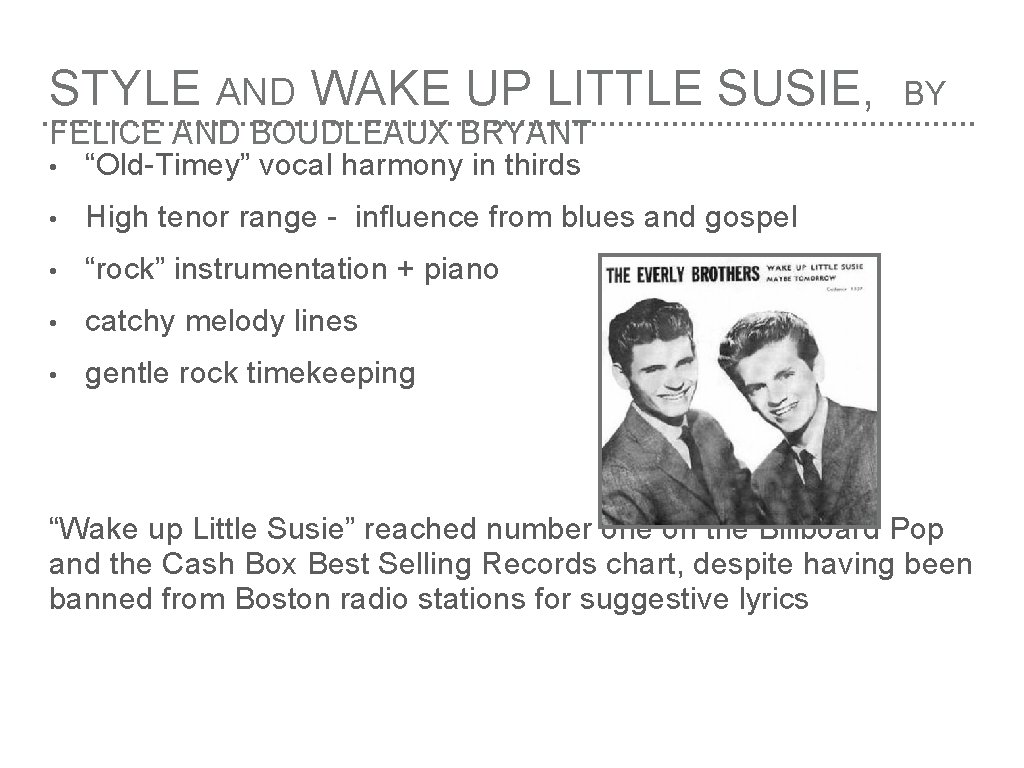
STYLE AND WAKE UP LITTLE SUSIE, BY FELICE AND BOUDLEAUX BRYANT • “Old-Timey” vocal harmony in thirds • High tenor range - influence from blues and gospel • “rock” instrumentation + piano • catchy melody lines • gentle rock timekeeping “Wake up Little Susie” reached number one on the Billboard Pop and the Cash Box Best Selling Records chart, despite having been banned from Boston radio stations for suggestive lyrics
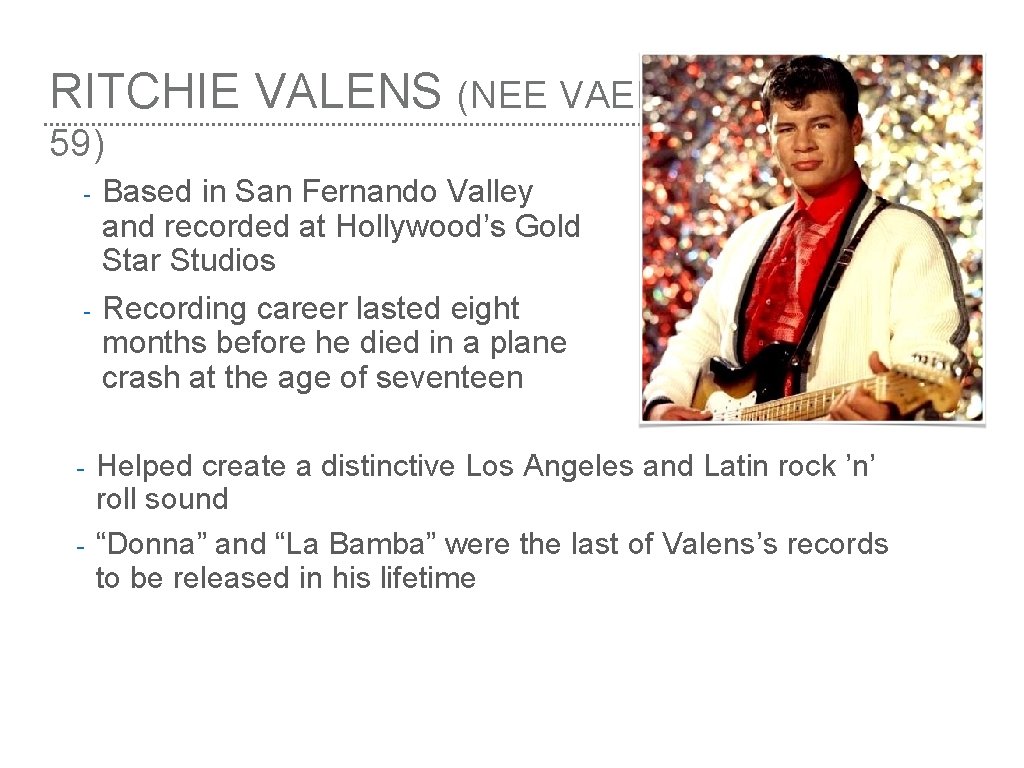
RITCHIE VALENS (NEE VAENZUELA) (1941– 59) - - - Based in San Fernando Valley and recorded at Hollywood’s Gold Star Studios Recording career lasted eight months before he died in a plane crash at the age of seventeen Helped create a distinctive Los Angeles and Latin rock ’n’ roll sound “Donna” and “La Bamba” were the last of Valens’s records to be released in his lifetime
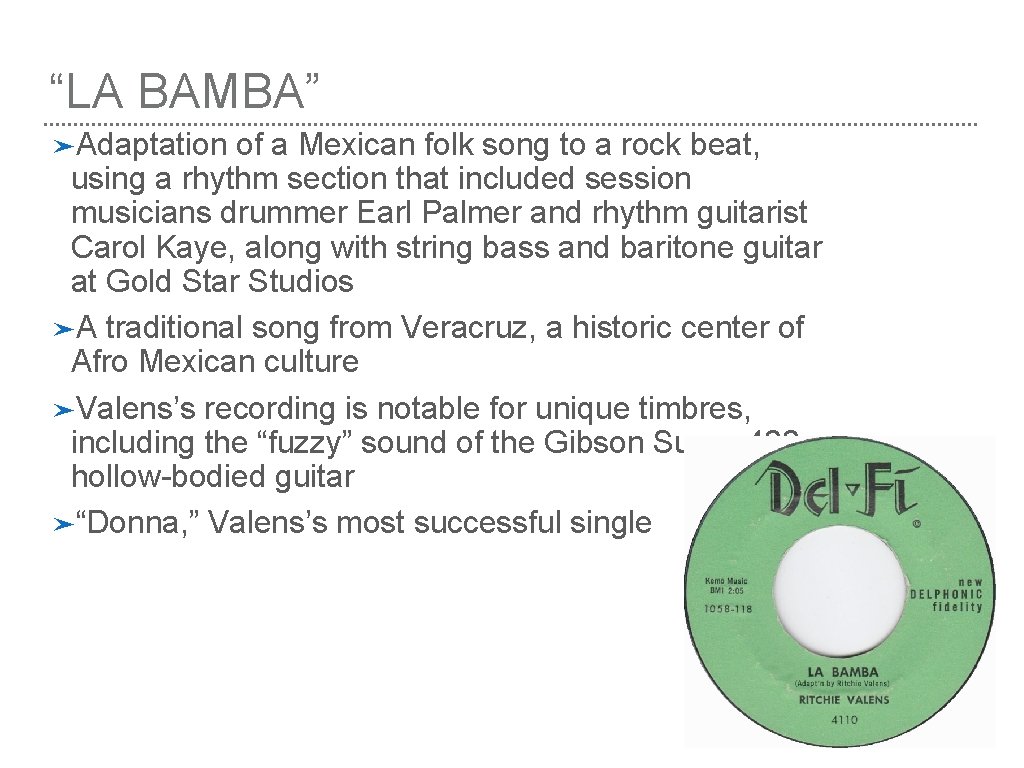
“LA BAMBA” ➤Adaptation of a Mexican folk song to a rock beat, using a rhythm section that included session musicians drummer Earl Palmer and rhythm guitarist Carol Kaye, along with string bass and baritone guitar at Gold Star Studios ➤A traditional song from Veracruz, a historic center of Afro Mexican culture ➤Valens’s recording is notable for unique timbres, including the “fuzzy” sound of the Gibson Super 400 hollow-bodied guitar ➤“Donna, ” Valens’s most successful single
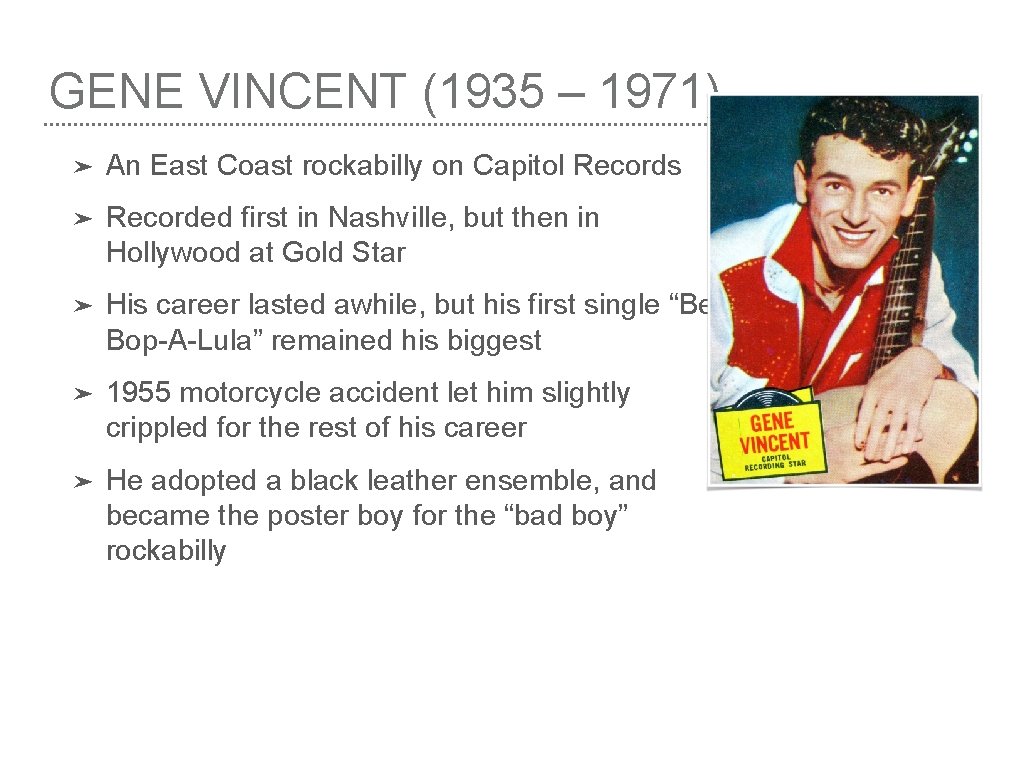
GENE VINCENT (1935 – 1971) ➤ An East Coast rockabilly on Capitol Records ➤ Recorded first in Nashville, but then in Hollywood at Gold Star ➤ His career lasted awhile, but his first single “Be. Bop-A-Lula” remained his biggest ➤ 1955 motorcycle accident let him slightly crippled for the rest of his career ➤ He adopted a black leather ensemble, and became the poster boy for the “bad boy” rockabilly
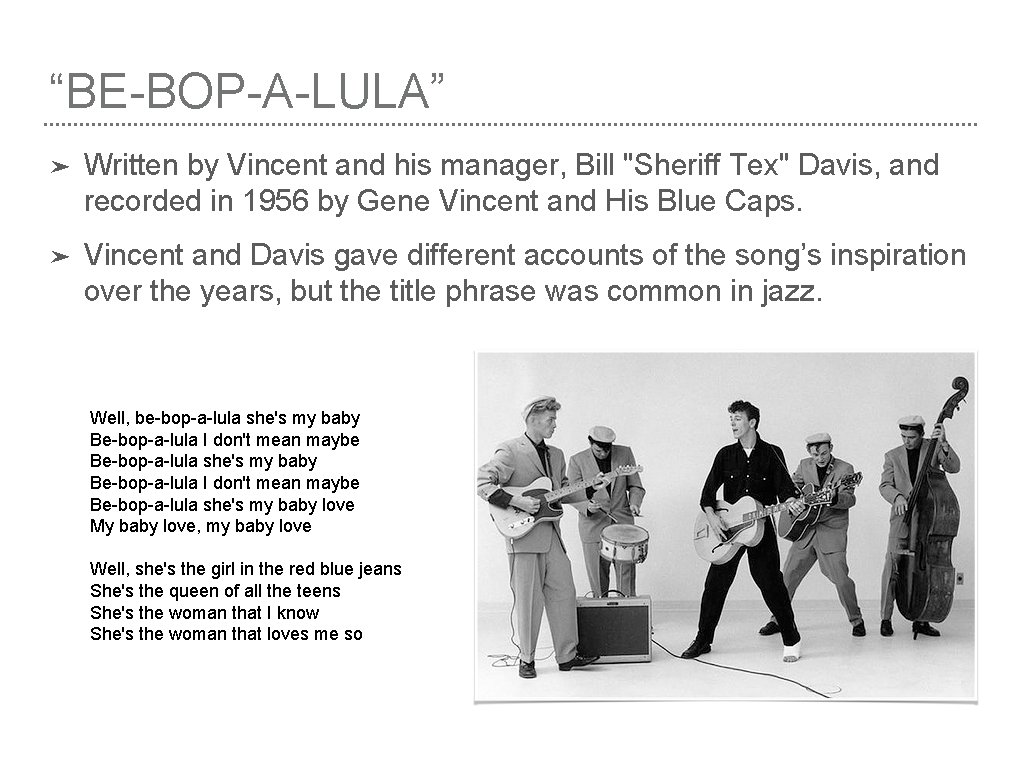
“BE-BOP-A-LULA” ➤ Written by Vincent and his manager, Bill "Sheriff Tex" Davis, and recorded in 1956 by Gene Vincent and His Blue Caps. ➤ Vincent and Davis gave different accounts of the song’s inspiration over the years, but the title phrase was common in jazz. Well, be-bop-a-lula she's my baby Be-bop-a-lula I don't mean maybe Be-bop-a-lula she's my baby love My baby love, my baby love Well, she's the girl in the red blue jeans She's the queen of all the teens She's the woman that I know She's the woman that loves me so
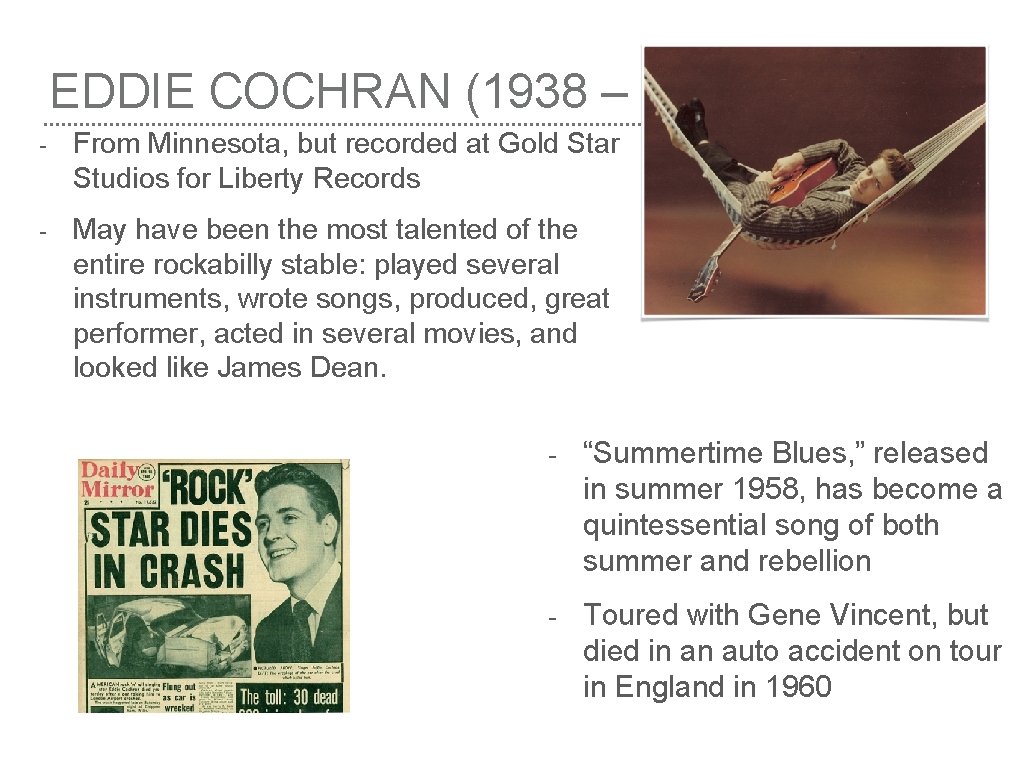
EDDIE COCHRAN (1938 – 1960) - From Minnesota, but recorded at Gold Star Studios for Liberty Records - May have been the most talented of the entire rockabilly stable: played several instruments, wrote songs, produced, great performer, acted in several movies, and looked like James Dean. - “Summertime Blues, ” released in summer 1958, has become a quintessential song of both summer and rebellion - Toured with Gene Vincent, but died in an auto accident on tour in England in 1960
“SUMMERTIME BLUES” ➤ “Summertime Blues” is a song co-written and recorded by American rockabilly artist Eddie Cochran. It was written by Cochran and his manager Jerry Capehart. ➤ It was recorded on March 28, 1958 at Gold Star Recording Studios in Hollywood. Cochran sang both vocals and played all the guitar parts, with Connie 'Guybo' Smith on electric bass and Earl Palmer on drums. It has been covered by multiple artists. I’m a-gonna raise a fuss, I’m a-gonna raise a holler About a-workin’ all summer just to try to earn a dollar Every time I call my baby and try to get a date My boss says, “No dice son, you gotta work late” Sometimes I wonder what I’m a-gonna do But there ain’t no cure for the summertime blues
- Slides: 16