
Rock Relationships and Geological Histories You must have



- Slides: 24
Rock Relationships and Geological Histories • You must have the presentation on Slide Show mode. On opening the presentation, you may be asked to enable macros. They must be enabled for the show to run. • Work your way through the practical using the Forward and Back buttons. • Initiate cartoons by clicking the Start button. • Answer the questions by clicking in the correct boxes (hopefully). Your score is for each question is based on your first try only! It does NOT count towards your assessment, and you can have as many goes as you want. What is your name? (Click here) This is the Forward button
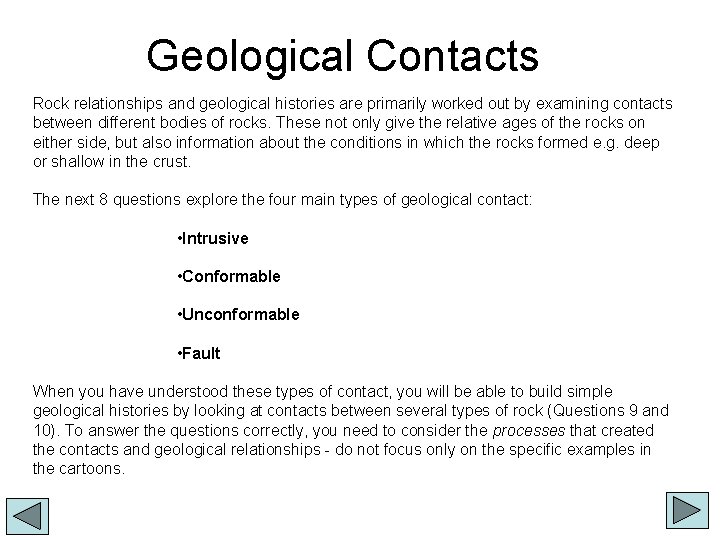
Geological Contacts Rock relationships and geological histories are primarily worked out by examining contacts between different bodies of rocks. These not only give the relative ages of the rocks on either side, but also information about the conditions in which the rocks formed e. g. deep or shallow in the crust. The next 8 questions explore the four main types of geological contact: • Intrusive • Conformable • Unconformable • Fault When you have understood these types of contact, you will be able to build simple geological histories by looking at contacts between several types of rock (Questions 9 and 10). To answer the questions correctly, you need to consider the processes that created the contacts and geological relationships - do not focus only on the specific examples in the cartoons.
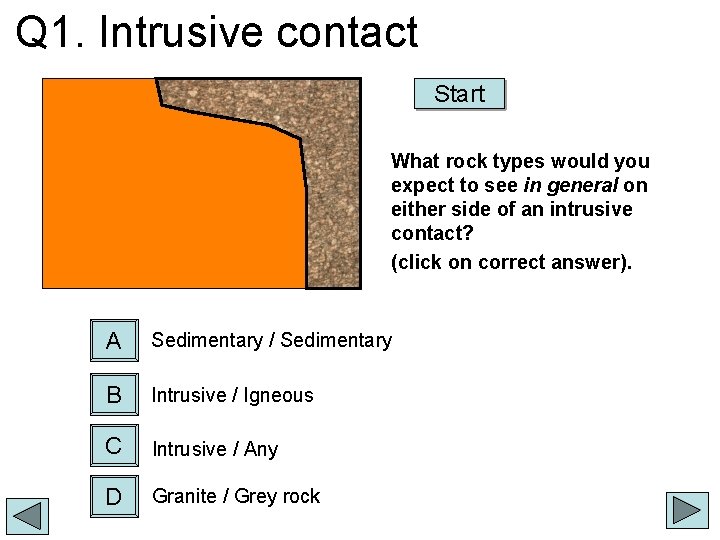
Q 1. Intrusive contact Start What rock types would you expect to see in general on either side of an intrusive contact? (click on correct answer). A Sedimentary / Sedimentary B Intrusive / Igneous C Intrusive / Any D Granite / Grey rock
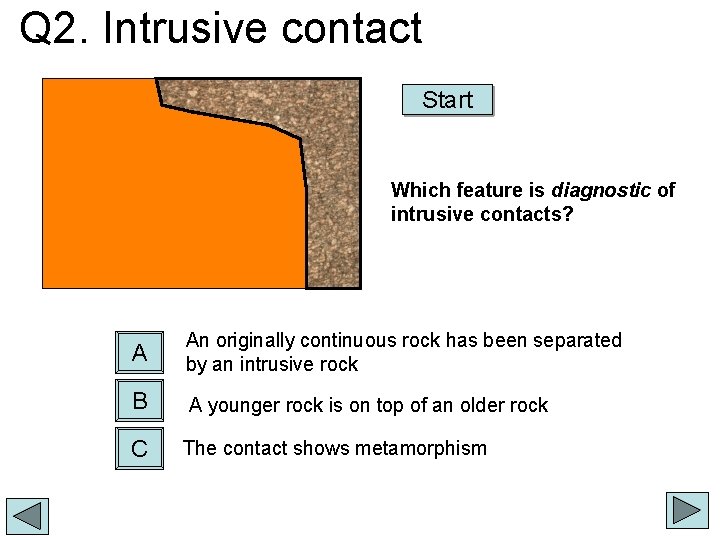
Q 2. Intrusive contact Start Which feature is diagnostic of intrusive contacts? A An originally continuous rock has been separated by an intrusive rock B A younger rock is on top of an older rock C The contact shows metamorphism
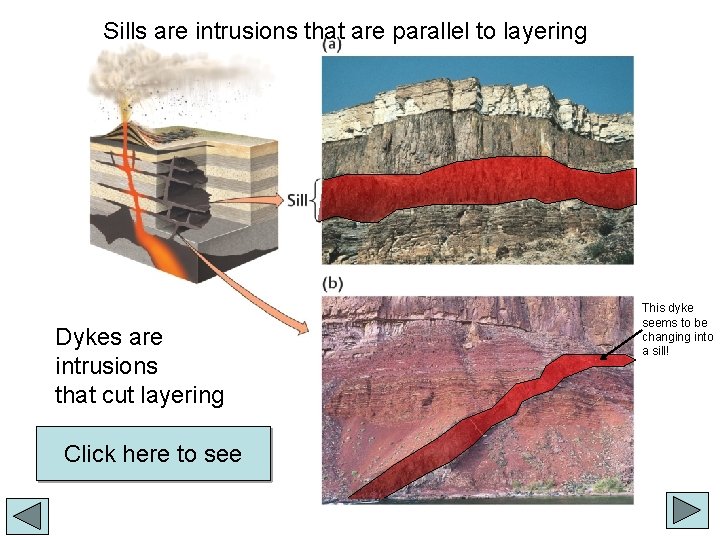
Sills are intrusions that are parallel to layering Dykes are intrusions that cut layering Click here to see This dyke seems to be changing into a sill!
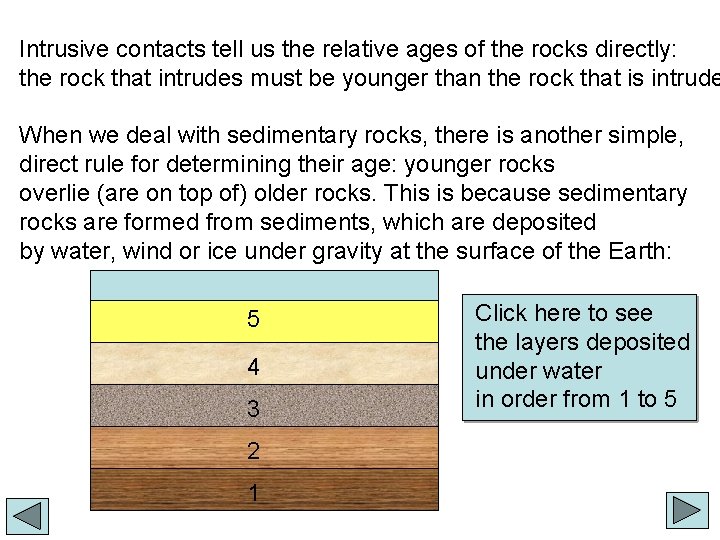
Intrusive contacts tell us the relative ages of the rocks directly: the rock that intrudes must be younger than the rock that is intrude When we deal with sedimentary rocks, there is another simple, direct rule for determining their age: younger rocks overlie (are on top of) older rocks. This is because sedimentary rocks are formed from sediments, which are deposited by water, wind or ice under gravity at the surface of the Earth: 5 4 3 2 1 Click here to see the layers deposited under water in order from 1 to 5
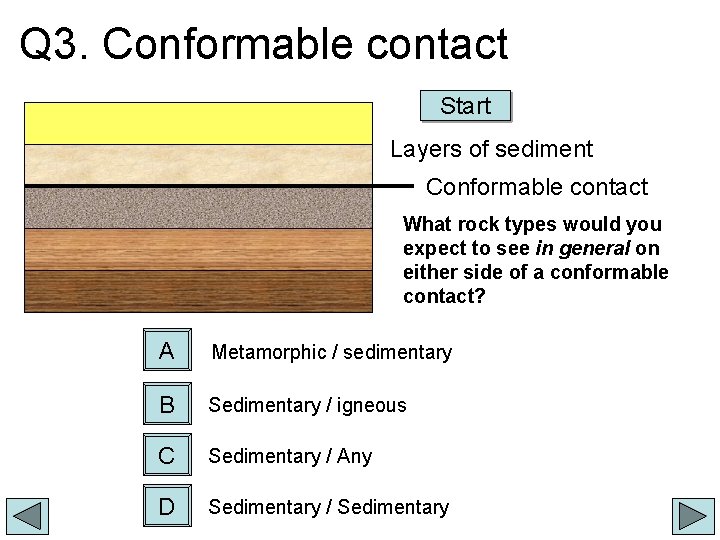
Q 3. Conformable contact Start Layers of sediment Conformable contact What rock types would you expect to see in general on either side of a conformable contact? A Metamorphic / sedimentary B Sedimentary / igneous C Sedimentary / Any D Sedimentary / Sedimentary
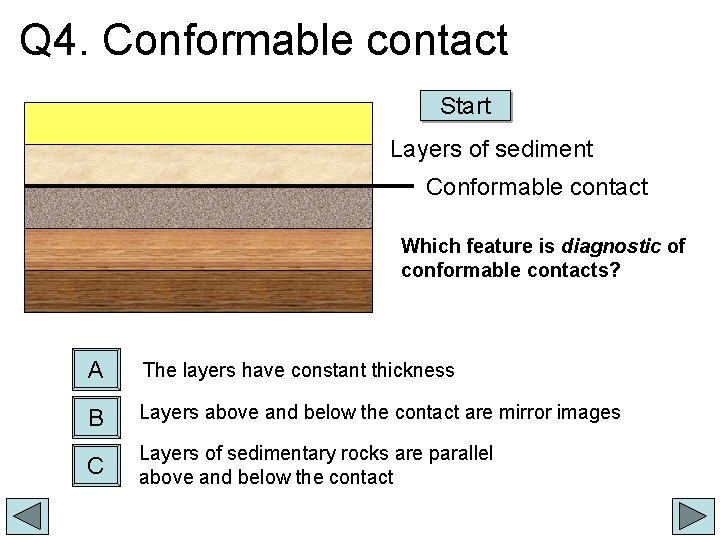
Q 4. Conformable contact Start Layers of sediment Conformable contact Which feature is diagnostic of conformable contacts? A The layers have constant thickness B Layers above and below the contact are mirror images C Layers of sedimentary rocks are parallel above and below the contact
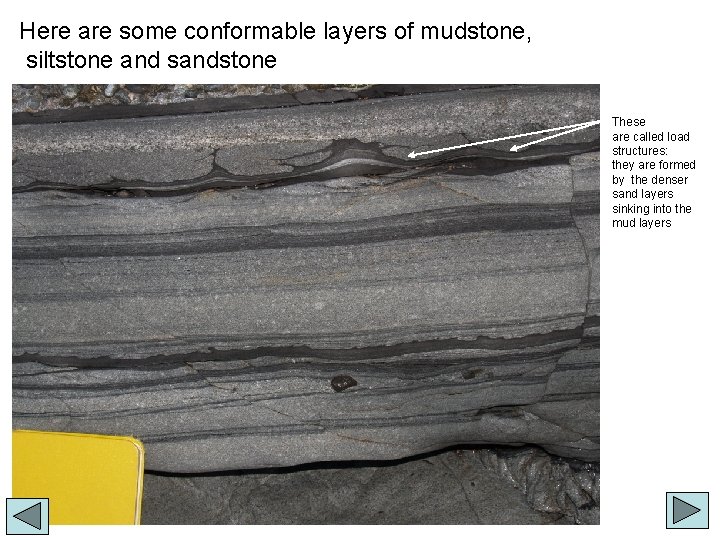
Here are some conformable layers of mudstone, siltstone and sandstone These are called load structures: they are formed by the denser sand layers sinking into the mud layers
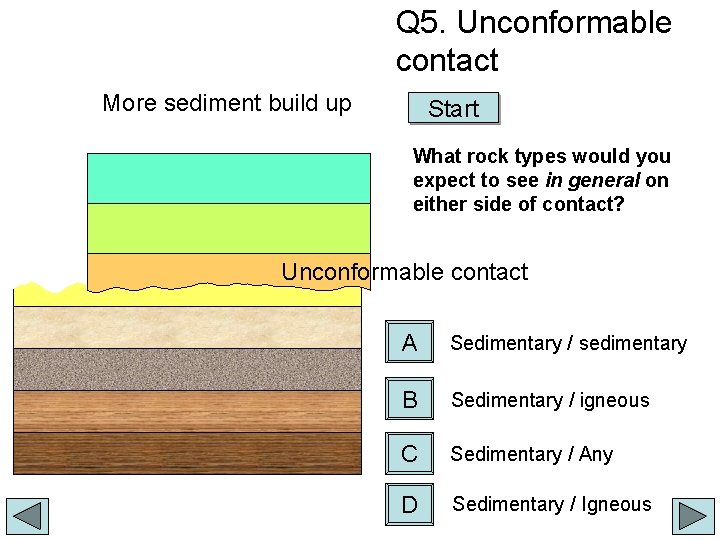
Sediment build up Uplift and rotation Weathering & Erosion More sediment build up Q 5. Unconformable contact Start What rock types would you expect to see in general on either side of contact? Unconformable contact A Sedimentary / sedimentary B Sedimentary / igneous C Sedimentary / Any D Sedimentary / Igneous
Sediment build up Uplift and rotation Weathering & Erosion More sediment build up Q 6. Unconformable contact Start Which feature is characteristic of unconformable contacts? Unconformable contact A Rocks below the contact are igneous B Sedimentary rocks overlie the contact, and are parallel to it C Rocks above the contact are igneous
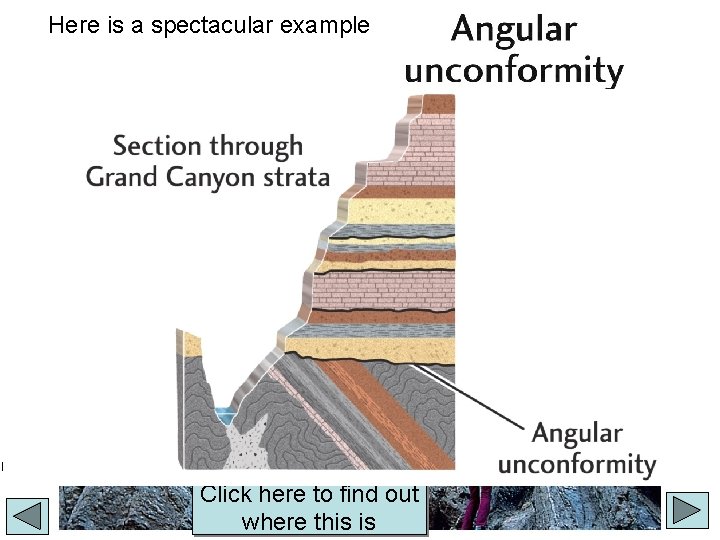
Here is a spectacular example Press et al. 2004 Click here to find out where this is
You can see the animations about unconformities on the course textbook web site by clicking on this link later: http: //www. wwnorton. com/college/geo/animations/types_of_unconformity. htm
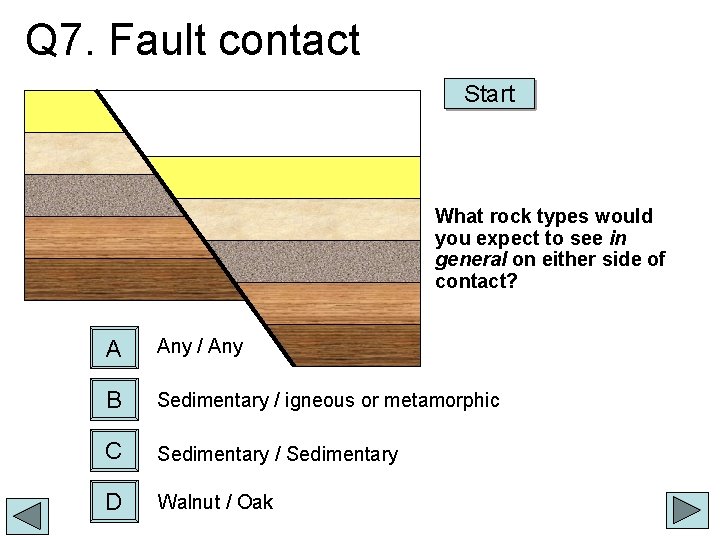
Q 7. Fault contact Start What rock types would you expect to see in general on either side of contact? A Any / Any B Sedimentary / igneous or metamorphic C Sedimentary / Sedimentary D Walnut / Oak
Q 8. Fault contact Start What are the diagnostic feature(s) of the contact? A Contact is planar B Planar contact displaces one side relative to the other C Contact must cut sedimentary layering
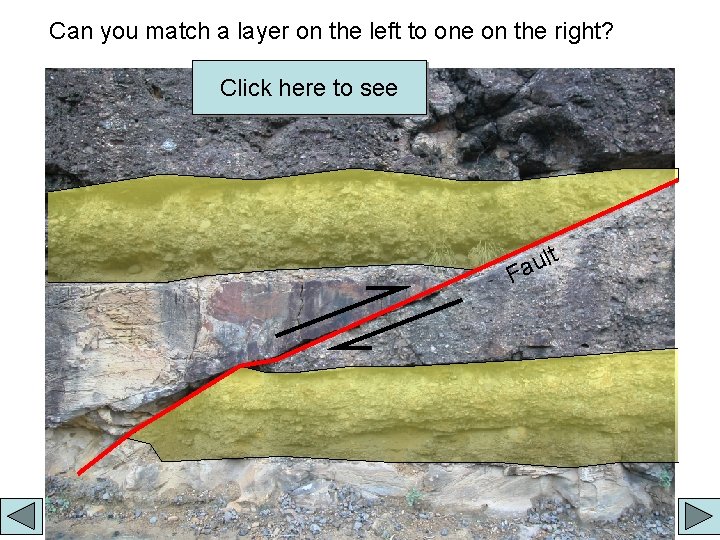
Can you match a layer on the left to one on the right? Click here to see t l u Fa
Intrusive relationships The first exercise shows an example of intrusive relationships. Interpreting the relationships involves considering all the steps from formation of the igneous rocks to the state in which you observe them today (i. e. at the present land surface). Hints: • Remember grainsize is an indication of cooling rate. • How do plutonic igneous rocks get to the surface when they are supposed to have cooled at depth?
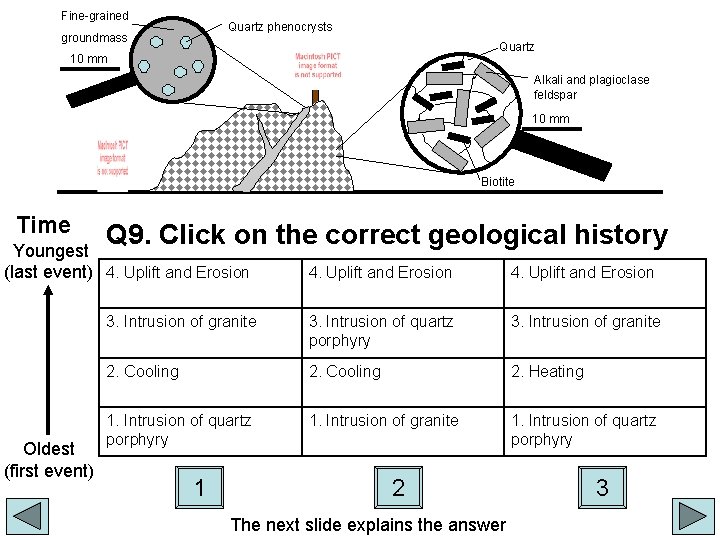
Fine-grained Quartz phenocrysts groundmass Quartz 10 mm Alkali and plagioclase feldspar 10 mm Biotite Time Q 9. Click on the correct geological history Youngest (last event) 4. Uplift and Erosion Oldest (first event) 4. Uplift and Erosion 3. Intrusion of granite 3. Intrusion of quartz porphyry 3. Intrusion of granite 2. Cooling 2. Heating 1. Intrusion of quartz porphyry 1. Intrusion of granite 1. Intrusion of quartz porphyry 1 2 The next slide explains the answer 3
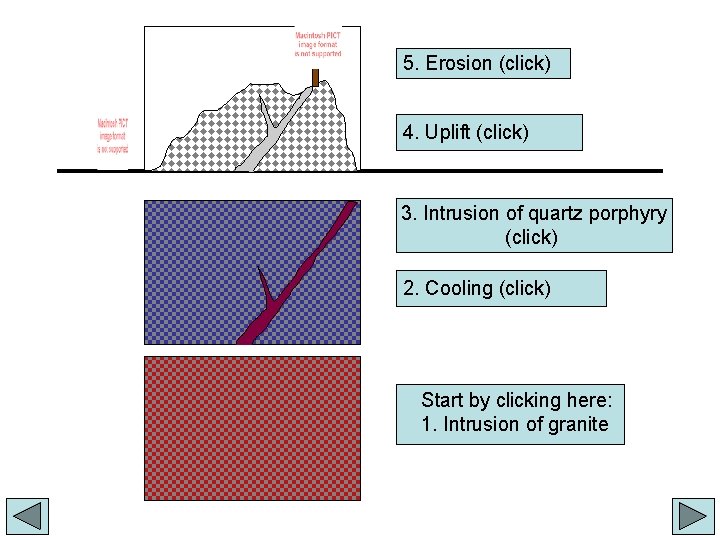
5. Erosion (click) 4. Uplift (click) 3. Intrusion of quartz porphyry (click) 2. Cooling (click) Start by clicking here: 1. Intrusion of granite
Relationships between intrusive, metamorphic and sedimentary rocks Sedimentary rocks can get tilted as they get buried, particularly due to tectonic forces. This produces a dip on the bedding surfaces that were previously horizontal (or nearly so). When these rocks get further buried into the regional metamorphic environment, they can be folded (into fairly regular shapes) and foliated (as we learnt earlier with metamorphic rocks). Also, it is common for metamorphic rocks to undergo brittle deformation producing faults, associated with earthquakes. When intrusive igneous rocks invade sedimentary rocks, they produce 10 - to 100 s-m scale contact metamorphic aureoles, converting the sediments into their contact metamorphosed equivalents. Some of these relationships are explored in the following exercise.
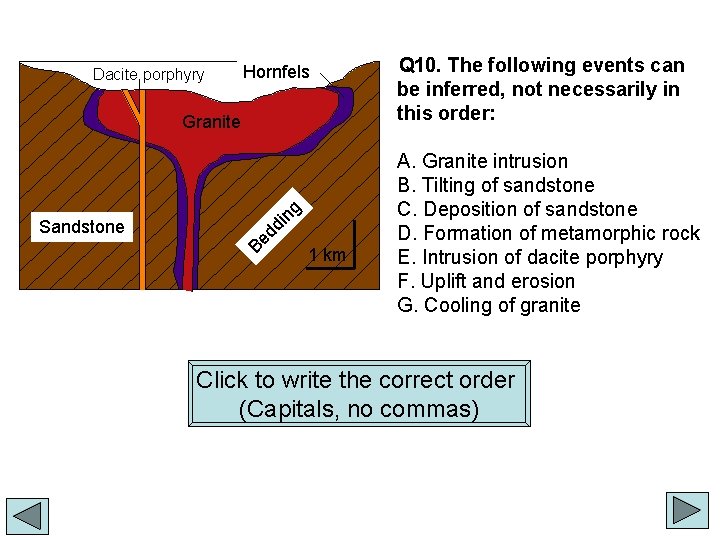
Hornfels Dacite porphyry dd Be Sandstone in g Granite 1 km Q 10. The following events can be inferred, not necessarily in this order: A. Granite intrusion B. Tilting of sandstone C. Deposition of sandstone D. Formation of metamorphic rock E. Intrusion of dacite porphyry F. Uplift and erosion G. Cooling of granite Click to write the correct order (Capitals, no commas)
You can also see an animation with four types of geological conta on the course web site by clicking on this link later: http: //www. wwnorton. com/college/geo/animations/geologic _history. htm
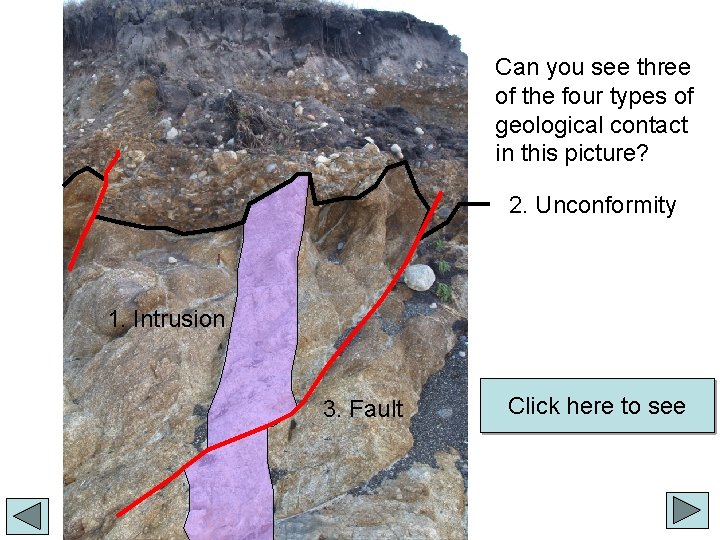
Can you see three of the four types of geological contact in this picture? 2. Unconformity 1. Intrusion 3. Fault Click here to see
How Did I Do? ……and all the rocks lived happily ever after. The End