
Rock Mechanics Laboratory ZB 223 Block Z Department
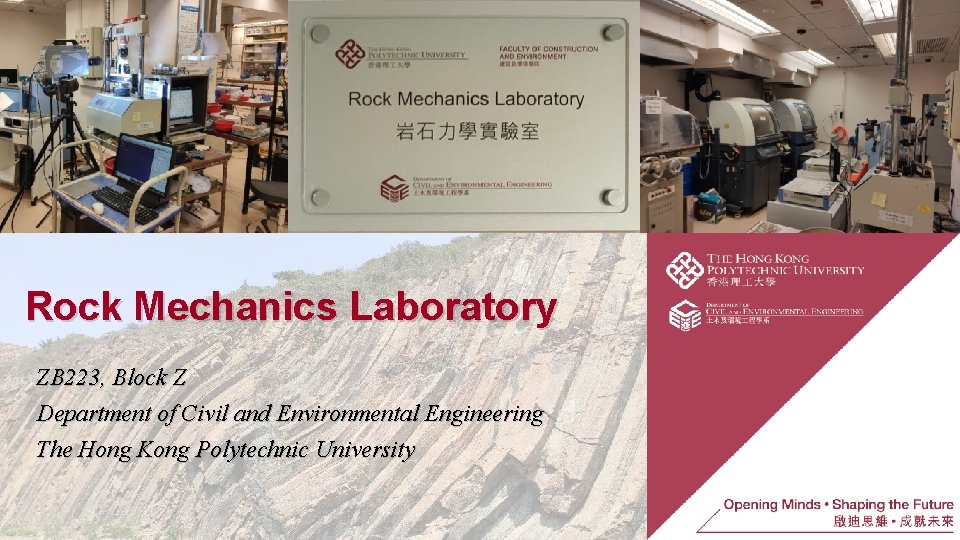
Rock Mechanics Laboratory ZB 223, Block Z Department of Civil and Environmental Engineering The Hong Kong Polytechnic University
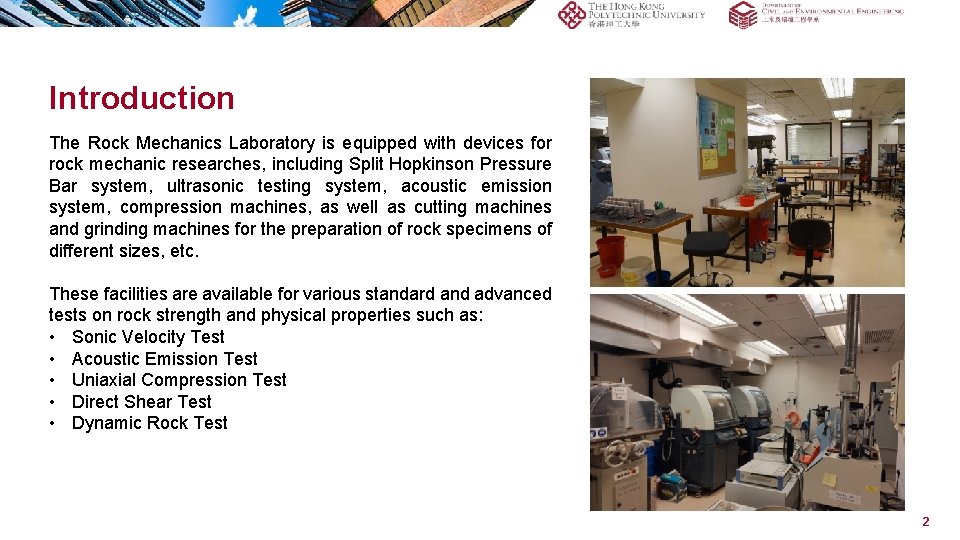
Introduction The Rock Mechanics Laboratory is equipped with devices for rock mechanic researches, including Split Hopkinson Pressure Bar system, ultrasonic testing system, acoustic emission system, compression machines, as well as cutting machines and grinding machines for the preparation of rock specimens of different sizes, etc. These facilities are available for various standard and advanced tests on rock strength and physical properties such as: • Sonic Velocity Test • Acoustic Emission Test • Uniaxial Compression Test • Direct Shear Test • Dynamic Rock Test 2
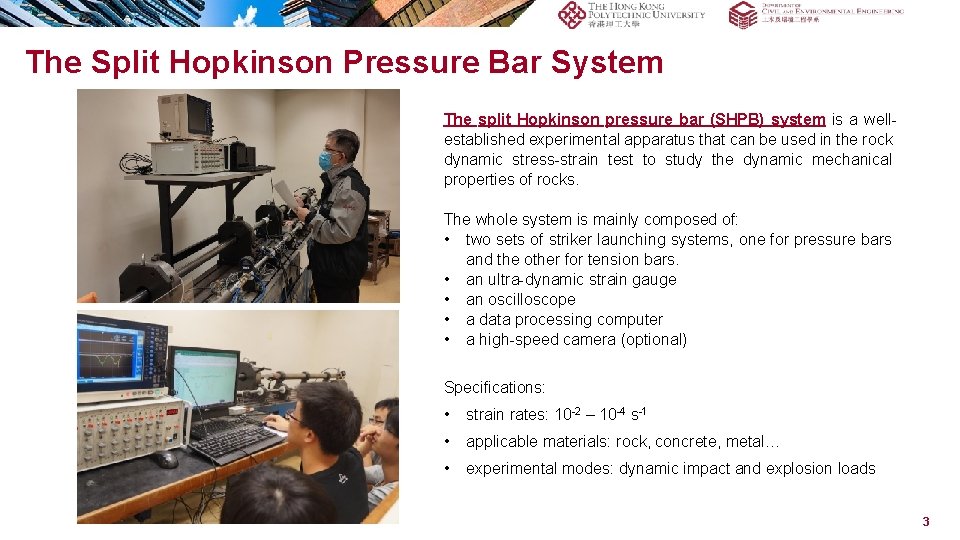
The Split Hopkinson Pressure Bar System The split Hopkinson pressure bar (SHPB) system is a wellestablished experimental apparatus that can be used in the rock dynamic stress-strain test to study the dynamic mechanical properties of rocks. The whole system is mainly composed of: • two sets of striker launching systems, one for pressure bars and the other for tension bars. • an ultra-dynamic strain gauge • an oscilloscope • a data processing computer • a high-speed camera (optional) Specifications: • strain rates: 10 -2 – 10 -4 s-1 • applicable materials: rock, concrete, metal… • experimental modes: dynamic impact and explosion loads 3
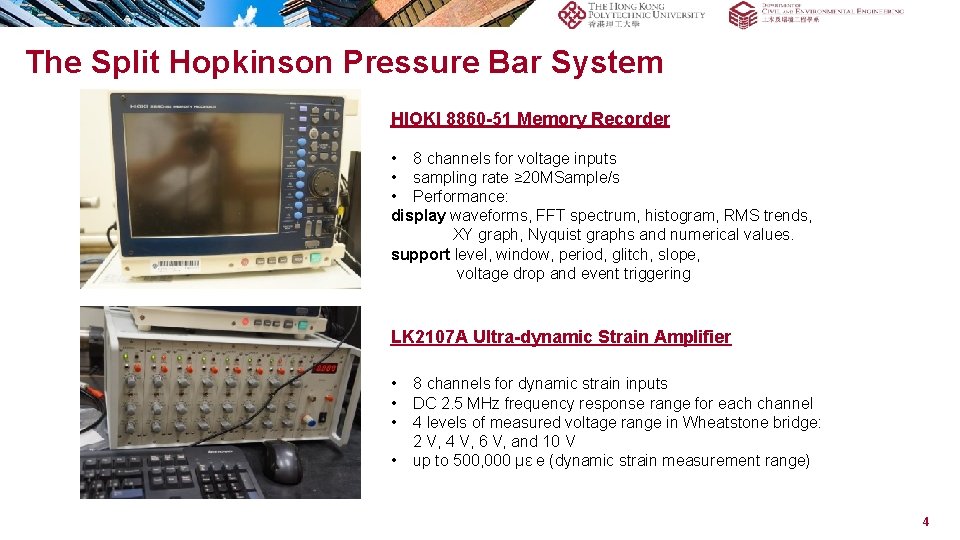
The Split Hopkinson Pressure Bar System HIOKI 8860 -51 Memory Recorder • 8 channels for voltage inputs • sampling rate ≥ 20 MSample/s • Performance: display waveforms, FFT spectrum, histogram, RMS trends, XY graph, Nyquist graphs and numerical values. support level, window, period, glitch, slope, voltage drop and event triggering LK 2107 A Ultra-dynamic Strain Amplifier • • 8 channels for dynamic strain inputs DC 2. 5 MHz frequency response range for each channel 4 levels of measured voltage range in Wheatstone bridge: 2 V, 4 V, 6 V, and 10 V up to 500, 000 με e (dynamic strain measurement range) 4

The Split Hopkinson Pressure Bar System The Structure of the Split Hopkinson Pressure Bar System 5
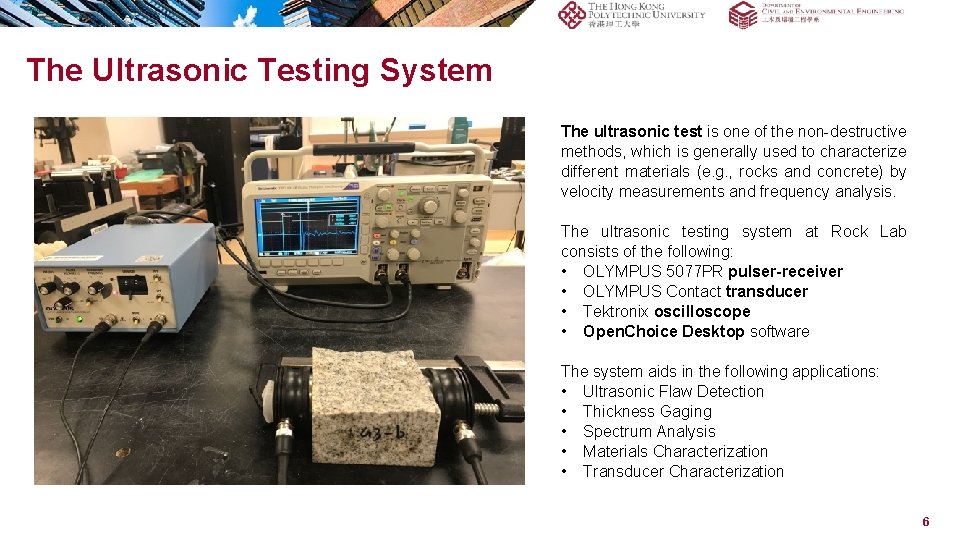
The Ultrasonic Testing System The ultrasonic test is one of the non-destructive methods, which is generally used to characterize different materials (e. g. , rocks and concrete) by velocity measurements and frequency analysis. The ultrasonic testing system at Rock Lab consists of the following: • OLYMPUS 5077 PR pulser-receiver • OLYMPUS Contact transducer • Tektronix oscilloscope • Open. Choice Desktop software The system aids in the following applications: • Ultrasonic Flaw Detection • Thickness Gaging • Spectrum Analysis • Materials Characterization • Transducer Characterization 6
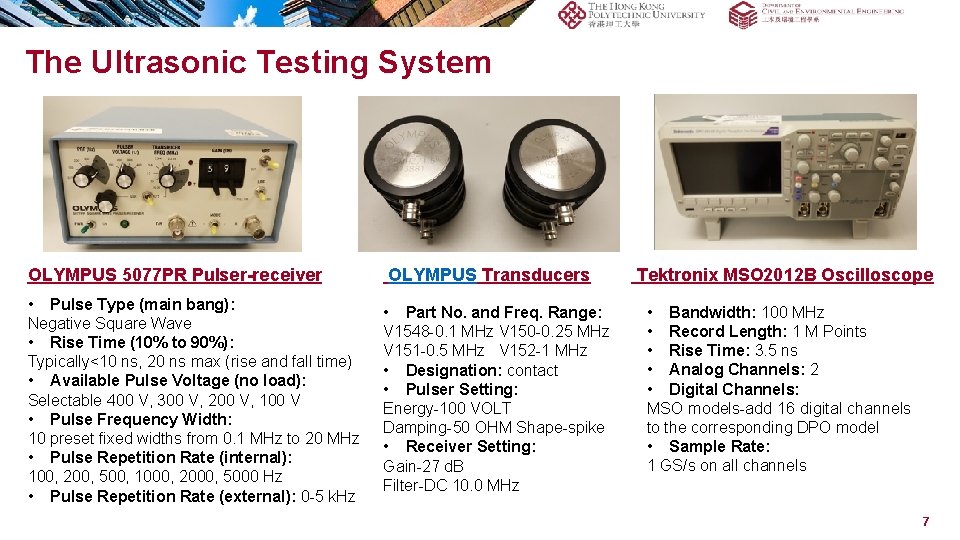
The Ultrasonic Testing System OLYMPUS 5077 PR Pulser-receiver • Pulse Type (main bang): Negative Square Wave • Rise Time (10% to 90%): Typically<10 ns, 20 ns max (rise and fall time) • Available Pulse Voltage (no load): Selectable 400 V, 300 V, 200 V, 100 V • Pulse Frequency Width: 10 preset fixed widths from 0. 1 MHz to 20 MHz • Pulse Repetition Rate (internal): 100, 200, 500, 1000, 2000, 5000 Hz • Pulse Repetition Rate (external): 0 -5 k. Hz OLYMPUS Transducers • Part No. and Freq. Range: V 1548 -0. 1 MHz V 150 -0. 25 MHz V 151 -0. 5 MHz V 152 -1 MHz • Designation: contact • Pulser Setting: Energy-100 VOLT Damping-50 OHM Shape-spike • Receiver Setting: Gain-27 d. B Filter-DC 10. 0 MHz Tektronix MSO 2012 B Oscilloscope • Bandwidth: 100 MHz • Record Length: 1 M Points • Rise Time: 3. 5 ns • Analog Channels: 2 • Digital Channels: MSO models-add 16 digital channels to the corresponding DPO model • Sample Rate: 1 GS/s on all channels 7
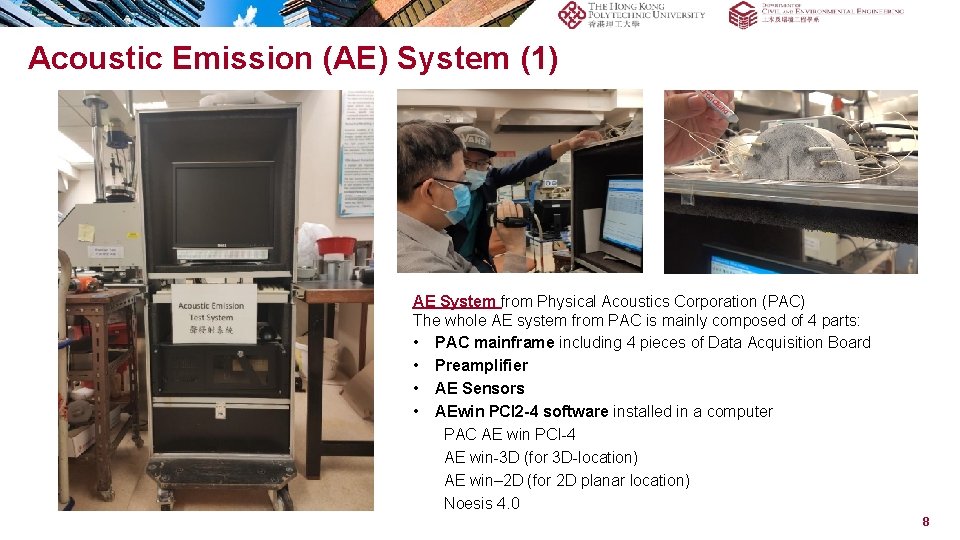
Acoustic Emission (AE) System (1) AE System from Physical Acoustics Corporation (PAC) The whole AE system from PAC is mainly composed of 4 parts: • PAC mainframe including 4 pieces of Data Acquisition Board • Preamplifier • AE Sensors • AEwin PCI 2 -4 software installed in a computer PAC AE win PCI-4 AE win-3 D (for 3 D-location) AE win– 2 D (for 2 D planar location) Noesis 4. 0 8
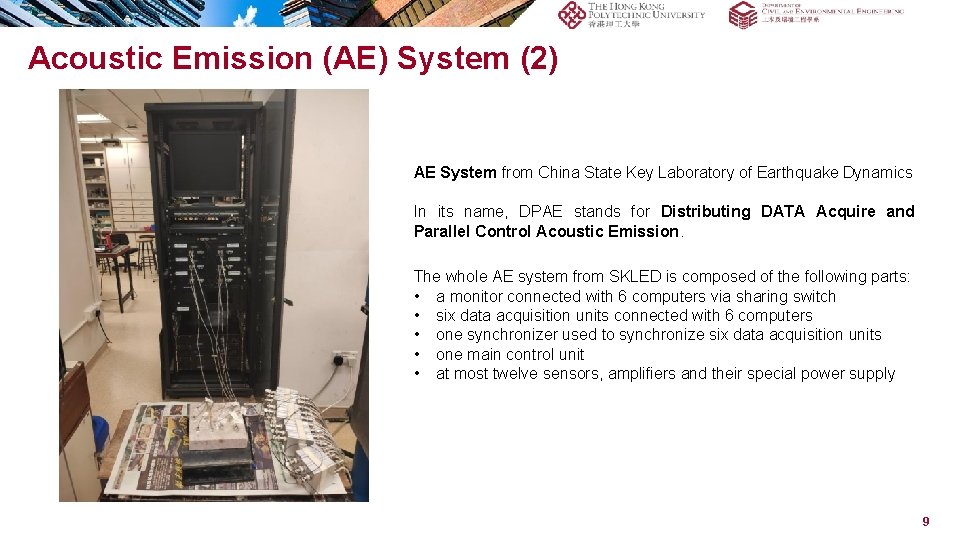
Acoustic Emission (AE) System (2) AE System from China State Key Laboratory of Earthquake Dynamics In its name, DPAE stands for Distributing DATA Acquire and Parallel Control Acoustic Emission. The whole AE system from SKLED is composed of the following parts: • a monitor connected with 6 computers via sharing switch • six data acquisition units connected with 6 computers • one synchronizer used to synchronize six data acquisition units • one main control unit • at most twelve sensors, amplifiers and their special power supply 9
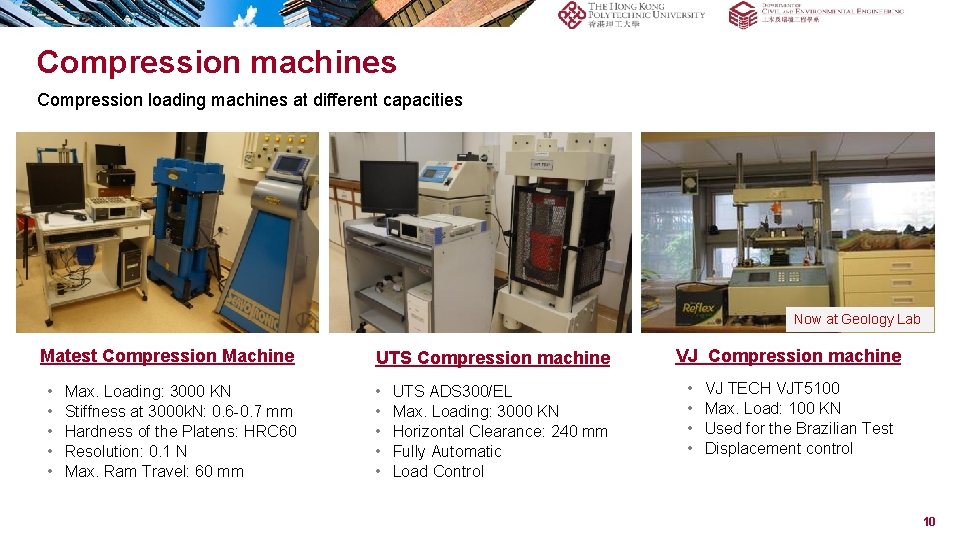
Compression machines Compression loading machines at different capacities Now at Geology Lab Matest Compression Machine • • • Max. Loading: 3000 KN Stiffness at 3000 k. N: 0. 6 -0. 7 mm Hardness of the Platens: HRC 60 Resolution: 0. 1 N Max. Ram Travel: 60 mm UTS Compression machine • • • UTS ADS 300/EL Max. Loading: 3000 KN Horizontal Clearance: 240 mm Fully Automatic Load Control VJ Compression machine • • VJ TECH VJT 5100 Max. Load: 100 KN Used for the Brazilian Test Displacement control 10
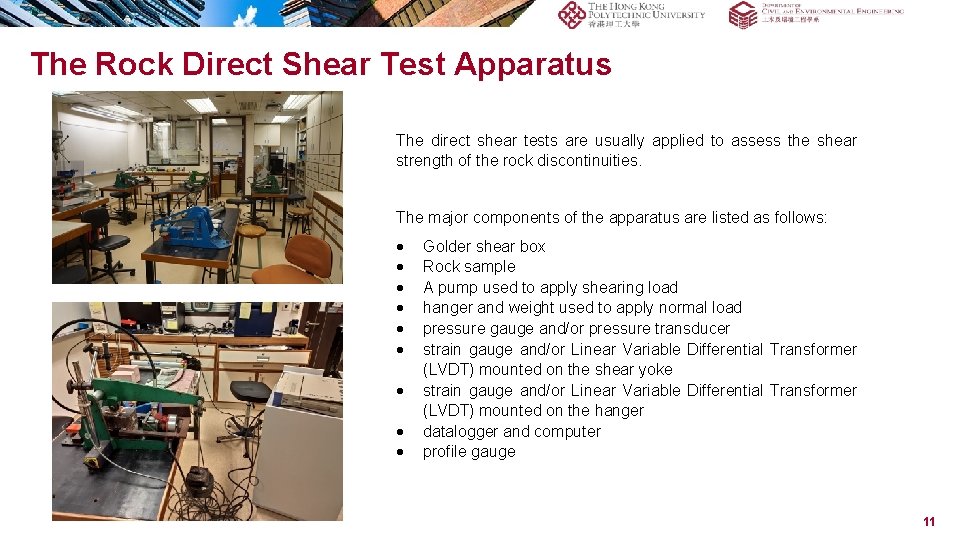
The Rock Direct Shear Test Apparatus The direct shear tests are usually applied to assess the shear strength of the rock discontinuities. The major components of the apparatus are listed as follows: Golder shear box Rock sample A pump used to apply shearing load hanger and weight used to apply normal load pressure gauge and/or pressure transducer strain gauge and/or Linear Variable Differential Transformer (LVDT) mounted on the shear yoke strain gauge and/or Linear Variable Differential Transformer (LVDT) mounted on the hanger datalogger and computer profile gauge 11
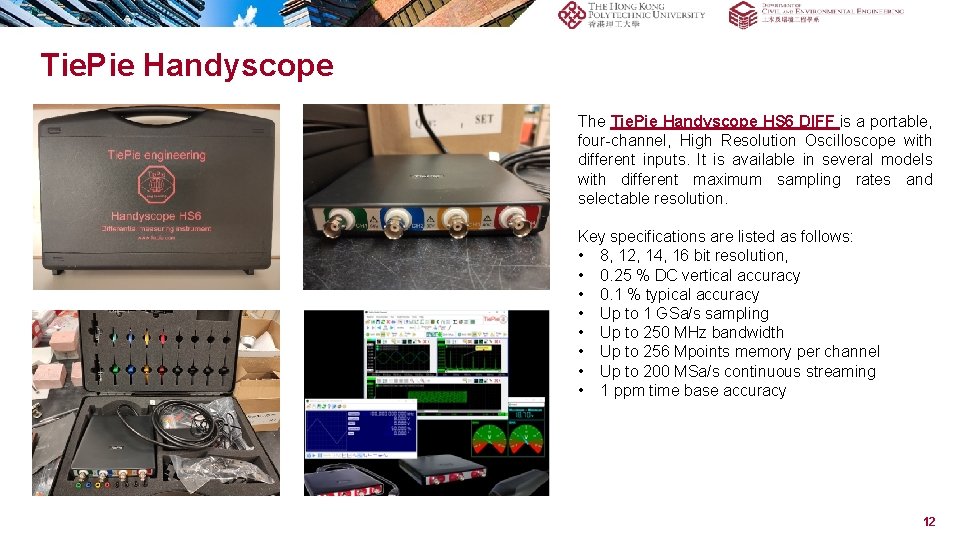
Tie. Pie Handyscope The Tie. Pie Handyscope HS 6 DIFF is a portable, four-channel, High Resolution Oscilloscope with different inputs. It is available in several models with different maximum sampling rates and selectable resolution. Key specifications are listed as follows: • 8, 12, 14, 16 bit resolution, • 0. 25 % DC vertical accuracy • 0. 1 % typical accuracy • Up to 1 GSa/s sampling • Up to 250 MHz bandwidth • Up to 256 Mpoints memory per channel • Up to 200 MSa/s continuous streaming • 1 ppm time base accuracy 12
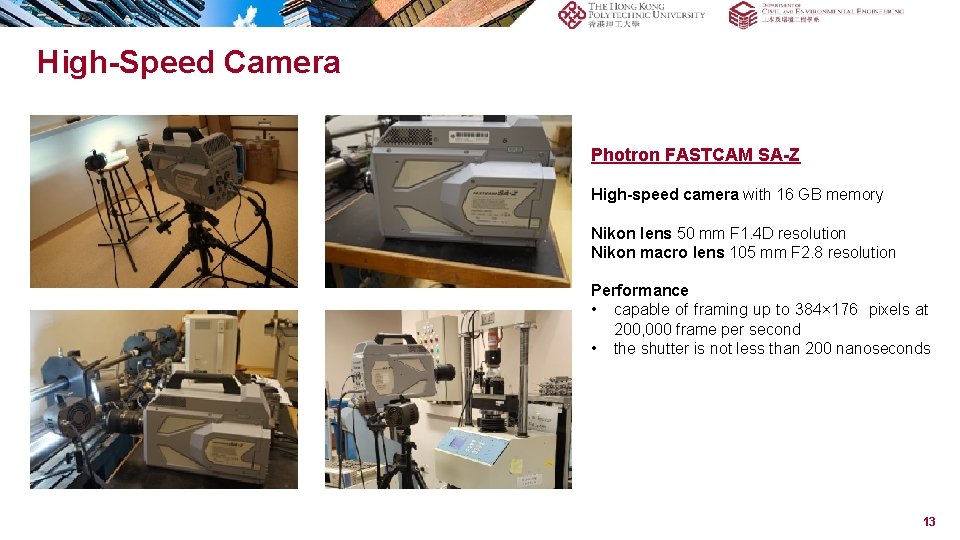
High-Speed Camera Photron FASTCAM SA-Z High-speed camera with 16 GB memory Nikon lens 50 mm F 1. 4 D resolution Nikon macro lens 105 mm F 2. 8 resolution Performance • capable of framing up to 384× 176 pixels at 200, 000 frame per second • the shutter is not less than 200 nanoseconds 13
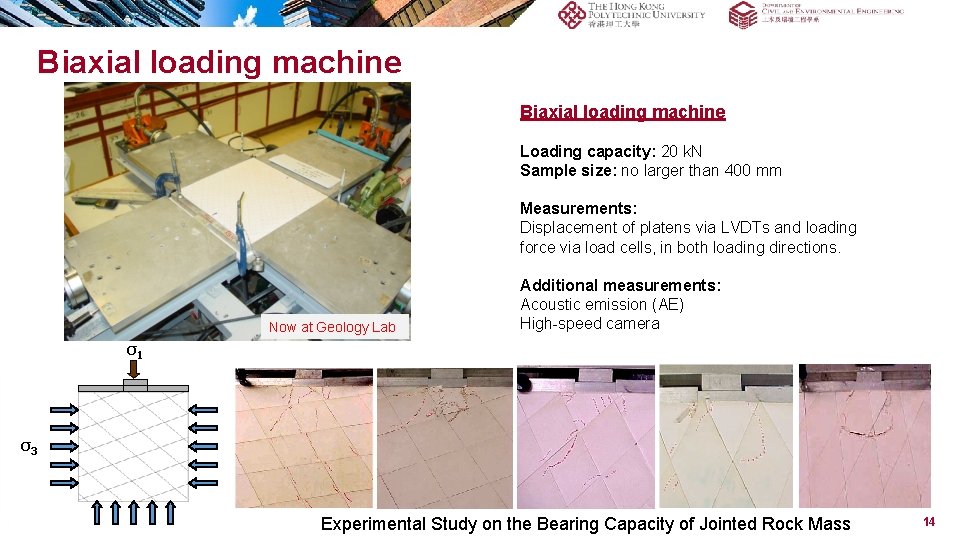
Biaxial loading machine Loading capacity: 20 k. N Sample size: no larger than 400 mm Measurements: Displacement of platens via LVDTs and loading force via load cells, in both loading directions. Now at Geology Lab Additional measurements: Acoustic emission (AE) High-speed camera σσ 31 σ1 σ3 σ σ33 Experimental Study on the Bearing Capacity of Jointed Rock Mass 14
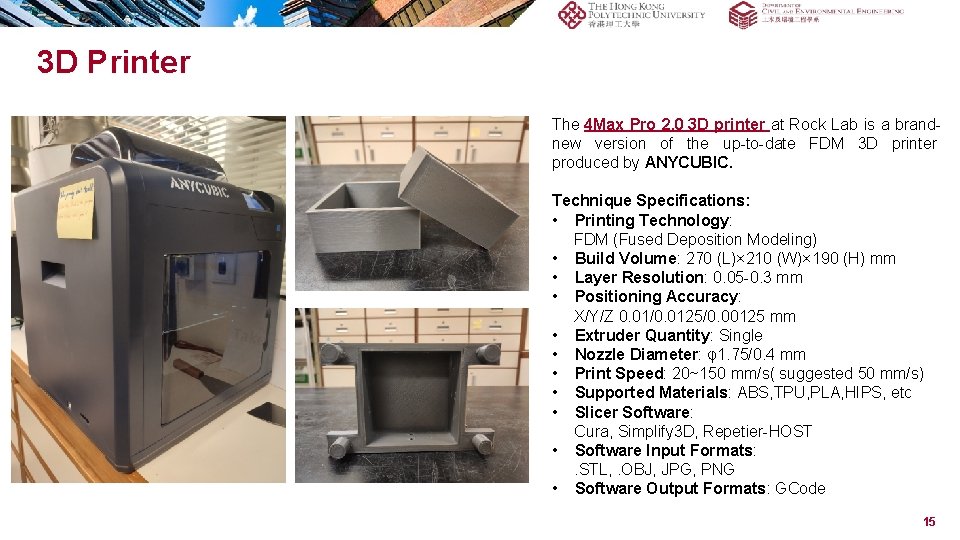
3 D Printer The 4 Max Pro 2. 0 3 D printer at Rock Lab is a brandnew version of the up-to-date FDM 3 D printer produced by ANYCUBIC. Technique Specifications: • Printing Technology: FDM (Fused Deposition Modeling) • Build Volume: 270 (L)× 210 (W)× 190 (H) mm • Layer Resolution: 0. 05 -0. 3 mm • Positioning Accuracy: X/Y/Z 0. 01/0. 0125/0. 00125 mm • Extruder Quantity: Single • Nozzle Diameter: φ1. 75/0. 4 mm • Print Speed: 20~150 mm/s( suggested 50 mm/s) • Supported Materials: ABS, TPU, PLA, HIPS, etc • Slicer Software: Cura, Simplify 3 D, Repetier-HOST • Software Input Formats: . STL, . OBJ, JPG, PNG • Software Output Formats: GCode 15
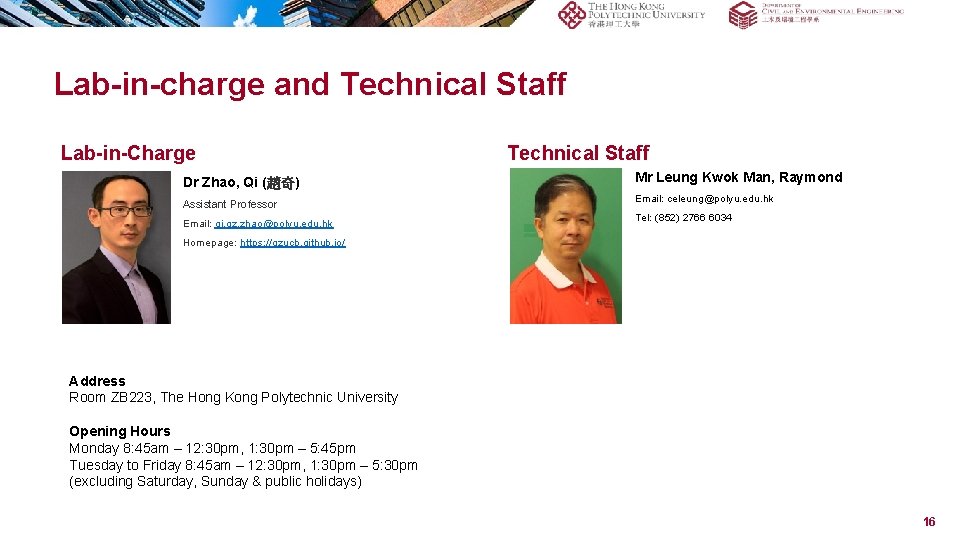
Lab-in-charge and Technical Staff Lab-in-Charge Dr Zhao, Qi (趙奇) Assistant Professor Email: qi. qz. zhao@polyu. edu. hk Technical Staff Mr Leung Kwok Man, Raymond Email: celeung@polyu. edu. hk Tel: (852) 2766 6034 Homepage: https: //qzucb. github. io/ Address Room ZB 223, The Hong Kong Polytechnic University Opening Hours Monday 8: 45 am – 12: 30 pm, 1: 30 pm – 5: 45 pm Tuesday to Friday 8: 45 am – 12: 30 pm, 1: 30 pm – 5: 30 pm (excluding Saturday, Sunday & public holidays) 16
- Slides: 16