
ROCK MASS CLASSIFICATIONS Marek Caa Dept of Geomechanics

- Slides: 65
ROCK MASS CLASSIFICATIONS Marek Cała – Dept. of Geomechanics, Civil Engineering & Geotechnics
Rock Mass Classification • Why? • How does this help us in tunnel design? Marek Cała – Dept. of Geomechanics, Civil Engineering & Geotechnics
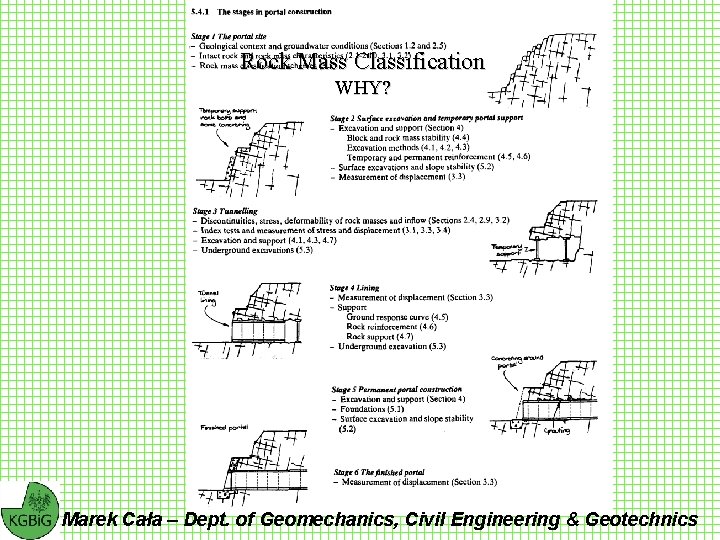
Rock Mass Classification WHY? Marek Cała – Dept. of Geomechanics, Civil Engineering & Geotechnics
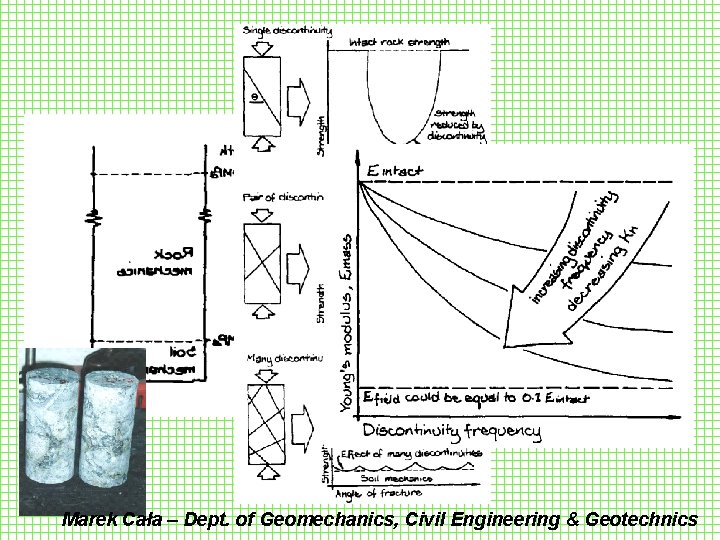
Ground interaction Marek Cała – Dept. of Geomechanics, Civil Engineering & Geotechnics
Summary of rock mass characteristics, testing methods and theoretical considerations Marek Cała – Dept. of Geomechanics, Civil Engineering & Geotechnics
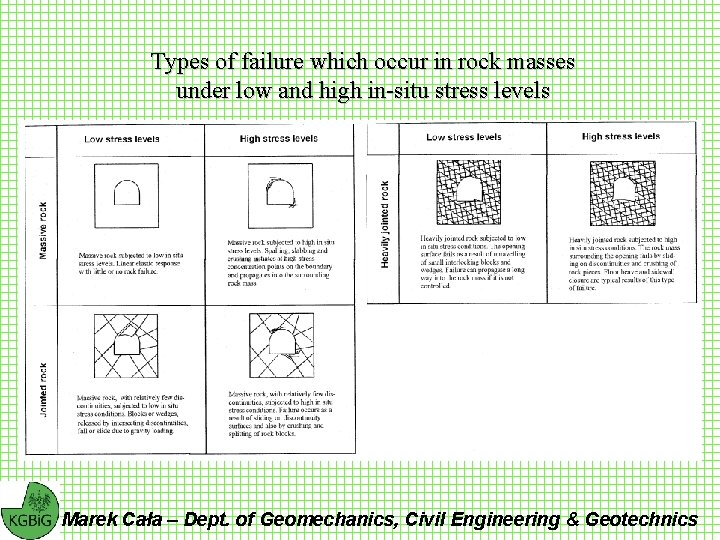
Types of failure which occur in rock masses under low and high in-situ stress levels Marek Cała – Dept. of Geomechanics, Civil Engineering & Geotechnics
Marek Cała – Dept. of Geomechanics, Civil Engineering & Geotechnics
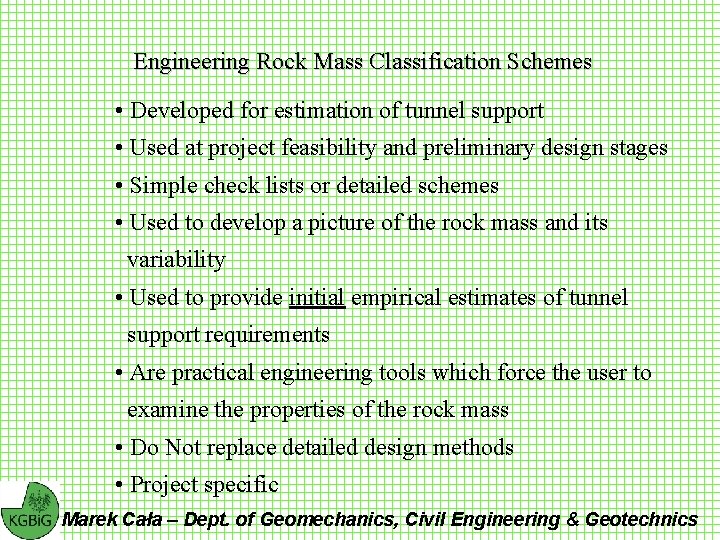
Engineering Rock Mass Classification Schemes • Developed for estimation of tunnel support • Used at project feasibility and preliminary design stages • Simple check lists or detailed schemes • Used to develop a picture of the rock mass and its variability • Used to provide initial empirical estimates of tunnel support requirements • Are practical engineering tools which force the user to examine the properties of the rock mass • Do Not replace detailed design methods • Project specific Marek Cała – Dept. of Geomechanics, Civil Engineering & Geotechnics
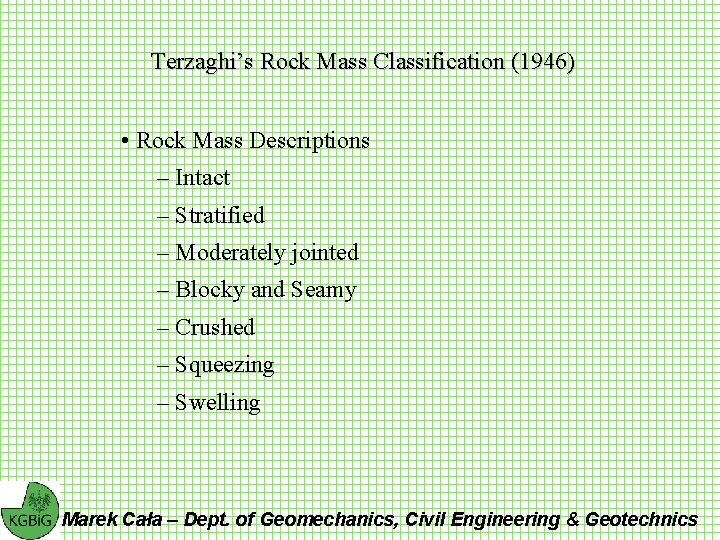
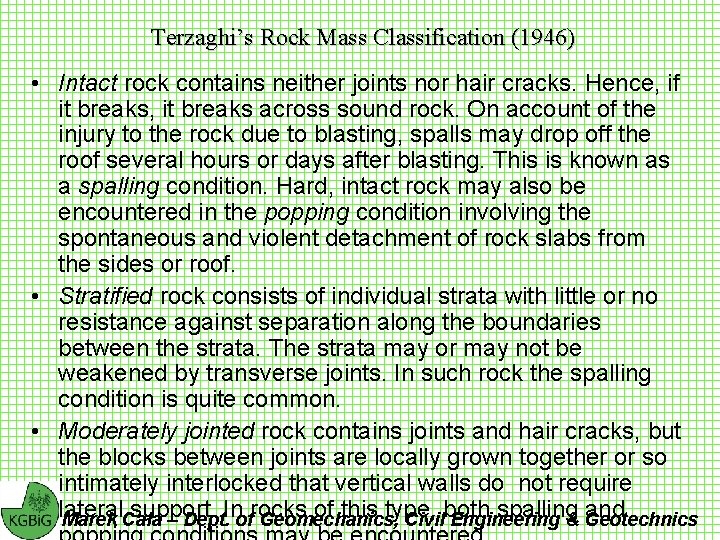
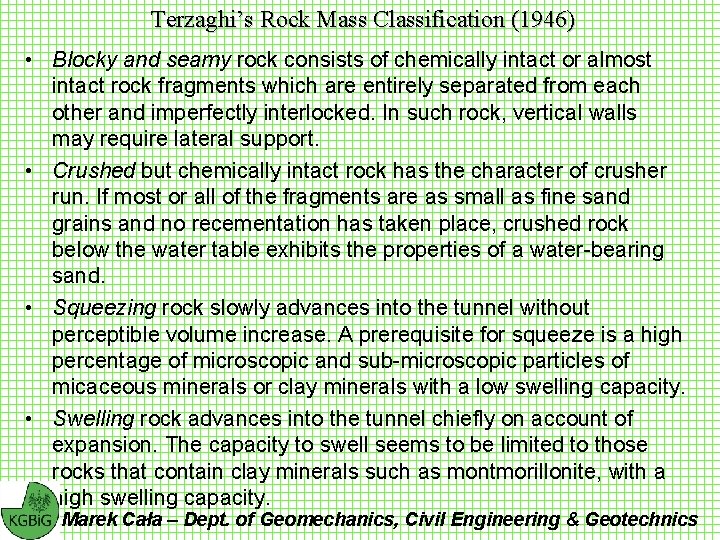
Terzaghi’s Rock Mass Classification (1946) • Rock Mass Descriptions – Intact – Stratified – Moderately jointed – Blocky and Seamy – Crushed – Squeezing – Swelling Marek Cała – Dept. of Geomechanics, Civil Engineering & Geotechnics
Terzaghi’s Rock Mass Classification (1946) • Intact rock contains neither joints nor hair cracks. Hence, if it breaks, it breaks across sound rock. On account of the injury to the rock due to blasting, spalls may drop off the roof several hours or days after blasting. This is known as a spalling condition. Hard, intact rock may also be encountered in the popping condition involving the spontaneous and violent detachment of rock slabs from the sides or roof. • Stratified rock consists of individual strata with little or no resistance against separation along the boundaries between the strata. The strata may or may not be weakened by transverse joints. In such rock the spalling condition is quite common. • Moderately jointed rock contains joints and hair cracks, but the blocks between joints are locally grown together or so intimately interlocked that vertical walls do not require lateral support. of this type, spalling and Marek Cała – Dept. Inofrocks Geomechanics, Civilboth Engineering & Geotechnics
Terzaghi’s Rock Mass Classification (1946) • Blocky and seamy rock consists of chemically intact or almost intact rock fragments which are entirely separated from each other and imperfectly interlocked. In such rock, vertical walls may require lateral support. • Crushed but chemically intact rock has the character of crusher run. If most or all of the fragments are as small as fine sand grains and no recementation has taken place, crushed rock below the water table exhibits the properties of a water-bearing sand. • Squeezing rock slowly advances into the tunnel without perceptible volume increase. A prerequisite for squeeze is a high percentage of microscopic and sub-microscopic particles of micaceous minerals or clay minerals with a low swelling capacity. • Swelling rock advances into the tunnel chiefly on account of expansion. The capacity to swell seems to be limited to those rocks that contain clay minerals such as montmorillonite, with a high swelling capacity. Marek Cała – Dept. of Geomechanics, Civil Engineering & Geotechnics
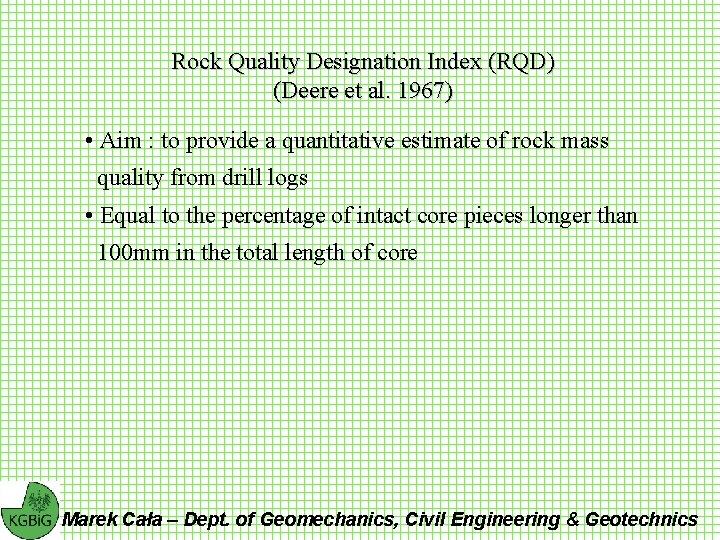
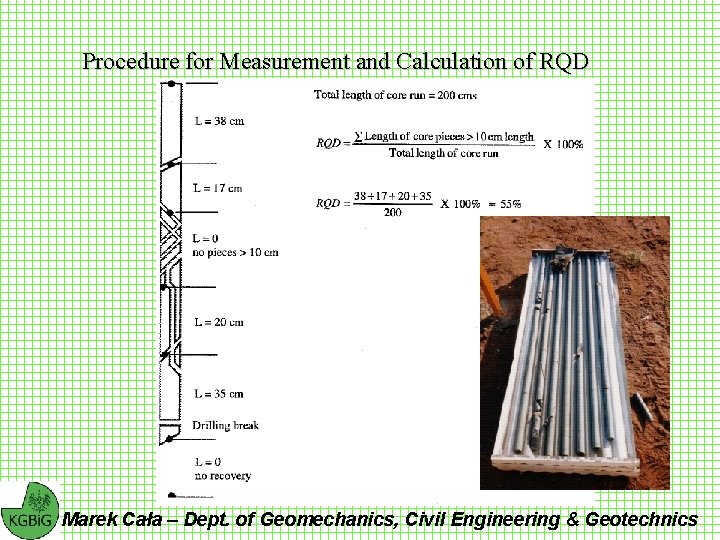
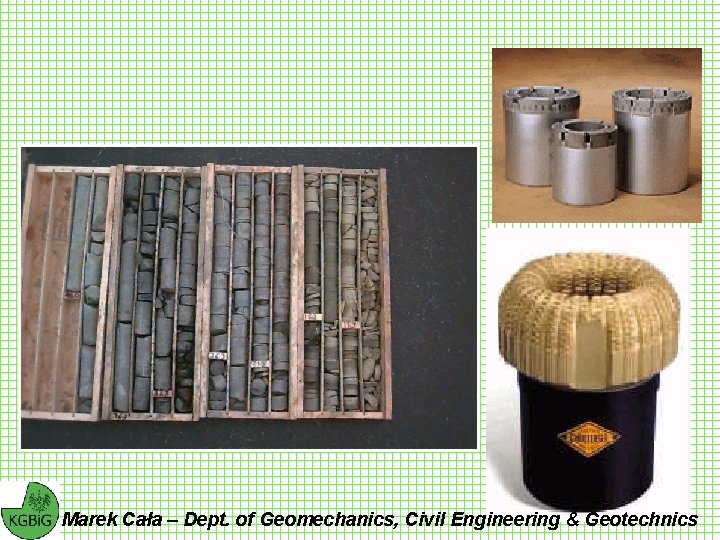
Rock Quality Designation Index (RQD) (Deere et al. 1967) • Aim : to provide a quantitative estimate of rock mass quality from drill logs • Equal to the percentage of intact core pieces longer than 100 mm in the total length of core Marek Cała – Dept. of Geomechanics, Civil Engineering & Geotechnics
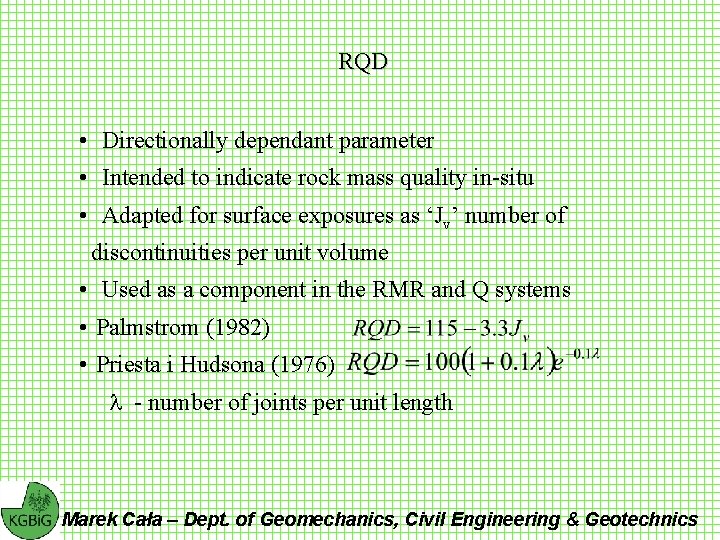
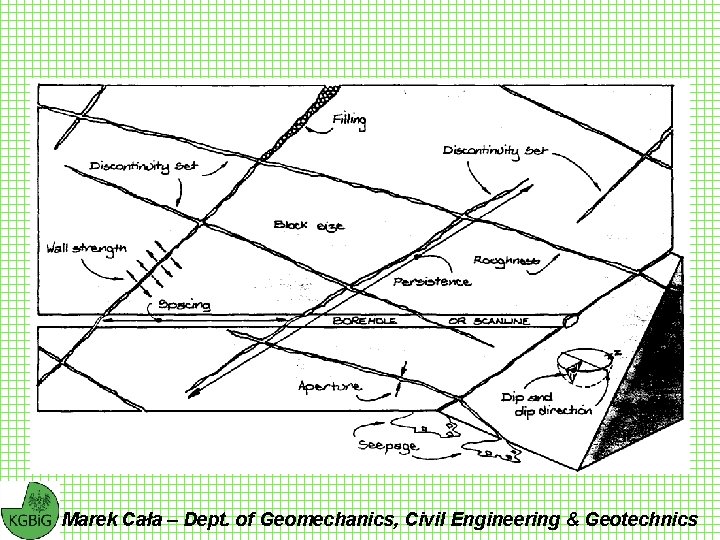
RQD • Directionally dependant parameter • Intended to indicate rock mass quality in-situ • Adapted for surface exposures as ‘Jv’ number of discontinuities per unit volume • Used as a component in the RMR and Q systems • Palmstrom (1982) • Priesta i Hudsona (1976) l - number of joints per unit length Marek Cała – Dept. of Geomechanics, Civil Engineering & Geotechnics
Procedure for Measurement and Calculation of RQD Marek Cała – Dept. of Geomechanics, Civil Engineering & Geotechnics
Marek Cała – Dept. of Geomechanics, Civil Engineering & Geotechnics
Weathering of Basalt with depth Marek Cała – Dept. of Geomechanics, Civil Engineering & Geotechnics
Marek Cała – Dept. of Geomechanics, Civil Engineering & Geotechnics
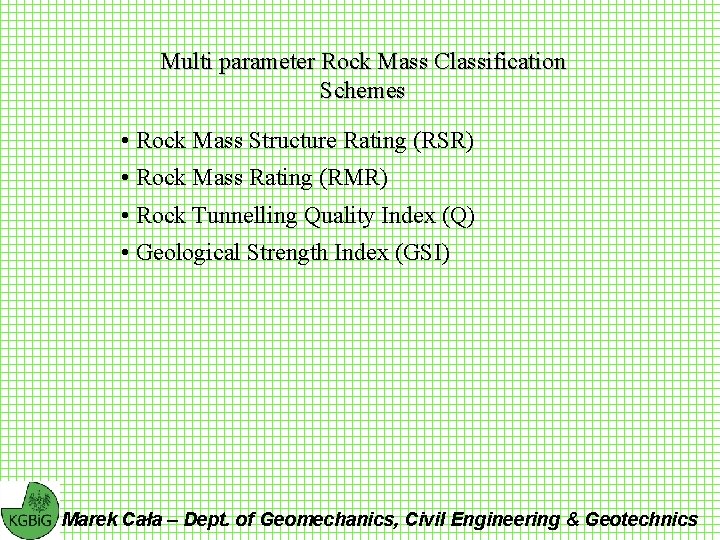
Multi parameter Rock Mass Classification Schemes • Rock Mass Structure Rating (RSR) • Rock Mass Rating (RMR) • Rock Tunnelling Quality Index (Q) • Geological Strength Index (GSI) Marek Cała – Dept. of Geomechanics, Civil Engineering & Geotechnics
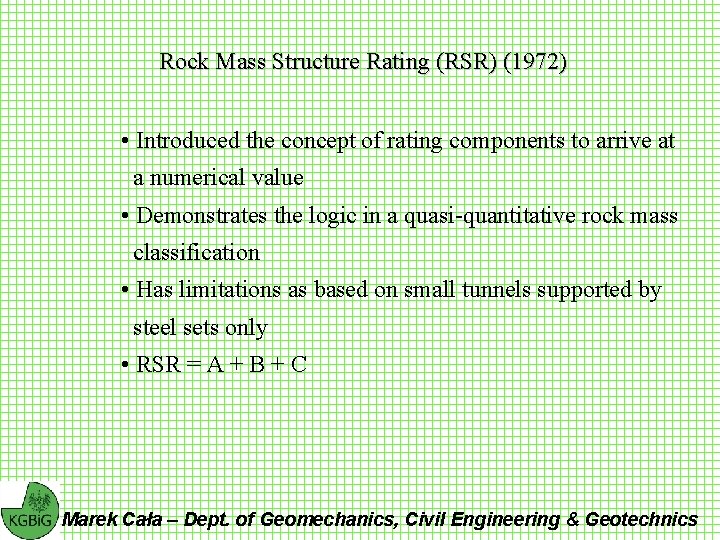
Rock Mass Structure Rating (RSR) (1972) • Introduced the concept of rating components to arrive at a numerical value • Demonstrates the logic in a quasi-quantitative rock mass classification • Has limitations as based on small tunnels supported by steel sets only • RSR = A + B + C Marek Cała – Dept. of Geomechanics, Civil Engineering & Geotechnics
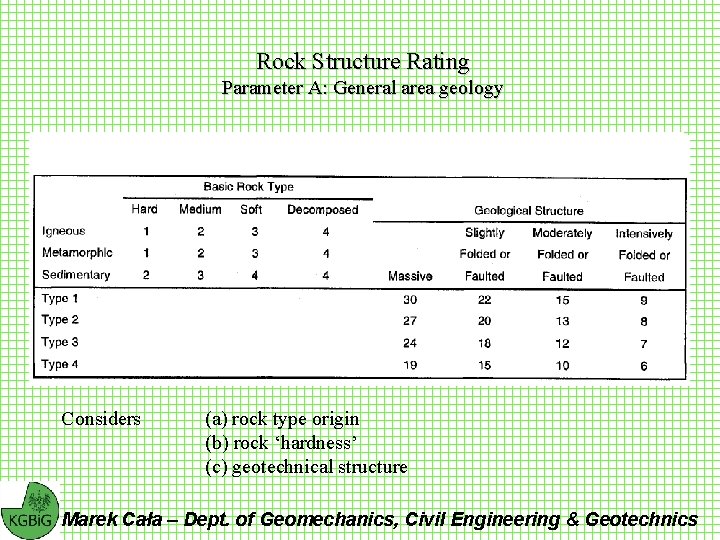
Rock Structure Rating Parameter A: General area geology Considers (a) rock type origin (b) rock ‘hardness’ (c) geotechnical structure Marek Cała – Dept. of Geomechanics, Civil Engineering & Geotechnics
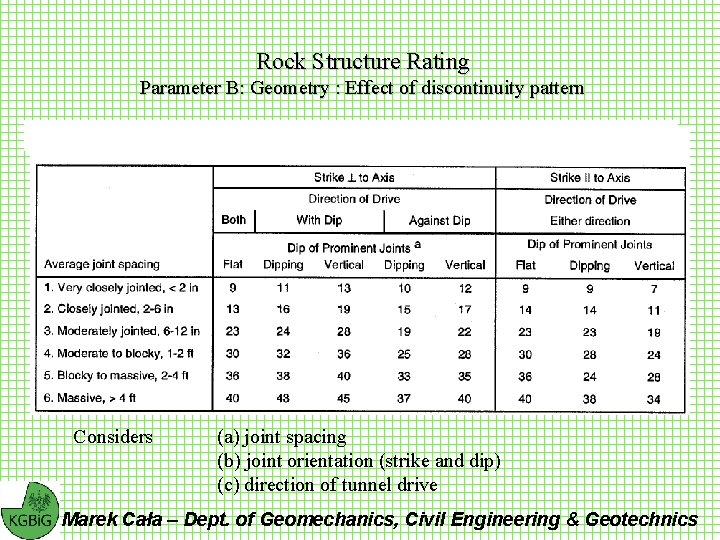
Rock Structure Rating Parameter B: Geometry : Effect of discontinuity pattern Considers (a) joint spacing (b) joint orientation (strike and dip) (c) direction of tunnel drive Marek Cała – Dept. of Geomechanics, Civil Engineering & Geotechnics
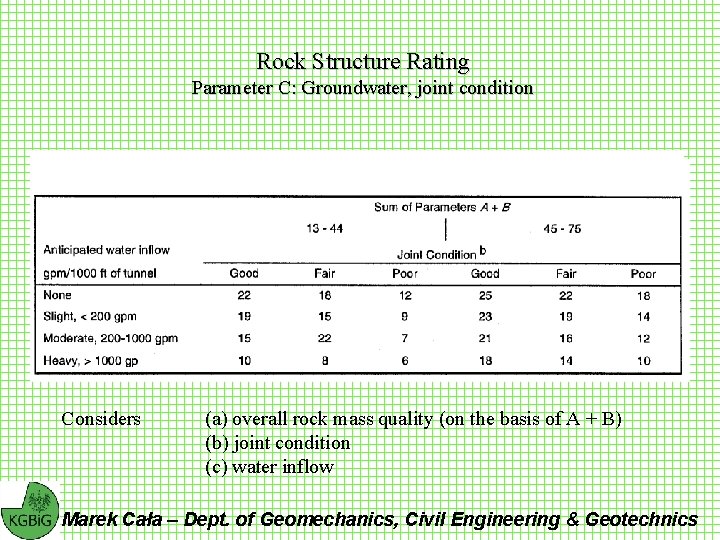
Rock Structure Rating Parameter C: Groundwater, joint condition Considers (a) overall rock mass quality (on the basis of A + B) (b) joint condition (c) water inflow Marek Cała – Dept. of Geomechanics, Civil Engineering & Geotechnics
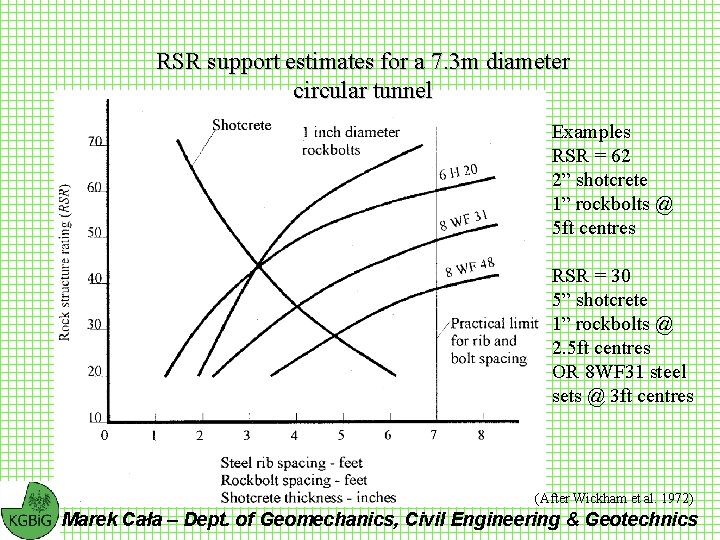
RSR support estimates for a 7. 3 m diameter circular tunnel Examples RSR = 62 2” shotcrete 1” rockbolts @ 5 ft centres RSR = 30 5” shotcrete 1” rockbolts @ 2. 5 ft centres OR 8 WF 31 steel sets @ 3 ft centres (After Wickham et al. 1972) Marek Cała – Dept. of Geomechanics, Civil Engineering & Geotechnics
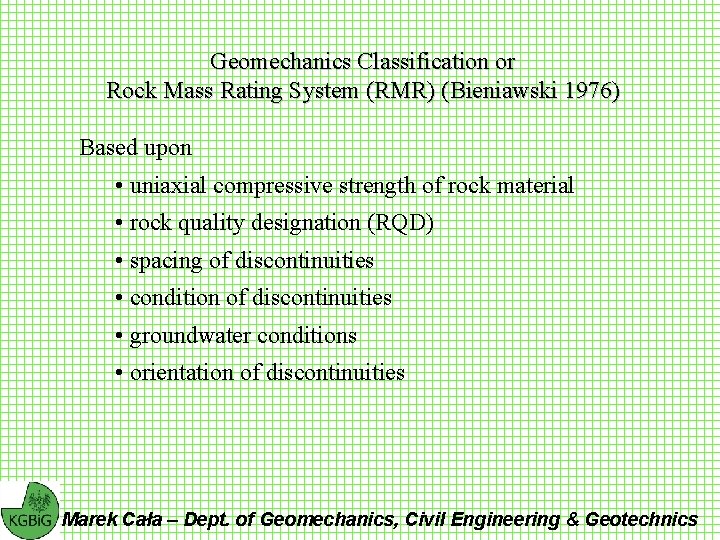
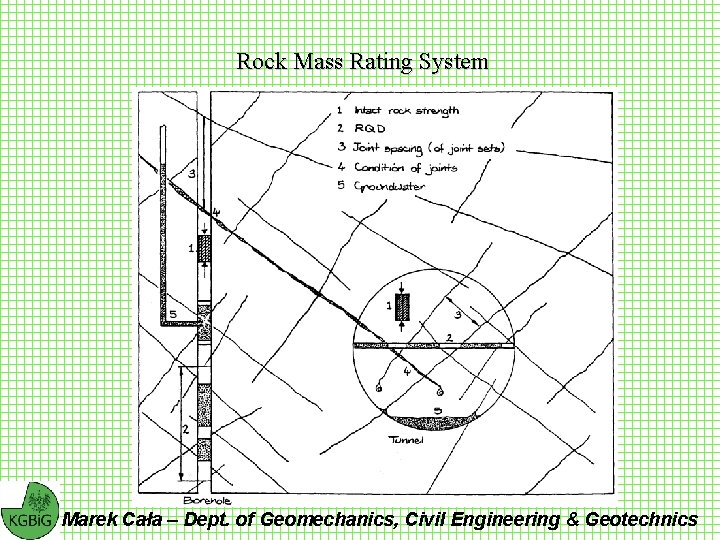
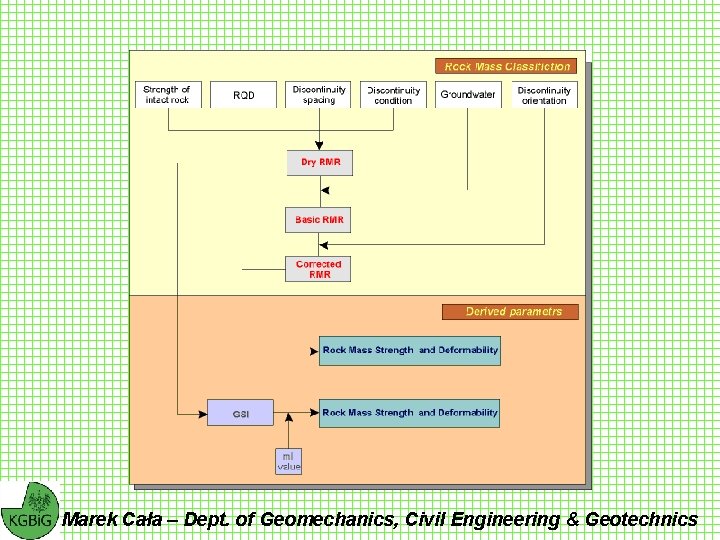
Geomechanics Classification or Rock Mass Rating System (RMR) (Bieniawski 1976) Based upon • uniaxial compressive strength of rock material • rock quality designation (RQD) • spacing of discontinuities • condition of discontinuities • groundwater conditions • orientation of discontinuities Marek Cała – Dept. of Geomechanics, Civil Engineering & Geotechnics
Rock Mass Rating System • Rock mass divided into structural regions • Each region is classified separately • Boundaries can be rock type or structural, eg: fault • Can be sub divided based on significant changes, eg: discontinuity spacing Marek Cała – Dept. of Geomechanics, Civil Engineering & Geotechnics
Rock Mass Rating System Marek Cała – Dept. of Geomechanics, Civil Engineering & Geotechnics
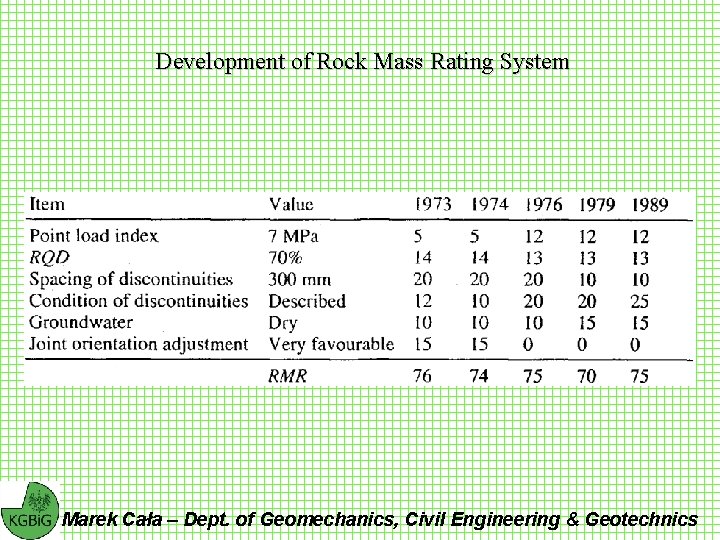
Rock Mass Rating System BUT: 1976 to 1989 Bieniawski • System refined by greater data • Ratings for parameters changed • Adapted by other workers for different situations • PROJECT SPECIFIC SYSTEMS Marek Cała – Dept. of Geomechanics, Civil Engineering & Geotechnics
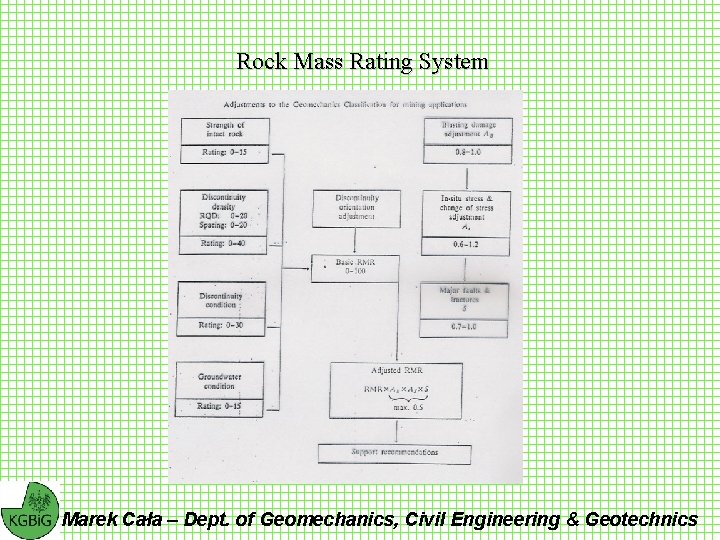
Development of Rock Mass Rating System Marek Cała – Dept. of Geomechanics, Civil Engineering & Geotechnics
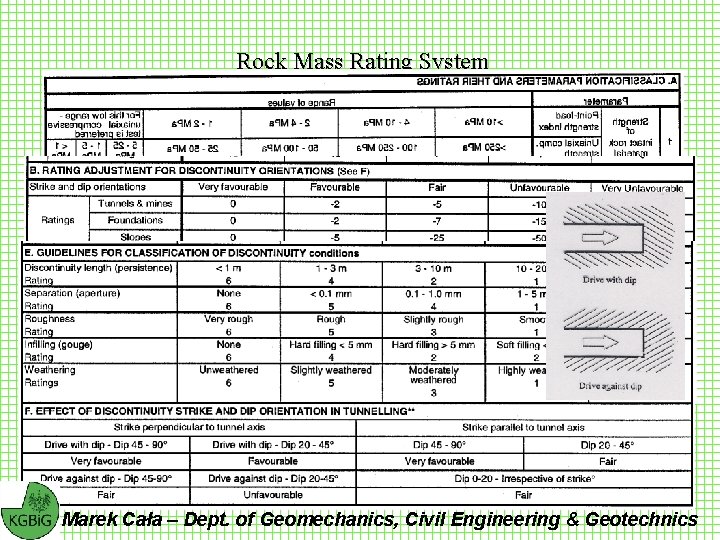
Rock Mass Rating System (After Bieniawski 1989) Marek Cała – Dept. of Geomechanics, Civil Engineering & Geotechnics
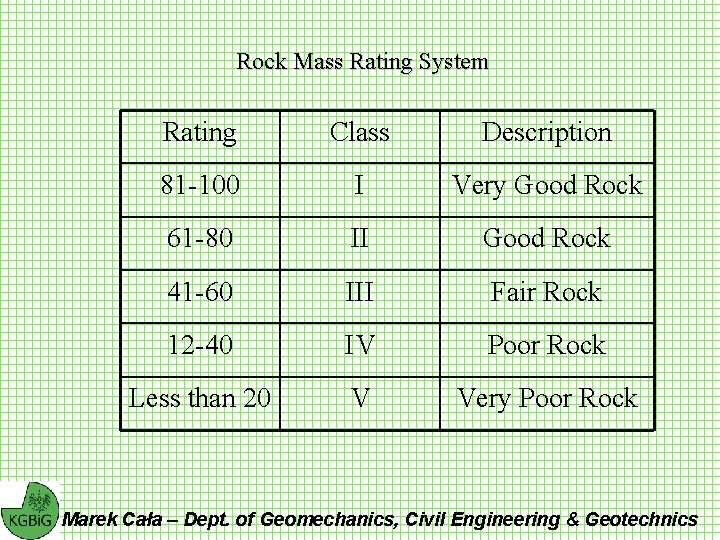
Rock Mass Rating System Rating Class Description 81 -100 I Very Good Rock 61 -80 II Good Rock 41 -60 III Fair Rock 12 -40 IV Poor Rock Less than 20 V Very Poor Rock Marek Cała – Dept. of Geomechanics, Civil Engineering & Geotechnics
Marek Cała – Dept. of Geomechanics, Civil Engineering & Geotechnics
Rock Mass Rating System Marek Cała – Dept. of Geomechanics, Civil Engineering & Geotechnics
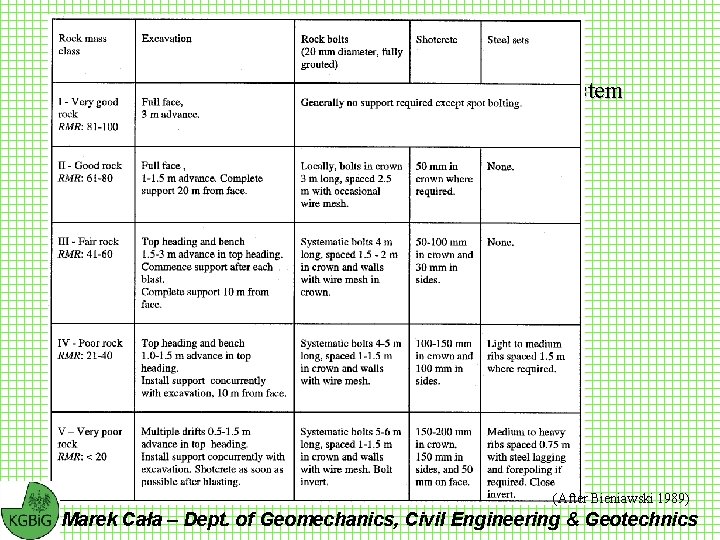
Guidelines for excavation and support of 10 m span rock tunnels in accordance with the RMR system (After Bieniawski 1989) Marek Cała – Dept. of Geomechanics, Civil Engineering & Geotechnics
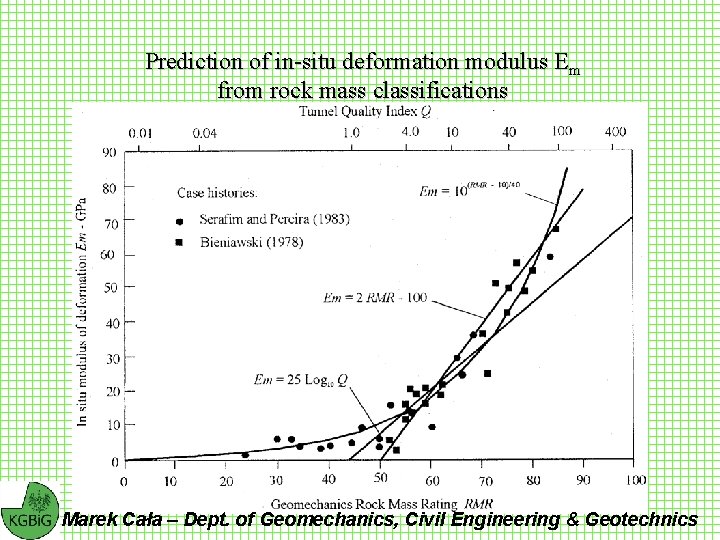
Prediction of in-situ deformation modulus Em from rock mass classifications Marek Cała – Dept. of Geomechanics, Civil Engineering & Geotechnics
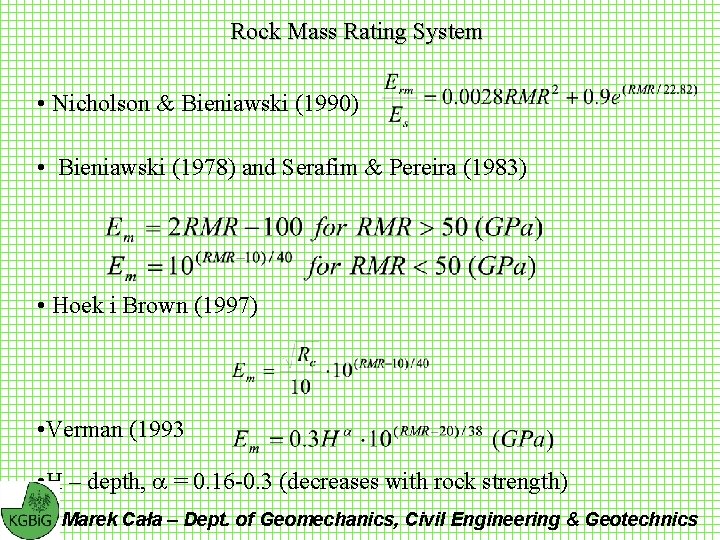
Rock Mass Rating System • Nicholson & Bieniawski (1990) • Bieniawski (1978) and Serafim & Pereira (1983) • Hoek i Brown (1997) • Verman (1993 • H – depth, a = 0. 16 -0. 3 (decreases with rock strength) Marek Cała – Dept. of Geomechanics, Civil Engineering & Geotechnics
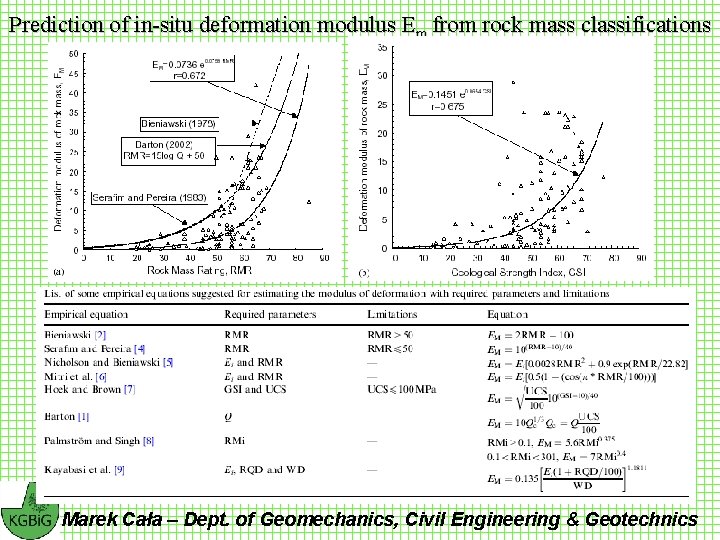
Prediction of in-situ deformation modulus Em from rock mass classifications Marek Cała – Dept. of Geomechanics, Civil Engineering & Geotechnics
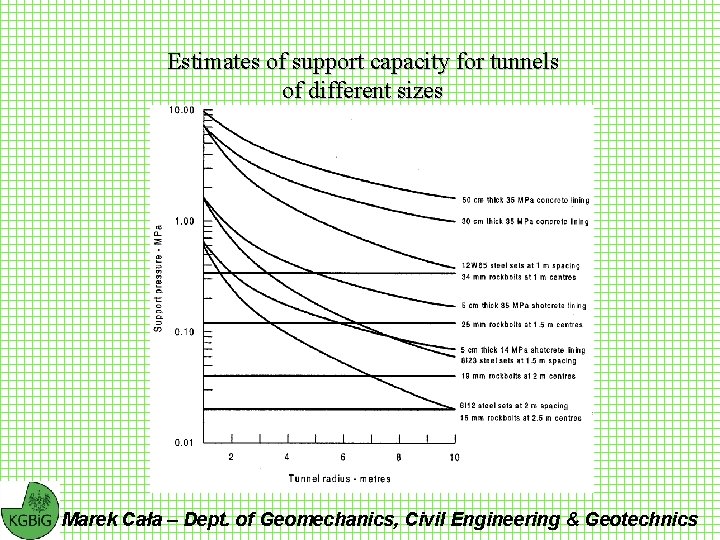
Estimates of support capacity for tunnels of different sizes Marek Cała – Dept. of Geomechanics, Civil Engineering & Geotechnics
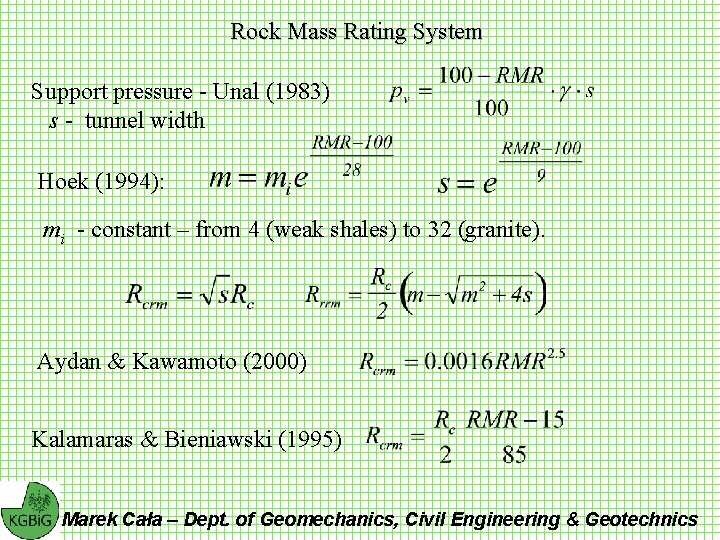
Rock Mass Rating System Support pressure - Unal (1983) s - tunnel width Hoek (1994): mi - constant – from 4 (weak shales) to 32 (granite). Aydan & Kawamoto (2000) Kalamaras & Bieniawski (1995) Marek Cała – Dept. of Geomechanics, Civil Engineering & Geotechnics
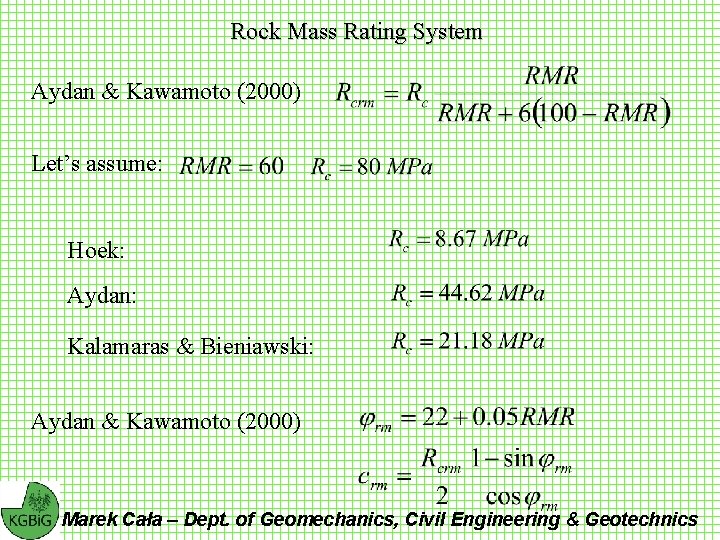
Rock Mass Rating System Aydan & Kawamoto (2000) Let’s assume: Hoek: Aydan: Kalamaras & Bieniawski: Aydan & Kawamoto (2000) Marek Cała – Dept. of Geomechanics, Civil Engineering & Geotechnics
Rock Tunnelling Quality Index Q – Barton, Lien, Lunde • Based on case histories in Scandinavia • Numerical values on a log scale • Range 0. 001 to 1000 Marek Cała – Dept. of Geomechanics, Civil Engineering & Geotechnics
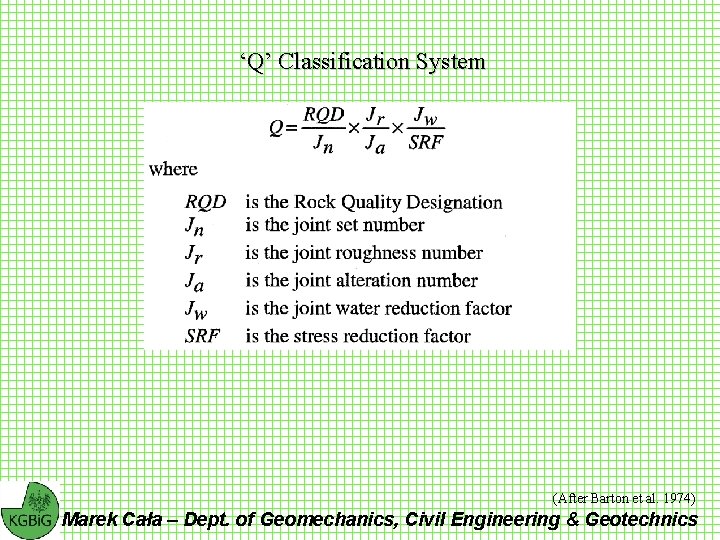
‘Q’ Classification System (After Barton et al. 1974) Marek Cała – Dept. of Geomechanics, Civil Engineering & Geotechnics
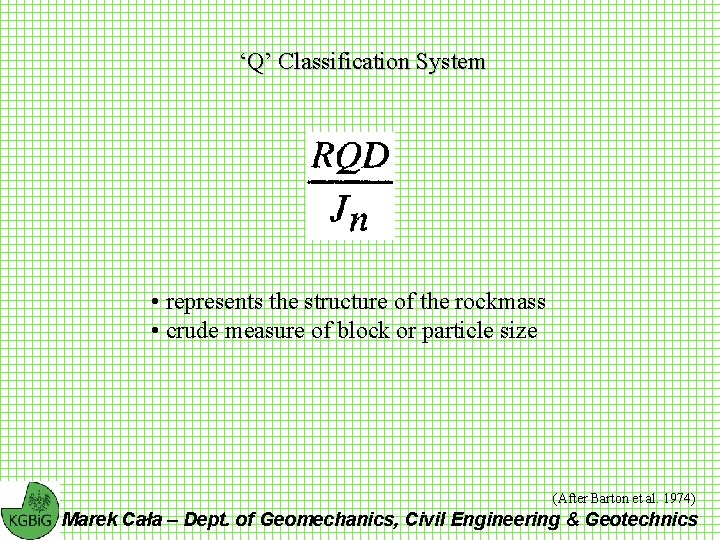
‘Q’ Classification System • represents the structure of the rockmass • crude measure of block or particle size (After Barton et al. 1974) Marek Cała – Dept. of Geomechanics, Civil Engineering & Geotechnics
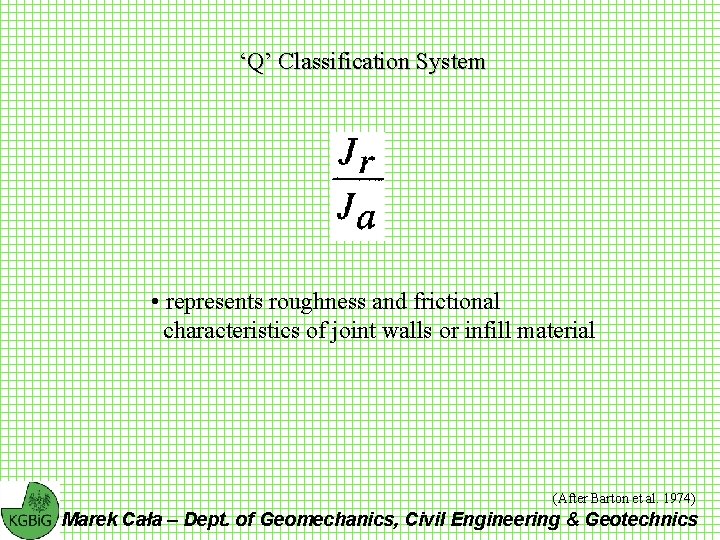
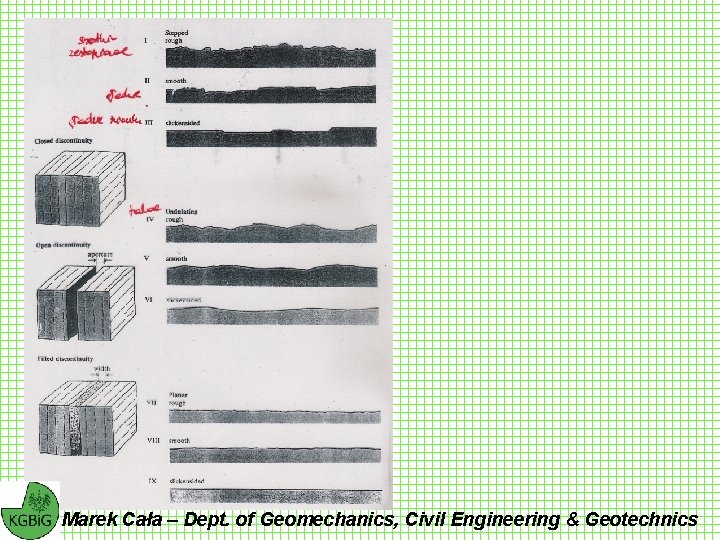
‘Q’ Classification System • represents roughness and frictional characteristics of joint walls or infill material (After Barton et al. 1974) Marek Cała – Dept. of Geomechanics, Civil Engineering & Geotechnics
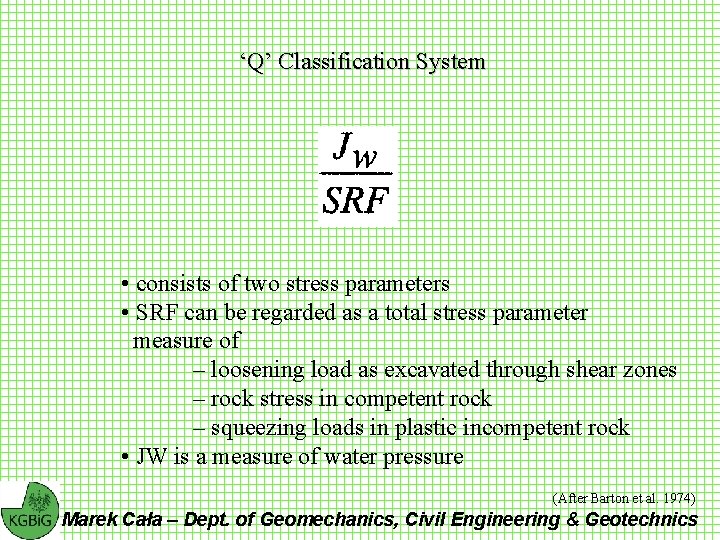
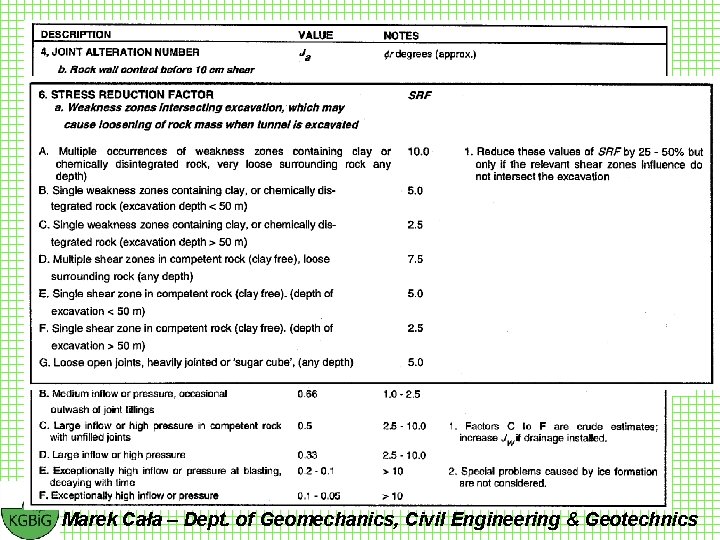
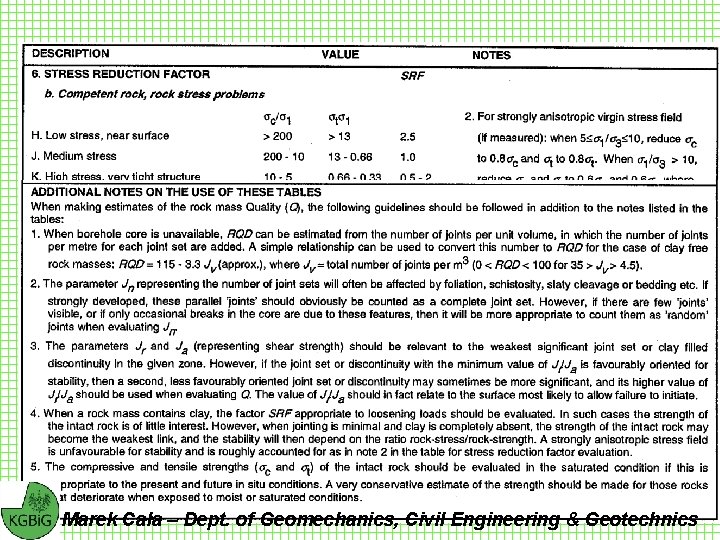
‘Q’ Classification System • consists of two stress parameters • SRF can be regarded as a total stress parameter measure of – loosening load as excavated through shear zones – rock stress in competent rock – squeezing loads in plastic incompetent rock • JW is a measure of water pressure (After Barton et al. 1974) Marek Cała – Dept. of Geomechanics, Civil Engineering & Geotechnics
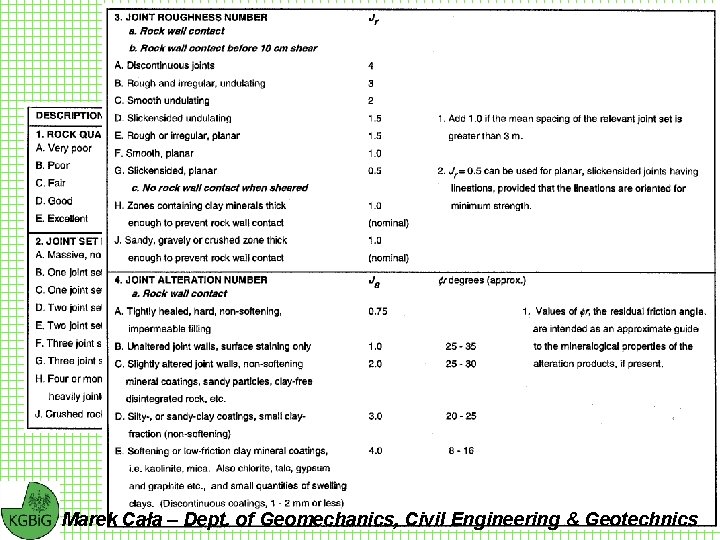
Classification of individual parameters used in the Tunnelling Quality Index Q Marek Cała – Dept. of Geomechanics, Civil Engineering & Geotechnics
Classification of individual parameters used in the Tunnelling Quality Index Q (cont’d) Marek Cała – Dept. of Geomechanics, Civil Engineering & Geotechnics
Classification of individual parameters used in the Tunnelling Quality Index Q (cont’d) Marek Cała – Dept. of Geomechanics, Civil Engineering & Geotechnics
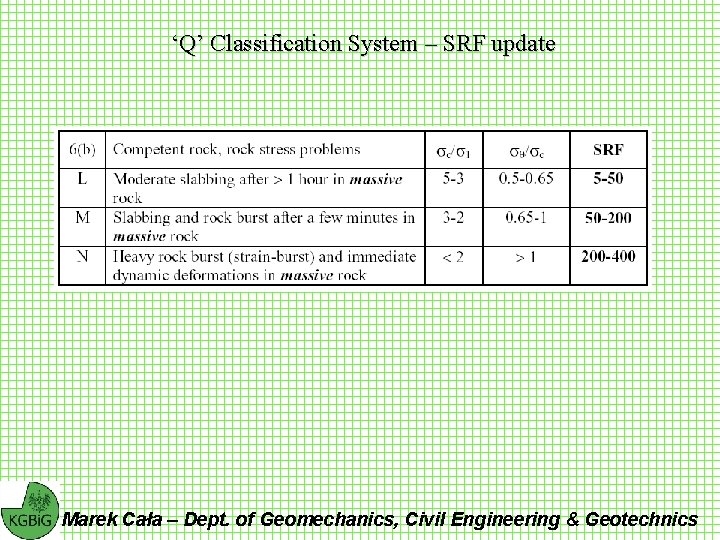
‘Q’ Classification System – SRF update Marek Cała – Dept. of Geomechanics, Civil Engineering & Geotechnics
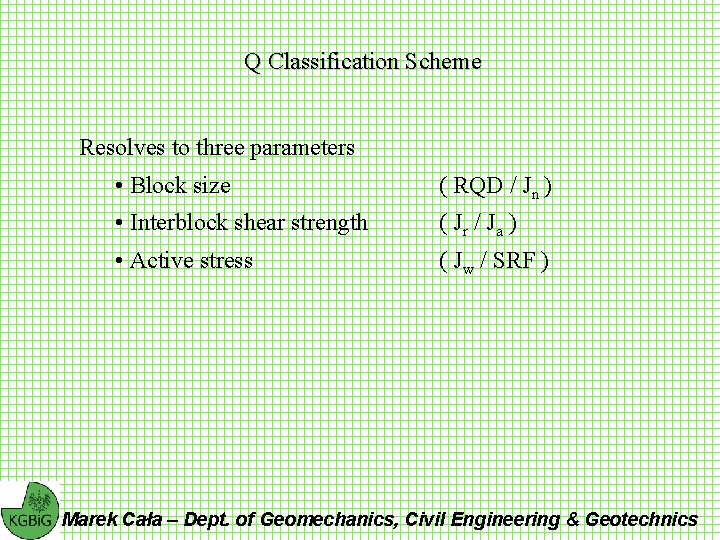
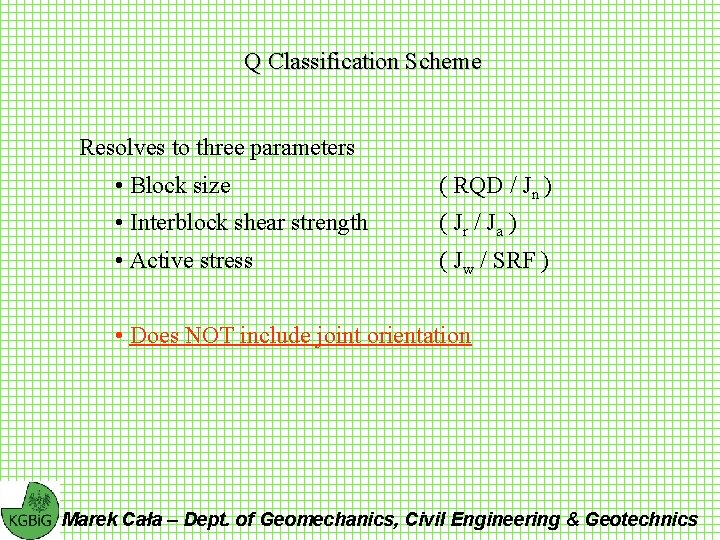
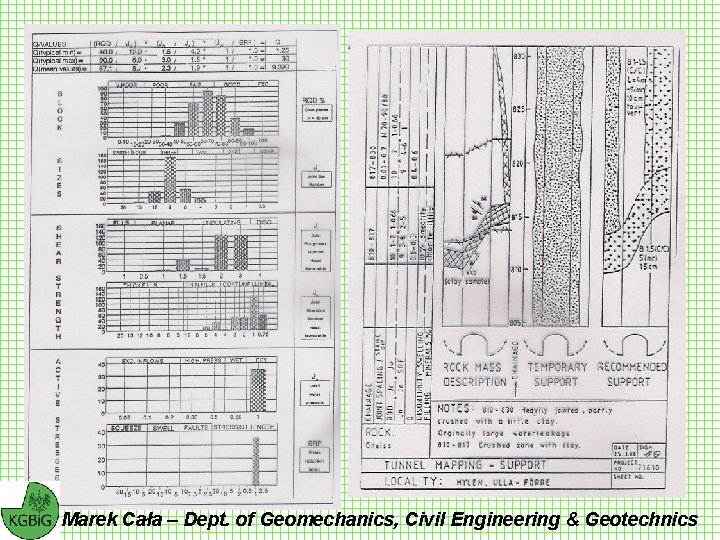
Q Classification Scheme Resolves to three parameters • Block size ( RQD / Jn ) • Interblock shear strength ( Jr / Ja ) • Active stress ( Jw / SRF ) Marek Cała – Dept. of Geomechanics, Civil Engineering & Geotechnics
Q Classification Scheme Resolves to three parameters • Block size ( RQD / Jn ) • Interblock shear strength ( Jr / Ja ) • Active stress ( Jw / SRF ) • Does NOT include joint orientation Marek Cała – Dept. of Geomechanics, Civil Engineering & Geotechnics
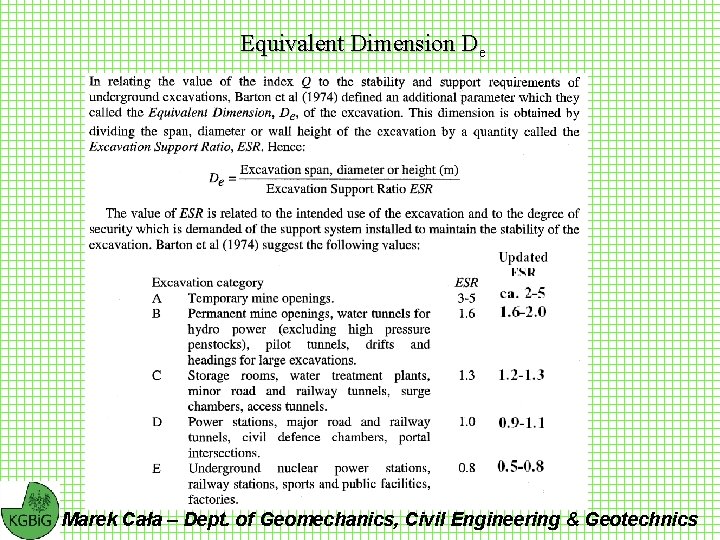
Equivalent Dimension De Marek Cała – Dept. of Geomechanics, Civil Engineering & Geotechnics
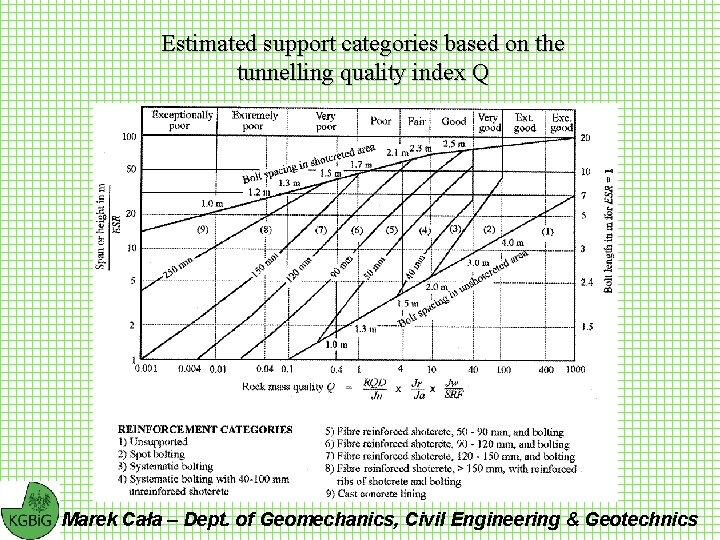
Estimated support categories based on the tunnelling quality index Q Marek Cała – Dept. of Geomechanics, Civil Engineering & Geotechnics
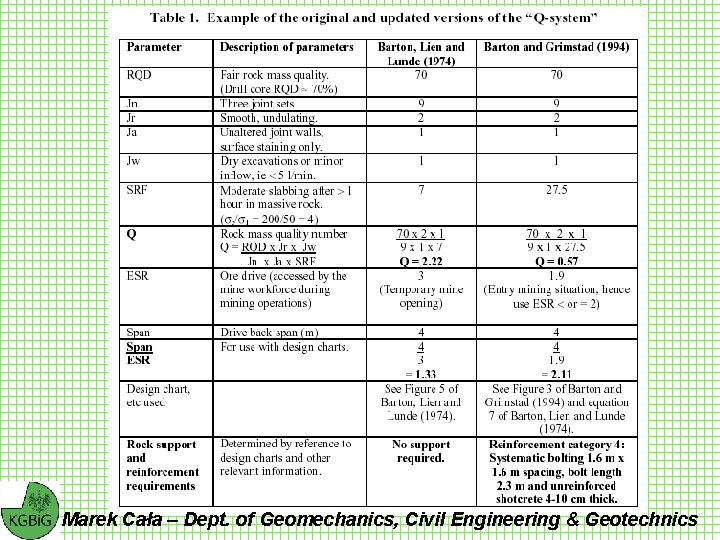
Q Classification Scheme Marek Cała – Dept. of Geomechanics, Civil Engineering & Geotechnics
Marek Cała – Dept. of Geomechanics, Civil Engineering & Geotechnics
Marek Cała – Dept. of Geomechanics, Civil Engineering & Geotechnics
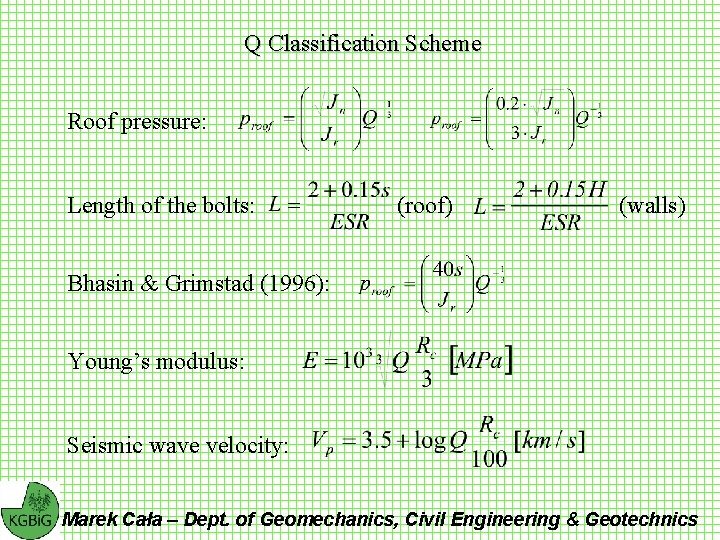
Q Classification Scheme Roof pressure: Length of the bolts: (roof) (walls) Bhasin & Grimstad (1996): Young’s modulus: Seismic wave velocity: Marek Cała – Dept. of Geomechanics, Civil Engineering & Geotechnics
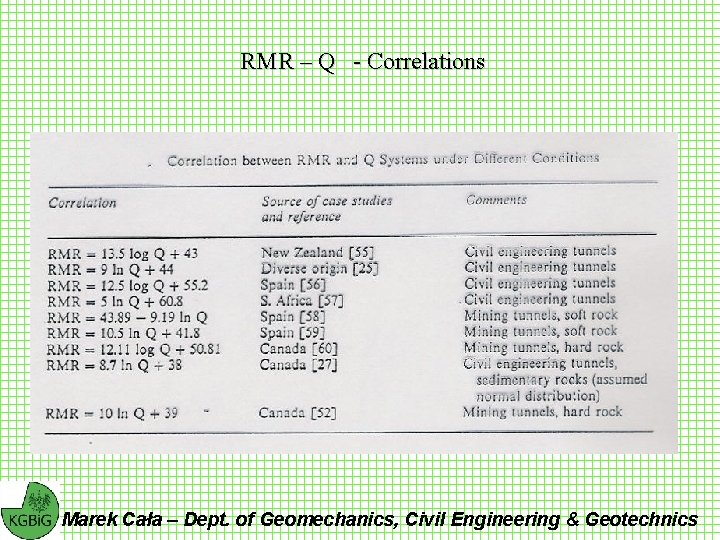
RMR – Q - Correlations Marek Cała – Dept. of Geomechanics, Civil Engineering & Geotechnics
Rock Mass Classification System • RMR and Q system or variants are the most widely used • both incorporate geological, geometric and design/engineering parameters to obtain a “value” of rock mass quality • empirical and require subjective assessment Marek Cała – Dept. of Geomechanics, Civil Engineering & Geotechnics
Rock Mass Classification System Approach: • accurately characterise the rockmass ie: full and complete description of the rockmass • assign parameters for classification later • always use two systems for comparison Marek Cała – Dept. of Geomechanics, Civil Engineering & Geotechnics
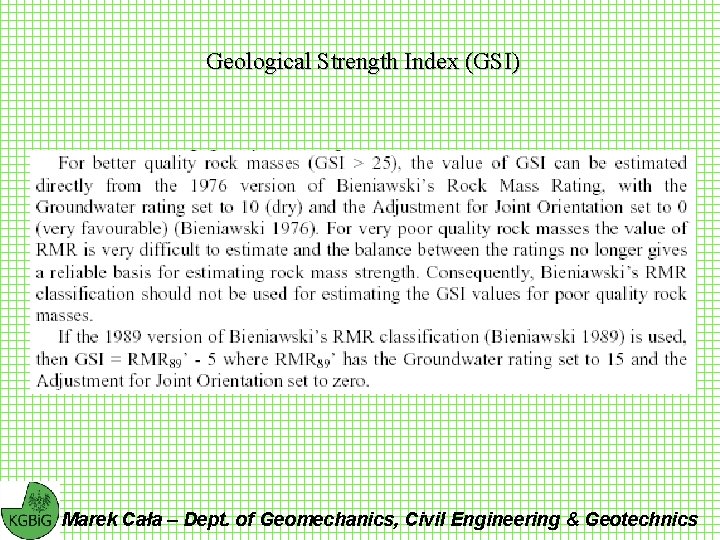
Geological Strength Index (GSI) • Method to link the constants m and s of Hoek-Brown failure criterion to observations in the field ie: a possible solution to the problem of estimating strength of jointed rockmass • A system for estimating the reduction in rockmass strength for different geological conditions • Overcomes deficiencies of RMR for poor quality rock Marek Cała – Dept. of Geomechanics, Civil Engineering & Geotechnics
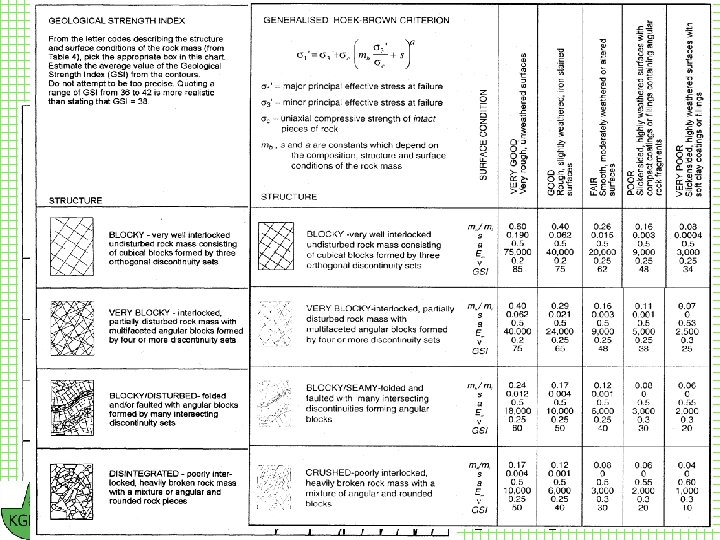
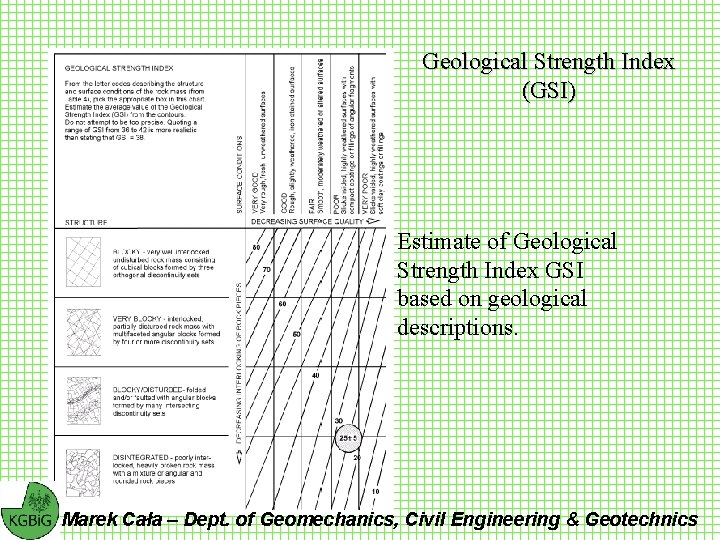
Estimate of Geological Strength Index GSI based on geological descriptions Estimation of constants based upon rock mass structure and discontinuity surface conditions Marek Cała – Dept. of Geomechanics, Civil Engineering & Geotechnics
Geological Strength Index (GSI) Marek Cała – Dept. of Geomechanics, Civil Engineering & Geotechnics
Geological Strength Index (GSI) Estimate of Geological Strength Index GSI based on geological descriptions. Marek Cała – Dept. of Geomechanics, Civil Engineering & Geotechnics
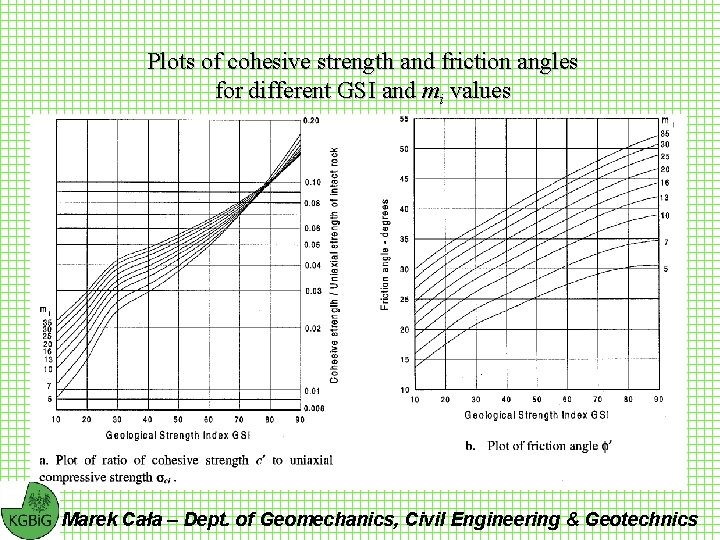
Plots of cohesive strength and friction angles for different GSI and mi values Marek Cała – Dept. of Geomechanics, Civil Engineering & Geotechnics
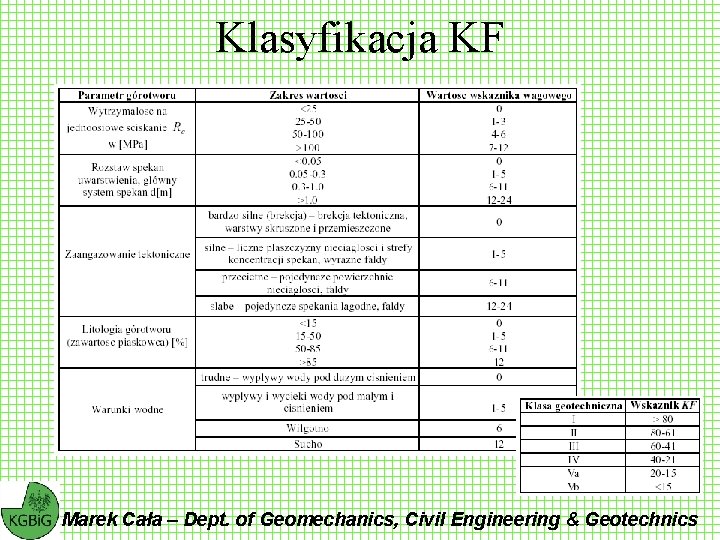
Klasyfikacja KF Marek Cała – Dept. of Geomechanics, Civil Engineering & Geotechnics