
Robustness by cutting planes and the Uncertain Set

Robustness by cutting planes and the Uncertain Set Covering Problem Matteo Fischetti Michele Monaci DEI, University of Padova {fisch, monaci}@dei. unipd. it AIRO 2008, Ischia, 10 September 2008 (work supported my Mi. UR and EU) 1

Motivation • A typical assumption in combinatorial optimization: The exact values of all input data are known in advance • This assumption can be violated in practical (real-world) applications • The optimal solution, even if computed very accurately, can be very hard to implement accurately • The solution found using nominal values of the parameters can be suboptimal or even infeasible • Small uncertainty in the data can make the nominal optimal solution completely meaningless from a practical viewpoint. 2
Dealing with Uncertainty • Nominal problem (LP) min { c. Tx: Ax ≤ b, x ≥ 0 } • We assume that each coefficient aij of matrix A can take any value ãij in the interval [aij – âij, aij + âij] • Bertsimas and Sim (BS’ 04): a solution is considered robust if it remains feasible when at most Γi coefficients in each row i take their worst value 3
Compact formulation • Replace the i-th row with its robust counterpart ai. Tx + β(Γi, x) ≤ bi where β(Γi, x) = max { ∑jЄS aijxj, |S| ≤ Γi} represents the level of protection of the solution with respect to row • Using LP duality, BS obtained a compact formulation for the robust LP involving a substantial n. of additional var. s and constraints 4

Robustness by cutting planes • Robustness of the solution with respect to row i can alternatively be imposed by means of robustness cuts ∑jЄN aijxj + ∑jЄS âijxj ≤ bi, for all S: |S| ≤ Γi • This allows one to work on the original variable space but requires to handle an exponential number of constraints. – Cutting planes approach – Separation of the current solution x* can be carried out in linear time: select the (at most) Γi variables with largest positive values of 5
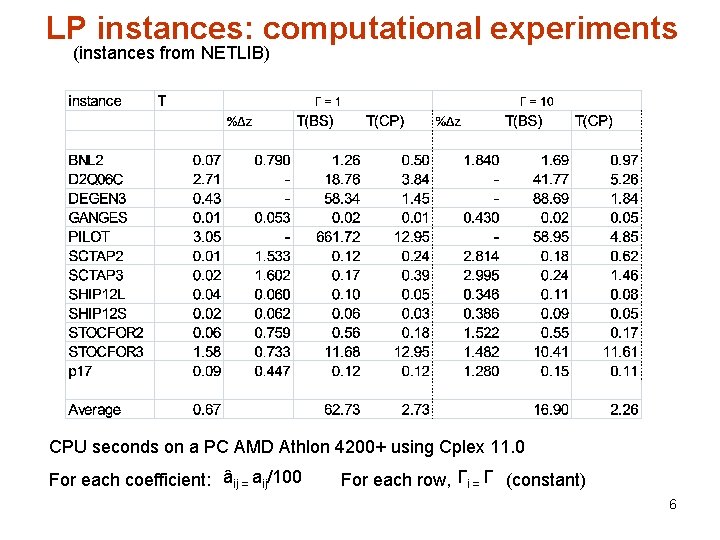
LP instances: computational experiments (instances from NETLIB) CPU seconds on a PC AMD Athlon 4200+ using Cplex 11. 0 For each coefficient: âij = aij/100 For each row, Γi = Γ (constant) 6
Cutting planes as the only option There are situations where cutting planes are the only possible way to deal with uncertainty Indeed, compact formulation by BS cannot be applied, e. g. , • when the nominal formulation of the problem is itself noncompact (e. g. , TSP) • when the uncertainty domain cannot be fully described by a linear system – e. g. , when the uncertainty domain involves yes-no decisions that cannot be modeled by continuous variables. Uncertain set covering problems 7
The Uncertain Set Covering Problem Classical set covering problem • Given a n x m binary matrix A and a cost cj for each column j find a minimum-cost set S of columns such that each row is covered by (at least) one selected column Uncertain counterpart (USCP) • Each column j has a positive (independent) probability pj of disappearing, and each row must be covered with a probability larger than a given threshold P Prob(ai. Tx ≥ 1 ) > P, for all row i USCP arises, e. g. , in crew scheduling applications where each pairing can be unavailable due to uncertainty (driver’s nonshow) 8
Modeling USCP • Basic ILP model (M 1): each row i must be covered by a set of columns having a small probability of disappearing all together ∑jЄNS aijxj ≥ 1 for all S: ∏jЄS pj > 1 -P – Separation problem can be solved quickly (knapsack problem) • Alternative compact ILP model (M 2), exploiting aij and xj binaries: Prob(ai. Tx ≥ 1 ) > P Probabilities are independent one each other ∏jЄN aijxjpj ≤ 1 - P ∑jЄN aijwjxj ≥ W (*) with Probability that the selected col. s covering row i disappear all together Apply logarithm to both terms wj = -log(pj), W = -log(1 -P) 9
Modeling USCP • The models are equivalent in terms of integer solutions, but the associated LP relaxations are different (and no dominance exists among them) • Constraints ∑jЄN aijwjxj ≥ W can be strengthened (*) – Replacing wj with w’j = min{wj, W} – With a rounding argument akin to Gomory’s fractional cuts; given a positive integer k, the following inequality is valid for USCP ∑jЄN vij xj ≥ k (**) where vij are “small integer” defined as (k-1)aijwj/(W-ε) rounded up No dominance exists between (*) and (**) These new constraints make the model more stable from a numerical point of view. 10
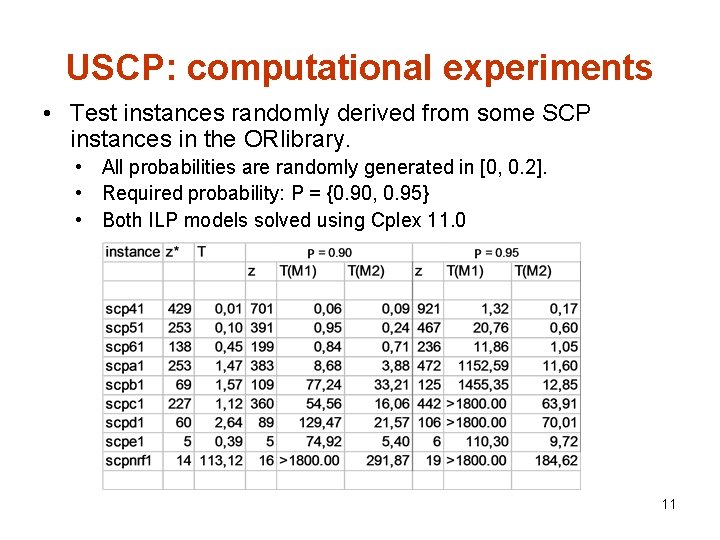
USCP: computational experiments • Test instances randomly derived from some SCP instances in the ORlibrary. • All probabilities are randomly generated in [0, 0. 2]. • Required probability: P = {0. 90, 0. 95} • Both ILP models solved using Cplex 11. 0 11
Uncertain graph connectivity • Given an undirected graph with costs and probabilities associated with edges, find a min-cost partial graph that is connected with a given probability P (NP-hard) • Arises e. g. in the design of reliable telecommunication network • ILP formulation min ∑eЄE cexe Prob(∑eЄδ(S) xe ≥ 1) > P for each proper nodeset S x binary • Assuming probabilities to be independent, the constraint associated with a given subset S reads ∑eЄδ(S) we xe ≥ W 12
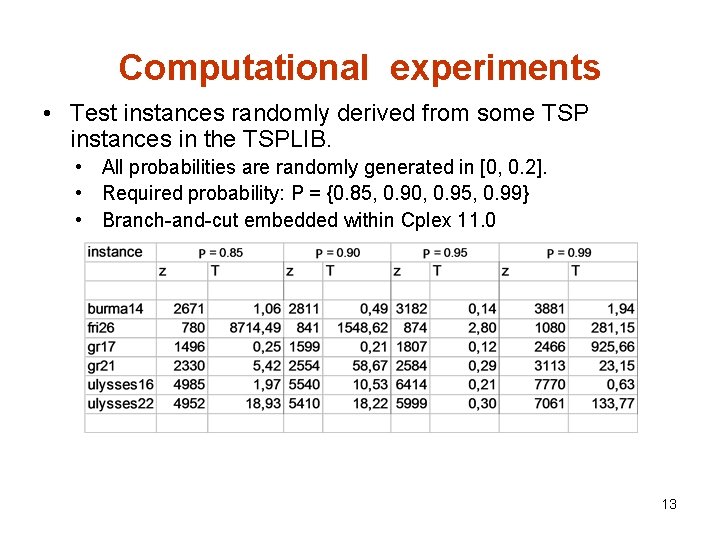
Computational experiments • Test instances randomly derived from some TSP instances in the TSPLIB. • All probabilities are randomly generated in [0, 0. 2]. • Required probability: P = {0. 85, 0. 90, 0. 95, 0. 99} • Branch-and-cut embedded within Cplex 11. 0 13
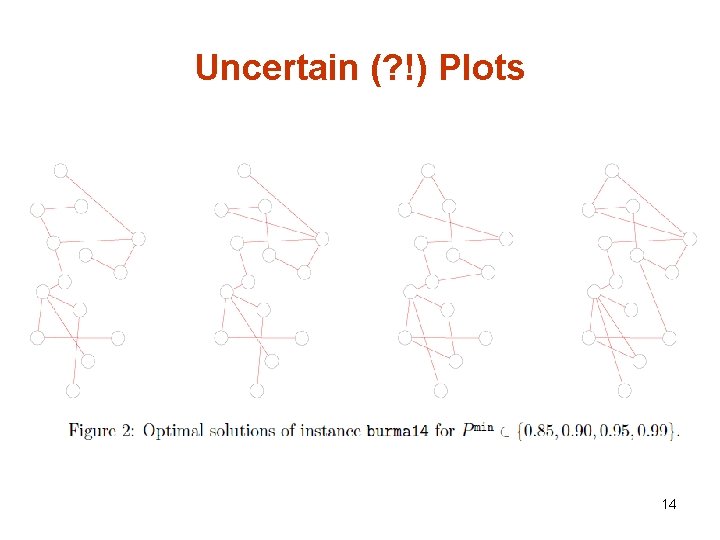
Uncertain (? !) Plots 14
- Slides: 14