
Robust Realtime Control Systems Reliability through algorithm design
Robust Real-time Control Systems Reliability through algorithm design, execution and system engineering Raktim Bhattacharya Assistant Professor raktim@aero. tamu. edu Department of Aerospace Engineering H. R. Bright Building, Rm. 701, Ross Street - TAMU 3141 College Station TX 77843 -3141 Raktim Bhattacharya AEROSPACE ENGINEERING
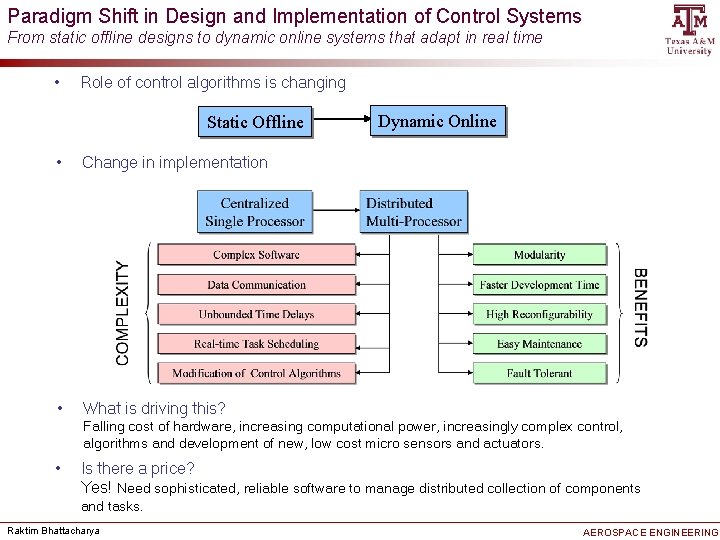
Paradigm Shift in Design and Implementation of Control Systems From static offline designs to dynamic online systems that adapt in real time • Role of control algorithms is changing Static Offline • Change in implementation • What is driving this? Dynamic Online Falling cost of hardware, increasing computational power, increasingly complex control, algorithms and development of new, low cost micro sensors and actuators. • Is there a price? Yes! Need sophisticated, reliable software to manage distributed collection of components and tasks. Raktim Bhattacharya AEROSPACE ENGINEERING
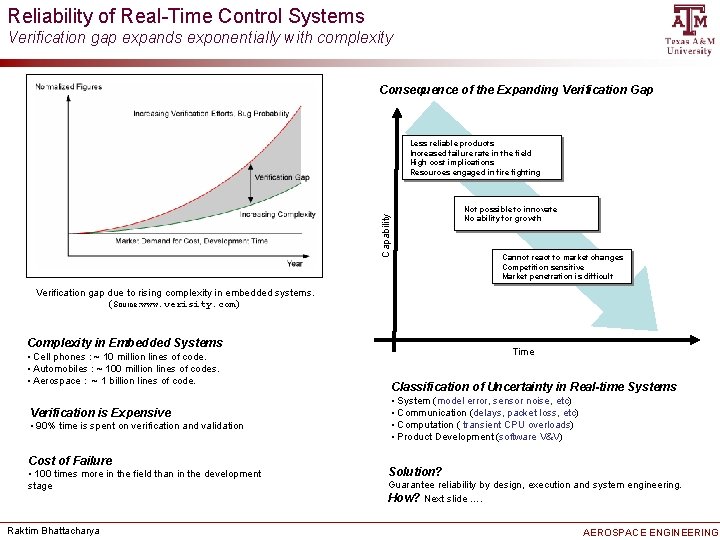
Reliability of Real-Time Control Systems Verification gap expands exponentially with complexity Consequence of the Expanding Verification Gap Capability Less reliable products Increased failure rate in the field High cost implications Resources engaged in fire fighting Not possible to innovate No ability for growth Cannot react to market changes Competition sensitive Market penetration is difficult Verification gap due to rising complexity in embedded systems. (Source: www. verisity. com) Complexity in Embedded Systems • Cell phones : ~ 10 million lines of code. • Automobiles : ~ 100 million lines of codes. • Aerospace : ~ 1 billion lines of code. Verification is Expensive • 90% time is spent on verification and validation Cost of Failure • 100 times more in the field than in the development stage Raktim Bhattacharya Time Classification of Uncertainty in Real-time Systems • System (model error, sensor noise, etc) • Communication (delays, packet loss, etc) • Computation ( transient CPU overloads) • Product Development (software V&V) Solution? Guarantee reliability by design, execution and system engineering. How? Next slide …. AEROSPACE ENGINEERING
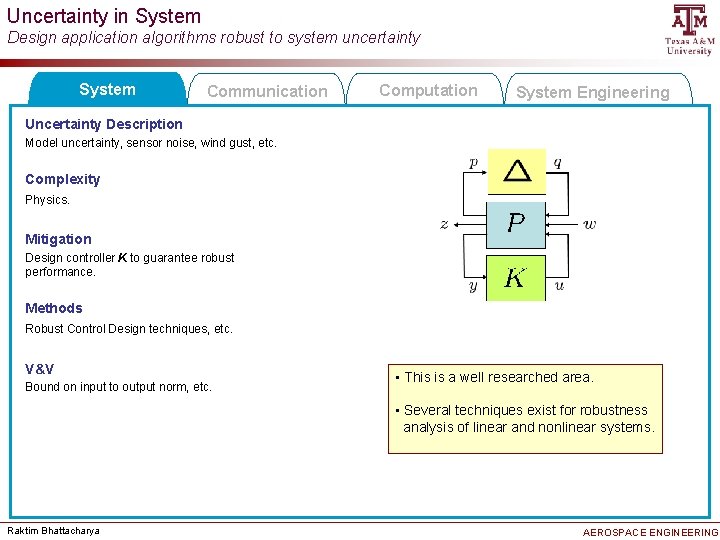
Uncertainty in System Design application algorithms robust to system uncertainty System Communication Computation System Engineering Uncertainty Description Model uncertainty, sensor noise, wind gust, etc. Complexity Physics. Mitigation Design controller K to guarantee robust performance. Methods Robust Control Design techniques, etc. V&V Bound on input to output norm, etc. • This is a well researched area. • Several techniques exist for robustness analysis of linear and nonlinear systems. Raktim Bhattacharya AEROSPACE ENGINEERING
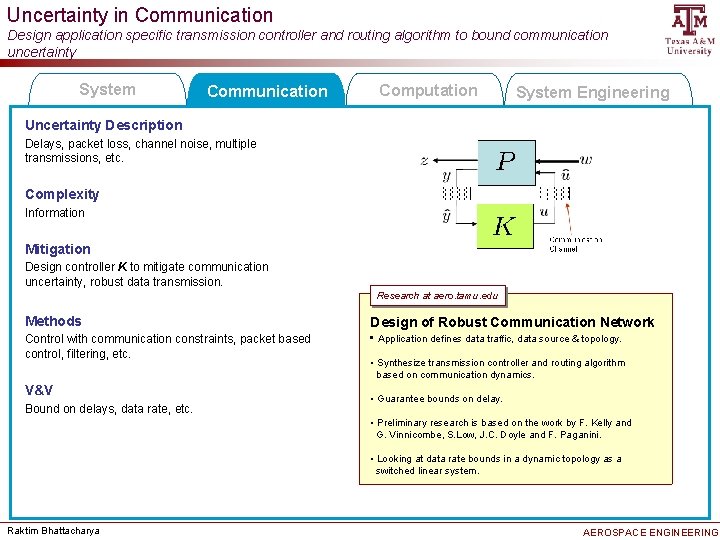
Uncertainty in Communication Design application specific transmission controller and routing algorithm to bound communication uncertainty System Communication Computation System Engineering Uncertainty Description Delays, packet loss, channel noise, multiple transmissions, etc. Complexity Information Mitigation Design controller K to mitigate communication uncertainty, robust data transmission. Research at aero. tamu. edu Methods Design of Robust Communication Network Control with communication constraints, packet based control, filtering, etc. • Application defines data traffic, data source & topology. V&V Bound on delays, data rate, etc. • Synthesize transmission controller and routing algorithm based on communication dynamics. • Guarantee bounds on delay. • Preliminary research is based on the work by F. Kelly and G. Vinnicombe, S. Low, J. C. Doyle and F. Paganini. • Looking at data rate bounds in a dynamic topology as a switched linear system. Raktim Bhattacharya AEROSPACE ENGINEERING
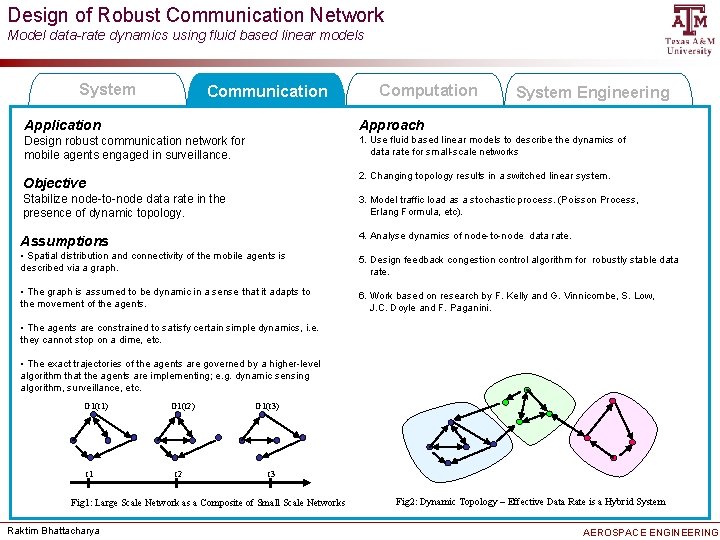
Design of Robust Communication Network Model data-rate dynamics using fluid based linear models System Communication Computation System Engineering Application Approach Design robust communication network for mobile agents engaged in surveillance. 1. Use fluid based linear models to describe the dynamics of data rate for small-scale networks 2. Changing topology results in a switched linear system. Objective Stabilize node-to-node data rate in the presence of dynamic topology. 3. Model traffic load as a stochastic process. (Poisson Process, Erlang Formula, etc). Assumptions 4. Analyse dynamics of node-to-node data rate. • Spatial distribution and connectivity of the mobile agents is described via a graph. 5. Design feedback congestion control algorithm for robustly stable data rate. • The graph is assumed to be dynamic in a sense that it adapts to the movement of the agents. 6. Work based on research by F. Kelly and G. Vinnicombe, S. Low, J. C. Doyle and F. Paganini. • The agents are constrained to satisfy certain simple dynamics, i. e. they cannot stop on a dime, etc. • The exact trajectories of the agents are governed by a higher-level algorithm that the agents are implementing; e. g. dynamic sensing algorithm, surveillance, etc. G 1(t 1) t 1 G 1(t 2) t 2 G 1(t 3) t 3 Fig 1: Large Scale Network as a Composite of Small Scale Networks Raktim Bhattacharya Fig 2: Dynamic Topology – Effective Data Rate is a Hybrid System AEROSPACE ENGINEERING
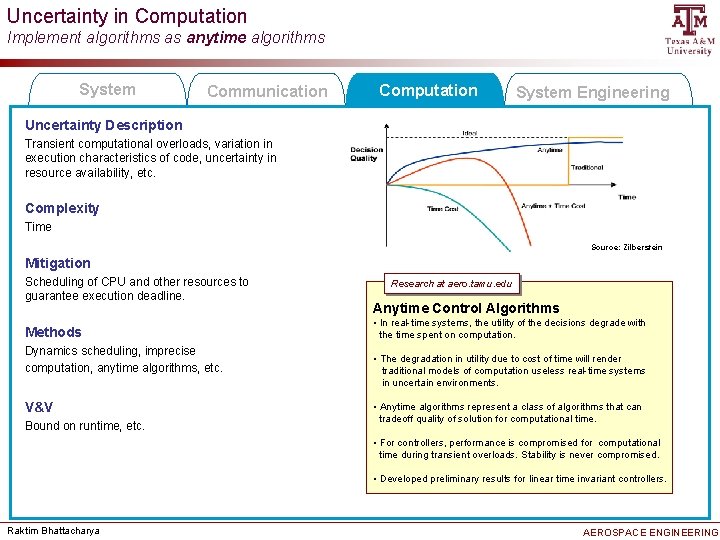
Uncertainty in Computation Implement algorithms as anytime algorithms System Communication Computation System Engineering Uncertainty Description Transient computational overloads, variation in execution characteristics of code, uncertainty in resource availability, etc. Complexity Time Source: Zilberstein Mitigation Scheduling of CPU and other resources to guarantee execution deadline. Methods Dynamics scheduling, imprecise computation, anytime algorithms, etc. V&V Bound on runtime, etc. Research at aero. tamu. edu Anytime Control Algorithms • In real-time systems, the utility of the decisions degrade with the time spent on computation. • The degradation in utility due to cost of time will render traditional models of computation useless real-time systems in uncertain environments. • Anytime algorithms represent a class of algorithms that can tradeoff quality of solution for computational time. • For controllers, performance is compromised for computational time during transient overloads. Stability is never compromised. • Developed preliminary results for linear time invariant controllers. Raktim Bhattacharya AEROSPACE ENGINEERING
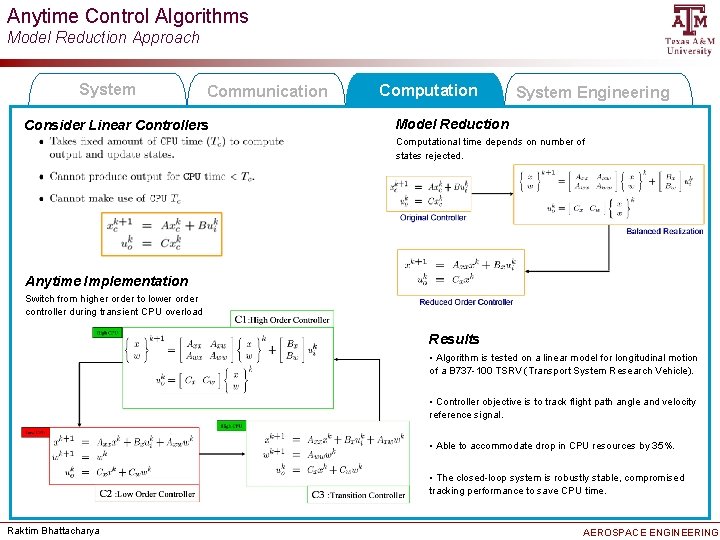
Anytime Control Algorithms Model Reduction Approach System Communication Consider Linear Controllers Computation System Engineering Model Reduction Computational time depends on number of states rejected. Anytime Implementation Switch from higher order to lower order controller during transient CPU overload Results • Algorithm is tested on a linear model for longitudinal motion of a B 737 -100 TSRV (Transport System Research Vehicle). • Controller objective is to track flight path angle and velocity reference signal. • Able to accommodate drop in CPU resources by 35%. • The closed-loop system is robustly stable, compromised tracking performance to save CPU time. Raktim Bhattacharya AEROSPACE ENGINEERING
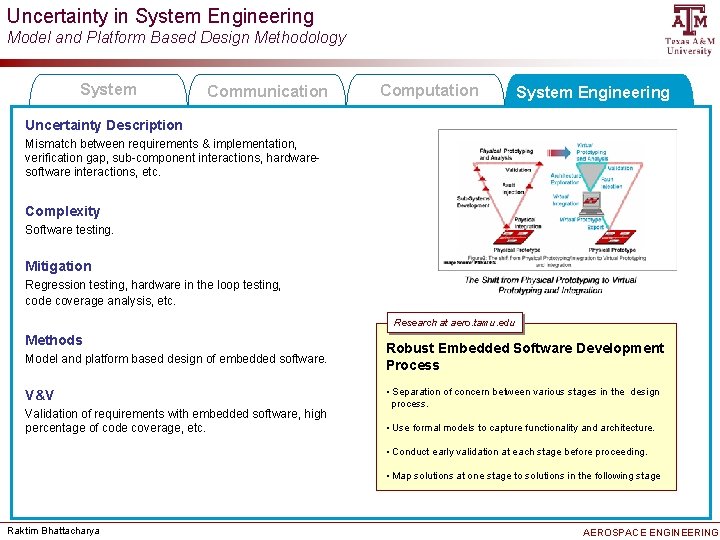
Uncertainty in System Engineering Model and Platform Based Design Methodology System Communication Computation System Engineering Uncertainty Description Mismatch between requirements & implementation, verification gap, sub-component interactions, hardwaresoftware interactions, etc. Complexity Software testing. Mitigation Regression testing, hardware in the loop testing, code coverage analysis, etc. Research at aero. tamu. edu Methods Model and platform based design of embedded software. Robust Embedded Software Development Process V&V • Separation of concern between various stages in the design process. Validation of requirements with embedded software, high percentage of code coverage, etc. • Use formal models to capture functionality and architecture. • Conduct early validation at each stage before proceeding. • Map solutions at one stage to solutions in the following stage Raktim Bhattacharya AEROSPACE ENGINEERING
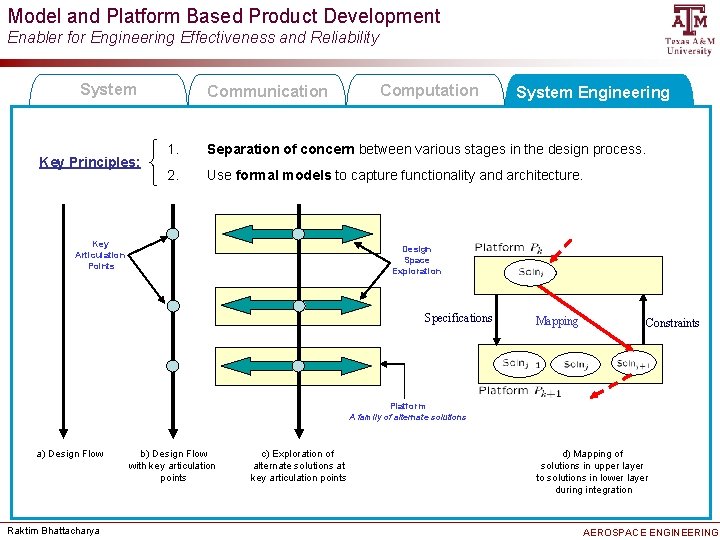
Model and Platform Based Product Development Enabler for Engineering Effectiveness and Reliability System Key Principles: Communication Computation System Engineering 1. Separation of concern between various stages in the design process. 2. Use formal models to capture functionality and architecture. Key Articulation Points Design Space Exploration Specifications Mapping Constraints Platform A family of alternate solutions a) Design Flow Raktim Bhattacharya b) Design Flow with key articulation points c) Exploration of alternate solutions at key articulation points d) Mapping of solutions in upper layer to solutions in lower layer during integration AEROSPACE ENGINEERING
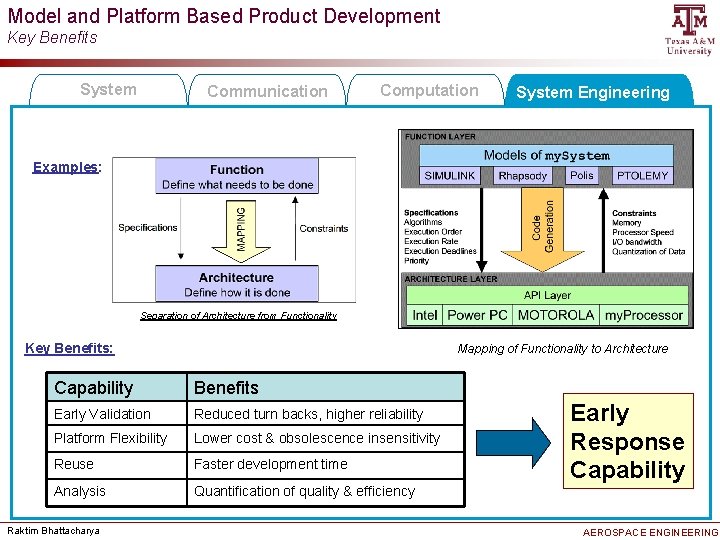
Model and Platform Based Product Development Key Benefits System Communication Computation System Engineering Examples: Separation of Architecture from Functionality Key Benefits: Mapping of Functionality to Architecture Capability Benefits Early Validation Reduced turn backs, higher reliability Platform Flexibility Lower cost & obsolescence insensitivity Reuse Faster development time Analysis Quantification of quality & efficiency Raktim Bhattacharya Early Response Capability AEROSPACE ENGINEERING
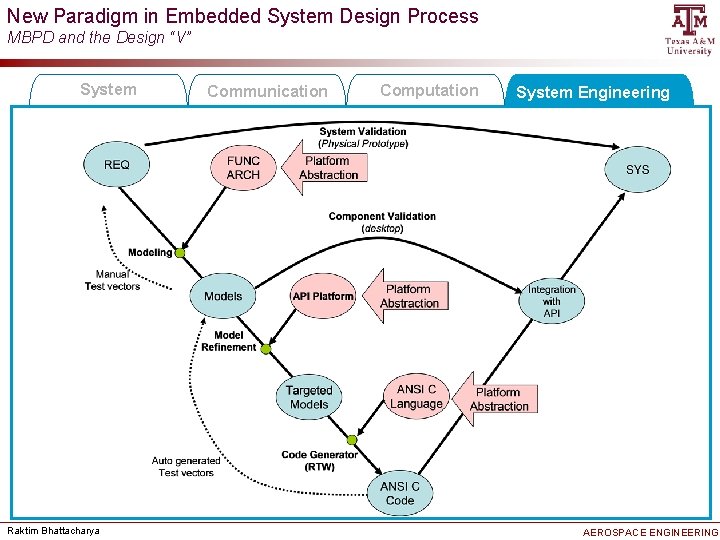
New Paradigm in Embedded System Design Process MBPD and the Design “V” System Raktim Bhattacharya Communication Computation System Engineering AEROSPACE ENGINEERING
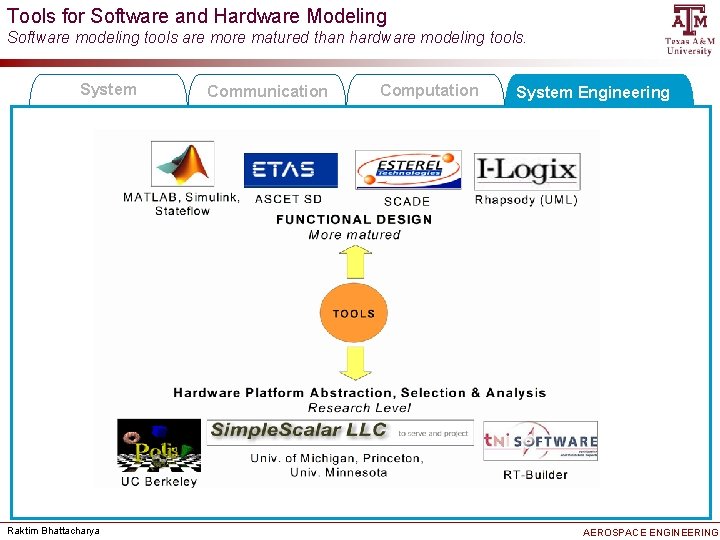
Tools for Software and Hardware Modeling Software modeling tools are more matured than hardware modeling tools. System Raktim Bhattacharya Communication Computation System Engineering AEROSPACE ENGINEERING
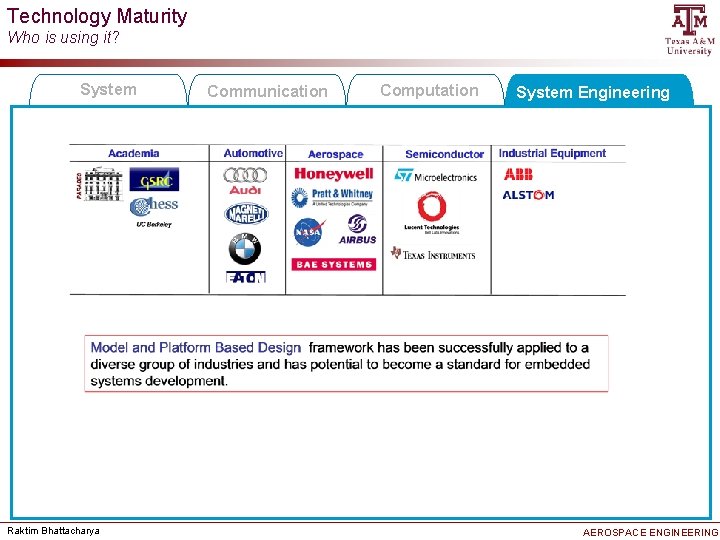
Technology Maturity Who is using it? System Raktim Bhattacharya Communication Computation System Engineering AEROSPACE ENGINEERING
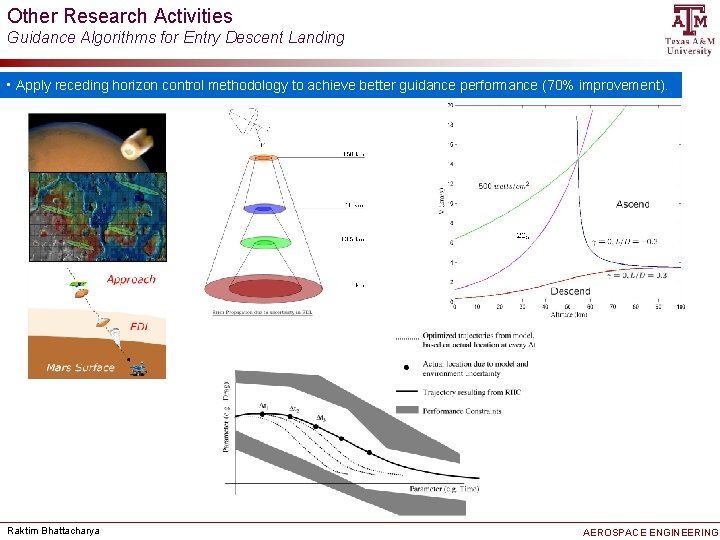
Other Research Activities Guidance Algorithms for Entry Descent Landing • Apply receding horizon control methodology to achieve better guidance performance (70% improvement). Raktim Bhattacharya AEROSPACE ENGINEERING
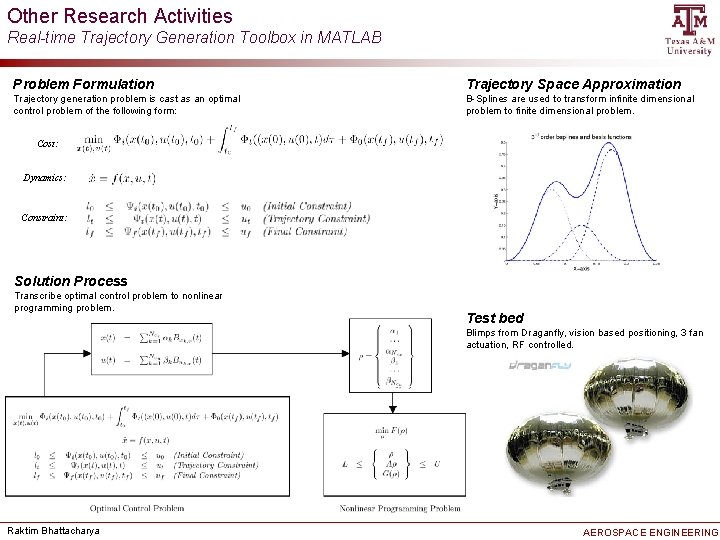
Other Research Activities Real-time Trajectory Generation Toolbox in MATLAB Problem Formulation Trajectory Space Approximation Trajectory generation problem is cast as an optimal control problem of the following form: B-Splines are used to transform infinite dimensional problem to finite dimensional problem. Cost: Dynamics: Constraint: Solution Process Transcribe optimal control problem to nonlinear programming problem. Test bed Blimps from Draganfly, vision based positioning, 3 fan actuation, RF controlled. Raktim Bhattacharya AEROSPACE ENGINEERING
Questions ? Raktim Bhattacharya AEROSPACE ENGINEERING
- Slides: 17