
ROBUST FACE ALIGNMENT WITH CASCADED COARSETOFINE AUTOENCODER NETWORK

ROBUST FACE ALIGNMENT WITH CASCADED COARSE-TO-FINE AUTO-ENCODER NETWORK Cheng Peng, Yongxin Ge, Mingjian Hong, Sheng Huang, Dan Yang Chongqing University
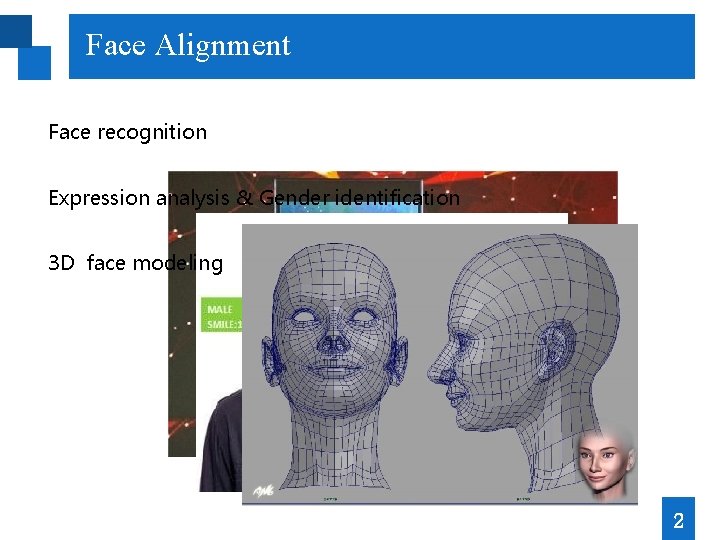
Face Alignment Face recognition Expression analysis & Gender identification 3 D face modeling 2
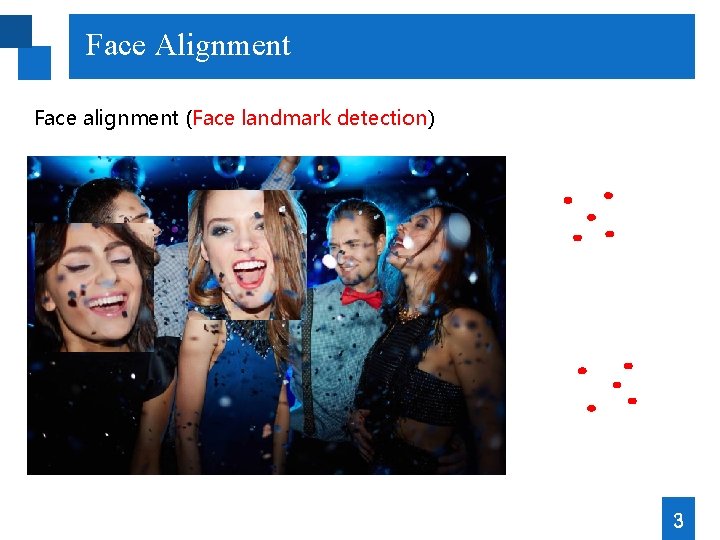
Face Alignment Face alignment (Face landmark detection) 3
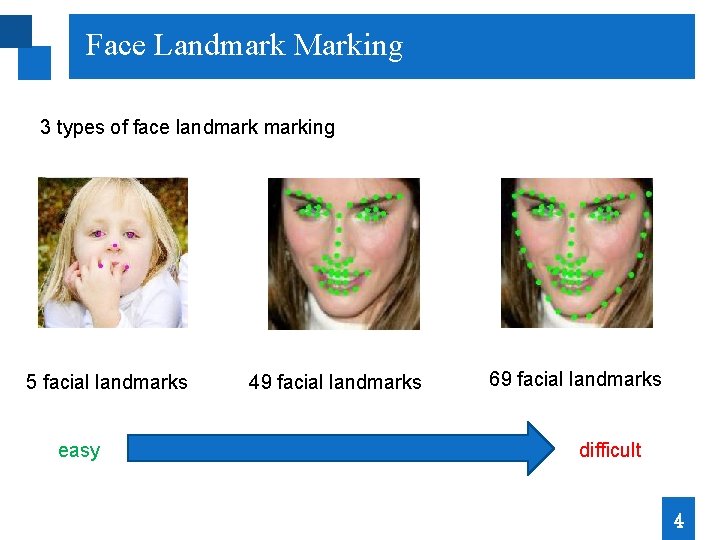
Face Landmark Marking 3 types of face landmarking 5 facial landmarks easy 49 facial landmarks 69 facial landmarks difficult 4
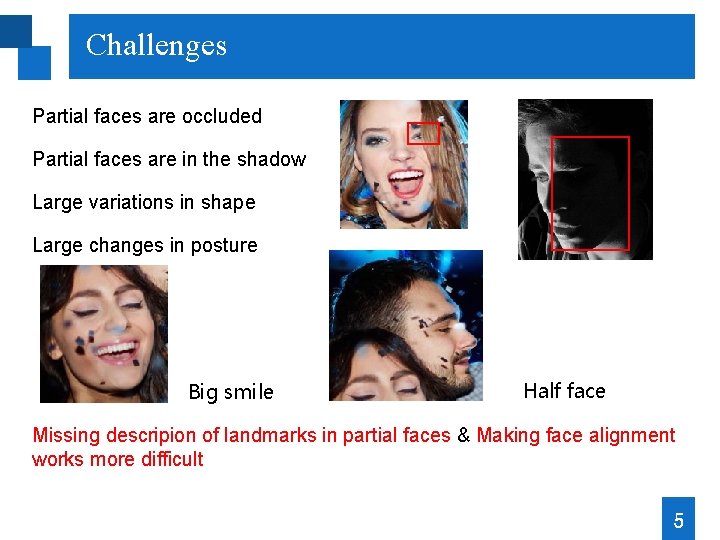
Challenges Partial faces are occluded Partial faces are in the shadow Large variations in shape Large changes in posture Big smile Half face Missing descripion of landmarks in partial faces & Making face alignment works more difficult 5
![Traditional Methods Face Alignment Shape Regression SDM [1] Jacobian & Hessian matrices Linear regression](http://slidetodoc.com/presentation_image_h2/f16596076f804502413b99aa93af3b06/image-6.jpg "Traditional Methods Face Alignment Shape Regression SDM [1] Jacobian & Hessian matrices Linear regression")
Traditional Methods Face Alignment Shape Regression SDM [1] Jacobian & Hessian matrices Linear regression [1] Xiong, X. , De la Torre, F. : Supervised descent method and its applications to face alignment. In CVPR, pp. 532– 539. IEEE (2013) 6
![Cascaded Shape Regression Methods CFAN [2] Extracting features by deep learning methods • CNN,](http://slidetodoc.com/presentation_image_h2/f16596076f804502413b99aa93af3b06/image-7.jpg "Cascaded Shape Regression Methods CFAN [2] Extracting features by deep learning methods • CNN,")
Cascaded Shape Regression Methods CFAN [2] Extracting features by deep learning methods • CNN, AE, RNN Cascaded Shape Regression • refining residual of shape stage-by-stage [2] Zhang, J. , Shan, S. , Kan, M. , Chen, X. : Coarse-to-fine auto-encoder networks (CFAN) for real-time face alignment. In ECCV, pp. 1 -16, 2014. 7
Motivation • Ignoring the difficulty of localizing distinct landmarks are unbalanced Divide one regressor into five regressors • Sift can easily suffer from partial occlusion and shadow Extract local pixel features • Deep neural network is easy to be over-fitting Smart training 8
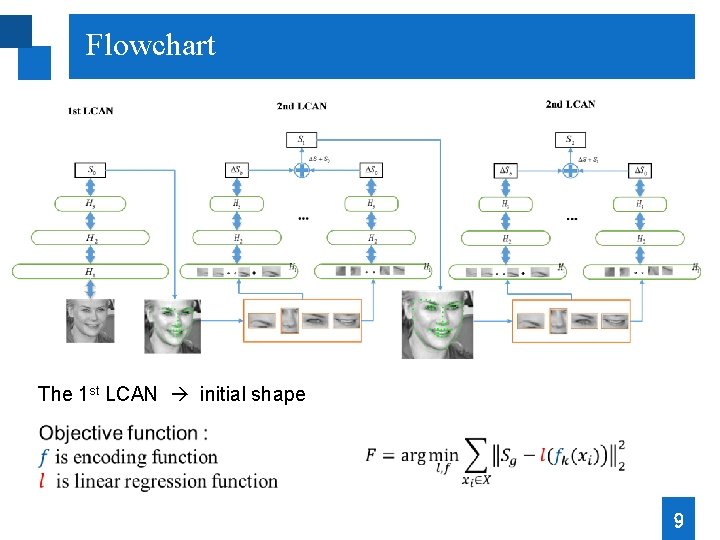
Flowchart The 1 st LCAN initial shape 9
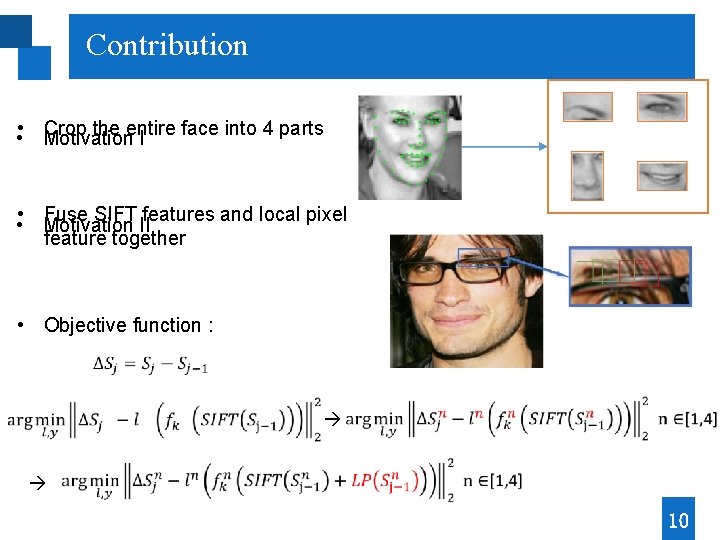
Contribution • Crop the entire face into 4 parts • Motivation I • Fuse SIFT features and local pixel • Motivation II feature together • Objective function : 10
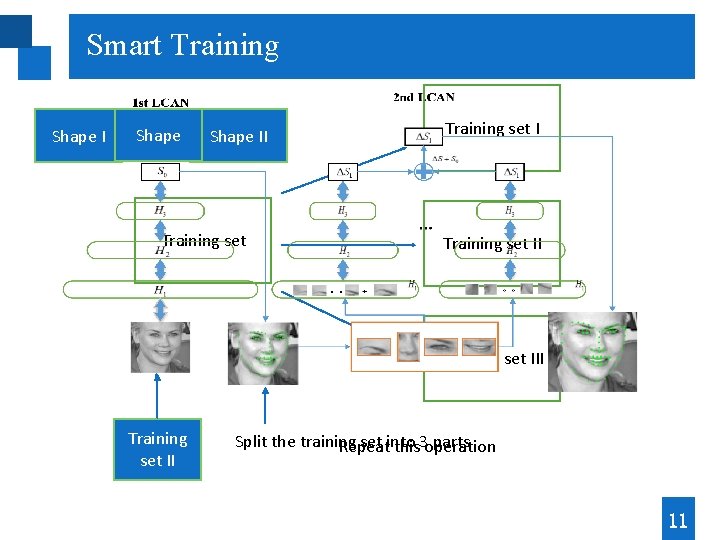
Smart Training Shape II Training set III Training set III Split the training set into parts Repeat this 3 operation 11
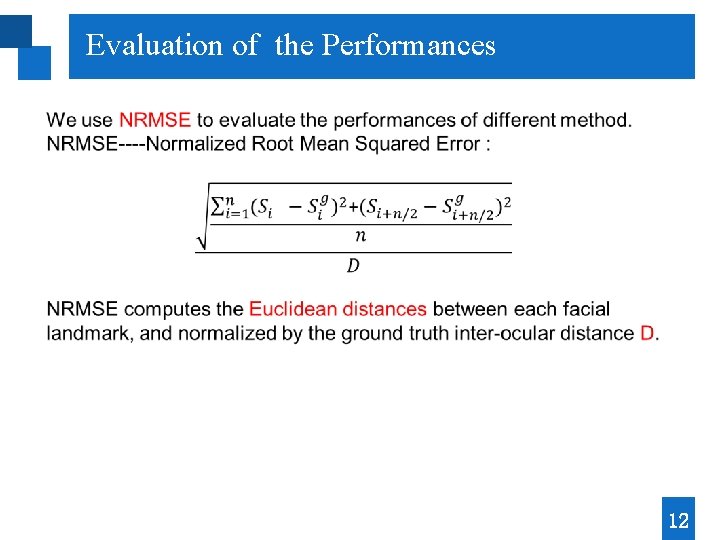
Evaluation of the Performances 12
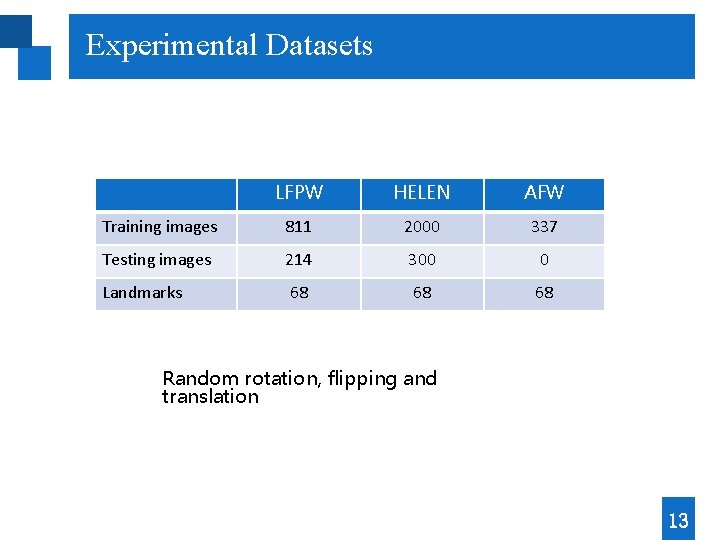
Experimental Datasets LFPW HELEN AFW Training images 811 2000 337 Testing images 214 300 0 Landmarks 68 68 68 Random rotation, flipping and translation 13
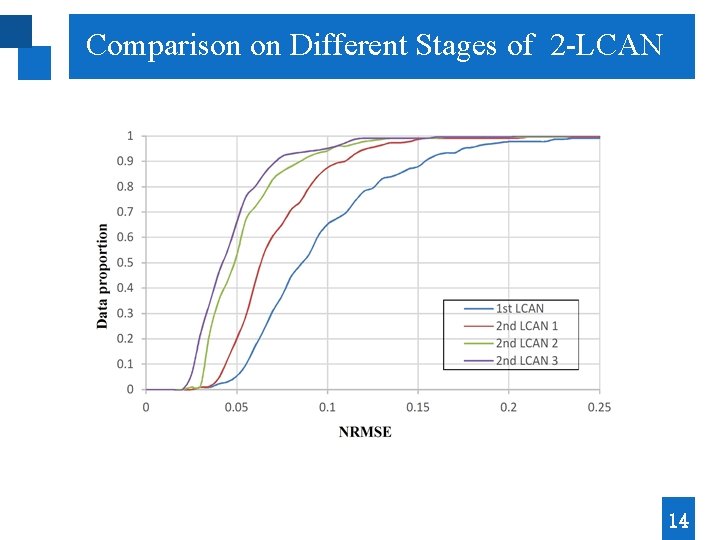
Comparison on Different Stages of 2 -LCAN 14
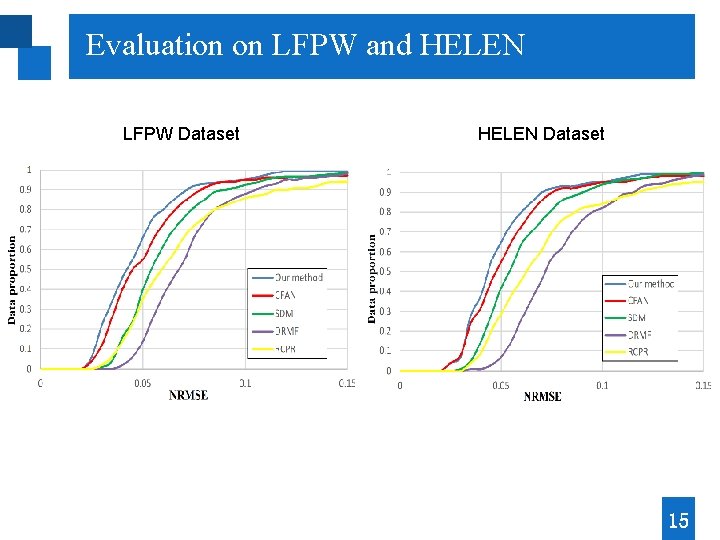
Evaluation on LFPW and HELEN LFPW Dataset HELEN Dataset 15
Summary • Factorizing the loss functions of different facial components • Fusing SIFT features and local pixel features together • A smart training method 16

THANKS
- Slides: 17