
Robots Theory Kirchhoffs Law Kirchhoffs Law In 1845
Robots – Theory Kirchhoffs Law

Kirchhoffs Law • In 1845, a German physicist, Gustav Kirchhoff developed a pair or set of rules or laws which deal with the conservation of current and energy within electrical circuits. These two rules are commonly known as: Kirchhoffs Circuit Laws with one of Kirchhoffs laws dealing with the current flowing around a closed circuit, Kirchhoffs Current Law, (KCL) while the other law deals with the voltage sources present in a closed circuit, Kirchhoffs Voltage Law, (KVL). 2
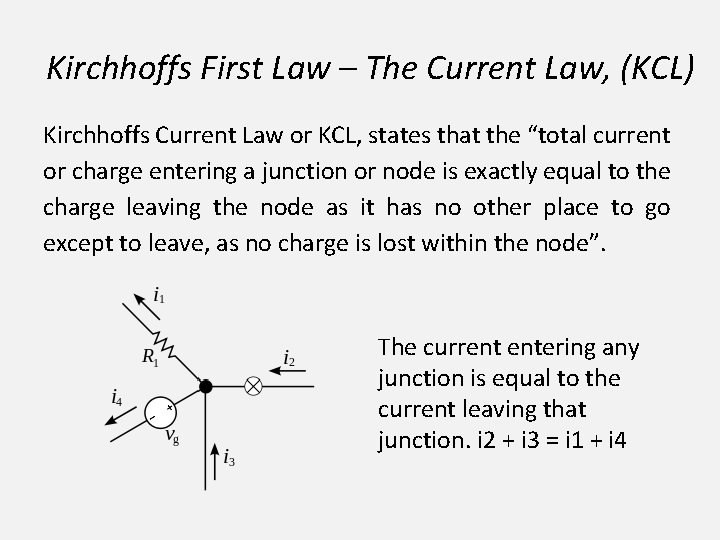
Kirchhoffs First Law – The Current Law, (KCL) Kirchhoffs Current Law or KCL, states that the “total current or charge entering a junction or node is exactly equal to the charge leaving the node as it has no other place to go except to leave, as no charge is lost within the node”. The current entering any junction is equal to the current leaving that junction. i 2 + i 3 = i 1 + i 4
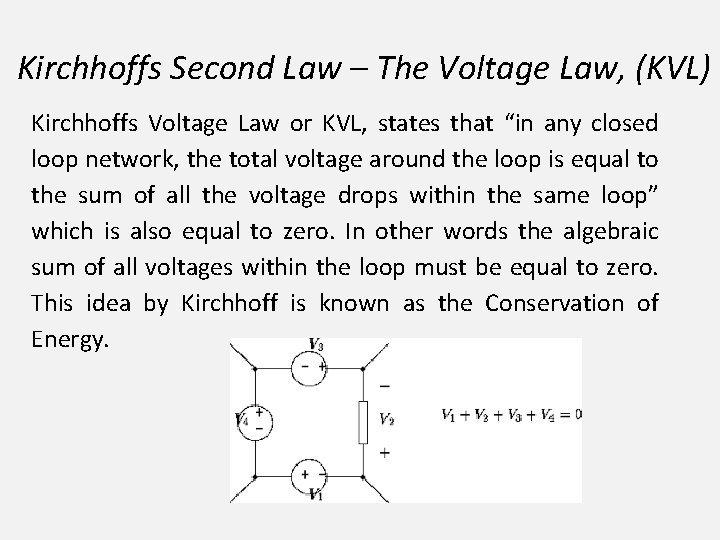
Kirchhoffs Second Law – The Voltage Law, (KVL) Kirchhoffs Voltage Law or KVL, states that “in any closed loop network, the total voltage around the loop is equal to the sum of all the voltage drops within the same loop” which is also equal to zero. In other words the algebraic sum of all voltages within the loop must be equal to zero. This idea by Kirchhoff is known as the Conservation of Energy.
- Slides: 4