
Robots their Application By Kamlesh Bachkar Syllabus Module

Robots & their Application By Kamlesh Bachkar
Syllabus Module 6 • Robots and their applications: • Introduction to robots, Types, Classifications, Selection of robots, Robot Degrees of freedom, Robot configuration, • Accuracy and repeatability, Specification of a robot, Robot feedback controls: Point to point control and Continuous path control, Control system for robot joint, • Adaptive control, Drives and transmission systems, End effectors, • Industrial robot applications of robots Link to NPTEL Course

Introduction • Origin of the word robot in 1923 — Translation of Czech play R. U. R. (Rossum’s Universal Robot, 1921) by Karel Capek (Capek, 1975). • From Czech word ‘robota’ meaning slave labour! • Designed to replace human beings, and depicted as very efficient and lacking emotion– Even now this description is prevalent! • Asimov (Asimov, 1970) in Round about coins robotics in his three laws of robotics— Robots are portrayed as harmless and in control of humans! • First industrial robot patent in 1954 by George C. Devol (US Patent No. 2, 988, 237) for Universal Automation or Unimation. • First robot by Unimation, Inc. (Founded by J. Engelbergerand George C. Devol) called Unimate– Used by General Motors at Trenton, New Jersey automobile plant for die-cast handling and spot welding.
Robotics • Definition • The branch of technology that deals with the design, construction, operation, and application of robots. • Robotics is a branch of engineering that involves the conception, design, manufacture, and operation of robots. This field overlaps with electronics, computer science, artificial intelligence, mechatronics, nanotechnology and bioengineering. • Need…. . ? ? • Utility …. . ? ?
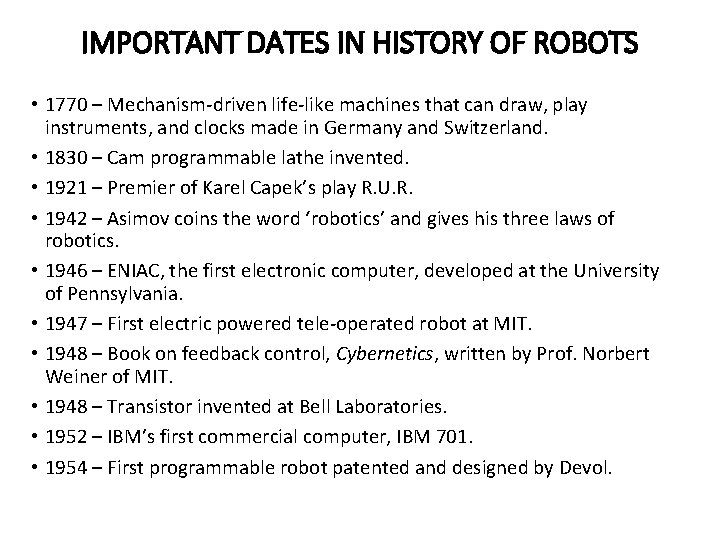
IMPORTANT DATES IN HISTORY OF ROBOTS • 1770 – Mechanism-driven life-like machines that can draw, play instruments, and clocks made in Germany and Switzerland. • 1830 – Cam programmable lathe invented. • 1921 – Premier of Karel Capek’s play R. U. R. • 1942 – Asimov coins the word ‘robotics’ and gives his three laws of robotics. • 1946 – ENIAC, the first electronic computer, developed at the University of Pennsylvania. • 1947 – First electric powered tele-operated robot at MIT. • 1948 – Book on feedback control, Cybernetics, written by Prof. Norbert Weiner of MIT. • 1948 – Transistor invented at Bell Laboratories. • 1952 – IBM’s first commercial computer, IBM 701. • 1954 – First programmable robot patented and designed by Devol.
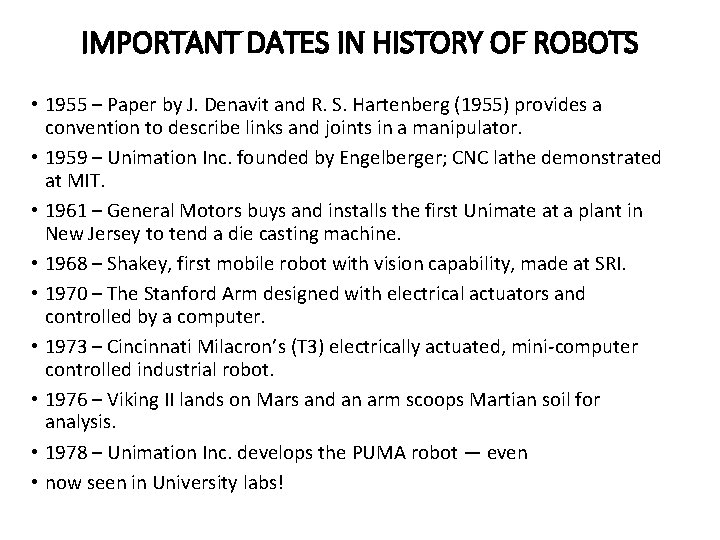
IMPORTANT DATES IN HISTORY OF ROBOTS • 1955 – Paper by J. Denavit and R. S. Hartenberg (1955) provides a convention to describe links and joints in a manipulator. • 1959 – Unimation Inc. founded by Engelberger; CNC lathe demonstrated at MIT. • 1961 – General Motors buys and installs the first Unimate at a plant in New Jersey to tend a die casting machine. • 1968 – Shakey, first mobile robot with vision capability, made at SRI. • 1970 – The Stanford Arm designed with electrical actuators and controlled by a computer. • 1973 – Cincinnati Milacron’s (T 3) electrically actuated, mini-computer controlled industrial robot. • 1976 – Viking II lands on Mars and an arm scoops Martian soil for analysis. • 1978 – Unimation Inc. develops the PUMA robot — even • now seen in University labs!
IMPORTANT DATES IN HISTORY OF ROBOTS • 1981 – Robot Manipulators by R. Paul, one of the first textbooks on robotics. • 1982 – First educational robots by Microbot and Rhino. • 1983 – Adept Technology, maker of SCARA robot, started. • 1995 – Intuitive Surgical formed to design and market surgical robots. • 1997 – Sojourner robot sends back pictures of Mars; the Honda P 3 humanoid robot, started in 1986, unveiled. • 2000 – Honda demonstrates Asimo humanoid robot capable of walking. • 2001 – Sony releases second generation Aibo robot dog. • 2004 – Spirit and Opportunity explore Mars surface and detect evidence of past existence of water. • 2007 – Humanoid robot Aiko capable of “feeling” pain. • 2009 – Micro-robots and emerging field of nano-robots marrying biology with engineering.
Anatomy of Industrial robots • Classes of robots • • robotic aircraft robotic ships mobile robots Many more • application of robots • • machine tending Welding Painting Assembly These “industrial robots” can be viewed as consisting of a mechanical portion “the manipulator” controlled by a microprocessor.
Subsystems of industrial robots • Actuators • Transmission systems • Power supplies & power storage system • Sensors and Electronics • Microprocessors & controllers • Algorithms & software's • Output • • • Control of individual motors and actuators. Planning trajectory & individual actuators in motion. Planning trajectories of end effector. Acting upon sensors input Planning tasks
Types of Industrial Robots • Articulated • Cartesian • Cylindrical • Polar • SCARA • Delta
Types of Industrial Robots • Articulated Rotary joints – simple two joint structures to 10 or more joints. The arm is connected to the base with a twisting joint. The links in the arm are connected by rotary joints. Each joint is called an axis and provides an additional degree of freedom, or range of motion. • Industrial robots commonly have four or six axes. • • • Cartesian • These are also called rectilinear or gantry robots. • Cartesian robots have three linear joints that use the Cartesian coordinate system (X, Y, and Z). • They also may have an attached wrist to allow for rotational movement. • The three prismatic joints deliver a linear motion along the axis.
Types of Industrial Robots • Cylindrical • The robot has at least one rotary joint at the base and at least one prismatic joint to connect the links. • The rotary joint uses a rotational motion along the joint axis, while the prismatic joint moves in a linear motion. • Cylindrical robots operate within a cylindrical-shaped work envelope. • Polar • Also called as spherical robots, in this configuration the arm is connected to the base with a twisting joint and a combination of two rotary joints and one linear joint. • The axes form a polar coordinate system and create a spherical-shaped work envelope.
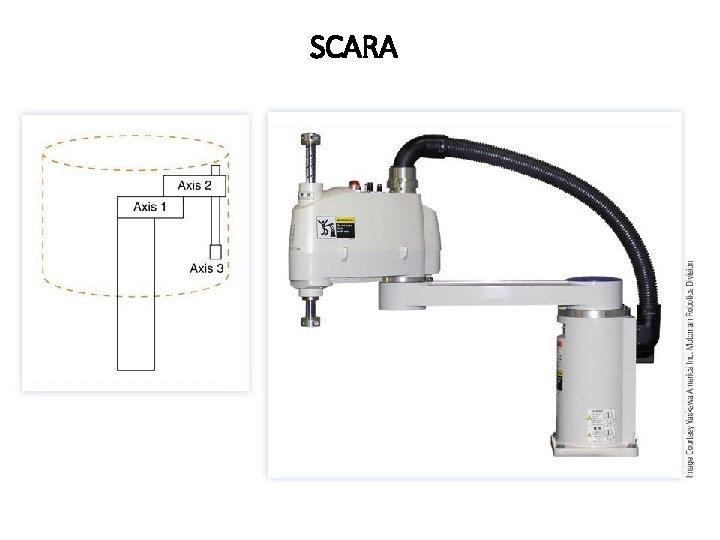
Types of Industrial Robots • SCARA (Selective Compliance Adaptive Robot Arm ) • Commonly used in assembly applications, this selectively compliant arm for robotic assembly is primarily cylindrical in design. • It features two parallel joints that provide compliance in one selected plane. • Delta • These spider-like robots are built from jointed parallelograms connected to a common base. • The parallelograms move a single EOAT(End of Arm Tooling) in a dome-shaped work area. • Heavily used in the food, pharmaceutical, and electronic industries, this robot configuration is capable of delicate, precise movement.
Types and Classification of Robot • Various ways of classifying a robot • • • Fixed or mobile. Serial or parallel. According to degree of freedom (DOF). Rigid or flexible. Control — Point-to-point, autonomy and “intelligence”. • Most older industrial robots • Fixed base and consisting of links connected by actuated joints. • Many modern robots can move on factory floors, uneven terrains or even walk, swim and fly
Types and Classification of Robot • Parameters for Classification • • • By power source By the shape of the work envelope By the size of the robot By the weight it can move By the type of jobs it is optimized for By the type of drive system used to move the robot
Types and Classification of Robot • Power Source • • • Electrical Hydraulic Pneumatic Nuclear Green • Solar • Wind • Organic sources • Natural heat sources
Geometry of the Work Envelope • Cartesian • Cylindrical • Spherical • Articulated • SCARA • Horizontally Base-Jointed Arm • Delta
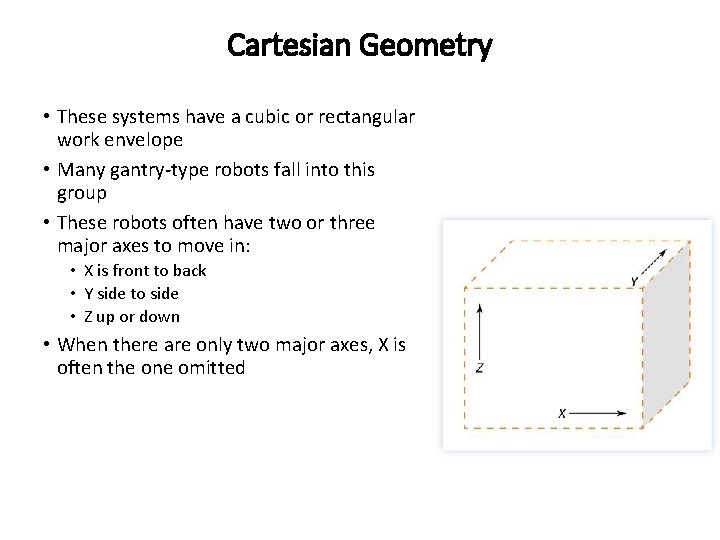
Cartesian Geometry • These systems have a cubic or rectangular work envelope • Many gantry-type robots fall into this group • These robots often have two or three major axes to move in: • X is front to back • Y side to side • Z up or down • When there are only two major axes, X is often the one omitted
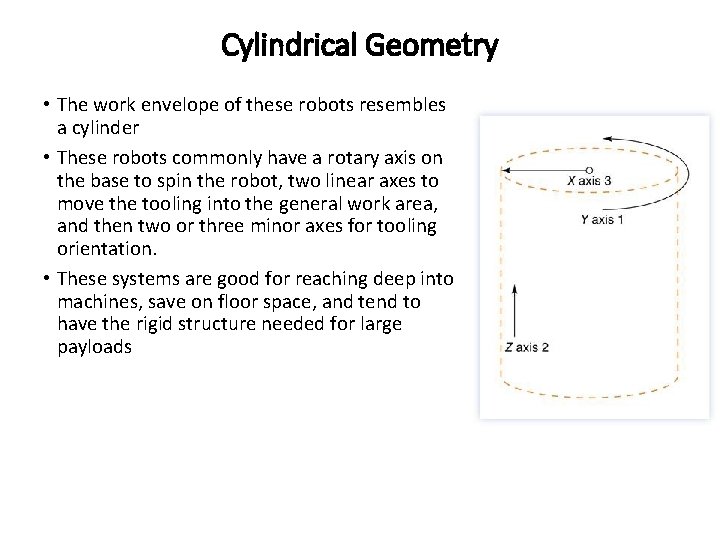
Cylindrical Geometry • The work envelope of these robots resembles a cylinder • These robots commonly have a rotary axis on the base to spin the robot, two linear axes to move the tooling into the general work area, and then two or three minor axes for tooling orientation. • These systems are good for reaching deep into machines, save on floor space, and tend to have the rigid structure needed for large payloads
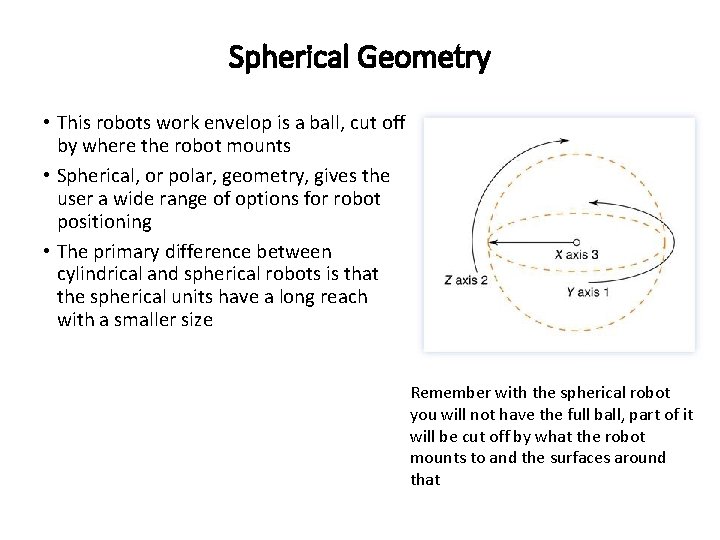
Spherical Geometry • This robots work envelop is a ball, cut off by where the robot mounts • Spherical, or polar, geometry, gives the user a wide range of options for robot positioning • The primary difference between cylindrical and spherical robots is that the spherical units have a long reach with a smaller size Remember with the spherical robot you will not have the full ball, part of it will be cut off by what the robot mounts to and the surfaces around that
Articulated Geometry • Articulated robots have a spherical-type envelope that is constrained by the construction of the robot • The articulated robot leaves linear motion behind for rotational motion at the various axes • This robot is also known as jointed arm, revolute, and even anthropomorphic, because in many cases, its motions look very organic and lifelike • It has a chunked-up portion of the spherical envelope due to the robot design and limitations of the system
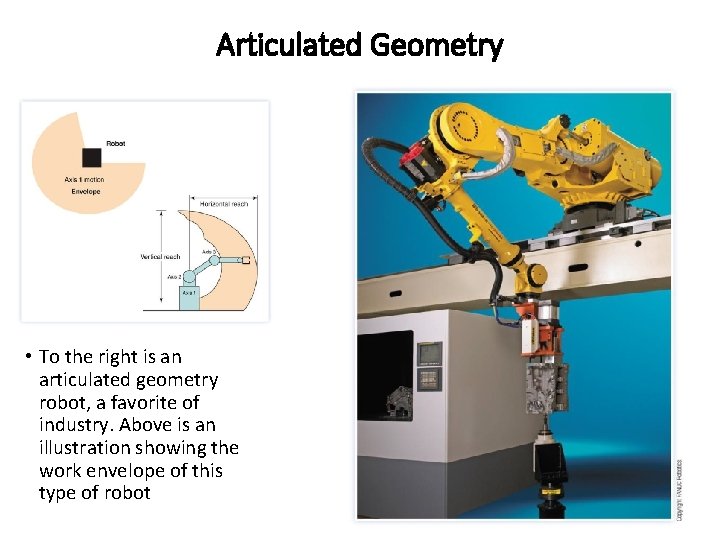
Articulated Geometry • To the right is an articulated geometry robot, a favorite of industry. Above is an illustration showing the work envelope of this type of robot
SCARA • Selective Compliance Articulated Robot Arm (SCARA)is unique in that it combines Cartesian linear motion with the rotation of an articulated system, creating a new motion type. • SCARA has a cylindrical geometry with axes 1 and 2 moving in a rotational manner and axis 3 moving in a linear vertical way to manipulate the tooling into position while applying force.
SCARA
DEGREE-OF-FREEDOM (DOF) • Degree of freedom (DOF) determines capability of a robot and number of actuated joints 6 (DOF) required for arbitrary task in 3 D. • Painting and welding can be done by 5 DOF robot. • Electronics assembly usually done by 4 DOF SCARA robot. • For extra flexibility/working volume, 5 or 6 DOF robot mounted on 2 or 3 DOF gantry or wheeled mobile robot. • Redundant robot with more than 6 DOF for avoiding obstacles, more flexibility etc. • Arrangement of first three joints (in fixed serial robots) are classified as: • • Cartesian Spherical Cylindrical Anthropomorphic — Human arm like. • SCARA or Selective Compliance Adaptive Robot Arm • Extensively used in electronic assembly. • Last three joints form a wrist — Orients the end-effector.
- Slides: 25