
Robotics Where AI meets the real world Ankit
Robotics Where AI meets the real world. Ankit Jain www. Ankit. Jain. info
What is a Robot ? n “A re-programmable, multifunctional manipulator designed to move material, parts, tools, or specialized devices through various programmed motions for the performance of a variety of tasks. ”
A robot must have the following essential characteristics: n n n Mobility: It possesses some form of mobility. Programmability: implying computational or symbol- manipulative capabilities that a designer can combine as desired (a robot is a computer). It can be programmed to accomplish a large variety of tasks. After being programmed, it operates automatically. Sensors: on or around the device that are able to sense the environment and give useful feedback to the device Mechanical capability: enabling it to act on its environment rather than merely function as a data processing or computational device (a robot is a machine); and Flexibility: it can operate using a range of programs and manipulates and transport materials in a variety of ways.
Isaac Asimov's Three Laws of Robotics n n Law Zero A robot may not injure humanity, or, through inaction, allow humanity to come to harm. First Law A robot may not injure a human being, or, through inaction, allow a human being to come to harm. Second Law A robot must obey orders given it by human beings, except where such orders would conflict with the First Law. Third Law A robot must protect its own existence as long as such protection does not conflict with the First or Second Law.

Construction & Working of the Robot Mechanical platforms- the hardware base Sensors Motors Driving mechanisms Power supplies Electronic Controls Microcontroller systems Languages R/C Servos Pneumatics Driving High-Current Loads from Logic Controllers
Sensors are the parts that act like senses and can detect objects or things like heat and light and convert the object information into symbols or in analog or digital form so that computers understand. And then Robots react according to information provided by the sensory system Vision Sensor Proximity Sensors Proprioceptive Sensors Logical Sensors
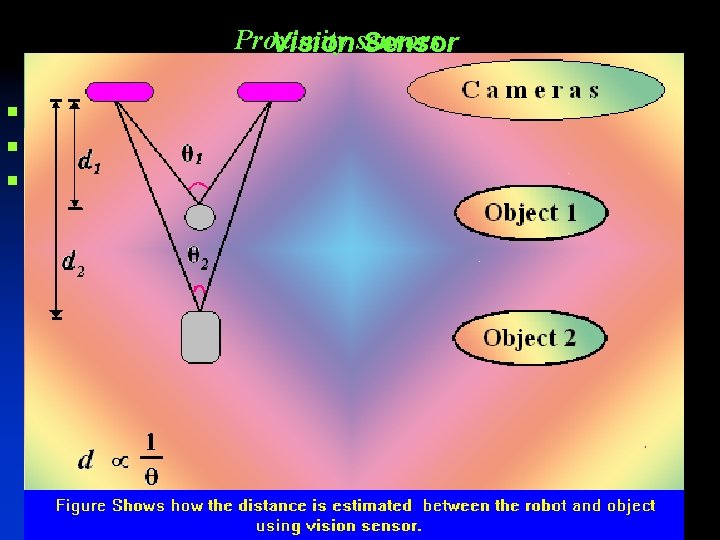
Proximity Vision sensors Sensor n n n Camera Frame grabber Image processing unit
Other devices Motors Driving mechanisms Power supplies Driving High-Current Loads from Logic
Microcontroller systems n n n Speed Size Memory Languages • Robo. ML (Robotic Markup Language) • ROSSUM • XRCL (Extensible Robot Control Language)
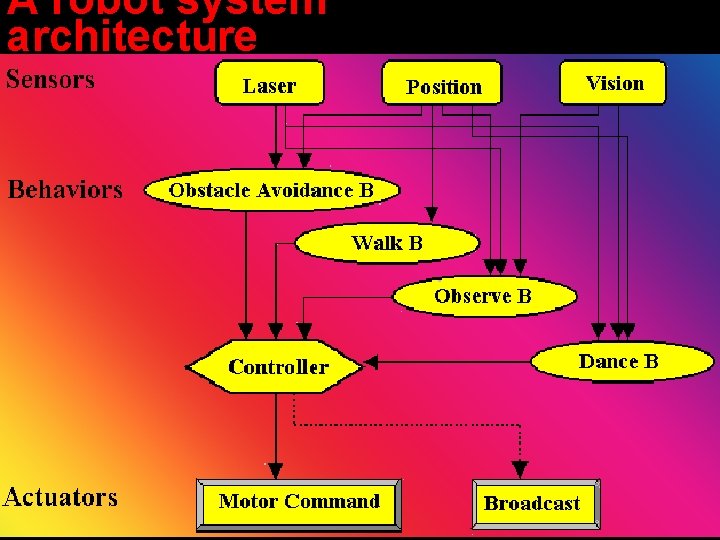
A robot system architecture
Artificial Intelligence n What is artificial intelligence? It is the science and engineering of making intelligent machines, especially intelligent computer programs n Can a machine think?
Appling Robots Safety Animatronics systems Industrial robots Space Robot Ants, James Mc. Lurkin invented micro robots that work together as a community.
Future n n Artificial neural networks Robots which train themselves Nothing can be predicted about future.
Summary Nothing is totally impossible. Perhaps one day n Advantages we will be able to produce robots that are practically indistinguishable n Disadvantages from ourselves. n Where gone Asimov’s law?
Acknowledgement Thanks to all of my respected teachers for allowing me to represent an article on Robotics. I thank to the Internet Faculty of our college for providing access to Internet for searching data. Thanks to my parents for providing me a ‘Personal Computer’.
- Slides: 15