
ROBOTICS Robot Actuators and Drive Systems TEMPUS IV
ROBOTICS Robot Actuators and Drive Systems TEMPUS IV Project: 158644 – JPCR Development of Regional Interdisciplinary Mechatronic Studies - DRIMS ROBOTICS

Content Robot Systems • Industrial robots drive chain • Servo drives • Position transducers • Clutches • Power transmission systems • Storage • Overall design TEMPUS IV Project: 158644 – JPCR Development of Regional Interdisciplinary Mechatronic Studies - DRIMS ROBOTICS 2

Robot Systems External Sensors Robot Control Environment Drive chain Robot Segments Internal Sensors TEMPUS IV Project: 158644 – JPCR Development of Regional Interdisciplinary Mechatronic Studies - DRIMS End. Effectors Object Periphery ROBOTICS 3

Industrial robots drive chain Generation the trajectory Robot Control Servo. Amplifier Servo. Actuator Coupling Transmission Tachometergenerator Storage Positioning system Segment TEMPUS IV Project: 158644 – JPCR Development of Regional Interdisciplinary Mechatronic Studies - DRIMS ROBOTICS 4
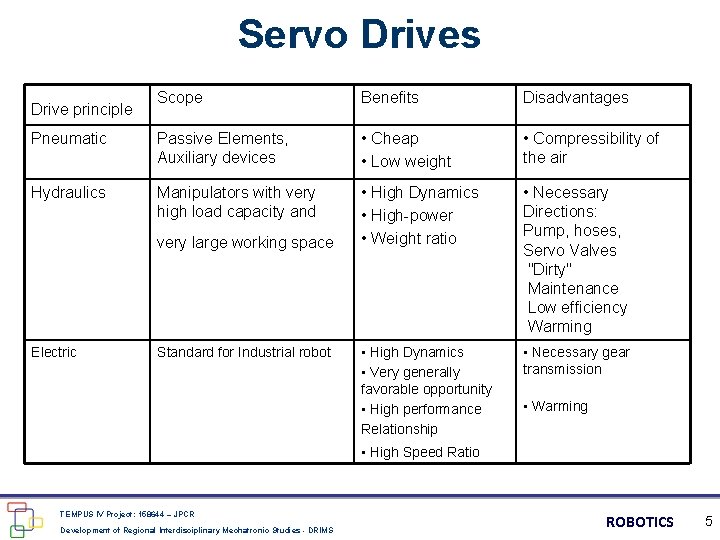
Servo Drives Scope Benefits Disadvantages Pneumatic Passive Elements, Auxiliary devices • Cheap • Low weight • Compressibility of the air Hydraulics Manipulators with very high load capacity and • High Dynamics • High-power • Weight ratio • Necessary Directions: Pump, hoses, Servo Valves "Dirty" Maintenance Low efficiency Warming • High Dynamics • Very generally favorable opportunity • High performance Relationship • Necessary gear transmission Drive principle very large working space Electric Standard for Industrial robot • Warming • High Speed Ratio TEMPUS IV Project: 158644 – JPCR Development of Regional Interdisciplinary Mechatronic Studies - DRIMS ROBOTICS 5
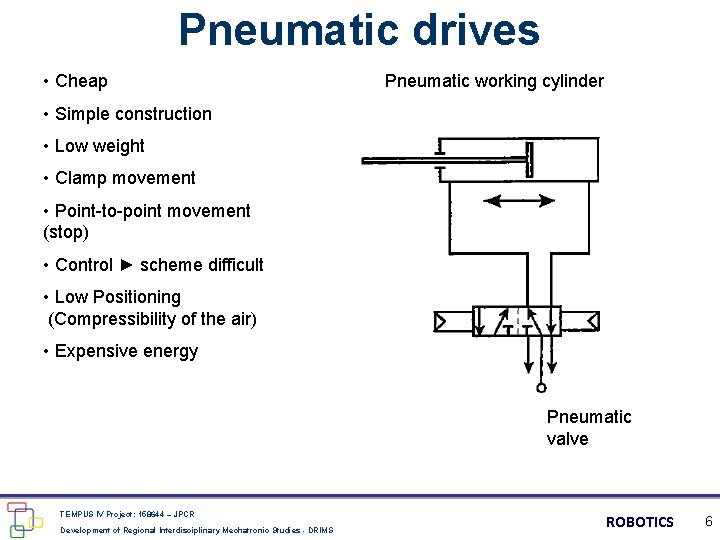
Pneumatic drives • Cheap Pneumatic working cylinder • Simple construction • Low weight • Clamp movement • Point-to-point movement (stop) • Control ► scheme difficult • Low Positioning (Compressibility of the air) • Expensive energy Pneumatic valve TEMPUS IV Project: 158644 – JPCR Development of Regional Interdisciplinary Mechatronic Studies - DRIMS ROBOTICS 6

Pneumatic Actuators - usage A pneumatic cylinder is used as a counterbalance to the individual robot axes. Source: ABB Pneumatic Cylinder Energy Example, an IR TEMPUS IV Project: 158644 – JPCR Development of Regional Interdisciplinary Mechatronic Studies - DRIMS ROBOTICS 7
Hydraulic drives • High energy concentration • Small size • Low weight • No gear needed • Leaks are detrimental • Costs (+ power unit oil reservoir 100 -150 liters) • Friction • Heat • Difficult interpretation of the regulator • Long ranges (over 3 m) • Large payload masses (over 150 kg) • Typical oil pressure ≈ 60 bar • Seal TEMPUS IV Project: 158644 – JPCR Development of Regional Interdisciplinary Mechatronic Studies - DRIMS ROBOTICS 8
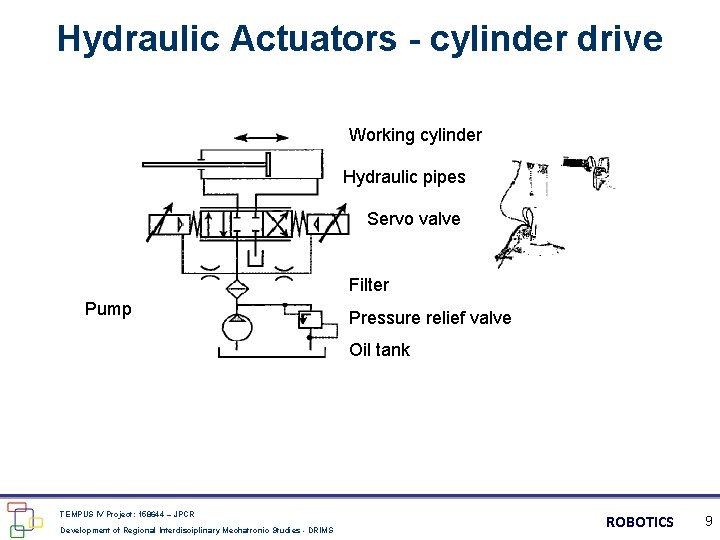
Hydraulic Actuators - cylinder drive Working cylinder Hydraulic pipes Servo valve Filter Pump Pressure relief valve Oil tank TEMPUS IV Project: 158644 – JPCR Development of Regional Interdisciplinary Mechatronic Studies - DRIMS ROBOTICS 9
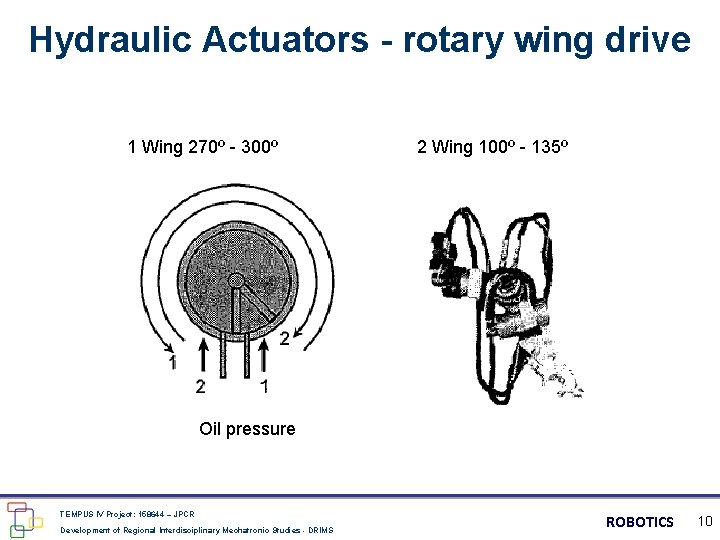
Hydraulic Actuators - rotary wing drive 1 Wing 270º - 300º 2 Wing 100º - 135º Oil pressure TEMPUS IV Project: 158644 – JPCR Development of Regional Interdisciplinary Mechatronic Studies - DRIMS ROBOTICS 10
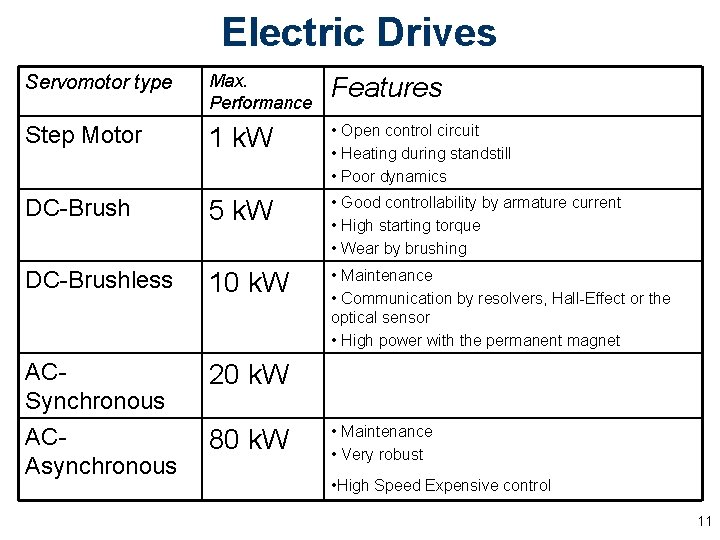
Electric Drives Servomotor type Max. Performance Features Step Motor 1 k. W • Open control circuit • Heating during standstill • Poor dynamics DC-Brush 5 k. W • Good controllability by armature current • High starting torque • Wear by brushing DC-Brushless 10 k. W • Maintenance • Communication by resolvers, Hall-Effect or the optical sensor • High power with the permanent magnet ACSynchronous ACAsynchronous 20 k. W 80 k. W • Maintenance • Very robust • High Speed Expensive control 11
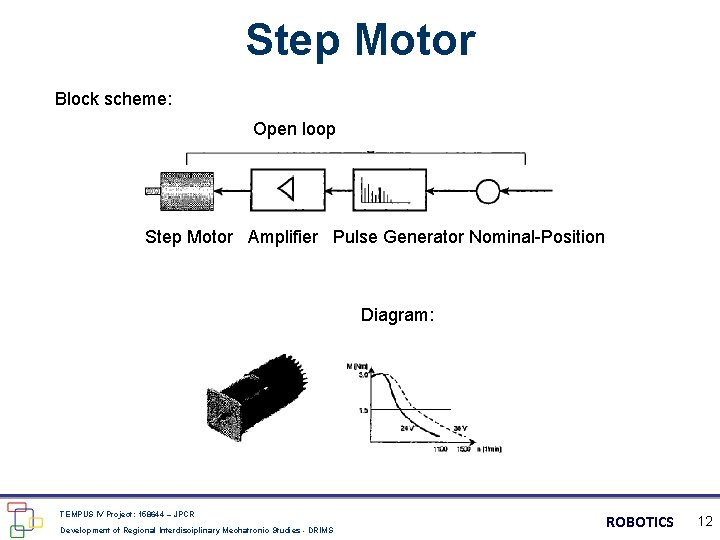
Step Motor Block scheme: Open loop Step Motor Amplifier Pulse Generator Nominal-Position Diagram: TEMPUS IV Project: 158644 – JPCR Development of Regional Interdisciplinary Mechatronic Studies - DRIMS ROBOTICS 12
Stepper Motor - Features • Open loop and speed control loop. • Relatively cheap. • By turning the control pulse to a drive axle increment (micro step). • Per rotation are more than 10, 000 increments (micro-steps). • Magnetic rigidity is low in the positioning. • As drive system with the furnace control circuit is not damped and therefore inclined to impulse vibration. • Mechanical vibrations or of control (closed-loop damped). • Power-weight ratio is the lowest of all electric motors. TEMPUS IV Project: 158644 – JPCR Development of Regional Interdisciplinary Mechatronic Studies - DRIMS ROBOTICS 13
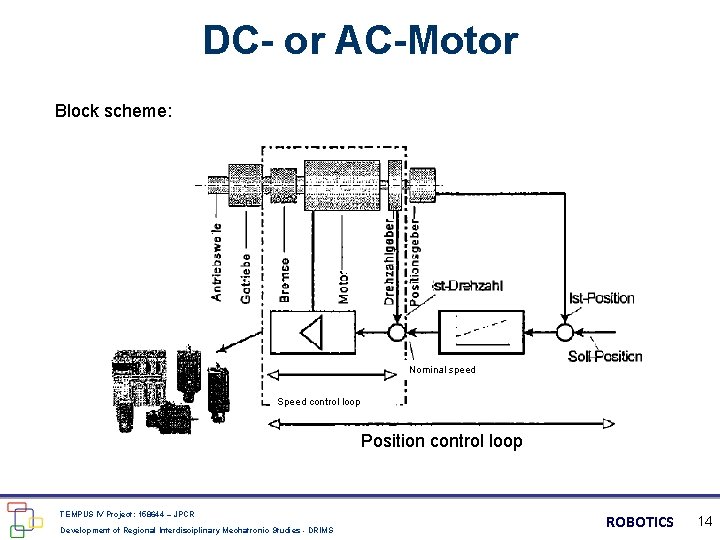
DC- or AC-Motor Block scheme: Nominal speed Speed control loop Position control loop TEMPUS IV Project: 158644 – JPCR Development of Regional Interdisciplinary Mechatronic Studies - DRIMS ROBOTICS 14
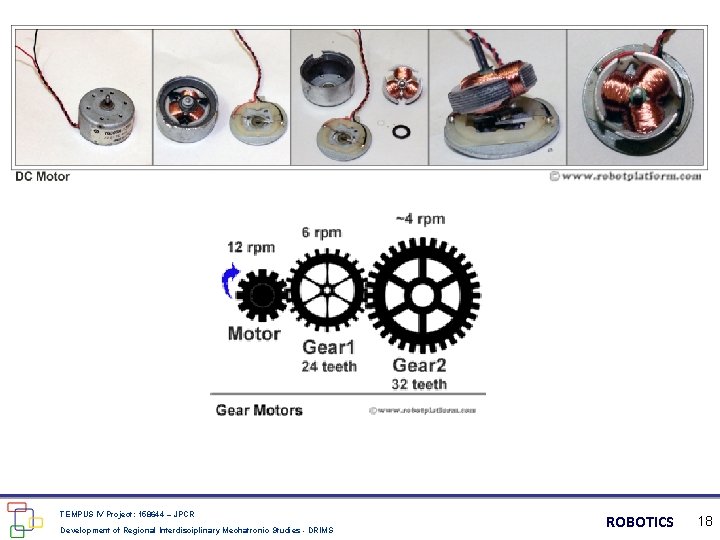
DC-motor features (direct current) → Mechanical or electronic Commutation → Low torque, high speed → Transmission is usually necessary - Backlash, friction losses → Constant velocity at different loads → Measurement system is required → Simple speed control → Dominating the first electrically driven robots → Mechanical commutation limits the maximum current transfer → Service cycle of the brush is approximately 30, 000 hours → These engines are increasingly being replaced by AC motors TEMPUS IV Project: 158644 – JPCR Development of Regional Interdisciplinary Mechatronic Studies - DRIMS ROBOTICS 15
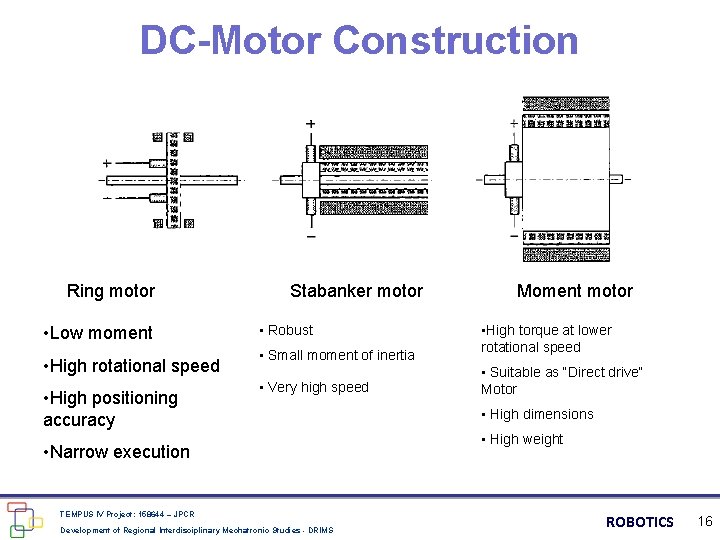
DC-Motor Construction Ring motor Stabanker motor Moment motor • Low moment • High rotational speed • High positioning accuracy • Robust • Small moment of inertia • Very high speed • Narrow execution TEMPUS IV Project: 158644 – JPCR Development of Regional Interdisciplinary Mechatronic Studies - DRIMS • High torque at lower rotational speed • Suitable as “Direct drive“ Motor • High dimensions • High weight ROBOTICS 16

DC-Brush Motor DC motor (with brushes) + gear + sensor Diagram: Input power: 90 V (12, 24, 36 90 V) TEMPUS IV Project: 158644 – JPCR Development of Regional Interdisciplinary Mechatronic Studies - DRIMS ROBOTICS 17
TEMPUS IV Project: 158644 – JPCR Development of Regional Interdisciplinary Mechatronic Studies - DRIMS ROBOTICS 18
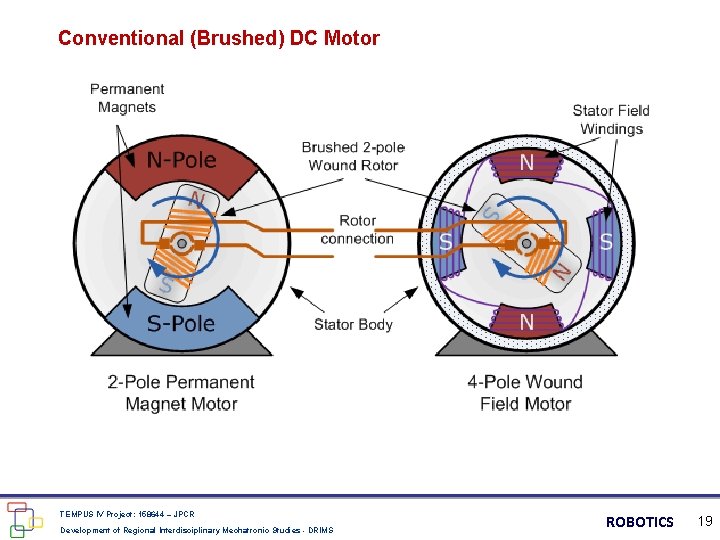
Conventional (Brushed) DC Motor TEMPUS IV Project: 158644 – JPCR Development of Regional Interdisciplinary Mechatronic Studies - DRIMS ROBOTICS 19
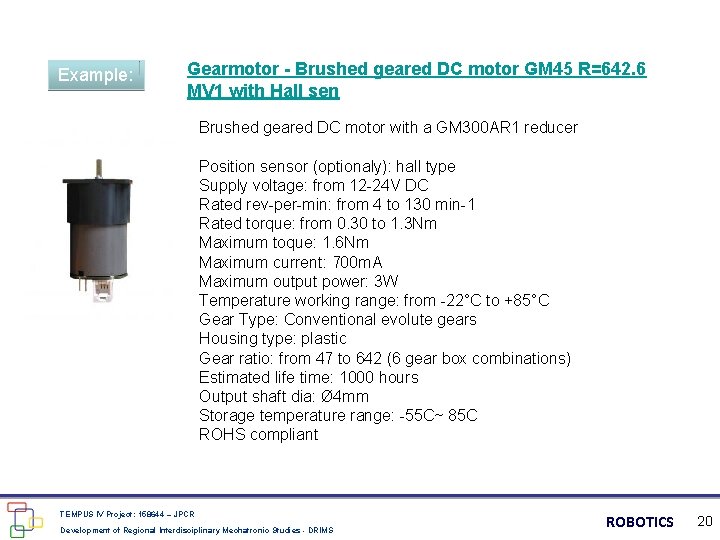
Example: Gearmotor - Brushed geared DC motor GM 45 R=642. 6 MV 1 with Hall sen Brushed geared DC motor with a GM 300 AR 1 reducer Position sensor (optionaly): hall type Supply voltage: from 12 -24 V DC Rated rev-per-min: from 4 to 130 min-1 Rated torque: from 0. 30 to 1. 3 Nm Maximum toque: 1. 6 Nm Maximum current: 700 m. A Maximum output power: 3 W Temperature working range: from -22°C to +85°C Gear Type: Conventional evolute gears Housing type: plastic Gear ratio: from 47 to 642 (6 gear box combinations) Estimated life time: 1000 hours Output shaft dia: Ø 4 mm Storage temperature range: -55 C~ 85 C ROHS compliant TEMPUS IV Project: 158644 – JPCR Development of Regional Interdisciplinary Mechatronic Studies - DRIMS ROBOTICS 20

DC-Brush Motor: • http: //upload. wikimedia. org/wikipedia/com mons/7/73/Ejs_Open_Source_Direct_Curr ent_Electrical_Motor_Model_Java_Applet _%28_DC_Motor_%29_80_degree_split_r ing. gif Simple two-pole DC motor Rotation: • http: //en. wikipedia. org/wiki/File: Electric_m otor. gif TEMPUS IV Project: 158644 – JPCR Development of Regional Interdisciplinary Mechatronic Studies - DRIMS ROBOTICS 21
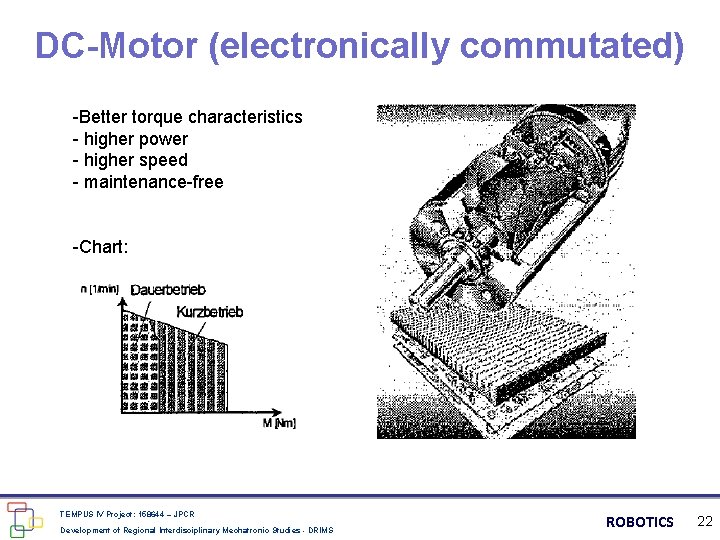
DC-Motor (electronically commutated) -Better torque characteristics - higher power - higher speed - maintenance-free -Chart: TEMPUS IV Project: 158644 – JPCR Development of Regional Interdisciplinary Mechatronic Studies - DRIMS ROBOTICS 22
AC-Motor (alternating current) Synchronous motor - Exchange of usual Keramikoxid-magnet by the permanent magnet (Somarium-cobalt, neodymium-ferrite-boronic) with higher power density. - The advanced power semiconductor technology (IGBT Insulated Gate - Bipolar Transistor) has improved the dynamics and controllability. - Power up to 10 -20 k. W, speed 3000 min ˉ ¹. Asynchronous motor - More robust than synchronous motor - Higher power density as a synchronous motor - By the excitation of the magnetic field, these motors can in large area at the constant output power and at the nominal rotational speeds. - This provides significant advantage over the synchronous motor. - Power to 80 k. W, speed up to 10000 min ˉ ¹. TEMPUS IV Project: 158644 – JPCR Development of Regional Interdisciplinary Mechatronic Studies - DRIMS ROBOTICS 23
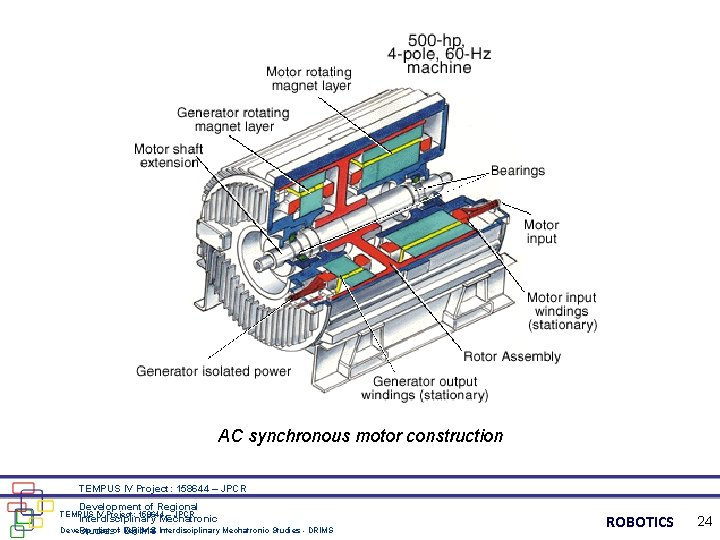
AC synchronous motor construction TEMPUS IV Project: 158644 – JPCR Development of Regional Interdisciplinary Mechatronic Development Studiesof- Regional DRIMS Interdisciplinary Mechatronic Studies - DRIMS TEMPUS IV Project: 158644 – JPCR ROBOTICS 24
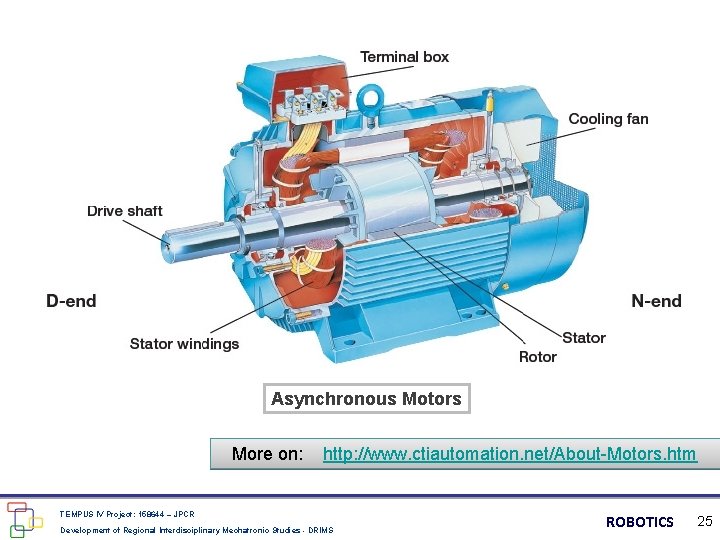
Asynchronous Motors More on: http: //www. ctiautomation. net/About-Motors. htm TEMPUS IV Project: 158644 – JPCR Development of Regional Interdisciplinary Mechatronic Studies - DRIMS ROBOTICS 25

AC-Motor Diagram: Block diagram: TEMPUS IV Project: 158644 – JPCR Development of Regional Interdisciplinary Mechatronic Studies - DRIMS ROBOTICS 26
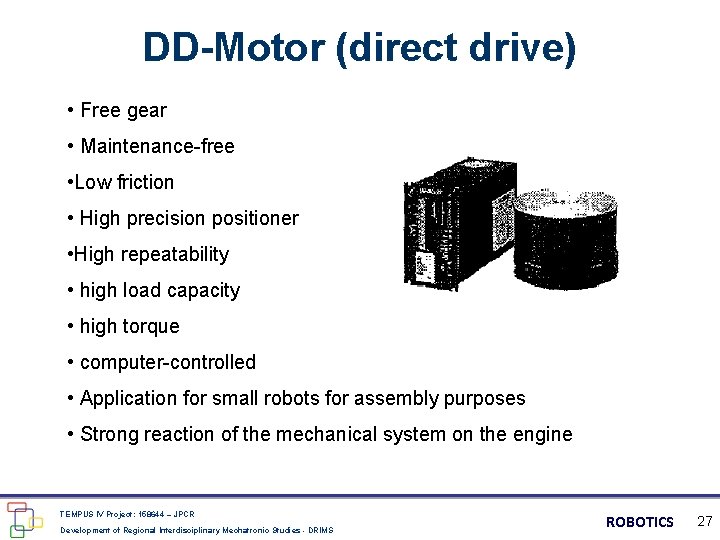
DD-Motor (direct drive) • Free gear • Maintenance-free • Low friction • High precision positioner • High repeatability • high load capacity • high torque • computer-controlled • Application for small robots for assembly purposes • Strong reaction of the mechanical system on the engine TEMPUS IV Project: 158644 – JPCR Development of Regional Interdisciplinary Mechatronic Studies - DRIMS ROBOTICS 27

TEMPUS IV Project: 158644 – JPCR Development of Regional Interdisciplinary Mechatronic Studies - DRIMS ROBOTICS 28

DD-Motor (direct drive) rotation moment Nm Diagram: rotation speed 1/min J = 0. 46 kgm² Measuring system: • Resolver • Incremental rotary encoder TEMPUS IV Project: 158644 – JPCR Development of Regional Interdisciplinary Mechatronic Studies - DRIMS Resolution: 425984 steps/rotation m = 75 kg Repeating precision: ± 5” Precision: ± 45” ROBOTICS 29
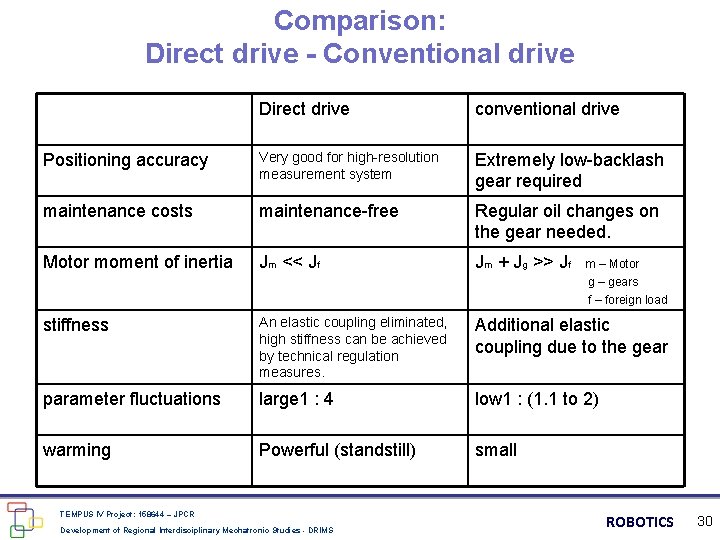
Comparison: Direct drive - Conventional drive Direct drive conventional drive Positioning accuracy Very good for high-resolution measurement system Extremely low-backlash gear required maintenance costs maintenance-free Regular oil changes on the gear needed. Motor moment of inertia Jm << Jf Jm + Jg >> Jf m – Motor g – gears f – foreign load stiffness An elastic coupling eliminated, high stiffness can be achieved by technical regulation measures. Additional elastic coupling due to the gear parameter fluctuations large 1 : 4 low 1 : (1. 1 to 2) warming Powerful (standstill) small TEMPUS IV Project: 158644 – JPCR Development of Regional Interdisciplinary Mechatronic Studies - DRIMS ROBOTICS 30
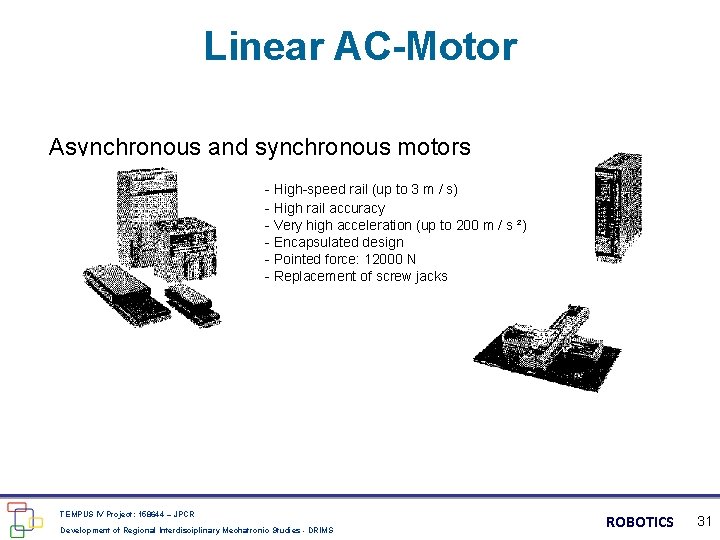
Linear AC-Motor Asynchronous and synchronous motors - High-speed rail (up to 3 m / s) - High rail accuracy - Very high acceleration (up to 200 m / s ²) - Encapsulated design - Pointed force: 12000 N - Replacement of screw jacks TEMPUS IV Project: 158644 – JPCR Development of Regional Interdisciplinary Mechatronic Studies - DRIMS ROBOTICS 31

Assessment criteria GEAR ROBOTER game synchronous stiffness positioning vibration behavior Mass moment of inertia construction volume efficiency Cycle time, accuracy vibrations, construction Price, long-term accuracy lifetime noise price TEMPUS IV Project: 158644 – JPCR Development of Regional Interdisciplinary Mechatronic Studies - DRIMS motion noise robot price ROBOTICS 32
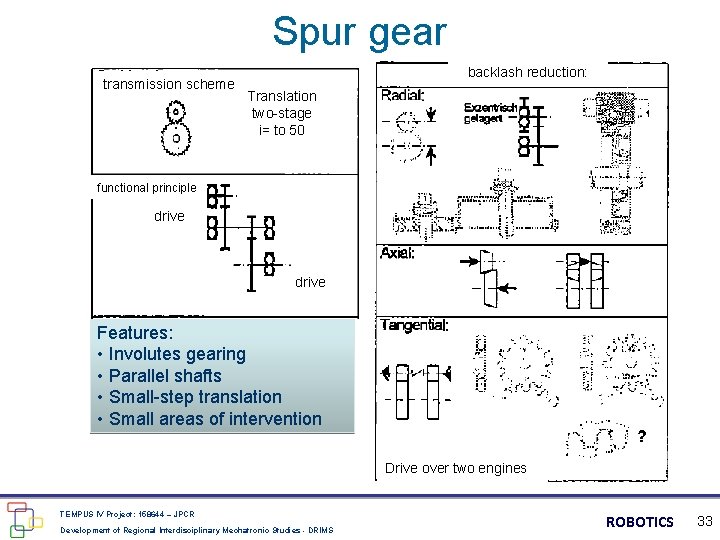
Spur gear transmission scheme backlash reduction: Translation two-stage i= to 50 functional principle drive Features: • Involutes gearing • Parallel shafts • Small-step translation • Small areas of intervention Drive over two engines TEMPUS IV Project: 158644 – JPCR Development of Regional Interdisciplinary Mechatronic Studies - DRIMS ROBOTICS 33
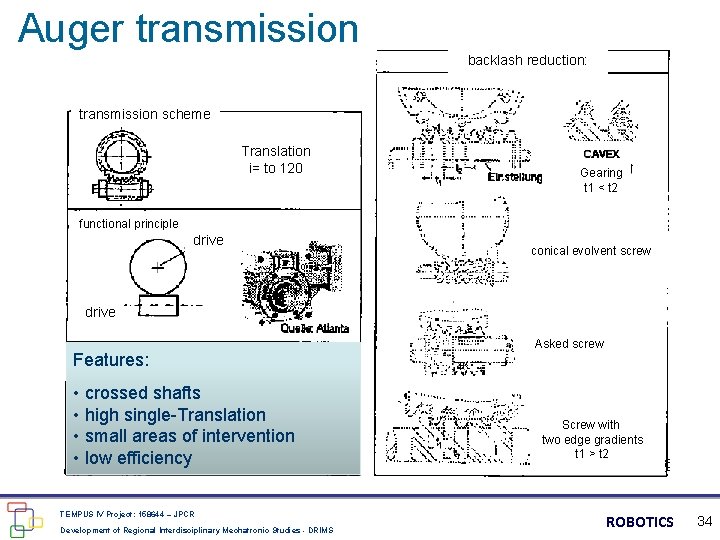
Auger transmission backlash reduction: transmission scheme Translation i= to 120 Gearing t 1 < t 2 functional principle drive conical evolvent screw drive Features: • crossed shafts • high single-Translation • small areas of intervention • low efficiency TEMPUS IV Project: 158644 – JPCR Development of Regional Interdisciplinary Mechatronic Studies - DRIMS Asked screw Screw with two edge gradients t 1 > t 2 ROBOTICS 34

Planet drives transmission scheme backlash reduction: Translation Two-stage i= to 70 functional principle drive Features: - involutes gearing - compact - coaxial shafts - medium-sized e areas of intervention - Stage - Low over implementation - high efficiency TEMPUS IV Project: 158644 – JPCR Development of Regional Interdisciplinary Mechatronic Studies - DRIMS ROBOTICS 35
Planetary gear • eccentric gearing – Akim – Stäubli – Cyclo – Dojen • Harmonic Drive Gears TEMPUS IV Project: 158644 – JPCR Development of Regional Interdisciplinary Mechatronic Studies - DRIMS ROBOTICS 36
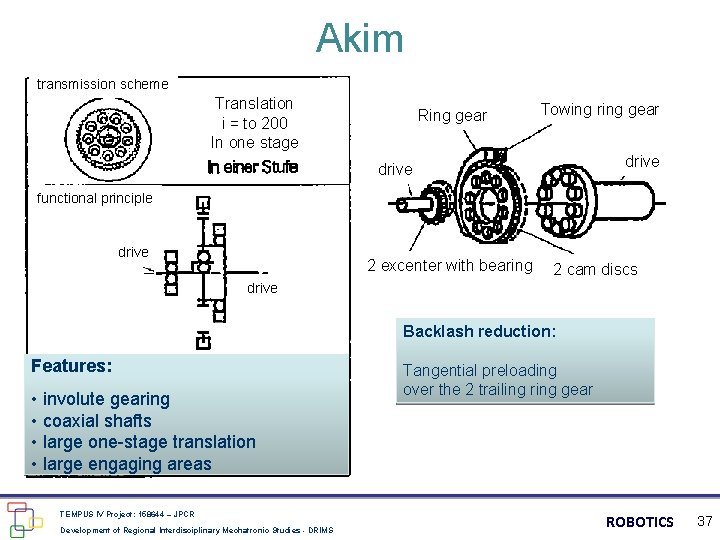
Akim transmission scheme Translation i = to 200 In one stage Ring gear Towing ring gear drive functional principle drive 2 excenter with bearing 2 cam discs drive Backlash reduction: Features: • involute gearing • coaxial shafts • large one-stage translation • large engaging areas TEMPUS IV Project: 158644 – JPCR Development of Regional Interdisciplinary Mechatronic Studies - DRIMS Tangential preloading over the 2 trailing ring gear ROBOTICS 37
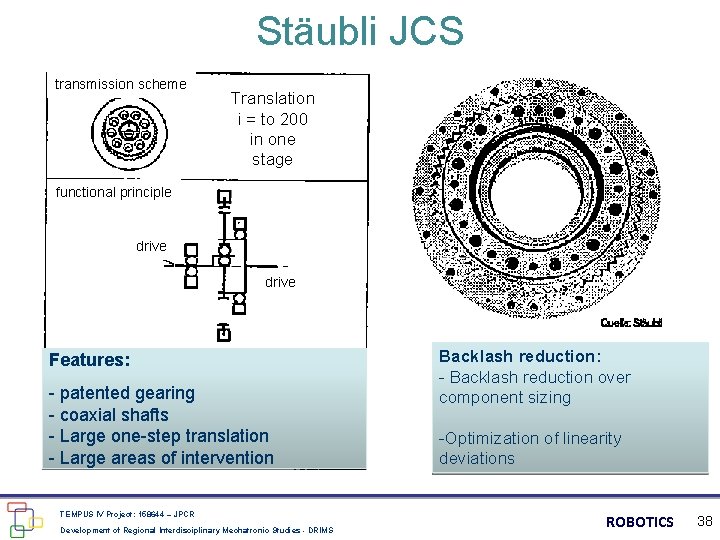
Stäubli JCS transmission scheme Translation i = to 200 in one stage functional principle drive Features: - patented gearing - coaxial shafts - Large one-step translation - Large areas of intervention TEMPUS IV Project: 158644 – JPCR Development of Regional Interdisciplinary Mechatronic Studies - DRIMS Backlash reduction: - Backlash reduction over component sizing -Optimization of linearity deviations ROBOTICS 38
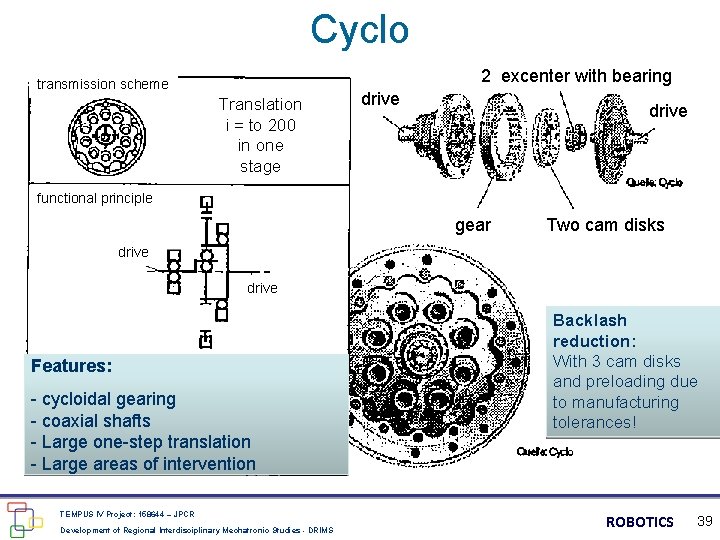
Cyclo 2 excenter with bearing transmission scheme Translation i = to 200 in one stage drive functional principle gear Two cam disks drive Features: - cycloidal gearing - coaxial shafts - Large one-step translation - Large areas of intervention TEMPUS IV Project: 158644 – JPCR Development of Regional Interdisciplinary Mechatronic Studies - DRIMS Backlash reduction: With 3 cam disks and preloading due to manufacturing tolerances! ROBOTICS 39
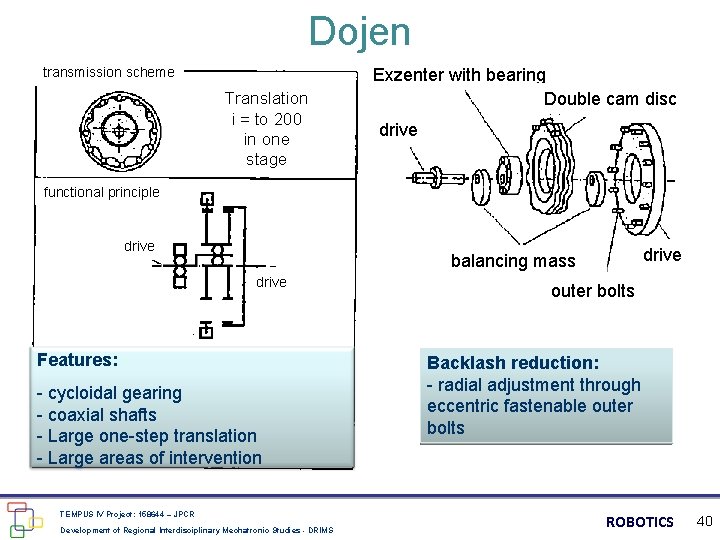
Dojen transmission scheme Translation i = to 200 in one stage Exzenter with bearing Double cam disc drive functional principle drive balancing mass drive Features: - cycloidal gearing - coaxial shafts - Large one-step translation - Large areas of intervention TEMPUS IV Project: 158644 – JPCR Development of Regional Interdisciplinary Mechatronic Studies - DRIMS outer bolts Backlash reduction: - radial adjustment through eccentric fastenable outer bolts ROBOTICS 40

Harmonic-Drive transmission scheme Translation i = to 320 (IH 160) in one stage functional principle Features: - evolvent and IH gearing - coaxial shafts - Large one-step translation - Large areas of intervention drive Backlash reduction: - Backlash reduction over component sizing TEMPUS IV Project: 158644 – JPCR Development of Regional Interdisciplinary Mechatronic Studies - DRIMS ROBOTICS 41
Literature: Paul E. Sandin: Robot Mechanisms and Mechanical Devices Illustrated, Chapter 1 Motor and Motion Control Systems, pp. 3 -33; Mc. Graw-Hill, 2003. TEMPUS IV Project: 158644 – JPCR Development of Regional Interdisciplinary Mechatronic Studies - DRIMS ROBOTICS 42
- Slides: 42