
ROBOTICS Manipulator Motion Jacobians TEMPUS IV Project 158644
ROBOTICS Manipulator Motion (Jacobians) TEMPUS IV Project: 158644 – JPCR Development of Regional Interdisciplinary Mechatronic Studies DRIMS ROBOTICS
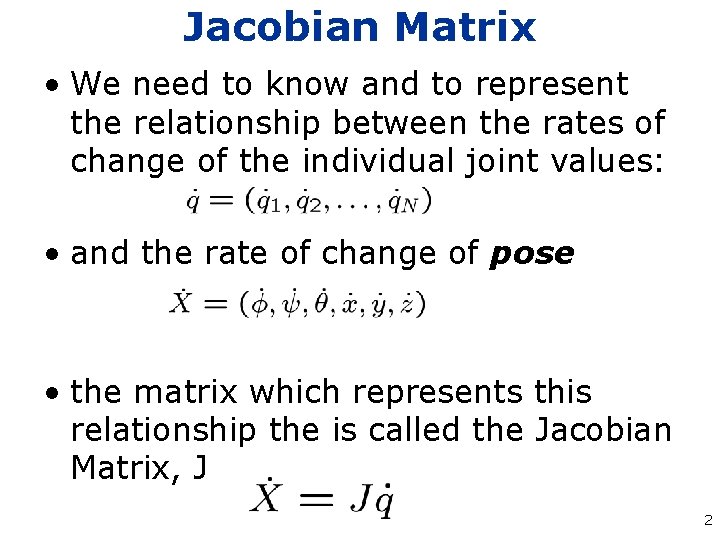
Jacobian Matrix • We need to know and to represent the relationship between the rates of change of the individual joint values: • and the rate of change of pose • the matrix which represents this relationship the is called the Jacobian Matrix, J 2
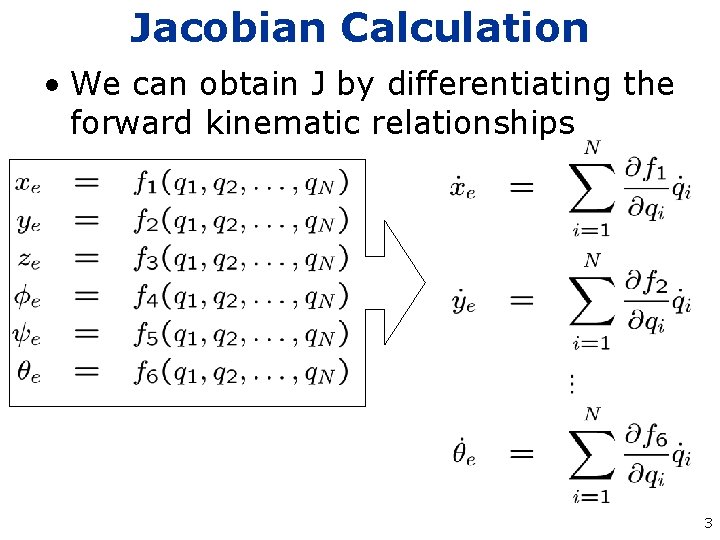
Jacobian Calculation • We can obtain J by differentiating the forward kinematic relationships 3
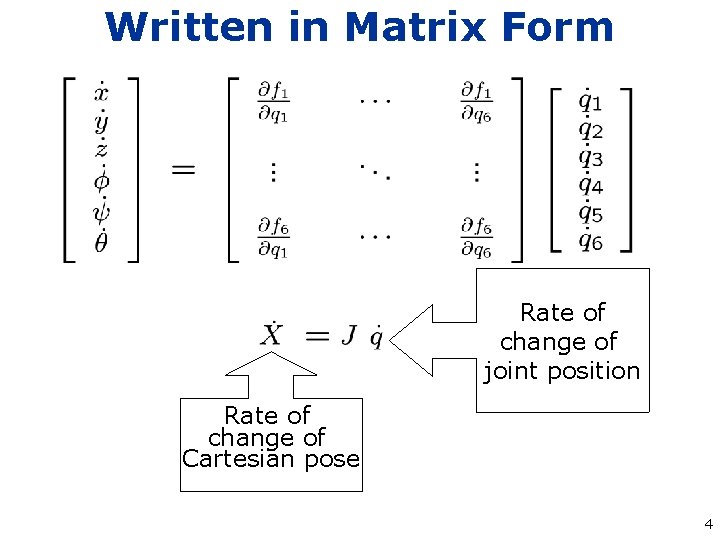
Written in Matrix Form Rate of change of joint position Rate of change of Cartesian pose 4
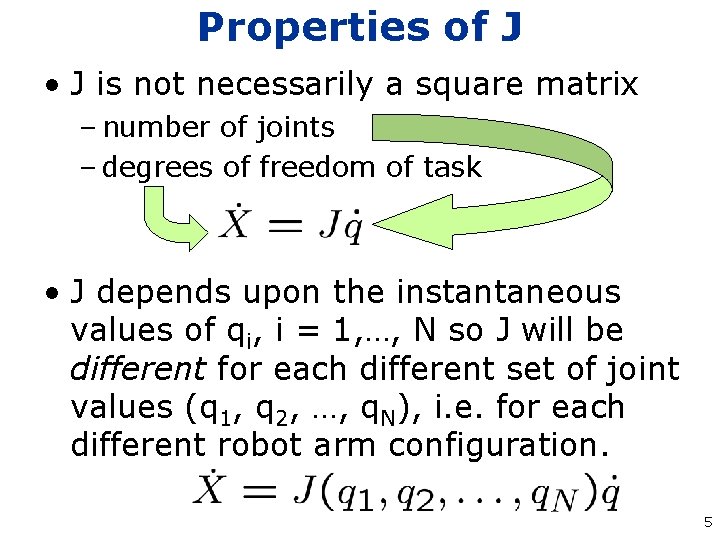
Properties of J • J is not necessarily a square matrix – number of joints – degrees of freedom of task • J depends upon the instantaneous values of qi, i = 1, …, N so J will be different for each different set of joint values (q 1, q 2, …, q. N), i. e. for each different robot arm configuration. 5

Robot Jacobian • To obtain the inverse Jacobian relation we need to invert J, which is, in general, hard. Three methods: 1. Invert J symbolically, which is only really practical for very simple robot geometries. 2. Numerically invert J for each configuration of the robot. This is computationally expensive, not always possible (e. g. when det(J)=0) and difficult if n 6 – Use pseudo-inverse (J¢ JT )− 1 JT 3. Derive J− 1 directly from the Inverse Kinematics equations, much as we uses the Forward Kinematics equations to obtain J above. TEMPUS IV Project: 158644 – JPCR Development of Regional Interdisciplinary Mechatronic Studies DRIMS ROBOTICS 6
Singularities • Robot is in a singular configuration when det(J)=0 – i. e. when the relationship can’t be inverted • Singular configuration occur when two or more joint axes become aligned in space. – When this happens the robot geometry effectively loses one (or more) independent degrees of freedom: two more of the degrees of freedom become mutually dependent. TEMPUS IV Project: 158644 – JPCR Development of Regional Interdisciplinary Mechatronic Studies DRIMS ROBOTICS 7
Singularities • The loss of one or more effective degrees of freedom thus occurs not just at a singular configuration, but also in a region (a volume in joint space) around it. – Not just when det(J) = 0 but nearby (J is ill-conditioned). – Condition number is a useful (scaleindependent) measure for matrix condition TEMPUS IV Project: 158644 – JPCR Development of Regional Interdisciplinary Mechatronic Studies DRIMS ROBOTICS 8
Types of Singularities • Workspace Boundary Singularities: the robot manipulator is fully extended or folded onto itself so that Pe is at or near the boundary of the robot workspace. – In such configurations, one or more joints will be at their limits of range of movement, so that they will not be able to maintain any movement at some particular speed. This effectively makes J a singular matrix. • Workspace Interior Singularities: occur inside the robot workspace away from any of the boundaries, and they are generally caused by two or more joint axes becoming aligned. TEMPUS IV Project: 158644 – JPCR Development of Regional Interdisciplinary Mechatronic Studies DRIMS ROBOTICS 9
Avoid Singularities • To avoid singular configurations there are three different possibilities: 1. Increase the number if degrees of freedom of the robot manipulator, perhaps by attaching to Pe a tool or gripper which has one or two degrees of freedom itself. 2. Restrict the movements that the robot can be programmed to make so as to avoid getting to or near to any singular configurations. 3. Dynamically modify J to remove the offending terms, and thus return det(J) 0. This means identifying the column and row of J that need to be removed. TEMPUS IV Project: 158644 – JPCR Development of Regional Interdisciplinary Mechatronic Studies DRIMS ROBOTICS 10
- Slides: 10