
Robotics and Control Technology Robotics with Lego Mindstorms
Robotics and Control Technology Robotics with Lego Mindstorms NXT
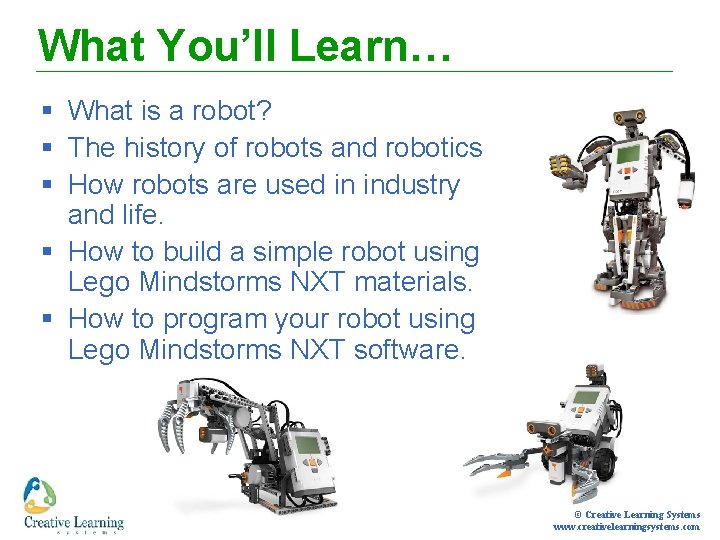
What You’ll Learn… § What is a robot? § The history of robots and robotics § How robots are used in industry and life. § How to build a simple robot using Lego Mindstorms NXT materials. § How to program your robot using Lego Mindstorms NXT software. © Creative Learning Systems www. creativelearningsystems. com
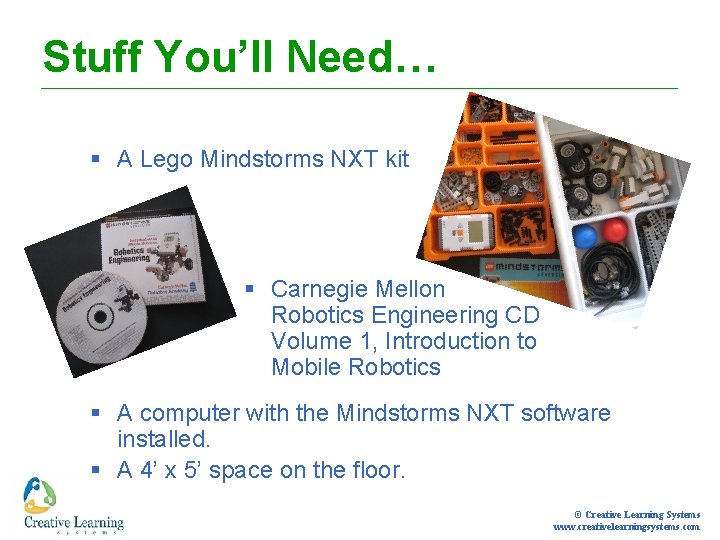
Stuff You’ll Need… § A Lego Mindstorms NXT kit § Carnegie Mellon Robotics Engineering CD Volume 1, Introduction to Mobile Robotics § A computer with the Mindstorms NXT software installed. § A 4’ x 5’ space on the floor. © Creative Learning Systems www. creativelearningsystems. com
e. Portfolio Suggestions… § § § § Before you begin the activities in this Learning Launcher, write down what you already know about robots and robotics. List three things you learned from the “What You Should Know…” section. Choose the definition of robot that makes the most sense to you and explain the reasons for your choice. Take a video of your robot attempting a task. With the camera running, give a commentary of what worked and what didn’t. Explain how you will improve the performance or fix a problem. Create a glossary of the vocabulary words associated with robots and robotics. Pay particular attention to the bold, italicized words in this Learning Launcher. Write a schematic drawing of one of your programs. Add comments to explain your intentions for the robot. Tell which of the “Research Prototypes” was a favorite and why. Describe how you have used a Sense-Plan-Act sequence in a situation in your life. © Creative Learning Systems www. creativelearningsystems. com
What You Should Know… There isn’t a single definition of robot that is agreed upon and used world-wide. The International Organization for Standardization gives a definition of robot as "an automatically controlled, reprogrammable, multipurpose, manipulator programmable in three or more axes, which may be either fixed in place or mobile for use in industrial automation application. ” The Robotics Institute of America (RIA) uses a broader definition: a robot is a "re-programmable multi-functional manipulator designed to move materials, parts, tools, or specialized devices through variable programmed motions for the performance of a variety of tasks". © Creative Learning Systems www. creativelearningsystems. com
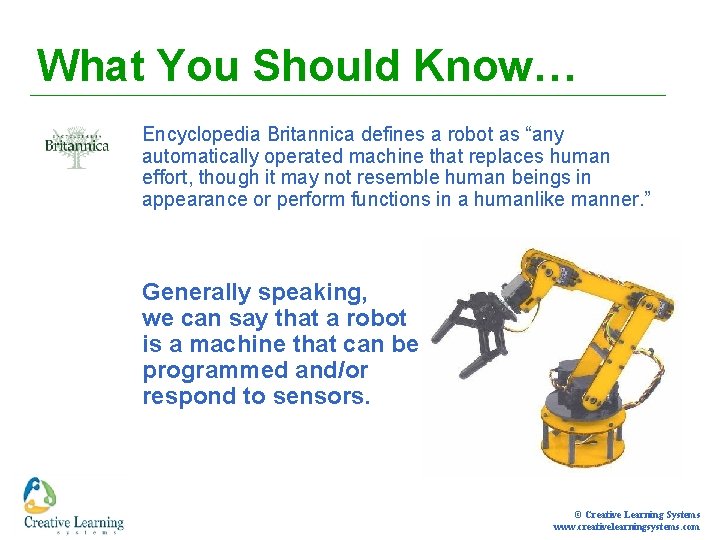
What You Should Know… Encyclopedia Britannica defines a robot as “any automatically operated machine that replaces human effort, though it may not resemble human beings in appearance or perform functions in a humanlike manner. ” Generally speaking, we can say that a robot is a machine that can be programmed and/or respond to sensors. © Creative Learning Systems www. creativelearningsystems. com
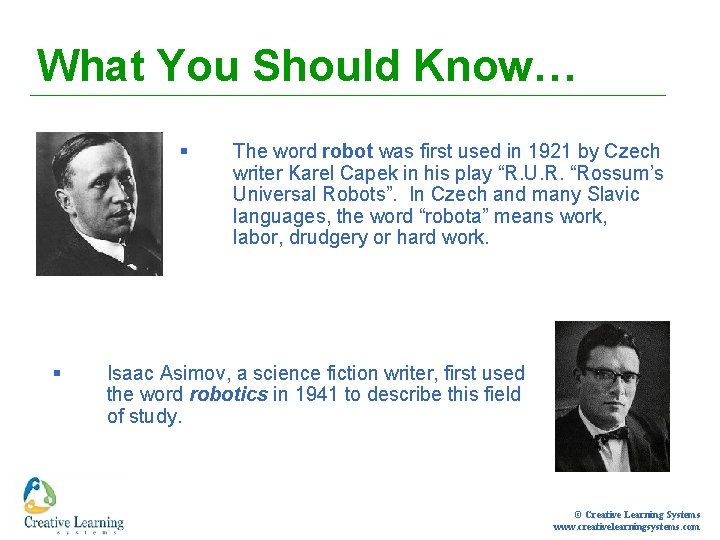
What You Should Know… § § The word robot was first used in 1921 by Czech writer Karel Capek in his play “R. U. R. “Rossum’s Universal Robots”. In Czech and many Slavic languages, the word “robota” means work, labor, drudgery or hard work. Isaac Asimov, a science fiction writer, first used the word robotics in 1941 to describe this field of study. © Creative Learning Systems www. creativelearningsystems. com
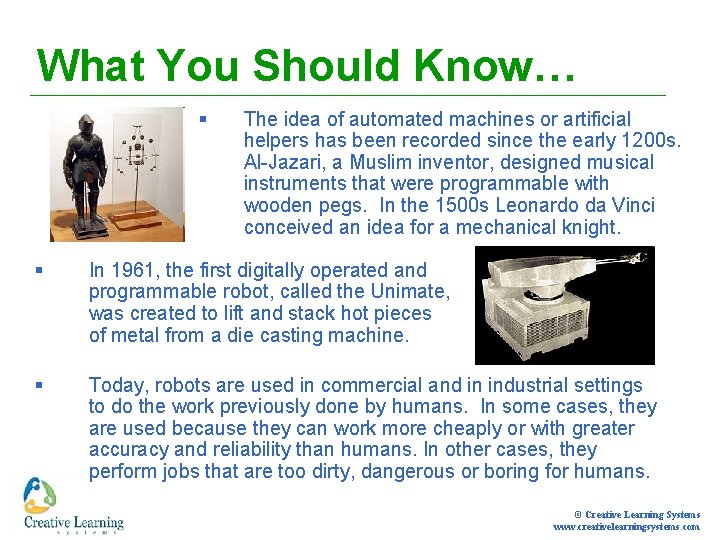
What You Should Know… § The idea of automated machines or artificial helpers has been recorded since the early 1200 s. Al-Jazari, a Muslim inventor, designed musical instruments that were programmable with wooden pegs. In the 1500 s Leonardo da Vinci conceived an idea for a mechanical knight. § In 1961, the first digitally operated and programmable robot, called the Unimate, was created to lift and stack hot pieces of metal from a die casting machine. § Today, robots are used in commercial and in industrial settings to do the work previously done by humans. In some cases, they are used because they can work more cheaply or with greater accuracy and reliability than humans. In other cases, they perform jobs that are too dirty, dangerous or boring for humans. © Creative Learning Systems www. creativelearningsystems. com
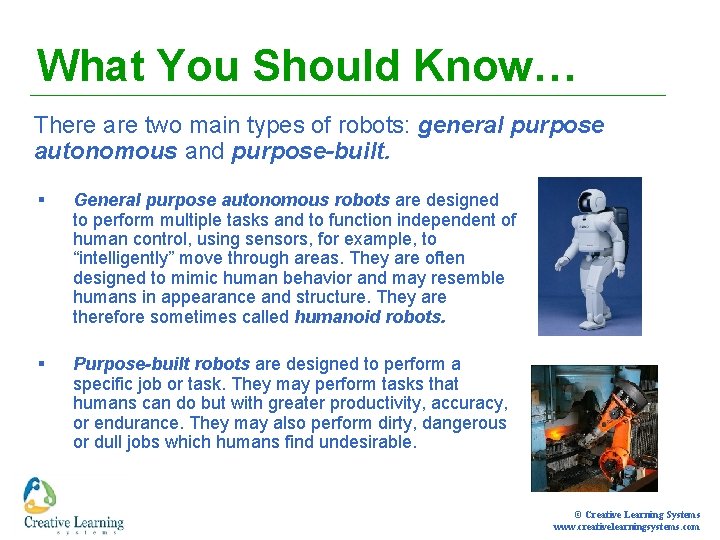
What You Should Know… There are two main types of robots: general purpose autonomous and purpose-built. § General purpose autonomous robots are designed to perform multiple tasks and to function independent of human control, using sensors, for example, to “intelligently” move through areas. They are often designed to mimic human behavior and may resemble humans in appearance and structure. They are therefore sometimes called humanoid robots. § Purpose-built robots are designed to perform a specific job or task. They may perform tasks that humans can do but with greater productivity, accuracy, or endurance. They may also perform dirty, dangerous or dull jobs which humans find undesirable. © Creative Learning Systems www. creativelearningsystems. com
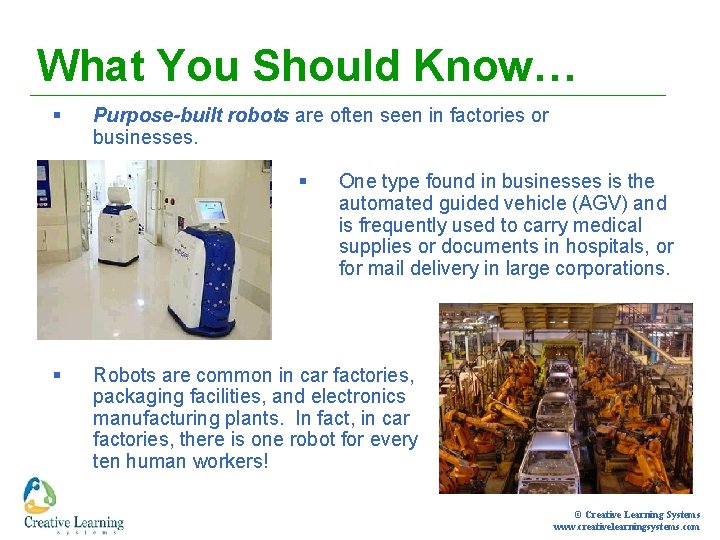
What You Should Know… § Purpose-built robots are often seen in factories or businesses. § § One type found in businesses is the automated guided vehicle (AGV) and is frequently used to carry medical supplies or documents in hospitals, or for mail delivery in large corporations. Robots are common in car factories, packaging facilities, and electronics manufacturing plants. In fact, in car factories, there is one robot for every ten human workers! © Creative Learning Systems www. creativelearningsystems. com
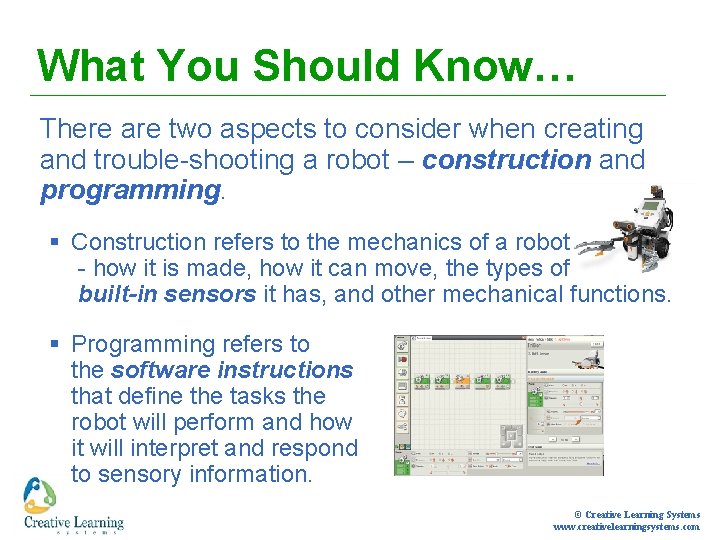
What You Should Know… There are two aspects to consider when creating and trouble-shooting a robot – construction and programming. § Construction refers to the mechanics of a robot - how it is made, how it can move, the types of built-in sensors it has, and other mechanical functions. § Programming refers to the software instructions that define the tasks the robot will perform and how it will interpret and respond to sensory information. © Creative Learning Systems www. creativelearningsystems. com
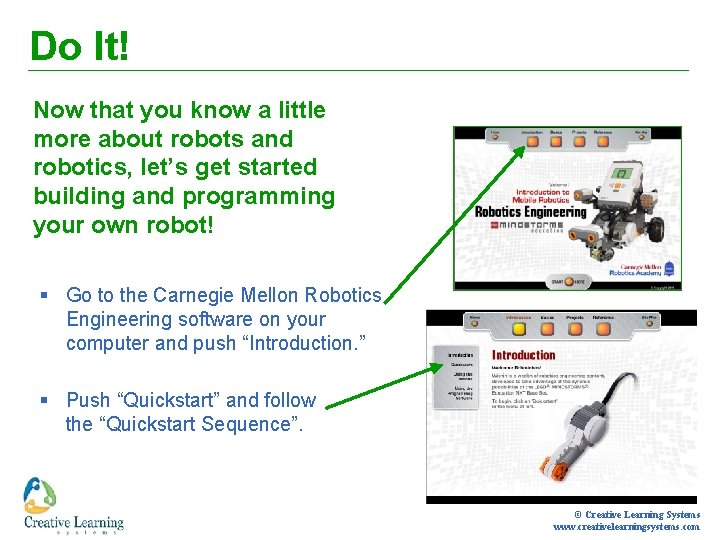
Do It! Now that you know a little more about robots and robotics, let’s get started building and programming your own robot! § Go to the Carnegie Mellon Robotics Engineering software on your computer and push “Introduction. ” § Push “Quickstart” and follow the “Quickstart Sequence”. © Creative Learning Systems www. creativelearningsystems. com
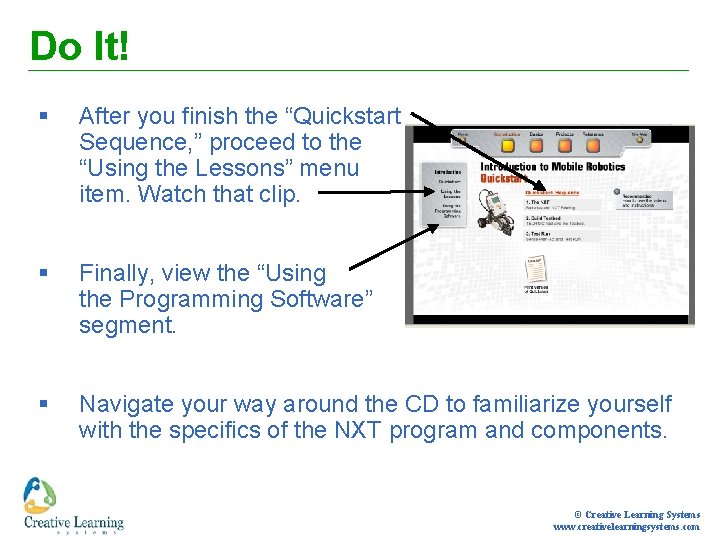
Do It! § After you finish the “Quickstart Sequence, ” proceed to the “Using the Lessons” menu item. Watch that clip. § Finally, view the “Using the Programming Software” segment. § Navigate your way around the CD to familiarize yourself with the specifics of the NXT program and components. © Creative Learning Systems www. creativelearningsystems. com
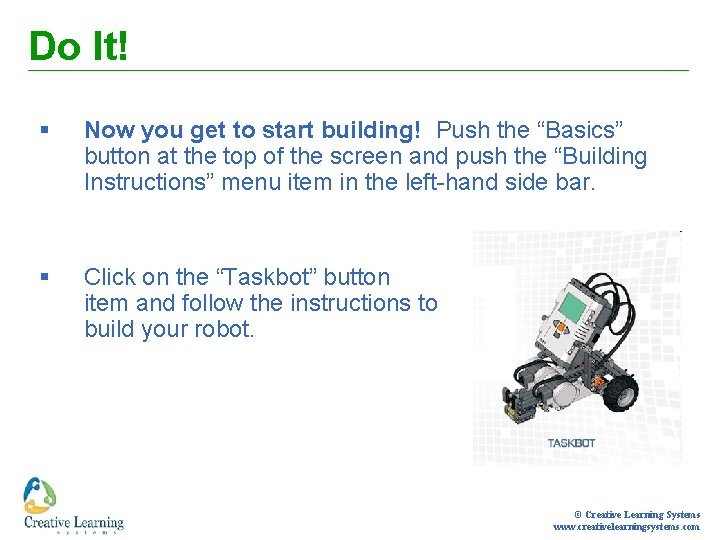
Do It! § Now you get to start building! Push the “Basics” button at the top of the screen and push the “Building Instructions” menu item in the left-hand side bar. § Click on the “Taskbot” button item and follow the instructions to build your robot. © Creative Learning Systems www. creativelearningsystems. com
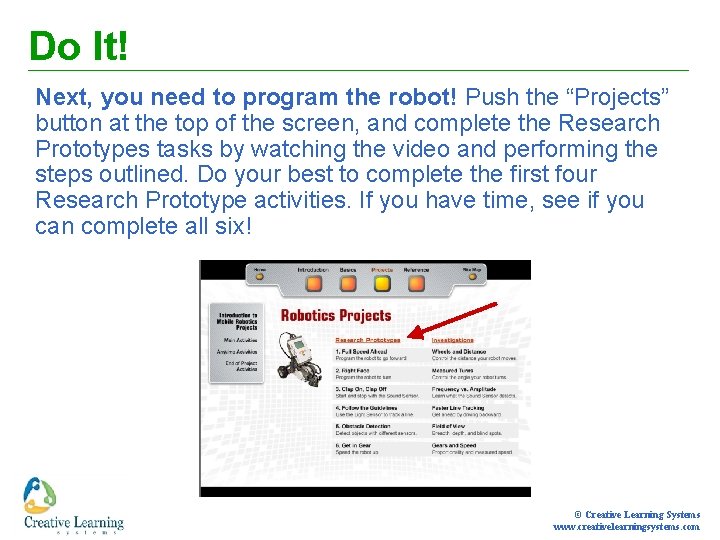
Do It! Next, you need to program the robot! Push the “Projects” button at the top of the screen, and complete the Research Prototypes tasks by watching the video and performing the steps outlined. Do your best to complete the first four Research Prototype activities. If you have time, see if you can complete all six! © Creative Learning Systems www. creativelearningsystems. com
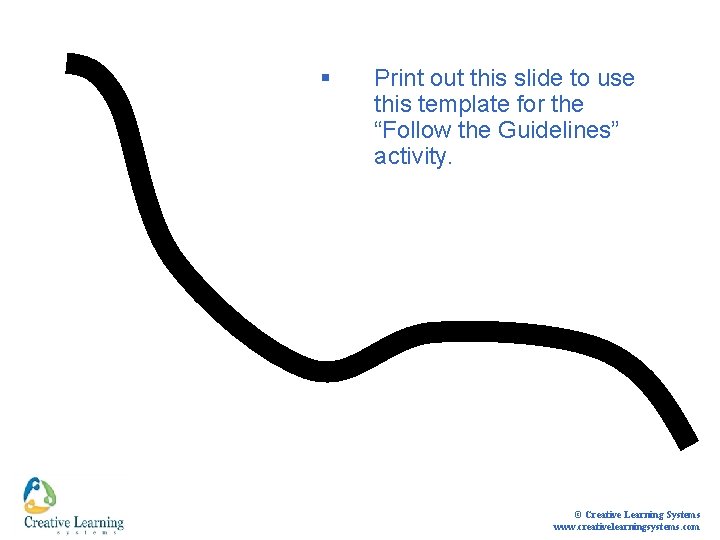
§ Print out this slide to use this template for the “Follow the Guidelines” activity. © Creative Learning Systems www. creativelearningsystems. com
Extend Yourself… § § § § Learn more about Leonardo da Vinci’s mechanical knight online. Write a description about how it would work. Go online to learn about the field of artificial intelligence. Science fiction writer Isaac Asimov contributed to the evolution of robotics through his thoughtful and imaginative writings. Go online to learn about his three laws of robotics. Why do you think Asimov felt these three laws were necessary? What other fictional books have been written about robots? Many early books were remarkably accurate in predicting the future, others seem almost comical now. Check them out at your library! What are nanorobots? Go online to learn about nanorobots and their amazing medical potential! Find out how robots are made to mimic human behavior. If robotics are created to reason, feel, and be self aware, then what would separate them from humans? Learn about the Robotics Institute at Carnegie Mellon University. Check out the Lego NXT website for more challenges. See what other NXT wizards are doing and post your projects! © Creative Learning Systems www. creativelearningsystems. com
- Slides: 17