
Robocalls An illustrated guide to origin mechanisms and
Robocalls – An illustrated guide to origin, mechanisms and prevention Remedies Henning Schulzrinne Columbia University August 2019 1
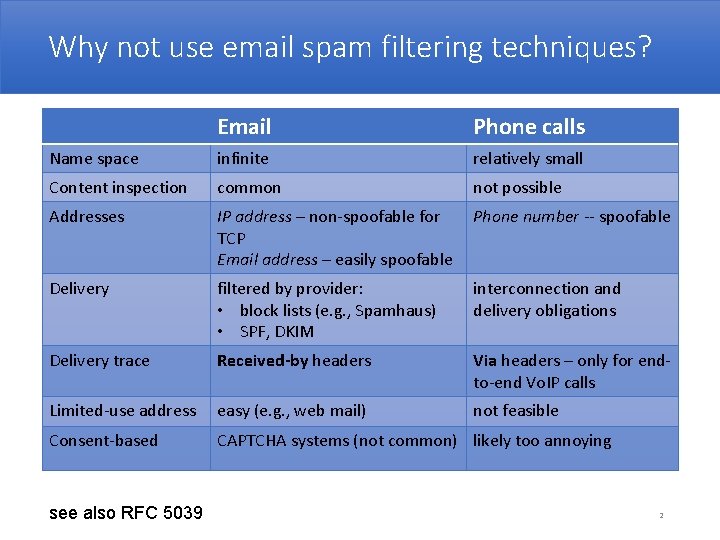
Why not use email spam filtering techniques? Email Phone calls Name space infinite relatively small Content inspection common not possible Addresses IP address – non-spoofable for TCP Email address – easily spoofable Phone number -- spoofable Delivery filtered by provider: • block lists (e. g. , Spamhaus) • SPF, DKIM interconnection and delivery obligations Delivery trace Received-by headers Via headers – only for endto-end Vo. IP calls Limited-use address easy (e. g. , web mail) Consent-based see also RFC 5039 not feasible CAPTCHA systems (not common) likely too annoying 2
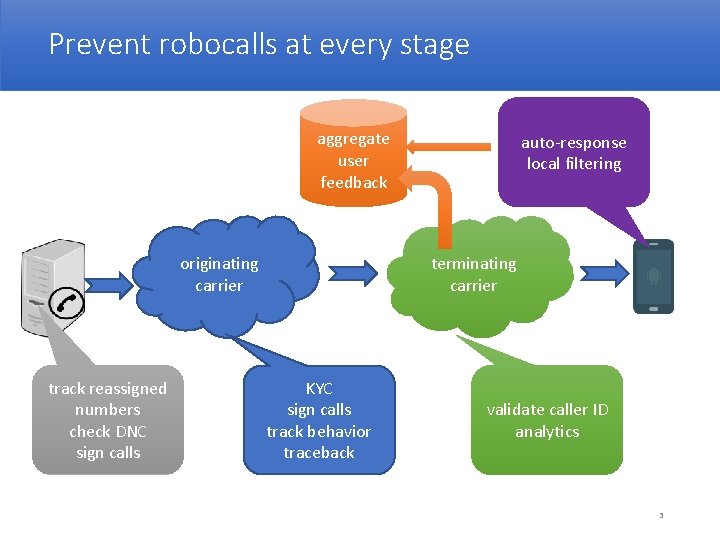
Prevent robocalls at every stage aggregate user feedback originating carrier track reassigned numbers check DNC sign calls auto-response local filtering terminating carrier KYC sign calls track behavior traceback validate caller ID analytics 3
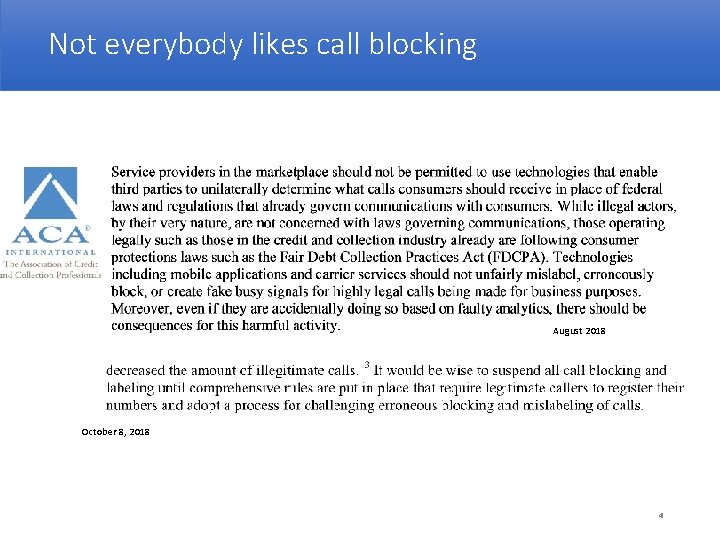
Not everybody likes call blocking August 2018 October 8, 2018 4
Who can do what? • Carriers by themselves • Work with third parties (Nomorobo, First. Orion, TNS, …) • Modify CNAM to show reputation of calling party ( Verizon) • But limited display capability • Carriers in cooperation • STIR/SHAKEN • Industry-wide blacklist • Common white list • Do-not-originate First Orion 5
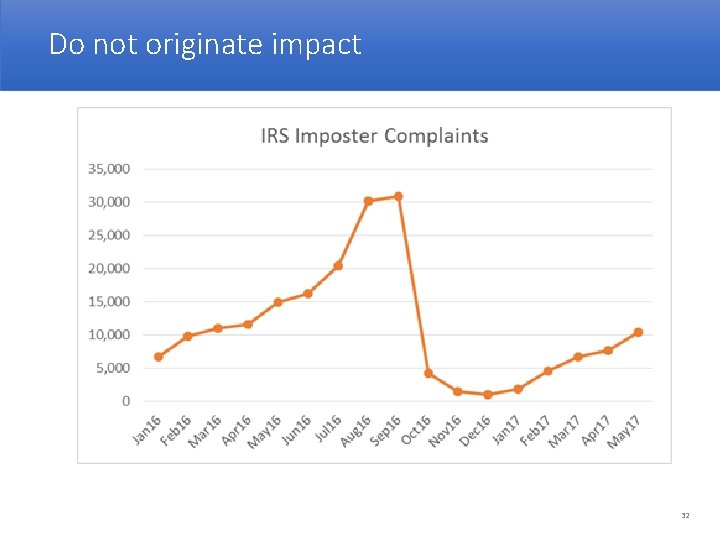
Blacklist & whitelist problems • Blacklist • Not too useful without authentication • Most useful: invalid, unassigned numbers & area codes • Do Not Originate (DNO) – numbers known not to make outbound calls • E. g. , IRS, 555 • Complaint about over-blocking (e. g. , PACE, Sirius. XM, Securus for inmate calls) illegal vs. unwanted in FCC 17 -59 • Whitelist • • No industry-wide effort Likely hard for accidental inclusions to find appropriate organization See CNAM caller ID problems How do validate legitimate robocallers? • No (FCC) license for medical notification services • But bonding may be an option • Re-assigned number database • Who will pay? 6
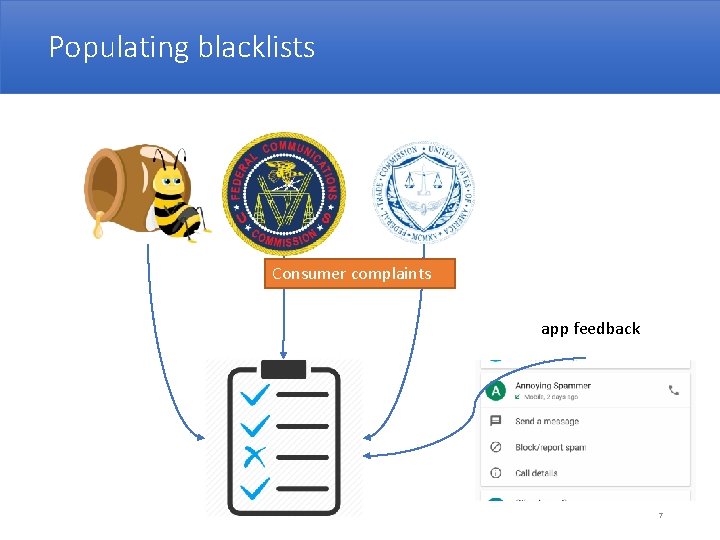
Populating blacklists Consumer complaints app feedback 7
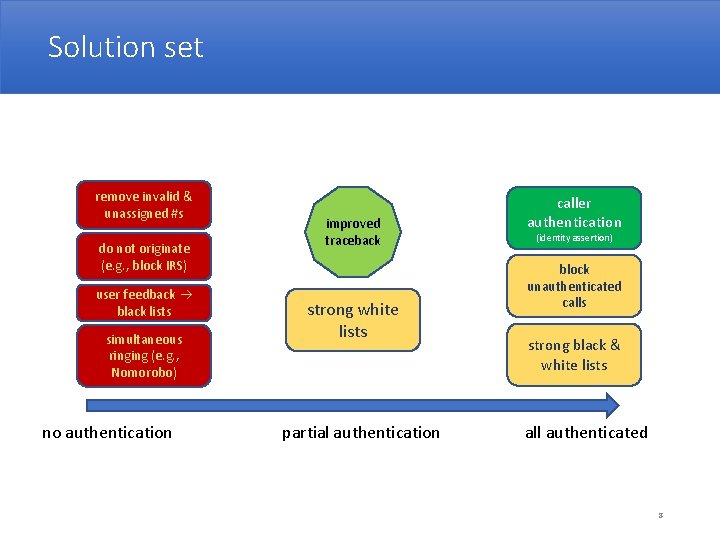
Solution set remove invalid & unassigned #s do not originate (e. g. , block IRS) user feedback black lists simultaneous ringing (e. g. , Nomorobo) no authentication improved traceback strong white lists partial authentication caller authentication (identity assertion) block unauthenticated calls strong black & white lists all authenticated 8
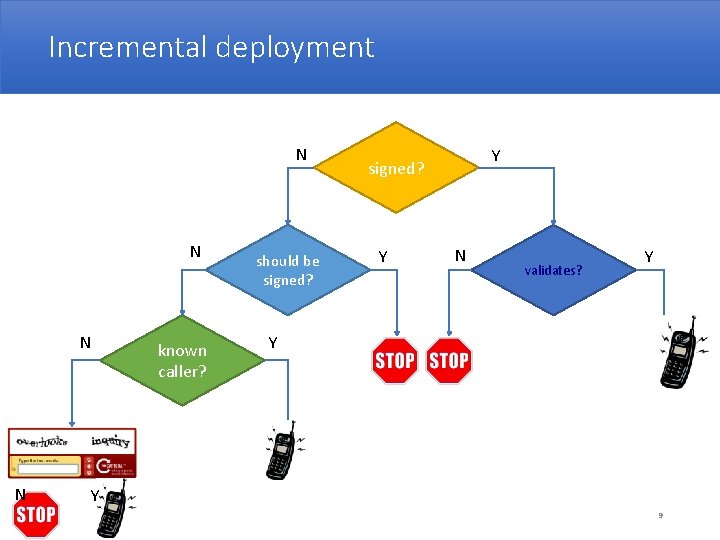
Incremental deployment N N known caller? should be signed? Y N validates? Y Y Y 9
WSJ: “Small Carriers Stymie Robocall Fight” • “Relatively few calls flagged as high risk of being illegal robocalls — 13% — originate from numbers owned by major telecom carriers, including AT&T, Verizon and T-Mobile, according to TNS, which provides network and data services to the telecommunications industry. ” • “R Squared Telecom LLC, based in Akron, Ohio. The company was launched in 2014 as an intermediary connecting Philippines-based call centers to the U. S. telephone system. ” • “The FCC has asserted limited jurisdiction over Vo. IP providers, an agency spokesman said. For example, one-way carriers -- those that place calls but don't receive them -- aren't subject to certain requirements. Many internet-based phone companies are set up this way. ” • The FTC has broad authority to go after deceptive business practices, but the agency believes some robocall intermediaries, including Vo. IP providers, fall outside its jurisdiction. … the FTC cites a May 2018 enforcement action related to scam callers where it declined to sue an internet-based phone company "for its knowing participation in the illegal robocalls. " • The FTC memo pointed the finger at the FCC, saying the company in question was likely a "common carrier" exclusively under the jurisdiction of the FCC. WSJ, 8/19/2019 10
Frankel proposal • All originating providers should do three things: • Permit volume calling only by vetted originators • Include a Billing Telephone Number linked to the Originating Provider • BTN is distinguished when: • • Commercial caller uses an alternative provider for outbound traffic (call termination) Calls are placed “on behalf of” another number, or incoming calls are forwarded Calls are originated from outside USA Wireless subscriber roams off-network • Cooperate with industry traceback efforts • Exception for vetted customers • Legitimate volume call originators subscribe to published best practices • Third-party auditing and compliance • Referenceable by providers, analytics companies, regulatory enforcement 11
STIR/SHAKEN 12
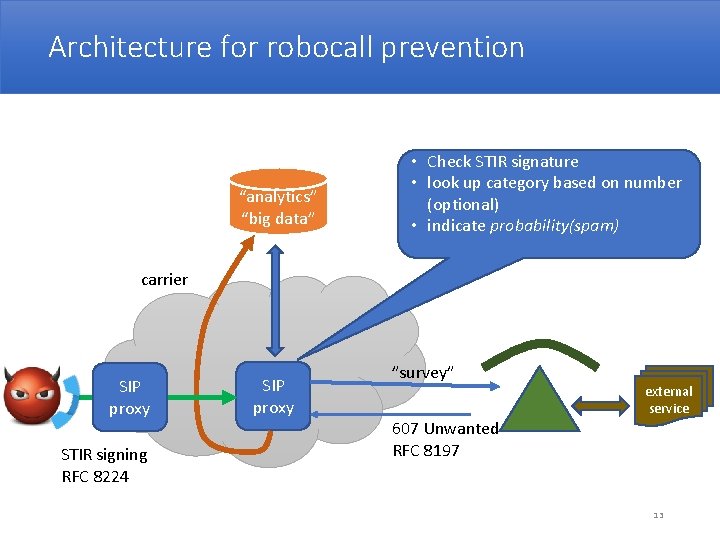
Architecture for robocall prevention “analytics” “big data” • Check STIR signature • look up category based on number (optional) • indicate probability(spam) carrier SIP proxy STIR signing RFC 8224 SIP proxy ”survey” 607 Unwanted RFC 8197 external service 13
The role of STIR/SHAKEN • Ensure that caller is authorized to use calling number • Identify originating carrier (or close to it) • Prevent impersonation and randomization • STIR: protocol additions to Vo. IP call signaling protocol (SIP) IETF • SHAKEN: guidelines for using STIR in carrier networks ATIS & SIPForum 14
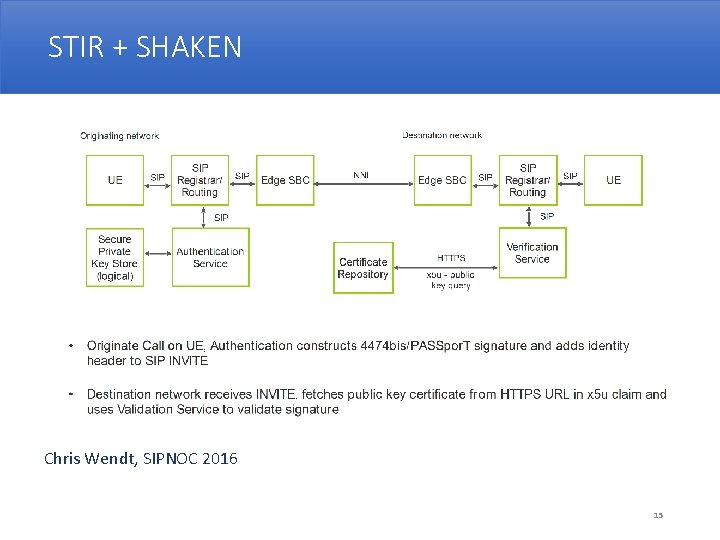
STIR + SHAKEN Chris Wendt, SIPNOC 2016 15
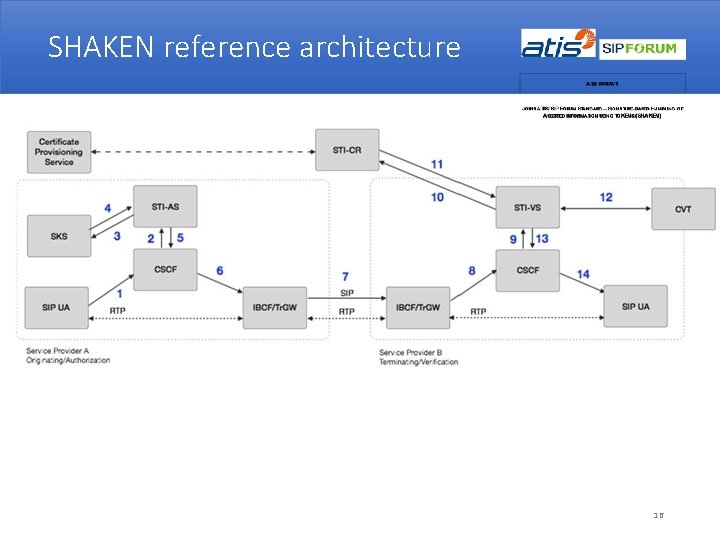
SHAKEN reference architecture 16
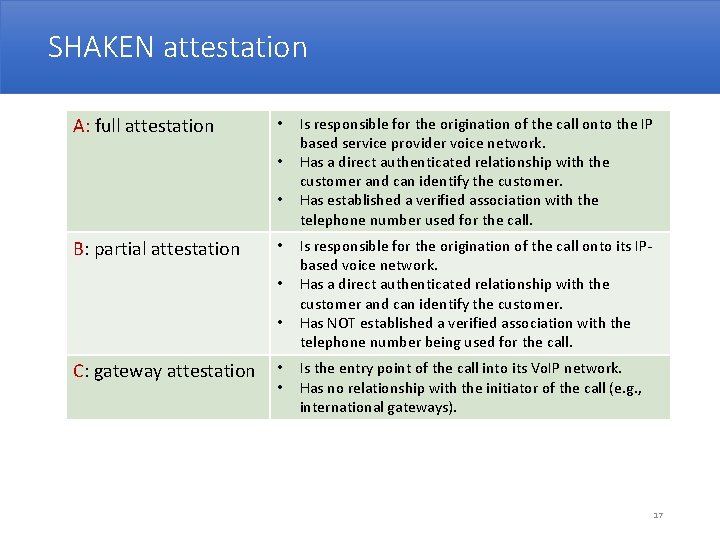
SHAKEN attestation A: full attestation • • • B: partial attestation • • • C: gateway attestation • • Is responsible for the origination of the call onto the IP based service provider voice network. Has a direct authenticated relationship with the customer and can identify the customer. Has established a verified association with the telephone number used for the call. Is responsible for the origination of the call onto its IPbased voice network. Has a direct authenticated relationship with the customer and can identify the customer. Has NOT established a verified association with the telephone number being used for the call. Is the entry point of the call into its Vo. IP network. Has no relationship with the initiator of the call (e. g. , international gateways). 17
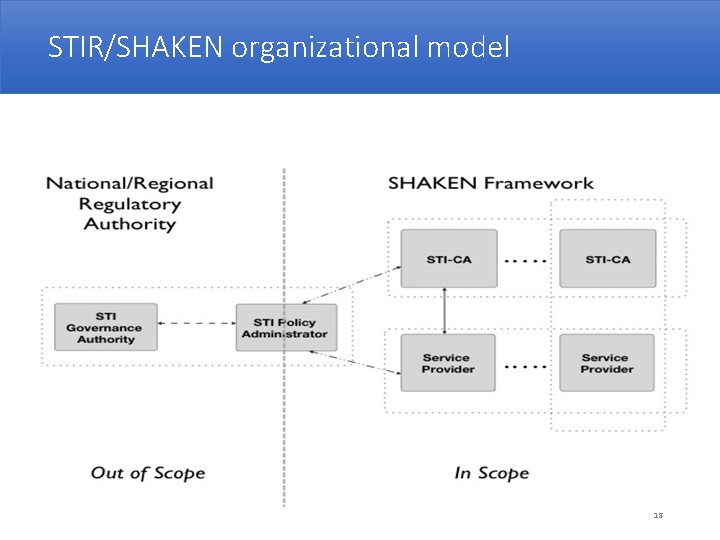
STIR/SHAKEN organizational model 18
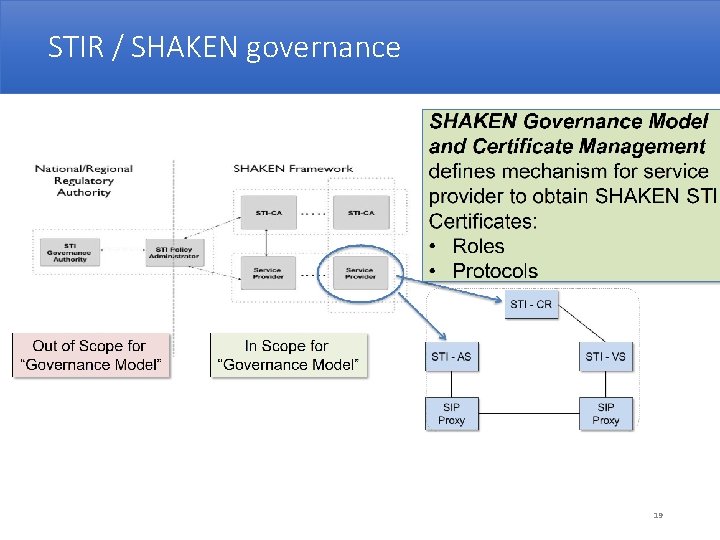
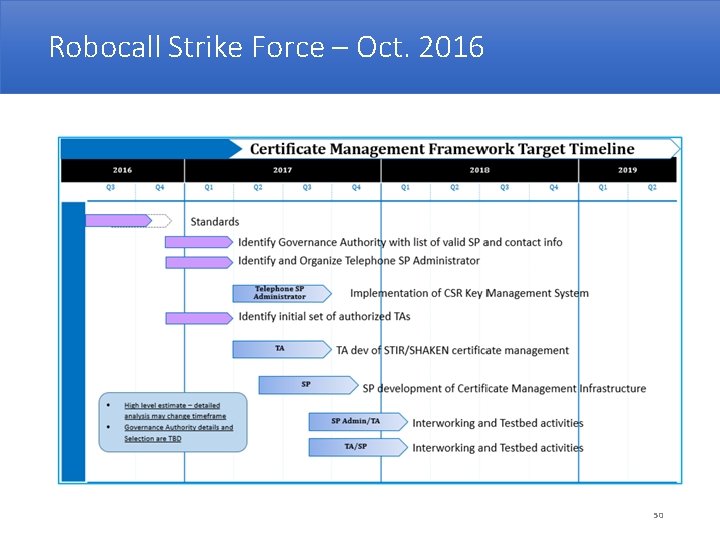
STIR / SHAKEN governance 19
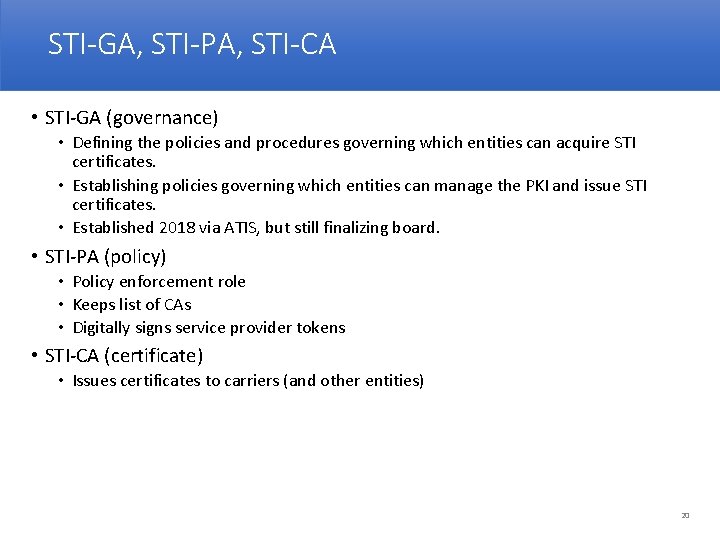
STI-GA, STI-PA, STI-CA • STI-GA (governance) • Defining the policies and procedures governing which entities can acquire STI certificates. • Establishing policies governing which entities can manage the PKI and issue STI certificates. • Established 2018 via ATIS, but still finalizing board. • STI-PA (policy) • Policy enforcement role • Keeps list of CAs • Digitally signs service provider tokens • STI-CA (certificate) • Issues certificates to carriers (and other entities) 20
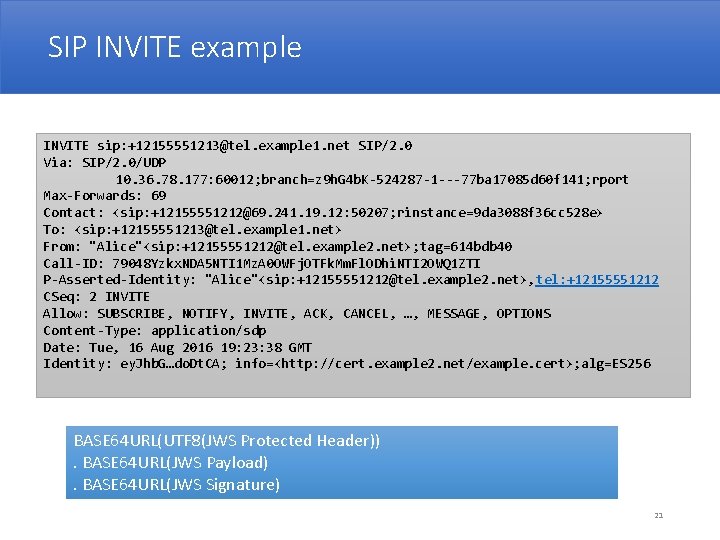
SIP INVITE example INVITE sip: +12155551213@tel. example 1. net SIP/2. 0 Via: SIP/2. 0/UDP 10. 36. 78. 177: 60012; branch=z 9 h. G 4 b. K-524287 -1 ---77 ba 17085 d 60 f 141; rport Max-Forwards: 69 Contact: <sip: +12155551212@69. 241. 19. 12: 50207; rinstance=9 da 3088 f 36 cc 528 e> To: <sip: +12155551213@tel. example 1. net> From: "Alice"<sip: +12155551212@tel. example 2. net>; tag=614 bdb 40 Call-ID: 79048 Yzkx. NDA 5 NTI 1 Mz. A 0 OWFj. OTFk. Mm. Fl. ODhi. NTI 2 OWQ 1 ZTI P-Asserted-Identity: "Alice"<sip: +12155551212@tel. example 2. net>, tel: +12155551212 CSeq: 2 INVITE Allow: SUBSCRIBE, NOTIFY, INVITE, ACK, CANCEL, …, MESSAGE, OPTIONS Content-Type: application/sdp Date: Tue, 16 Aug 2016 19: 23: 38 GMT Identity: ey. Jhb. G…do. Dt. CA; info=<http: //cert. example 2. net/example. cert>; alg=ES 256 BASE 64 URL(UTF 8(JWS Protected Header)). BASE 64 URL(JWS Payload). BASE 64 URL(JWS Signature) 21
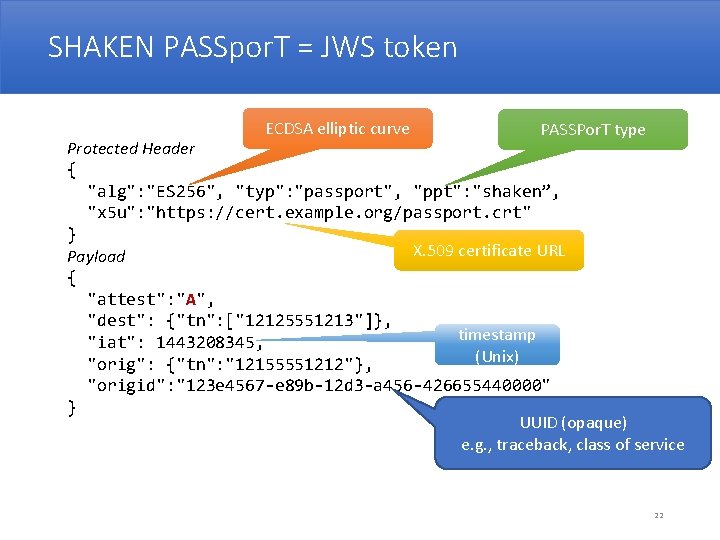
SHAKEN PASSpor. T = JWS token ECDSA elliptic curve PASSPor. T type Protected Header { "alg": "ES 256", "typ": "passport", "ppt": "shaken”, "x 5 u": "https: //cert. example. org/passport. crt" } X. 509 certificate URL Payload { "attest": "A", "dest": {"tn": ["12125551213"]}, timestamp "iat": 1443208345, (Unix) "orig": {"tn": "12155551212"}, "origid": "123 e 4567 -e 89 b-12 d 3 -a 456 -426655440000" } UUID (opaque) e. g. , traceback, class of service 22
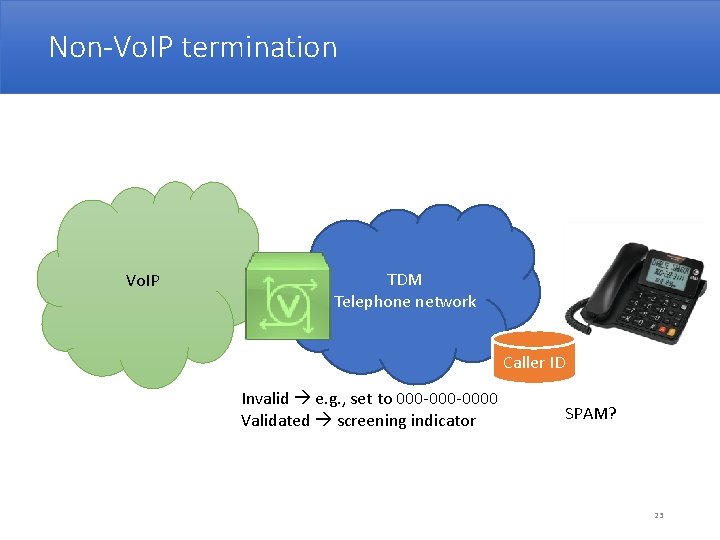
Non-Vo. IP termination Vo. IP TDM Telephone network Caller ID Invalid e. g. , set to 000 -0000 Validated screening indicator SPAM? 23
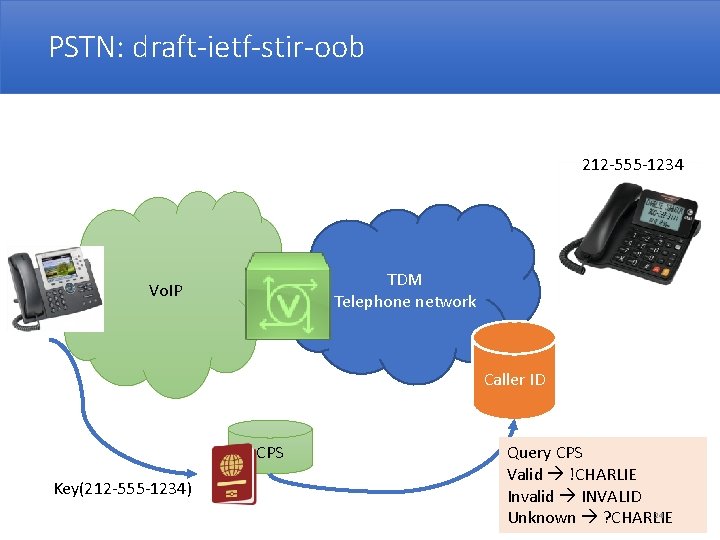
PSTN: draft-ietf-stir-oob 212 -555 -1234 TDM Telephone network Vo. IP Caller ID CPS Key(212 -555 -1234) Query CPS Valid !CHARLIE Invalid INVALID 24 Unknown ? CHARLIE
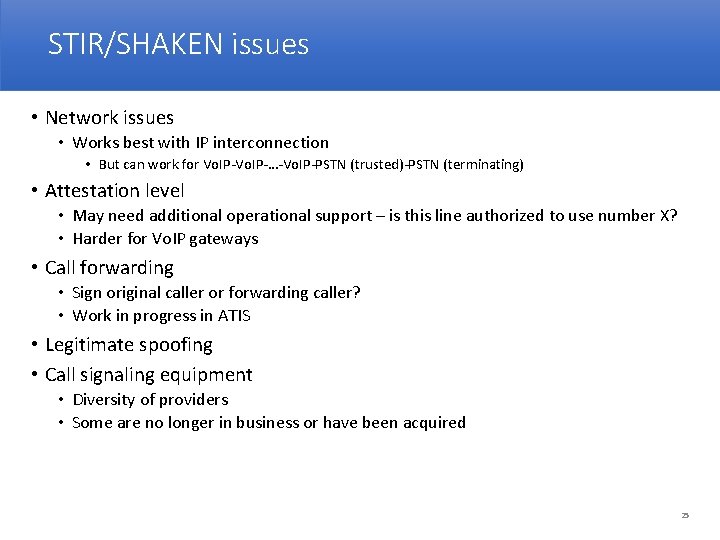
STIR/SHAKEN issues • Network issues • Works best with IP interconnection • But can work for Vo. IP-…-Vo. IP-PSTN (trusted)-PSTN (terminating) • Attestation level • May need additional operational support – is this line authorized to use number X? • Harder for Vo. IP gateways • Call forwarding • Sign original caller or forwarding caller? • Work in progress in ATIS • Legitimate spoofing • Call signaling equipment • Diversity of providers • Some are no longer in business or have been acquired 25
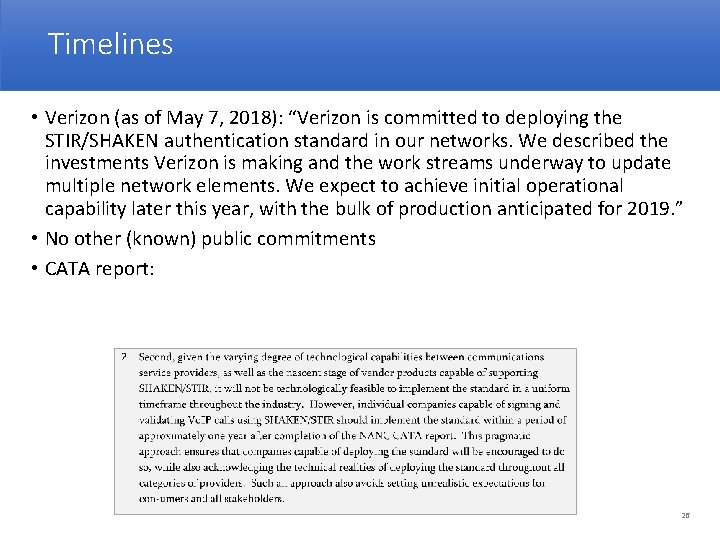
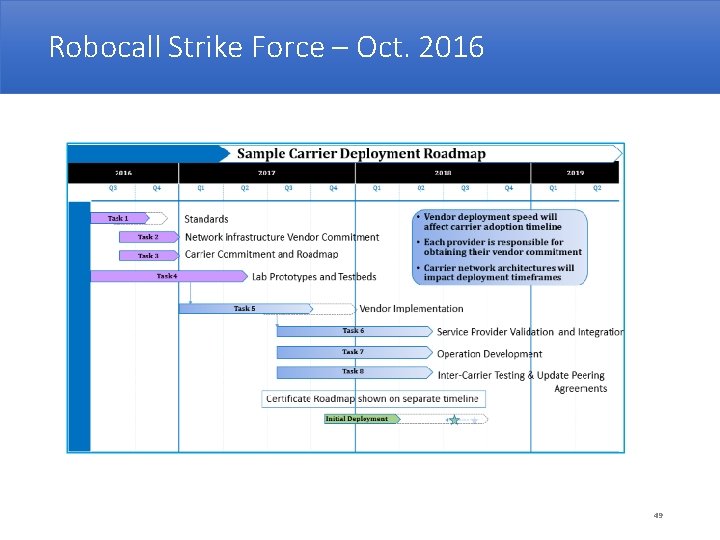
Timelines • Verizon (as of May 7, 2018): “Verizon is committed to deploying the STIR/SHAKEN authentication standard in our networks. We described the investments Verizon is making and the work streams underway to update multiple network elements. We expect to achieve initial operational capability later this year, with the bulk of production anticipated for 2019. ” • No other (known) public commitments • CATA report: 26
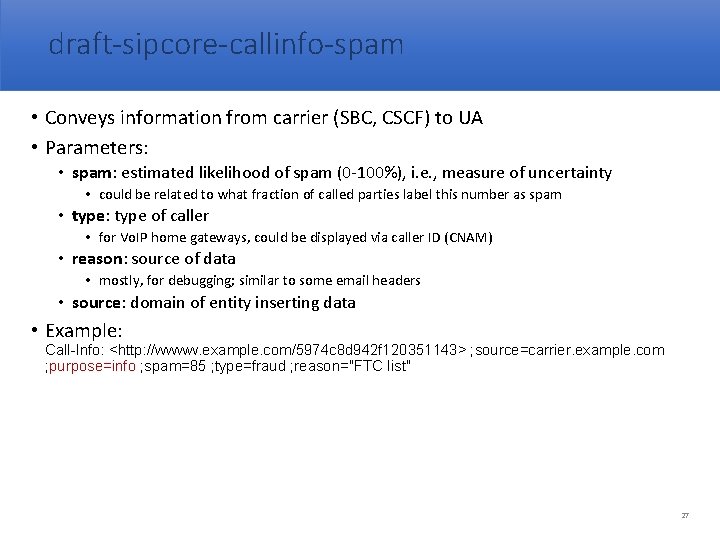
draft-sipcore-callinfo-spam • Conveys information from carrier (SBC, CSCF) to UA • Parameters: • spam: estimated likelihood of spam (0 -100%), i. e. , measure of uncertainty • could be related to what fraction of called parties label this number as spam • type: type of caller • for Vo. IP home gateways, could be displayed via caller ID (CNAM) • reason: source of data • mostly, for debugging; similar to some email headers • source: domain of entity inserting data • Example: Call-Info: <http: //wwww. example. com/5974 c 8 d 942 f 120351143> ; source=carrier. example. com ; purpose=info ; spam=85 ; type=fraud ; reason="FTC list" 27
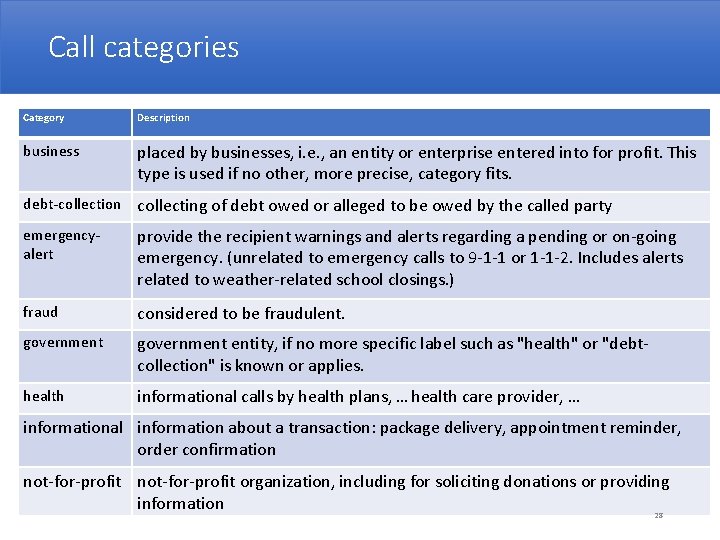
Call categories Category Description business placed by businesses, i. e. , an entity or enterprise entered into for profit. This type is used if no other, more precise, category fits. debt-collection collecting of debt owed or alleged to be owed by the called party emergencyalert provide the recipient warnings and alerts regarding a pending or on-going emergency. (unrelated to emergency calls to 9 -1 -1 or 1 -1 -2. Includes alerts related to weather-related school closings. ) fraud considered to be fraudulent. government entity, if no more specific label such as "health" or "debtcollection" is known or applies. health informational calls by health plans, … health care provider, … informational information about a transaction: package delivery, appointment reminder, order confirmation not-for-profit organization, including for soliciting donations or providing information 28
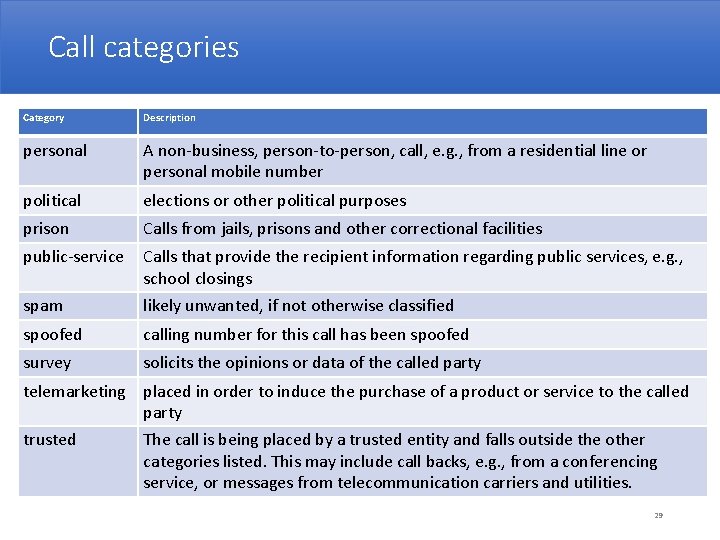
Call categories Category Description personal A non-business, person-to-person, call, e. g. , from a residential line or personal mobile number political elections or other political purposes prison Calls from jails, prisons and other correctional facilities public-service spam Calls that provide the recipient information regarding public services, e. g. , school closings likely unwanted, if not otherwise classified spoofed calling number for this call has been spoofed survey solicits the opinions or data of the called party telemarketing placed in order to induce the purchase of a product or service to the called party trusted The call is being placed by a trusted entity and falls outside the other categories listed. This may include call backs, e. g. , from a conferencing service, or messages from telecommunication carriers and utilities. 29
Do Not Originate (DNO) 30
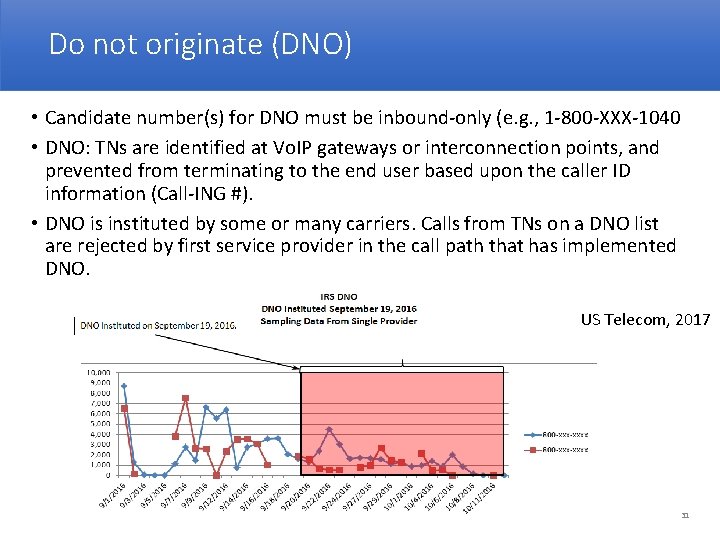
Do not originate (DNO) • Candidate number(s) for DNO must be inbound-only (e. g. , 1 -800 -XXX-1040 • DNO: TNs are identified at Vo. IP gateways or interconnection points, and prevented from terminating to the end user based upon the caller ID information (Call-ING #). • DNO is instituted by some or many carriers. Calls from TNs on a DNO list are rejected by first service provider in the call path that has implemented DNO. US Telecom, 2017 31
Do not originate impact 32
Consumer tools 33
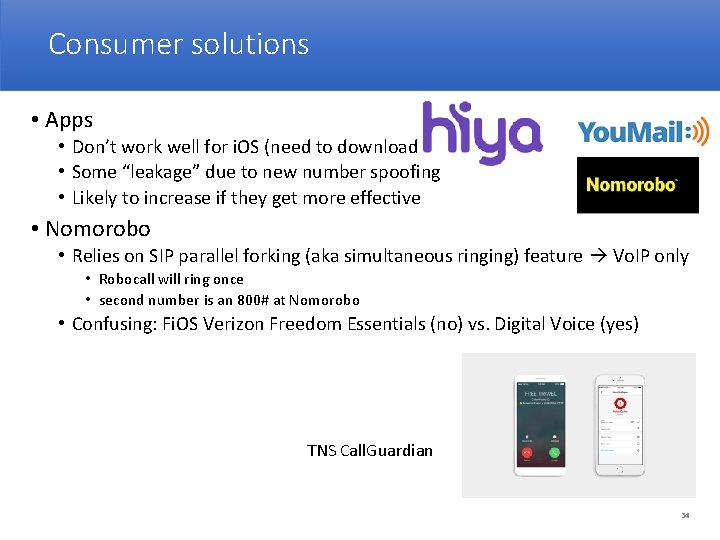
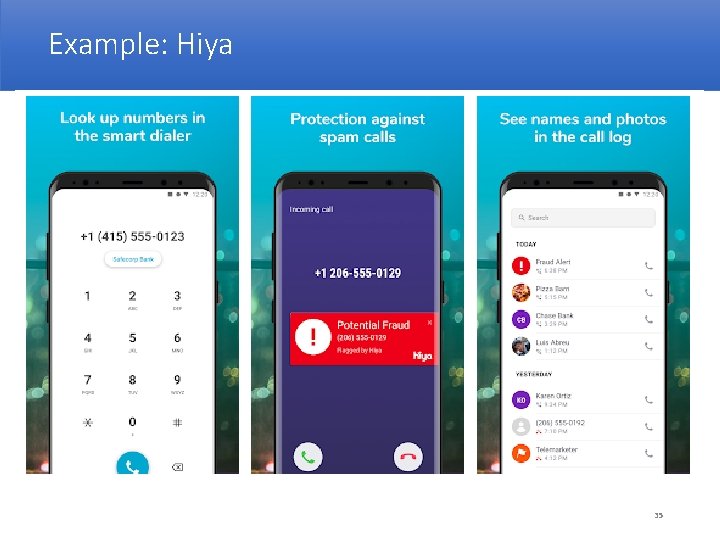
Consumer solutions • Apps • Don’t work well for i. OS (need to download blacklist) • Some “leakage” due to new number spoofing • Likely to increase if they get more effective • Nomorobo • Relies on SIP parallel forking (aka simultaneous ringing) feature Vo. IP only • Robocall will ring once • second number is an 800# at Nomorobo • Confusing: Fi. OS Verizon Freedom Essentials (no) vs. Digital Voice (yes) TNS Call. Guardian 34
Example: Hiya 35
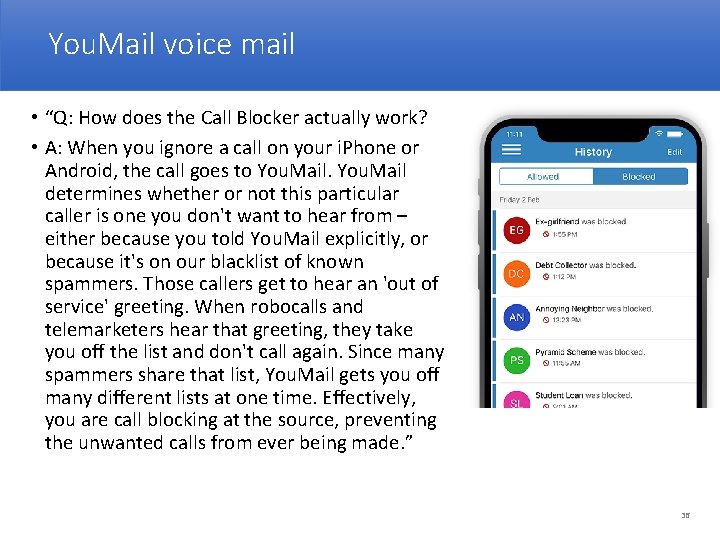
You. Mail voice mail • “Q: How does the Call Blocker actually work? • A: When you ignore a call on your i. Phone or Android, the call goes to You. Mail determines whether or not this particular caller is one you don't want to hear from – either because you told You. Mail explicitly, or because it's on our blacklist of known spammers. Those callers get to hear an 'out of service' greeting. When robocalls and telemarketers hear that greeting, they take you off the list and don't call again. Since many spammers share that list, You. Mail gets you off many different lists at one time. Effectively, you are call blocking at the source, preventing the unwanted calls from ever being made. ” 36
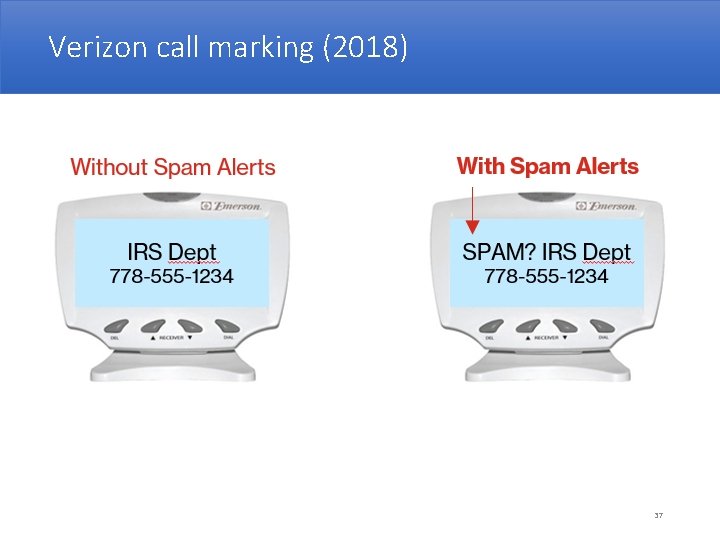
Verizon call marking (2018) 37
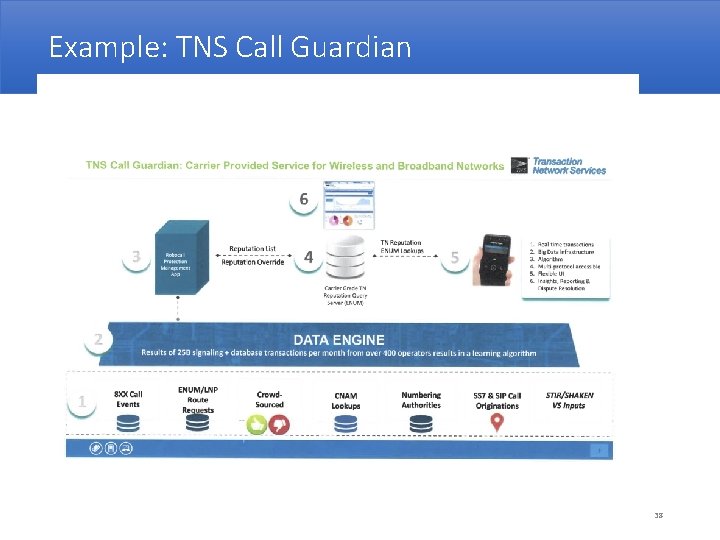
Example: TNS Call Guardian 38
Does the brand of smartphone matter? • You. Mail claim: “Our data shows that i. Phone users get 22% more scam calls, 32% more payment reminders calls, and 25% more telemarketing calls. ” 39
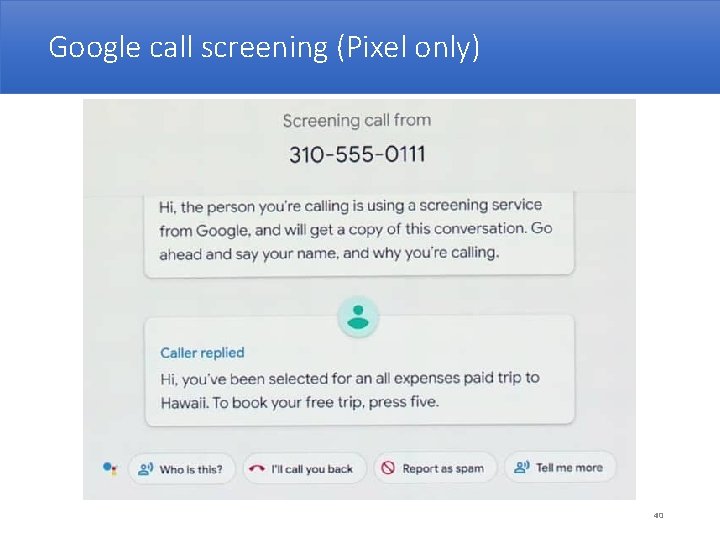
Google call screening (Pixel only) 40
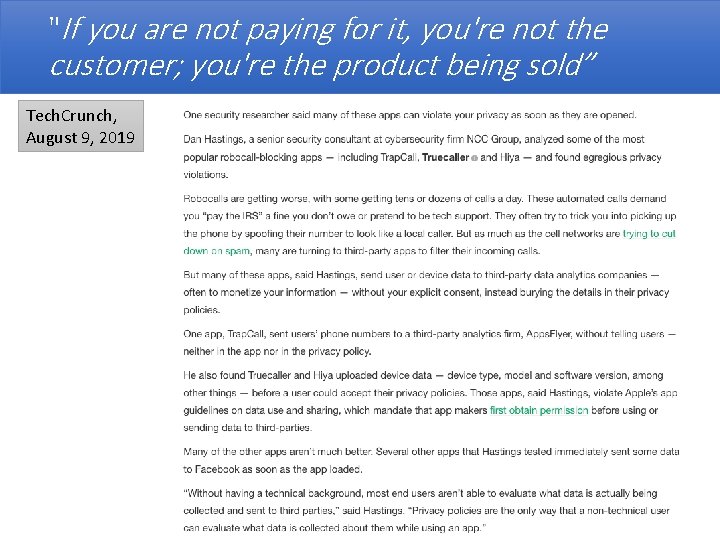
"If you are not paying for it, you're not the customer; you're the product being sold” Tech. Crunch, August 9, 2019 41
Tracking & tracing 42
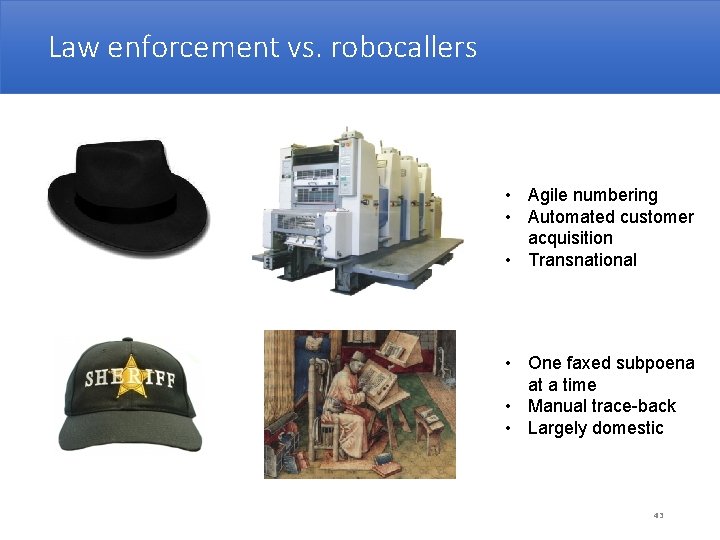
Law enforcement vs. robocallers • Agile numbering • Automated customer acquisition • Transnational • One faxed subpoena at a time • Manual trace-back • Largely domestic 43
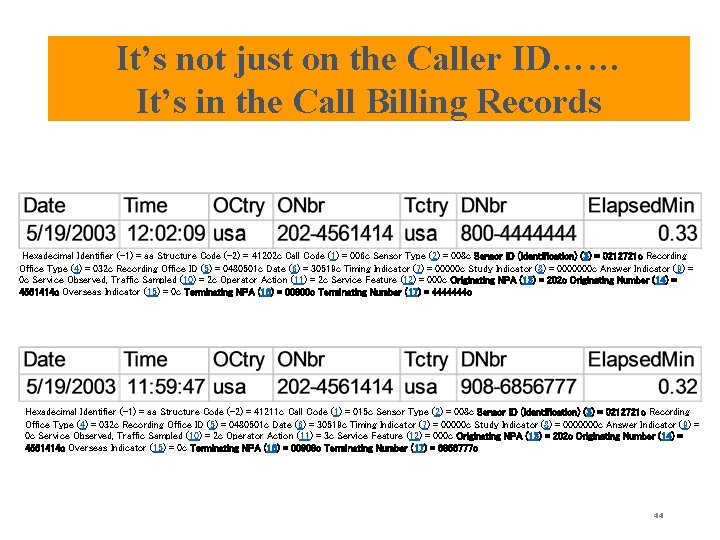
It’s not just on the Caller ID…… It’s in the Call Billing Records Hexadecimal Identifier (-1) = aa Structure Code (-2) = 41202 c Call Code (1) = 006 c Sensor Type (2) = 008 c Sensor ID (Identification) (3) = 0212721 c Recording Office Type (4) = 032 c Recording Office ID (5) = 0480501 c Date (6) = 30519 c Timing Indicator (7) = 00000 c Study Indicator (8) = 0000000 c Answer Indicator (9) = 0 c Service Observed, Traffic Sampled (10) = 2 c Operator Action (11) = 2 c Service Feature (12) = 000 c Originating NPA (13) = 202 c Originating Number (14) = 4561414 c Overseas Indicator (15) = 0 c Terminating NPA (16) = 00800 c Terminating Number (17) = 4444444 c Hexadecimal Identifier (-1) = aa Structure Code (-2) = 41211 c Call Code (1) = 015 c Sensor Type (2) = 008 c Sensor ID (Identification) (3) = 0212721 c Recording Office Type (4) = 032 c Recording Office ID (5) = 0480501 c Date (6) = 30519 c Timing Indicator (7) = 00000 c Study Indicator (8) = 0000000 c Answer Indicator (9) = 0 c Service Observed, Traffic Sampled (10) = 2 c Operator Action (11) = 3 c Service Feature (12) = 000 c Originating NPA (13) = 202 c Originating Number (14) = 4561414 c Overseas Indicator (15) = 0 c Terminating NPA (16) = 00908 c Terminating Number (17) = 6856777 c 44
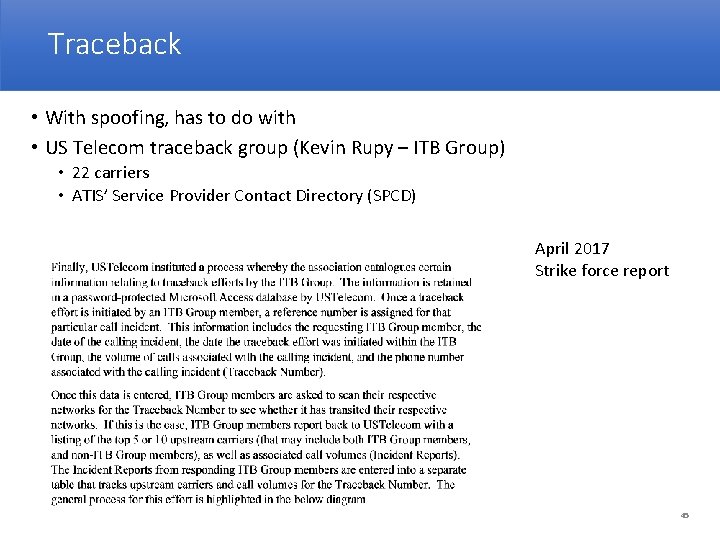
Traceback • With spoofing, has to do with • US Telecom traceback group (Kevin Rupy – ITB Group) • 22 carriers • ATIS’ Service Provider Contact Directory (SPCD) April 2017 Strike force report 45
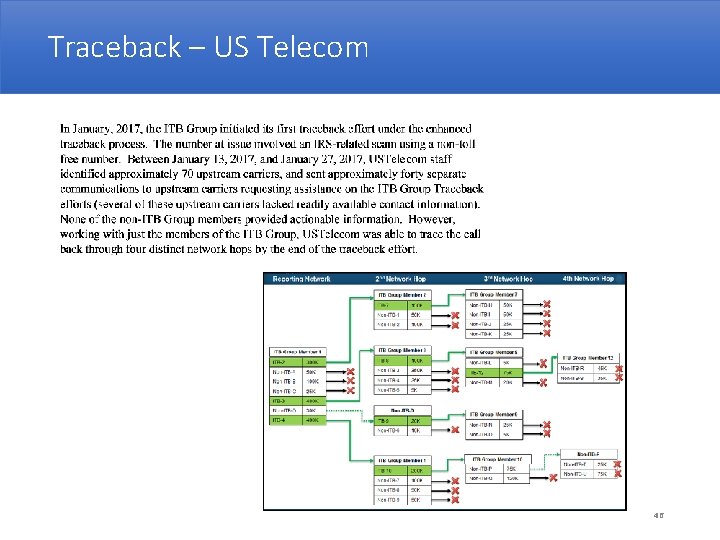
Traceback – US Telecom 46
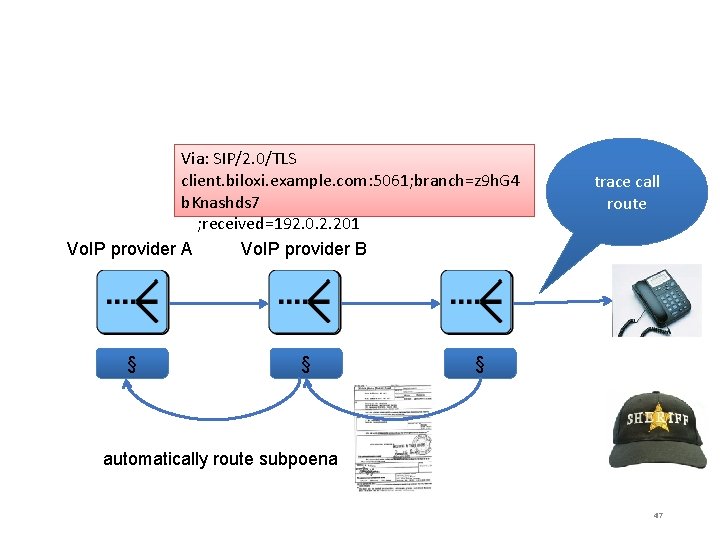
Via: SIP/2. 0/TLS client. biloxi. example. com: 5061; branch=z 9 h. G 4 b. Knashds 7 ; received=192. 0. 2. 201 Vo. IP provider A Vo. IP provider B § § trace call route § automatically route subpoena 47
Federal & state actions 48
Robocall Strike Force – Oct. 2016 49
Robocall Strike Force – Oct. 2016 50
FCC blocking rules • 2015 Order: carriers may offers customers tools to block unwanted robocalls • Requires informed consumer opt-in • Blocking permitted regardless of whether legal or illegal • November 2017: non-opt-in blocking for • calls from invalid/unassigned numbers or • if the subscriber assigned the number authorizes the blocking (e. g. , IRS) do not originate • June 2019: opt-out blocking • voice service providers may offer consumers call blocking through an opt-out process • “may offer opt-out call-blocking programs based on any reasonable analytics designed to identify unwanted calls” • suggest “including a point of contact for legitimate callers to report what they believe to be erroneous blocking as well as a mechanism for such complaints to be resolved” • “offering an opt-in white list program using the consumer’s contact list” 51
FCC analytics (June 2019) • large bursts of calls in a short timeframe • low average call duration • low call completion ratios • invalid numbers placing a large volume of calls • common Caller ID Name (CNAM) values across voice service providers • a large volume of complaints related to a suspect line • sequential dialing patterns • neighbor spoofing patterns • patterns that indicate TCPA or other contract violations • correlation of network data with data from regulators, consumers, and other carriers • and comparison of dialed numbers to the National Do Not Call Registry 52
State AG anti-robocall principles (August 2019) • #1: Offer Free Call Blocking and Labeling. For smartphone mobile and Vo. IP residential customers, make available free, easy-to-use call blocking and labeling tools and regularly engage in easily understandable outreach efforts to notify them about these tools. For all types of customers, implement network-level call blocking at no charge. Use best efforts to ensure that all tools offered safeguard customers’ personal, proprietary, and location information. • #2: Implement STIR/SHAKEN call authentication. • #3: Analyze and Monitor Network Traffic. Analyze high-volume voice network traffic to identify and monitor patterns consistent with robocalls. 53
State AG anti-robocall principles • #4: Investigate Suspicious Calls and Calling Patterns. If a provider detects a pattern consistent with illegal robocalls, or if a provider otherwise has reason to suspect illegal robocalling or spoofing is taking place over its network, seek to identify the party that is using its network to originate, route, or terminate these calls and take appropriate action. Taking appropriate action may include, but is not limited to, initiating a traceback investigation, verifying that the originating commercial customer owns or is authorized to use the Caller ID number, determining whether the Caller ID name sent to a receiving party matches the customer’s corporate name, trademark, or d/b/a name, terminating the party’s ability to originate, route, or terminate calls on its network, and notifying law enforcement authorities. • #5: Confirm the Identity of Commercial Customers. Confirm the identity of new commercial Vo. IP customers by collecting information such as physical business location, contact person(s), state or country of incorporation, federal tax ID, and the nature of the customer’s business. 54
State AG Anti-Robocall Principles • #6: Require Traceback Cooperation in Contracts. For all new and renegotiated contracts governing the transport of voice calls, use best efforts to require cooperation in traceback investigations by identifying the upstream provider from which the suspected illegal robocall entered its network or by identifying its own customer if the call originated in its network. • #7: Cooperate in Traceback Investigations. To allow for timely and comprehensive law enforcement efforts against illegal robocallers, dedicate sufficient resources to provide prompt and complete responses to traceback requests from law enforcement and from USTelecom’s Industry Traceback Group. Identify a single point of contact in charge of responding to these traceback requests, and respond to traceback requests as soon as possible. • #8: Communicate with State Attorneys General. Communicate and cooperate with state Attorneys General about recognized scams and trends in illegal robocalling. Due to the ever-changing nature of technology, update the state Attorneys General about potential additional solutions for combatting illegal robocalls. 55
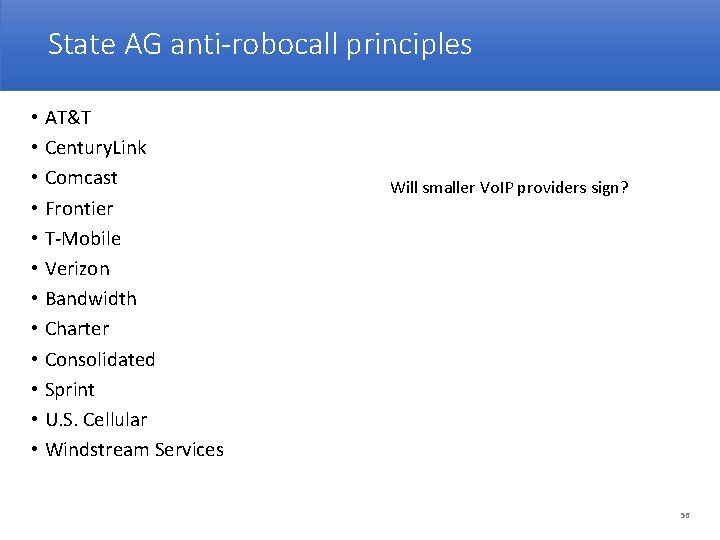
State AG anti-robocall principles • AT&T • Century. Link • Comcast • Frontier • T-Mobile • Verizon • Bandwidth • Charter • Consolidated • Sprint • U. S. Cellular • Windstream Services Will smaller Vo. IP providers sign? 56
TRACED Act (S. 151 – passed 05/2019) • Implements a forfeiture penalty for violations (with or without intent) of the prohibition on certain robocalls. • Requires voice service providers to develop call authentication technologies. • The Federal Communications Commission (FCC) shall promulgate rules establishing when a provider may block a voice call based on information provided by the call authentication framework, but also must establish a process to permit a calling party adversely affected by the framework to verify the authenticity of their calls. The FCC shall also initiate a rulemaking to help protect a subscriber from receiving unwanted calls or texts from a caller using an unauthenticated number. 57
TRACED Act – new definitions & authentication • VOICE SERVICE. —The term “voice service”— • (A) means any service that is interconnected with the public switched telephone network and that furnishes voice communications to an end user using resources from the North American Numbering Plan • (B) includes— • (i) transmissions from a telephone facsimile machine, computer, or other device to a telephone facsimile machine; and • (ii) …, any service that enables real-time, two-way voice communications, … and permits out-bound calling, whether or not the service is one-way or two-way voice over internet protocol. • …, not later than 18 months after the date of enactment of this Act, the [FCC] shall require a provider of voice service to implement the STIR/SHAKEN authentication framework… 58
TRACED Act • Requires DOJ and the FCC to assemble an interagency working group to study and report to Congress on the enforcement of the prohibition of certain robocalls. Specifically, the working group will look into how to better enforce against robocalls by examining issues like the types of laws, policies, or constraints that could be inhibiting enforcement. • Requires the FCC to initiate a proceeding to determine whether its policies regarding access to number resources could be modified to help reduce access to numbers by potential robocall violators. 59
H. R. 3375 - Stopping Bad Robocalls Act • Passed House July 24, 2019 • “the establishment of a database of telephone numbers that have been disconnected” • no citation required to seek forfeiture penalty • four year statute of limitations (47 USC 227 b) • annual robocall report 60
H. R. 3375 - Stopping Bad Robocalls Act • call authentication regulations within one year, effective within 6 months • no line item charge for call authentication • blocking service “are provided with no additional line item charge to consumers and no additional charge to callers for resolving complaints related to erroneously blocked calls” • require contact information for Vo. IP providers • “would be an interconnected Vo. IP service (as so defined) except that the service permits users to terminate calls to the public switched telephone network but does not permit users to receive calls that originate on the public switched telephone network” 61
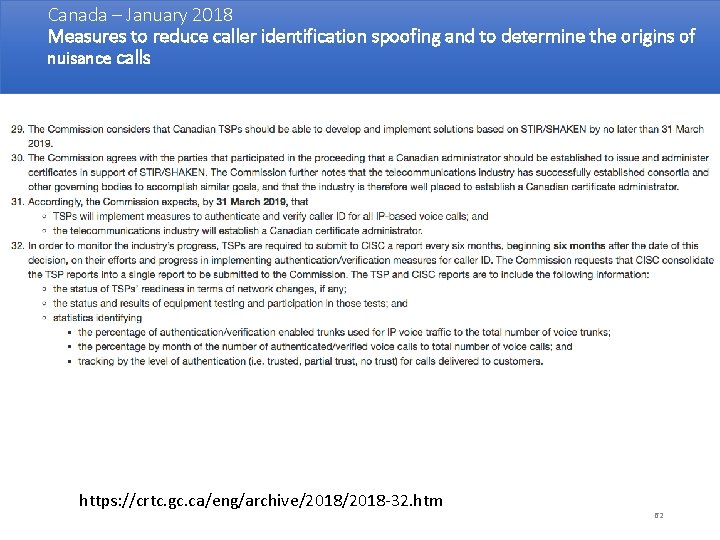
Canada – January 2018 Measures to reduce caller identification spoofing and to determine the origins of nuisance calls https: //crtc. gc. ca/eng/archive/2018 -32. htm 62
Make numbers valuable • If spoofing stops, robocallers will find number resellers • Robocallers will “burn” numbers – use until number gets blocked • number exhaust problem – many numbers become “tainted” • may still be sufficiently cheap to make calls e. g. , at 1, 000 calls, only $0. 001 • Create consumer (low-volume) and high-volume numbers • e. g. , $10/year for low-volume outbound numbers (e. g. , 10 calls/day) • $1, 000/year for high-volume number (> 10 calls per day) • Also helps solve USF problems 63
- Slides: 63