
Robo Shopping Cart Zeyi Huang Zehong Lin Carlos
Robo Shopping Cart Zeyi Huang, Zehong Lin, Carlos Gonzalez
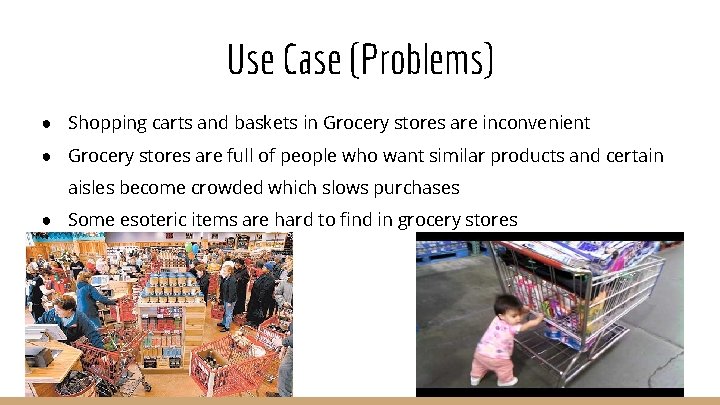
Use Case (Problems) ● Shopping carts and baskets in Grocery stores are inconvenient ● Grocery stores are full of people who want similar products and certain aisles become crowded which slows purchases ● Some esoteric items are hard to find in grocery stores
Use Case (Solution) ● Web app takes customer’s shopping list ● Autonomous shopping cart then guides customers through store to pick up item on shopping list while carrying their items ● Increasing efficiency through store increases revenue ● Removing inconvenience of carrying basket / pushing cart increases customer satisfaction
Requirements ● The cart should sense the items put onto cart in 90% of cases (pressure pad inconsistencies with light items) ● The cart senses the item and starts driving to next item within 2 seconds (noticeable amount of lag time) ● The cart should drive at 3. 1 mph (avg. human walking speed) ● The cart should stop within +-0. 25 m of object (comfortable reach distance)
Requirements (cont. ) ● The cart should never go to the incorrect location (eliminates efficiency) ● The cart should take the optimal route to next item on list (increases efficiency)
Testing, Verification, Metrics 1. Item Placement Detection test: 20 Random items placed in cart. Detects at least 18. 2. Item Placement Response test: 20 detected items. Once item is detected, cart always starts moving to next item within 2 seconds. 3. Speed Test: Pick 10 most common items and measure cart average speed from each item to every other item (90 total paths) 4. Proximity test: Pick 10 most common items. Have cart drive to each from random initial location. Measure Average distance error between cart and item.
Testing, Verification, Metrics 5. Locate Item test: Pick random cart location. Have it navigate to 10 items. 6. Route Optimality test: Pick 10 items. Start cart at random location. Manually verify each path is optimal
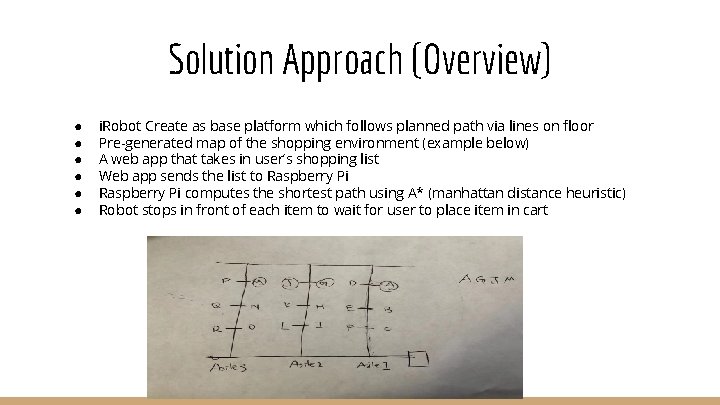
Solution Approach (Overview) ● ● ● i. Robot Create as base platform which follows planned path via lines on floor Pre-generated map of the shopping environment (example below) A web app that takes in user’s shopping list Web app sends the list to Raspberry Pi computes the shortest path using A* (manhattan distance heuristic) Robot stops in front of each item to wait for user to place item in cart
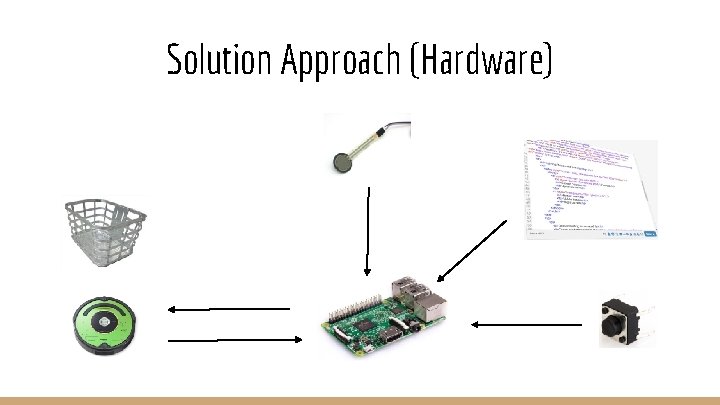
Solution Approach (Hardware)
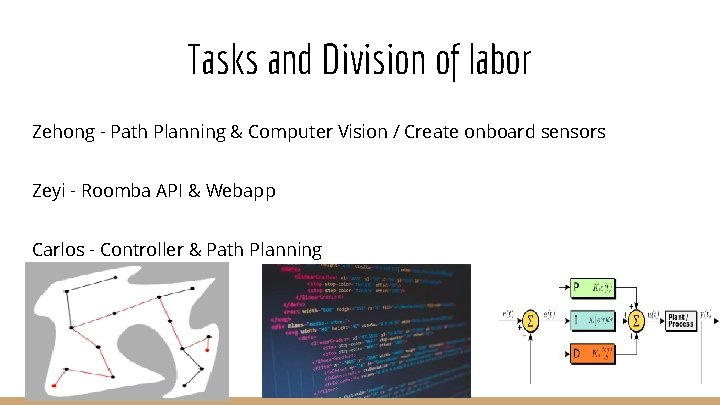
Tasks and Division of labor Zehong - Path Planning & Computer Vision / Create onboard sensors Zeyi - Roomba API & Webapp Carlos - Controller & Path Planning
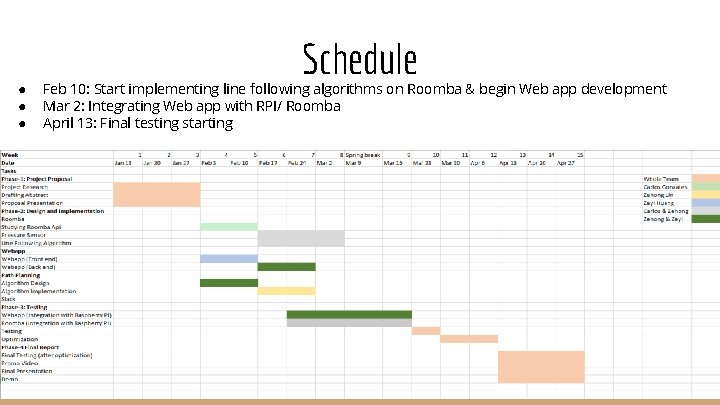
● ● ● Schedule Feb 10: Start implementing line following algorithms on Roomba & begin Web app development Mar 2: Integrating Web app with RPI/ Roomba April 13: Final testing starting
References 1. 2. 3. 4. 5. https: //www. irobot. com/about-irobot/stem/create-2 http: //roombots. mx. com/make_your_own https: //www. irobotweb. com/-/media/Main. Site/PDFs/About/STEM/Create/Robo. Cam-Web. Interface. pdf https: //www. irobot. com/about-irobot/stem/create-2/projects https: //www. irobotweb. com/~/media/Main. Site/PDFs/About/STEM/Create/i. Robot_Roomba_600_Open_Interface_Spec. pdf
- Slides: 12