
Robin Parker Melissa Helwig Reference Questions The Search

Robin Parker & Melissa Helwig
§Reference Questions §The Search
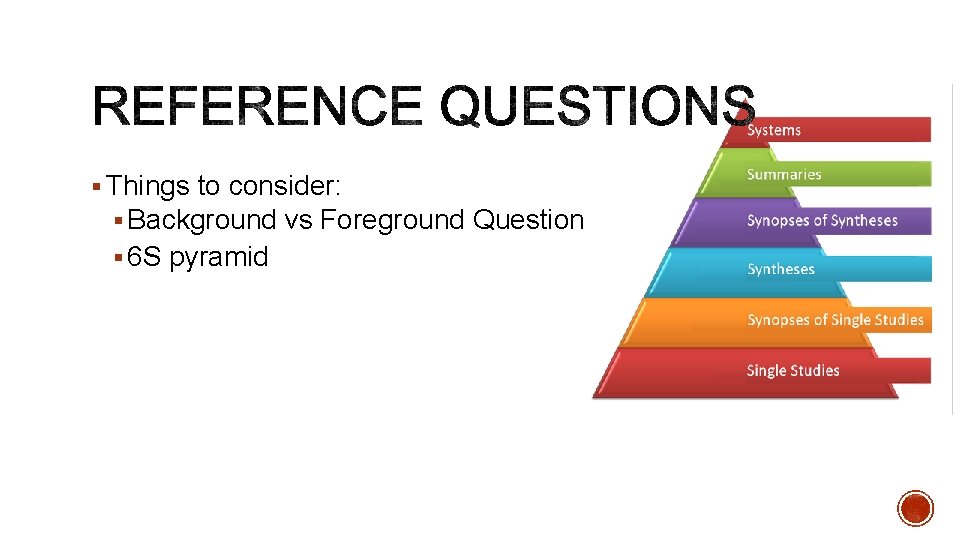
§ Things to consider: § Background vs Foreground Question § 6 S pyramid
§ Ask for general knowledge about a condition or thing § Tend to have two components: § A question root (who, what, when, how, why? ) and a verb § A disorder, test, treatment or other aspect of health care § Examples: § What causes SARS? § What causes migraines? § How often should women over the age of 40 have a mammogram?
§ Where to find the answers: § Textbooks (ex. Harrisons Principles of Internal Medicine) § Handbooks (ex. Handbook of Fluid, Electrolyte & Acid-Base Imbalances) § Databases (ex. Dynamed)
§ Ask for specific knowledge to inform clinical decisions or actions § Have essential components: PICO OR PIOx OR PICOT § Examples of Foreground Questions: § In young children with acute otitis media, is short-term antibiotic therapy as effective as long-term antibiotic therapy? § Among family members of patients undergoing diagnostic procedures, does standard care, listening to tranquil music or audiotaped comedy routines make a difference in the reduction of reported anxiety?

A parent stops by your pharmacy counter, they are concerned that their tween is developing acne and have seen commercials for proactiv and other acne treatments but wonder if they should try something else first? You remember there is a recent guideline published on pediatric acne, and ask them for a few minutes so you can look it up and answer their question.
A patient returns from working overseas in a malaria region and is excited to learn she is pregnant. She is now entering her 2 nd trimester and arrives at the local rural hospital with malaria. The health care team wonders about drug therapy options for the patient?
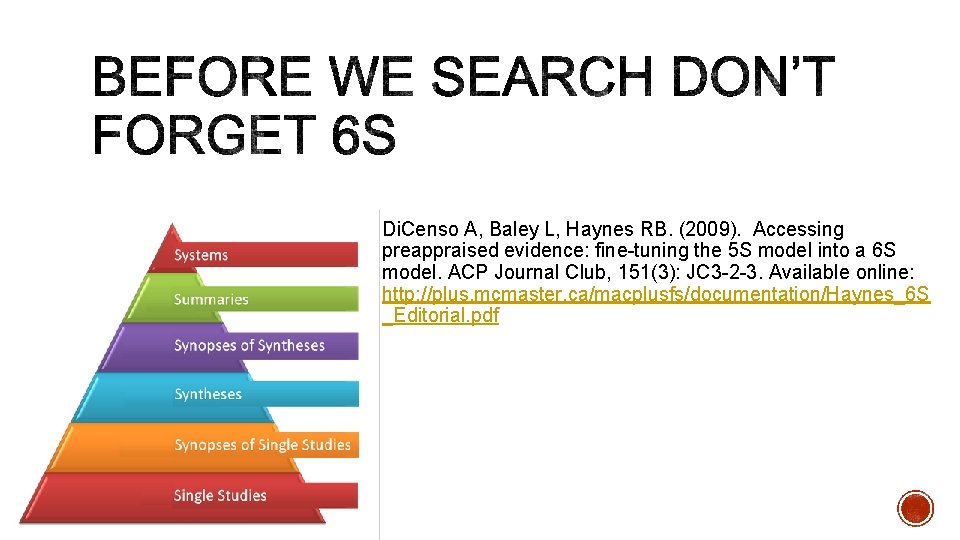
Di. Censo A, Baley L, Haynes RB. (2009). Accessing preappraised evidence: fine-tuning the 5 S model into a 6 S model. ACP Journal Club, 151(3): JC 3 -2 -3. Available online: http: //plus. mcmaster. ca/macplusfs/documentation/Haynes_6 S _Editorial. pdf
§ Point of care tools § Dynamed, Clinical Key, etc § Citation Databases § Pub. Med, CINAHL, Web of Science, Psyc. INFO § Specialized/hybrid databases § Cochrane Library, Canadian Electronic Library § Other resources § Association, society websites, government sources, statistics
§ One of your med students has identified a potential mentor for their RIM program with similar area of interest in family practice, specifically related to end of life care. Before meeting with this potential mentor, they want to scope the literature, become familiar with the research in the field, and get some ideas for potential research questions for their RIM project. You open Pub. Med to start a literature search with the student.
§ In order to have a more focused question, the student decides to look at the role of hydration (fluid therapy) in palliative care at end of life.
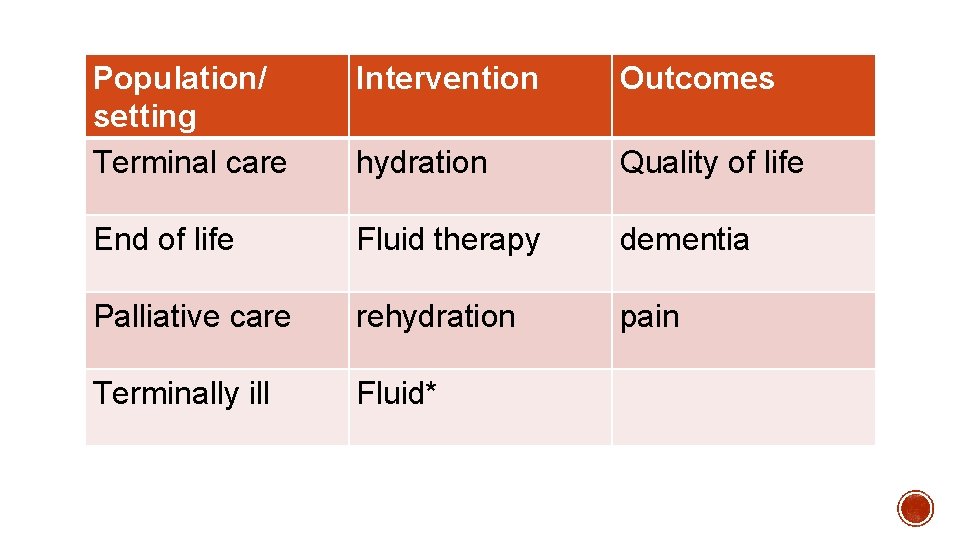
Population/ setting Terminal care Intervention Outcomes hydration Quality of life End of life Fluid therapy dementia Palliative care rehydration pain Terminally ill Fluid*
- Slides: 14