
Roberts Rules of Order Simplified Guide to an
Robert’s Rules of Order: Simplified Guide to an Organized Meeting The National Exchange Club Ken Roberts
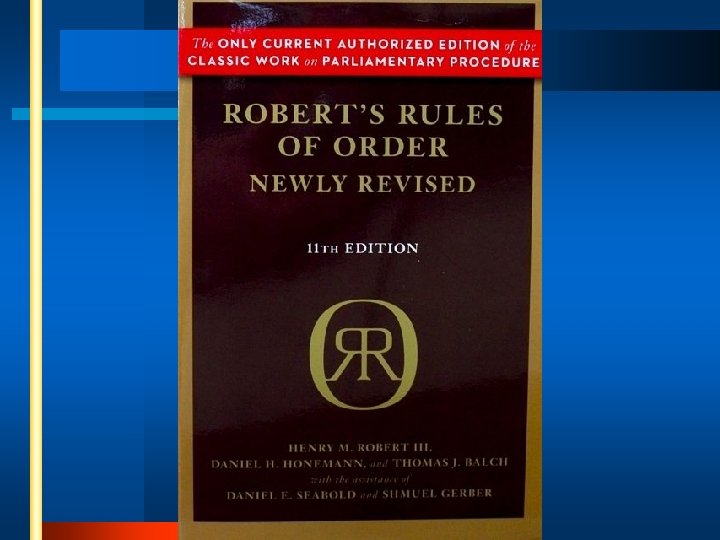
Today’s Topics Fundamental Principles Definitions Operating Procedures Responsibilities of the Chairman General Types of Motions Making Motions Precedence of Motions Newly Revised 11 th Edition (2013)
Fundamental Principles All members have equal rights with mutual respect. The rights of minority groups must be protected while the will of the majority must govern. Only one item is considered at a time. Majority vote decides the issue.

Fundamental Principles Any action limiting members rights requires 2/3 majority. Any item once decided cannot be brought up again except by motion to reconsider. Simplest, clearest, and most expeditious is proper providing it does not violate members rights.
Definitions Mass Meeting –Widely open unorganized group. Typically a single event like a rally. Assembly – Organized group limited to defined membership like club meeting. Convention – Assembly of delegates. Board – Managerial group with powers defined by larger organization. Committee – Subordinate body.

Definitions Quorum – The number of members required to legally conduct business. Generally in Bylaws. Otherwise: • Mass Meeting – The number present • Body of Delegates or Convention – A majority of those registered as attending. • Assembly of enrolled members – A majority of the members. If defining a quorum, set a number that is representative and dependable
Definitions Improper Motions • A motion that is absurd or seeks to obstruct the will of the assembly. • A motion that conflicts with the purpose or Bylaws of the organization. • Unless a motion to reconsider, motions that are practically the same or conflicting with previous decisions. • A motion that is outside the scope or purpose of the group.
Board Operating Procedures A written agenda should be presented at the beginning of each board meeting. This should be adopted and then followed.

Board Operating Procedures Someone must keep an accurate and permanent record of business conducted by the board. This record should record all motions, a summary of debate on each motion and its disposition.
Board Operating Procedures The minutes of each meeting should be provided to each board member for their review prior to the next board meeting. As one of the first orders of business at each board meeting, the minutes of the previous board meeting should be approved after noting any corrections.
Board Operating Procedures The title of the presiding officer is not gender specific (i. e. the president or chairman may be either male or female). Proper form of address would be, “Mr. President. . . ” or “Madam Chairman. . . ” depending upon the title and gender of the presiding officer

Chairman’s Responsibilities The chairman’s primary responsibility is to maintain order and expedite the purpose of the meeting. • The chairman has the obligation to protect board members from having their time wasted by repetitive and frivolous discussion. Time wasted on comments not adding to a debate is time that may be needed later on other items. • The chairman must be sensitive to the mood of the group and recognize when to ask if they are ready to vote.
Chairman’s Responsibilities Recognize board members entitled to speak or propose motions. (Some motions may be made while another member has the floor. Speaker must state the purpose of the interruption so the chairman can rule on its validity. ) Restate motions after they have been seconded, then open discussion.
Chairman’s Responsibilities Close discussion and put motions to the vote. • Votes on undebatable motion should be called immediately. • If any member objects to closing discussion on a debatable motion, a 2/3 vote is required to order closure to a debate. • Restate the motion as it was made or amended before calling for a vote.
Chairman’s Responsibilities Announce the result of a vote immediately. • A tie vote defeats a motion requiring a majority of those voting. Avoid entering into any controversy or interfering with legitimate motions.
Chairman’s Responsibilities Maintain order and proper procedure • Make necessary rulings promptly and clearly Expedite board business. • Must be compatible with rights of board members. • May advise members on how to proceed • May order routine action without vote (“If there is no objection …”)
Chairman’s Responsibilities Protect the board from frivolous or improper motions. • You may refuse to entertain motion where purpose is to obstruct the board’s business. Guard the board’s time. • Adopt an agenda and follow it. • Do not allow unauthorized interruptions by spectators

General Type of Motions Main Motions • To introduce items for board’s consideration • Cannot be made when another motion is under consideration • They yield to privileged, subsidiary and incidental motions “I move that we purchase…”

General Type of Motions Subsidiary Motions • These change the main motion or affect how it is handled. • These must be voted on before the main motion. For example: “I move we refer this to the finance committee. ” “I move we amend the motion to read …”
General Type of Motions Privileged Motions • These motions are most urgent matters not related to pending business For example: “I move that we recess for …” “ I move that we adjourn. ”

General Type of Motions Incidental Motions • These motions are questions of procedure that arise out of other motions and must be considered before the other motion. For example: “I move that we suspend the rules for the purpose of …” “ I rise to a point of order. ”
Making Motions Obtain the floor • • Wait until previous speaker is finished. Rise and address the chairman Give your name Presiding officer will recognize you be repeating your name.
Making Motions Make your motion • Speak clearly and concisely • State your motion affirmatively (not negatively) • Avoid personalities and stay on the subject.

Making Motions Wait for a second • Another member will say, “I second the motion. ” • Presiding officer may ask for a second • If there is no second, your motion will not be considered.
Making Motions Presiding officer restates your motion “It is moved and seconded that we …” • After this debate or voting can occur • Your motion, once made and seconded, is property of the group. You can not change it without consent of the group.
Making Motions Discussion • The person making the motion is allowed to speak first. • Direct comments to presiding officer • Keep to time limit (if any) • You may speak again after all other speakers have had their chance. • You may speak a third time with 2/3 vote to suspend the rules.
Making Motions Voting on the question • The presiding officer asks the group “Are you ready for the question? ” • If no more discussion (or if there has been a 2/3 vote to end debate) the vote is taken • The presiding officer announces the voting results
Precedence of Motions 1. 2. 3. 4. 5. 6. Adjourn Recess Raise a question of privilege Call for the orders of the day Lay on the table (table) Order the previous question (close debate)
Precedence of Motions Limit or extend limits of debate 8. Postpone definitely 9. Commit or refer 10. Amend 11. Postponed indefinitely 12. Main motion 7.
Newly Revised th 11 Edition Overview: In 2013 Robert’s Rules of Order Newly Revised was updated. These changes do not affect the Fundamental Principles we have discussed but reflect more modern procedures to the benefit of smaller groups where less formality may be desired.
Small Boards and Committees Members raise hand for recognition. Motions do not need a second. Member may speak multiple times. Informal discussion may take place before a motion. If proposal is perfectly clear, a vote may be taken without motion. Chairman may discuss and vote.
Not Covered Today’s seminar has necessarily been limited to leadership guides and basic parliamentary actions. The second half of the handbook you have been given is a quick reference for your use. It contains many of the most common motions and how they are to be used.
Any Questions?
- Slides: 35