
ROBERT J STERNBERG Hannah Rogers and Natalie Price

ROBERT J. STERNBERG Hannah Rogers and Natalie Price
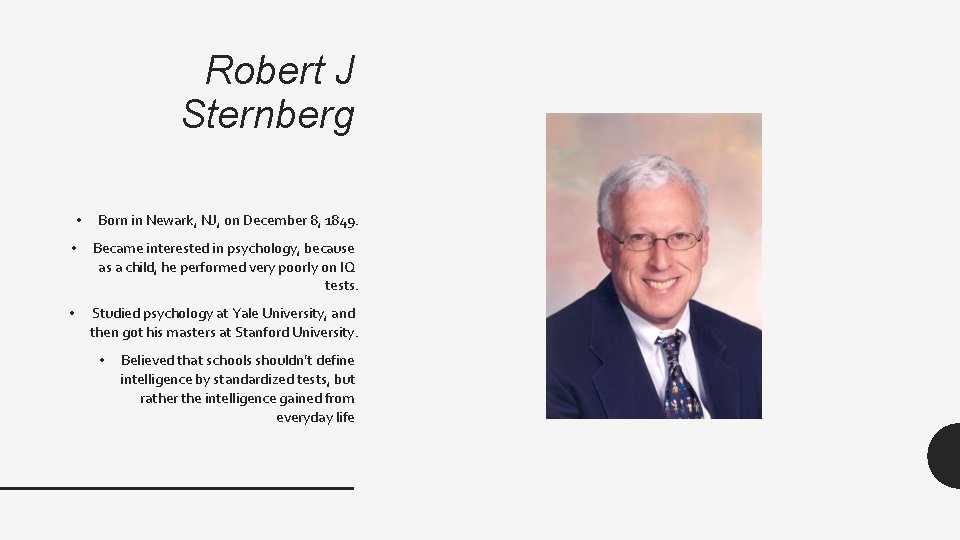
Robert J Sternberg • Born in Newark, NJ, on December 8, 1849. • Became interested in psychology, because as a child, he performed very poorly on IQ tests. • Studied psychology at Yale University, and then got his masters at Stanford University. • Believed that schools shouldn’t define intelligence by standardized tests, but rather the intelligence gained from everyday life
Successful Intelligence • He asked himself why people with a practical ability to do a job like his- to teach, research, and administratewere not accepted because of a lack of memorization. • Concluded that the education systems had students failing because this system was unable to see or nurture their creativity and practical abilities. • This helped him form his “triarchic” theory of intelligence and it’s practical application.
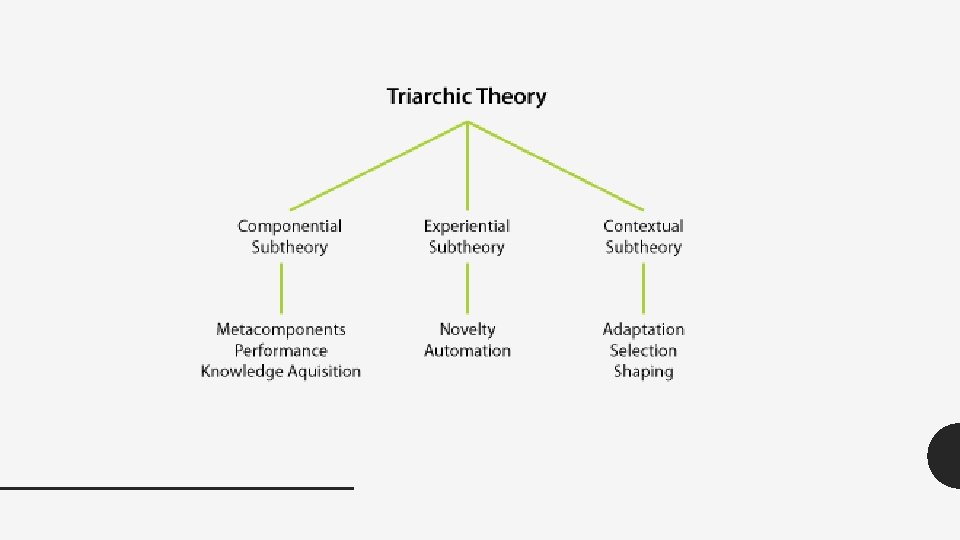
Componential Subtheory • Also known as Analytical Facet • Focuses on planning, monitoring, and reflection • Similar to the standard definition of knowledge as measured by academic problem solving, such as puzzles or word problems • Sternberg considers this reflects how an individual relates to his internal world • Believes that analytical knowledge is based on the joint operations of metacomponents and performance components and knowledge acquisition components of intelligence
Meta Components • Control, monitor, and evaluate cognitive processing • These are the executive functions to order and organize performance and knowledge • Used to analyze problems and pick a strategy for solving them • They decide what to and the performance components actually do it
Performance Concepts • Execute strategies assembled by the metacomponents • They are the basic operations involved in any cognitive act • They are the cognitive processes that enable us to encode stimuli, hold information in short-term memory, make calculations, perform mental calculations, and retrieve information
Knowledge Components • Are the processes used in gaining and storing new knowledge, like the capacity for learning • The strategies you use to help memorize things exemplify the processes that fall into this category • Sternberg feels that people with better reasoning ability generally spend more time understanding the problem but reach their solution faster than those who are less skilled at the task

Experiential Subtheory • Also known as the Creative Facet • Focuses on developing, applying new ideas, and creating solutions • Involves insights, synthesis, and the ability to react to novel situations and stimuli • Sternberg considers this the experiential aspect of intelligence and reflects how an individual connects the internal world to external reality. • He also thinks that the creative facet to consist of the ability, which allows people to think creatively and that which allows people to adjust creatively and effectively to new situations • He believes that individuals that are more intelligent will also move from consciously learning in a novel situation to automating the new learning so that they can attend to other tasks
Novelty & Automatization • There are two broad classes of abilities associated with intelligence: novelty skills and automatization skills • A task measures intelligence is it requires the ability to deal with novel demands or the ability to automatize information processing • Novel tasks or situations are good measures of intellectual ability because they assess an individual’s ability to apply existing knowledge to new problems
Contextual Subtheory • Also known as the Practical Facet • Focuses on selecting and shaping real-world environments and experiments • Involves the ability to grasp, understand deal with everyday tasks • This reflects how the individual relates to the external world around them • Sternberg states that intelligence is “Purposive adaptation to, shaping of, and selection of real-world environments relevant to one’s life” • Purposive means that intelligence is directed towards goals, however vague or subconscious they may be • This means that intelligence is indicated by one’s attempts to adapt to one’s environments • Contextual Subtheory can be said to be intelligence that operates in the real world • People with this type of intelligence can adapt to, or shape their environment, which is otherwise known as “street smarts” • In measuring this subtheory, not only mental skills but attitudes and emotional factors can influence the intelligence that is measured
Additional Thoughts • Practical intelligence is a combination of: adaption to the environment in order to have goals met, changing the environment in order to have goals met, or, it adapting and changing don’t work then move to a new environment in which goals can be met • Sternberg believes that individuals considered intelligent in one culture may be looked on as unintelligent in another • An important part of this theory is to avoid defining intelligence in terms of intelligence tests rather than performance in the everyday world
- Slides: 12