
Robert Browning and His Dramatic Monologue The most
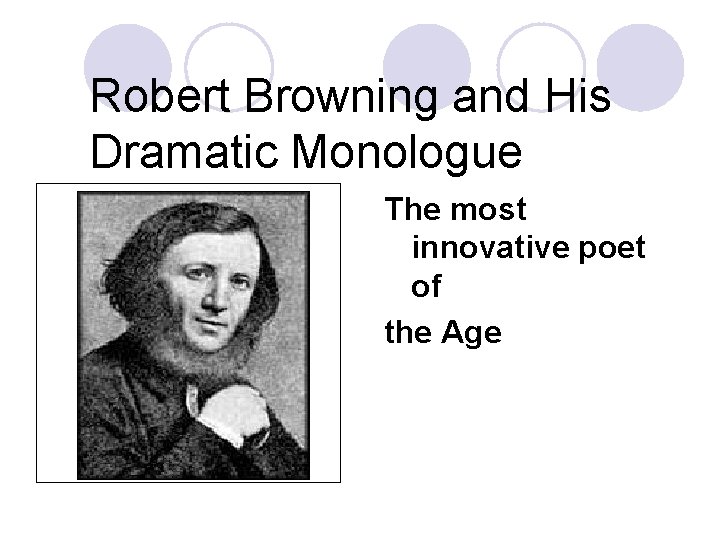
Robert Browning and His Dramatic Monologue The most innovative poet of the Age

Robert browning ( 1809 -1892) l Life l born on May 7, 1812, in Camberwell (a suburb of London) l Mainly educated at home; l Met Elizabeth Barrett in 1845 and married her in 1846; l Lived in Italy until his wife’s death in 1861; l Died in 1892 and was buried in Poet's Corner of Westminster Abbey.
Major Works l Dramatic Lyrics(1842) l Dramatic Romances and Lyrics(1845) l Men and Women (1855) l Dramatic Personae (1864)
Dramatic monologue l. A speech by an imaginary speaker to an imaginary listener. l Three requirements: 1. An imaginary speaker; 2. A silent listener; 3. A dramatic situation; The readers complete the dramatic scene by inference and imagination.

Browning’s best known dramatic monologues l My Last Duchess l Fra Lippo Lippi l The Bishop Orders His tomb l Porphyria’s Lover l The Ring and the Book

l Who is the speaker? l Who is the listener? l What is the scene?
Questions for consideration l What kind of person is the duke? How is your opinion different from the duke’s opinion of himself? l Why is the duke dissatisfied with his last wife? What can you infer about the duchess’s personality from the duke’s speech? l Why does the duke tell the story of his late wife to the messenger?
The Charcters The Duke: self-conceited, cruel, tyrannical, jealous, narrowminded, hypocritical, egotistical, possessive; appearing cultivated and hospitable, but actually a ruthless brute;
l The Duchess: young, beautiful, innocent, passionate, vital, wellbred, democratic-minded;
Dramatic irony l There is a great gap between what the duke’s opinion of himself and his last wife and the opinion formed by the reader himself about the Duke and his late wife.
l All the time, the duke tries to expose the flaws of his late wife, to speak ill of her, but the readers grow more and more fond of the duchess and become more and more sympathetic with her.
l All the time, the duke tries to uplift and defend himself, but the readers gradually see his false pretense, hallow values and profound cruelty. What is wonderful is all these evil qualities of the duke are revealed through his own mouth.
The poem is written in heroic couplet, but it reads like prose. It is called by some critics “ a verse novel”.
- Slides: 14