
ROAMING MANAGEMENT UNDER SS 7 The missing parts
- Slides: 27
ROAMING MANAGEMENT UNDER SS 7
� The missing parts in the picture are the interactions between the PCS network and the PSTN. � This section briefly describes how mobile roaming is managed by the PSTN signaling.
Common channel signaling (CCS) � Common channel signaling (CCS) is a signaling method that provides control and management functions in the telephone network. � CCS consists of ◦ supervisory functions, ◦ addressing, and ◦ call information provisioning.
CCS �A CCS channel conveys messages to ◦ initiate and terminate calls; ◦ determines the status of some part of the network; and ◦ controls the amount of traffic allowed. � CCS uses a separate out‑of‑band signaling network to carry signaling messages.
SS 7 � Signalling System No. 7 (SS 7) is a CCS system. � Signaling between a PCS network and the PSTN are typically achieved by the SS 7 network.
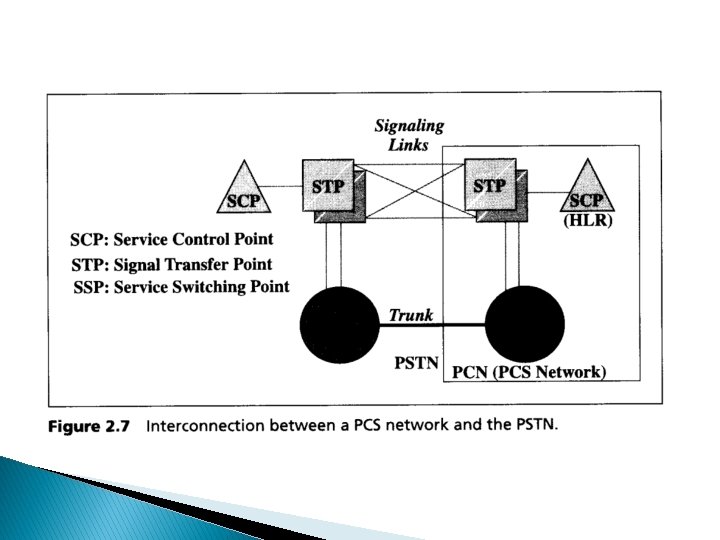
SS 7 � Figure 2. 7 shows the network elements that are involved in the interconnection between a PCS network and the PSTN. � In the figure, the dashed lines represent the signaling links; the solid line represents a trunk.
SS 7 � The SS 7 network consists of three distinct components: ◦ Service Switching Point (SSP). ◦ Signal Transfer Point (STP). ◦ Service Control Point (SCP).
Service Switching Point (SSP) �A telephone switch interconnected by SS 7 links. The SSPs perform call processing on calls that originate, tandem, or terminate at that node. � A local SSP in the PSTN can be a central office (CO) or end office (EO). � An SSP in a PCS network is called a mobile switching center (MSC).
Signal Transfer Point (STP) �A switch that relays SS 7 messages between network switches and databases. � Based on the address fields of the SS 7 messages, the STPs route the messages to the correct out going signaling links.
Service Control Point (SCP). � Contains databases for providing enhanced services. � An SCP accepts queries from an SSP and returns the requested information to the SSP. � In mobile applications, an SCP may contain an HLR or a VLR.
SS 7 � In this network, the trunks (voice circuits) connect SSPs to carry user data/voice information. � The signaling links connect SCPs to STPs, and STPs to SSPs. � The SSPs and SCPs are connected indirectly through STPs.
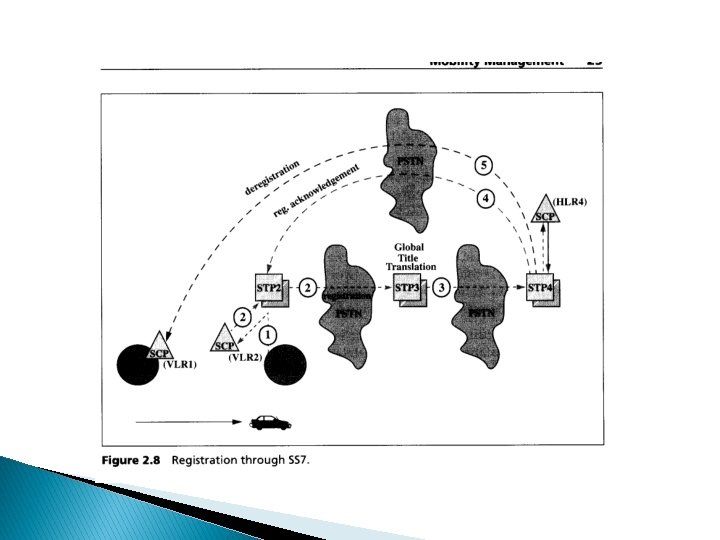
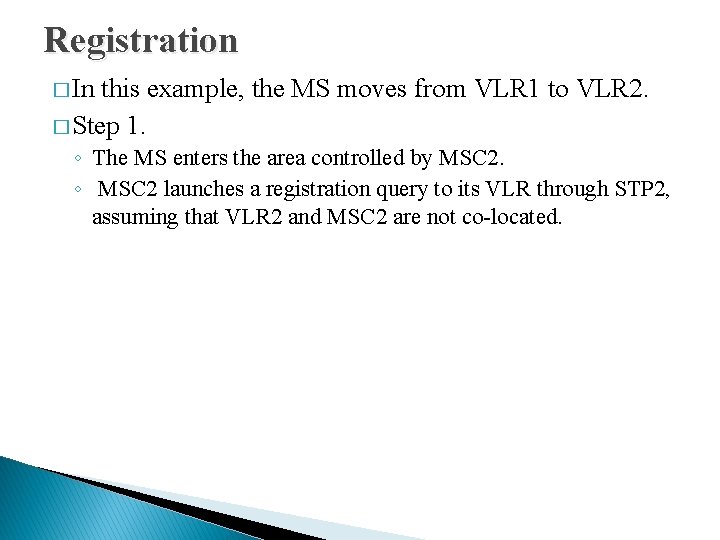
Registration � In this example, the MS moves from VLR 1 to VLR 2. � Step 1. ◦ The MS enters the area controlled by MSC 2. ◦ MSC 2 launches a registration query to its VLR through STP 2, assuming that VLR 2 and MSC 2 are not co located.
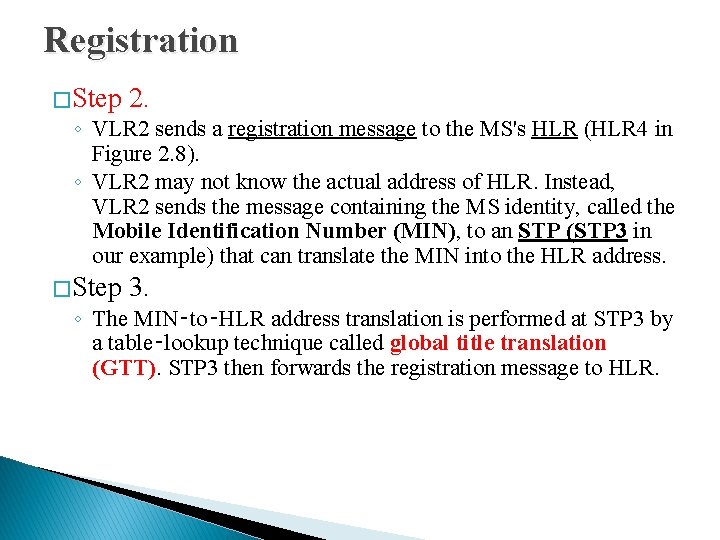
Registration � Step 2. � Step 3. ◦ VLR 2 sends a registration message to the MS's HLR (HLR 4 in Figure 2. 8). ◦ VLR 2 may not know the actual address of HLR. Instead, VLR 2 sends the message containing the MS identity, called the Mobile Identification Number (MIN), to an STP (STP 3 in our example) that can translate the MIN into the HLR address. ◦ The MIN‑to‑HLR address translation is performed at STP 3 by a table‑lookup technique called global title translation (GTT). STP 3 then forwards the registration message to HLR.
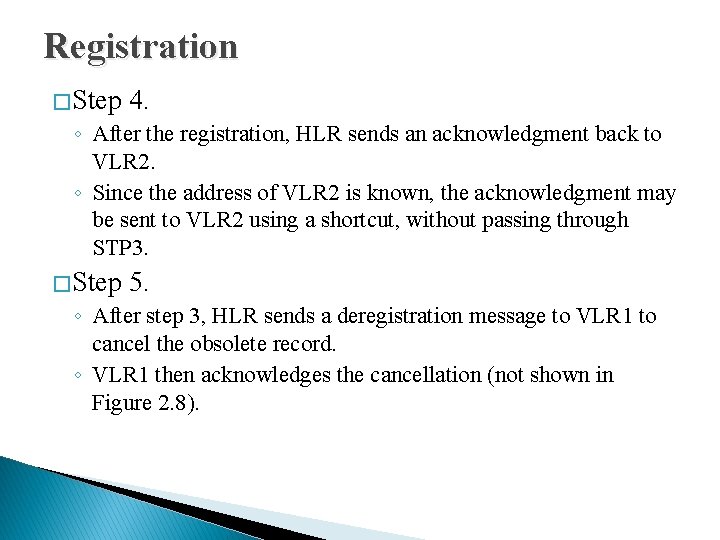
Registration � Step 4. ◦ After the registration, HLR sends an acknowledgment back to VLR 2. ◦ Since the address of VLR 2 is known, the acknowledgment may be sent to VLR 2 using a shortcut, without passing through STP 3. � Step 5. ◦ After step 3, HLR sends a deregistration message to VLR 1 to cancel the obsolete record. ◦ VLR 1 then acknowledges the cancellation (not shown in Figure 2. 8).
� In steps 2, 3, 4, and 5, the messages may visit several STPs before arriving at their destinations, and the registration process may generate considerable traffic in the SS 7 network. � Thus, it is desirable to reduce the registration traffic. � Two approaches have been proposed to reduce the "cost" of deregistration at step 5 in Figure 2. 8: ◦ implicit deregistration ◦ periodic re-registration
Implicit deregistration � Obsolete VLR records are not deleted until the database is full. � If the database is full when an MS arrives, a record is deleted, freeing storage space to accommodate the newly arrived MS. � A replacement policy is required to select a record for replacement (it is possible that a valid record is replaced, and the information is lost). � Advantage: no deregistration messages are sent among the SS 7 network elements.
Periodic re-registration � the MS periodically reregisters to the VLR. � If the VLR does not receive the re registration message within a timeout period, the record is deleted. � This approach only creates local message traffic between the MSC and the VLR. Furthermore, no SS 7 signaling messages are generated if the VLR is co located with the MSC.
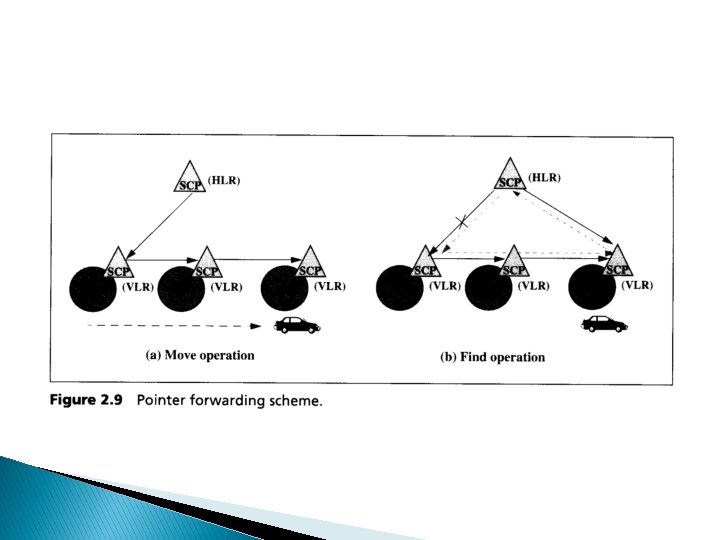
Pointer Forwarding Scheme � To reduce the registration traffic at steps 2 and 3 in Figure 2. 8, a pointer forwarding scheme was proposed, which consists of two operations: � Move operation (registration). � Find operation (call delivery).
Move operation (registration) � When an MS moves from one VLR to another, a pointer is created from the old VLR to the new VLR. No registration to the HLR is required (see Figure 2. 9(a)).
Find operation (call delivery) � When the HLR attempts to locate the MS for call delivery, the pointer chain is traced. After the find operation, the HLR points directly to the destination VLR (see Figure 2. 9(b)).
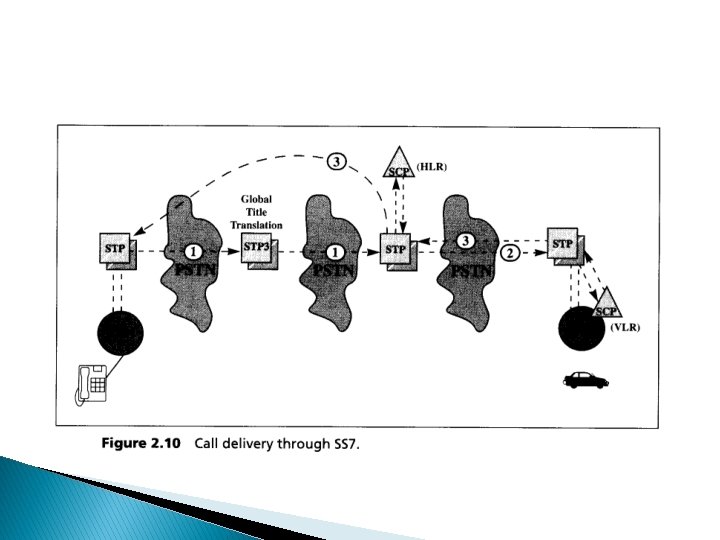
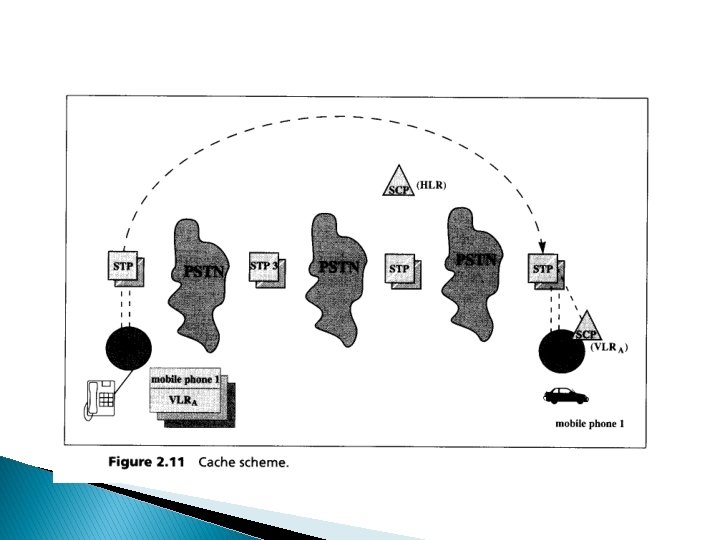
Call Delivery � Similar to the registration process, visits to several STPs and a GTT may be required to access the HLR in call delivery. � Several STPs may be visited to obtain the routable address from the VLR. � To reduce the call delivery traffic, a cache scheme was proposed to maintain a cache in the originating SSPs. � Another possibility is to maintain the cache in the STP that performs GTTs, that is, STP 3 in Figure 2. 11. � A cache entry consists of two fields: the MIN of an MS and the address of the current visited VLR of the MS. The cache contains entries for MSs recently accessed from the SSP
cache scheme � When the calling party originates a call to an MS, the SSP first checks if the cache entry for the MS exists. There are three possibilities: � Case 1: The cache entry does not exist. The call delivery procedure illustrated in Figure 2. 10 is performed. � Case 2: The cache entry exists and is current. The VLR is directly accessed as shown in Figure 2. 11. � Case 3: The cache entry exists but is obsolete. The procedure detects that the cache entry is obsolete if the queried VLR's response is negative. The call deliiverv procedure illustrated in Figure 2. 10 is performed.