
RoadSign Detection and Recognition Based on Support Vector
Road-Sign Detection and Recognition Based on Support Vector Machines Saturnino, Sergio et al. Yunjia Man ECG 782 Dr. Brendan
Outline 1. Introduction 2. Detection and recognition system Ø Segmentation Ø Shape classification Ø Recognition 3. Experimental results 4. Conclusions
1. Introduction • Road signs: - regulate traffic - indicate the state of the road - color and shape • Common problems: - variable lighting conditions possible rotation of the signs different dimensions of the signs occlusions (trees, other signs or vehicles) number of signs quite large
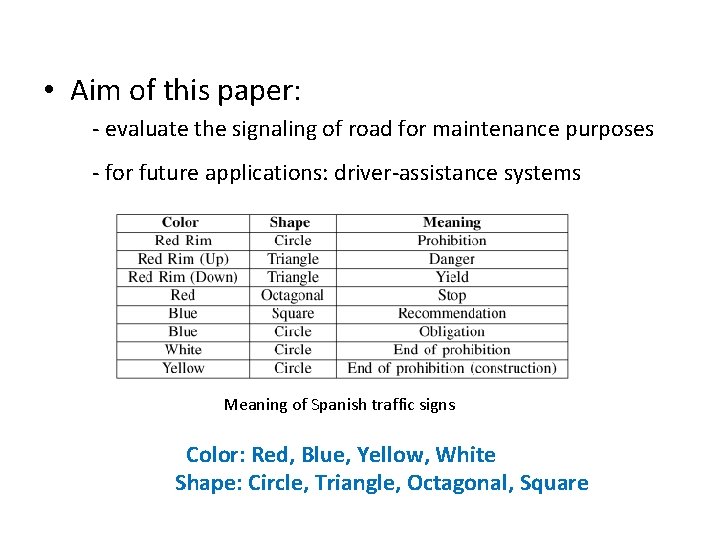
• Aim of this paper: - evaluate the signaling of road for maintenance purposes - for future applications: driver-assistance systems Meaning of Spanish traffic signs Color: Red, Blue, Yellow, White Shape: Circle, Triangle, Octagonal, Square
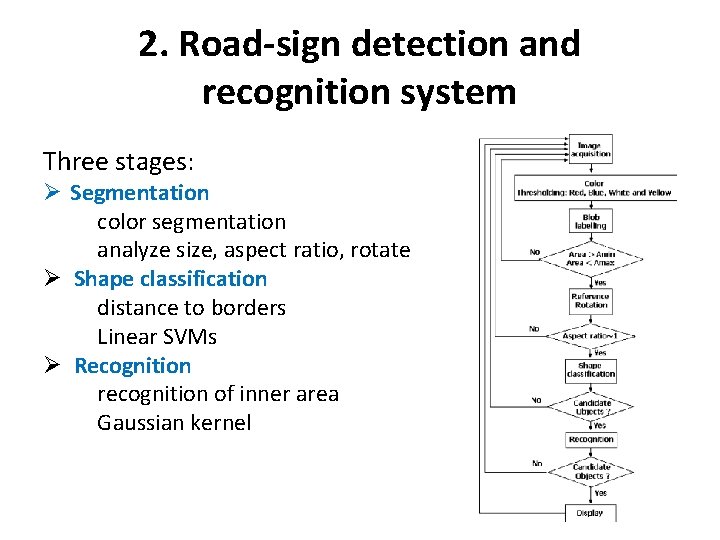
2. Road-sign detection and recognition system Three stages: Ø Segmentation color segmentation analyze size, aspect ratio, rotate Ø Shape classification distance to borders Linear SVMs Ø Recognition recognition of inner area Gaussian kernel
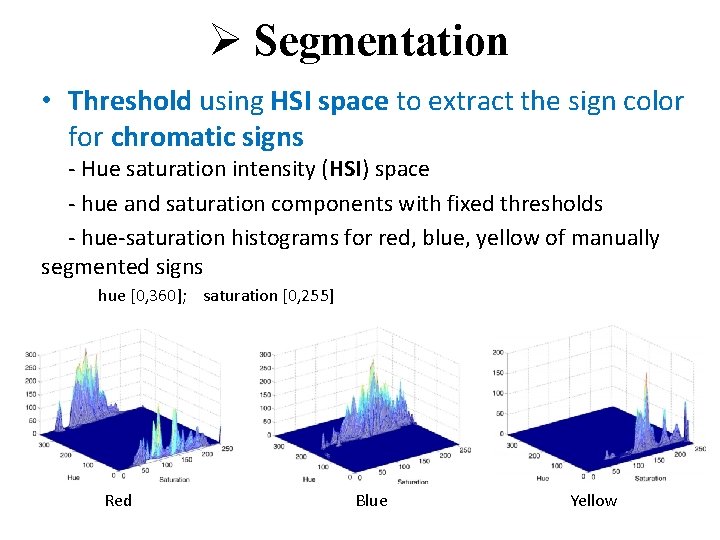
Ø Segmentation • Threshold using HSI space to extract the sign color for chromatic signs - Hue saturation intensity (HSI) space - hue and saturation components with fixed thresholds - hue-saturation histograms for red, blue, yellow of manually segmented signs hue [0, 360]; saturation [0, 255] Red Blue Yellow
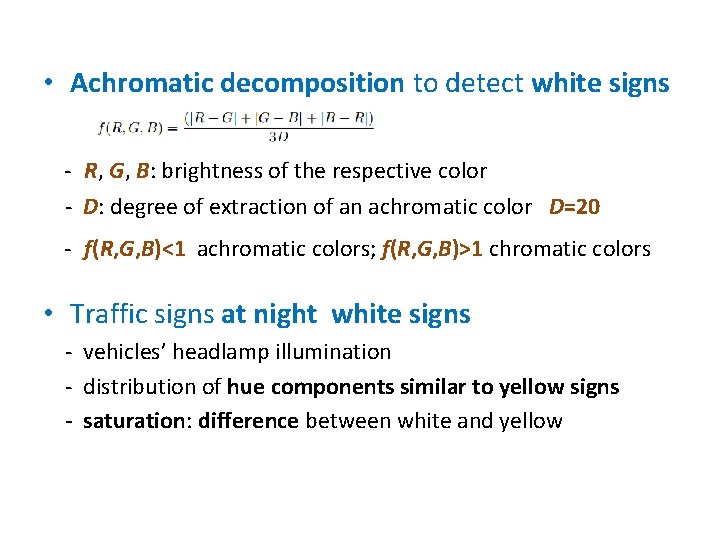
• Achromatic decomposition to detect white signs - R, G, B: brightness of the respective color - D: degree of extraction of an achromatic color D=20 - f(R, G, B)<1 achromatic colors; f(R, G, B)>1 chromatic colors • Traffic signs at night white signs - vehicles’ headlamp illumination - distribution of hue components similar to yellow signs - saturation: difference between white and yellow
• Two contributions: rim and inner region - independent process • Blobs of interest (Bo. I) – possible traffic signs - blobs: connected image pixels in the four color categories small and big blobs: noise and noninterest objects limit of size: between 1/20 and 2/3 limit of aspect ratio: between 1/1. 9 and 1. 9 corresponding bounding box: rectangle rotated to reference position
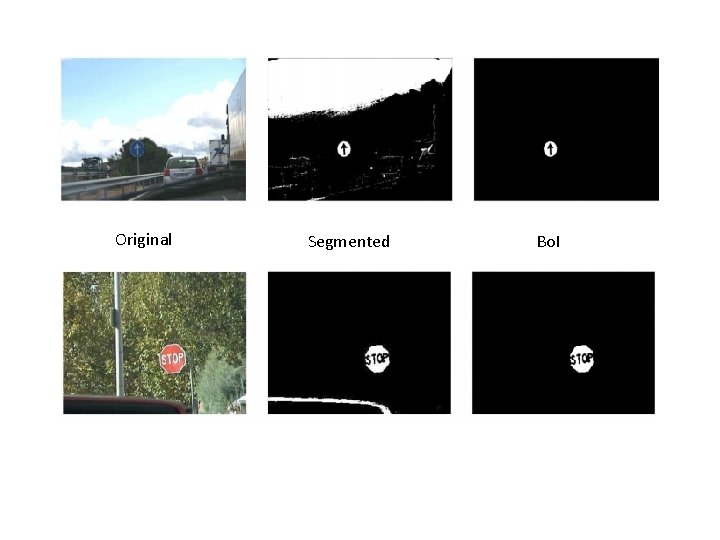
Original Segmented Bo. I
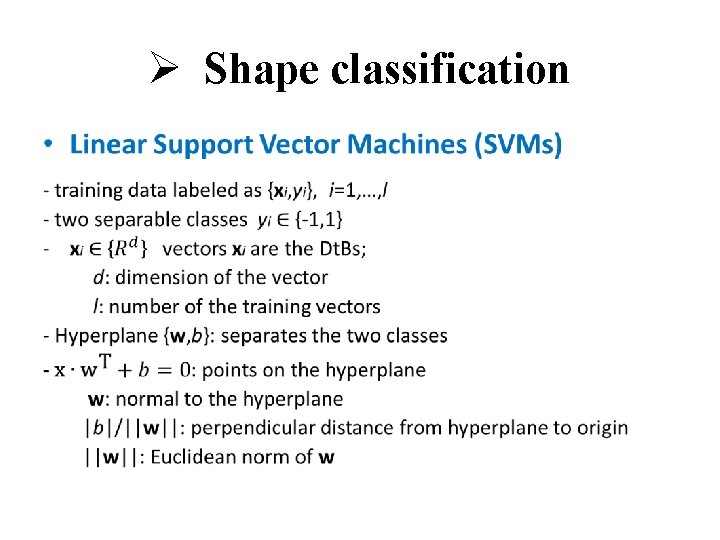
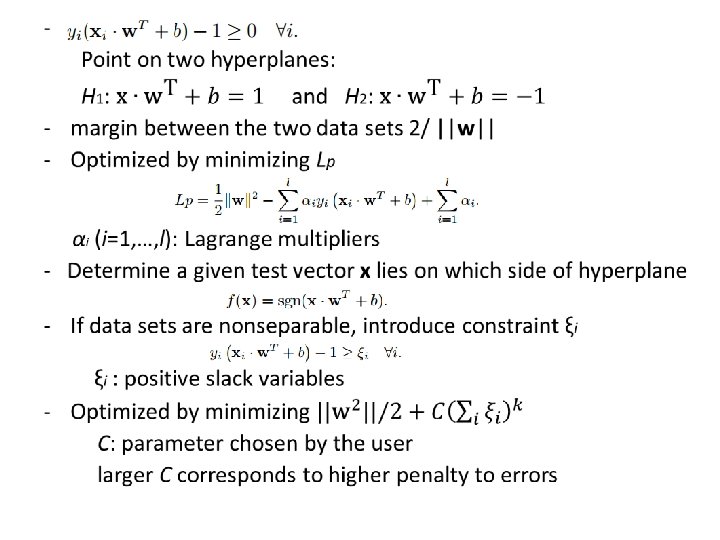
Ø Shape classification •
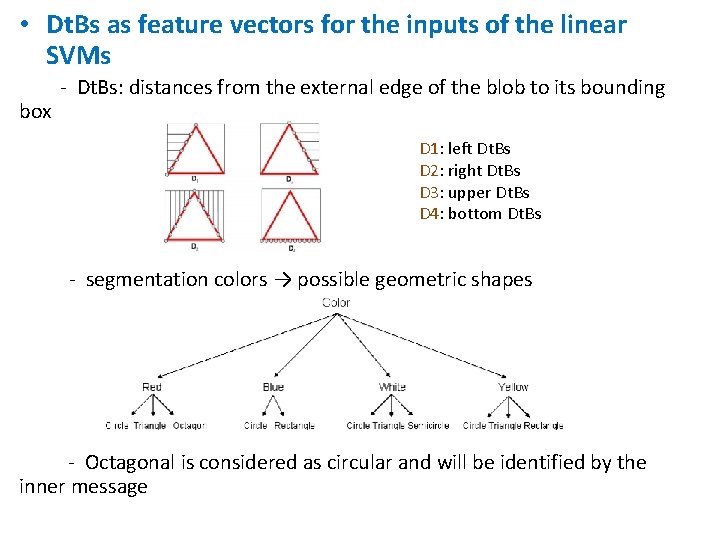
• Dt. Bs as feature vectors for the inputs of the linear SVMs box - Dt. Bs: distances from the external edge of the blob to its bounding D 1: left Dt. Bs D 2: right Dt. Bs D 3: upper Dt. Bs D 4: bottom Dt. Bs - segmentation colors → possible geometric shapes - Octagonal is considered as circular and will be identified by the inner message
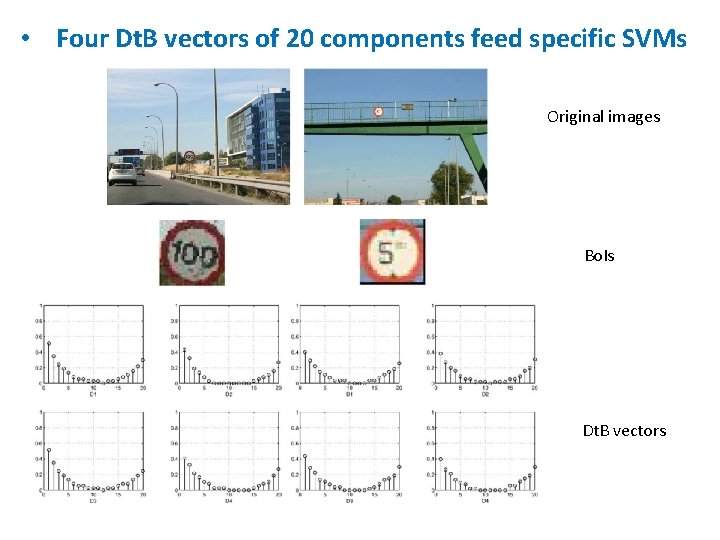
• Four Dt. B vectors of 20 components feed specific SVMs Original images Bo. Is Dt. B vectors
- eg. Red blob → 4 Dt. B SVMs to classify circle (‘ 1’) or not (‘-1’) → 4 Dt. B SVMs to classify rectangle (‘ 1’) or not (‘-1’) → 4 favorable votes for each shape - Majority voting method with a threshold # of votes < threshold → rejected as noisy shape in case of a tie → linear SVM outputs of favorable classification • Invariant to translation, rotation and scale - position of the candidate blob does not matter all blobs are oriented to a reference position Dt. B vectors are normalized to the bounding-box dimensions robust to occlusions
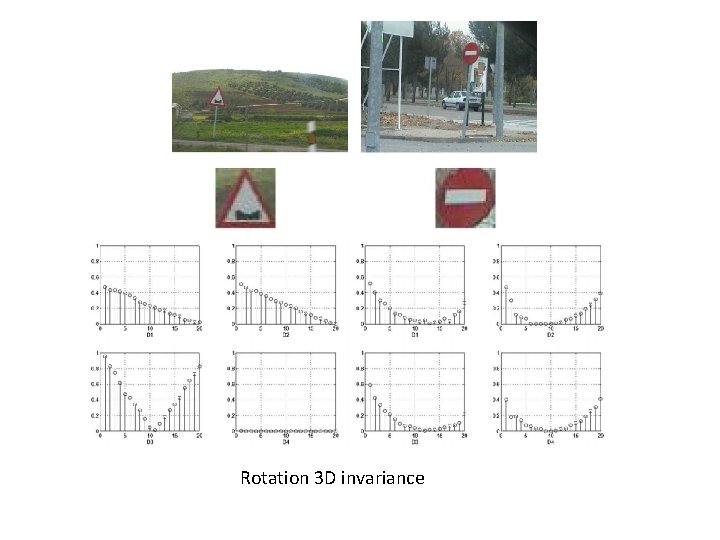
Rotation 3 D invariance
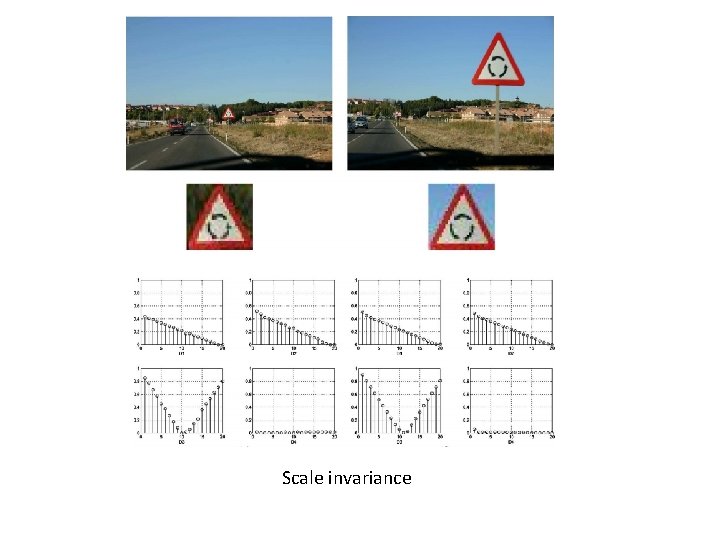
Scale invariance
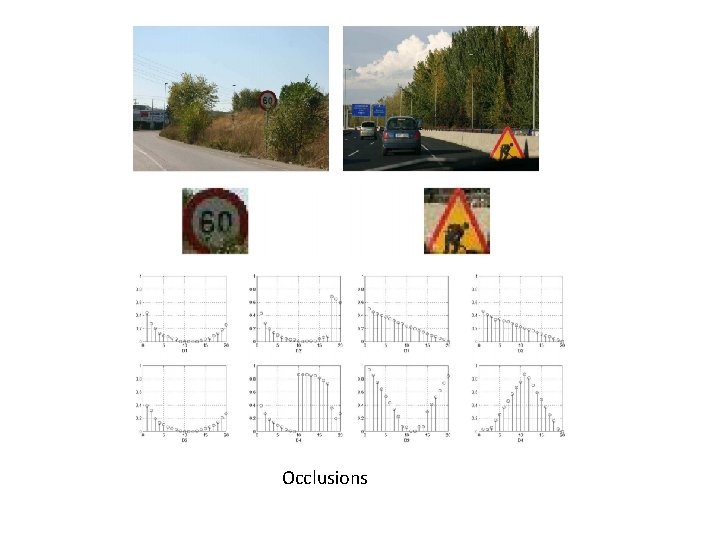
Occlusions
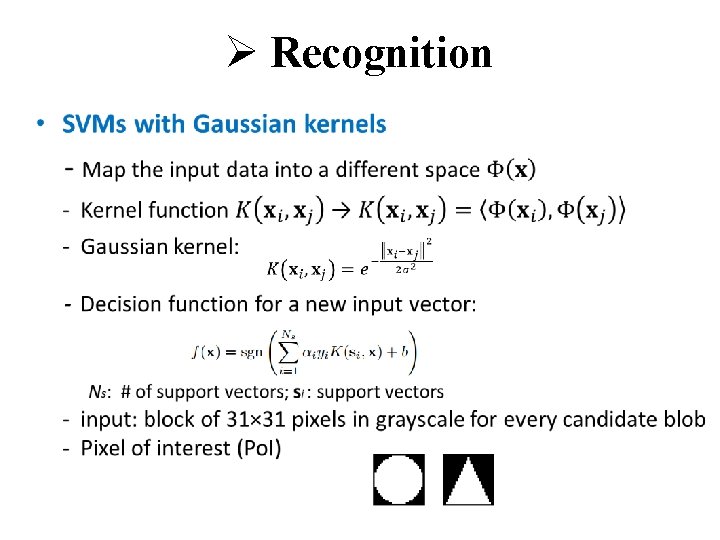
Ø Recognition •
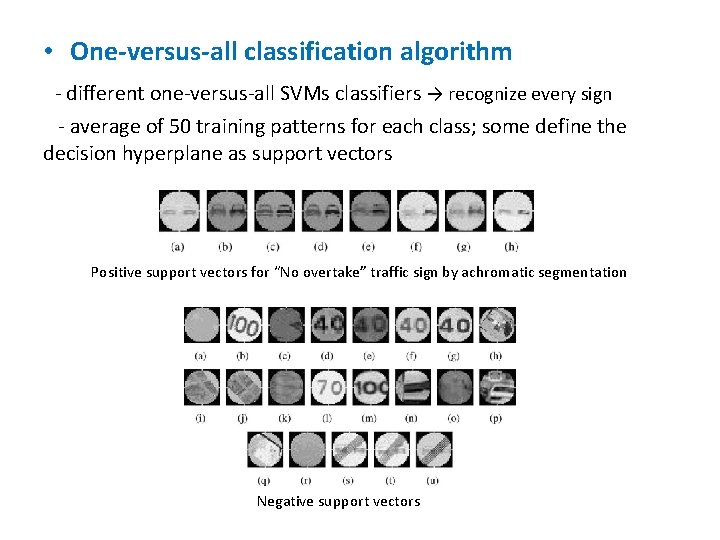
• One-versus-all classification algorithm - different one-versus-all SVMs classifiers → recognize every sign - average of 50 training patterns for each class; some define the decision hyperplane as support vectors Positive support vectors for “No overtake” traffic sign by achromatic segmentation Negative support vectors
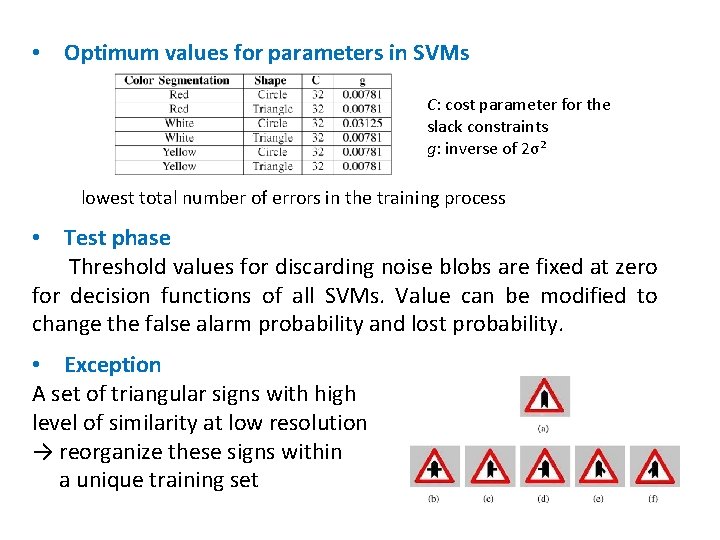
• Optimum values for parameters in SVMs C: cost parameter for the slack constraints g: inverse of 2σ² lowest total number of errors in the training process • Test phase Threshold values for discarding noise blobs are fixed at zero for decision functions of all SVMs. Value can be modified to change the false alarm probability and lost probability. • Exception A set of triangular signs with high level of similarity at low resolution → reorganize these signs within a unique training set
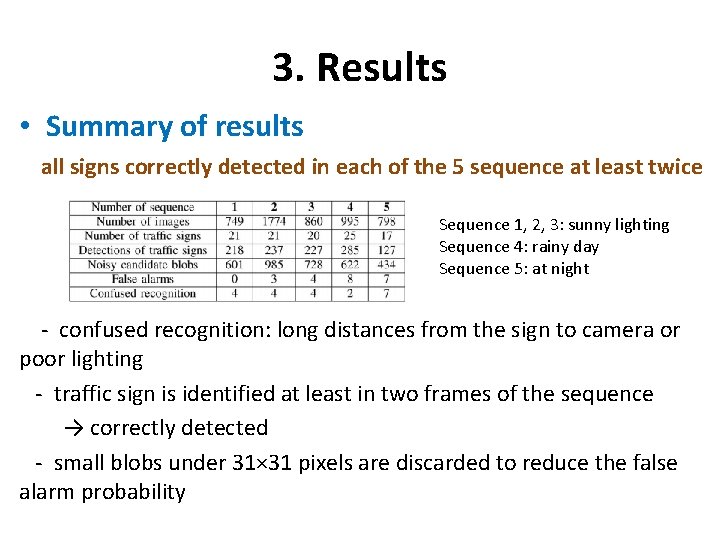
3. Results • Summary of results all signs correctly detected in each of the 5 sequence at least twice Sequence 1, 2, 3: sunny lighting Sequence 4: rainy day Sequence 5: at night - confused recognition: long distances from the sign to camera or poor lighting - traffic sign is identified at least in two frames of the sequence → correctly detected - small blobs under 31× 31 pixels are discarded to reduce the false alarm probability
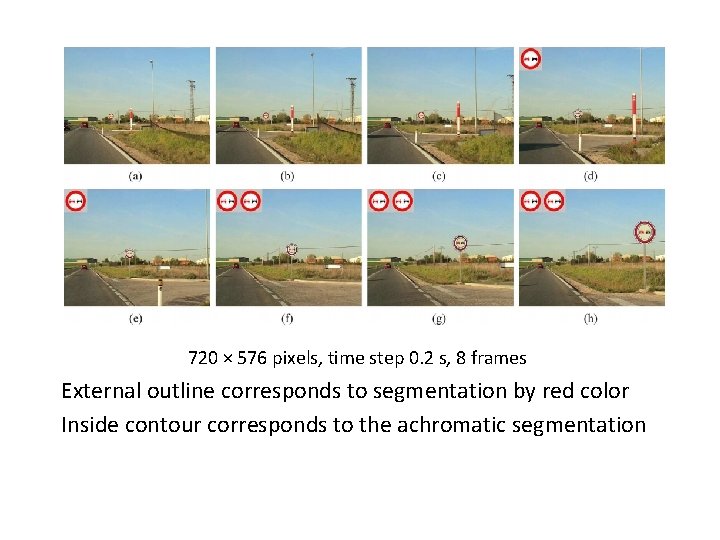
720 × 576 pixels, time step 0. 2 s, 8 frames External outline corresponds to segmentation by red color Inside contour corresponds to the achromatic segmentation
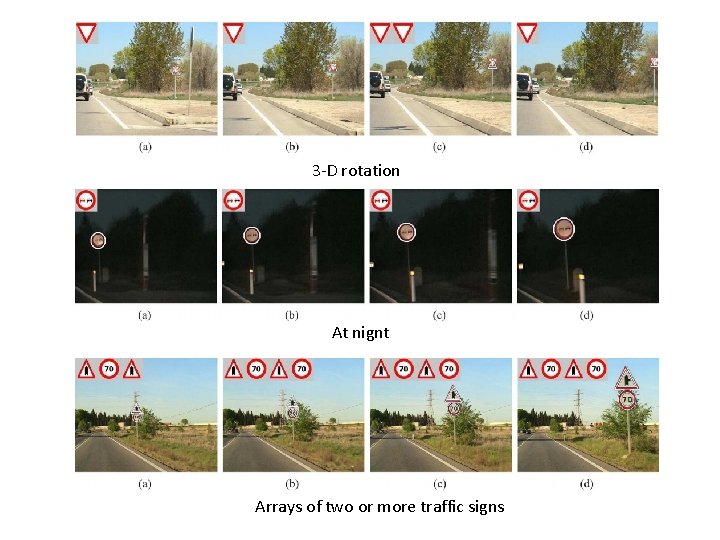
3 -D rotation At nignt Arrays of two or more traffic signs
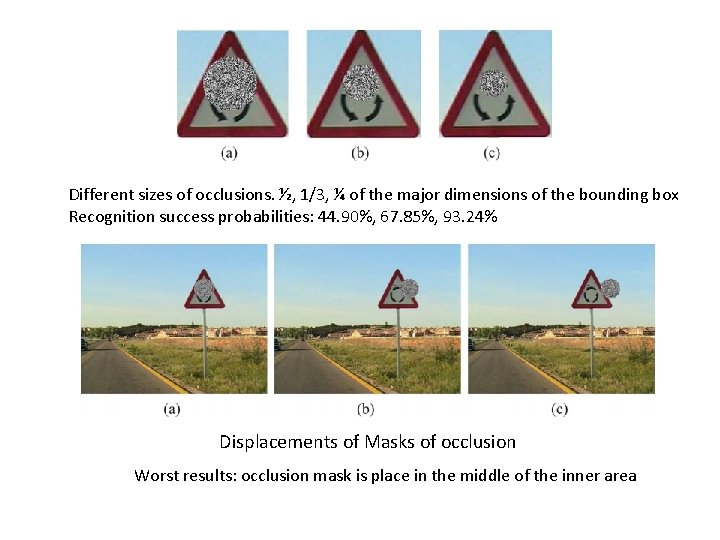
Different sizes of occlusions. ½, 1/3, ¼ of the major dimensions of the bounding box Recognition success probabilities: 44. 90%, 67. 85%, 93. 24% Displacements of Masks of occlusion Worst results: occlusion mask is place in the middle of the inner area
4. Conclusions • A complete system to detect and recognize traffic signs from a video sequence considering all existing difficulties • Linear SVMs for shape classification • Gaussian kernels for recognizing inner area • Candidate sign is valid if detected and recognized in at least two frames of a sequence • System is accurate to detect different geometric shapes • System works correctly in difficult situations • System is invariant to rotations, positions and scales • Able to detect signs occluded partially
- Slides: 25