
Roadmap Probabilistic CFGs Handling ambiguity more likely analyses
Roadmap • Probabilistic CFGs – Handling ambiguity – more likely analyses – Adding probabilities • • Grammar Parsing: probabilistic CYK Learning probabilities: Treebanks & Inside-Outside Issues with probabilities – Resolving issues • Lexicalized grammars – Independence assumptions – Alternative grammar formalisms • Dependency Grammar
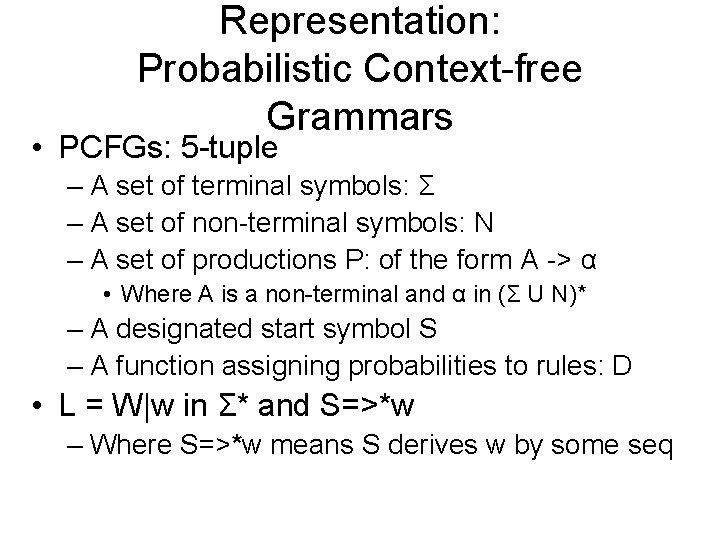
Representation: Probabilistic Context-free Grammars • PCFGs: 5 -tuple – A set of terminal symbols: Σ – A set of non-terminal symbols: N – A set of productions P: of the form A -> α • Where A is a non-terminal and α in (Σ U N)* – A designated start symbol S – A function assigning probabilities to rules: D • L = W|w in Σ* and S=>*w – Where S=>*w means S derives w by some seq
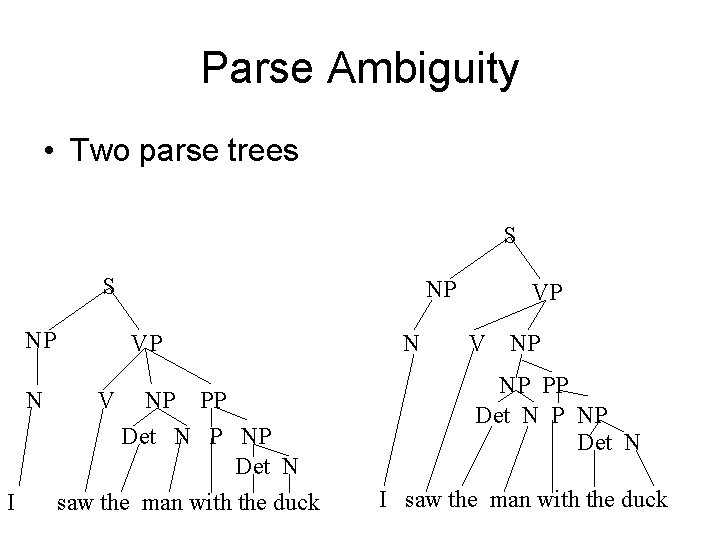
Parse Ambiguity • Two parse trees S S NP N I NP VP V NP PP Det N P NP Det N saw the man with the duck N VP V NP NP PP Det N P NP Det N I saw the man with the duck
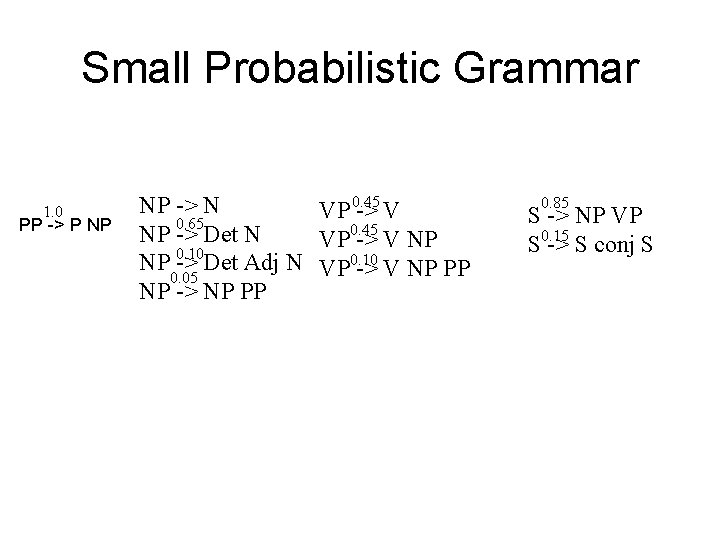
Small Probabilistic Grammar 1. 0 PP -> P NP 0. 45 NP -> N VP -> V 0. 65 0. 45 NP -> Det N VP -> V NP 0. 10 NP -> Det Adj N VP 0. 10 -> V NP PP 0. 05 NP -> NP PP 0. 85 S -> NP VP S 0. 15 -> S conj S
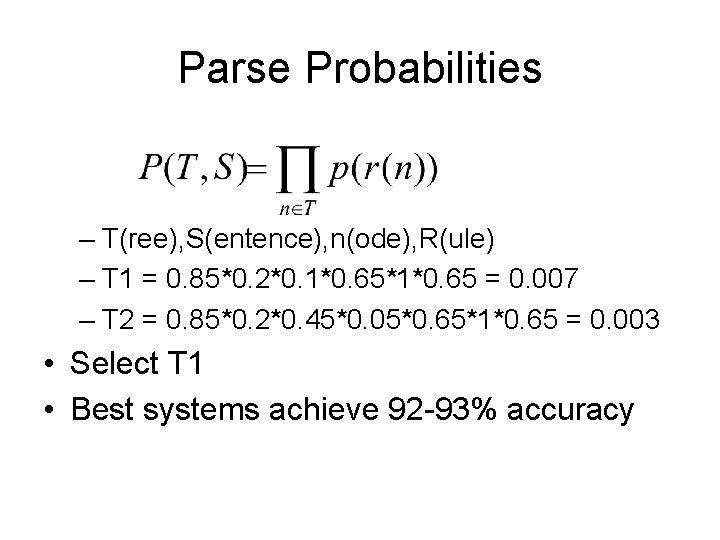
Parse Probabilities – T(ree), S(entence), n(ode), R(ule) – T 1 = 0. 85*0. 2*0. 1*0. 65*1*0. 65 = 0. 007 – T 2 = 0. 85*0. 2*0. 45*0. 05*0. 65*1*0. 65 = 0. 003 • Select T 1 • Best systems achieve 92 -93% accuracy

Probabilistic CYK Parsing • Augmentation of Cocke-Younger-Kasami – Bottom-up parsing • Inputs – PCFG in CNF G={N, Σ, P, S, D}, N have indices – N words w 1…wn • DS: Dynamic programming array: π[i, j, a] • Holding max prob index a spanning i, j • Output: Parse π[1, n, 1] with S and w 1. . wn
Probabilistic CYK Parsing • Base case: Input strings of length 1 – In CNF, prob must be from A=>wi • Recursive case: For strings > 1, A=>*wij iff there is rule A->BC and some k, 1<=k<j st B derives the first k symbols and C the last j-k. Since len < |wij|, probability in table. Multiply subparts; compute max over all subparts.
Inside-Outside Algorithm • EM approach – Similar to Forward-Backward training of HMM • Estimate number of times production used – Base on sentence parses – Issue: Ambiguity • Distribute across rule possibilities – Iterate to convergence
Issues with PCFGs • Non-local dependencies – Rules are context-free; language isn’t • Example: – Subject vs non-subject NPs • Subject: 90% pronouns (SWB) • NP-> Pron vs NP-> Det Nom: doesn’t know if subj • Lexical context: – Verb subcategorization: • Send NP PP vs Saw NP PP – One approach: lexicalization
Probabilistic Lexicalized CFGs • Key notion: “head” – Each non-terminal assoc w/lexical head • E. g. verb with verb phrase, noun with noun phrase – Each rule must identify RHS element as head • Heads propagate up tree – Conceptually like adding 1 rule per head value • VP(dumped) -> VBD(dumped)NP(sacks)PP(into) • VP(dumped) -> VBD(dumped)NP(cats)PP(into)
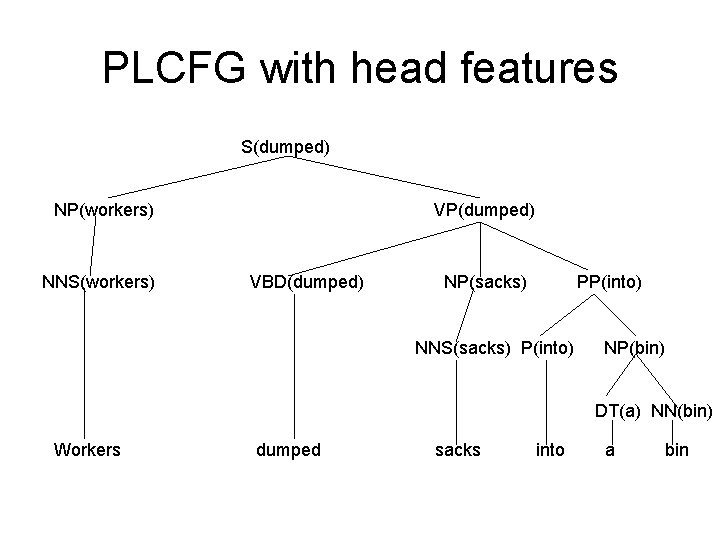
PLCFG with head features S(dumped) NP(workers) NNS(workers) VP(dumped) VBD(dumped) NP(sacks) PP(into) NNS(sacks) P(into) NP(bin) DT(a) NN(bin) Workers dumped sacks into a bin
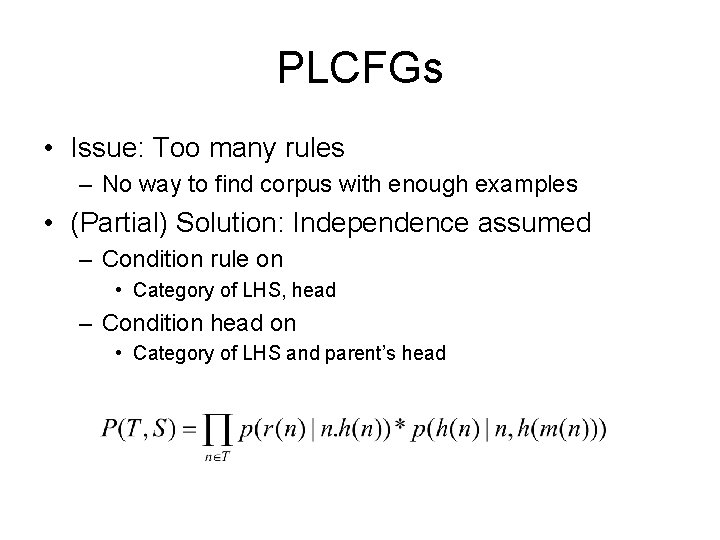
PLCFGs • Issue: Too many rules – No way to find corpus with enough examples • (Partial) Solution: Independence assumed – Condition rule on • Category of LHS, head – Condition head on • Category of LHS and parent’s head
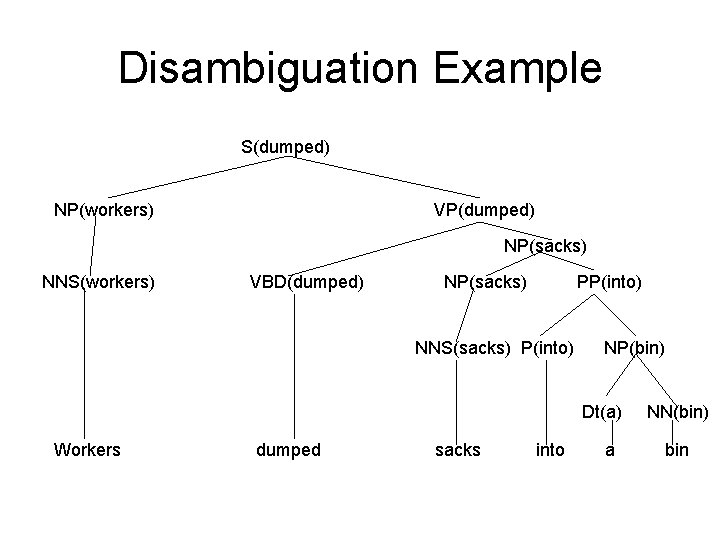
Disambiguation Example S(dumped) NP(workers) VP(dumped) NP(sacks) NNS(workers) VBD(dumped) NP(sacks) PP(into) NNS(sacks) P(into) NP(bin) Dt(a) Workers dumped sacks into a NN(bin) bin
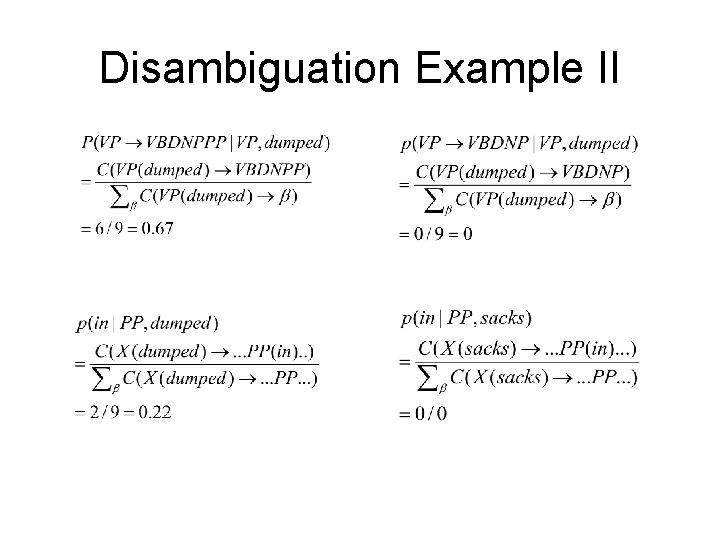
Disambiguation Example II
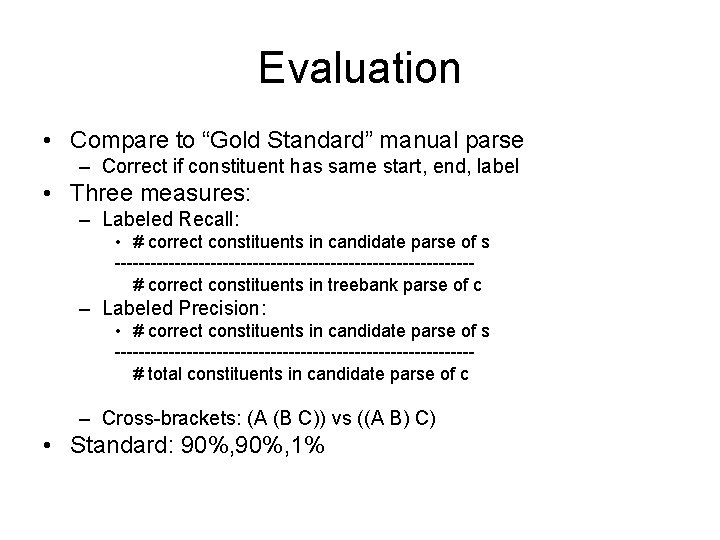
Evaluation • Compare to “Gold Standard” manual parse – Correct if constituent has same start, end, label • Three measures: – Labeled Recall: • # correct constituents in candidate parse of s ------------------------------# correct constituents in treebank parse of c – Labeled Precision: • # correct constituents in candidate parse of s ------------------------------# total constituents in candidate parse of c – Cross-brackets: (A (B C)) vs ((A B) C) • Standard: 90%, 1%
Dependency Grammars • Pure lexical dependency – Relate words based on binary syntactic relns – No constituency, phrase structure rules • Why? – Better for languages with flexible word orders – Abstracts away from surface form/order • Root node + word nodes – Link with dependency relations – fixed set • E. g. subj, obj, dat, loc, attr, mode, comp, …
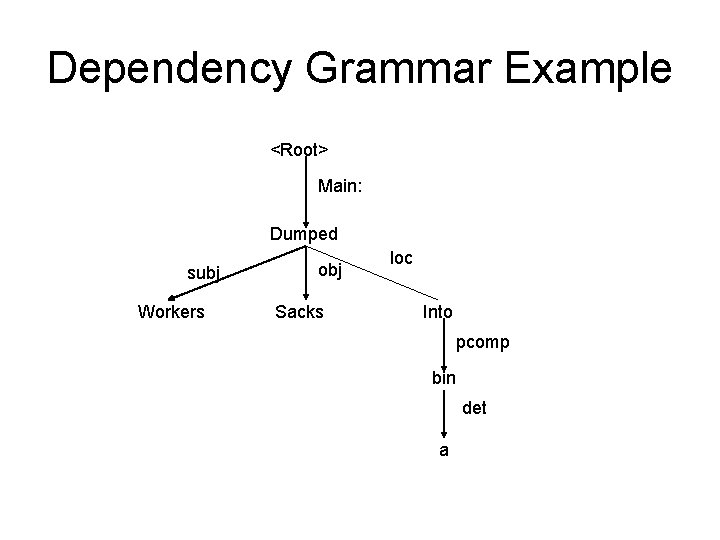
Dependency Grammar Example <Root> Main: Dumped subj Workers obj Sacks loc Into pcomp bin det a
- Slides: 17