
Road to WWII Expansion and Appeasement Daily Question
- Slides: 11
Road to WWII: Expansion and Appeasement
Daily Question How do international politics or policies impact Hitler’s expansionist aims?
Expansion and Appeasement Other European powers and the United States allowed for German expansion even though it broke the Treaty of Versailles Western Many A powers wanted to avoid another world war historians argue that France and Britain allowed it on purpose powerful Germany allows for a buffer against communism in the USSR
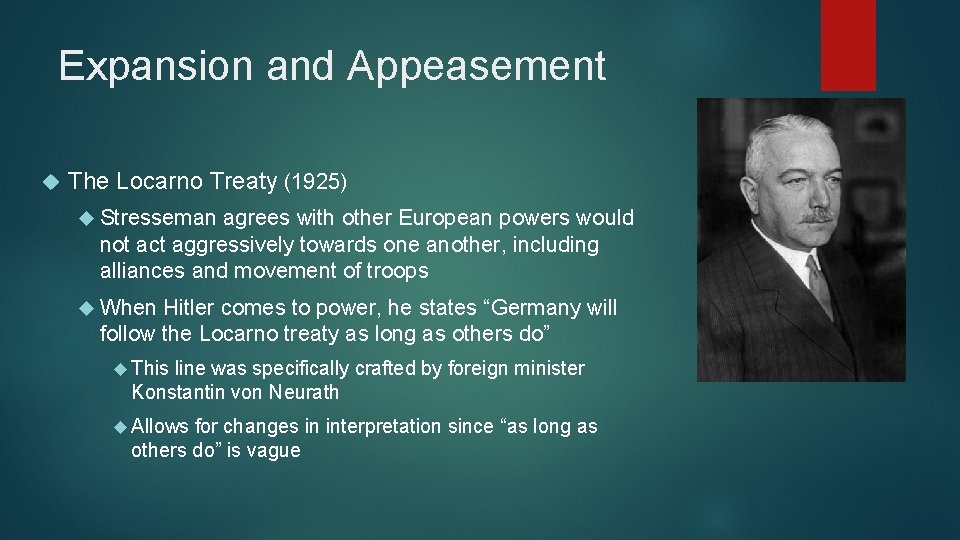
Expansion and Appeasement The Locarno Treaty (1925) Stresseman agrees with other European powers would not act aggressively towards one another, including alliances and movement of troops When Hitler comes to power, he states “Germany will follow the Locarno treaty as long as others do” This line was specifically crafted by foreign minister Konstantin von Neurath Allows for changes in interpretation since “as long as others do” is vague
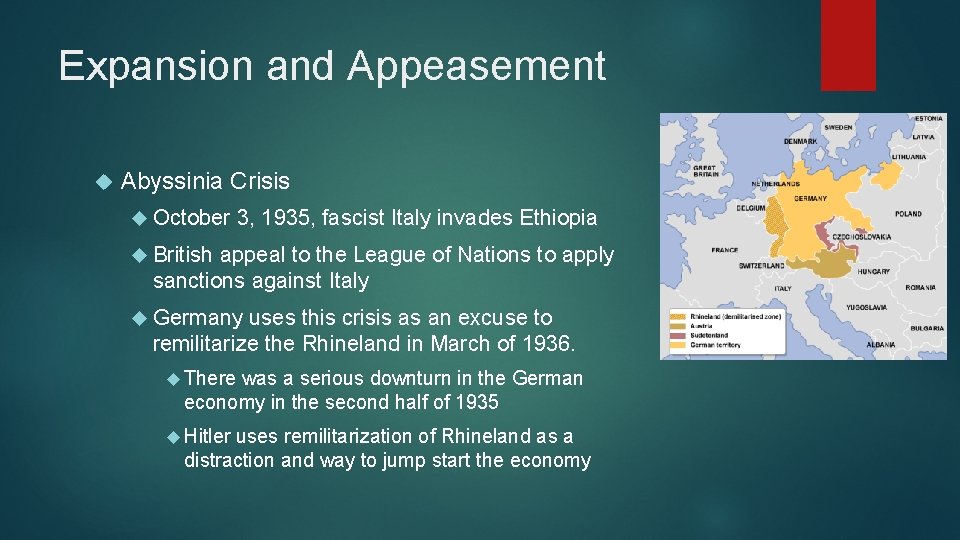
Expansion and Appeasement Abyssinia Crisis October 3, 1935, fascist Italy invades Ethiopia British appeal to the League of Nations to apply sanctions against Italy Germany uses this crisis as an excuse to remilitarize the Rhineland in March of 1936. There was a serious downturn in the German economy in the second half of 1935 Hitler uses remilitarization of Rhineland as a distraction and way to jump start the economy
Expansion and Appeasement Anschluss (Unification) with Austria, March 1938 Treaty forbade a unification, even though millions in both countries wanted a union Austria obviously at the center of the “uniting all Germans” ideal Austria had descended into a one party state after 1934, with the Christian Social Party in control Austrian Göring in National Socialists banned, as well as all other parties particular expressed the desire to unite with Austria, wins Hitler’s support in late 1937.
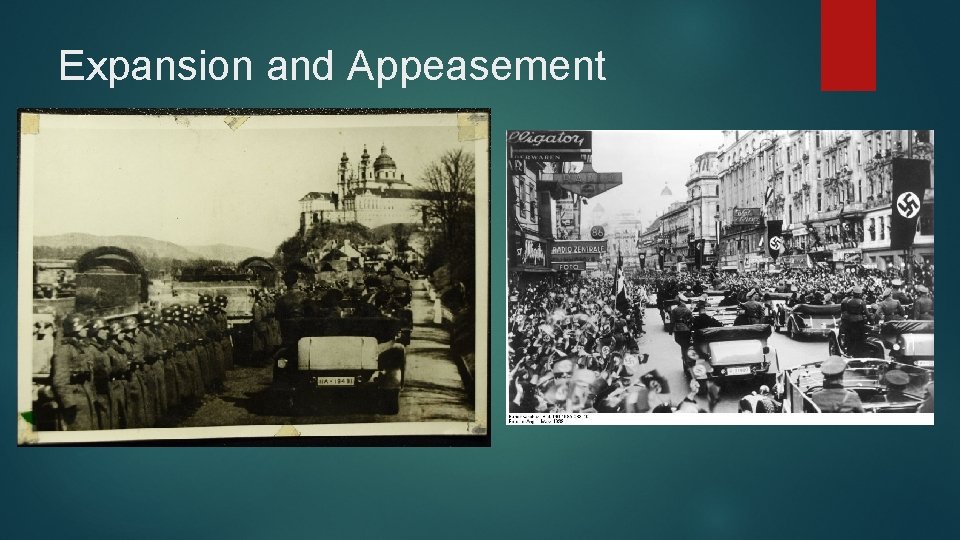
Expansion and Appeasement Anschluss (continued) Hitler demands a union with Austria, threatens invasion Wants Arthur Seyss-Inquart to have a prominent role in unification and government (major Austrian Nazi) Hitler makes a speech directed towards Austria and Czechoslovakia: “The German Reich is no longer willing to tolerate the suppression of ten million Germans across its borders. ” Avoiding war, Austria backs down. German troops “invade” Austria on March 12 th 1938. No violence
Expansion and Appeasement
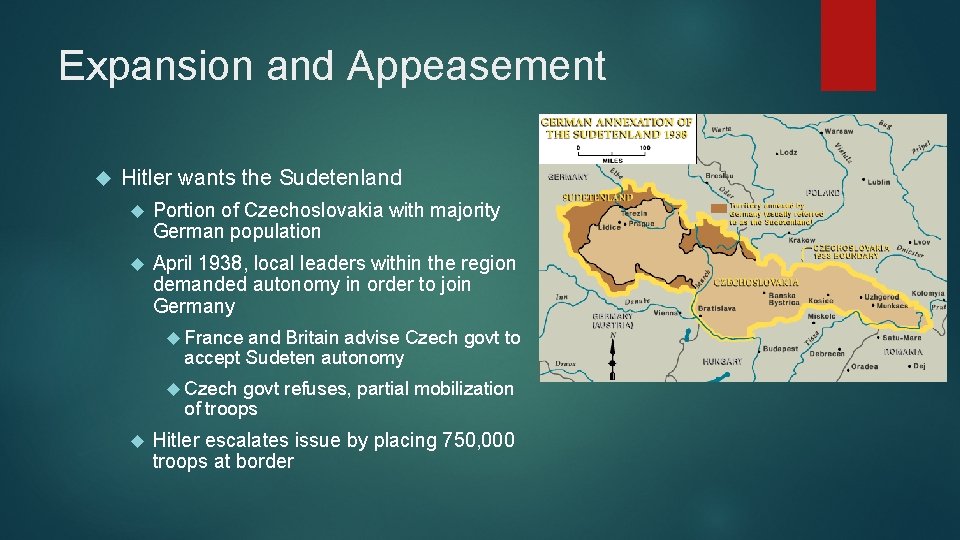
Expansion and Appeasement Hitler wants the Sudetenland Portion of Czechoslovakia with majority German population April 1938, local leaders within the region demanded autonomy in order to join Germany France and Britain advise Czech govt to accept Sudeten autonomy Czech govt refuses, partial mobilization of troops Hitler escalates issue by placing 750, 000 troops at border
Expansion and Appeasement British Prime Minister, Neville Chamberlain, believes that refusal to accept Hitler’s demands would lead to war Munich Agreement, Sept 1938 Chamberlain, Daladier, Hitler, and Mussolini meet in Munich to negotiate the Sudetenland crisis Hitler demands Sudeten union with Germany Britain and France agree that the only way to stop this would be to declare war Wanting Mussolini to avoid war, Chamberlain agrees announces the agreement on September 30 th, 1938.
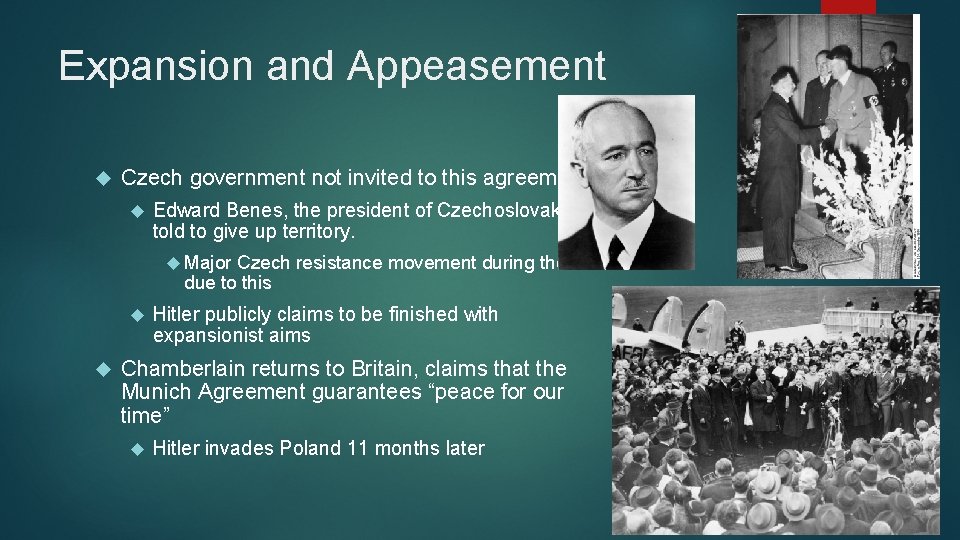
Expansion and Appeasement Czech government not invited to this agreement Edward Benes, the president of Czechoslovakia, told to give up territory. Major Czech resistance movement during the war due to this Hitler publicly claims to be finished with expansionist aims Chamberlain returns to Britain, claims that the Munich Agreement guarantees “peace for our time” Hitler invades Poland 11 months later