
Road Accident Fund Financial Model and Regulation Portfolio
- Slides: 6
Road Accident Fund Financial Model and Regulation Portfolio Committee on Transport 18 th March 2008 1
Regulation of the RAF “The fuel levy should be recognised as taxation imposed upon the road using public to fund the road accident benefits scheme as one component of the system of social security and not as an insurance premium to enable motorists to participate in a liability insurance scheme”. RAF Commission, 2002 • The Financial Services Board, in accordance with S(14)(3) of the Road Accident Fund Act, is responsible for the financial oversight of the fund. However, the Fund does not operate in accordance with the following short term insurance principles: • • • Insured drivers do not have a direct relationship with the insurer, Premiums do not sufficiently to cover expected claims and expenses, An insured person who is regarded as a high risk or has a poor claims record does not pay a higher premium and cannot be precluded from obtaining insurance cover. • The Strategy for the reform of the RAF, published in 2006 for public comment, proposes a no-fault system in which the state provides pecuniary benefits to all victims of road accidents coupled with discretionary insurance for the protection of incomes and lifestyles. • Future regulatory provisions may need to be aligned to the envisaged contributory social security reforms, although road accident funding is likely to remain a distinct system. 2
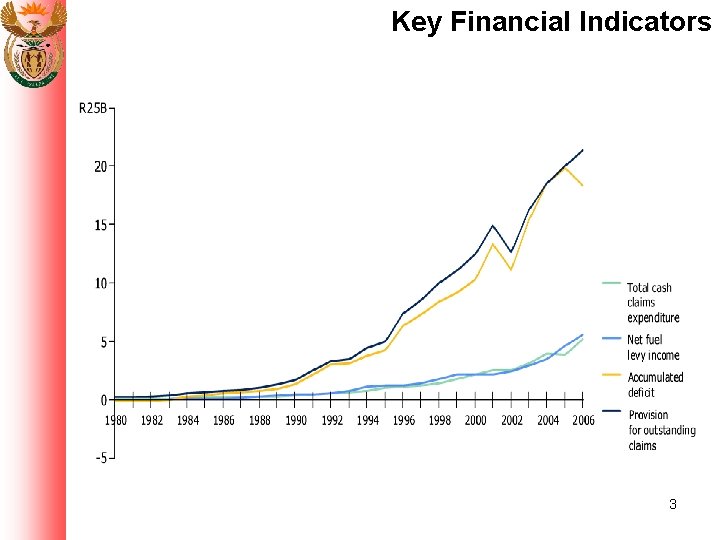
Key Financial Indicators 3
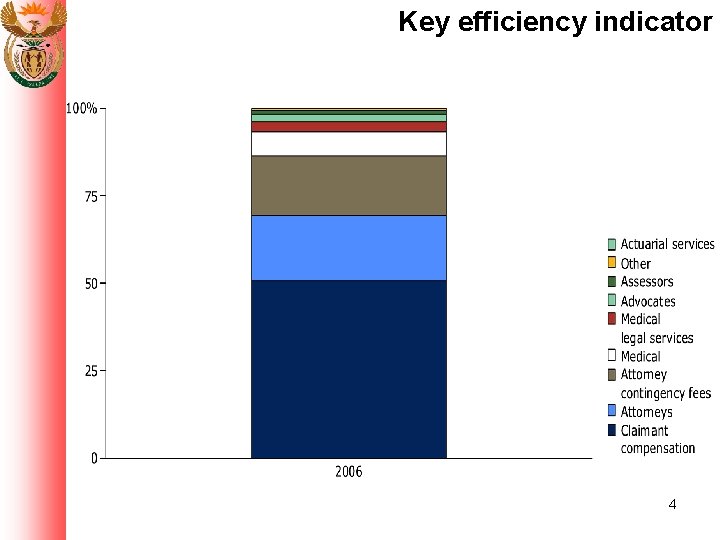
Key efficiency indicator 4
Equitable, reasonable, affordable and sustainable • • To address the backlogs through increases in the fuel levy, without ensuring effectiveness in payment of claims would further burden taxpayers with the costs of an inequitable and inefficient system of compensation. It is imperative that any additional funding is targeted rather at better healthcare and social security outcomes. • The solvency of the fund depends of government introducing a system of income and medical benefits for all road accident victims which provides for the right to healthcare, social security and dignity, without a large proportion of funds having to be consumed in legal fees. • Such a system was outlined by the Road Accident Commission, as a pay-as -you go system in which benefits are moderated by thresholds and ceilings to ensure affordability and sustainability in line with social security principles. • Alongside this statutory benefit arrangement, personal insurance products should be permitted to provide discretionary protection based on preference and willingness to pay, subject to regulation by the Financial Services Board. In this way, wealthy road users will pay for their own insurance against loss of income, above the statutory benefit. This form of insurance will be necessary for both the promulgation of the RAF Amendment Act, 2005 and the proposed Road Accident Benefit Scheme legislation. 5
Recommendation – The financial viability of the Fund needs to be addressed though a change in the policy guiding road accident compensation in South Africa and not through additional levies charged to the road using public. – To provide for transparency during that transformation of the Fund, the Fund should continue to budget for outstanding liabilities, despite the fact that the regulations regarding short term insurance are not appropriate. – The RAF should continue to improve efficiencies and reduce claims processing and administration costs to prevent the backlog from growing without resorting to measures which will negatively affect the road-using public. – That capital expenditure estimates as provided for the 2008 MTEF should be reviewed in line with the Comprehensive Social Security System to ensure effective and efficient institutional infrastructure for basic, contributory and discretionary social security. – The RAF fuel levy will increase by 5 c in 2008/09 and 2009/10. At this stage no additional fuel levy increase is planned for 2010/11, as it is envisaged that by then the new RAB scheme operating on social security principles should be in place. – The outstanding liability (currently valued at R 25. 2 billion in 2007/08) will need to be addressed when the Road Accident Benefit Scheme legislation is promulgated, and it may require direct funding from the fiscus; fuel levy increases or a special government bond to underwrite accumulated liabilities. 6