
RNA TRANSCRIPTION TRANSLATION How does the cell use
- Slides: 10
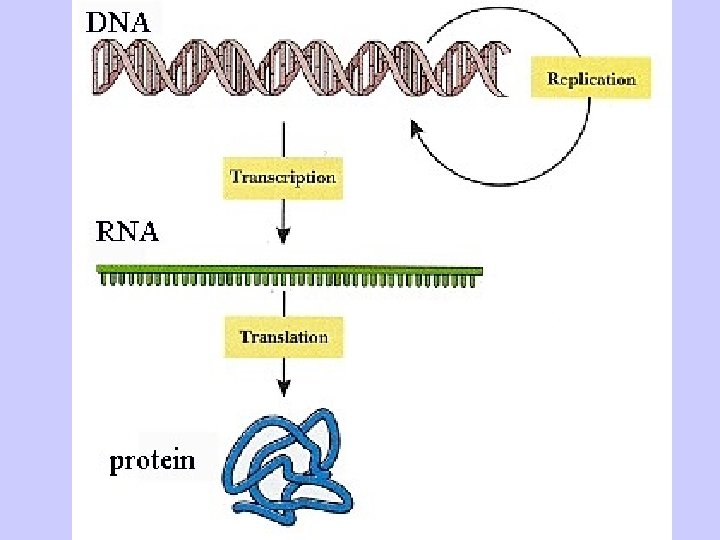
RNA/ TRANSCRIPTION / TRANSLATION How does the cell use the DNA code to make proteins? (how is the code “read”? )
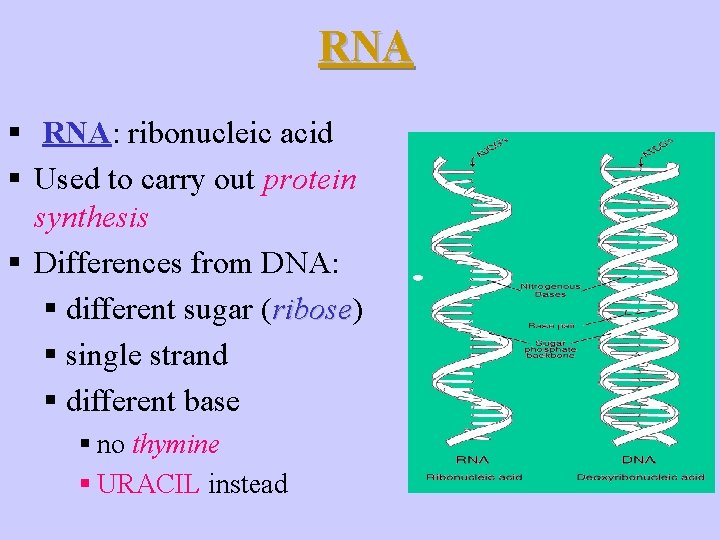
RNA § RNA: ribonucleic acid § Used to carry out protein synthesis § Differences from DNA: § different sugar (ribose) ribose § single strand § different base § no thymine § URACIL instead
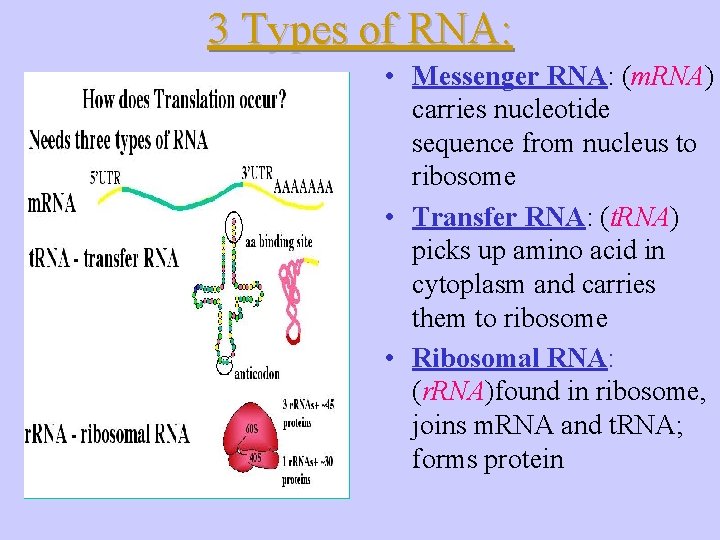
3 Types of RNA: • Messenger RNA: (m. RNA) carries nucleotide sequence from nucleus to ribosome • Transfer RNA: (t. RNA) picks up amino acid in cytoplasm and carries them to ribosome • Ribosomal RNA: (r. RNA)found in ribosome, joins m. RNA and t. RNA; forms protein
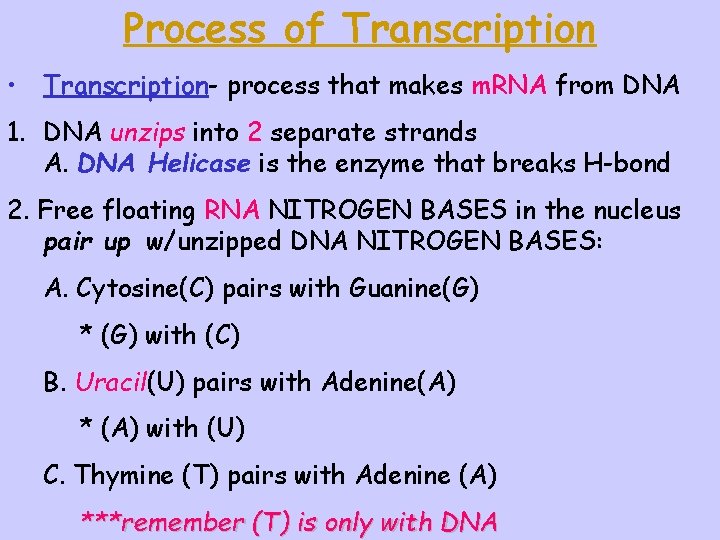
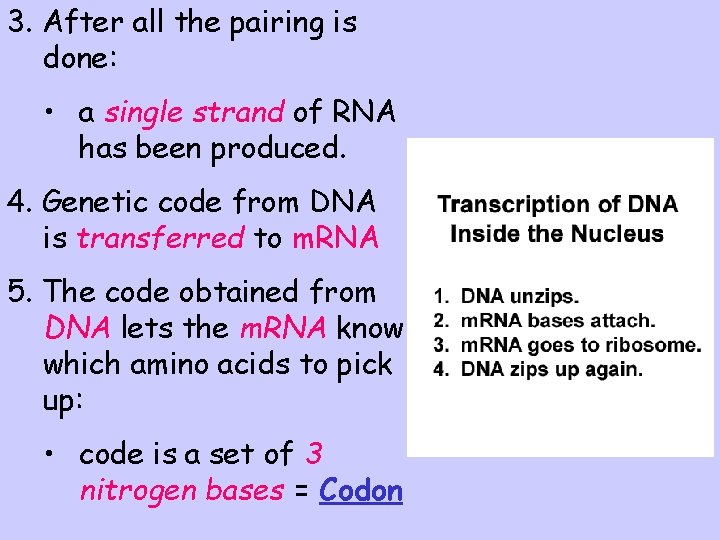
Process of Transcription • Transcription- process that makes m. RNA from DNA 1. DNA unzips into 2 separate strands A. DNA Helicase is the enzyme that breaks H-bond 2. Free floating RNA NITROGEN BASES in the nucleus pair up w/unzipped DNA NITROGEN BASES: A. Cytosine(C) pairs with Guanine(G) * (G) with (C) B. Uracil(U) pairs with Adenine(A) * (A) with (U) C. Thymine (T) pairs with Adenine (A) ***remember (T) is only with DNA
3. After all the pairing is done: • a single strand of RNA has been produced. 4. Genetic code from DNA is transferred to m. RNA 5. The code obtained from DNA lets the m. RNA know which amino acids to pick up: • code is a set of 3 nitrogen bases = Codon
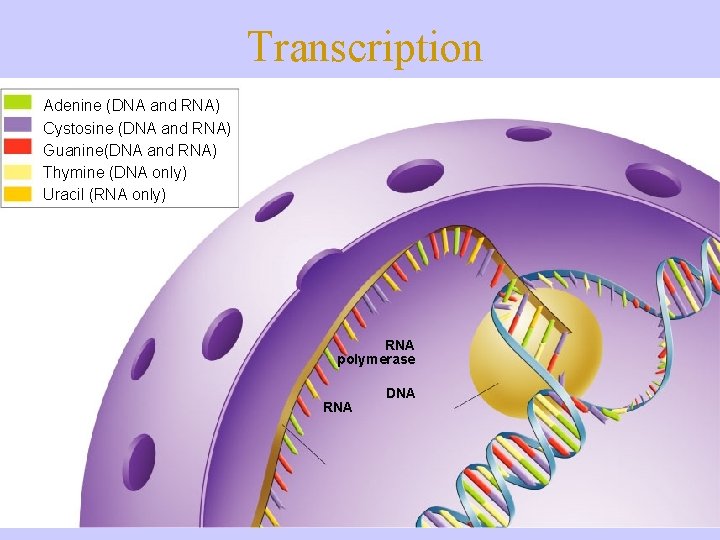
Transcription Adenine (DNA and RNA) Cystosine (DNA and RNA) Guanine(DNA and RNA) Thymine (DNA only) Uracil (RNA only) RNA polymerase RNA DNA
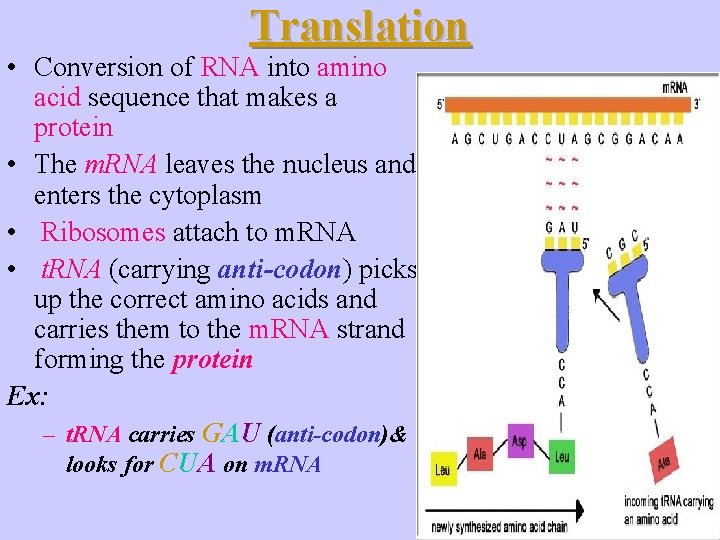
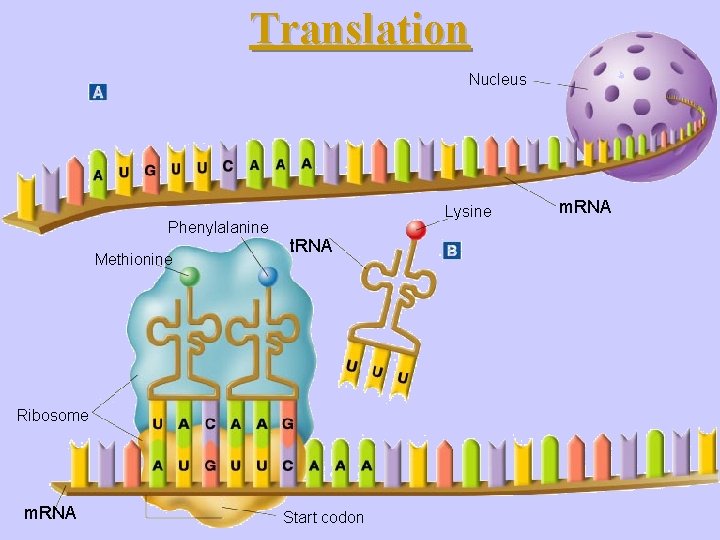
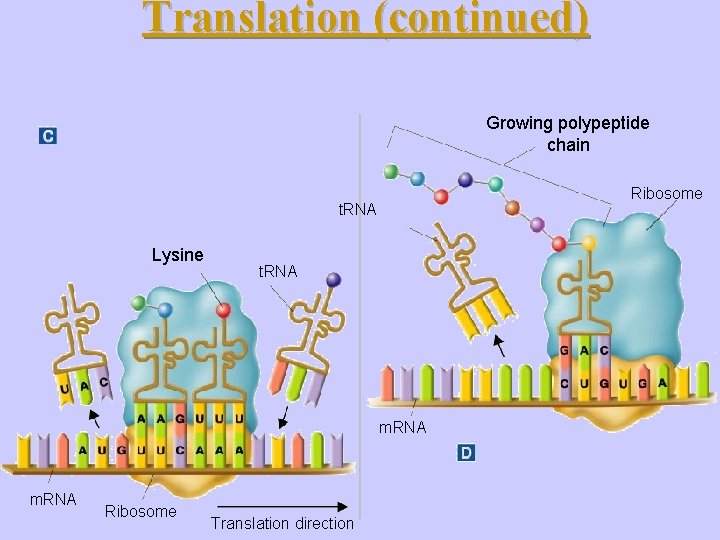
Translation • Conversion of RNA into amino acid sequence that makes a protein • The m. RNA leaves the nucleus and enters the cytoplasm • Ribosomes attach to m. RNA • t. RNA (carrying anti-codon) picks up the correct amino acids and carries them to the m. RNA strand forming the protein Ex: – t. RNA carries GAU (anti-codon)& looks for CUA on m. RNA
Translation Nucleus Lysine Phenylalanine Methionine t. RNA Ribosome m. RNA Start codon m. RNA
Translation (continued) Growing polypeptide chain Ribosome t. RNA Lysine t. RNA m. RNA Ribosome Translation direction