
RNA structure and function By Dr Mohammed Hosny
RNA structure and function By Dr. Mohammed Hosny Hassan, Associate Professor of Medical Biochemistry, Faculty of Medicine, South Valley University
Chemistry or Structure of Ribonucleic Acids (RNAs): There are four types of RNAs which are: (1) Messenger RNA (m. RNA). (2) Ribosomal RNA (r. RNAs). (3) Transfer RNA (t. RNA). (4) Small RNAs (s. RNAs). • These types will be discussed in some details: By Dr. Mohammed Hosny Hassan, Associate Professor of Medical Biochemistry, Faculty of Medicine, South Valley University
I- The messenger RNA (m. RNA): • The blue script ( primary transcript) of m. RNA is heterogenous nuclear RNA "hn. RNA" , also called immature m. RNA which differ from other types of RNA in that it never leave the nucleus and functions as a precursor from which m. RNA is processed. • Length: It is single RNA strand with 400 -4000 nucleotides in length. • Function: It carries codons for protein synthesis which are recognized by anticodons of t. RNAs. • Structure: It is single strand formed of linear sequence of its building ribonucleotides units ( AMP , UMP , GMP , CMP) with: By Dr. Mohammed Hosny Hassan, Associate Professor of Medical Biochemistry, Faculty of Medicine, South Valley University
1. 7 -methyl guanosine triphosphate cap at 5' end: Functions: • Facilitates initiation of translation of m. RNA. • Protects the 5'end from attack by 5' to 3' exonucleases & phosphatases. 2. Poly adenylate tail (poly A tail) at 3' end: It is formed of 25 -250 adenine nucleotide base. Functions: • Facilitates the m. RNA transport. • Protect the 3'end from attack by 3' to 5' exonucleases. 3. 3' & 5' terminal un translated regions: Functions: • Contain regulatory sequence to which regulatory proteins bind to regulate translation of m. RNA. • Control the m. RNA half life. By Dr. Mohammed Hosny Hassan, Associate Professor of Medical Biochemistry, Faculty of Medicine, South Valley University
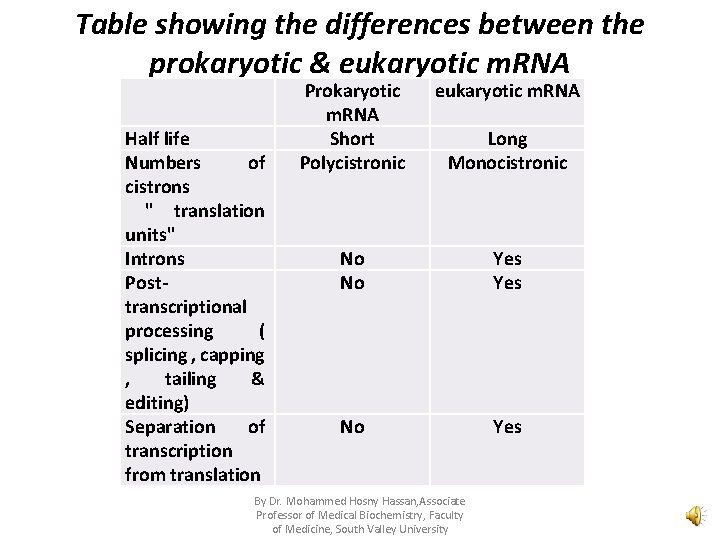
Table showing the differences between the prokaryotic & eukaryotic m. RNA Half life Numbers of cistrons " translation units" Introns Posttranscriptional processing ( splicing , capping , tailing & editing) Separation of transcription from translation Prokaryotic m. RNA Short Polycistronic eukaryotic m. RNA No No Yes Long Monocistronic By Dr. Mohammed Hosny Hassan, Associate Professor of Medical Biochemistry, Faculty of Medicine, South Valley University
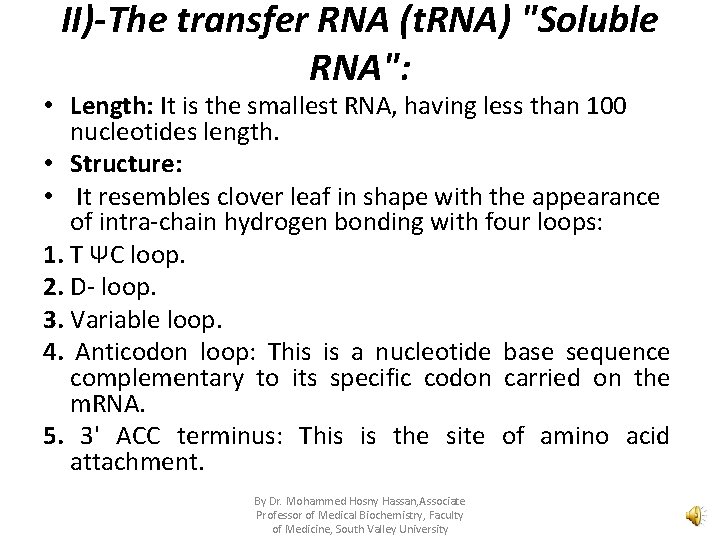
II)-The transfer RNA (t. RNA) "Soluble RNA": • Length: It is the smallest RNA, having less than 100 nucleotides length. • Structure: • It resembles clover leaf in shape with the appearance of intra-chain hydrogen bonding with four loops: 1. T ΨC loop. 2. D- loop. 3. Variable loop. 4. Anticodon loop: This is a nucleotide base sequence complementary to its specific codon carried on the m. RNA. 5. 3' ACC terminus: This is the site of amino acid attachment. By Dr. Mohammed Hosny Hassan, Associate Professor of Medical Biochemistry, Faculty of Medicine, South Valley University
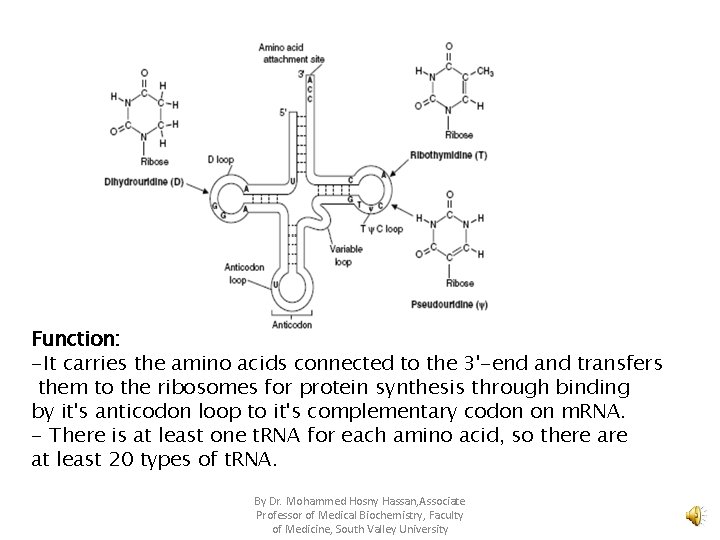
Function: -It carries the amino acids connected to the 3'-end and transfers them to the ribosomes for protein synthesis through binding by it's anticodon loop to it's complementary codon on m. RNA. - There is at least one t. RNA for each amino acid, so there at least 20 types of t. RNA. By Dr. Mohammed Hosny Hassan, Associate Professor of Medical Biochemistry, Faculty of Medicine, South Valley University
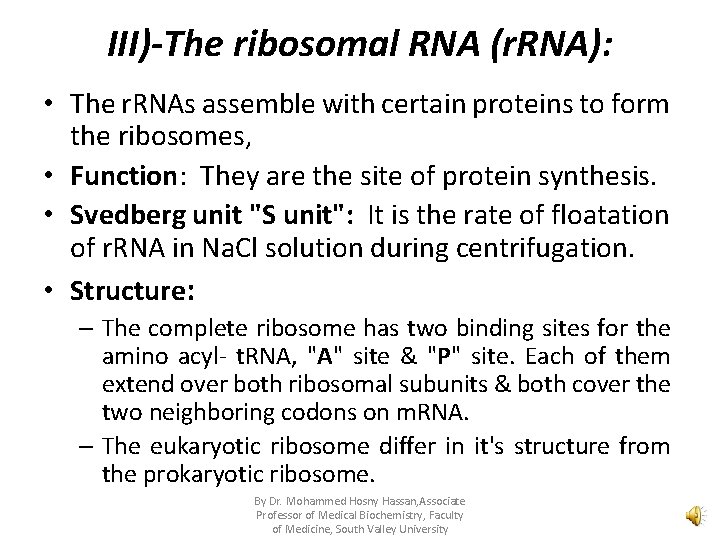
III)-The ribosomal RNA (r. RNA): • The r. RNAs assemble with certain proteins to form the ribosomes, • Function: They are the site of protein synthesis. • Svedberg unit "S unit": It is the rate of floatation of r. RNA in Na. Cl solution during centrifugation. • Structure: – The complete ribosome has two binding sites for the amino acyl- t. RNA, "A" site & "P" site. Each of them extend over both ribosomal subunits & both cover the two neighboring codons on m. RNA. – The eukaryotic ribosome differ in it's structure from the prokaryotic ribosome. By Dr. Mohammed Hosny Hassan, Associate Professor of Medical Biochemistry, Faculty of Medicine, South Valley University
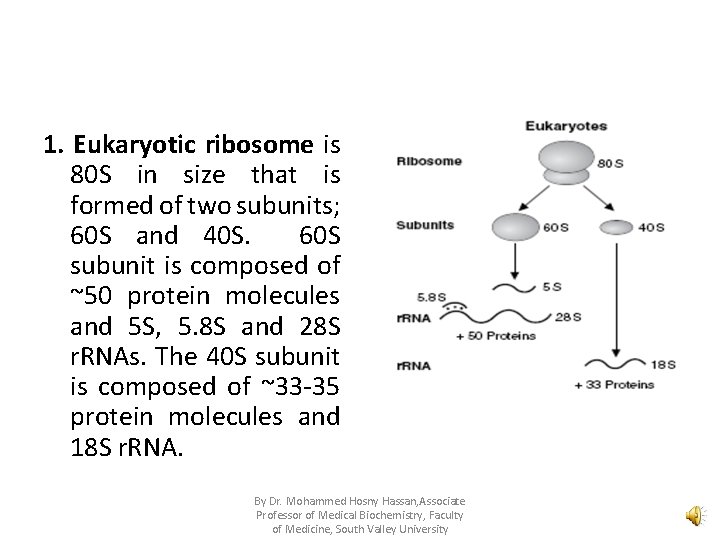
1. Eukaryotic ribosome is 80 S in size that is formed of two subunits; 60 S and 40 S. 60 S subunit is composed of ~50 protein molecules and 5 S, 5. 8 S and 28 S r. RNAs. The 40 S subunit is composed of ~33 -35 protein molecules and 18 S r. RNA. By Dr. Mohammed Hosny Hassan, Associate Professor of Medical Biochemistry, Faculty of Medicine, South Valley University
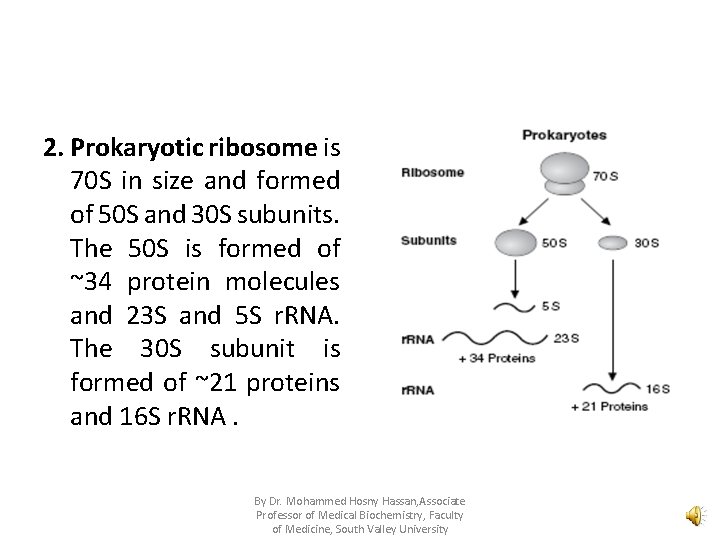
2. Prokaryotic ribosome is 70 S in size and formed of 50 S and 30 S subunits. The 50 S is formed of ~34 protein molecules and 23 S and 5 S r. RNA. The 30 S subunit is formed of ~21 proteins and 16 S r. RNA. By Dr. Mohammed Hosny Hassan, Associate Professor of Medical Biochemistry, Faculty of Medicine, South Valley University

By Dr. Mohammed Hosny Hassan, Associate Professor of Medical Biochemistry, Faculty of Medicine, South Valley University
- Slides: 11