
RNA Secondary Structure Prediction with ErrorDriven TransformationBased Learning
RNA Secondary Structure Prediction with Error-Driven Transformation-Based Learning (TBL) CMPT 881 Computational Biology Daniel Zimmerman Transformation-based learning of RNA Secondary Structures
Outline 1. Short background – RNA, Secondary structure 2. Historical work in structure prediction – Nussinov, Zuker 3. TBL Overview – Previous applications, Discussion of rules and transformations 4. Present work – Algorithm, Complexity 5. Data Set 6. Results 7. Discussion, Conclusion Transformation-based learning of RNA Secondary Structures
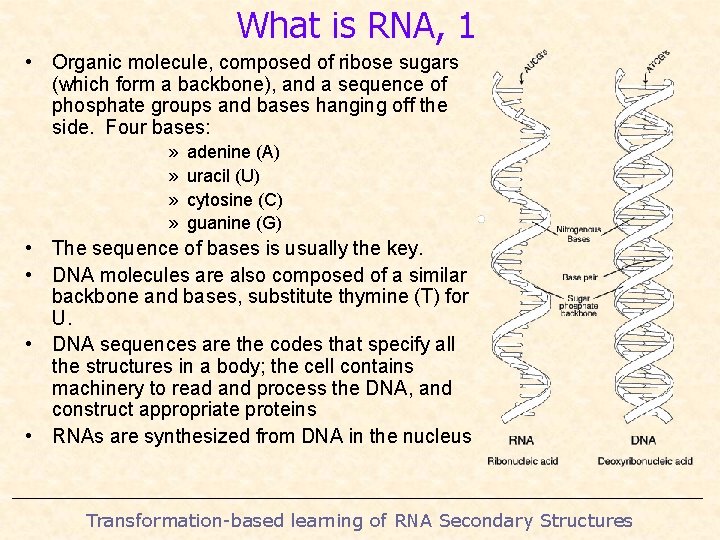
What is RNA, 1 • Organic molecule, composed of ribose sugars (which form a backbone), and a sequence of phosphate groups and bases hanging off the side. Four bases: » » adenine (A) uracil (U) cytosine (C) guanine (G) • The sequence of bases is usually the key. • DNA molecules are also composed of a similar backbone and bases, substitute thymine (T) for U. • DNA sequences are the codes that specify all the structures in a body; the cell contains machinery to read and process the DNA, and construct appropriate proteins • RNAs are synthesized from DNA in the nucleus Transformation-based learning of RNA Secondary Structures
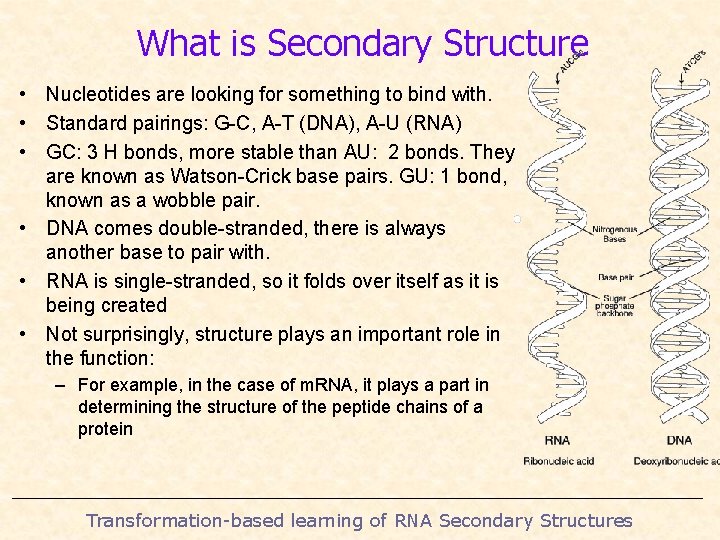
What is Secondary Structure • Nucleotides are looking for something to bind with. • Standard pairings: G-C, A-T (DNA), A-U (RNA) • GC: 3 H bonds, more stable than AU: 2 bonds. They are known as Watson-Crick base pairs. GU: 1 bond, known as a wobble pair. • DNA comes double-stranded, there is always another base to pair with. • RNA is single-stranded, so it folds over itself as it is being created • Not surprisingly, structure plays an important role in the function: – For example, in the case of m. RNA, it plays a part in determining the structure of the peptide chains of a protein Transformation-based learning of RNA Secondary Structures

Types of secondary structure a. hairpin loop b. internal loop c. bulge loop d. multi-branched loop e. stem f. pseudoknot • a through e are all properly nested: if a base pair (i, j), i < j, encloses structure 1, and base pair (k, l), k < l, encloses structure 2, then either i < j < k < l, or • Never i < k < l < j, or k<i<j<l i<k<j<l • Pseudoknots violate this property Transformation-based learning of RNA Secondary Structures
Types of secondary structure • If we ignore pseudoknots, then having the base pairing information tells us all we need to know about the structure of the sequence • typically structure predictors ignore pseudoknots because if they are included, then the problem becomes very hard Transformation-based learning of RNA Secondary Structures

A. Nakaya et al. Phylogenetic Tree Analysis Using RNA Secondary Structure. Bio Images. 1999. http: //www. nih. go. jp/yoken/bioimaging/issues/7 -4. html Conn, G. L. , Draper, D. E. , Lattman, E. E. & Gittis, A. G. (1999). Crystal Structure of a Conserved Ribosomal Protein - RNA Complex. Science 284, 1171 - 1174. http: //www. jhu. edu/~chem/draper/Recent. Publications. html Transformation-based learning of RNA Secondary Structures
How to predict secondary structure? • Given an RNA sequence, can we predict structure? • Complication: structure tends to be conserved more than sequence • Previous approaches – – Base pair maximization (Nussinov et al, 1978) Energy minimization (Zuker, 1989) (70%) Covariance model (Rivas, Eddy) – includes pseudoknots Evolutionary approach, with SCFGs (Knudsen and Hein, 1999) – combine CFG productions with probabilities of mutations » S -> Loop S | Loop » Stem -> base Stem base | Loop S » Loop -> base Stem Base Transformation-based learning of RNA Secondary Structures
What is Transformation-based Error-driven Learning? • Goal: to develop a program to accurately perform a task on a corpus. • A tagger to assign parts of speech (POS) to the words in a document • A program to predict the secondary structure of an RNA sequence • The learner has access to • a set of rules which will transform the corpus, • the annotated version of the corpus (for POS, this is the document with the correct parts of speech indicated) • Learning proceeds by making guesses: performs a rule, and compares the result to the annotated version to see how many mistakes there are • The learner eventually ranks all the rules Transformation-based learning of RNA Secondary Structures
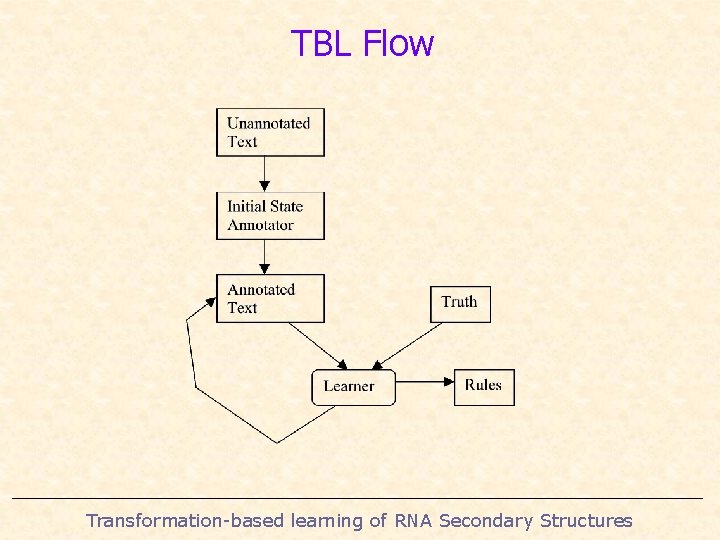
TBL Flow Transformation-based learning of RNA Secondary Structures
Previous applications of TBL • The TBL algorithm used here was developed by Eric Brill in 1992, for part-of-speech tagging • He noted that corpus-based approaches do not need sophisticated domain knowledge, but that simple ngram models hide too much linguistic information in the statistics • Achieved very good results for the task: 97. 2%, when trained on 600 000 words, and tested on a different set of 150 000 words • These lead to the motivations for trying it on RNA: simple, has achieved good results in the past, and very fast in application! Transformation-based learning of RNA Secondary Structures
TBL Rules • Rules consist of two parts: • triggering environment • transformation • Example for the POS application (non-lexical): • trigger: the POS of the preceding word is TO • transformation: change the POS of the current word to be VB (stem form of the verb) Transformation-based learning of RNA Secondary Structures
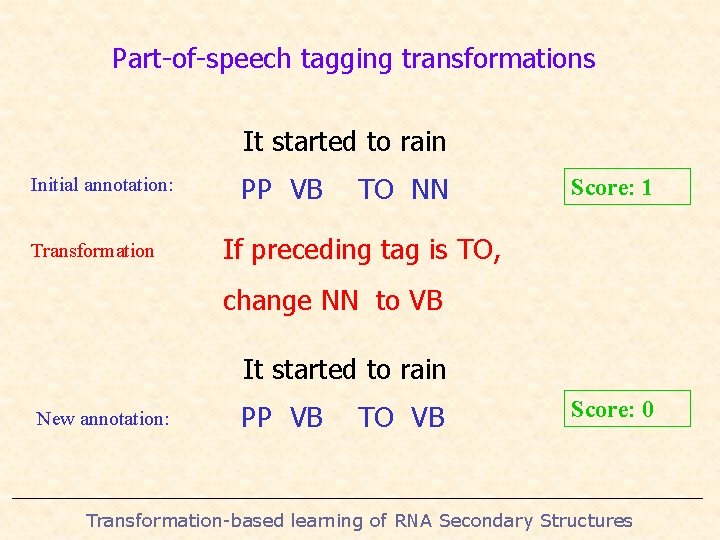
Part-of-speech tagging transformations It started to rain Initial annotation: Transformation PP VB TO NN Score: 1 If preceding tag is TO, change NN to VB It started to rain New annotation: PP VB TO VB Score: 0 Transformation-based learning of RNA Secondary Structures
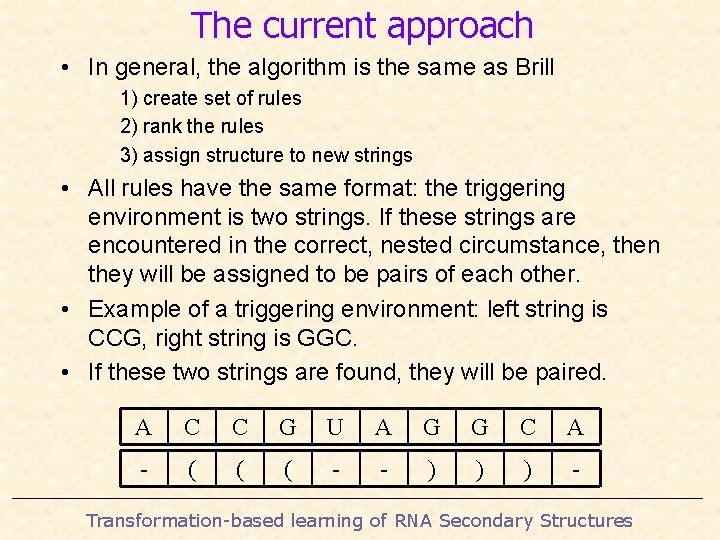
The current approach • In general, the algorithm is the same as Brill 1) create set of rules 2) rank the rules 3) assign structure to new strings • All rules have the same format: the triggering environment is two strings. If these strings are encountered in the correct, nested circumstance, then they will be assigned to be pairs of each other. • Example of a triggering environment: left string is CCG, right string is GGC. • If these two strings are found, they will be paired. A C C G U A G G C A - ( ( ( - - ) ) ) - Transformation-based learning of RNA Secondary Structures
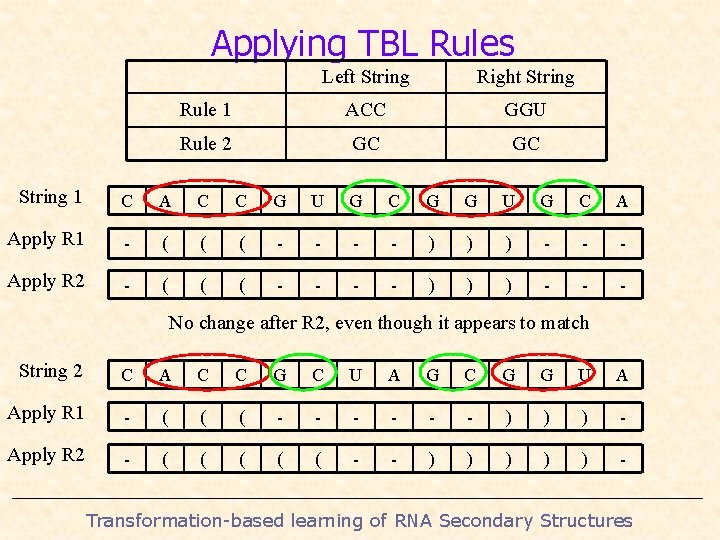
Applying TBL Rules Left String Right String Rule 1 ACC GGU Rule 2 GC GC String 1 C A C C G U G C G G U G C A Apply R 1 - ( ( ( - - ) ) ) - - - Apply R 2 - ( ( ( - - ) ) ) - - - No change after R 2, even though it appears to match String 2 C A C C G C U A G C G G U A Apply R 1 - ( ( ( - - - ) ) ) - Apply R 2 - ( ( ( - - ) ) ) - Transformation-based learning of RNA Secondary Structures
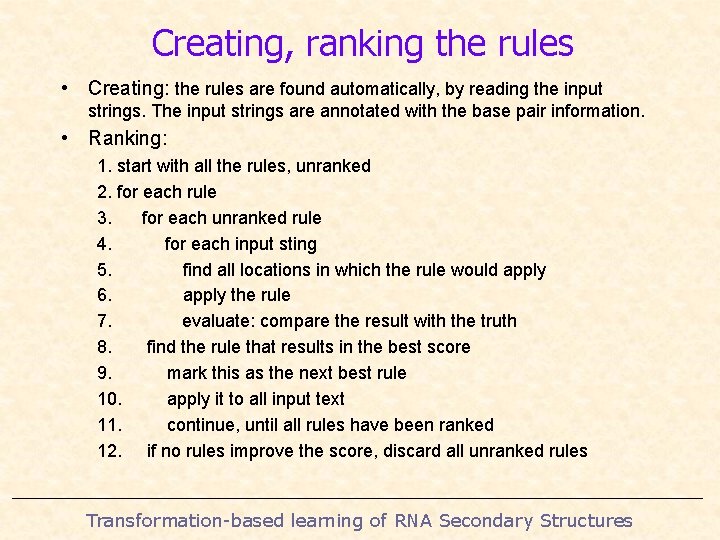
Creating, ranking the rules • Creating: the rules are found automatically, by reading the input strings. The input strings are annotated with the base pair information. • Ranking: 1. start with all the rules, unranked 2. for each rule 3. for each unranked rule 4. for each input sting 5. find all locations in which the rule would apply 6. apply the rule 7. evaluate: compare the result with the truth 8. find the rule that results in the best score 9. mark this as the next best rule 10. apply it to all input text 11. continue, until all rules have been ranked 12. if no rules improve the score, discard all unranked rules Transformation-based learning of RNA Secondary Structures
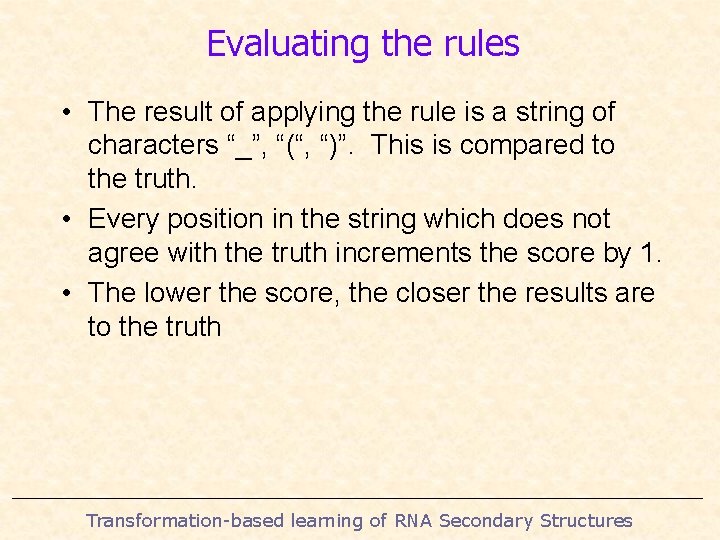
Evaluating the rules • The result of applying the rule is a string of characters “_”, “(“, “)”. This is compared to the truth. • Every position in the string which does not agree with the truth increments the score by 1. • The lower the score, the closer the results are to the truth Transformation-based learning of RNA Secondary Structures
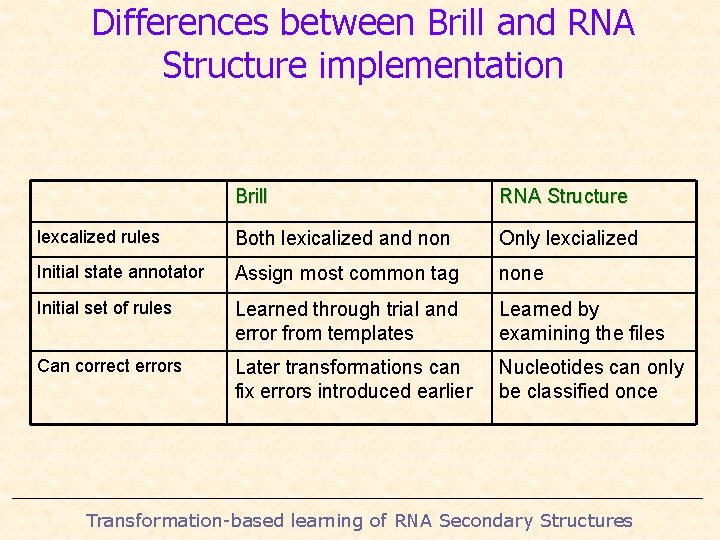
Differences between Brill and RNA Structure implementation Brill RNA Structure lexcalized rules Both lexicalized and non Only lexcialized Initial state annotator Assign most common tag none Initial set of rules Learned through trial and error from templates Learned by examining the files Can correct errors Later transformations can fix errors introduced earlier Nucleotides can only be classified once Transformation-based learning of RNA Secondary Structures
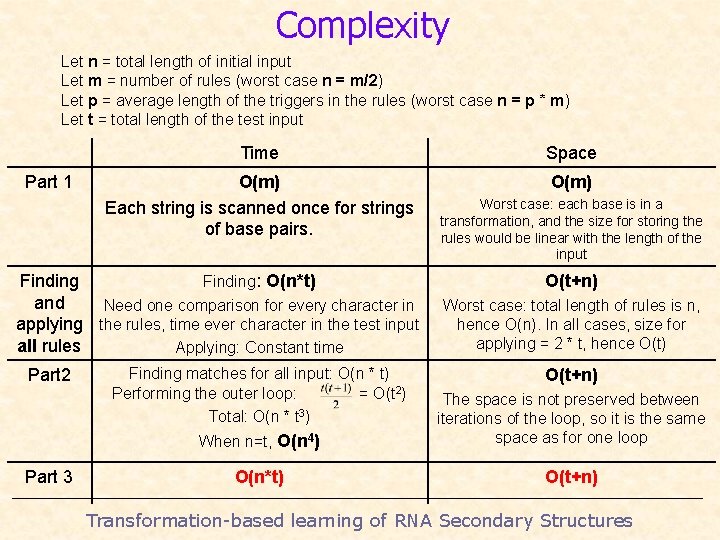
Complexity Let n = total length of initial input Let m = number of rules (worst case n = m/2) Let p = average length of the triggers in the rules (worst case n = p * m) Let t = total length of the test input Part 1 Time Space O(m) Each string is scanned once for strings of base pairs. O(m) Finding: O(n*t) and Need one comparison for every character in applying the rules, time ever character in the test input all rules Applying: Constant time Part 2 Part 3 Finding matches for all input: O(n * t) Performing the outer loop: = O(t 2) Total: O(n * t 3) Worst case: each base is in a transformation, and the size for storing the rules would be linear with the length of the input O(t+n) Worst case: total length of rules is n, hence O(n). In all cases, size for applying = 2 * t, hence O(t) O(t+n) When n=t, O(n 4) The space is not preserved between iterations of the loop, so it is the same space as for one loop O(n*t) O(t+n) Transformation-based learning of RNA Secondary Structures
Data set • Obtained from the online GOBASE database – hosted at Université de Montréal • Unable to find text RNA sequences with secondary structure information embedded • Therefore took unannotated sequences and ran them through the program RNAStructure. It uses the energy minimization algorithm and generates a data file with secondary structure information – used these as the input • Therefore, not training on real RNA structure data – but on incorrect estimates. Transformation-based learning of RNA Secondary Structures
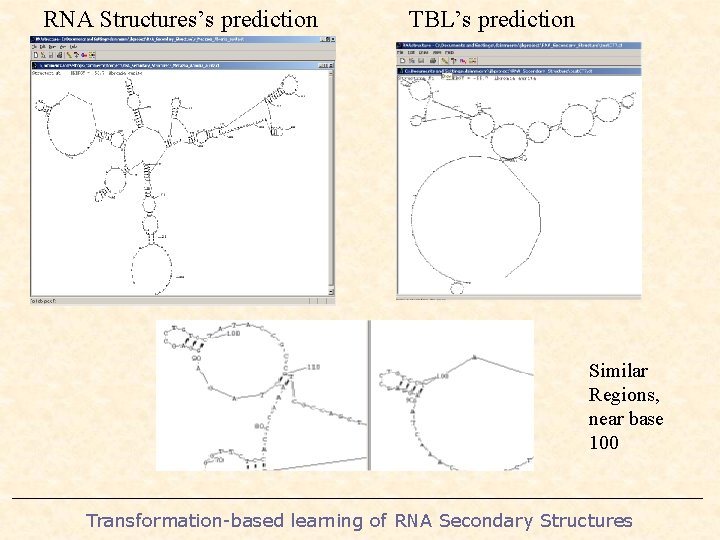
RNA Structures’s prediction TBL’s prediction Similar Regions, near base 100 Transformation-based learning of RNA Secondary Structures
Results • Baseline: since there are 3 symbols, we can assign to a position, a minimal baseline we could expect would be the random score, 33%. The top score to aim for would be the optimal score for the energy minimization algorithm approximately 70%. • For these trials, since the data was generated by the energy algorithm, no reason accuracy could not be higher than 70%. • In practice, because of the constraints on the output, the baseline should be higher than 33%, but since the results are so poor, i have not investigated what a more reasonable number would be. Transformation-based learning of RNA Secondary Structures
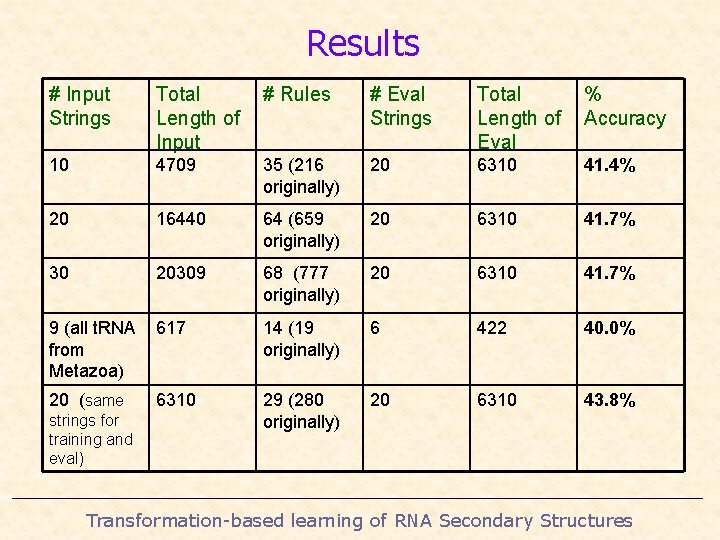
Results # Input Strings Total Length of Input # Rules # Eval Strings Total Length of Eval % Accuracy 10 4709 35 (216 originally) 20 6310 41. 4% 20 16440 64 (659 originally) 20 6310 41. 7% 30 20309 68 (777 originally) 20 6310 41. 7% 9 (all t. RNA from Metazoa) 617 14 (19 originally) 6 422 40. 0% 20 (same 6310 29 (280 originally) 20 6310 43. 8% strings for training and eval) Transformation-based learning of RNA Secondary Structures
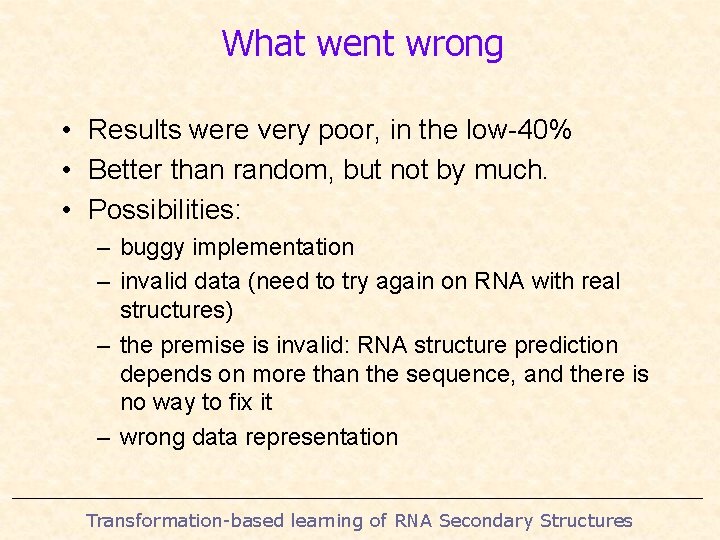
What went wrong • Results were very poor, in the low-40% • Better than random, but not by much. • Possibilities: – buggy implementation – invalid data (need to try again on RNA with real structures) – the premise is invalid: RNA structure prediction depends on more than the sequence, and there is no way to fix it – wrong data representation Transformation-based learning of RNA Secondary Structures
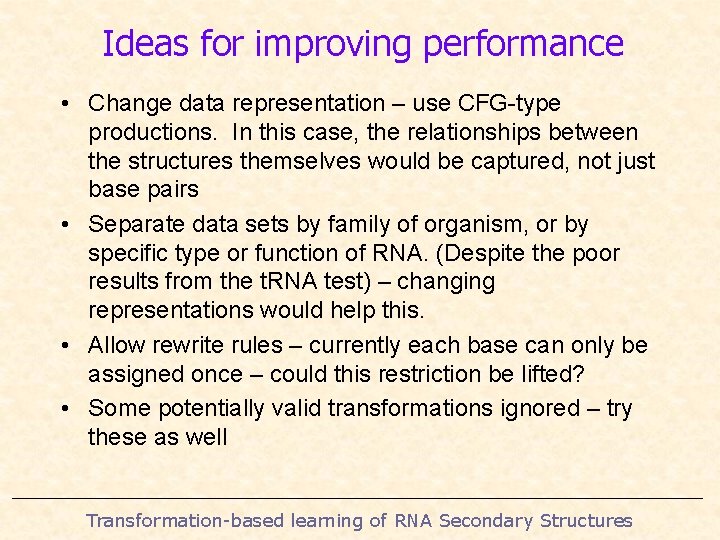
Ideas for improving performance • Change data representation – use CFG-type productions. In this case, the relationships between the structures themselves would be captured, not just base pairs • Separate data sets by family of organism, or by specific type or function of RNA. (Despite the poor results from the t. RNA test) – changing representations would help this. • Allow rewrite rules – currently each base can only be assigned once – could this restriction be lifted? • Some potentially valid transformations ignored – try these as well Transformation-based learning of RNA Secondary Structures
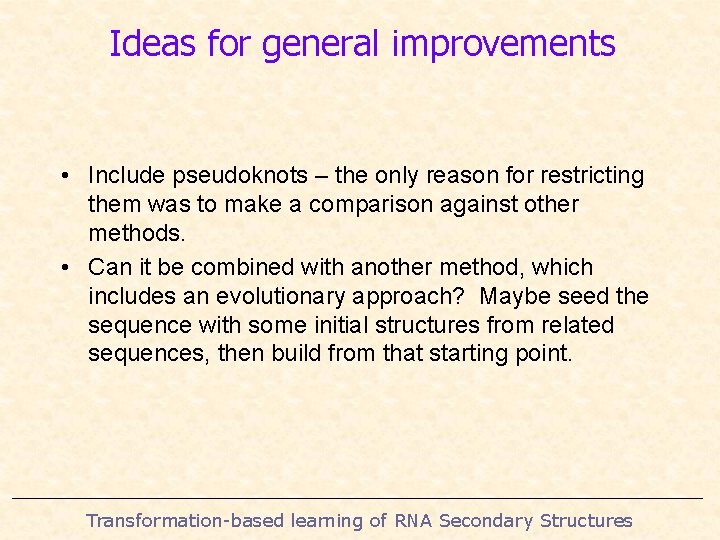
Ideas for general improvements • Include pseudoknots – the only reason for restricting them was to make a comparison against other methods. • Can it be combined with another method, which includes an evolutionary approach? Maybe seed the sequence with some initial structures from related sequences, then build from that starting point. Transformation-based learning of RNA Secondary Structures
Conclusion • Disappointing results, but still want to test it on real data before drawing the obvious conclusion • A hybrid approach might be the way to improve it • A fun exercise • Questions Transformation-based learning of RNA Secondary Structures
- Slides: 27