
RNA Protein Synthesis Vocabulary Messenger RNA m RNA
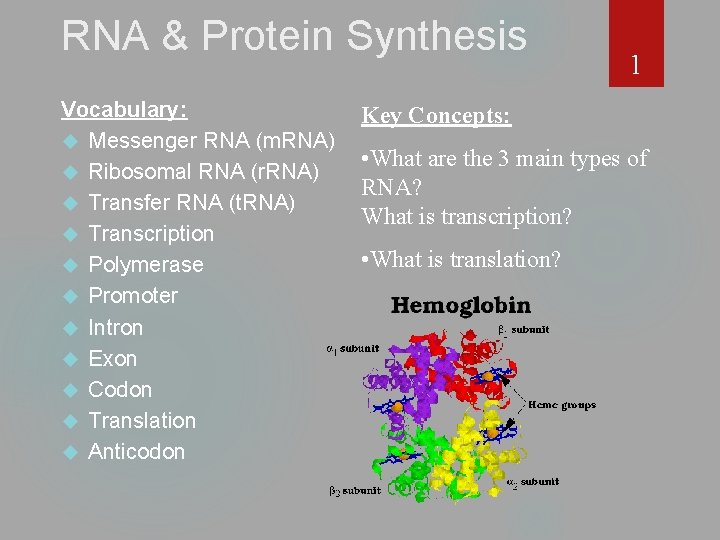
RNA & Protein Synthesis Vocabulary: Messenger RNA (m. RNA) Ribosomal RNA (r. RNA) Transfer RNA (t. RNA) Transcription Polymerase Promoter Intron Exon Codon Translation Anticodon 1 Key Concepts: • What are the 3 main types of RNA? What is transcription? • What is translation?
The Importance of Proteins They are diverse! control chemical messages in cell Direct the synthesis of carbohydrates, lipids, and nucleotides Act as enzymes Give the cell structure and movement 2
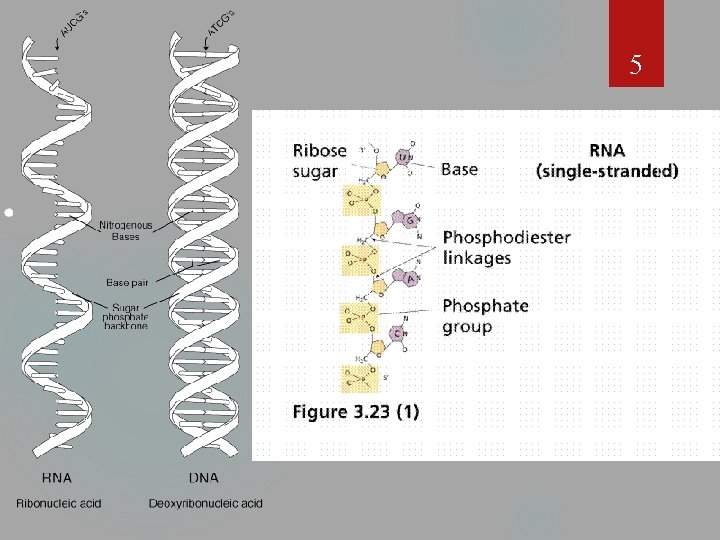
3 Like DNA= made of nucleotides Disposable 3 copy of DNA segment differences: 1) sugar= ribose 2) single stranded 3) instead of the base thymine (T), RNA uses uracil (U)
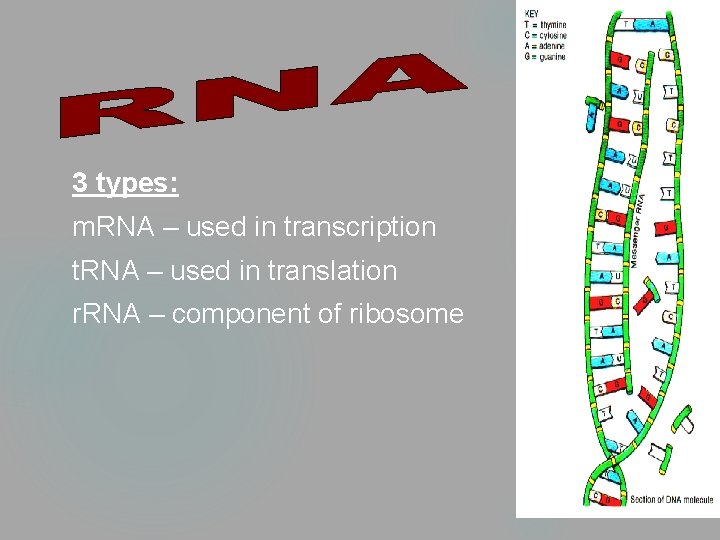
3 types: m. RNA – used in transcription t. RNA – used in translation r. RNA – component of ribosome
5
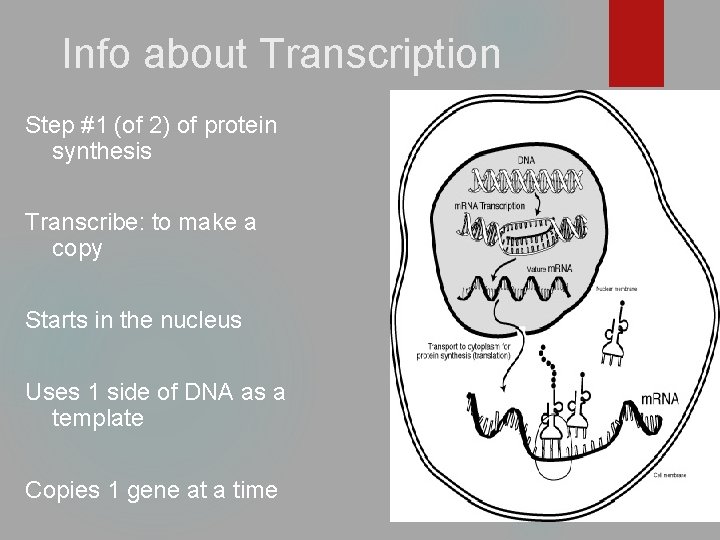
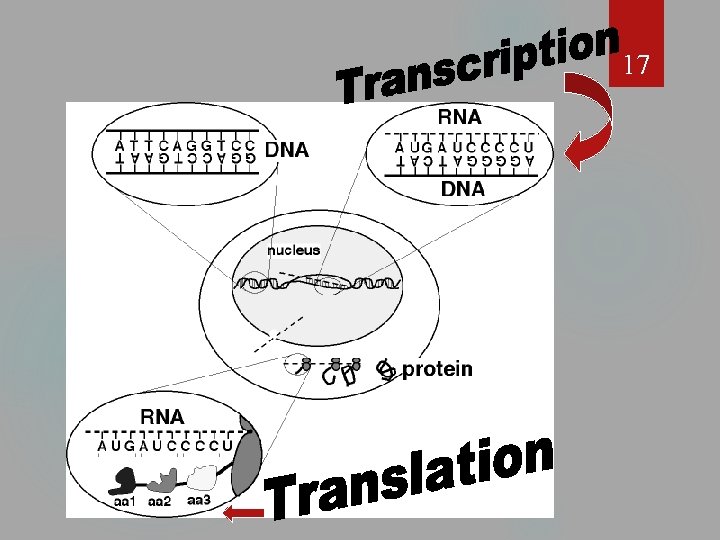
Info about Transcription Step #1 (of 2) of protein synthesis Transcribe: to make a copy Starts in the nucleus Uses 1 side of DNA as a template Copies 1 gene at a time
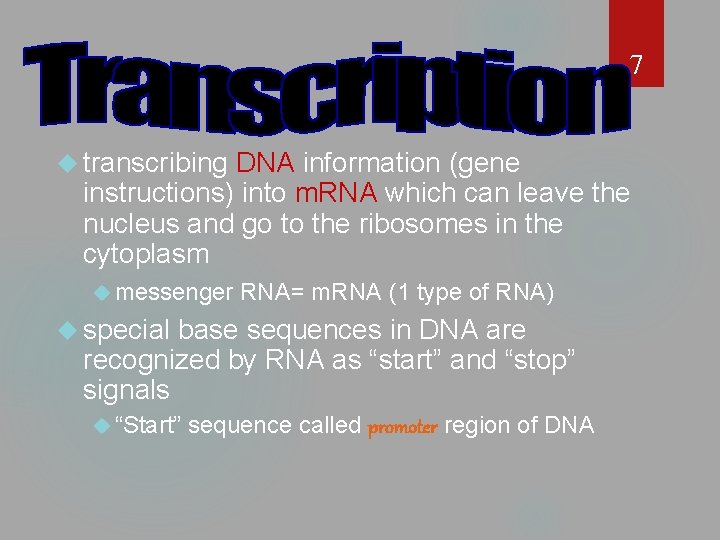
7 transcribing DNA information (gene instructions) into m. RNA which can leave the nucleus and go to the ribosomes in the cytoplasm messenger RNA= m. RNA (1 type of RNA) special base sequences in DNA are recognized by RNA as “start” and “stop” signals “Start” sequence called promoter region of DNA
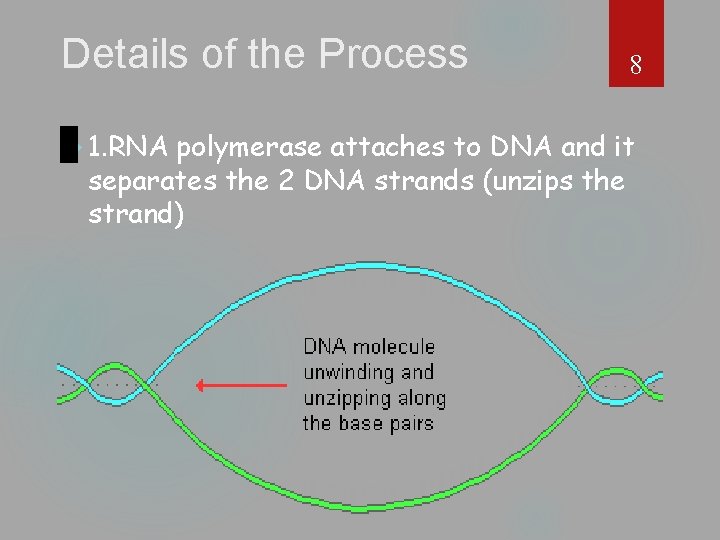
Details of the Process 1. RNA 8 polymerase attaches to DNA and it separates the 2 DNA strands (unzips the strand)
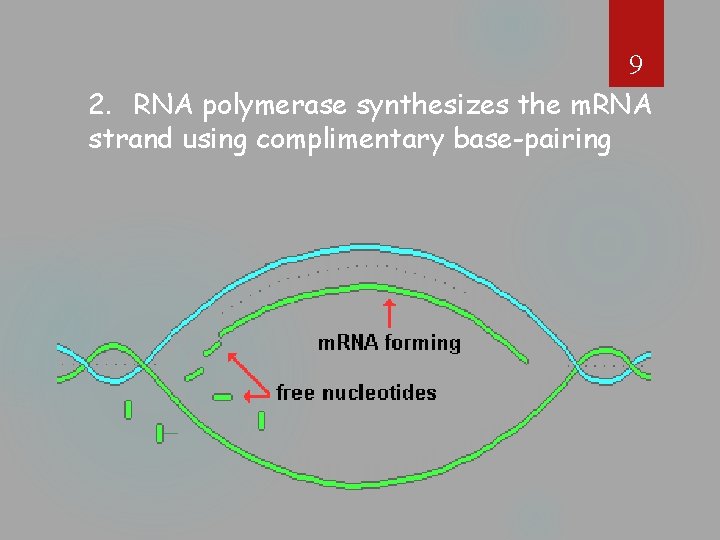
9 2. RNA polymerase synthesizes the m. RNA strand using complimentary base-pairing
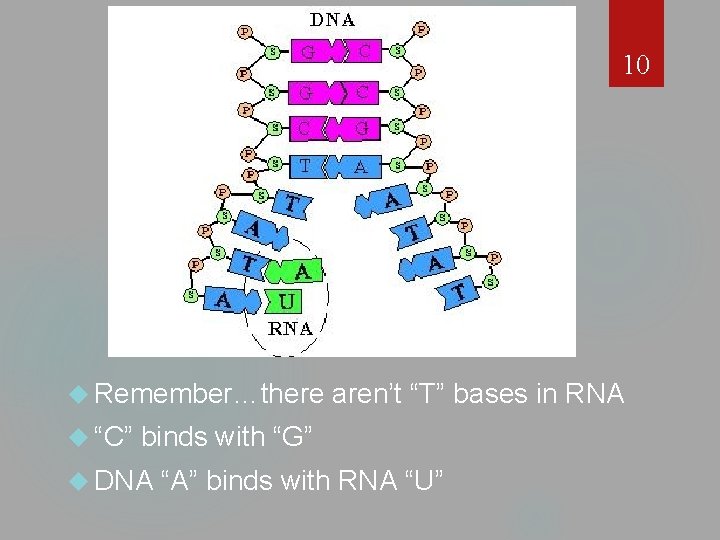
10 Remember…there “C” aren’t “T” bases in RNA binds with “G” DNA “A” binds with RNA “U”
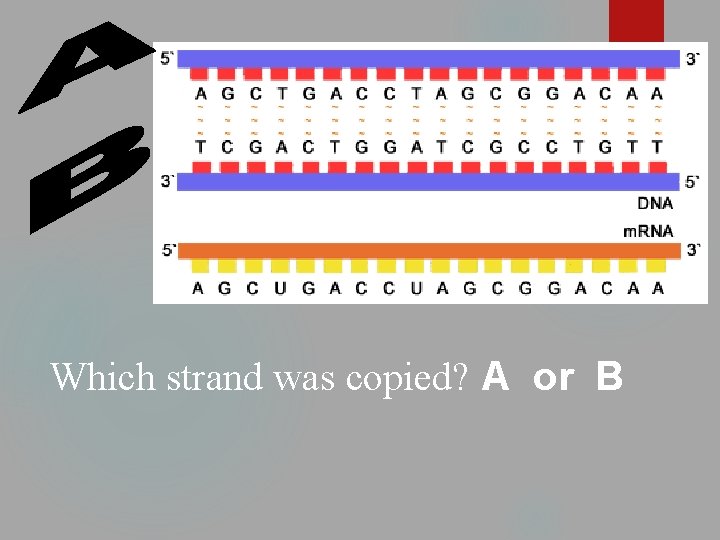
11 Which strand was copied? A or B
when RNA polymerase reaches the 12 end or "STOP" part of the genetic code for that protein, it releases 3. 4. DNA re-zips 5. finished m. RNA (messenger) leaves the nucleus and goes to a ribosome in the cytoplasm
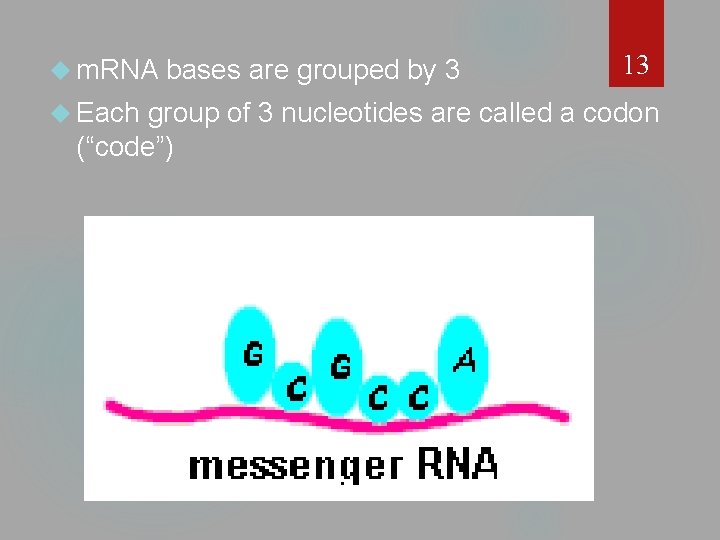
m. RNA Each bases are grouped by 3 13 group of 3 nucleotides are called a codon (“code”)
Review of Transcription Base pair rule is still used but there is never any thymine in RNA so: (A-U & C-G). Uracil is the base that bonds with adenine. DNA can never leave the nucleus, so m. RNA serves as the messenger to the ribosome RNA has one strand while DNA has 2. m. RNA leaves the nucleus and travels to the ribosome to start Translation.
More Review of Transcription occurs in the nucleus The product of transcription is m. RNA Only 1 side of DNA is used as a template & only 1 gene is needed Enzymes regulate the process
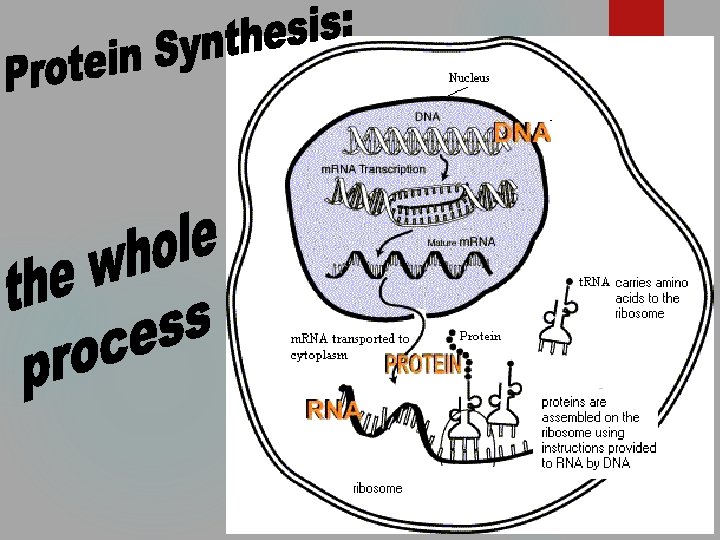
Transcription ends with m. RNA which 16 will exit the nucleus to the cytoplasm So… if Transcription is the first step of Protein Synthesis, what happens next in the cytoplasm?
17
18 Making a protein (string of amino acids) from the information carried by m. RNA. Occurs in the ribosome. ~A group of 3 m. RNA bases makes up a “codon” (think of as a “code word”) ~ each codon specifies a particular amino acid ~ there are “start” and “stop” codons
Quick Review of Proteins 1) Made of amino acids 2) There are only 20 amino acids to make up a lot of proteins 3) Proteins are a major component of cells 4) Proteins are made in ribosomes
Amino acid 20
21 m. RNA travels from the nucleus and attaches onto the ribosome with codons ~3 nucleotides of m. RNA = codon 2 nd kind of RNA= ribosomal RNA (r. RNA) ~ makes up the majority of the ribosome
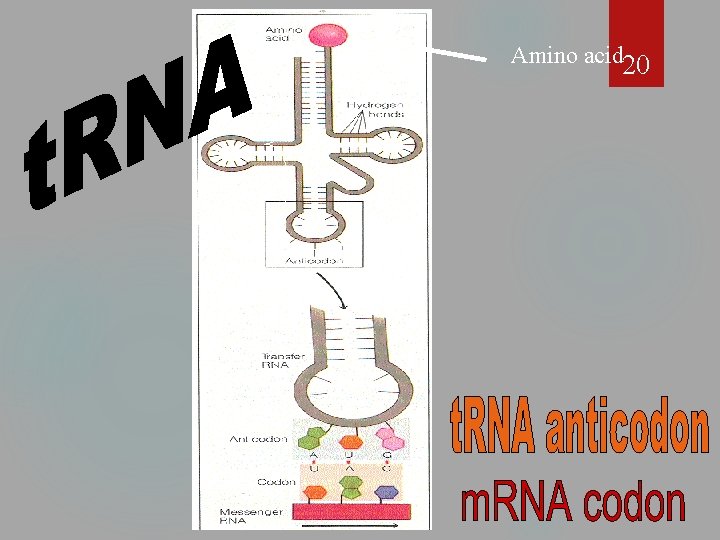
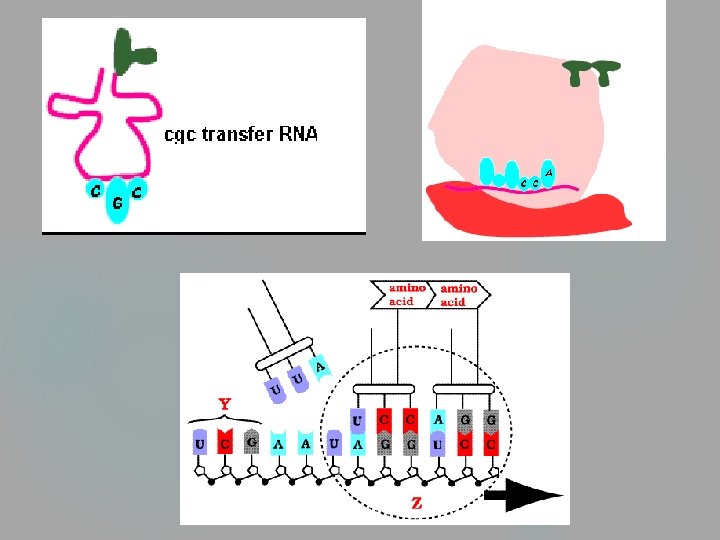
22 3 rd kind of RNA= transfer RNA (t. RNA) carries amino acids to the ribosomes (amino acids join together to form proteins) ~ there are 64 different t. RNA molecules (more than 1 for each amino acid) ~ REDUNDANCY of the CODE!! ~ 3 nucleotides of t. RNA that “match” or compliment the m. RNA = anticodon
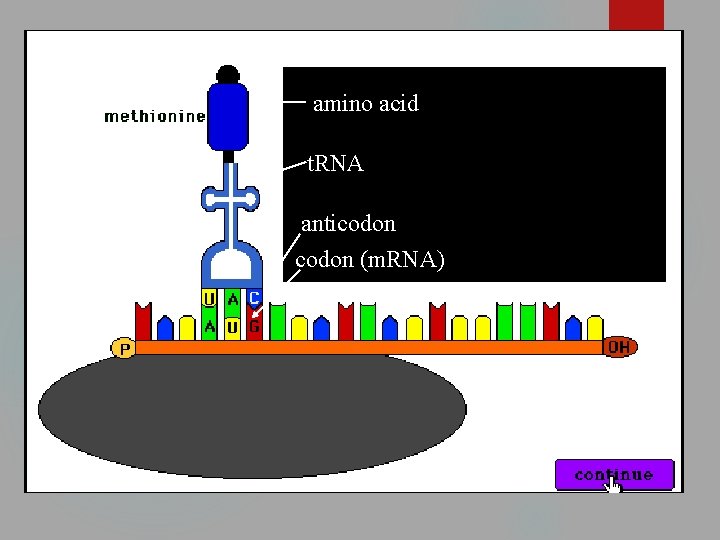
23 amino acid t. RNA anticodon (m. RNA)
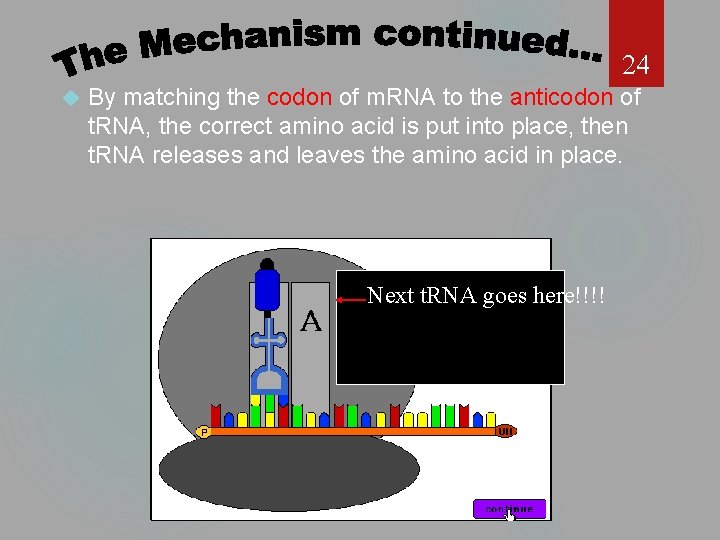
24 By matching the codon of m. RNA to the anticodon of t. RNA, the correct amino acid is put into place, then t. RNA releases and leaves the amino acid in place. Next t. RNA goes here!!!!
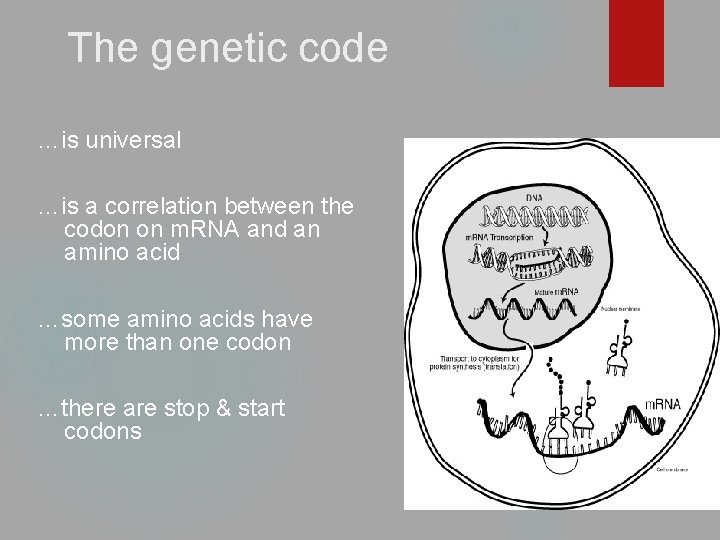
The genetic code …is universal …is a correlation between the codon on m. RNA and an amino acid …some amino acids have more than one codon …there are stop & start codons
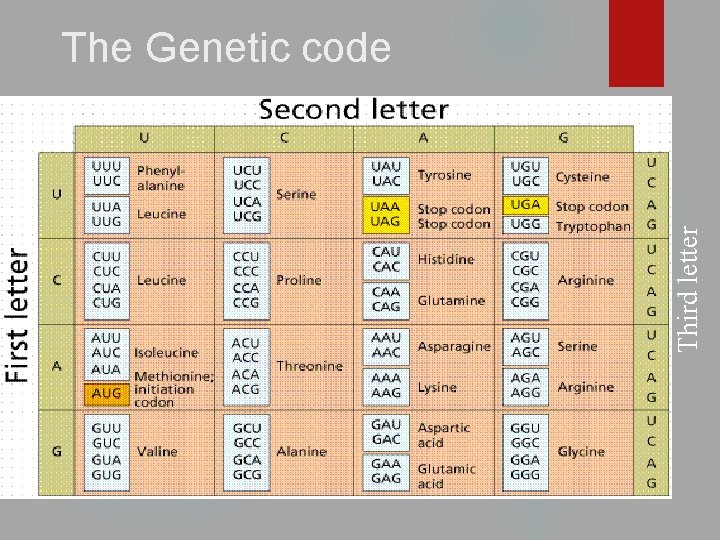
Third letter The Genetic code
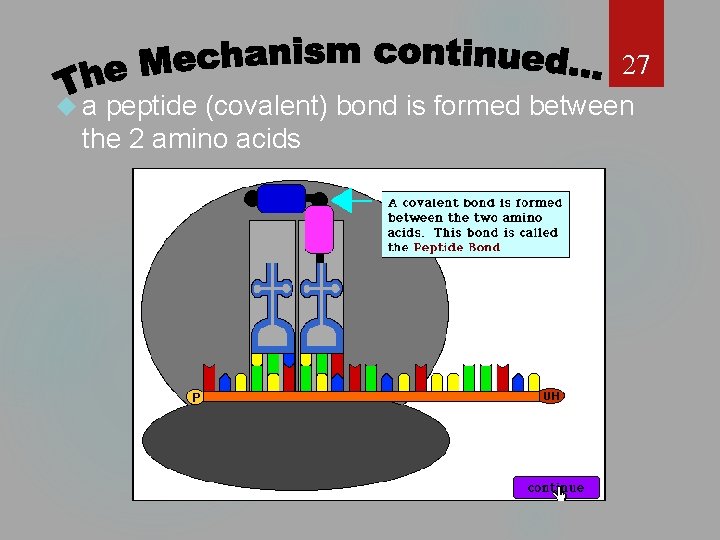
27 a peptide (covalent) bond is formed between the 2 amino acids
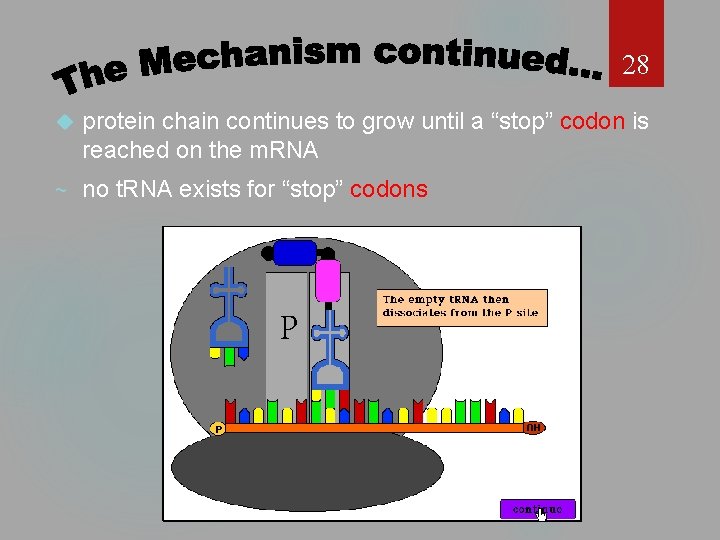
28 protein chain continues to grow until a “stop” codon is reached on the m. RNA ~ no t. RNA exists for “stop” codons
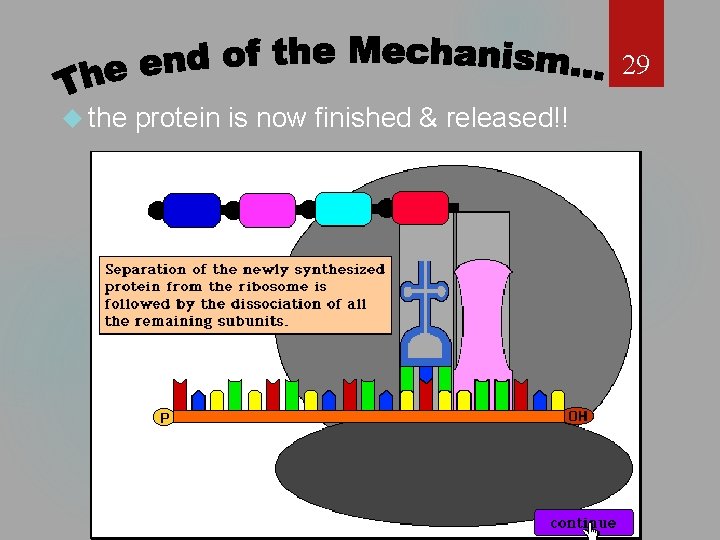
29 the protein is now finished & released!!
30
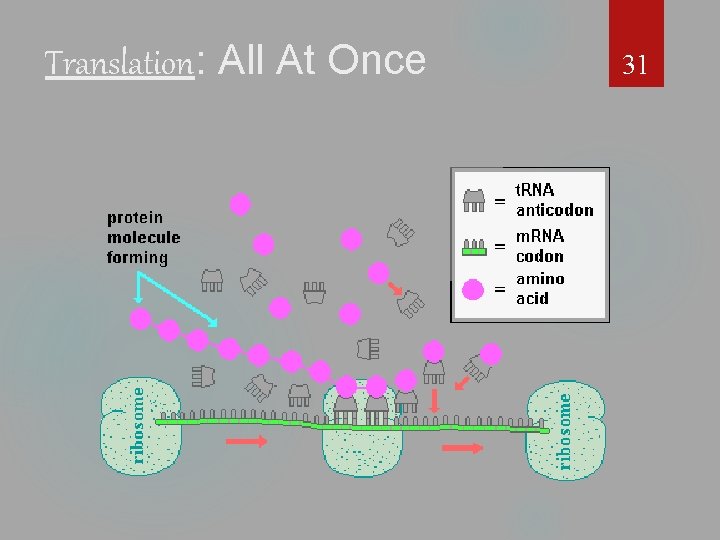
Translation: All At Once 31
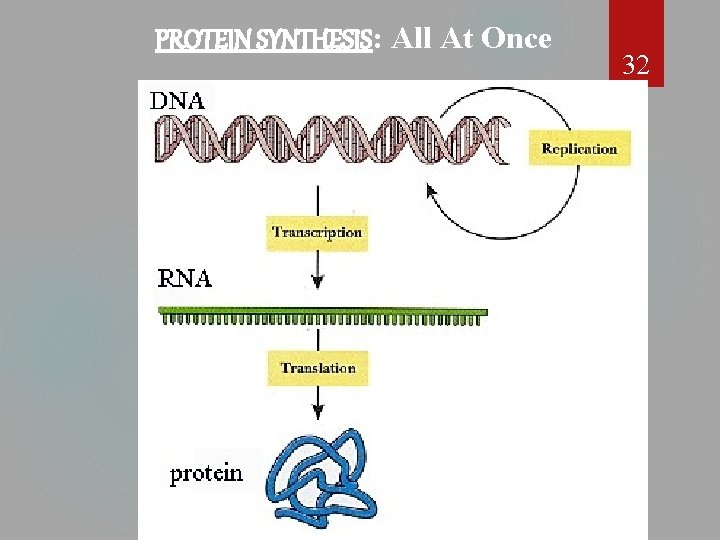
PROTEIN SYNTHESIS: All At Once 32
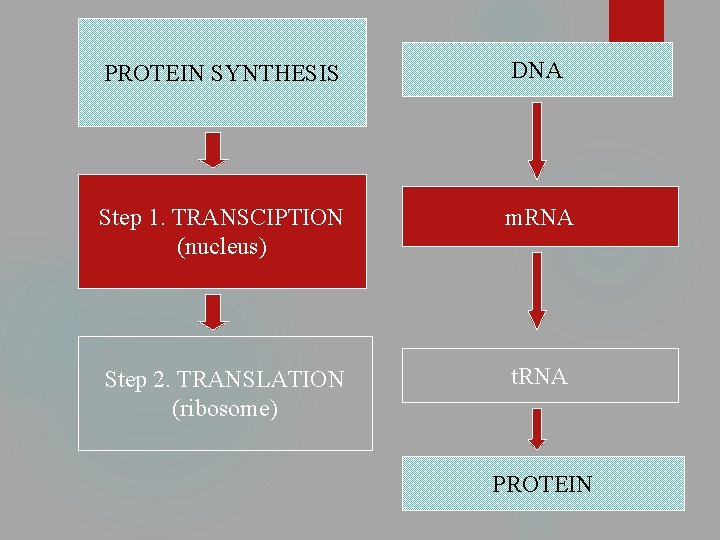
PROTEIN SYNTHESIS DNA Step 1. TRANSCIPTION (nucleus) m. RNA Step 2. TRANSLATION (ribosome) t. RNA PROTEIN 33
34
Review of Translation Purpose is to make bring amino acids to the ribosomes to make proteins. Translation occurs on the ribosomes as t. RNA delivers amino acids. This occurs as the anticodons on the t. RNA match up with the codons of the m. RNA. A start codon begins the process. Once the amino acids are delivered the t. RNA leaves and gathers more. The stop codon ends the process and the amino acid chain makes a protein.
- Slides: 35