
RNA Protein Synthesis Understanding the Code Agenda What



- Slides: 17
RNA & Protein Synthesis Understanding the Code
Agenda What are genes? What is RNA? Types of RNA Protein Synthesis (with guided practice) Transcription Translation Video of protein synthesis Understanding the Code (with guided practice) Lab: Modeling Protein Synthesis with Words
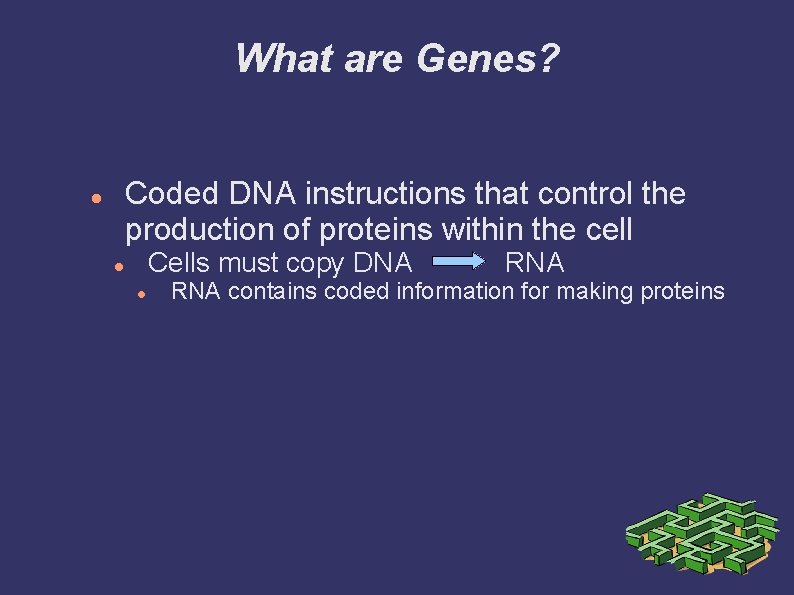
What are Genes? Coded DNA instructions that control the production of proteins within the cell Cells must copy DNA RNA contains coded information for making proteins
What is RNA? DNA = sugar (Deoxyribose), phosphate group and N base Double stranded C-G and A-T RNA = sugar (Ribose), phosphate group and N base Single stranded C-G and A-U (no T) Image from: http: //www. phschool. com/science/biology_place/biocoach/bioprop/ribose. html
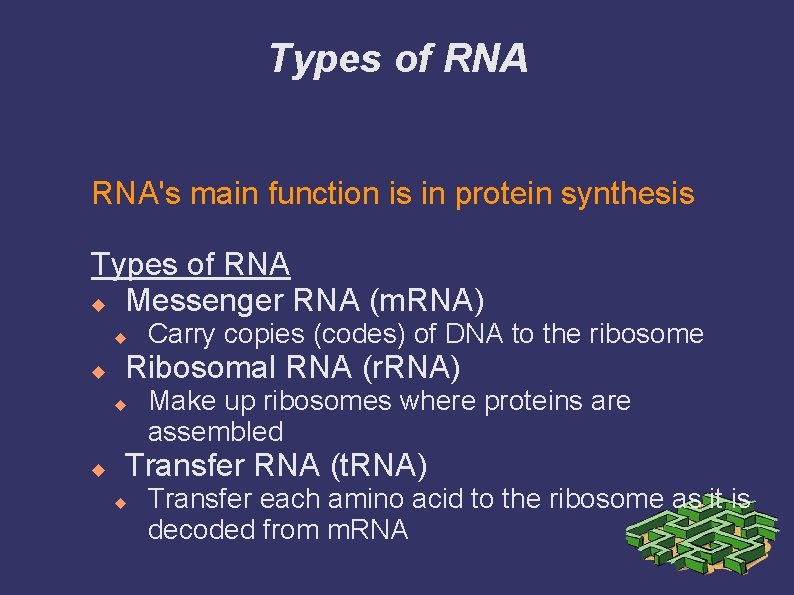
Types of RNA's main function is in protein synthesis Types of RNA Messenger RNA (m. RNA) Ribosomal RNA (r. RNA) Carry copies (codes) of DNA to the ribosome Make up ribosomes where proteins are assembled Transfer RNA (t. RNA) Transfer each amino acid to the ribosome as it is decoded from m. RNA
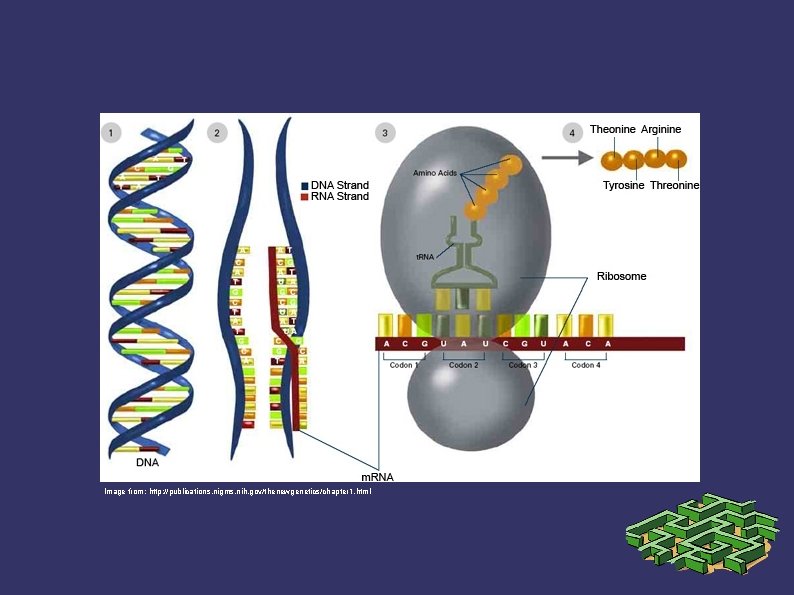
Image from: http: //publications. nigms. nih. gov/thenewgenetics/chapter 1. html
Protein Synthesis Consists of Transcription – the process of copying part of the DNA into a complementary sequence of RNA Translation – the decoding of an m. RNA message into a polypeptide chain (protein)
Transcription RNA polymerase transcribes DNA to make messenger RNA (m. RNA). RNA polymerase only binds to promoter regions RNA polymerase unzips the DNA strands and allows free nucleotides to bind The m. RNA sequence (dark red strand) is complementary to the DNA sequence (blue strand). m. RNA exits the nucleus and travels to the ribosomes to be “read”
Your Turn Using knowledge from our previous lesson on DNA replication, write this DNA sequence in your INBs and then replicate it 1. DNA: ATGAAAAACAAGGTACACATCTAG Now, transcribe this DNA into m. RNA (Remember C – G and A – U in RNA)
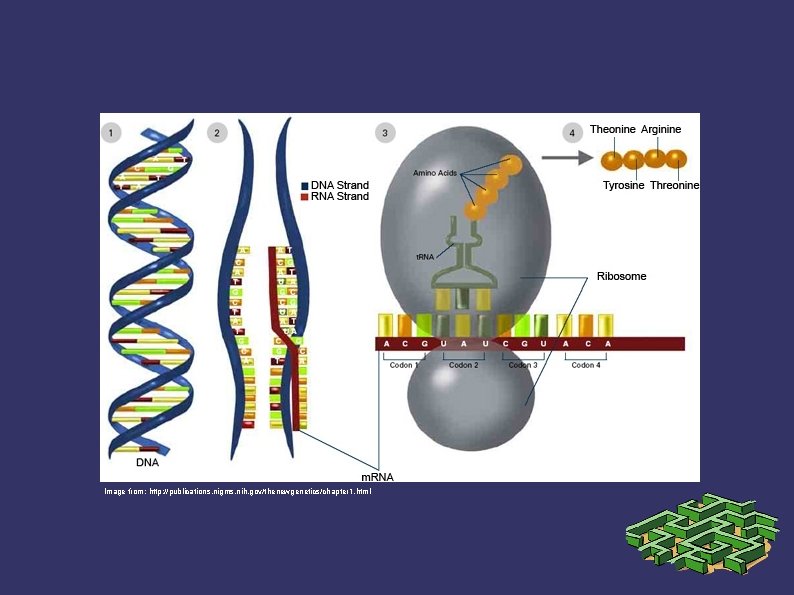
Translation m. RNA docks with a ribosome in the cytoplasm The codons are “read” and t. RNA brings the correct anticodon and corresponding amino acid Amino acids link up as they are brought Strands of amino acids = polypeptides (proteins) Process continues until a “stop” codon is reached Polypeptide is released
Image from: http: //publications. nigms. nih. gov/thenewgenetics/chapter 1. html
Your Turn Using the m. RNA you transcribed previously in your INBs 1. DNA: ATGAAAAACAAGGTACACATCTAG 2. m. RNA: UACUUUUUGUUCCAUGUGUAGAUC Now, translate this m. RNA into t. RNA (Remember it's still RNA so C – G and A – U)
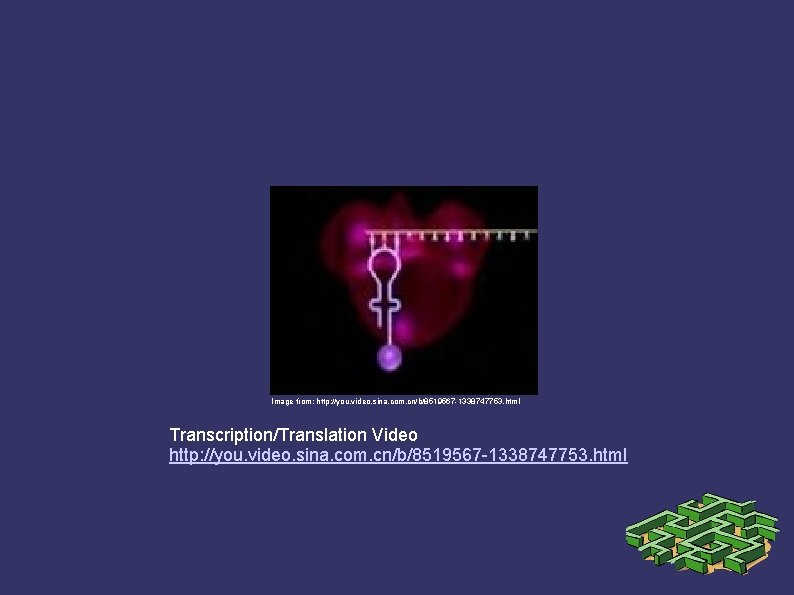
Image from: http: //you. video. sina. com. cn/b/8519567 -1338747753. html Transcription/Translation Video http: //you. video. sina. com. cn/b/8519567 -1338747753. html
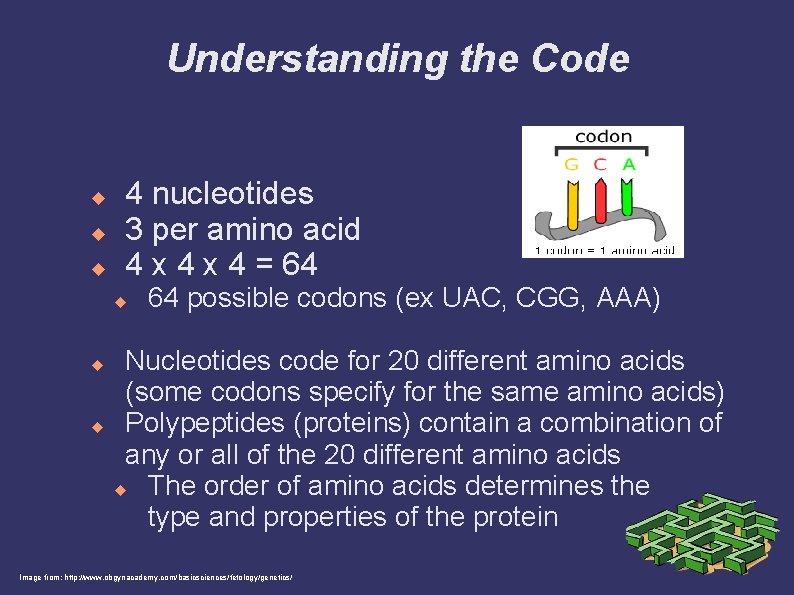
Understanding the Code 4 nucleotides 3 per amino acid 4 x 4 = 64 possible codons (ex UAC, CGG, AAA) Nucleotides code for 20 different amino acids (some codons specify for the same amino acids) Polypeptides (proteins) contain a combination of any or all of the 20 different amino acids The order of amino acids determines the type and properties of the protein Image from: http: //www. obgynacademy. com/basicsciences/fetology/genetics/
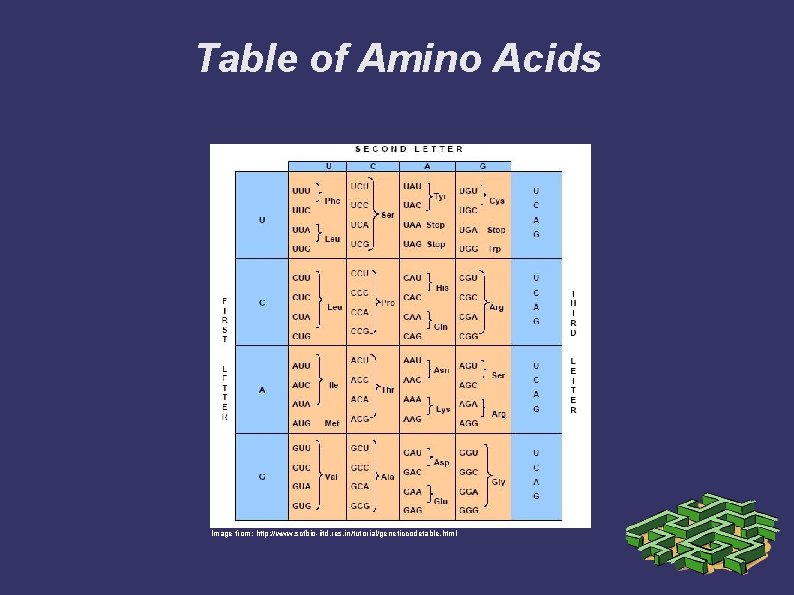
Table of Amino Acids Image from: http: //www. scfbio-iitd. res. in/tutorial/geneticcodetable. html
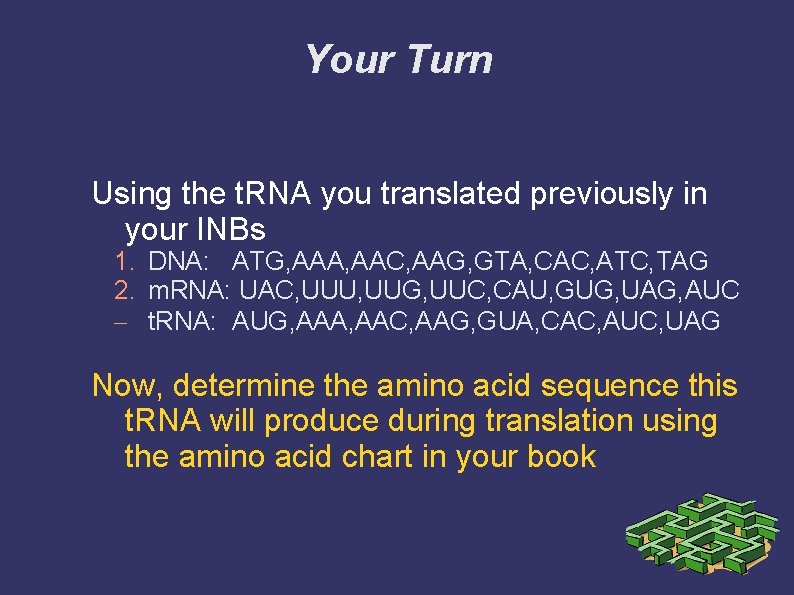
Your Turn Using the t. RNA you translated previously in your INBs 1. DNA: ATG, AAA, AAC, AAG, GTA, CAC, ATC, TAG 2. m. RNA: UAC, UUU, UUG, UUC, CAU, GUG, UAG, AUC – t. RNA: AUG, AAA, AAC, AAG, GUA, CAC, AUC, UAG Now, determine the amino acid sequence this t. RNA will produce during translation using the amino acid chart in your book
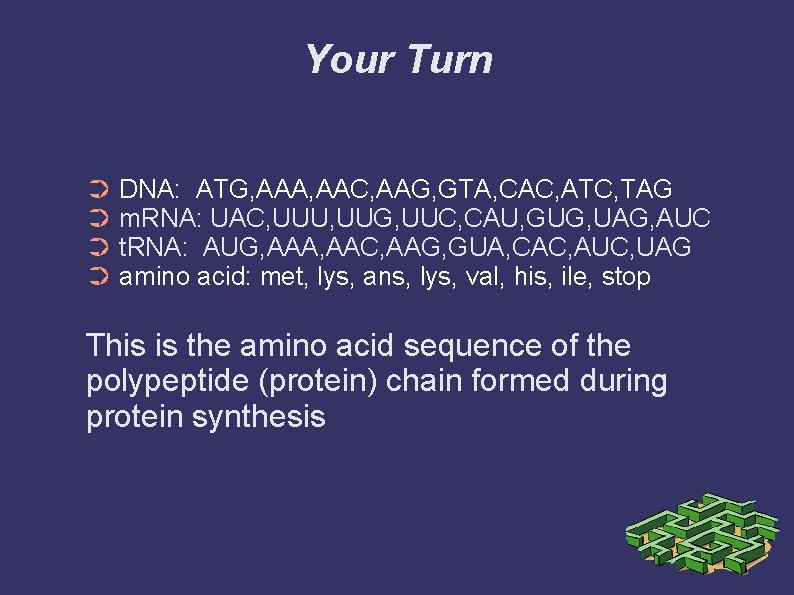
Your Turn ➲ DNA: ATG, AAA, AAC, AAG, GTA, CAC, ATC, TAG ➲ m. RNA: UAC, UUU, UUG, UUC, CAU, GUG, UAG, AUC ➲ t. RNA: AUG, AAA, AAC, AAG, GUA, CAC, AUC, UAG ➲ amino acid: met, lys, ans, lys, val, his, ile, stop This is the amino acid sequence of the polypeptide (protein) chain formed during protein synthesis