
RNA polymerase II The central enzyme of gene

- Slides: 48
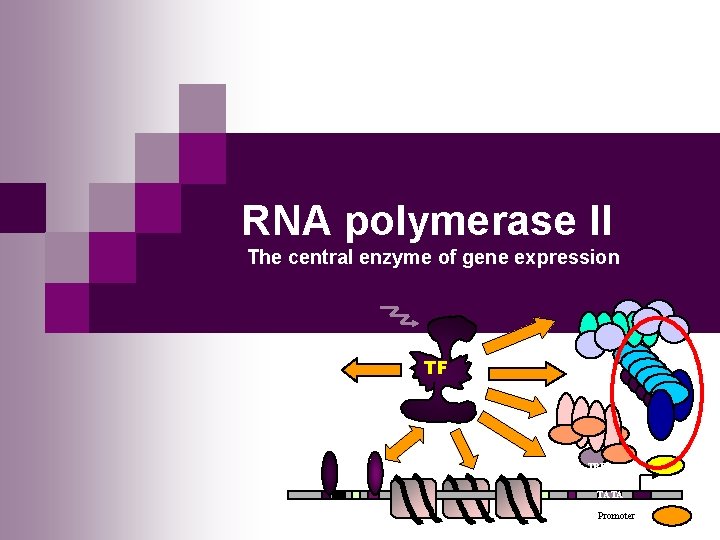
RNA polymerase II The central enzyme of gene expression TF TBP TATA Promoter
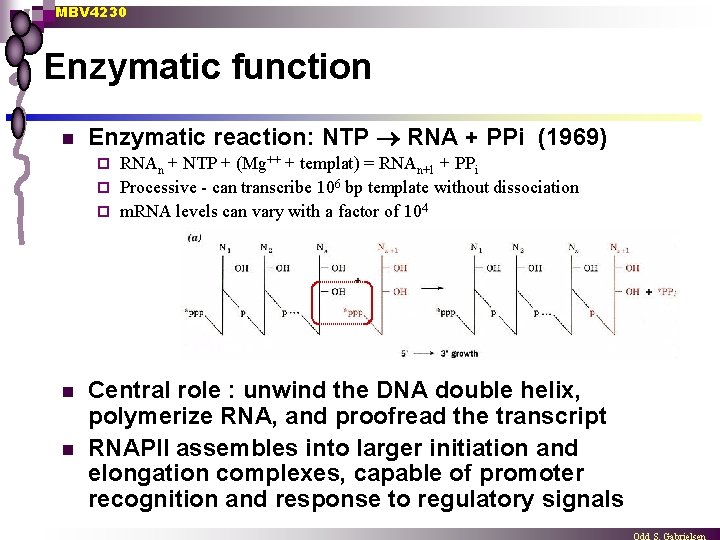
MBV 4230 Enzymatic function n Enzymatic reaction: NTP RNA + PPi (1969) RNAn + NTP + (Mg++ + templat) = RNAn+1 + PPi ¨ Processive - can transcribe 106 bp template without dissociation ¨ m. RNA levels can vary with a factor of 104 ¨ n n Central role : unwind the DNA double helix, polymerize RNA, and proofread the transcript RNAPII assembles into larger initiation and elongation complexes, capable of promoter recognition and response to regulatory signals
MBV 4230 Polymerization reaction n 1. Initiation PIC assembly (pre-initiation complex) ¨ Open complex formation ¨ Promoter clearance ¨ n 2. Elongation - transition to stable TEC ¨ n (transcription elongation complex) 3. Termination
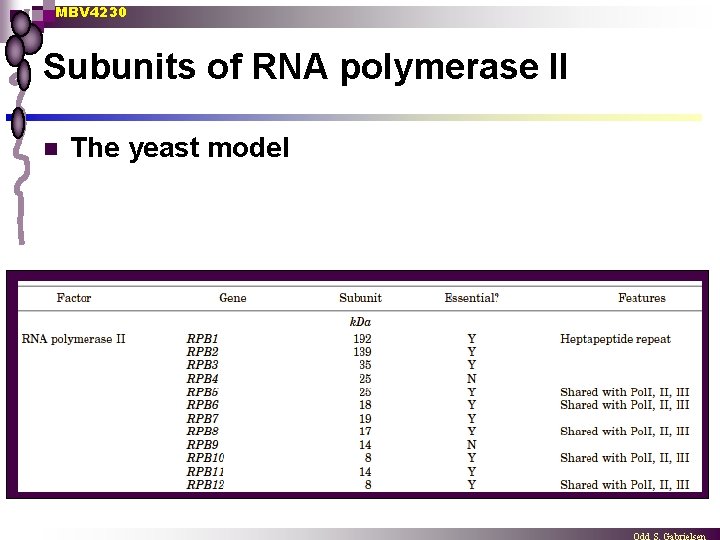
MBV 4230 Subunit structure n Composition and stochiometry ¨ ¨ ¨ n 12 polypeptides 2 large (220 and 150 k. Da) + 10 small (10 - 45 k. Da) Stoichiometry: 1, 2 and <1 Yeast: 10 essensial, 2 non-essensial Phosphorylated subunits: RPB 1 and RPB 6 Highly conserved between eukaryotes ¨ Several subunits in yeast RNAPII can be functionally exchanged with mammalian subunits
MBV 4230 Subunits of RNA polymerase II n The yeast model
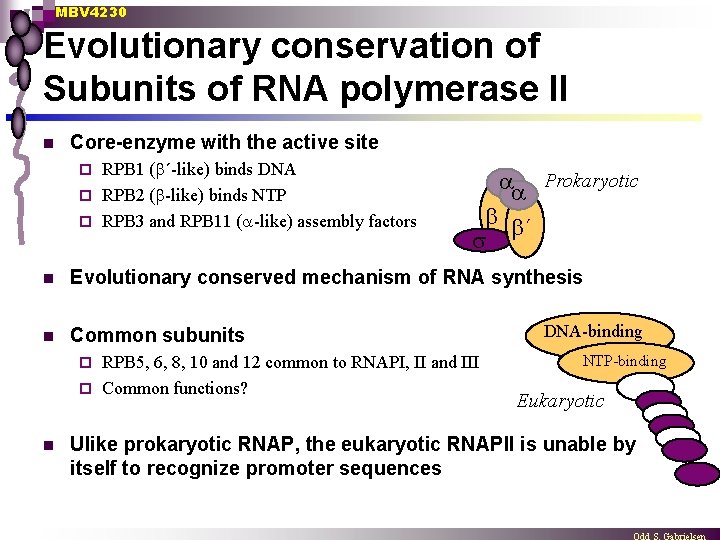
MBV 4230 Evolutionary conservation of Subunits of RNA polymerase II n Core-enzyme with the active site RPB 1 ( ´-like) binds DNA ¨ RPB 2 ( -like) binds NTP ¨ RPB 3 and RPB 11 ( -like) assembly factors ¨ Prokaryotic ´ n Evolutionary conserved mechanism of RNA synthesis n Common subunits RPB 5, 6, 8, 10 and 12 common to RNAPI, II and III ¨ Common functions? ¨ n DNA-binding NTP-binding Eukaryotic Ulike prokaryotic RNAP, the eukaryotic RNAPII is unable by itself to recognize promoter sequences
3 D structure of RNAPII
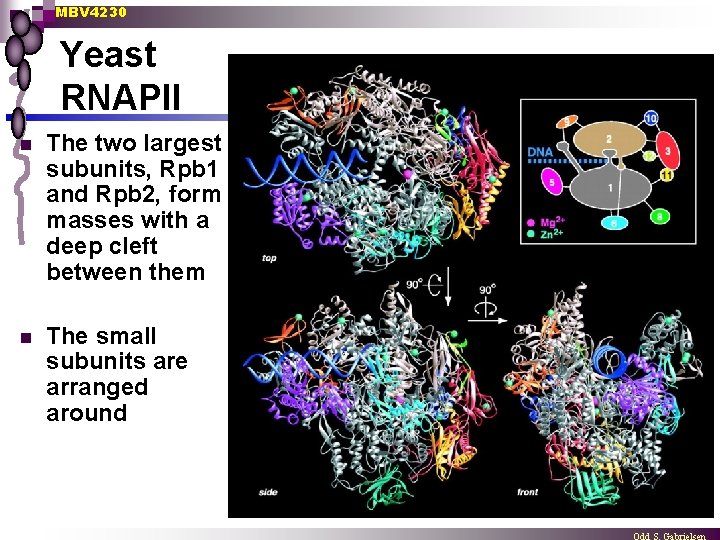
MBV 4230 Yeast RNAPII n The two largest subunits, Rpb 1 and Rpb 2, form masses with a deep cleft between them n The small subunits are arranged around
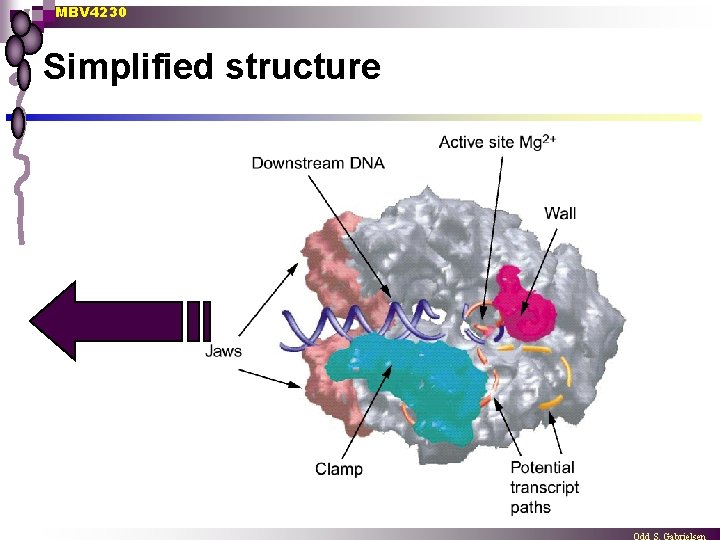
MBV 4230 Simplified structure
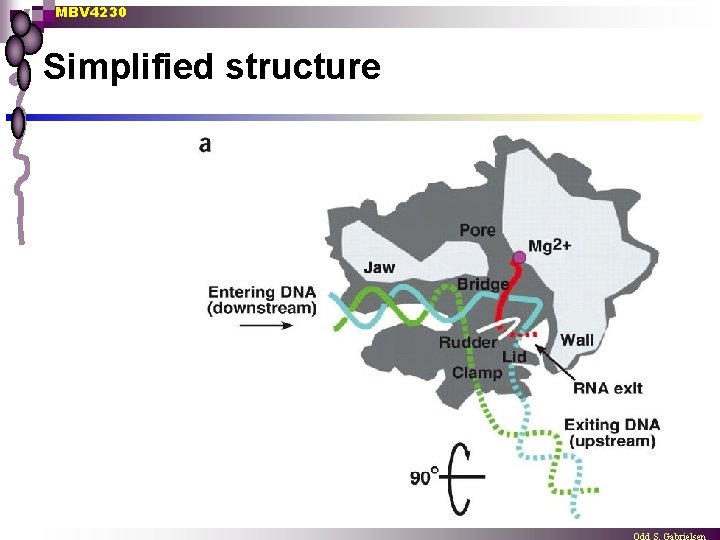
MBV 4230 Simplified structure
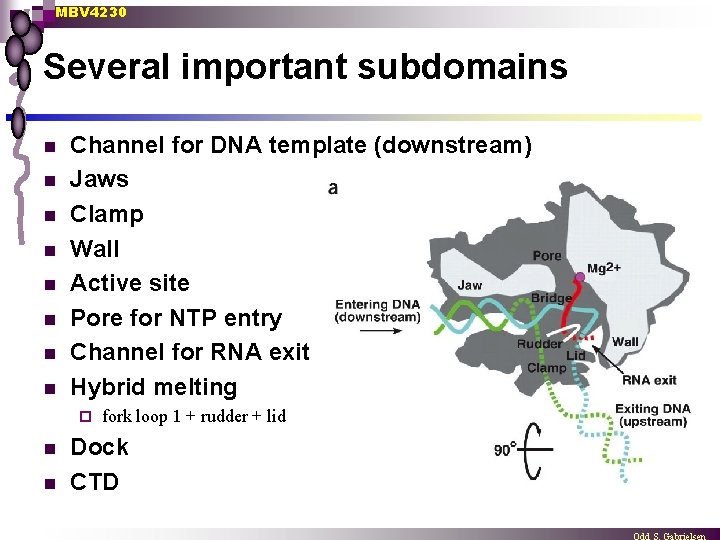
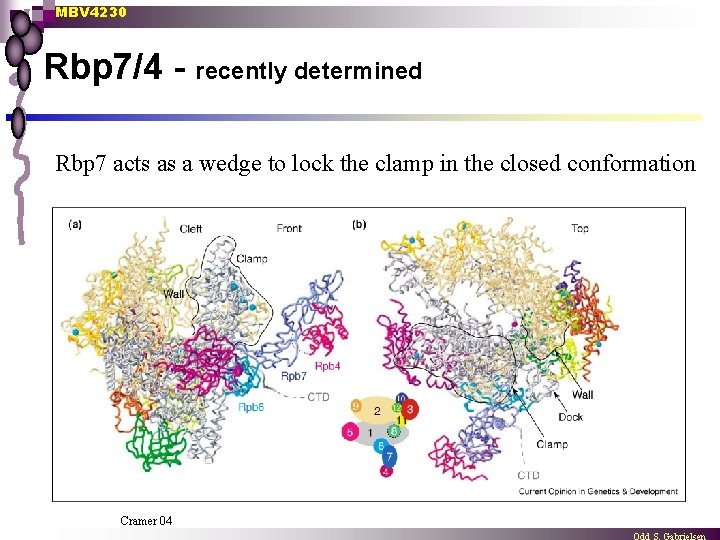
MBV 4230 Several important subdomains n n n n Channel for DNA template (downstream) Jaws Clamp Wall Active site Pore for NTP entry Channel for RNA exit Hybrid melting ¨ n n fork loop 1 + rudder + lid Dock CTD
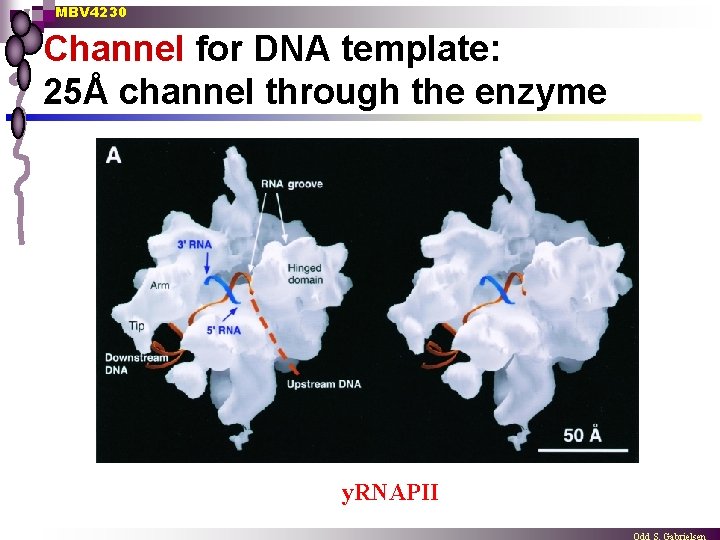
MBV 4230 Channel for DNA template: 25Å channel through the enzyme y. RNAPII
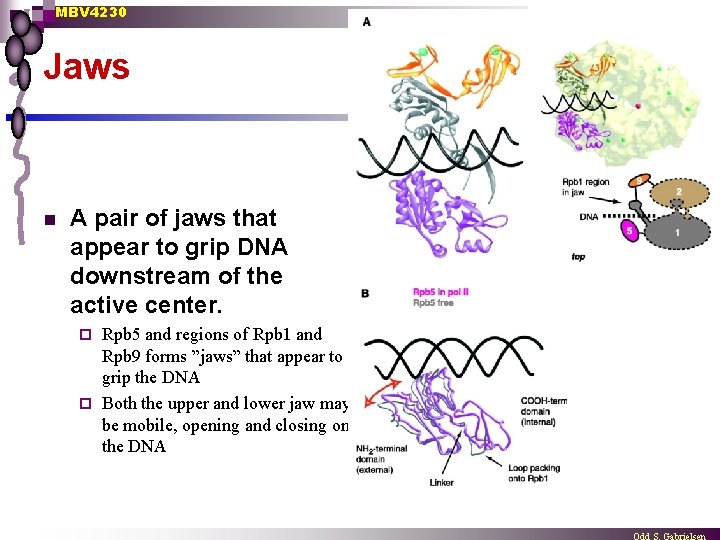
MBV 4230 Jaws n A pair of jaws that appear to grip DNA downstream of the active center. Rpb 5 and regions of Rpb 1 and Rpb 9 forms ”jaws” that appear to grip the DNA ¨ Both the upper and lower jaw may be mobile, opening and closing on the DNA ¨
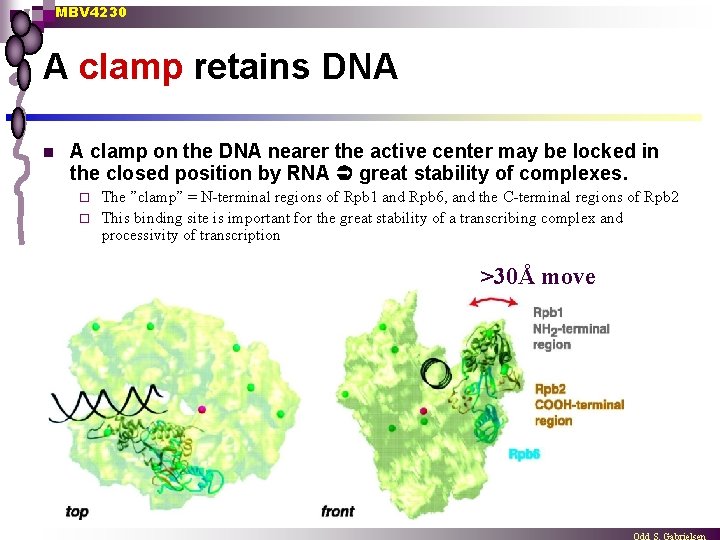
MBV 4230 A clamp retains DNA n A clamp on the DNA nearer the active center may be locked in the closed position by RNA great stability of complexes. The ”clamp” = N-terminal regions of Rpb 1 and Rpb 6, and the C-terminal regions of Rpb 2 ¨ This binding site is important for the great stability of a transcribing complex and processivity of transcription ¨ >30Å move
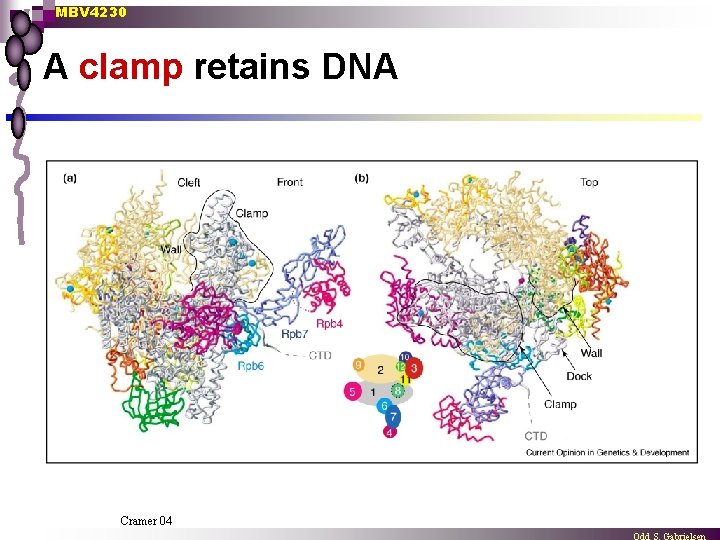
MBV 4230 A clamp retains DNA Cramer 04
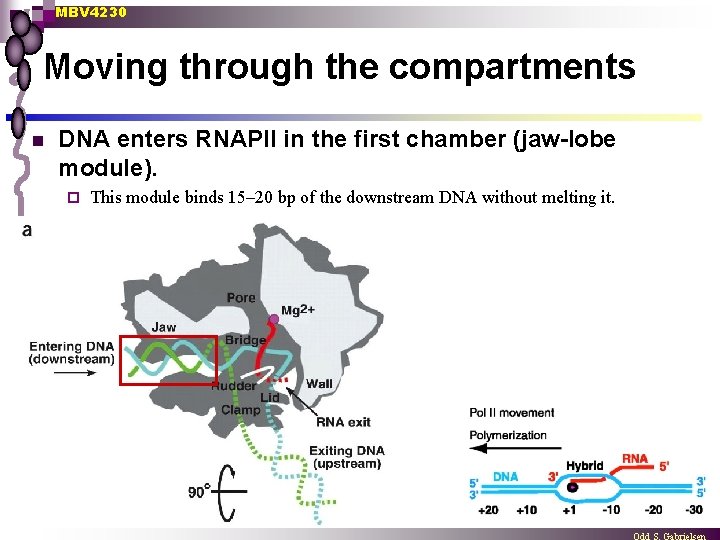
MBV 4230 Moving through the compartments n DNA enters RNAPII in the first chamber (jaw-lobe module). ¨ This module binds 15– 20 bp of the downstream DNA without melting it.
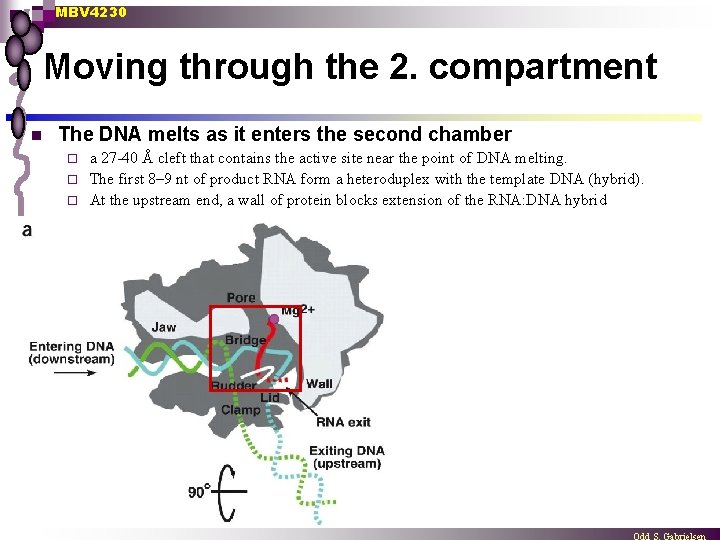
MBV 4230 Moving through the 2. compartment n The DNA melts as it enters the second chamber a 27 -40 Å cleft that contains the active site near the point of DNA melting. ¨ The first 8– 9 nt of product RNA form a heteroduplex with the template DNA (hybrid). ¨ At the upstream end, a wall of protein blocks extension of the RNA: DNA hybrid ¨
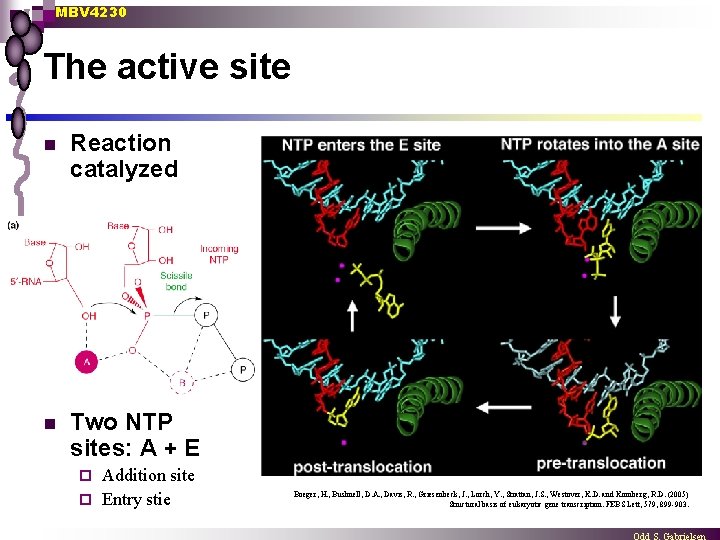
MBV 4230 The active site n Reaction catalyzed n Two NTP sites: A + E Addition site ¨ Entry stie ¨ Boeger, H. , Bushnell, D. A. , Davis, R. , Griesenbeck, J. , Lorch, Y. , Strattan, J. S. , Westover, K. D. and Kornberg, R. D. (2005) Structural basis of eukaryotic gene transcription. FEBS Lett, 579, 899 -903.
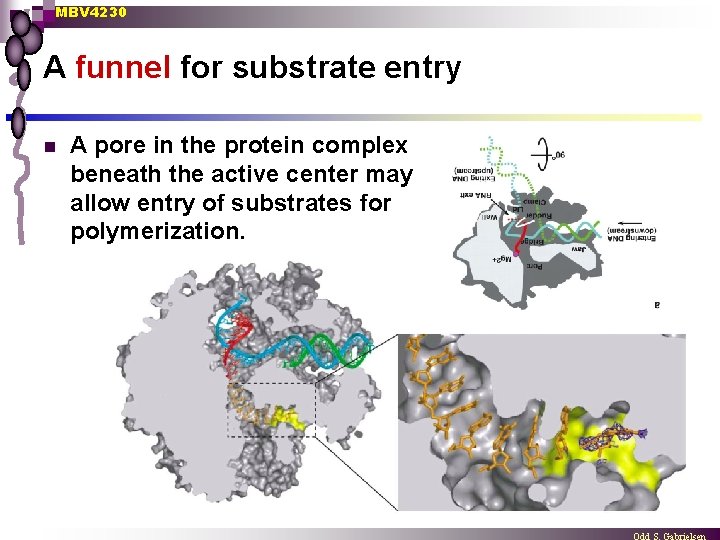
MBV 4230 A funnel for substrate entry n A pore in the protein complex beneath the active center may allow entry of substrates for polymerization.
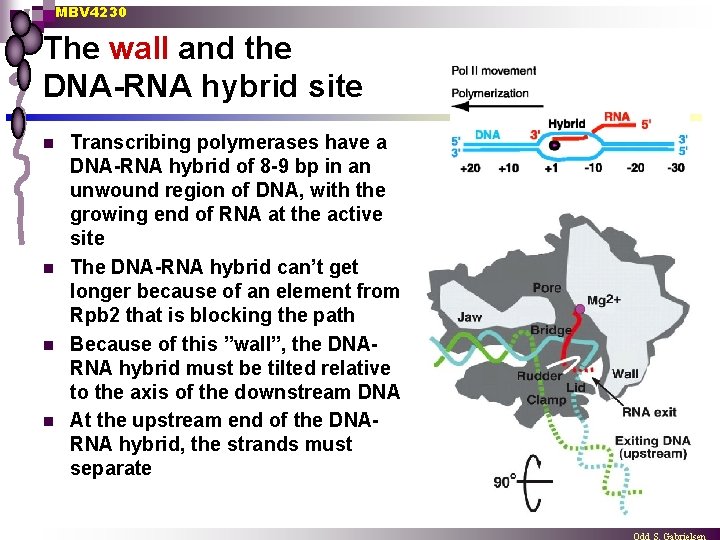
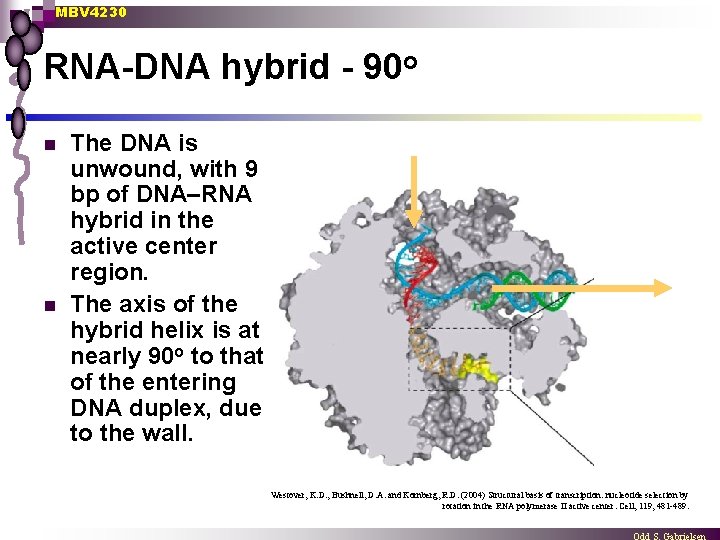
MBV 4230 The wall and the DNA-RNA hybrid site n n Transcribing polymerases have a DNA-RNA hybrid of 8 -9 bp in an unwound region of DNA, with the growing end of RNA at the active site The DNA-RNA hybrid can’t get longer because of an element from Rpb 2 that is blocking the path Because of this ”wall”, the DNARNA hybrid must be tilted relative to the axis of the downstream DNA At the upstream end of the DNARNA hybrid, the strands must separate
MBV 4230 RNA-DNA hybrid - 90 o n n The DNA is unwound, with 9 bp of DNA–RNA hybrid in the active center region. The axis of the hybrid helix is at nearly 90 o to that of the entering DNA duplex, due to the wall. Westover, K. D. , Bushnell, D. A. and Kornberg, R. D. (2004) Structural basis of transcription: nucleotide selection by rotation in the RNA polymerase II active center. Cell, 119, 481 -489.
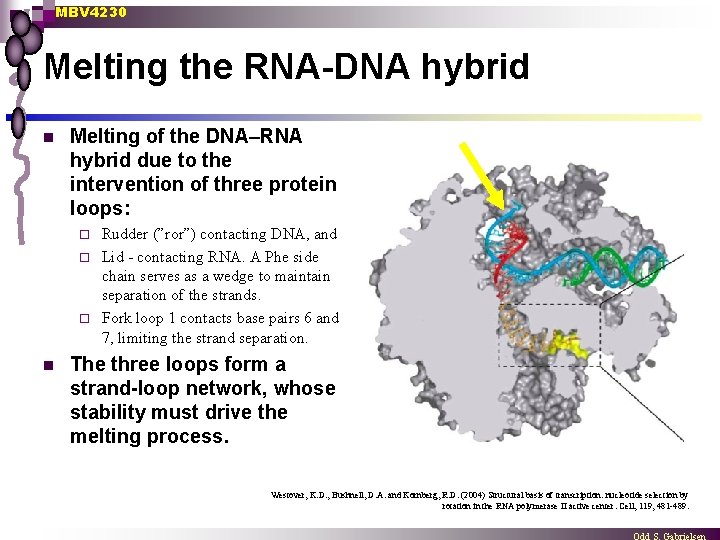
MBV 4230 Melting the RNA-DNA hybrid n Melting of the DNA–RNA hybrid due to the intervention of three protein loops: Rudder (”ror”) contacting DNA, and ¨ Lid - contacting RNA. A Phe side chain serves as a wedge to maintain separation of the strands. ¨ Fork loop 1 contacts base pairs 6 and 7, limiting the strand separation. ¨ n The three loops form a strand-loop network, whose stability must drive the melting process. Westover, K. D. , Bushnell, D. A. and Kornberg, R. D. (2004) Structural basis of transcription: nucleotide selection by rotation in the RNA polymerase II active center. Cell, 119, 481 -489.
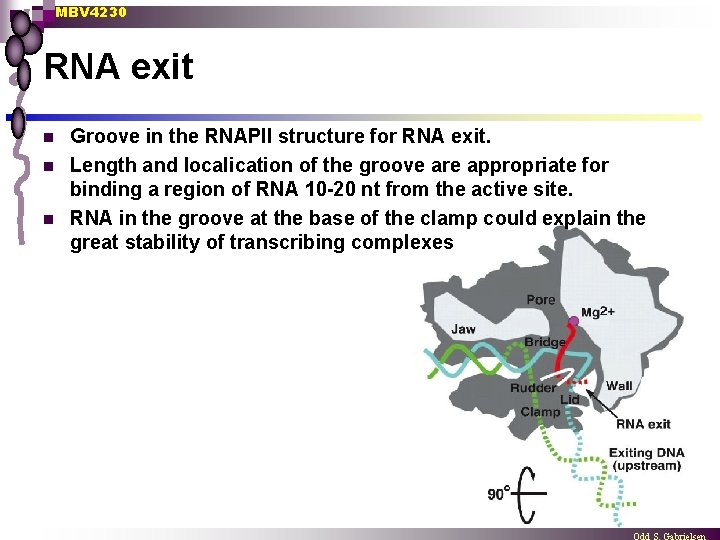
MBV 4230 RNA exit n n n Groove in the RNAPII structure for RNA exit. Length and localication of the groove are appropriate for binding a region of RNA 10 -20 nt from the active site. RNA in the groove at the base of the clamp could explain the great stability of transcribing complexes
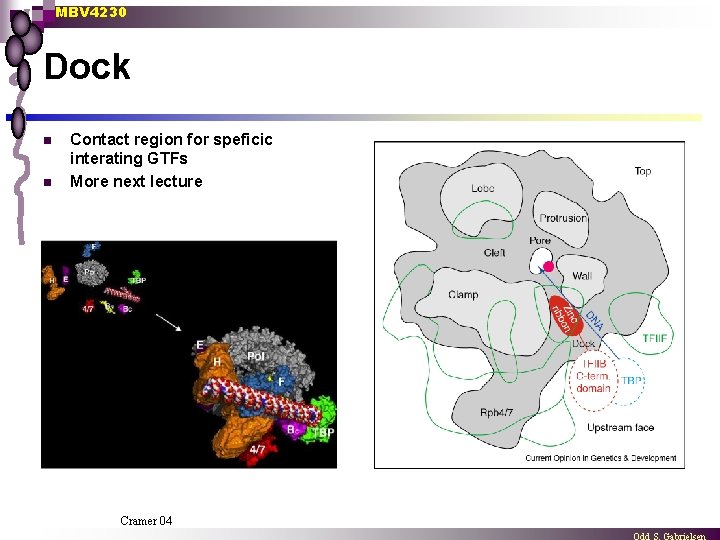
MBV 4230 Dock n n Contact region for speficic interating GTFs More next lecture Cramer 04
MBV 4230 Rbp 7/4 - recently determined Rbp 7 acts as a wedge to lock the clamp in the closed conformation Cramer 04
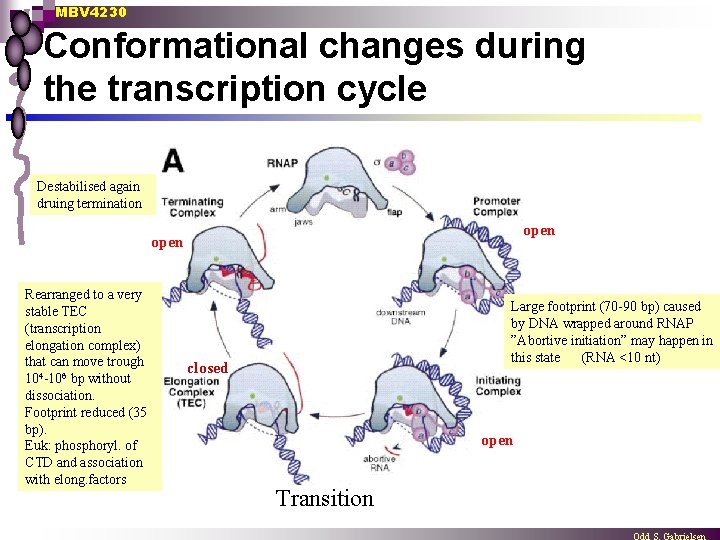
MBV 4230 Opening and closing of RNAPII n Open RNAP during formation of PIC moderate stability ¨ Extended footprint - DNA folded around the enzyme ¨ Strand separation and placement of template in active site, transcription bubble ¨ ”Abortive initiation” (RNA up to 10 nt) without structural change ¨ n RNAP closes during promoter clearance and transition to TEC contacts to PIC are disrupted and new contacts with elongation factors formed ¨ CTD is phosphorylated (more later) ¨ Conformational change to a ternary complex of high stability ¨ Closed chanel around the DNA-RNA hybrid in the active site ¨ n RNAP opens and becomes destabilised during termination Reversal of the structural changes - opening and destabilization ¨ Prokaryot: RNA-hairpin opens RNA exit - destabilization buble - AU-rich dissociation ¨
MBV 4230 Conformational changes during the transcription cycle Destabilised again druing termination open Rearranged to a very stable TEC (transcription elongation complex) that can move trough 104 -106 bp without dissociation. Footprint reduced (35 bp). Euk: phosphoryl. of CTD and association with elong. factors Large footprint (70 -90 bp) caused by DNA wrapped around RNAP ”Abortive initiation” may happen in this state (RNA <10 nt) closed open Transition
CTD
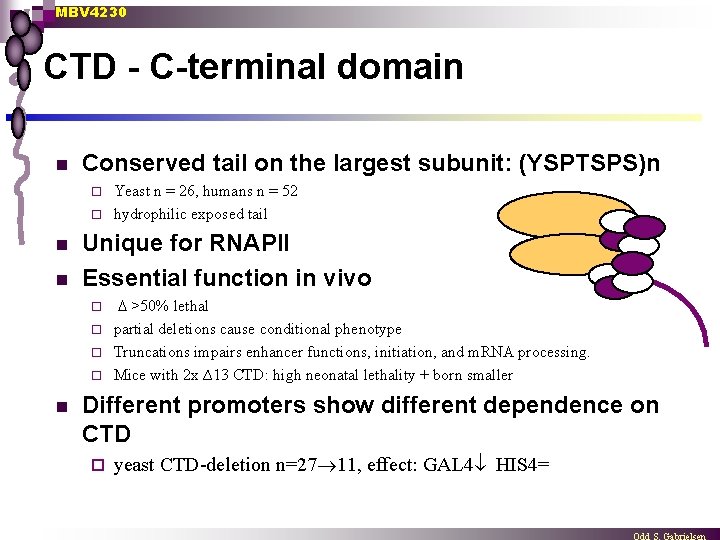
MBV 4230 CTD - C-terminal domain n Conserved tail on the largest subunit: (YSPTSPS)n Yeast n = 26, humans n = 52 ¨ hydrophilic exposed tail ¨ n n Unique for RNAPII Essential function in vivo >50% lethal ¨ partial deletions cause conditional phenotype ¨ Truncations impairs enhancer functions, initiation, and m. RNA processing. ¨ Mice with 2 x ∆13 CTD: high neonatal lethality + born smaller ¨ n Different promoters show different dependence on CTD ¨ yeast CTD-deletion n=27 11, effect: GAL 4 HIS 4=
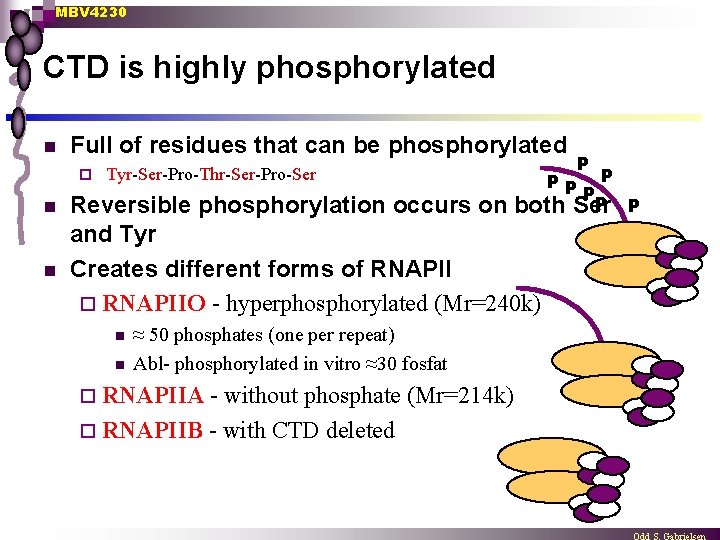
MBV 4230 CTD is highly phosphorylated n Full of residues that can be phosphorylated ¨ n n Tyr-Ser-Pro-Thr-Ser-Pro-Ser P PP P P both Ser Reversible phosphorylation occurs on and Tyr Creates different forms of RNAPII ¨ RNAPIIO - hyperphosphorylated (Mr=240 k) n n ≈ 50 phosphates (one per repeat) Abl- phosphorylated in vitro ≈30 fosfat ¨ RNAPIIA - without phosphate (Mr=214 k) ¨ RNAPIIB - with CTD deleted
MBV 4230 CTDs phosphorylation changes during the transcription cycle n Function of RNAPIIA ≠ RNAPIIO PIC assembly: only non-phosphorylated RNAPIIA ¨ Elongation complex: only hyperphosphorylated RNAPIIO ¨ n Phosphorylation status changes during the transcription cycles Phosphorylation occurs after PIC assembly ¨ dephosphorylation - on free polymerase or upon termination ¨
MBV 4230 CTD-phosphorylation changes during the transcription cycle
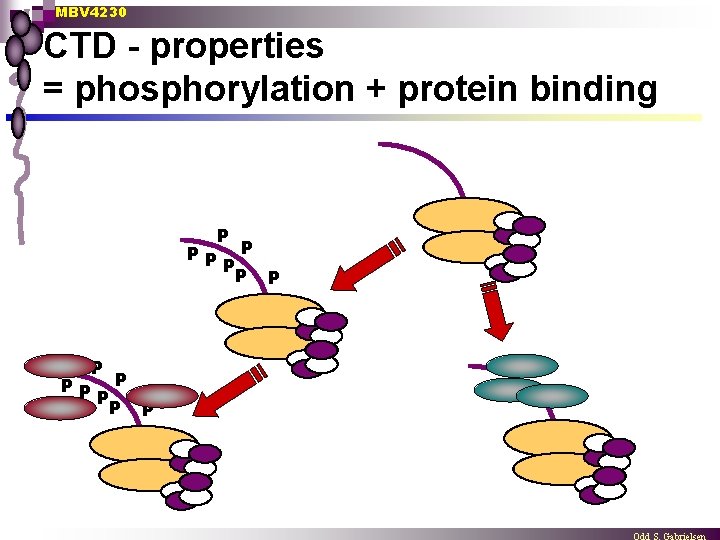
MBV 4230 CTD - properties = phosphorylation + protein binding P PP P P P P
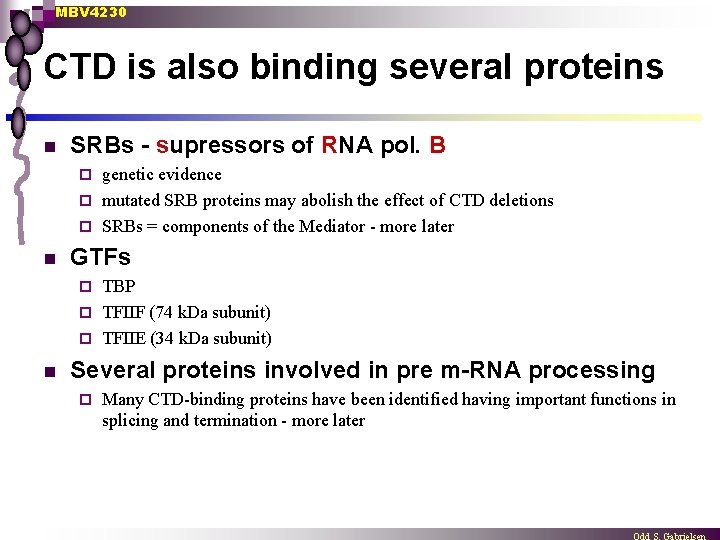
MBV 4230 CTD is also binding several proteins n SRBs - supressors of RNA pol. B genetic evidence ¨ mutated SRB proteins may abolish the effect of CTD deletions ¨ SRBs = components of the Mediator - more later ¨ n GTFs TBP ¨ TFIIF (74 k. Da subunit) ¨ TFIIE (34 k. Da subunit) ¨ n Several proteins involved in pre m-RNA processing ¨ Many CTD-binding proteins have been identified having important functions in splicing and termination - more later
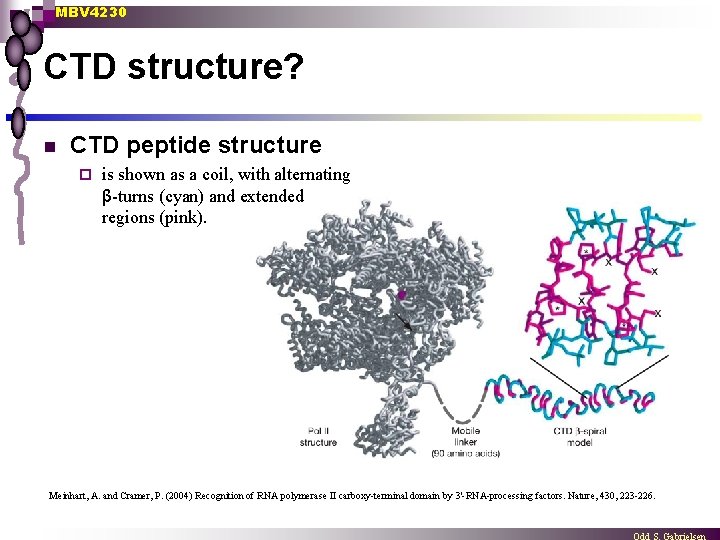
MBV 4230 CTD structure? n CTD peptide structure ¨ is shown as a coil, with alternating β-turns (cyan) and extended regions (pink). Meinhart, A. and Cramer, P. (2004) Recognition of RNA polymerase II carboxy-terminal domain by 3'-RNA-processing factors. Nature, 430, 223 -226.
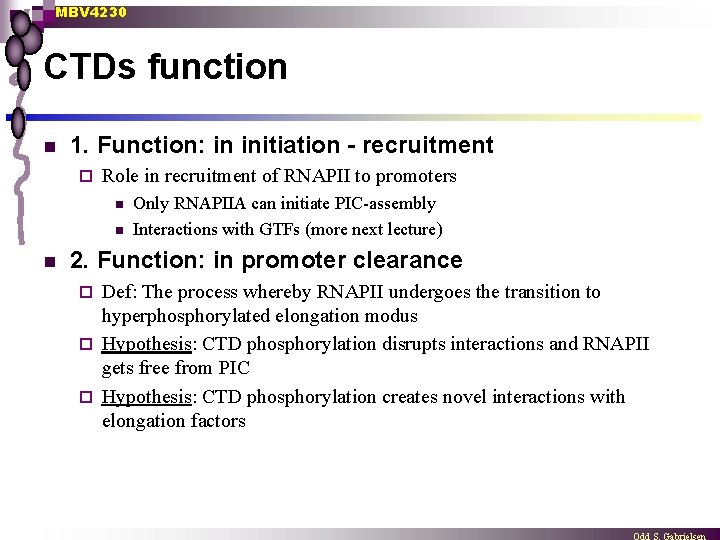
MBV 4230 CTDs function n 1. Function: in initiation - recruitment ¨ Role in recruitment of RNAPII to promoters n n n Only RNAPIIA can initiate PIC-assembly Interactions with GTFs (more next lecture) 2. Function: in promoter clearance Def: The process whereby RNAPII undergoes the transition to hyperphosphorylated elongation modus ¨ Hypothesis: CTD phosphorylation disrupts interactions and RNAPII gets free from PIC ¨ Hypothesis: CTD phosphorylation creates novel interactions with elongation factors ¨
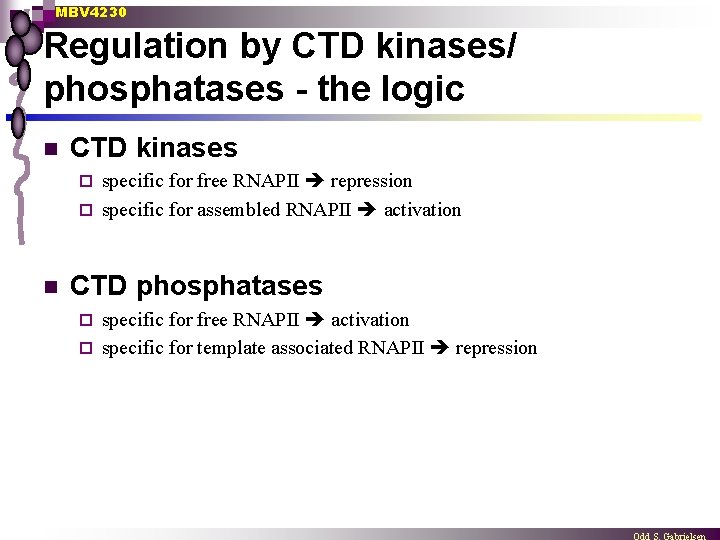
MBV 4230 Regulation by CTD kinases/ phosphatases - the logic n CTD kinases specific for free RNAPII repression ¨ specific for assembled RNAPII activation ¨ n CTD phosphatases specific for free RNAPII activation ¨ specific for template associated RNAPII repression ¨
MBV 4230 Regulated CTD-phosphorylation
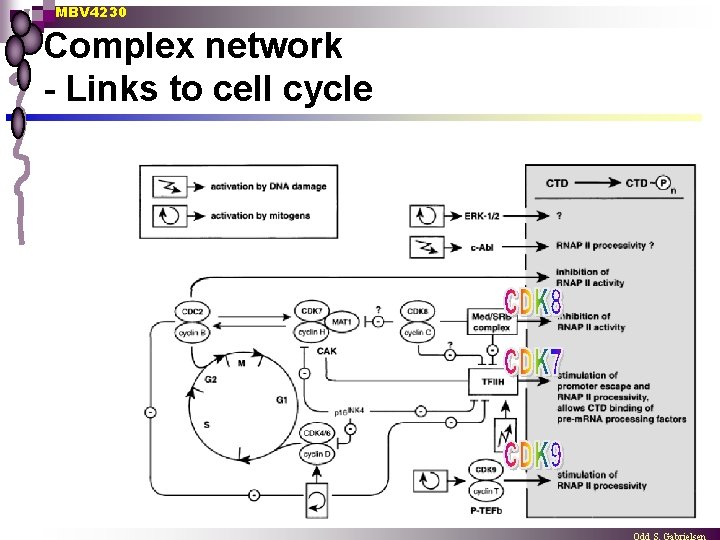
MBV 4230 CTD kinases n Several CTD-kinases = Cdk´s ¨ Four of the putative CTD kinases are members of the cyclin-dependent kinase (CDK)/cyclin family whose members consist of a catalytic subunit bound to a regulatory cyclin subunit.
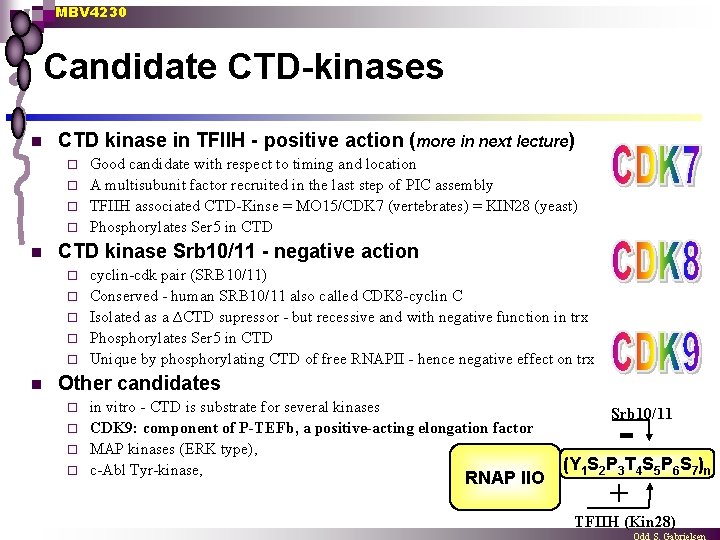
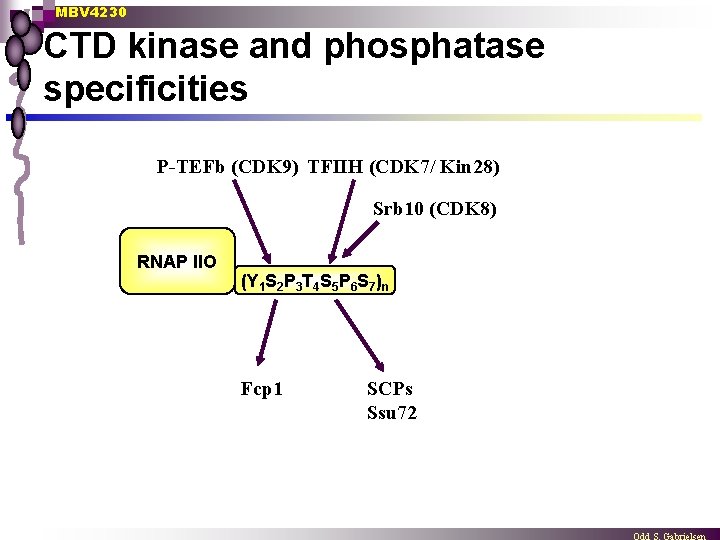
MBV 4230 Candidate CTD-kinases n CTD kinase in TFIIH - positive action (more in next lecture) Good candidate with respect to timing and location ¨ A multisubunit factor recruited in the last step of PIC assembly ¨ TFIIH associated CTD-Kinse = MO 15/CDK 7 (vertebrates) = KIN 28 (yeast) ¨ Phosphorylates Ser 5 in CTD ¨ n CTD kinase Srb 10/11 - negative action ¨ ¨ ¨ n cyclin-cdk pair (SRB 10/11) Conserved - human SRB 10/11 also called CDK 8 -cyclin C Isolated as a ∆CTD supressor - but recessive and with negative function in trx Phosphorylates Ser 5 in CTD Unique by phosphorylating CTD of free RNAPII - hence negative effect on trx Other candidates in vitro - CTD is substrate for several kinases ¨ CDK 9: component of P-TEFb, a positive-acting elongation factor ¨ MAP kinases (ERK type), ¨ c-Abl Tyr-kinase, ¨ RNAP IIO Srb 10/11 - (Y 1 S 2 P 3 T 4 S 5 P 6 S 7)n + TFIIH (Kin 28)
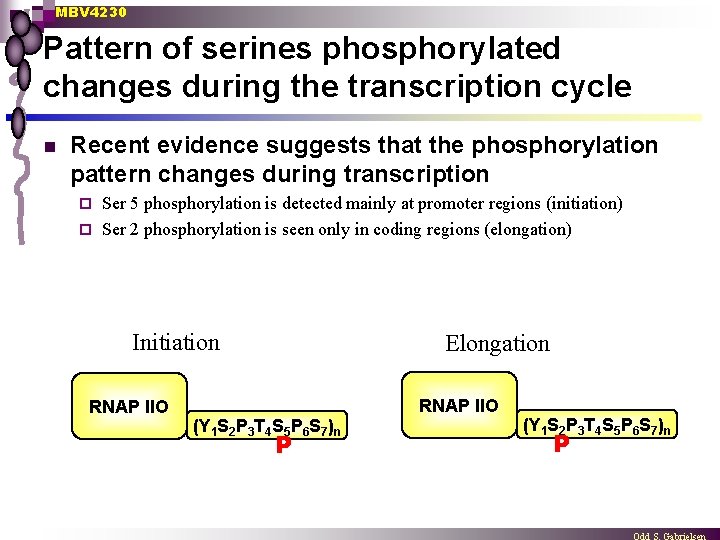
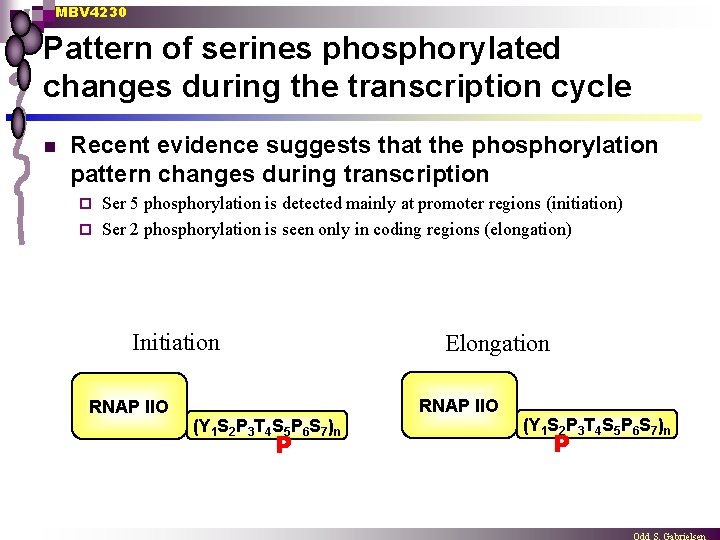
MBV 4230 Pattern of serines phosphorylated changes during the transcription cycle n Recent evidence suggests that the phosphorylation pattern changes during transcription Ser 5 phosphorylation is detected mainly at promoter regions (initiation) ¨ Ser 2 phosphorylation is seen only in coding regions (elongation) ¨ Initiation RNAP IIO Elongation (Y 1 S 2 P 3 T 4 S 5 P 6 S 7)n P RNAP IIO (Y 1 S 2 P 3 T 4 S 5 P 6 S 7)n P
MBV 4230 Pattern of serines phosphorylated changes during the transcription cycle n Recent evidence suggests that the phosphorylation pattern changes during transcription Ser 5 phosphorylation is detected mainly at promoter regions (initiation) ¨ Ser 2 phosphorylation is seen only in coding regions (elongation) ¨ Initiation RNAP IIO Elongation (Y 1 S 2 P 3 T 4 S 5 P 6 S 7)n P RNAP IIO (Y 1 S 2 P 3 T 4 S 5 P 6 S 7)n P
MBV 4230 May different promoters recruit different CTDK? n Evidence for distinct phosphorylated forms Both Ser and Tyr phosphorylated - different kinases ¨ Several activities in vitro ¨ CTK 1 disruption in yeast reduces but don’t abolish CTD phosphorylation ¨ n n If different CTDKs are recruited at different promoters promoter-imprinting ! Multiple CTD kinases may be caused by redundancy ¨ different promoters recruit different kinases ¨ different timing / cell cycle ¨ different subcellular localization ¨
MBV 4230 Complex network - Links to cell cycle
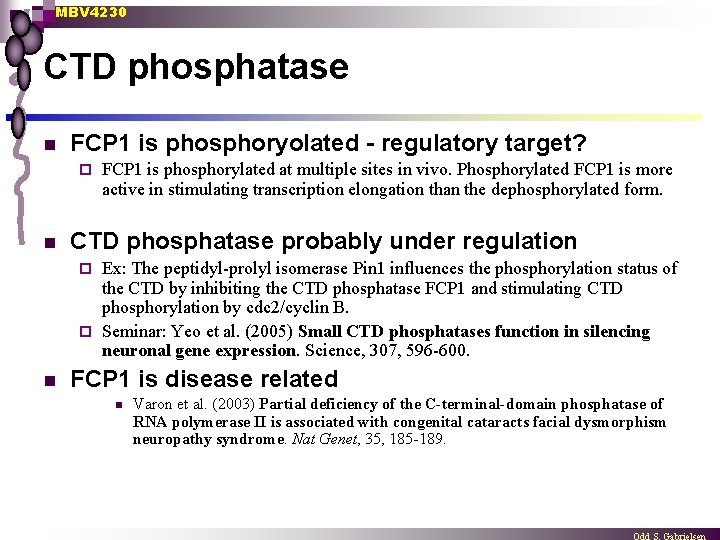
MBV 4230 CTD phosphatases n First CTD phosphatase characterized = FCP 1 Fcp 1 p is necessary for CTD dephosphorylation in vivo ¨ yeast cells with temperature-sensitive mutations have severe defects in poly(A)+ m. RNA synthesis at the nonpermissive temperature ¨ n n FCP 1 dephosphorylates Ser 2 in CTD Function - elongation and recycling human FCP 1 can stimulate elongation by RNAPII ¨ FCP 1 presumably helps to recycle RNAP II at the end of the transcription cycle by converting RNAP IIO into IIA for another round of transcription. ¨ n Other CTD phosphatases specific for Ser 5 SCPs - a family of small CTD phosphatases that preferentially catalyze the dephosphorylation of Ser 5 within CTD. Expression of SCP 1 inhibits activated transcription from a number of promoters. SCP 1 may play a role in transition from initiation/capping to processive transcript elongation. ¨ Ssu 72, a component of the yeast cleavage/polyadenylation factor (CPF) complex, is a CTD phosphatase with specificity for Ser 5 -P. Ssu 72 may have a dual role in transcription: in recycling of RNAP II and in trx termination. ¨
MBV 4230 CTD phosphatase n FCP 1 is phosphoryolated - regulatory target? ¨ n FCP 1 is phosphorylated at multiple sites in vivo. Phosphorylated FCP 1 is more active in stimulating transcription elongation than the dephosphorylated form. CTD phosphatase probably under regulation Ex: The peptidyl-prolyl isomerase Pin 1 influences the phosphorylation status of the CTD by inhibiting the CTD phosphatase FCP 1 and stimulating CTD phosphorylation by cdc 2/cyclin B. ¨ Seminar: Yeo et al. (2005) Small CTD phosphatases function in silencing neuronal gene expression. Science, 307, 596 -600. ¨ n FCP 1 is disease related n Varon et al. (2003) Partial deficiency of the C-terminal-domain phosphatase of RNA polymerase II is associated with congenital cataracts facial dysmorphism neuropathy syndrome. Nat Genet, 35, 185 -189.
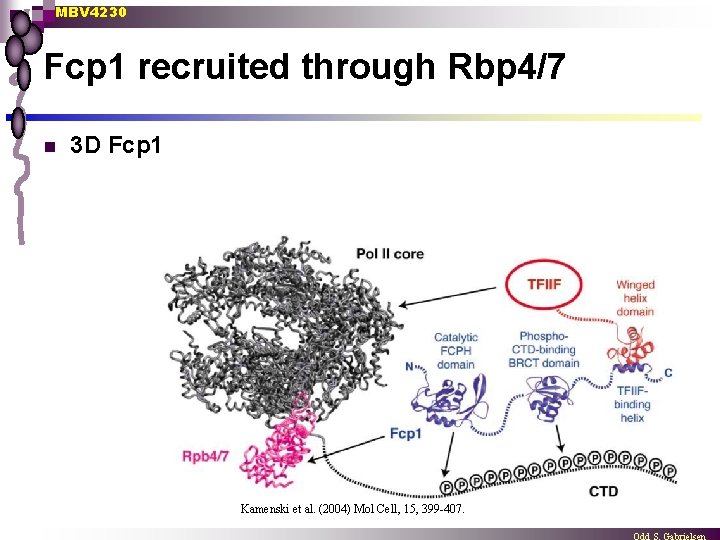
MBV 4230 Fcp 1 recruited through Rbp 4/7 n 3 D Fcp 1 Kamenski et al. (2004) Mol Cell, 15, 399 -407.
MBV 4230 CTD kinase and phosphatase specificities P-TEFb (CDK 9) TFIIH (CDK 7/ Kin 28) Srb 10 (CDK 8) RNAP IIO (Y 1 S 2 P 3 T 4 S 5 P 6 S 7)n Fcp 1 SCPs Ssu 72