
RNA Matrices and RNA Secondary Structures Institute for


- Slides: 37
RNA Matrices and RNA Secondary Structures Institute for Mathematics and Its Applications: RNA in Biology, Bioengineering and Nanotechnology, University of Minnesota October 29 – November 2, 2007 Asamoah Nkwanta, Morgan State University Nkwanta@jewel. morgan. edu
RNA Secondary Structure Prediction l Given a primary sequence, we want to find the biological function of the related secondary structure. To achieve this goal we predict its’ secondary structure using a lattice walk or path approach. l This walk approach involves enumerative combinatorics and is connected to infinite lower triangular matrices called RNA matrices.
RNA Secondary Structure l Primary Structure – The linear sequence of bases in an RNA molecule l Secondary Structure – The folding or coiling of the sequence due to bonded nucleotide pairs: A-U, G-C l Tertiary Structure – The three dimensional configuration of an RNA molecule. The three dimensional shape is important for biological function, and it is harder to predict.
RNA Molecule Ribonucleic acid (RNA) molecule: Three main categories l m. RNA (messenger) – carries genetic information from genes to other cells l t. RNA (transfer) – carries amino acids to a ribosome (cells for making proteins) l r. RNA (ribosomal) – part of the structure of a ribosome
RNA Molcule (cont. ) Other types (RNA) molecules: sn. RNA (small nuclear RNA) – carries genetic information from genes to other cells l mi. RNA (micro RNA) – carries amino acids to a ribosome (cells for making proteins) l i. RNA (immune RNA) – part of the structure of a ribosome (Important for HIV studies) l
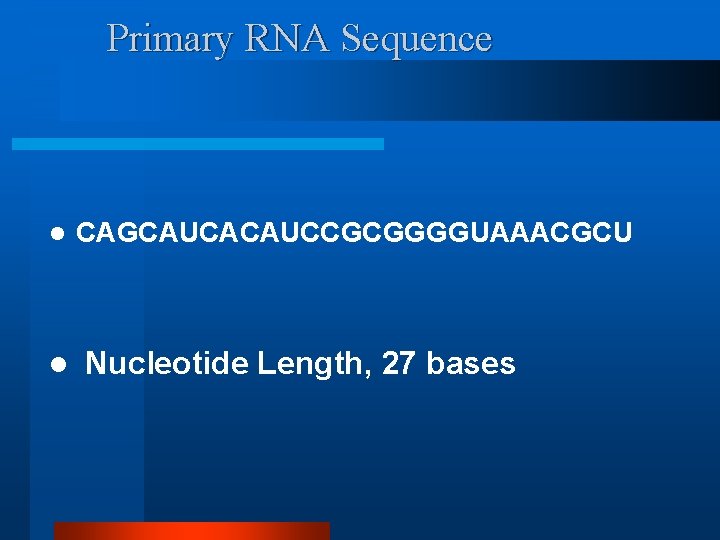
Primary RNA Sequence l l CAGCAUCACAUCCGCGGGGUAAACGCU Nucleotide Length, 27 bases
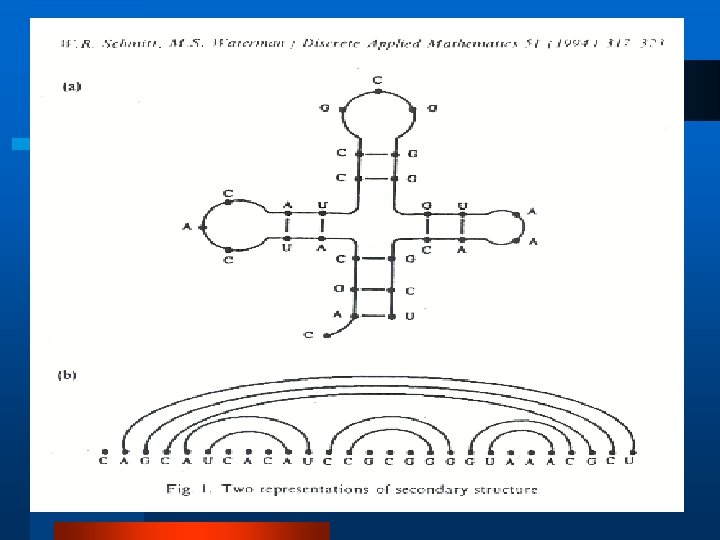
Geometric Representation l Secondary structure is a graph defined on a set of n labeled points (M. S. Waterman, 1978) l Biological l Combinatorial/Graph l Random Theoretic Walk l Other Representations
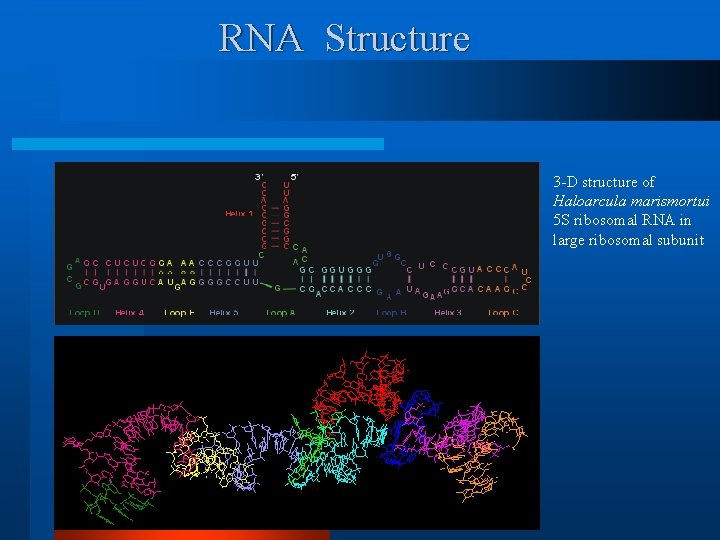
RNA Structure 3 -D structure of Haloarcula marismortui 5 S ribosomal RNA in large ribosomal subunit
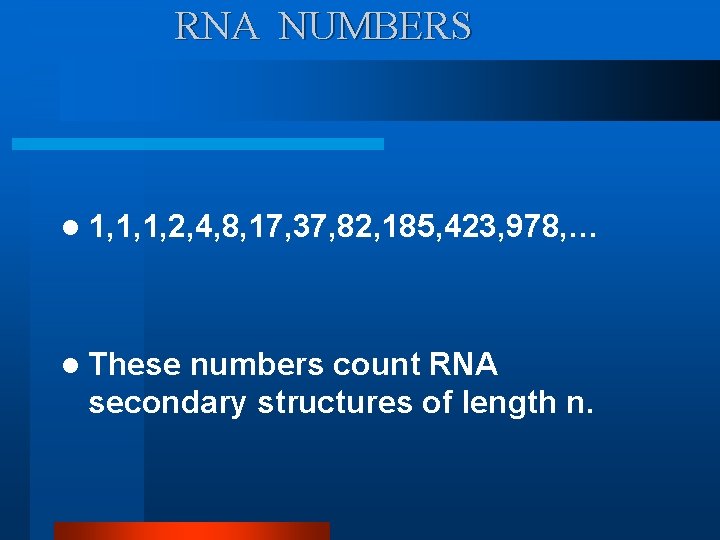
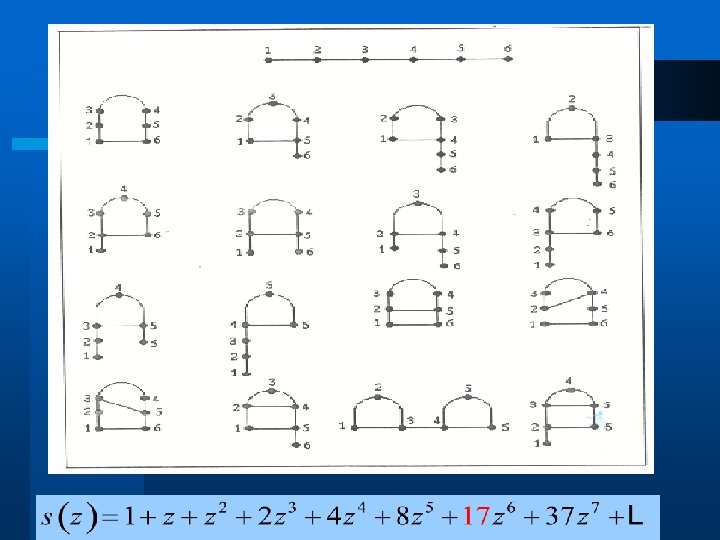
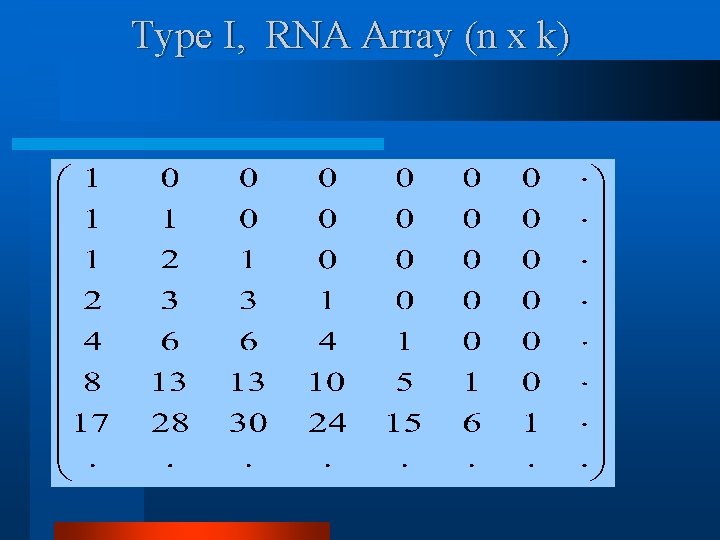
RNA NUMBERS l 1, 1, 1, 2, 4, 8, 17, 37, 82, 185, 423, 978, … l These numbers count RNA secondary structures of length n.
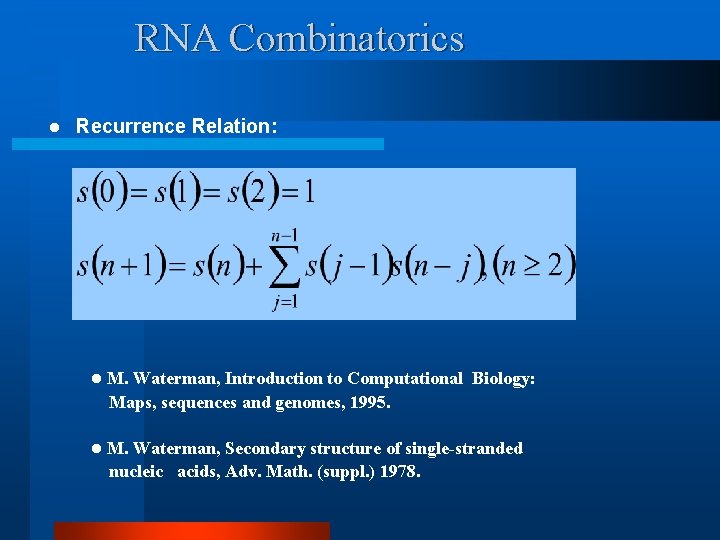
RNA Combinatorics l Recurrence Relation: l M. Waterman, Introduction to Computational Biology: Maps, sequences and genomes, 1995. l M. Waterman, Secondary structure of single-stranded nucleic acids, Adv. Math. (suppl. ) 1978.
Counting Sequence Database l The On-line Encyclopedia of Integer Sequences: http: /www. research. att. com/njas/sequence s/index. html l N. J. A. Sloane & S. Plouffe, The Encyclopedia of Integer Sequences, Academic Press, 1995.
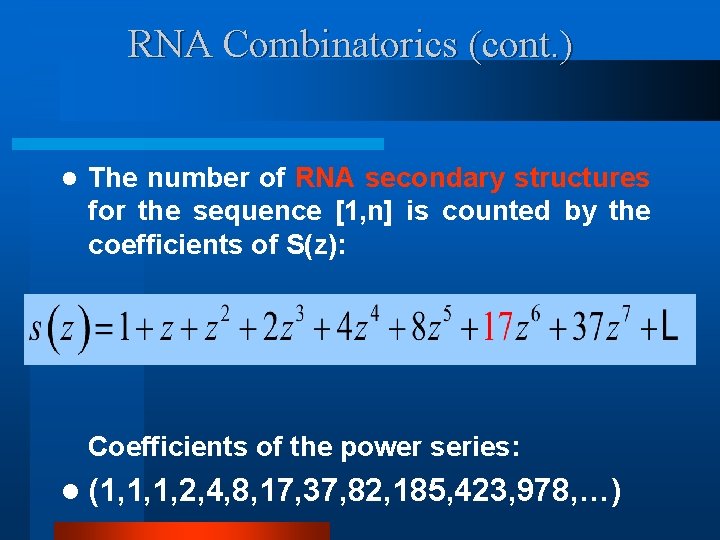
RNA Combinatorics (cont. ) l The number of RNA secondary structures for the sequence [1, n] is counted by the coefficients of S(z): Coefficients of the power series: l (1, 1, 1, 2, 4, 8, 17, 37, 82, 185, 423, 978, …)
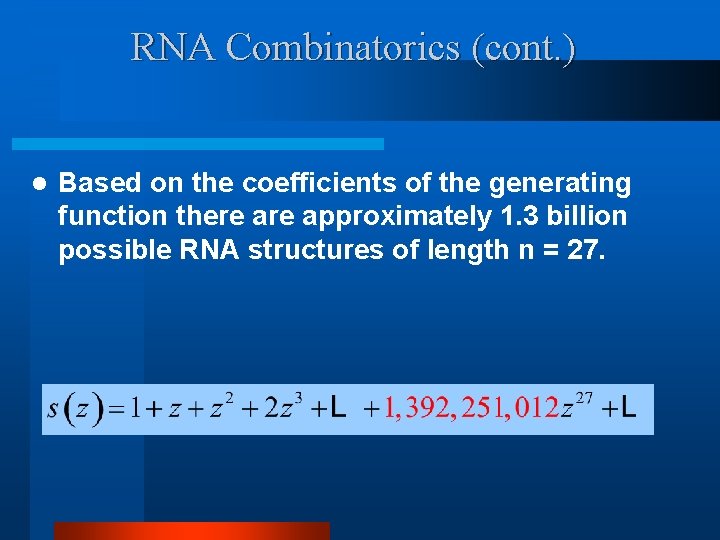
RNA Combinatorics (cont. ) l Based on the coefficients of the generating function there approximately 1. 3 billion possible RNA structures of length n = 27.
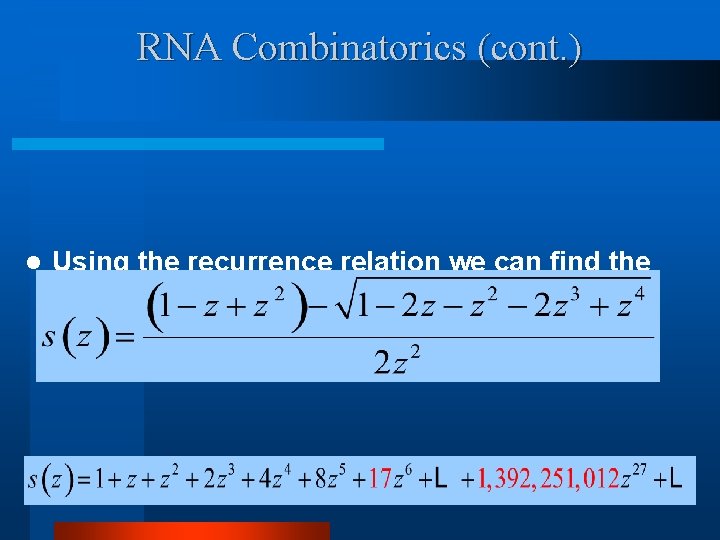
RNA Combinatorics (cont. ) l Using the recurrence relation we can find the closed form generating function associated with the RNA numbers.
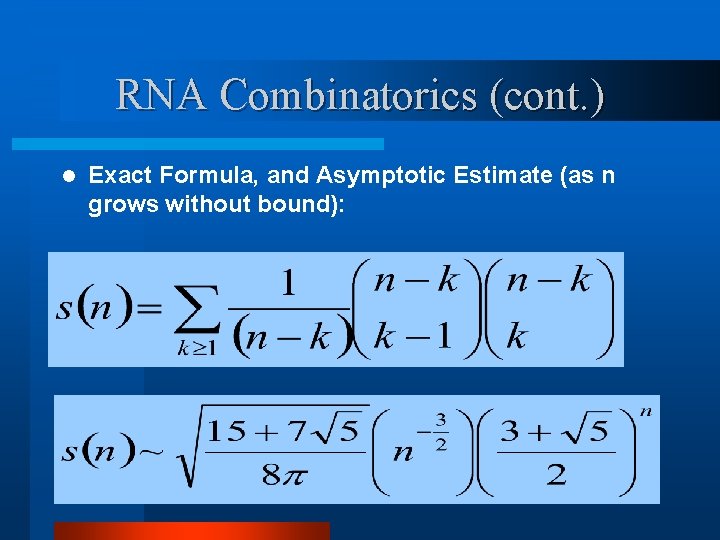
RNA Combinatorics (cont. ) l Exact Formula, and Asymptotic Estimate (as n grows without bound):
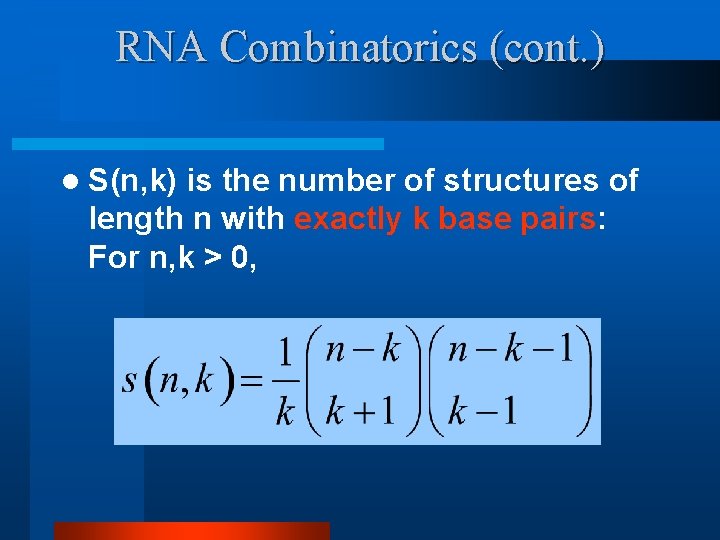
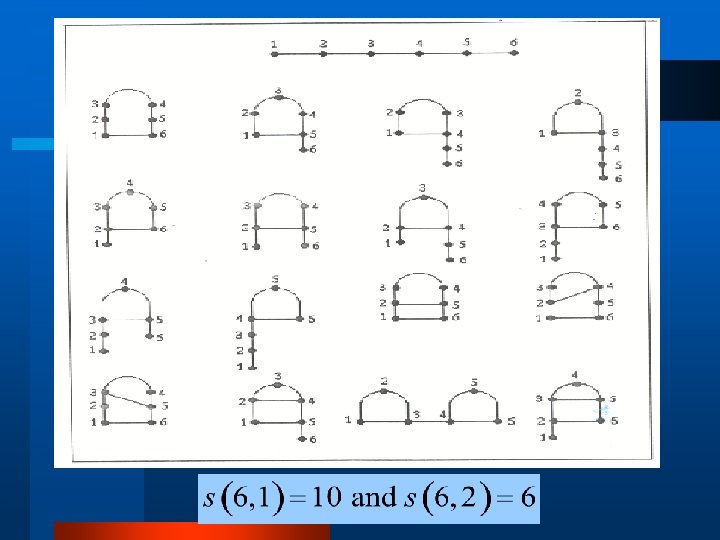
RNA Combinatorics (cont. ) l S(n, k) is the number of structures of length n with exactly k base pairs: For n, k > 0,
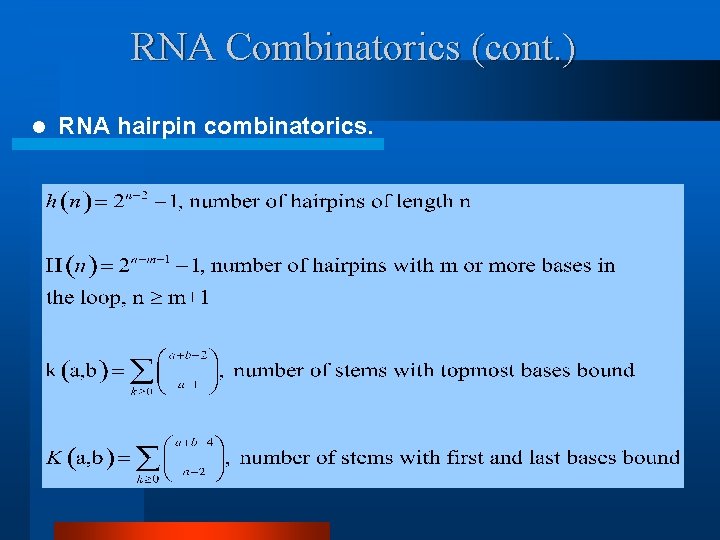
RNA Combinatorics (cont. ) l RNA hairpin combinatorics.
Random Walk l. A random walk is a lattice path from one point to another such that steps are allowed in a discrete number of directions and are of a certain length
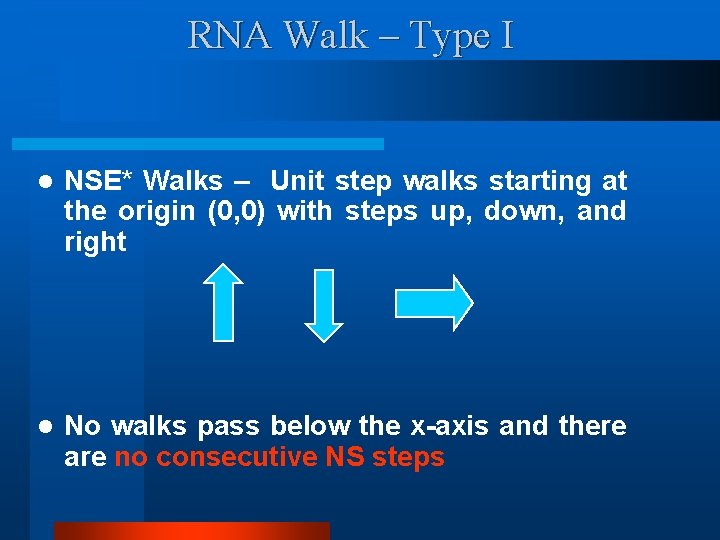
RNA Walk – Type I l NSE* Walks – Unit step walks starting at the origin (0, 0) with steps up, down, and right l No walks pass below the x-axis and there are no consecutive NS steps
Type I, RNA Array (n x k)
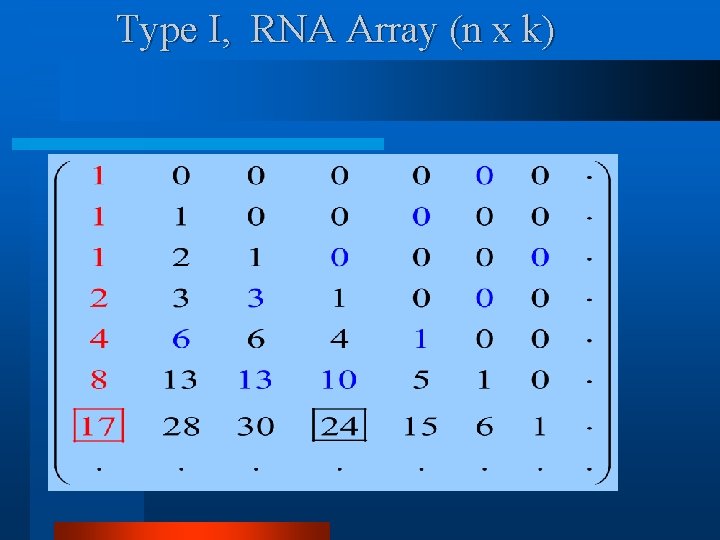
Type I, RNA Array (n x k)
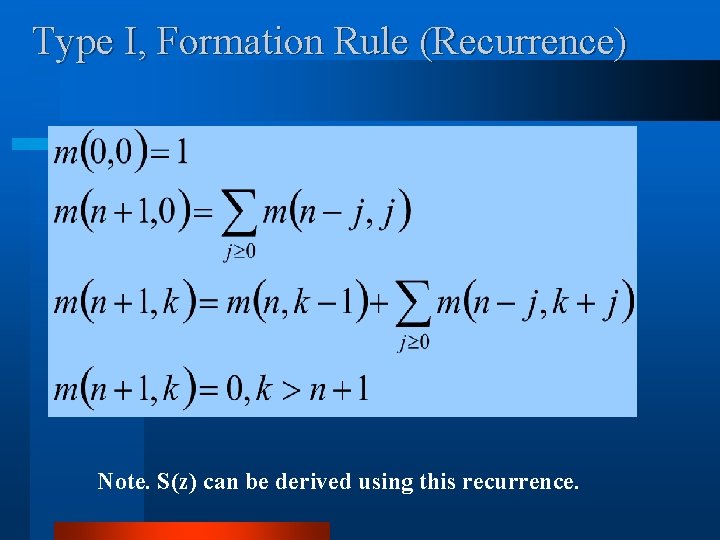
Type I, Formation Rule (Recurrence) Note. S(z) can be derived using this recurrence.
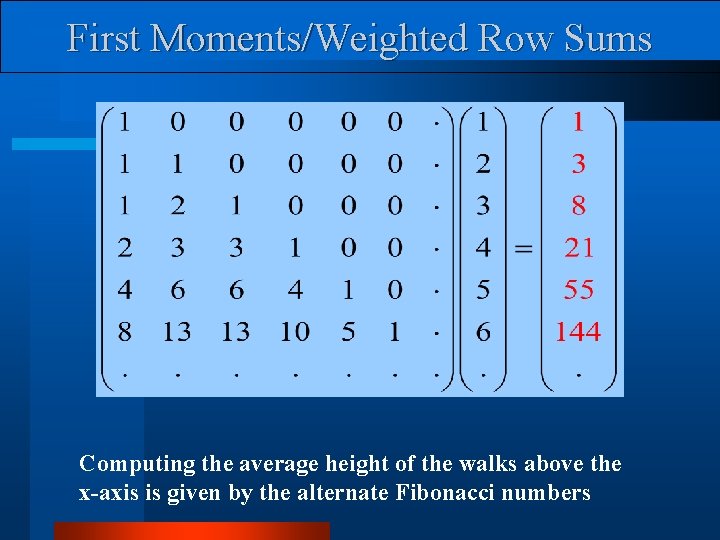
First Moments/Weighted Row Sums Computing the average height of the walks above the x-axis is given by the alternate Fibonacci numbers
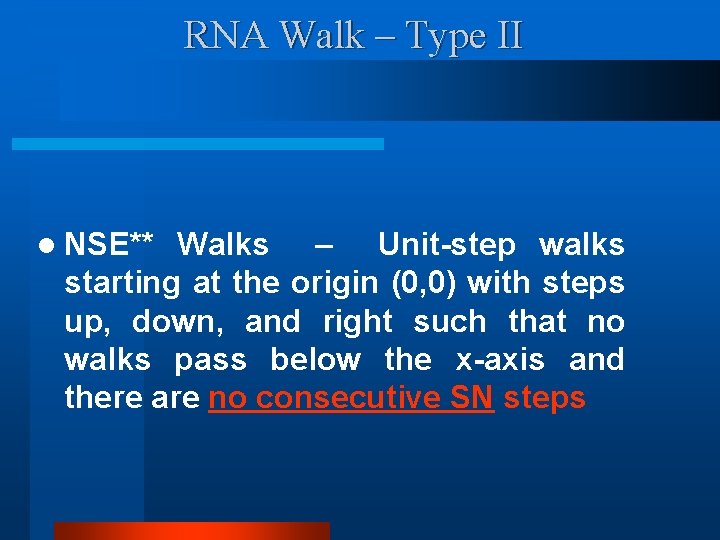
RNA Walk – Type II l NSE** Walks – Unit-step walks starting at the origin (0, 0) with steps up, down, and right such that no walks pass below the x-axis and there are no consecutive SN steps
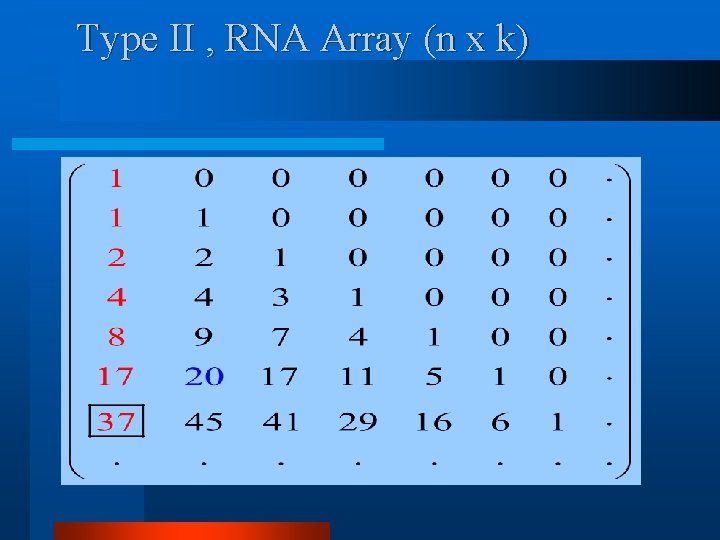
Type II , RNA Array (n x k)
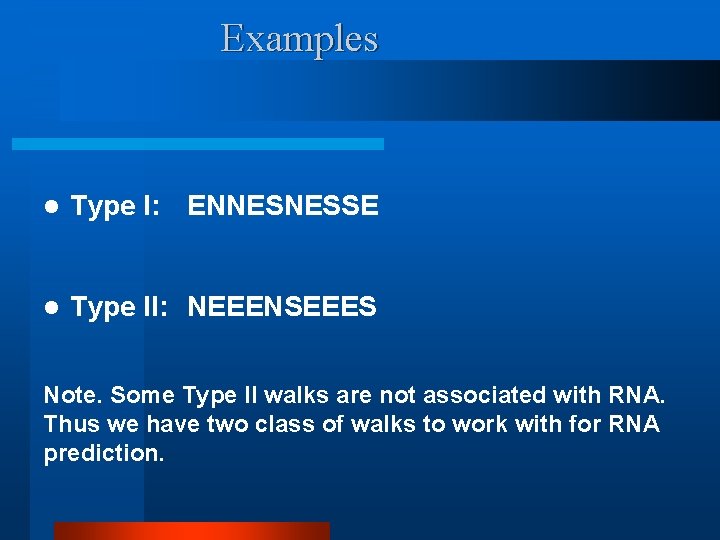
Examples l Type I: ENNESNESSE l Type II: NEEENSEEES Note. Some Type II walks are not associated with RNA. Thus we have two class of walks to work with for RNA prediction.
RNA Walk Bijection l Theorem: There is a bijection between the set of NSE* walks of length n+1 ending at height k = 0 and the set of NSE** walks of length n ending at height k = 0. l Source: Lattice paths, generating functions, and the Riordan group, Ph. D. Thesis, Howard University, Washington, DC, 1997
Main Theorem l Theorem: There is a bijection between the set of RNA secondary structures of length n and the set of NSE* walks ending at height k = 0. l Source: Lattice paths and RNA secondary structures, DIMAC Series in Discrete Math. & Theoretical Computer Science 34 (1997) 137 -147. (CAARMS 2 Proceedings)
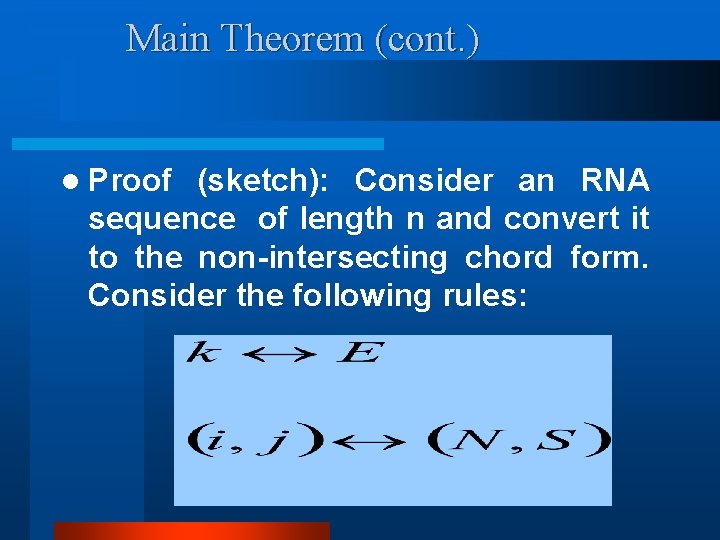
Main Theorem (cont. ) l Proof (sketch): Consider an RNA sequence of length n and convert it to the non-intersecting chord form. Consider the following rules:
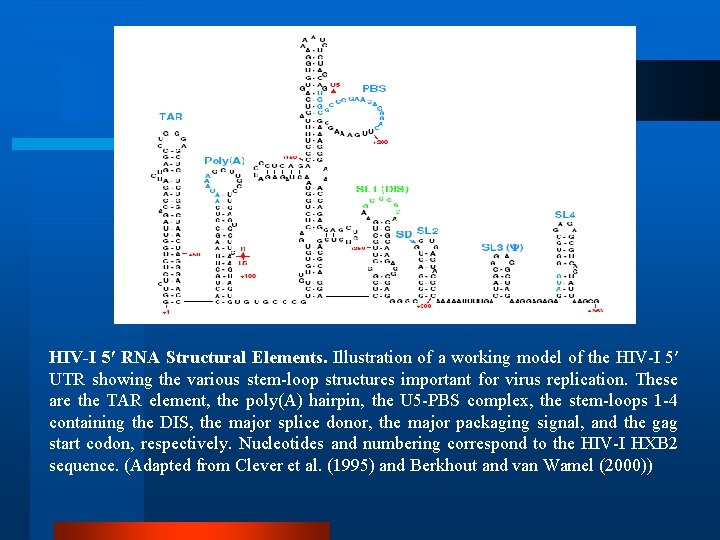
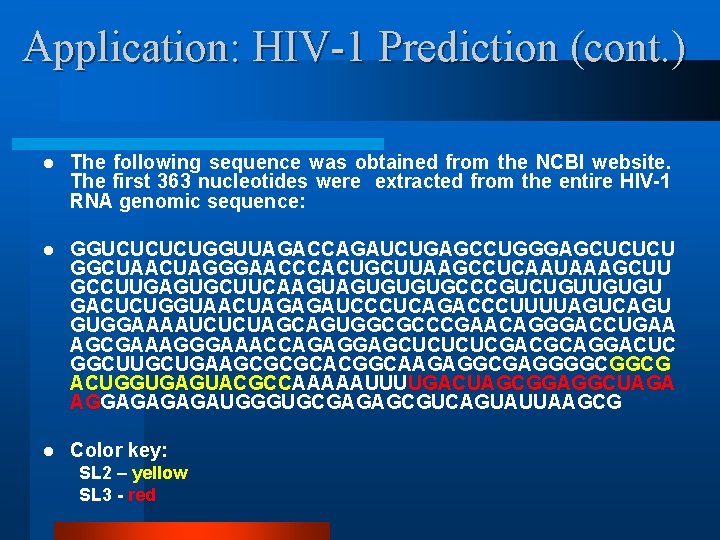
Application: HIV-1 Prediction l Given primary RNA sequences and using RNA combinatorics, the goal of this project is to model components of an HIV-1 RNA secondary structure (namely SL 2 and SL 3 domains). The major concentration of this project is on reducing the minimum free energy to form an optimum HIV-1 RNA secondary structure. l Source: HIV-1 sequence prediction, 2007, in progress
HIV-I 5′ RNA Structural Elements. Illustration of a working model of the HIV-I 5′ UTR showing the various stem-loop structures important for virus replication. These are the TAR element, the poly(A) hairpin, the U 5 -PBS complex, the stem-loops 1 -4 containing the DIS, the major splice donor, the major packaging signal, and the gag start codon, respectively. Nucleotides and numbering correspond to the HIV-I HXB 2 sequence. (Adapted from Clever et al. (1995) and Berkhout and van Wamel (2000))
Application: HIV-1 Prediction (cont. ) l The following sequence was obtained from the NCBI website. The first 363 nucleotides were extracted from the entire HIV-1 RNA genomic sequence: l GGUCUCUCUGGUUAGACCAGAUCUGAGCCUGGGAGCUCUCU GGCUAACUAGGGAACCCACUGCUUAAGCCUCAAUAAAGCUU GCCUUGAGUGCUUCAAGUAGUGUGUGCCCGUCUGUUGUGU GACUCUGGUAACUAGAGAUCCCUCAGACCCUUUUAGUCAGU GUGGAAAAUCUCUAGCAGUGGCGCCCGAACAGGGACCUGAA AGCGAAAGGGAAACCAGAGGAGCUCUCUCGACGCAGGACUC GGCUUGCUGAAGCGCGCACGGCAAGAGGCGAGGGGCGGCG ACUGGUGAGUACGCCAAAAAUUUUGACUAGCGGAGGCUAGA AGGAGAUGGGUGCGAGAGCGUCAGUAUUAAGCG l Color key: SL 2 – yellow SL 3 - red
Future Research: Centers For l Biological and Chemical Sensors Research l Environmental Research l The mission is to advance the fundamental scientific and technological knowledge needed to enable the development of new biological and chemical sensors. Toxicology and Biosensors
Math-Bio Collaborators l Dwayne Hill, Biology Dept. , MSU l Alvin Kennedy and Richard Williams, Chemistry Dept. , MSU l Wilfred Ndifon, Ecology and Evolutionary Biology Dept. , Princeton U. l Boniface Eke, Mathematics Dept. , MSU