
RNA Interference RNA Interference Over ten years ago

- Slides: 5
RNA Interference
RNA Interference • Over ten years ago, Andrew Fire and Craig Mello showed the ability of double stranded RNA molecules to inhibit the expression of homologous genes in C. elegans (Fire et al. 1998). • For this achievement they were honoured with the Nobel Prize for Medicine or Physiology in 2006.
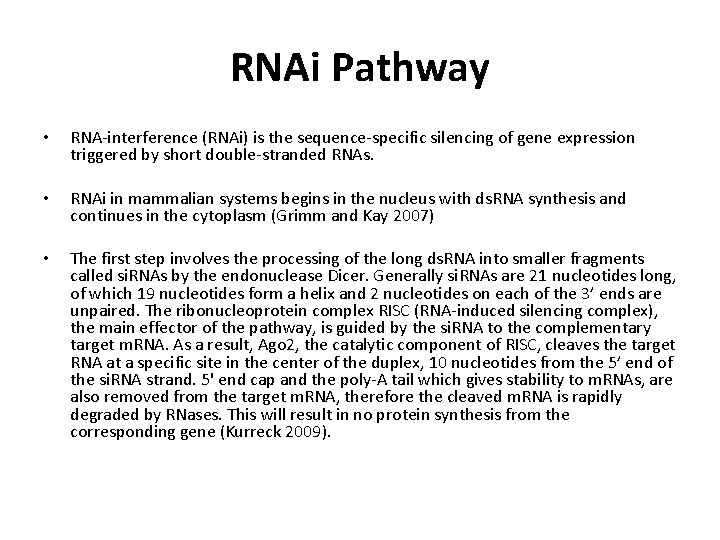
RNAi Pathway • RNA-interference (RNAi) is the sequence-specific silencing of gene expression triggered by short double-stranded RNAs. • RNAi in mammalian systems begins in the nucleus with ds. RNA synthesis and continues in the cytoplasm (Grimm and Kay 2007) • The first step involves the processing of the long ds. RNA into smaller fragments called si. RNAs by the endonuclease Dicer. Generally si. RNAs are 21 nucleotides long, of which 19 nucleotides form a helix and 2 nucleotides on each of the 3’ ends are unpaired. The ribonucleoprotein complex RISC (RNA-induced silencing complex), the main effector of the pathway, is guided by the si. RNA to the complementary target m. RNA. As a result, Ago 2, the catalytic component of RISC, cleaves the target RNA at a specific site in the center of the duplex, 10 nucleotides from the 5’ end of the si. RNA strand. 5' end cap and the poly-A tail which gives stability to m. RNAs, are also removed from the target m. RNA, therefore the cleaved m. RNA is rapidly degraded by RNases. This will result in no protein synthesis from the corresponding gene (Kurreck 2009).
si. RNA Delivery • The modulators of RNAi include exogenously introduced doublestranded RNA (ds. RNA) in the form of either short hairpin RNA (sh. RNA) or short interfering RNA (si. RNA); or micro RNA (mi. RNA) which are the endogenous regulators of gene expression. • As any otherapeutic agent, RNAi requires an effective and safe delivery vector. • Moreover, specific tissue and cell targeting after systemic administration remain a formidable challenge. • a number of different strategies have been developed for the in vitro and in vivo delivery of • si. RNA
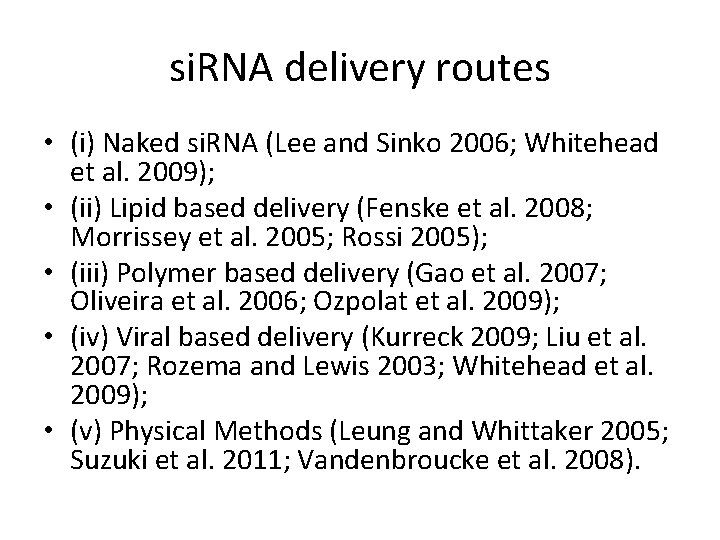
si. RNA delivery routes • (i) Naked si. RNA (Lee and Sinko 2006; Whitehead et al. 2009); • (ii) Lipid based delivery (Fenske et al. 2008; Morrissey et al. 2005; Rossi 2005); • (iii) Polymer based delivery (Gao et al. 2007; Oliveira et al. 2006; Ozpolat et al. 2009); • (iv) Viral based delivery (Kurreck 2009; Liu et al. 2007; Rozema and Lewis 2003; Whitehead et al. 2009); • (v) Physical Methods (Leung and Whittaker 2005; Suzuki et al. 2011; Vandenbroucke et al. 2008).