
RNA AND PROTEIN SYNTHESIS How your cell makes

- Slides: 34
RNA AND PROTEIN SYNTHESIS
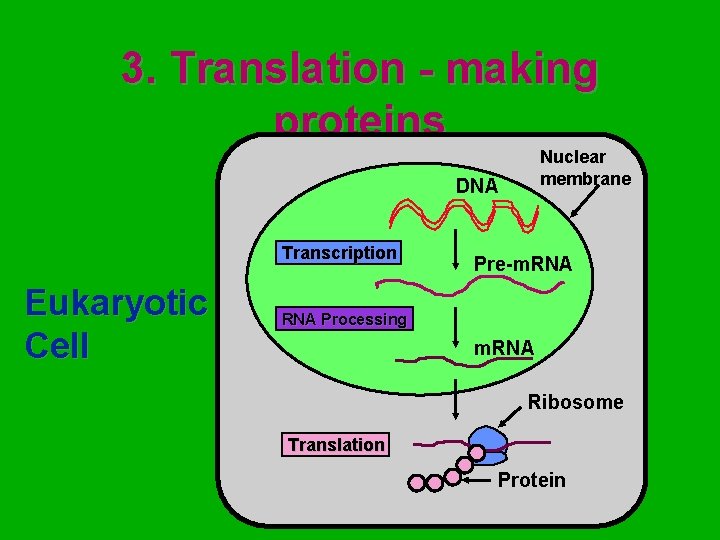
How your cell makes very important proteins • The production (synthesis) of proteins • 3 phases: phases 1. Transcription 2. RNA processing 3. Translation • DNA RNA Protein
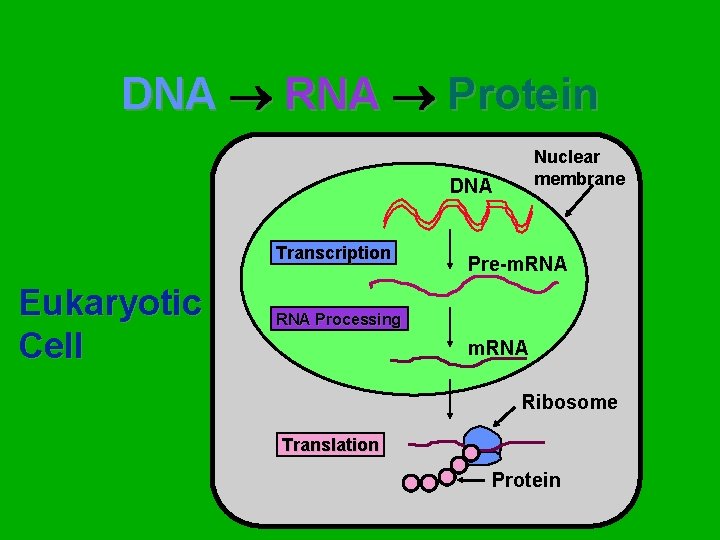
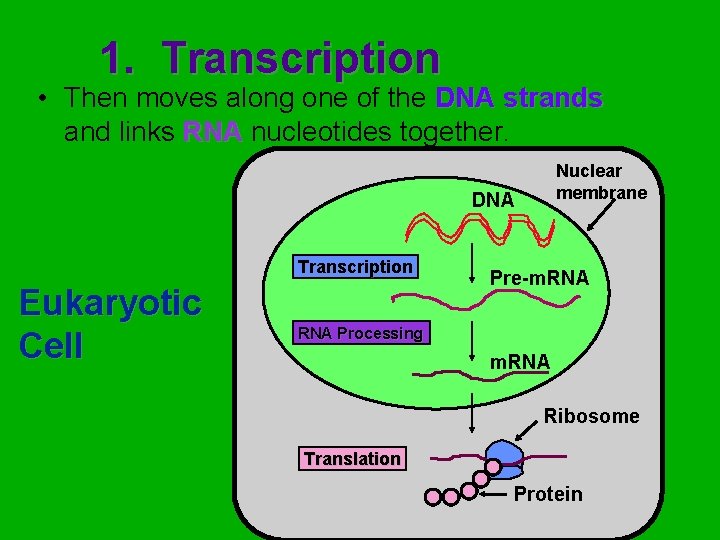
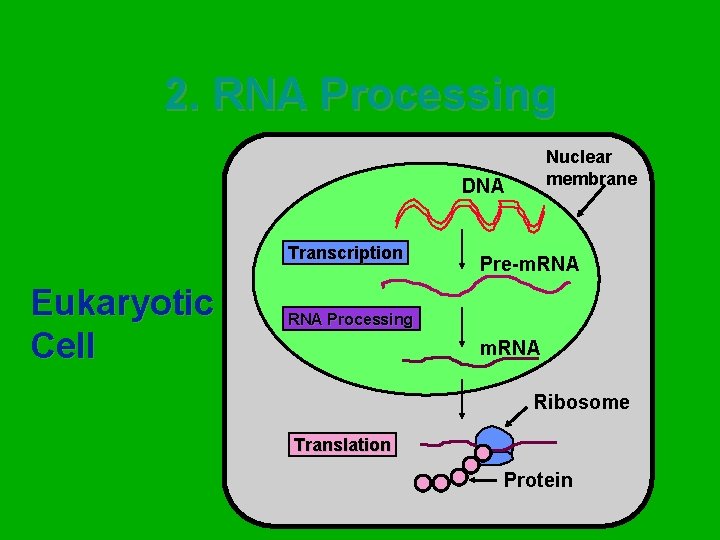
DNA RNA Protein Nuclear membrane DNA Transcription Eukaryotic Cell Pre-m. RNA Processing m. RNA Ribosome Translation Protein
Before making proteins, Your cell must first make RNA • Question: • How does RNA (ribonucleic acid) differ from DNA (deoxyribonucleic acid)? acid)
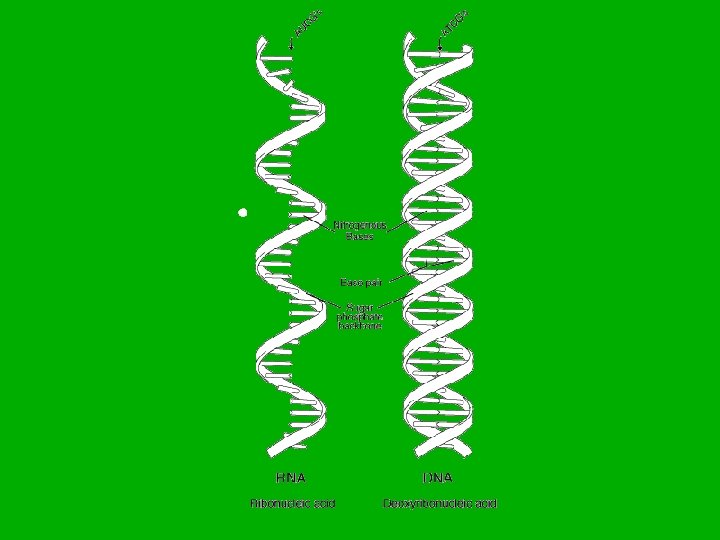
RNA differs from DNA 1. RNA has a sugar ribose DNA has a sugar deoxyribose 2. RNA contains uracil (U) DNA has thymine (T) 3. RNA molecule is single-stranded DNA is double-stranded
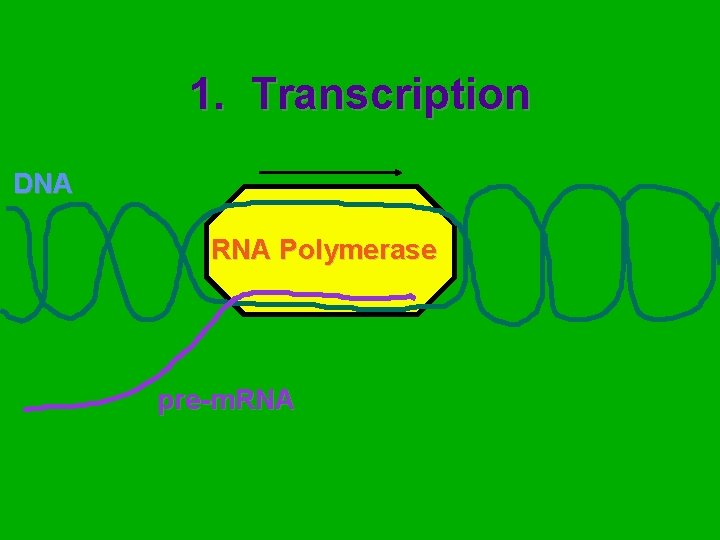
1. Transcription • Then moves along one of the DNA strands and links RNA nucleotides together. Nuclear membrane DNA Transcription Eukaryotic Cell Pre-m. RNA Processing m. RNA Ribosome Translation Protein
1. Transcription OR RNA production • RNA molecules are produced by copying part of DNA into a complementary sequence of RNA • This process is started and controlled by an enzyme called RNA polymerase.
1. Transcription DNA RNA Polymerase pre-m. RNA
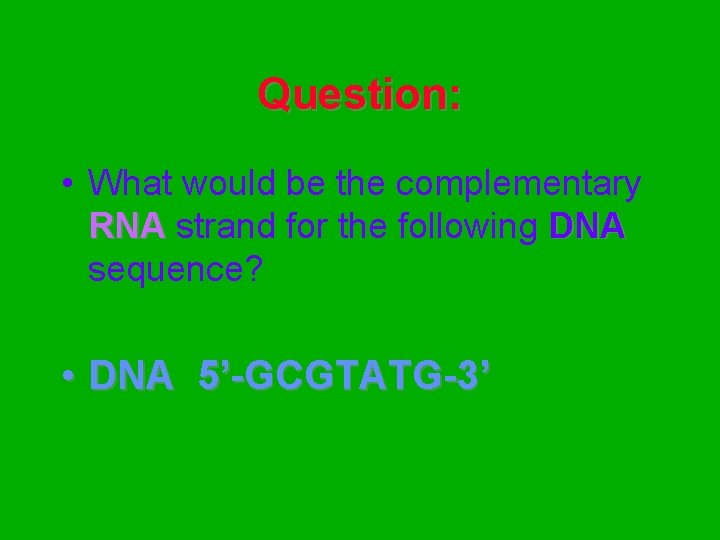
Question: • What would be the complementary RNA strand for the following DNA sequence? • DNA 5’-GCGTATG-3’
Types of RNA • Three types of RNA: RNA A. messenger RNA (m. RNA) B. transfer RNA (t. RNA) C. ribosome RNA (r. RNA) • Remember: all produced in the nucleus!
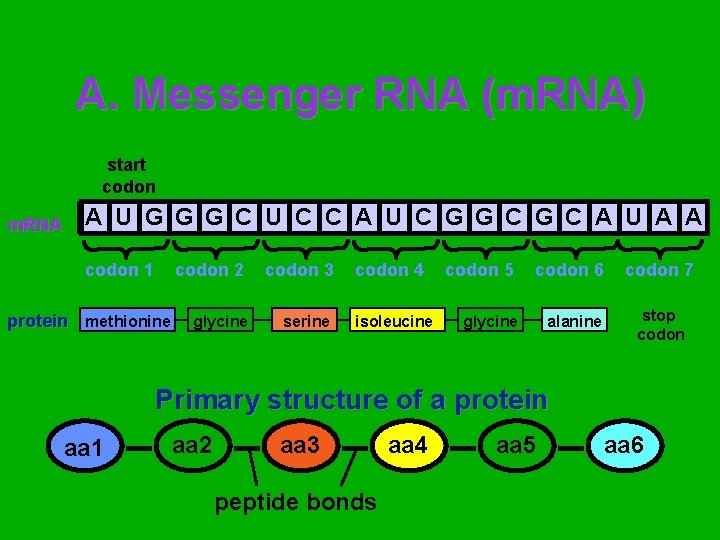
m. RNA • Carries instructions from DNA to the rest of the ribosome. • Tells the ribosome what kind of protein to make • Acts like an email from the principal to the cafeteria lady.
A. Messenger RNA (m. RNA) start codon m. RNA A U G G G C U C C A U C G G C A U A A codon 1 protein methionine codon 2 codon 3 glycine serine codon 4 isoleucine codon 5 codon 6 glycine alanine codon 7 stop codon Primary structure of a protein aa 1 aa 2 aa 3 peptide bonds aa 4 aa 5 aa 6
If the cell is a school… • The Nucleus is the school office • The Nucleolus is the principal’s office • The DNA is the principal • Ribosomes are the cafeteria ladies • m. RNA is the email from the principal to the cafeteria lady
r. RNA • Part of the structure of a ribosome • Helps in protein production t. RNA A go-getter. Gets the right parts to make the right protein according to m. RNA instructions
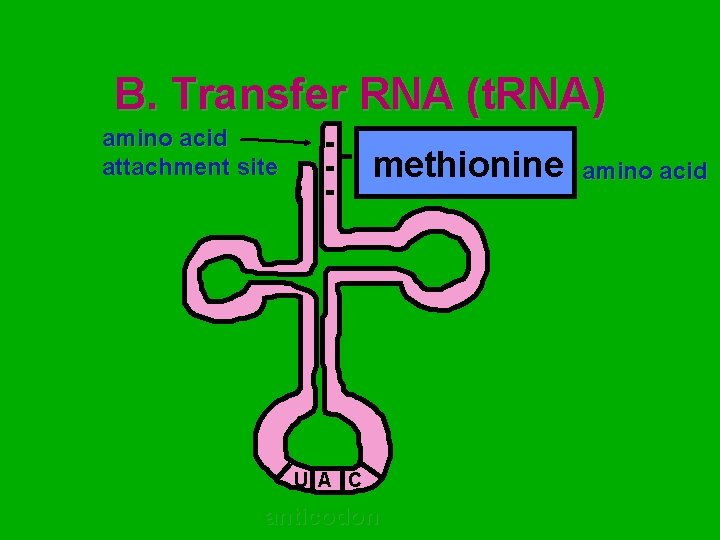
B. Transfer RNA (t. RNA) amino acid attachment site methionine U A C anticodon amino acid
2. RNA Processing Nuclear membrane DNA Transcription Eukaryotic Cell Pre-m. RNA Processing m. RNA Ribosome Translation Protein
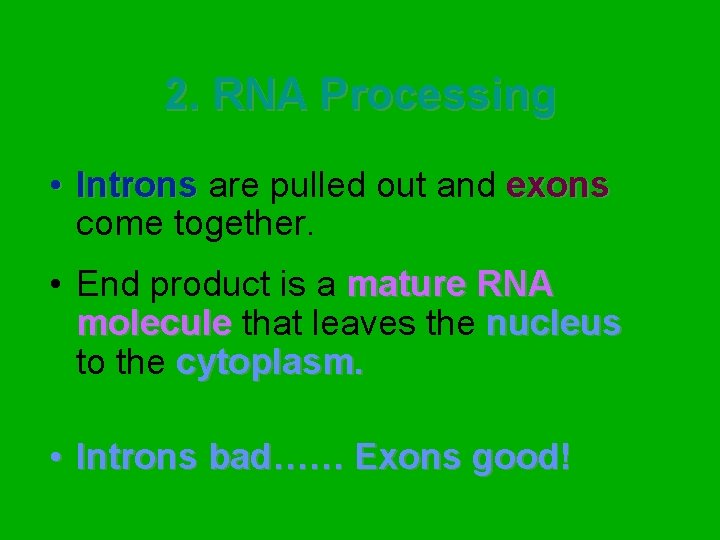
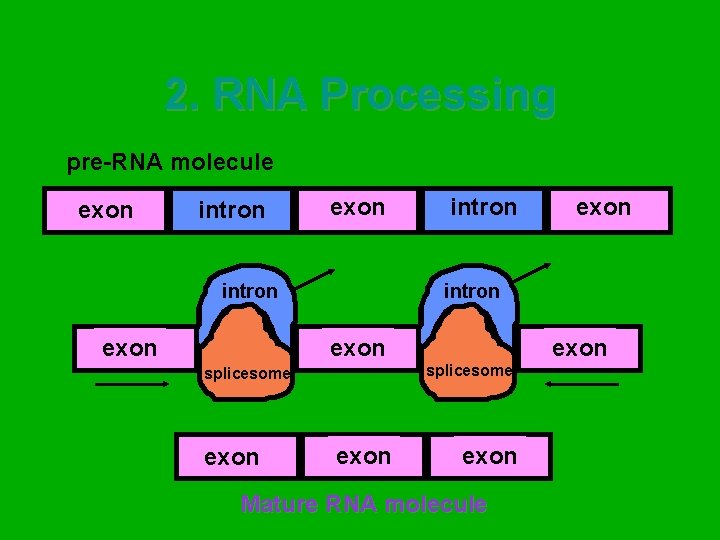
2. RNA Processing • Introns are pulled out and exons come together. • End product is a mature RNA molecule that leaves the nucleus to the cytoplasm. • Introns bad…… Exons good!
2. RNA Processing pre-RNA molecule exon intron exon splicesome exon Mature RNA molecule
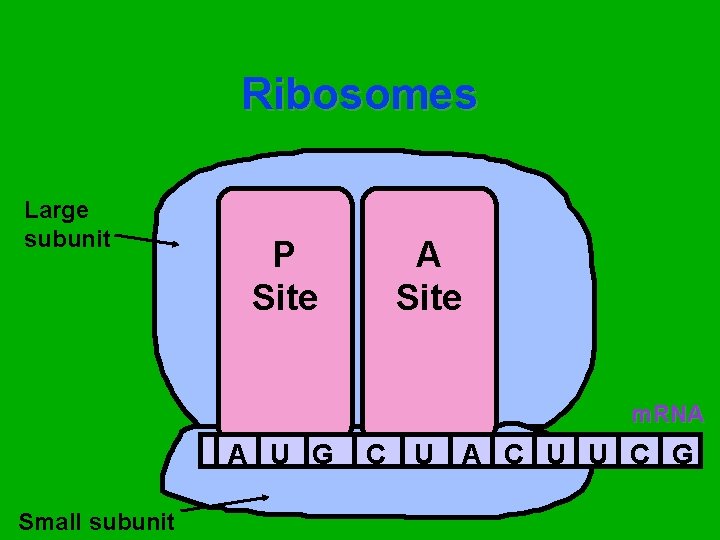
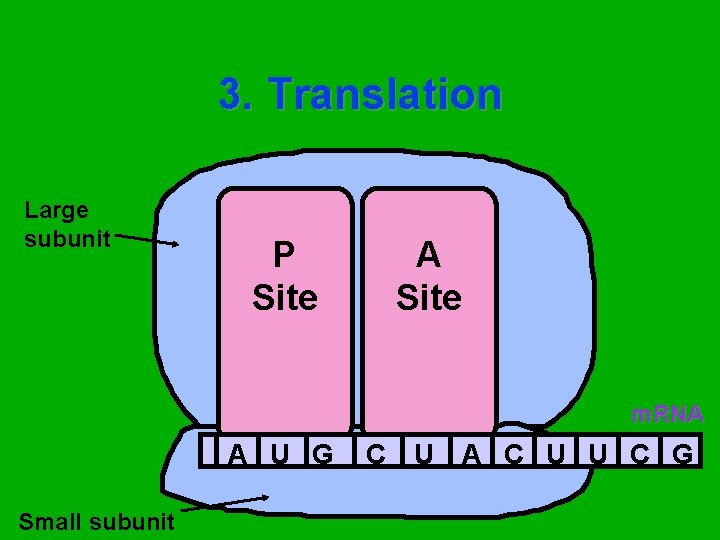
Ribosomes Large subunit P Site A Site m. RNA A U G Small subunit C U A C U U C G
3. Translation - making proteins Nuclear membrane DNA Transcription Eukaryotic Cell Pre-m. RNA Processing m. RNA Ribosome Translation Protein
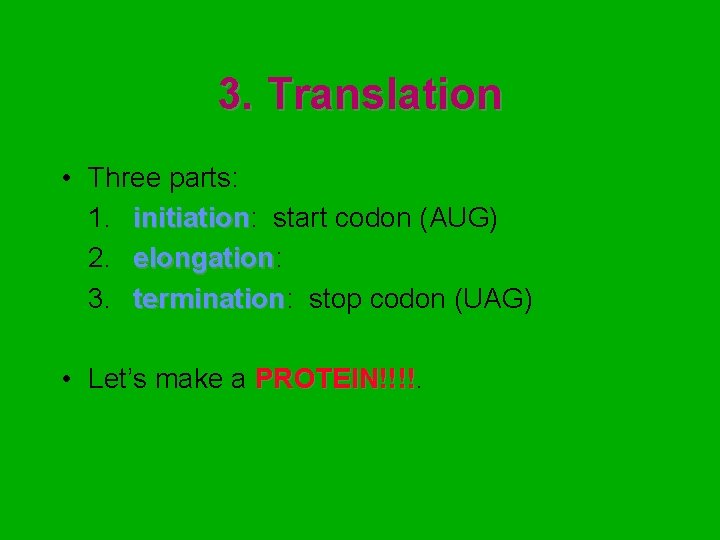
3. Translation • Three parts: 1. initiation: initiation start codon (AUG) 2. elongation: elongation 3. termination: termination stop codon (UAG) • Let’s make a PROTEIN!!!!
3. Translation Large subunit P Site A Site m. RNA A U G Small subunit C U A C U U C G
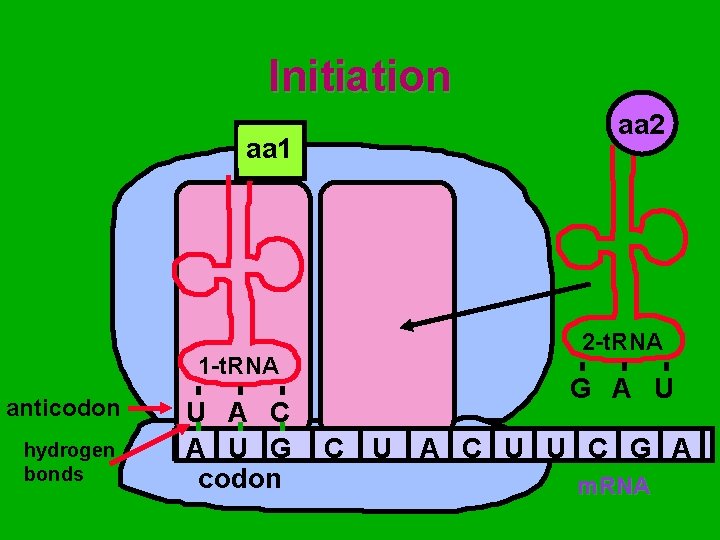
Initiation aa 1 1 -t. RNA anticodon hydrogen bonds U A C A U G codon aa 2 2 -t. RNA G A U C U A C U U C G A m. RNA
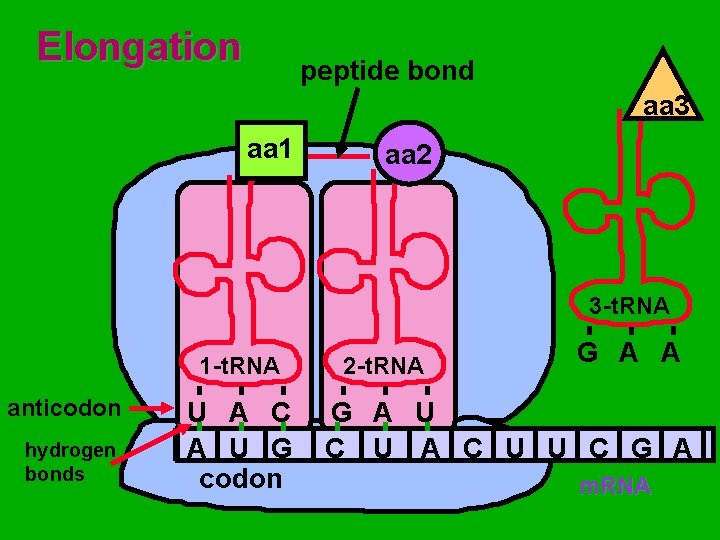
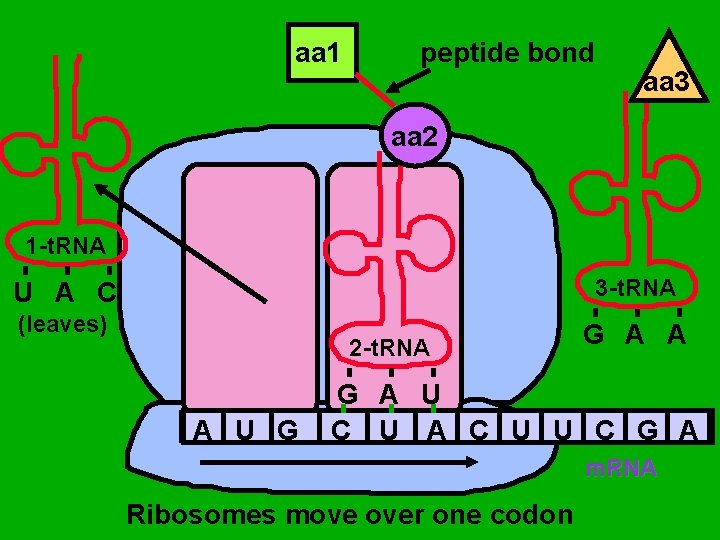
Elongation peptide bond aa 3 aa 1 aa 2 3 -t. RNA 1 -t. RNA anticodon hydrogen bonds U A C A U G codon 2 -t. RNA G A U C U A C U U C G A m. RNA
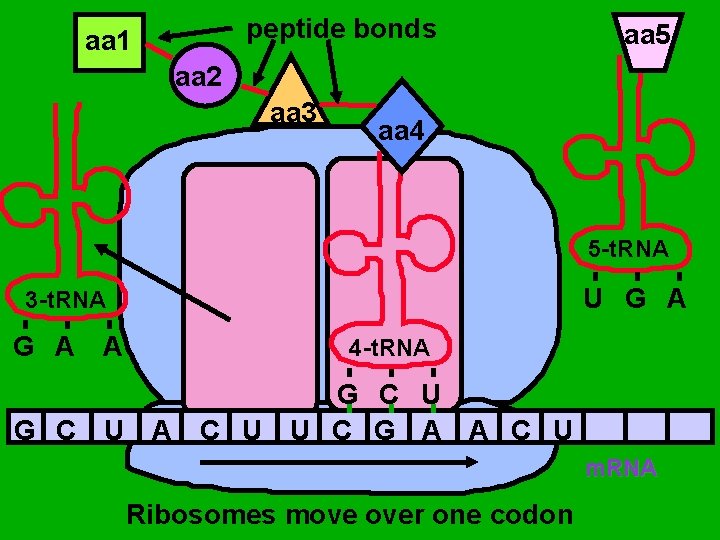
aa 1 peptide bond aa 3 aa 2 1 -t. RNA 3 -t. RNA U A C (leaves) 2 -t. RNA A U G G A A G A U C U A C U U C G A m. RNA Ribosomes move over one codon
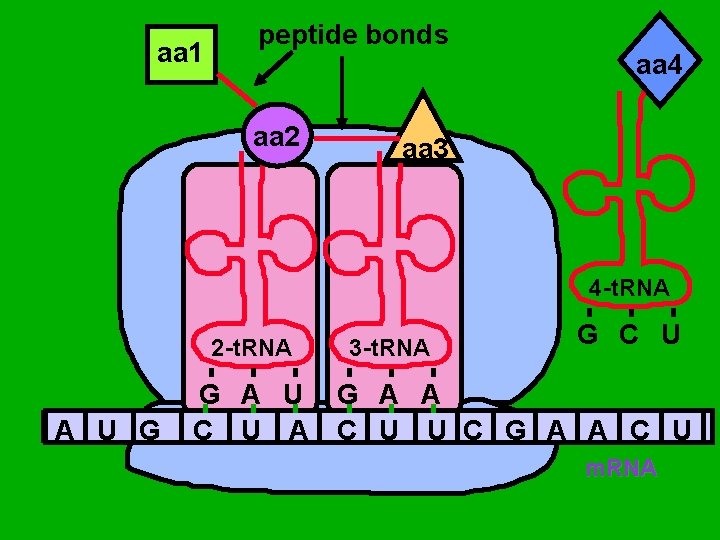
aa 1 peptide bonds aa 2 aa 4 aa 3 4 -t. RNA 2 -t. RNA A U G 3 -t. RNA G C U G A A C U U C G A A C U m. RNA
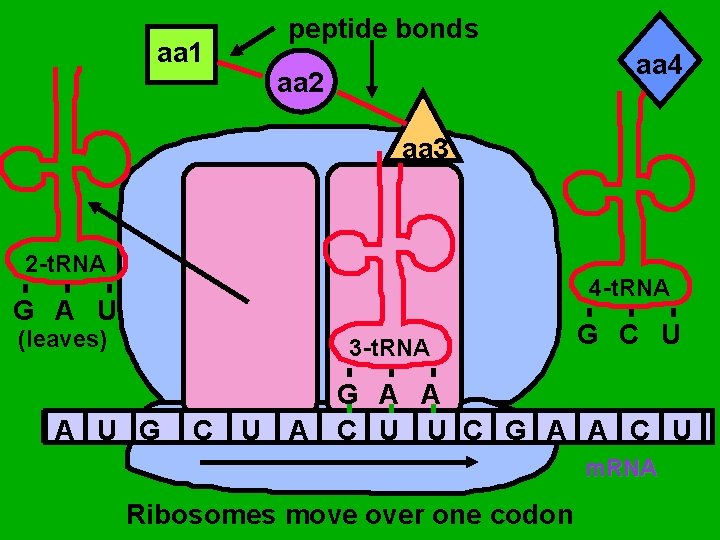
aa 1 peptide bonds aa 4 aa 2 aa 3 2 -t. RNA 4 -t. RNA G A U (leaves) 3 -t. RNA A U G G C U G A A C U U C G A A C U m. RNA Ribosomes move over one codon
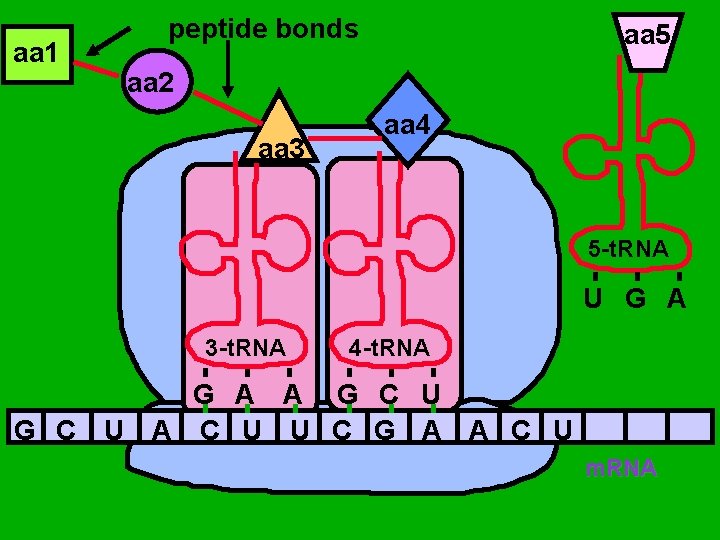
aa 1 peptide bonds aa 5 aa 2 aa 3 aa 4 5 -t. RNA U G A 3 -t. RNA 4 -t. RNA G A A G C U A C U U C G A A C U m. RNA
peptide bonds aa 1 aa 5 aa 2 aa 3 aa 4 5 -t. RNA U G A 3 -t. RNA G A A 4 -t. RNA G C U A C U U C G A A C U m. RNA Ribosomes move over one codon
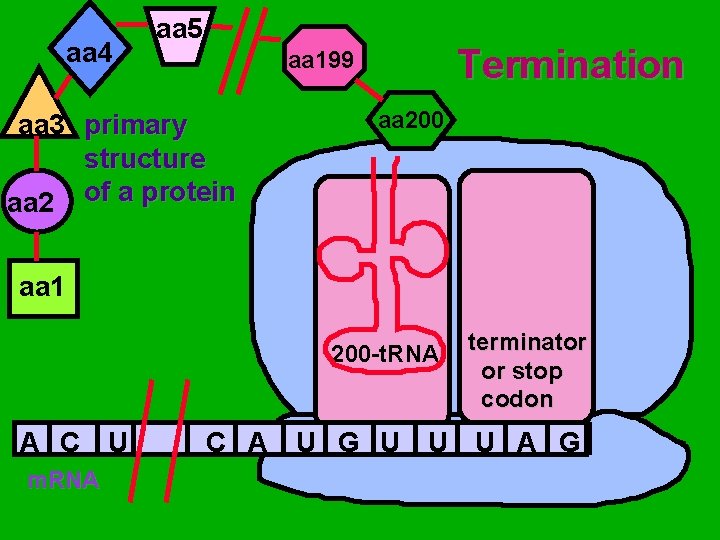
aa 4 aa 5 Termination aa 199 aa 3 primary structure aa 2 of a protein aa 200 aa 1 200 -t. RNA A C U m. RNA terminator or stop codon C A U G U U U A G
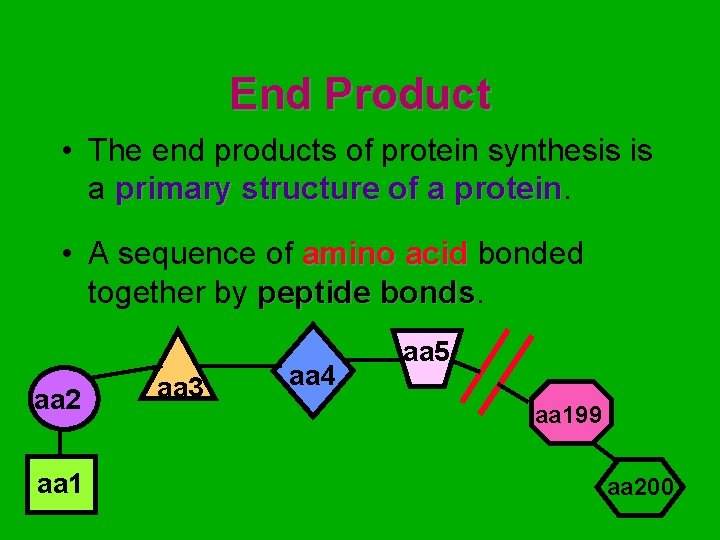
End Product • The end products of protein synthesis is a primary structure of a protein • A sequence of amino acid bonded together by peptide bonds aa 2 aa 1 aa 3 aa 4 aa 5 aa 199 aa 200
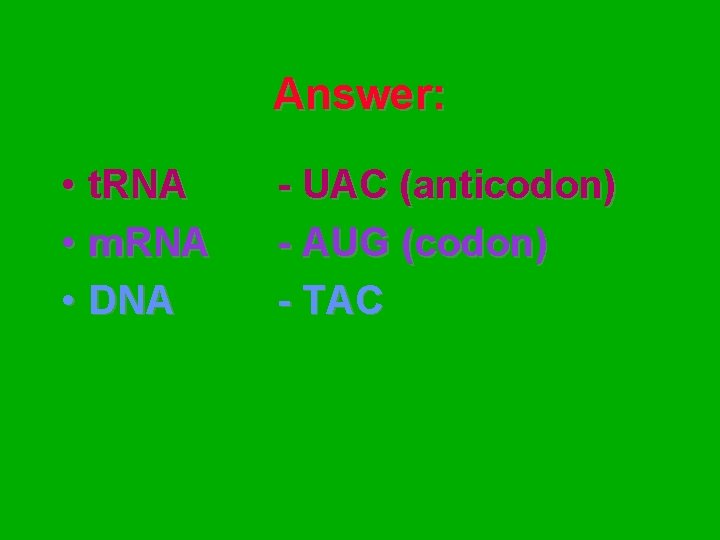
Question: • The anticodon UAC belongs to a t. RNA that recognizes and binds to a particular amino acid. • What would be the DNA base code for this amino acid?
Answer: • t. RNA • m. RNA • DNA - UAC (anticodon) - AUG (codon) - TAC