
RNA and Protein Synthesis Genes Traits depend on

- Slides: 27
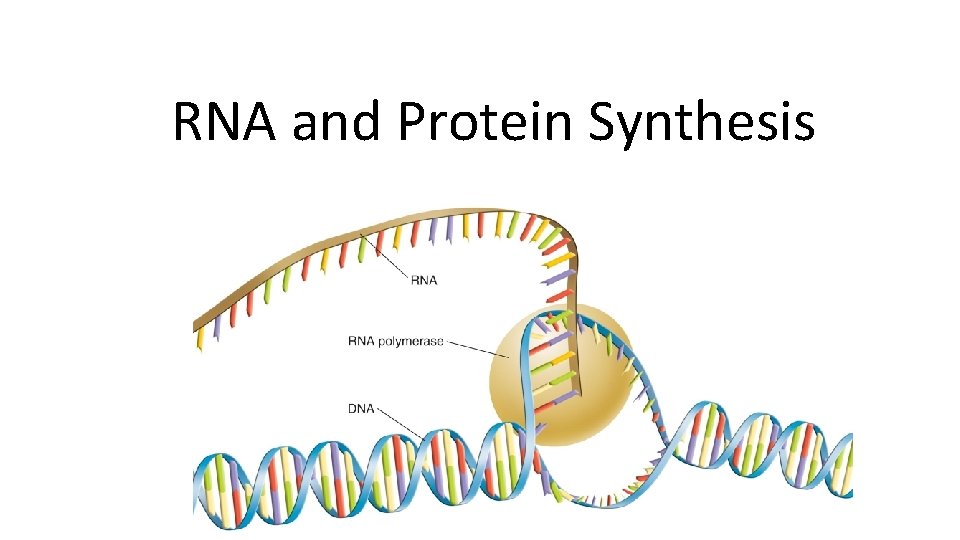
RNA and Protein Synthesis
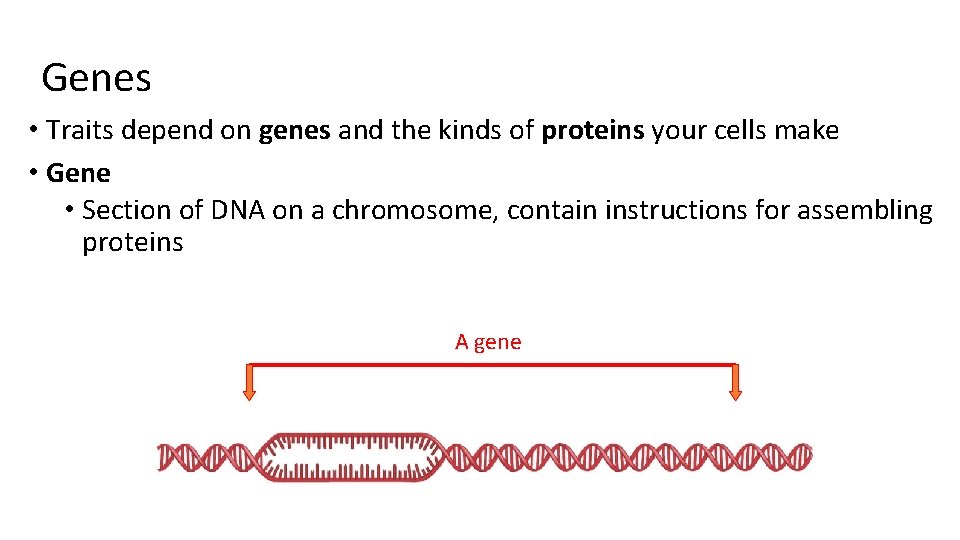
Genes • Traits depend on genes and the kinds of proteins your cells make • Gene • Section of DNA on a chromosome, contain instructions for assembling proteins A gene
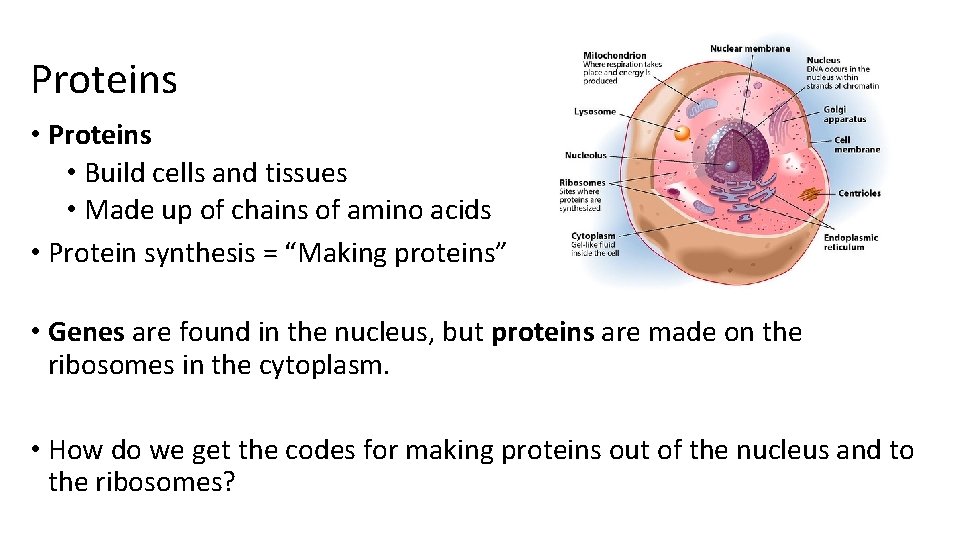
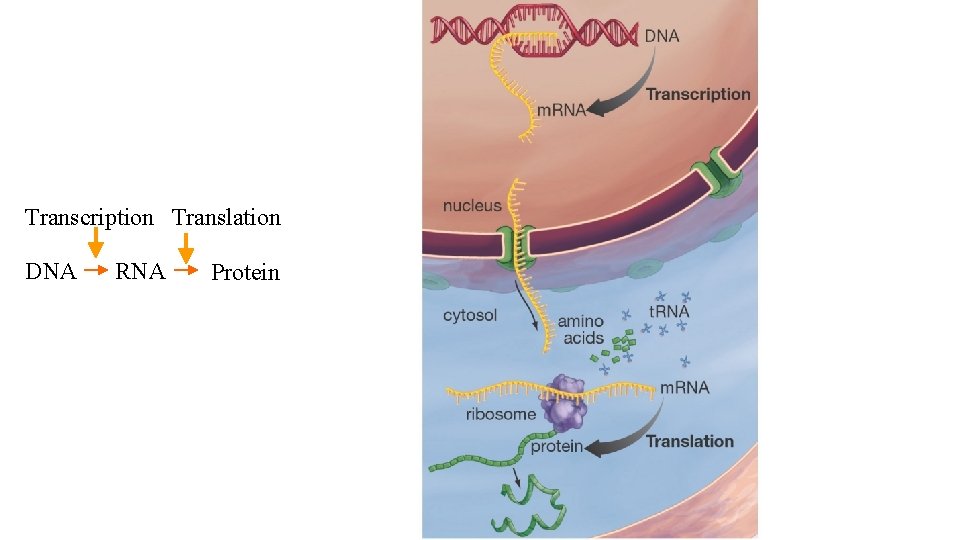
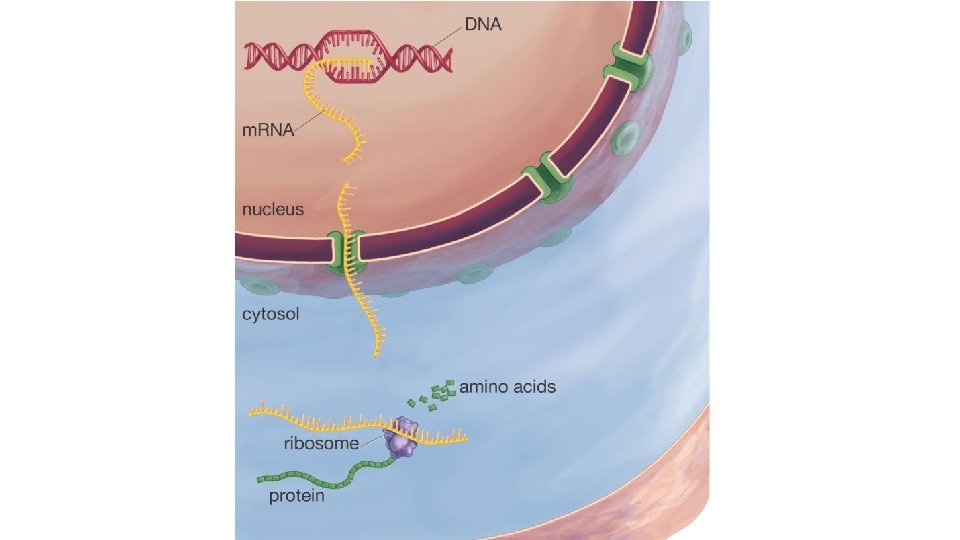
Proteins • Build cells and tissues • Made up of chains of amino acids • Protein synthesis = “Making proteins” • Genes are found in the nucleus, but proteins are made on the ribosomes in the cytoplasm. • How do we get the codes for making proteins out of the nucleus and to the ribosomes?
RNA • RNA – contains coded information for making proteins • DNA is the “master plan” and RNA is the “blueprint” • DNA is copied into an RNA code in the nucleus • RNA can travel outside of the nucleus to the ribosomes
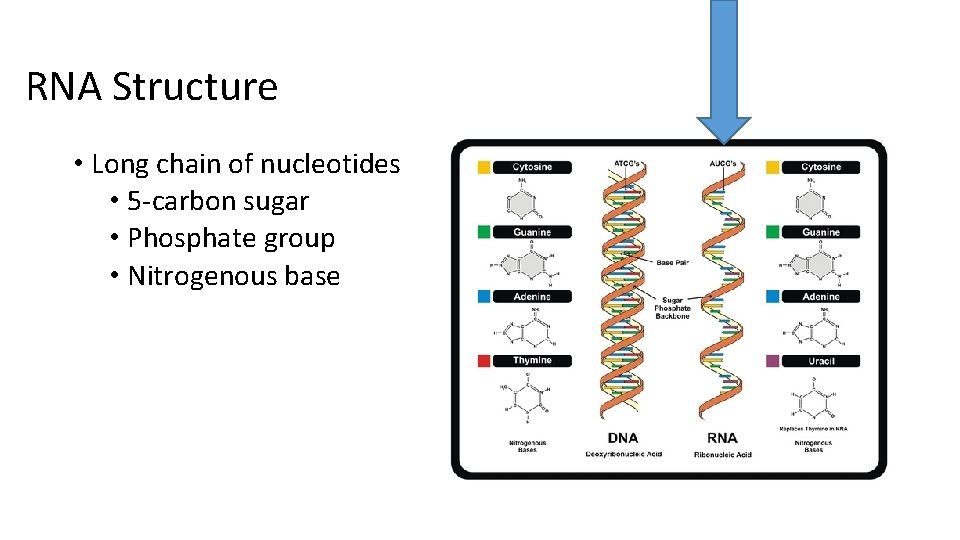
RNA Structure • Long chain of nucleotides • 5 -carbon sugar • Phosphate group • Nitrogenous base
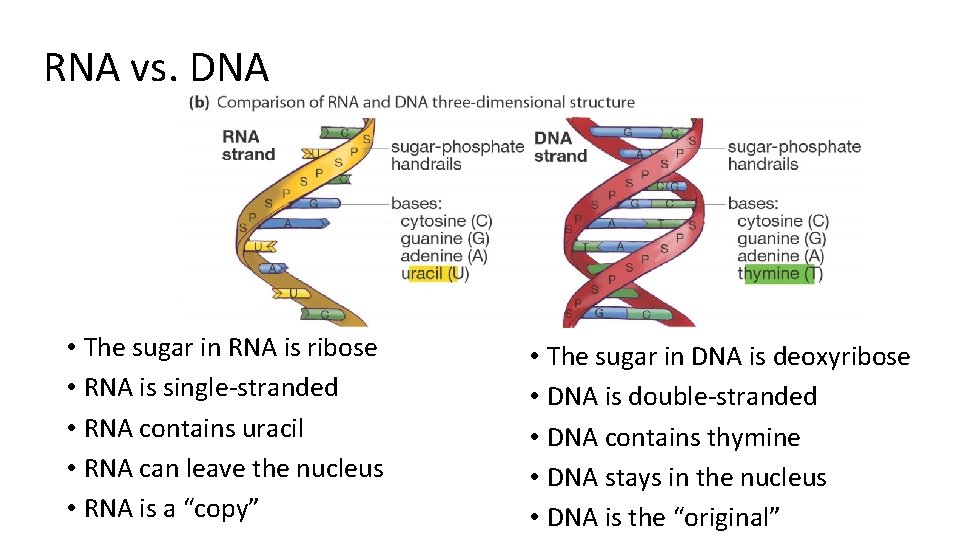
RNA vs. DNA • The sugar in RNA is ribose • RNA is single-stranded • RNA contains uracil • RNA can leave the nucleus • RNA is a “copy” • The sugar in DNA is deoxyribose • DNA is double-stranded • DNA contains thymine • DNA stays in the nucleus • DNA is the “original”
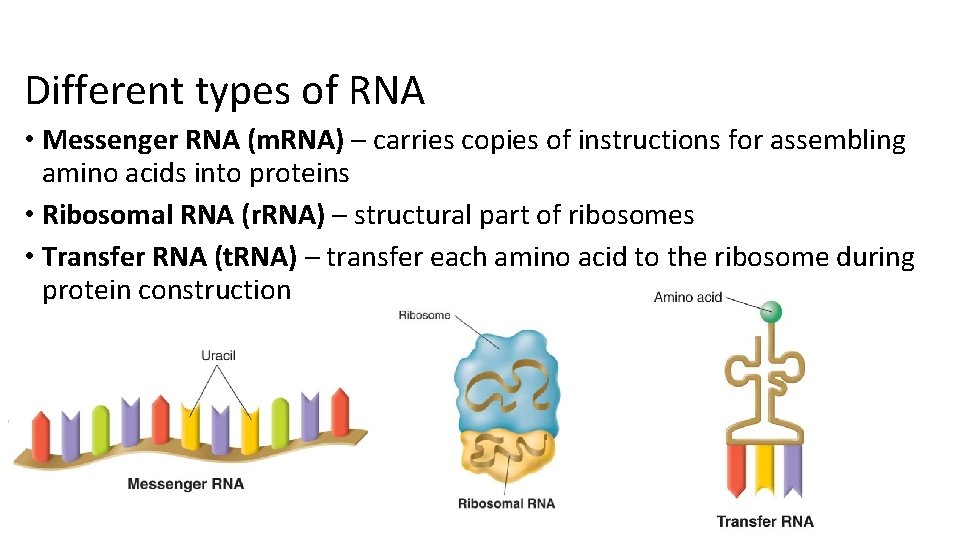
Different types of RNA • Messenger RNA (m. RNA) – carries copies of instructions for assembling amino acids into proteins • Ribosomal RNA (r. RNA) – structural part of ribosomes • Transfer RNA (t. RNA) – transfer each amino acid to the ribosome during protein construction
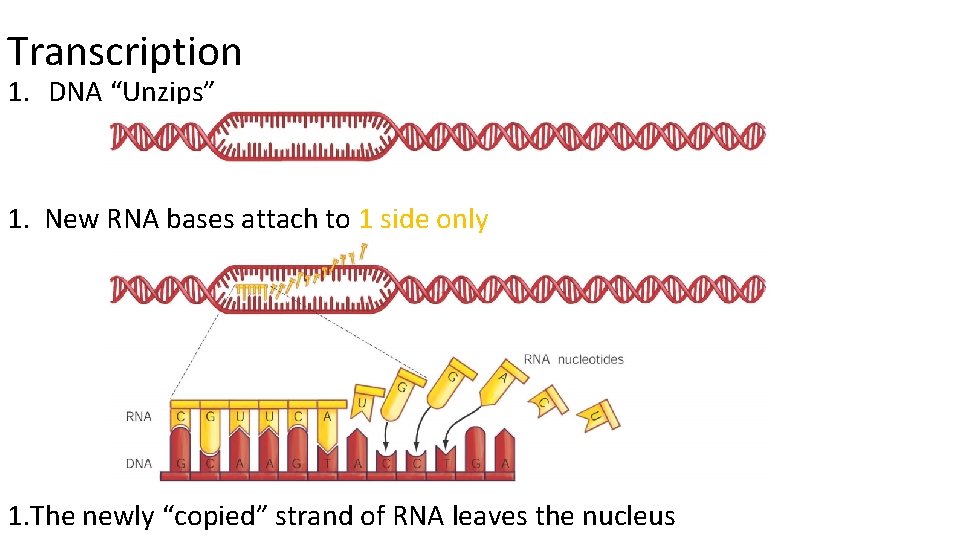
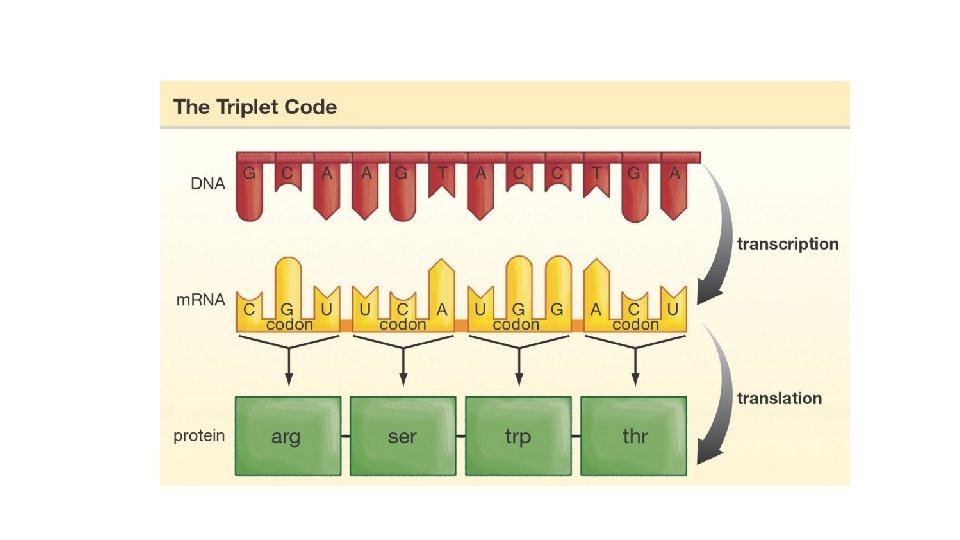
Transcription • DNA → RNA • Copying nucleotide sequence of DNA into a complementary sequence of RNA
Transcription 1. DNA “Unzips” 1. New RNA bases attach to 1 side only 1. The newly “copied” strand of RNA leaves the nucleus
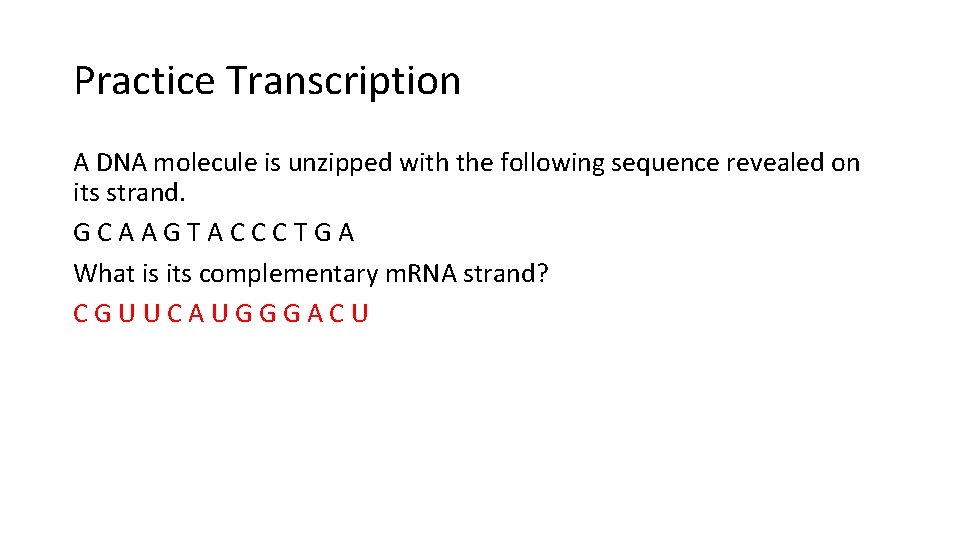
Practice Transcription A DNA molecule is unzipped with the following sequence revealed on its strand. GCAAGTACCCTGA What is its complementary m. RNA strand? CGUUCAUGGGACU
So now we have… • DNA → RNA • Nucleus → leaving nucleus into cytoplasm towards the ribosome • Next is… • RNA → Protein
Translation • Takes place on ribosomes • Cell uses information from messenger RNA to produce proteins
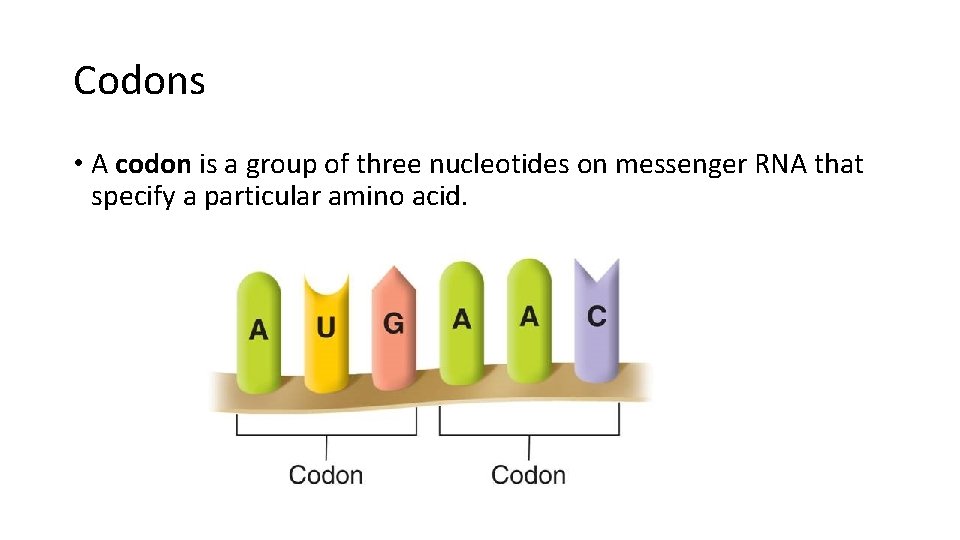
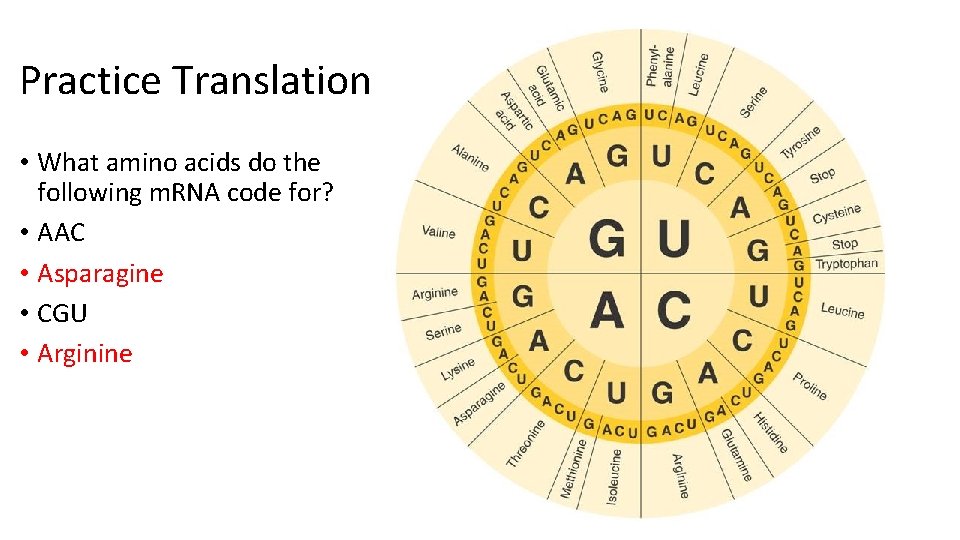
Codons • A codon is a group of three nucleotides on messenger RNA that specify a particular amino acid.
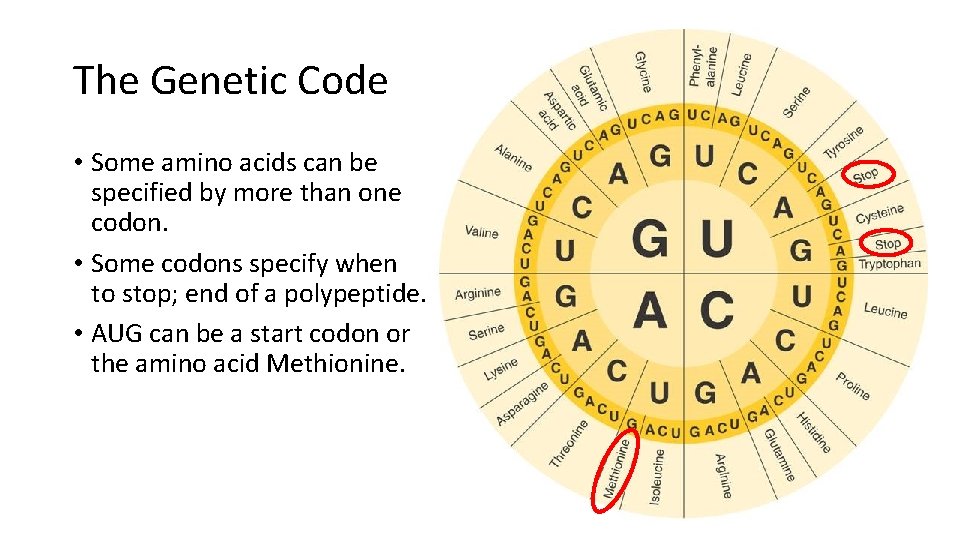
The Genetic Code • Some amino acids can be specified by more than one codon. • Some codons specify when to stop; end of a polypeptide. • AUG can be a start codon or the amino acid Methionine.
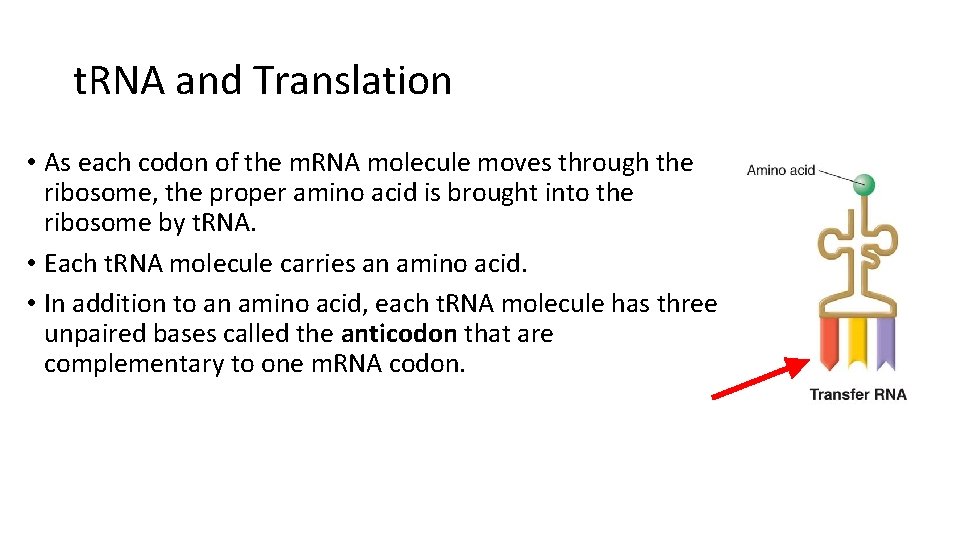
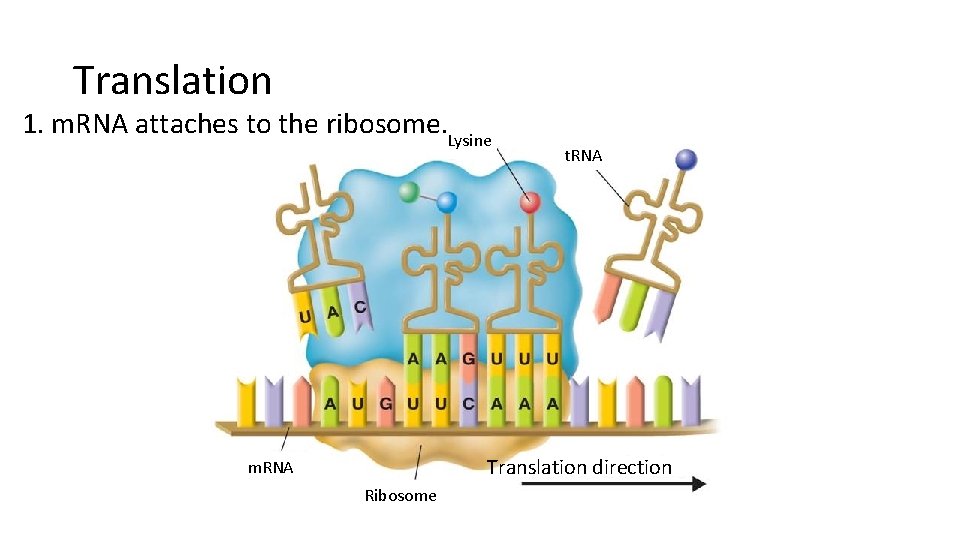
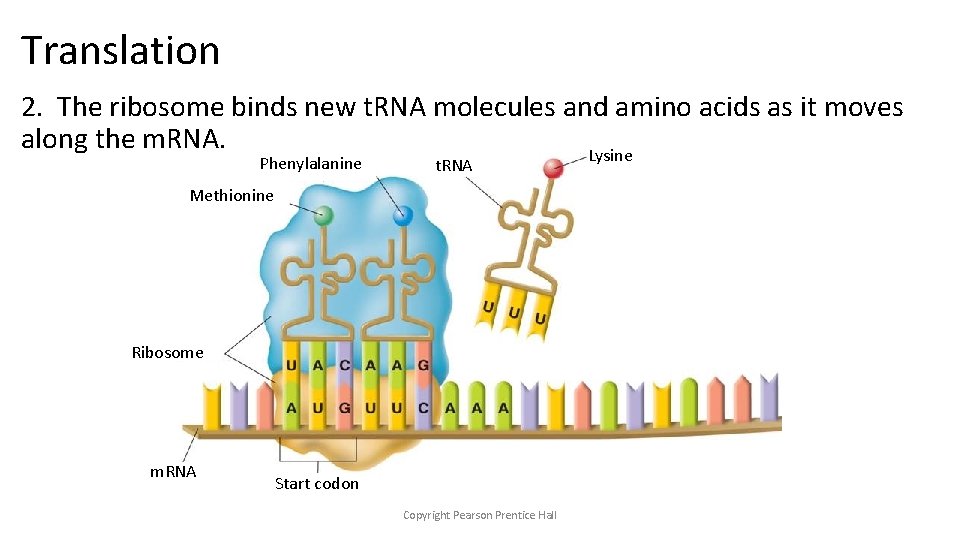
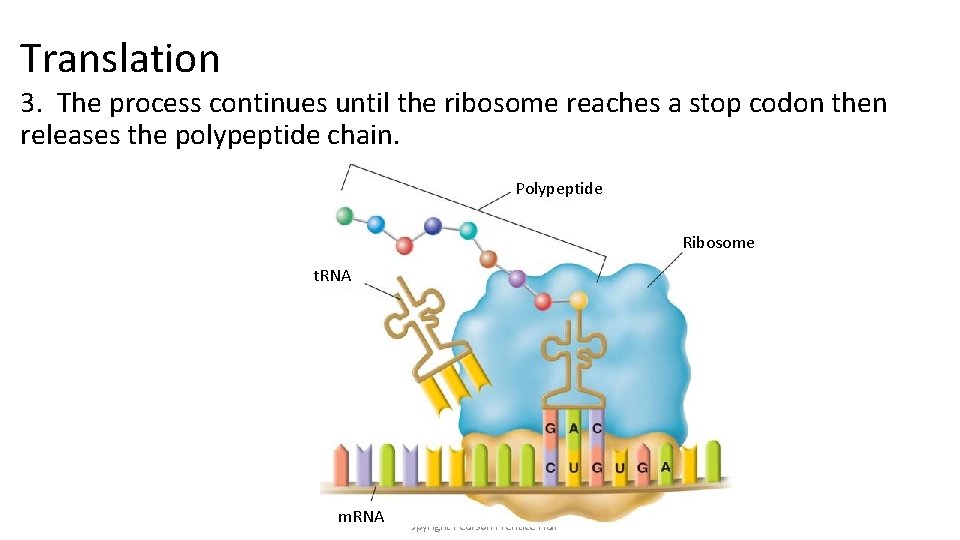
t. RNA and Translation • As each codon of the m. RNA molecule moves through the ribosome, the proper amino acid is brought into the ribosome by t. RNA. • Each t. RNA molecule carries an amino acid. • In addition to an amino acid, each t. RNA molecule has three unpaired bases called the anticodon that are complementary to one m. RNA codon.
Translation 1. m. RNA attaches to the ribosome. Lysine t. RNA Translation direction m. RNA Ribosome Copyright Pearson Prentice Hall
Translation 2. The ribosome binds new t. RNA molecules and amino acids as it moves along the m. RNA. Lysine Phenylalanine t. RNA Methionine Ribosome m. RNA Start codon Copyright Pearson Prentice Hall
Translation 3. The process continues until the ribosome reaches a stop codon then releases the polypeptide chain. Polypeptide Ribosome t. RNA m. RNA Copyright Pearson Prentice Hall
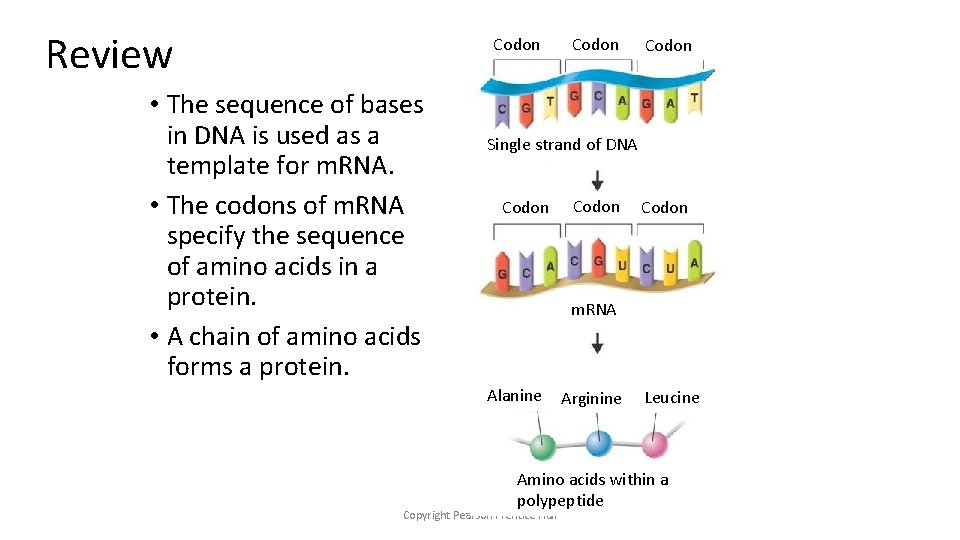
Review Codon • The sequence of bases in DNA is used as a template for m. RNA. • The codons of m. RNA specify the sequence of amino acids in a protein. • A chain of amino acids forms a protein. Codon Single strand of DNA Codon m. RNA Alanine Arginine Leucine Amino acids within a polypeptide Copyright Pearson Prentice Hall
Transcription Translation DNA RNA Protein
Practice Translation • What amino acids do the following m. RNA code for? • AAC • Asparagine • CGU • Arginine
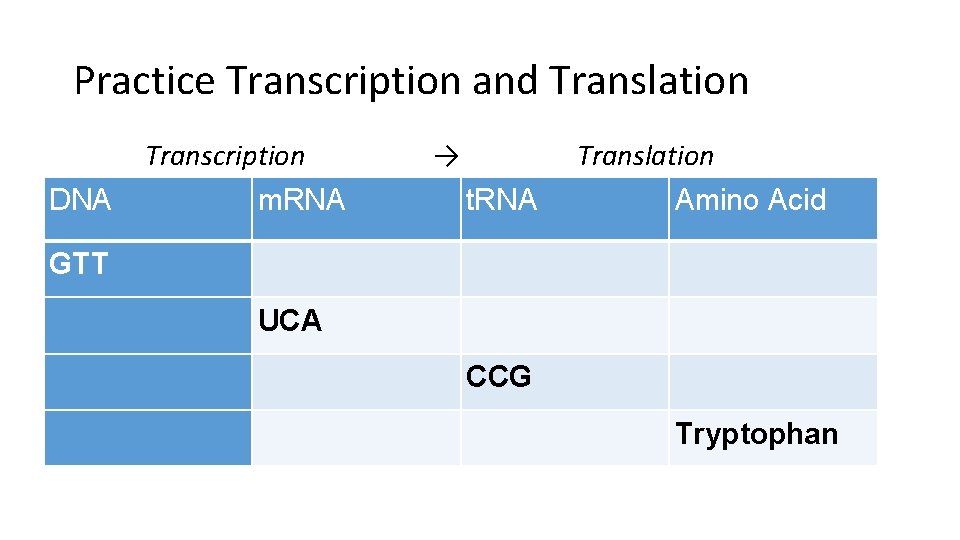
Practice Transcription and Translation Transcription DNA m. RNA → Translation t. RNA Amino Acid GTT UCA CCG Tryptophan
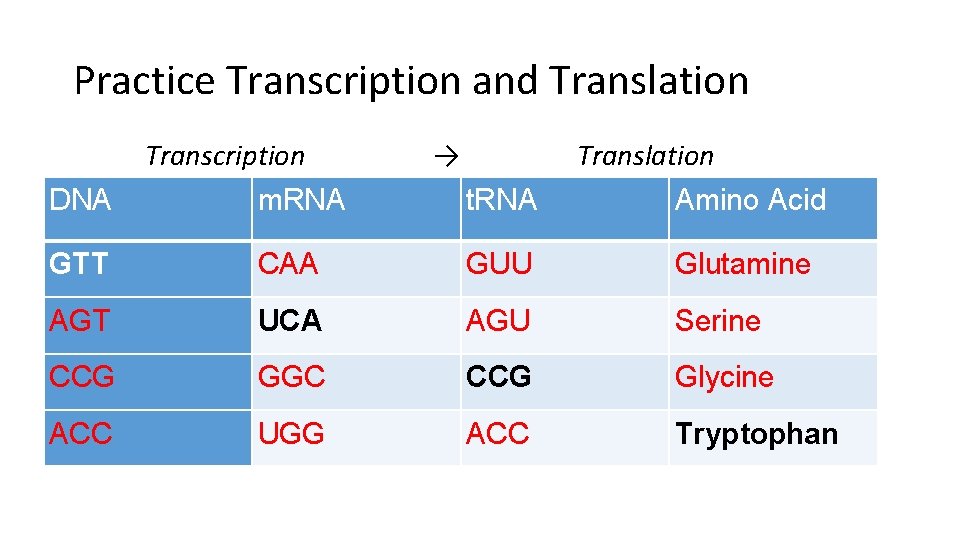
Practice Transcription and Translation Transcription → Translation DNA m. RNA t. RNA Amino Acid GTT CAA GUU Glutamine AGT UCA AGU Serine CCG GGC CCG Glycine ACC UGG ACC Tryptophan
Video • http: //youtu. be/NJxobgk. PEAo