
RNA and Protein Synthesis Chapter 13 Pgs 360

- Slides: 49
RNA and Protein Synthesis Chapter 13 (Pgs 360 -389 Miller and Levine Biology text) http: //www. youtube. com/watch? v=su. Ns. V 0 c. T 6 c
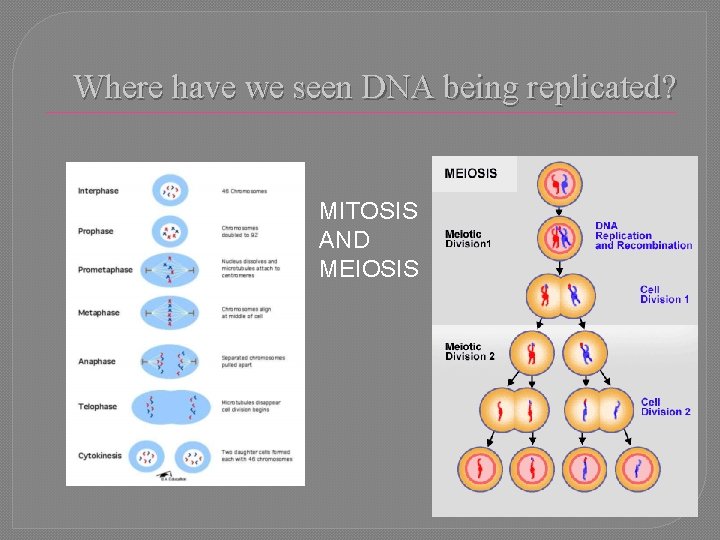
Where have we seen DNA being replicated? MITOSIS AND MEIOSIS
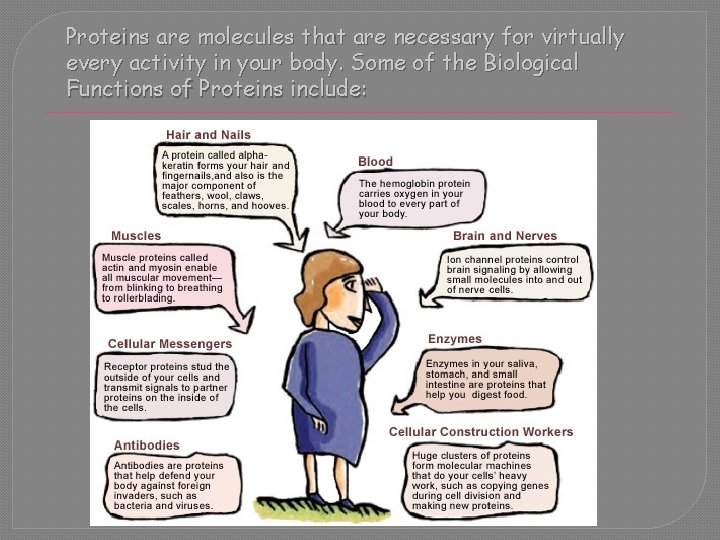
Proteins are molecules that are necessary for virtually every activity in your body. Some of the Biological Functions of Proteins include:
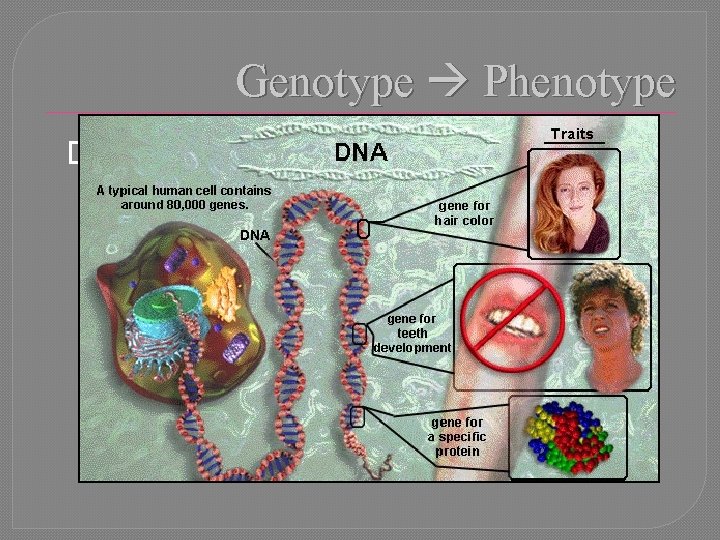
Genotype Phenotype DNA m. RNA t. RNA PROTEIN Transcription Translation
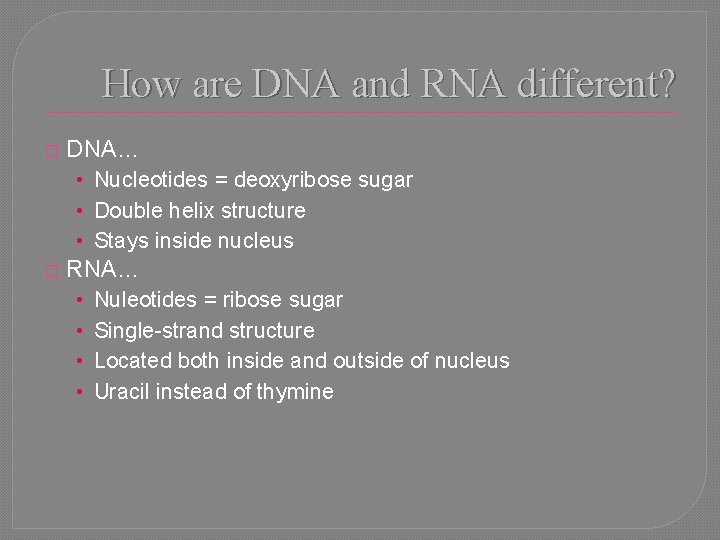
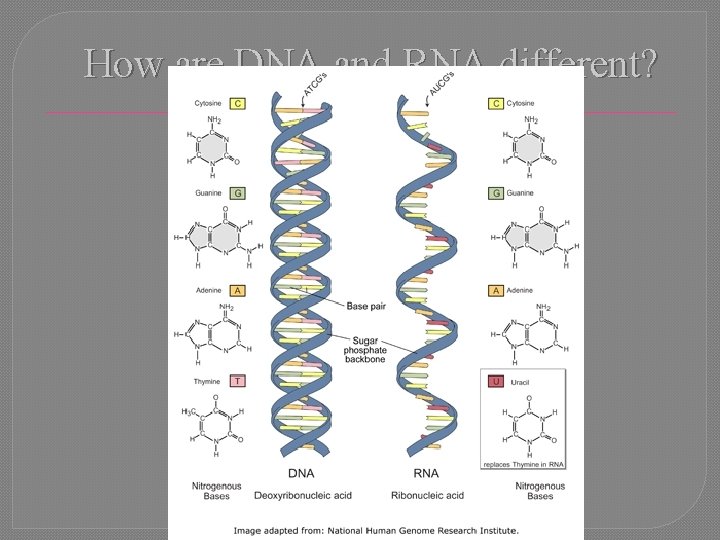
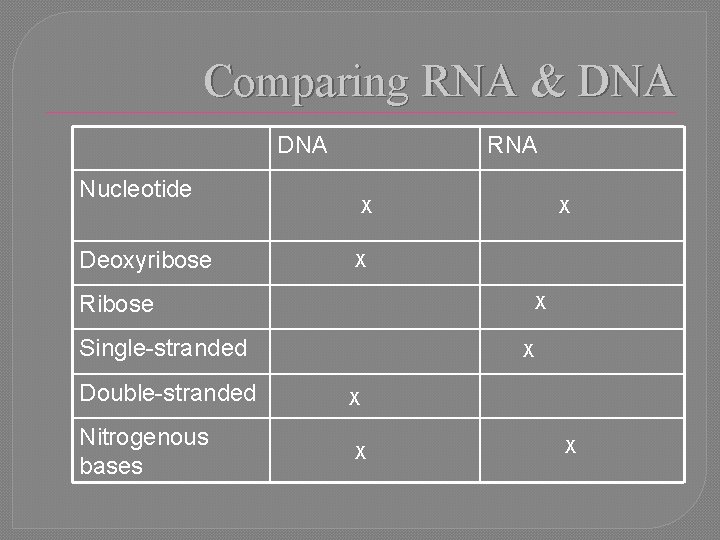
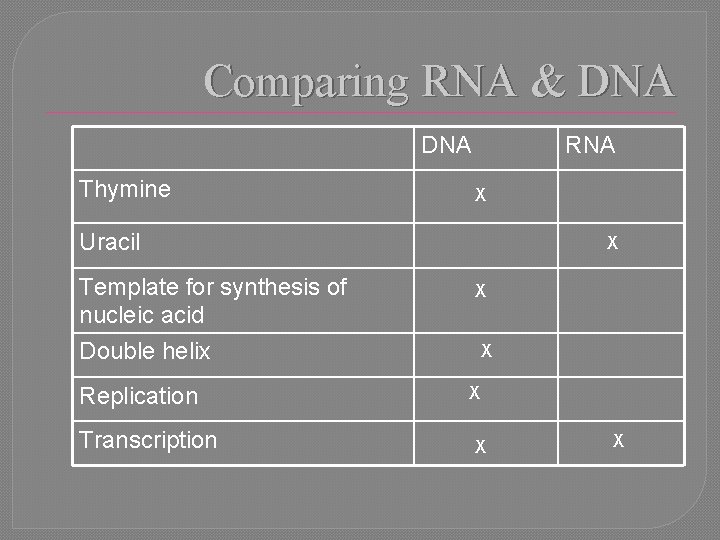
How are DNA and RNA different? � DNA… • Nucleotides = deoxyribose sugar • Double helix structure • Stays inside nucleus � RNA… • • Nuleotides = ribose sugar Single-strand structure Located both inside and outside of nucleus Uracil instead of thymine
How are DNA and RNA different?
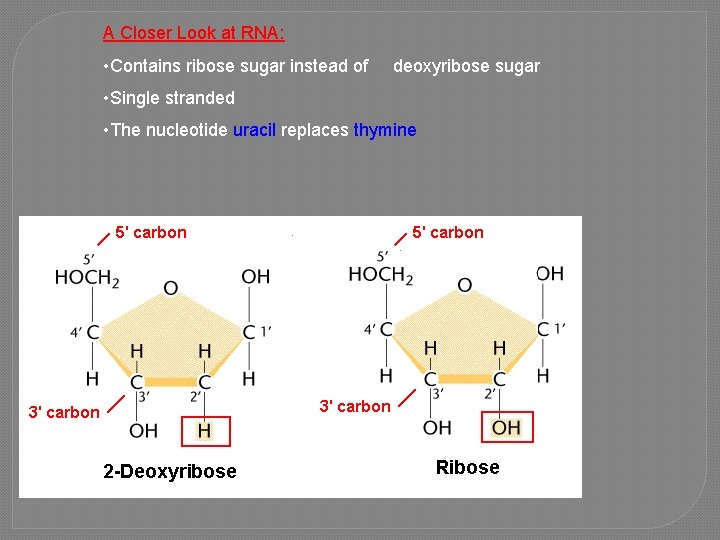
A Closer Look at RNA: • Contains ribose sugar instead of deoxyribose sugar • Single stranded • The nucleotide uracil replaces thymine
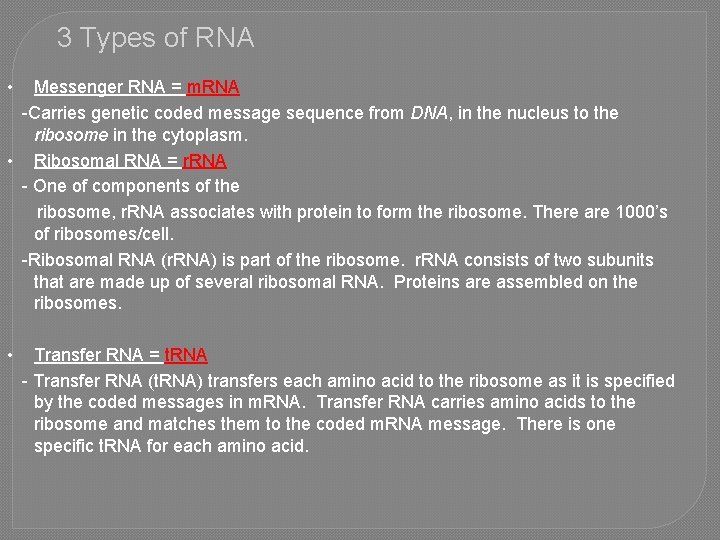
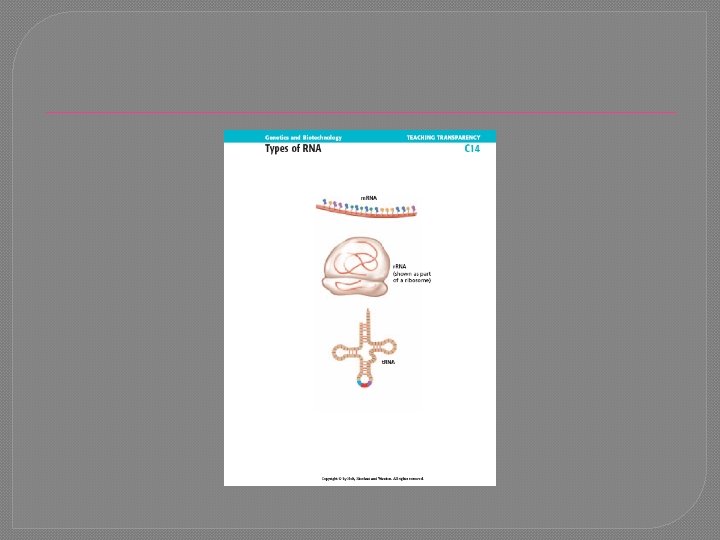
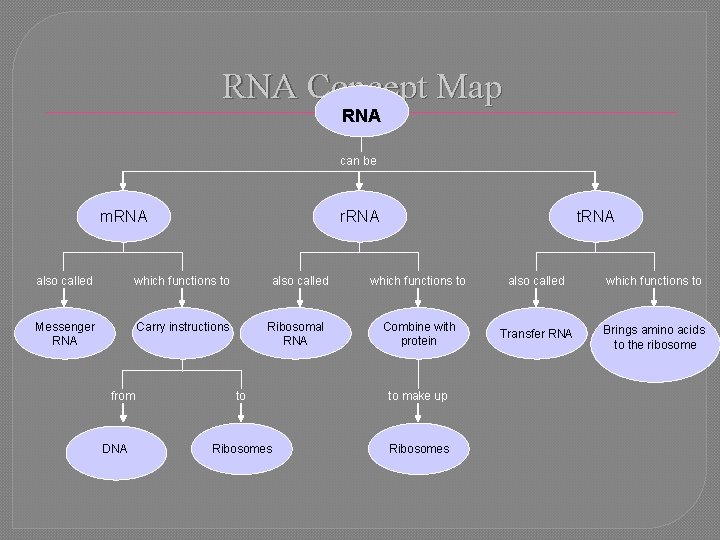
3 Types of RNA • Messenger RNA = m. RNA -Carries genetic coded message sequence from DNA, in the nucleus to the ribosome in the cytoplasm. • Ribosomal RNA = r. RNA - One of components of the ribosome, r. RNA associates with protein to form the ribosome. There are 1000’s of ribosomes/cell. -Ribosomal RNA (r. RNA) is part of the ribosome. r. RNA consists of two subunits that are made up of several ribosomal RNA. Proteins are assembled on the ribosomes. • Transfer RNA = t. RNA - Transfer RNA (t. RNA) transfers each amino acid to the ribosome as it is specified by the coded messages in m. RNA. Transfer RNA carries amino acids to the ribosome and matches them to the coded m. RNA message. There is one specific t. RNA for each amino acid.
http: //www. youtube. com/watch? v=NJxobgk. PEAo
Transcription �m. RNA – stands for messenger RNA • it is the copy of the DNA message for making a protein • Occurs in the nucleus • Promoter region on DNA marks where transcription should start and terminator region marks where it should stop
Basic Principles of Transcription and Translation • Transcription – Is the synthesis of RNA under the direction of DNA – Produces messenger RNA (m. RNA) – In transcription, segments of DNA serve as templates to produce complementary RNA molecules. – In eukaryotes, RNA is produced in the cell’s nucleus and then moves to the cytoplasm.
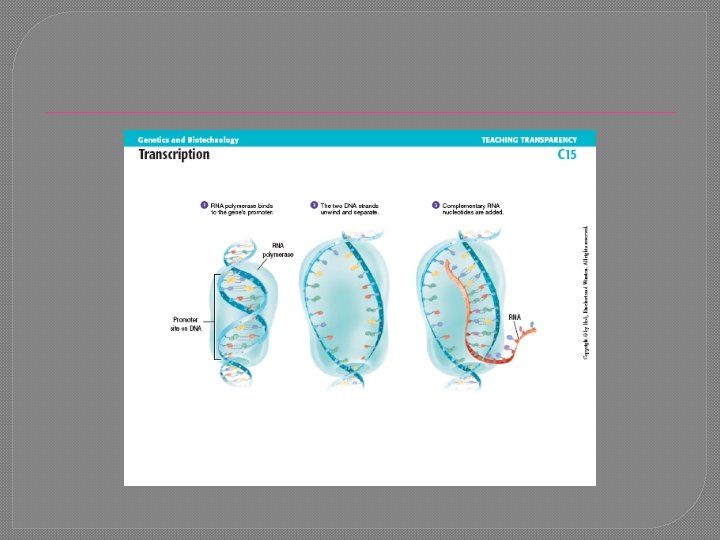
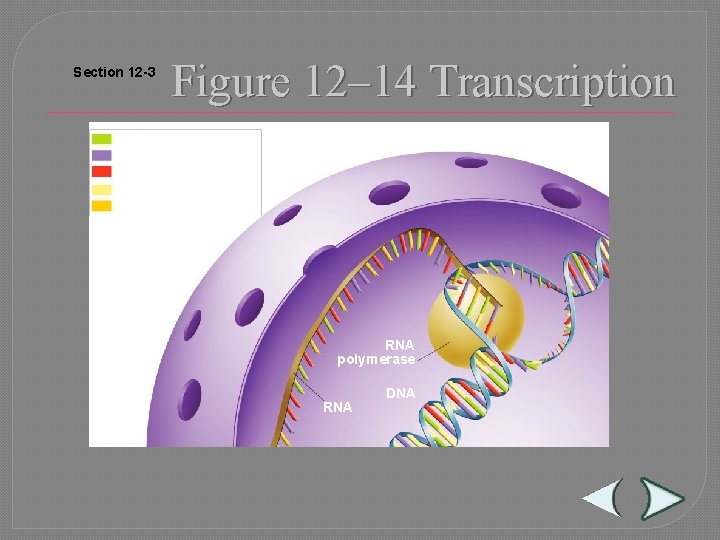
Transcription requires an enzyme known as RNA polymerase • Binds to DNA during transcription and separates the DNA strands. • It uses one strand of DNA as a template to create a complementary strand of RNA.
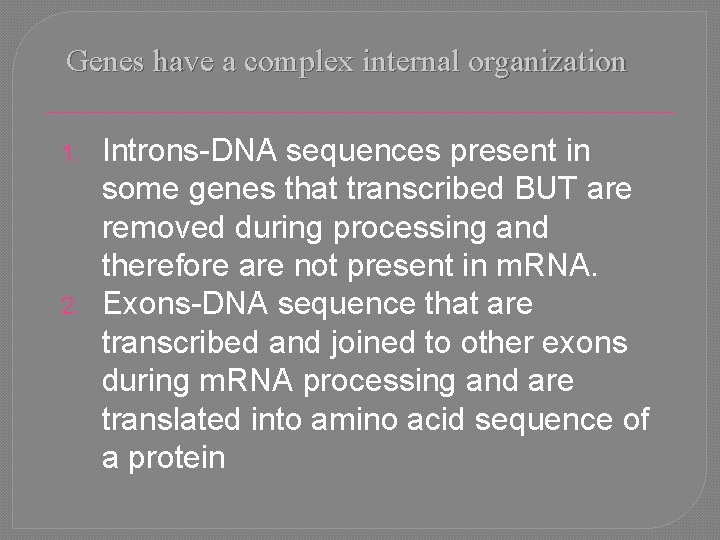
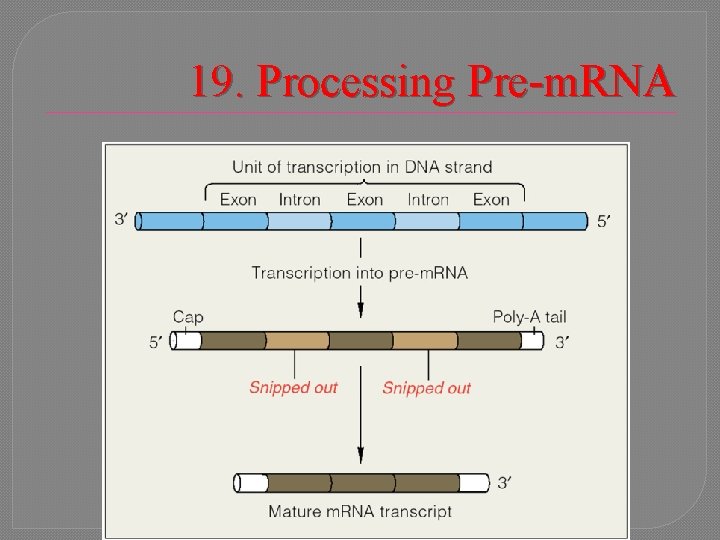
• RNA polymerase only binds to promoters, which are regions of DNA that have specific base sequences. • Before it becomes m. RNA, it is called prem. RNA. Pre-m. RNA molecules have bits and pieces cut of them before they can go into action. The portions that are cut out are called introns. • The remaining pieces, known as exons, are then spliced back together to form the final m. RNA.
Genes have a complex internal organization 1. 2. Introns-DNA sequences present in some genes that transcribed BUT are removed during processing and therefore are not present in m. RNA. Exons-DNA sequence that are transcribed and joined to other exons during m. RNA processing and are translated into amino acid sequence of a protein
19. Processing Pre-m. RNA
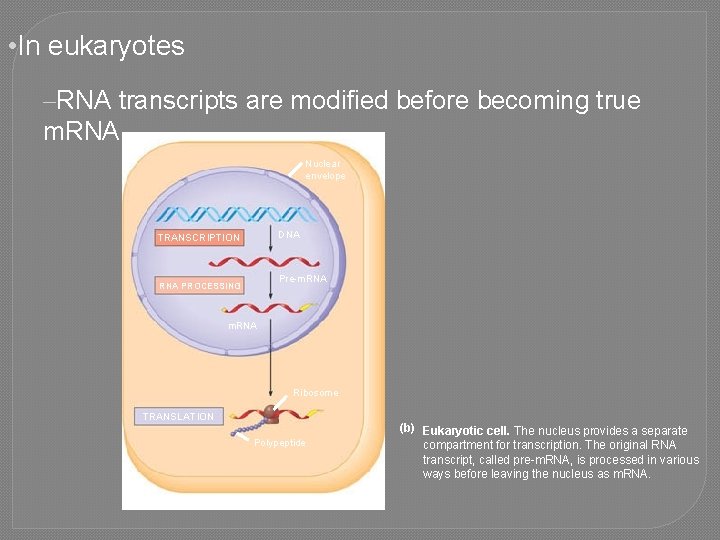
• In eukaryotes –RNA transcripts are modified before becoming true m. RNA Nuclear envelope DNA TRANSCRIPTION Pre-m. RNA PROCESSING m. RNA Ribosome TRANSLATION Polypeptide (b) Eukaryotic cell. The nucleus provides a separate compartment for transcription. The original RNA transcript, called pre-m. RNA, is processed in various ways before leaving the nucleus as m. RNA.
m. RNA �No T (thymine) so when it reads the nucleotide A on DNA it matches it with ____?
Protein Synthesis= transcription and translation �DNA contains all the information for your traits – the genes �These genes are blueprints and need to remain safe – kept inside the nucleus �Copies can be made though – a messenger �http: //www. youtube. com/watch? v=NJxobg k. PEAo
Section 13. 2 Ribosomes and Protein Synthesis �Proteins are made by joining amino acids together into long chains called polypeptides. � 20 different amino acids are commonly found in polypeptides. �RNA contains four different bases: �Adenine, cytosine, guanine, and uracil.
Codons �The genetic code is read three letters at a time, so that each words is three bases long and corresponds to a single amino acid. �Each three letter “word” is called a codon.
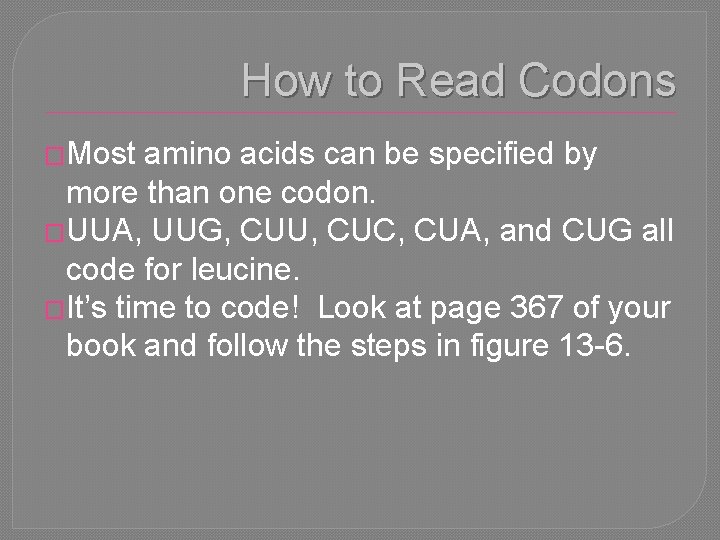
How to Read Codons �Most amino acids can be specified by more than one codon. �UUA, UUG, CUU, CUC, CUA, and CUG all code for leucine. �It’s time to code! Look at page 367 of your book and follow the steps in figure 13 -6.
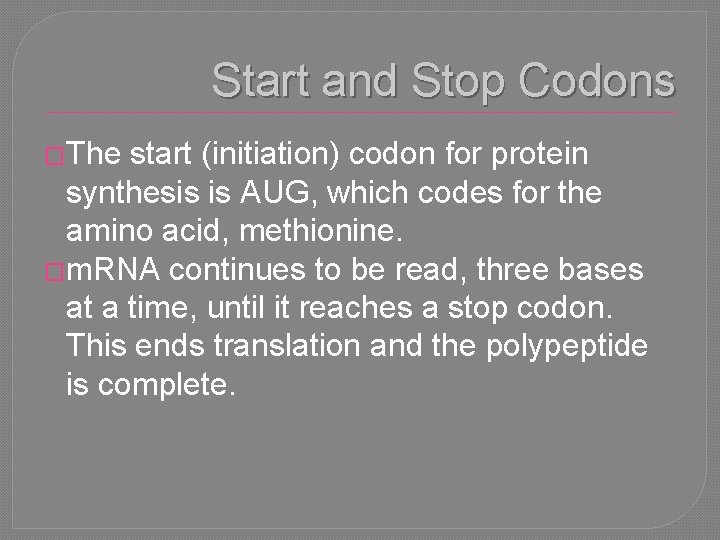
Start and Stop Codons �The start (initiation) codon for protein synthesis is AUG, which codes for the amino acid, methionine. �m. RNA continues to be read, three bases at a time, until it reaches a stop codon. This ends translation and the polypeptide is complete.
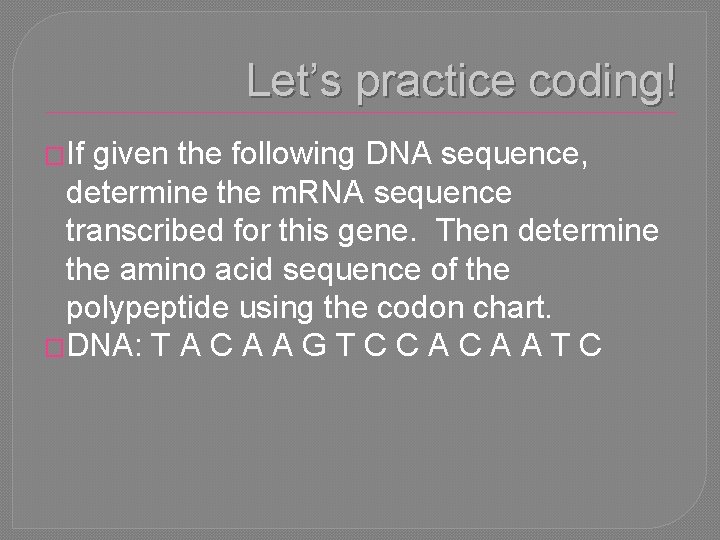
Let’s practice coding! �If given the following DNA sequence, determine the m. RNA sequence transcribed for this gene. Then determine the amino acid sequence of the polypeptide using the codon chart. �DNA: T A C A A G T C C A A T C
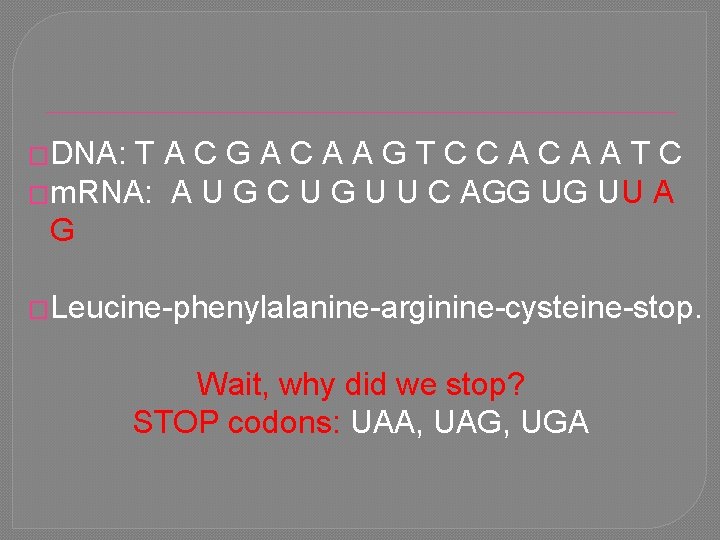
�DNA: TACGACAAGTCCACAATC �m. RNA: A U G C U G U U C AGG UG UU A G �Leucine-phenylalanine-arginine-cysteine-stop. Wait, why did we stop? STOP codons: UAA, UAG, UGA
Translation �m. RNA gives instructions on the order in which amino acids should be joined to produce a polypeptide. �Ribosomes use the sequence of codons in m. RNA to assemble amino acids into polypeptide chains. �Translation is the process of decoding an m. RNA message into a protein.
�Transcription is carried on in the cell’s nucleus. �Translation is carried out by ribosomes after the transcribed m. RNA enters the cell’s cytoplasm.
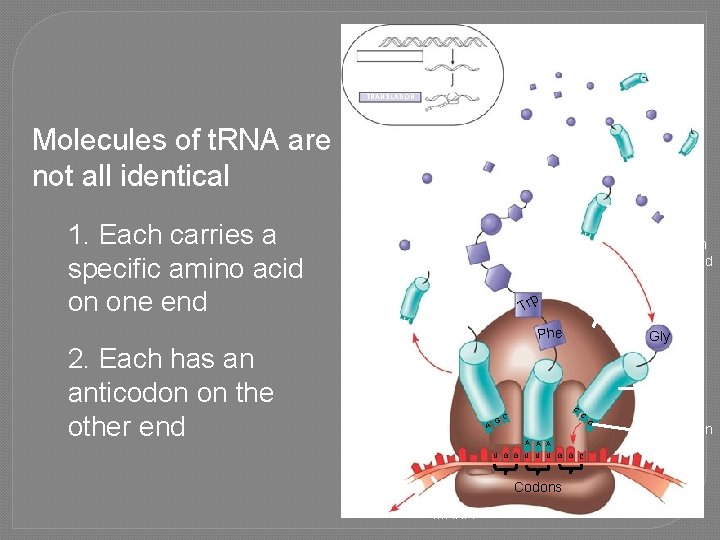
Steps to Translation 1. Translation begins when a ribosome attaches to an m. RNA molecule in the cytoplasm. 2. t. RNA brings the proper amino acid into the ribosome. One at a time, the ribosome attaches these amino acids to the growing chain.
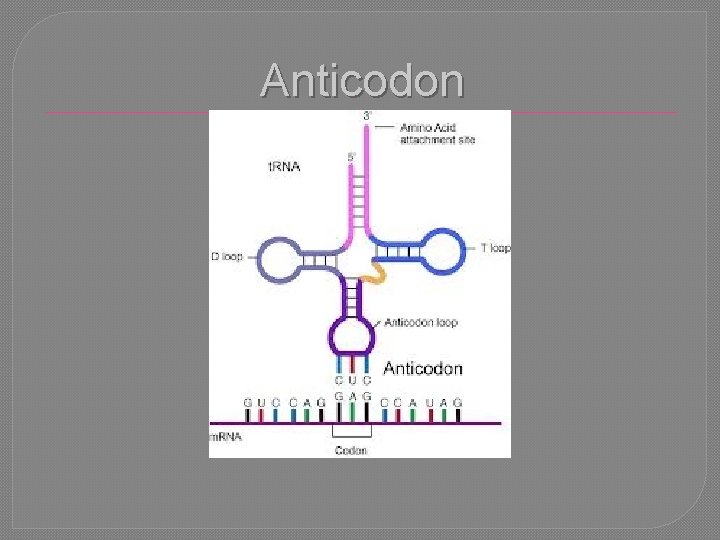
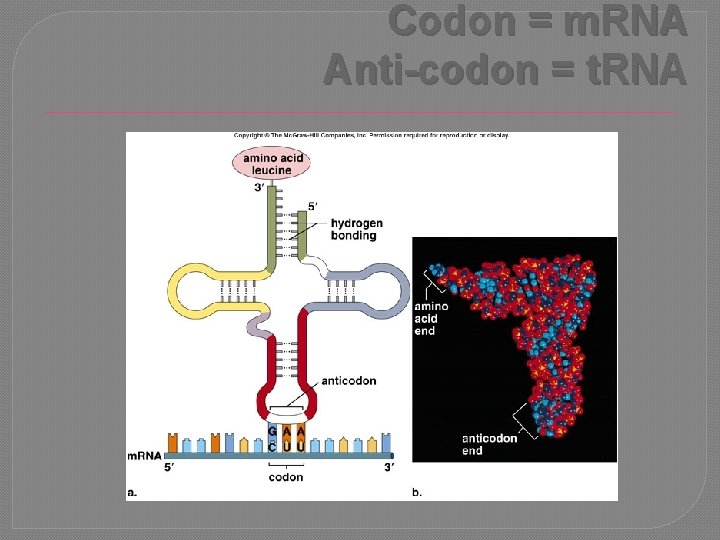
A Little Info about t. RNA �Each t. RNA molecule carries just one kind of amino acid and it contains three unpaired bases. These are called the anticodon. �HOLD UP Mrs. Wald…. WHAT? ! A codon and an anticodon? Please explain.
Anticodon
TRANSCRIPTION DNA m. RNA Ribosome TRANSLATION Polypeptide Molecules of t. RNA are not all identical Amino acids Polypeptide 1. Each carries a specific amino acid on one end Trp Ribosome Phe 2. Each has an anticodon on the other end t. RNA with amino acid attached Gly t. RNA C A G C C G Anticodon A A A U G G U U U G G C Codons 5 m. RNA 3
� If you are provided the codon: AUG The anticodon (which is located on t. RNA) is: UAC Great, so what’s the amino acid? Do you use AUG or UAC? You use the codon, so AUG, which codes for the amino acid methionine.
Let’s continue with t. RNA � 3. The ribosome joins the amino acids in the binding sites and t. RNA floats away from the ribosome. This creates a peptide chain! � 4. The process continues until the ribosome reaches one of three of the stop condons.
3 Forms of RNA �All three forms of RNA come together during translation. �m. RNA carries the coded message. �t. RNA delivers the correct amino acid. �Ribosomes are composed of roughly 80 proteins and 3 or 4 r. RNA molecules. �r. RNA helps hold ribosomal proteins in place and locate the beginning of the m. RNA message.
The Central Dogma of Biology �Proteins have everything to do with traits! �The central dogma of molecular biology is that information is transferred from DNA to RNA to protein.
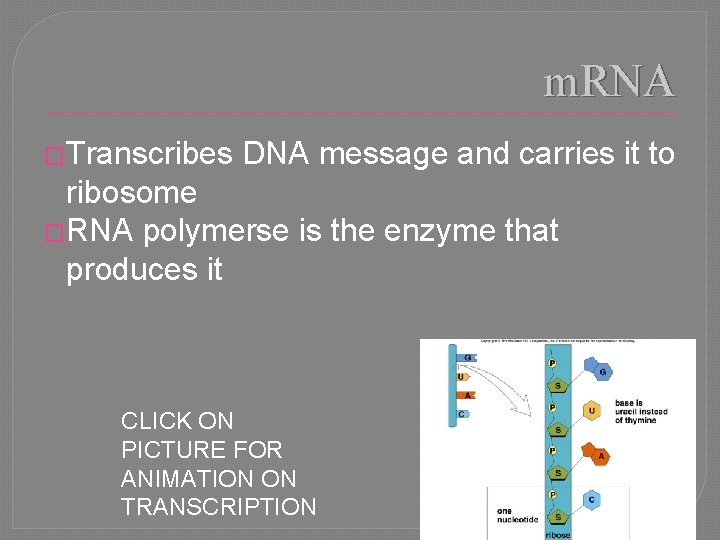
m. RNA �Transcribes DNA message and carries it to ribosome �RNA polymerse is the enzyme that produces it CLICK ON PICTURE FOR ANIMATION ON TRANSCRIPTION
t. RNA �Once m. RNA is made it attaches to a ribosome �t. RNA = transfer RNA and they carry amino acids �Amino acids are the building blocks of proteins (remember? )
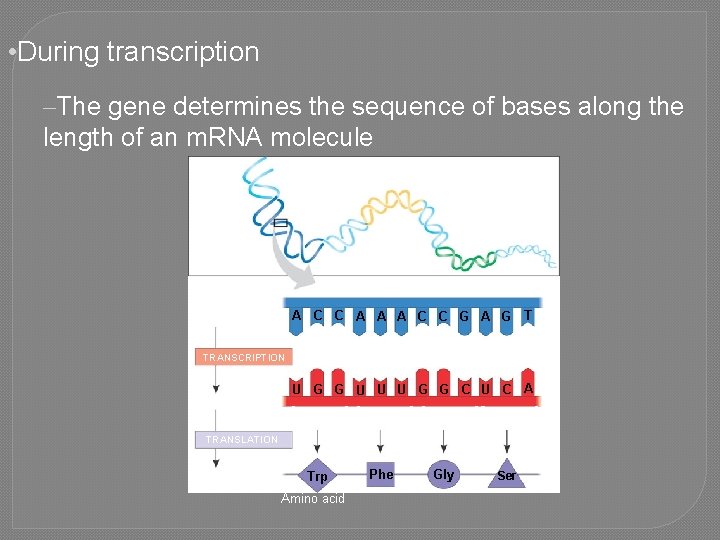
• During transcription –The gene determines the sequence of bases along the length of an m. RNA molecule Gene 2 DNA molecule Gene 1 Gene 3 DNA strand 3 A C C A A A C C G A G T (template) 5 TRANSCRIPTION m. RNA 5 U G G U U U G G C U C A Codon TRANSLATION Protein Trp Amino acid Phe Gly Ser 3
Section 12 -3 Figure 12– 14 Transcription Adenine (DNA and RNA) Cystosine (DNA and RNA) Guanine(DNA and RNA) Thymine (DNA only) Uracil (RNA only) RNA polymerase RNA DNA
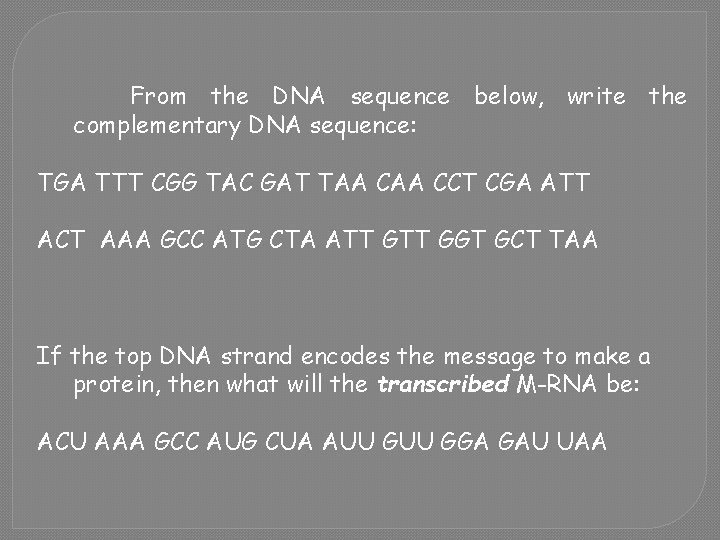
From the DNA sequence below, write the complementary DNA sequence: TGA TTT CGG TAC GAT TAA CCT CGA ATT ACT AAA GCC ATG CTA ATT GGT GCT TAA If the top DNA strand encodes the message to make a protein, then what will the transcribed M-RNA be: ACU AAA GCC AUG CUA AUU GGA GAU UAA
Codon = m. RNA Anti-codon = t. RNA
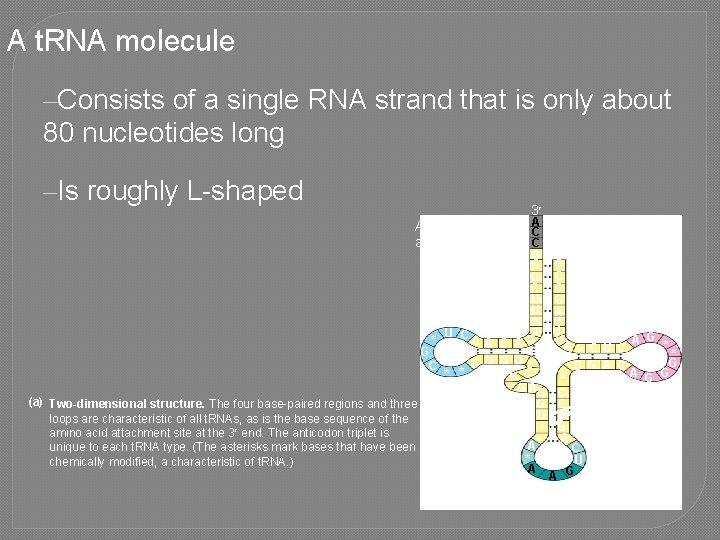
A t. RNA molecule –Consists of a single RNA strand that is only about 80 nucleotides long –Is roughly L-shaped 3 A C C A 5 C G G C C G U A A U U C A C AG * A * G U G C C * * * U C * * G AG C (a) Two-dimensional structure. The four base-paired regions and three G C U A loops are characteristic of all t. RNAs, as is the base sequence of the * G amino acid attachment site at the 3 end. The anticodon triplet is A A* unique to each t. RNA type. (The asterisks mark bases that have been C U * chemically modified, a characteristic of t. RNA. ) A G A Amino acid attachment site Anticodon C U C G A G * * G A G G Hydrogen bonds
Molecular Components of Translation • A cell translates an m. RNA message into protein –With the help of transfer RNA (t. RNA) http: //highered. mcgrawhill. com/sites/dl/free/0072437316/120060/r avenanimation. html
Molecular Components of Transcription • RNA synthesis – Is catalyzed by RNA polymerase, which pries the DNA strands apart and hooks together the RNA nucleotides – Follows the same base-pairing rules as DNA, except that in RNA, uracil substitutes for thymine
Comparing RNA & DNA RNA Nucleotide Deoxyribose X X X Ribose X Single-stranded Double-stranded Nitrogenous bases X X
Comparing RNA & DNA Thymine RNA X Uracil Template for synthesis of nucleic acid Double helix Replication Transcription X X X
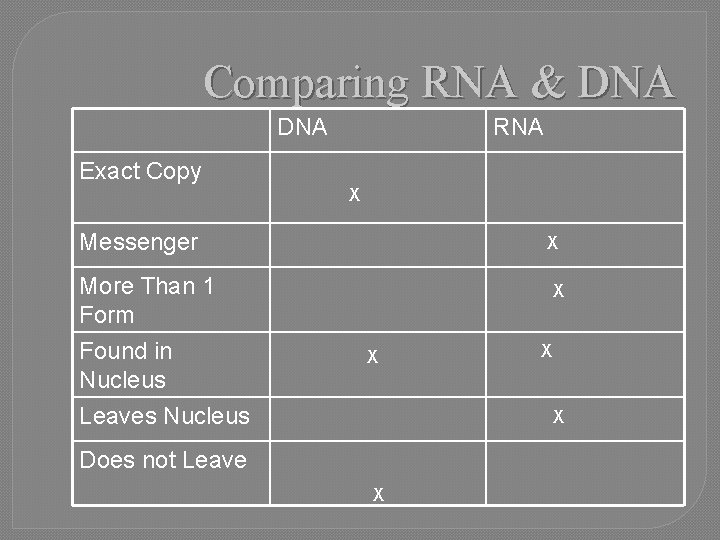
Comparing RNA & DNA RNA Exact Copy X Messenger More Than 1 Form Found in Nucleus Leaves Nucleus X X X Does not Leave X
RNA Concept Map RNA can be m. RNA r. RNA also called which functions to Messenger RNA Carry instructions from DNA also called Ribosomal RNA t. RNA which functions to also called which functions to Combine with protein Transfer RNA Brings amino acids to the ribosome to to make up Ribosomes