
RN Skills Laboratory Documentation Week 3 Objectives n
RN Skills Laboratory Documentation Week 3
Objectives n n n Admission & Discharge Nursing History Charting Care Planning Reporting
Admissions n n n Advanced Directives Clients Bill of Rights Assessment by RN Clearly identifiable by wrist band Consent by adult guardians or DPOAs
Discharges n n n Discharge instructions are given Follow-up information is given Education and handouts
Nursing History n Essential elements of clinical care – – n Empathic listening Interviewing at all ages, moods, and backgrounds Examination of different body systems Clinical reasoning Structure and purpose – Comprehensive vs Focused – Subjective vs objective
Nursing History n Initial Information – Identifying Data – Reliability n n Chief Compliant (HPI) Medications Allergies Past History – Medical, Surgical, Ob/Gyn, Psych
Nursing History n n Family History Personal and Social History – Substance use: smoking, alcohol, drugs – Occupation, Education – Interest, coping, Strengths, Fears – Marital status, Home situation – Exercise/diet, alternative health – Safety, spirituality
Nursing History n Review of the systems (ROS) – – – General Skin HEENT Breasts Respiratory Cardiovascular, Peripheralvascular Gastrointestinal Urinary Genital Musculoskeletal Psychiatric, Neurological Hematologic, Endocrine
HPI n n Essential elements to gathering data for present illness Usually start 2 days before Then day before Then the current day
HPI n PQRSTU – Provocative or Palliative – Quality or Quantity – Region or Radiation – Severity Scales – Timing – Understanding
HPI n OLDCARTS – – – – Onset Location Duration Character Aggravating/associated symptoms Relieving factors Temporal factors Severity
Charting Guidelines n n n n Procedure done Detailed description of the procedure Equipment used Characteristics of expected or unexpected findings Patient/family response Care plan addressed Signature, designation (J. Kennett, SN)
Care Planning n n n Approved WCU Care Plan Template Demographic information Vital Signs Admission Diagnosis Diagnostic Procedures/Surgeries (with dates) Discharge Referrals
Care Planning n n n Erickson’s Developmental Stage Socioeconomic/Cultural Orientation Psychosocial Considerations History of Present Illness Past medical/surgical history (with dates) Labs
Care Planning n n Pathophysiology (Need a med/surg text book – no Tabers or Internet) Collaborative Problems – Prescriber’s Orders with rationale n n n Medication list Risk problem Actual problem
Change of Shift Report n n n There is little agreement on what makes a good report Report is information and relationship exchange Change of shift report is part of nursing culture that can improve patient care
Change of Shift Report n n n Be supported and therapeutic when communicating information Provide information, actions and outcomes Shift reports demonstrate the value of nursing actions, reflects nurses’ motivation and patient satisfaction
Change of Shift Report n n n Avoid negative criticism, praise for work well done Not merely a mechanism of communication but activities prescribed by the physician and nursing activities Do not give commentaries of staff or patient management
Change of Shift Report n Strategies in giving a good report – Incorporate into the plan of care – Site activities that have been done, and those that have not been done – What are the discharge plans – Make sure your notes are documented in the clinical record
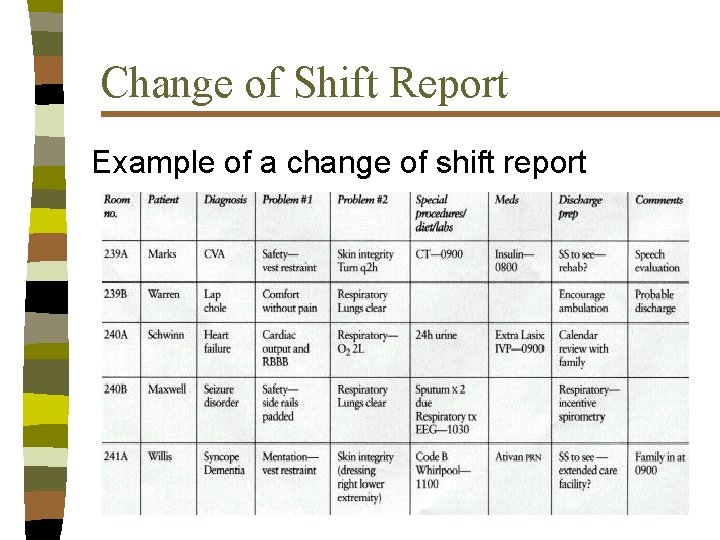
Change of Shift Report Example of a change of shift report
Change of Shift Report Example of a narrative shift report n In room 2203 -2 is John Doe n 78 year old male n Patient of Dr. Jones n Admitted with FUO, currently being treated for sepsis n His problems areas are….
Change of Shift Report n n n Alert/Oriented now B/P - stable the last 12 hours -110/70 at 1600 Fluids - receiving IV replacement and taking PO Output is improving 1800 ml yesterday 2600 ml today - we need an UA C&S in the AM Social Services is talking about placement because the family can not continue to care for him at home
Change of Shift Report References Hays, M. M. (2003). The phenomenal shift report: A paradox. Journal for Nurses in Staff Development 19 (1), 25 -33. Mosher, C. & Bontomasi, R. (1996). How to improve your shift report. American Journal of Nursing 96(8), 32 -34.
- Slides: 23