
RMON 1 RMON 2 RMON is a set



- Slides: 26
RMON 1
RMON 2 �RMON is a set of standardized MIB variables that monitor networks. Even if RMON initially referred to only the RMON MIB, the term RMON now is often used to refer to the concept of remote monitoring and to the entire series of RMON MIB extensions
RMON Goal 3 �The initial goal of RMON was to: monitor network traffic in a local-area network (LAN) environment to provide comprehensive information for network fault diagnosis, planning, and performance tuning to network administrators.
RMON approach 4 �RMON implements a passive collection approach that measures specific aspects of the traffic without interfering by adding monitoring traffic.
RMON devices 5 RMON can be implemented in network elements, such as Cisco routers and switches, or it can be deployed using dedicated RMON probes
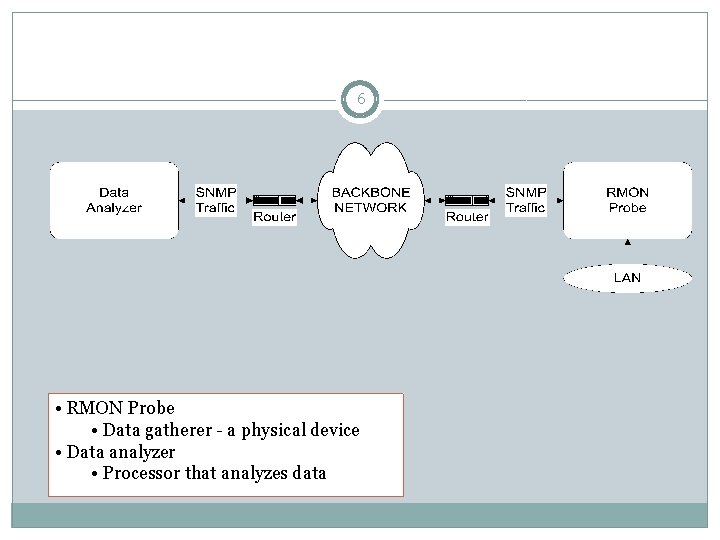
6 • RMON Probe • Data gatherer - a physical device • Data analyzer • Processor that analyzes data
7
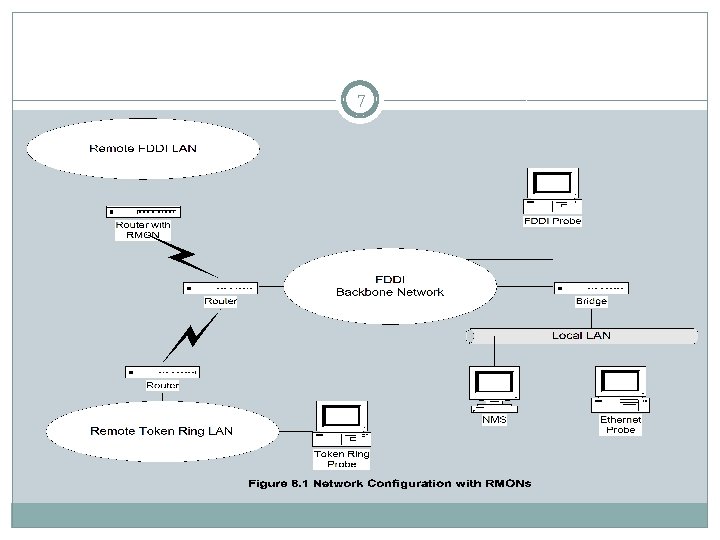
8 • Note that RMON is embedded monitoring remote FDDI LAN • Analysis done in NMS
RMON Benefits 9 • Monitors and analyzes locally and relays data; Less load on the network • Needs no direct visibility by NMS; More reliable information • Permits monitoring on a more frequent basis and hence faster fault diagnosis • Increases productivity for administrators
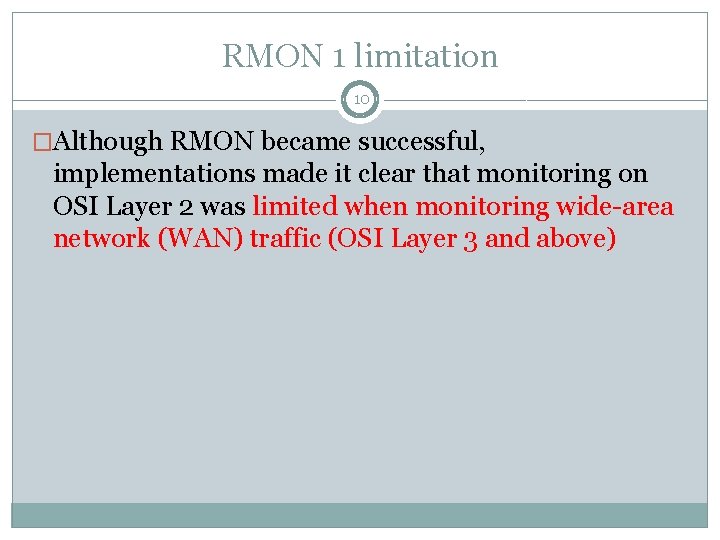
RMON 1 limitation 10 �Although RMON became successful, implementations made it clear that monitoring on OSI Layer 2 was limited when monitoring wide-area network (WAN) traffic (OSI Layer 3 and above)
RMON 2 11 �RMON version 2 (RMON 2) is an extension to RMON version 1 (RMON 1), which refers to the initial RMON specifications monitoring on OSI Layer 2. RMON 2 focuses on the layers of traffic above the Media Access Control (MAC) layer; the main enhancement of RMON 2 is the capability to measure Layer 3 network traffic and application statistics.
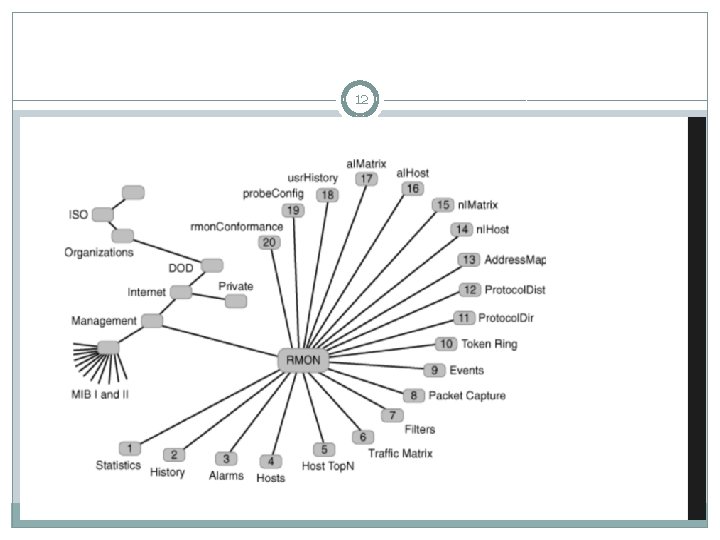
12
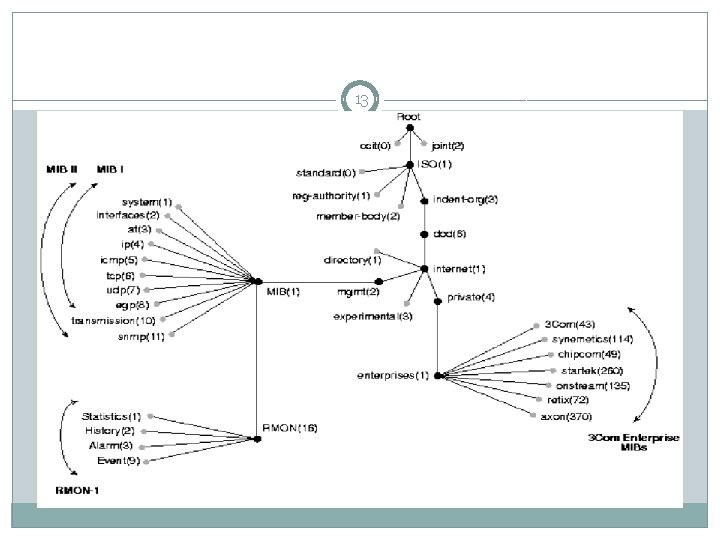
13
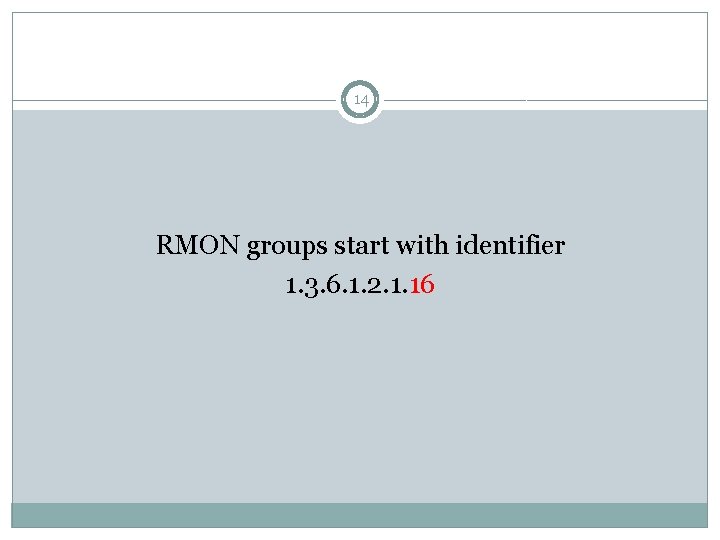
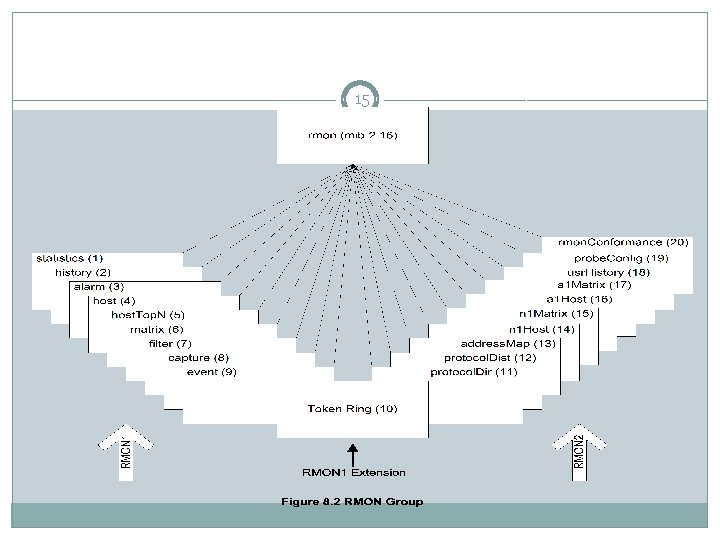
14 RMON groups start with identifier 1. 3. 6. 1. 2. 1. 16
15
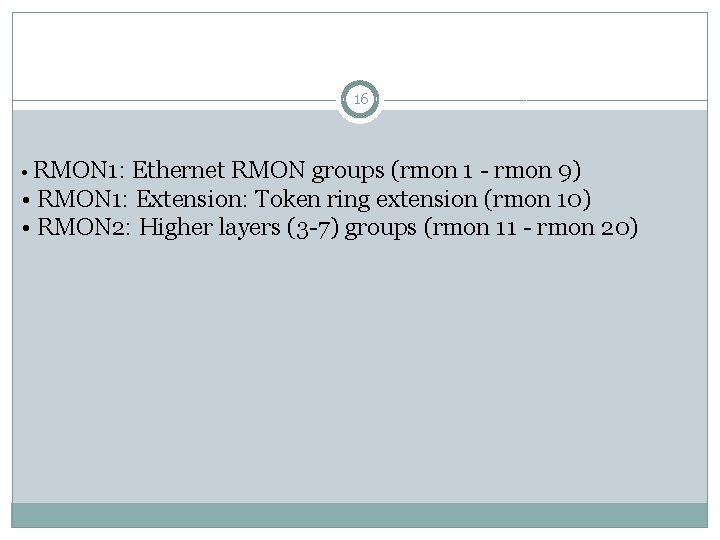
16 • RMON 1: Ethernet RMON groups (rmon 1 - rmon 9) • RMON 1: Extension: Token ring extension (rmon 10) • RMON 2: Higher layers (3 -7) groups (rmon 11 - rmon 20)
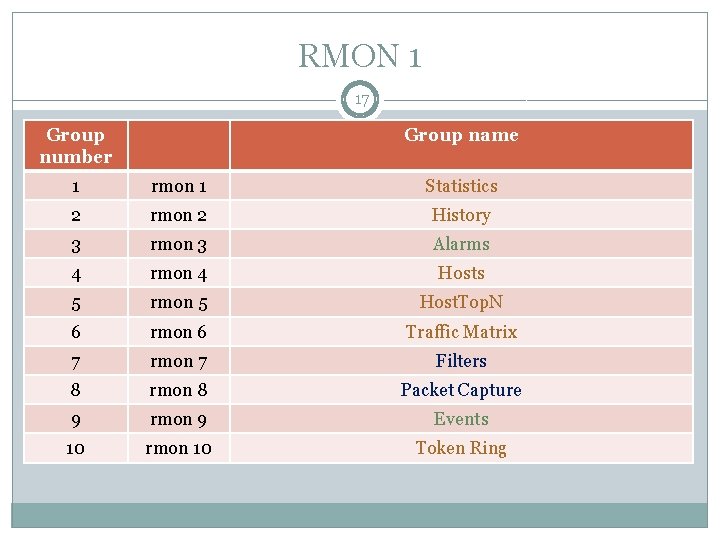
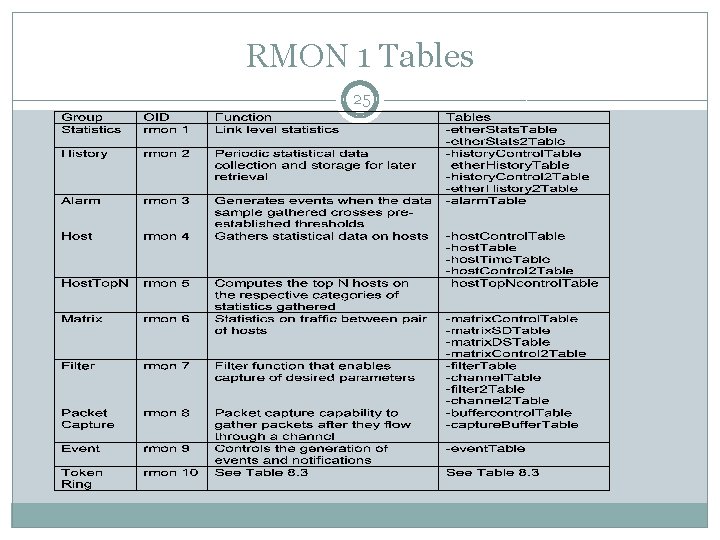
RMON 1 17 Group number Group name 1 rmon 1 Statistics 2 rmon 2 History 3 rmon 3 Alarms 4 rmon 4 Hosts 5 rmon 5 Host. Top. N 6 rmon 6 Traffic Matrix 7 rmon 7 Filters 8 rmon 8 Packet Capture 9 rmon 9 Events 10 rmon 10 Token Ring
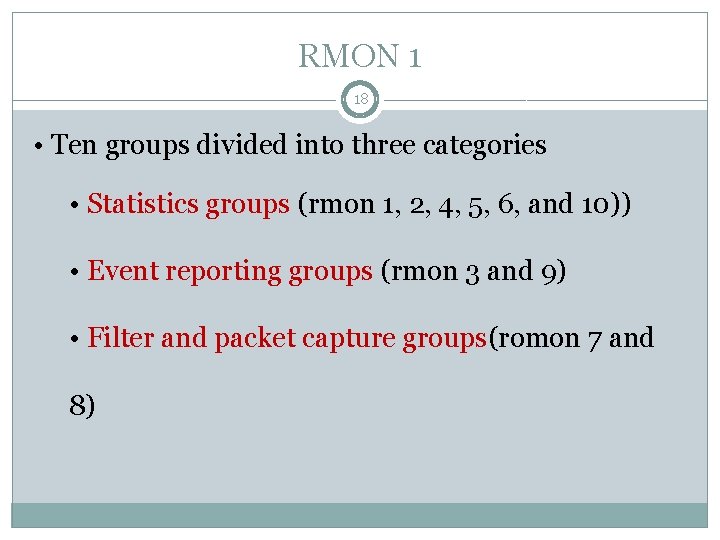
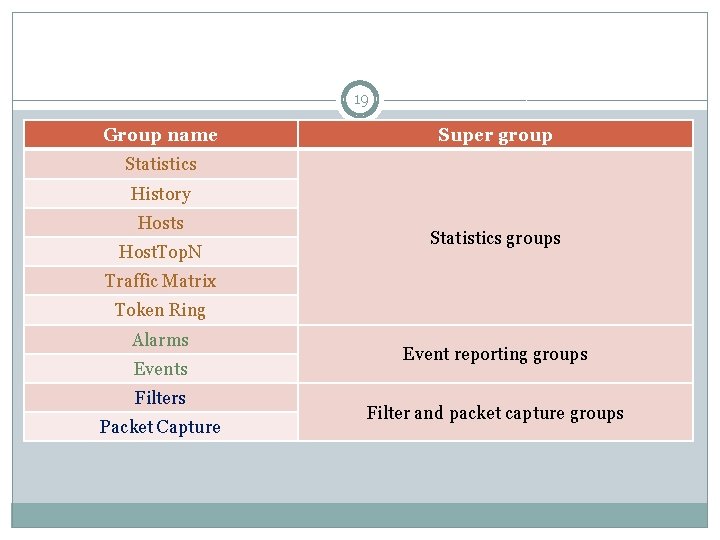
RMON 1 18 • Ten groups divided into three categories • Statistics groups (rmon 1, 2, 4, 5, 6, and 10)) • Event reporting groups (rmon 3 and 9) • Filter and packet capture groups(romon 7 and 8)
19 Group name Super group Statistics History Hosts Host. Top. N Statistics groups Traffic Matrix Token Ring Alarms Events Filters Packet Capture Event reporting groups Filter and packet capture groups
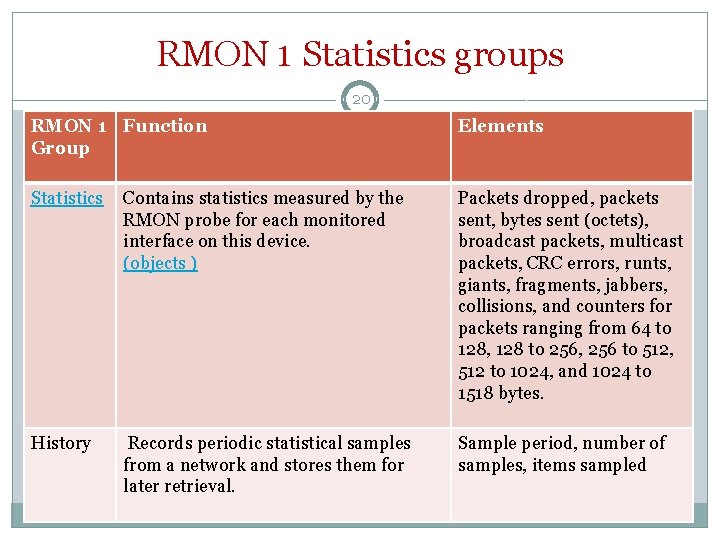
RMON 1 Statistics groups 20 RMON 1 Function Group Elements Statistics Contains statistics measured by the RMON probe for each monitored interface on this device. (objects ) Packets dropped, packets sent, bytes sent (octets), broadcast packets, multicast packets, CRC errors, runts, giants, fragments, jabbers, collisions, and counters for packets ranging from 64 to 128, 128 to 256, 256 to 512, 512 to 1024, and 1024 to 1518 bytes. History Records periodic statistical samples from a network and stores them for later retrieval. Sample period, number of samples, items sampled
RMON 1 Statistics groups 21 RMON 1 Group Function Elements Hosts Contains statistics associated with each Host MAC address, packets, host discovered on the LAN. and bytes received and transmitted, as well as number of broadcast, multicast, and error packets. Host. Top. N Prepares tables that describe the hosts Statistics, host(s), sample that top a list ordered by one of their start and stop periods, rate base statistics over an interval specified base, and duration. by the management station. Thus, these statistics are rate-based
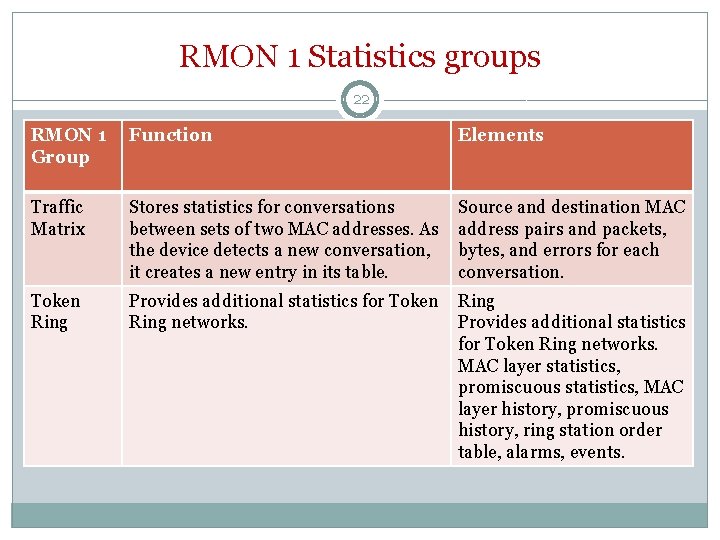
RMON 1 Statistics groups 22 RMON 1 Group Function Elements Traffic Matrix Stores statistics for conversations between sets of two MAC addresses. As the device detects a new conversation, it creates a new entry in its table. Source and destination MAC address pairs and packets, bytes, and errors for each conversation. Token Ring Provides additional statistics for Token Ring networks. MAC layer statistics, promiscuous statistics, MAC layer history, promiscuous history, ring station order table, alarms, events.
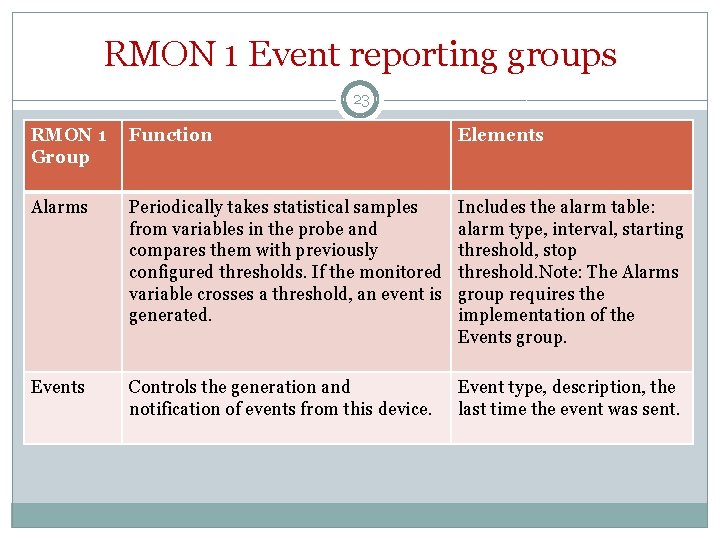
RMON 1 Event reporting groups 23 RMON 1 Group Function Elements Alarms Periodically takes statistical samples from variables in the probe and compares them with previously configured thresholds. If the monitored variable crosses a threshold, an event is generated. Includes the alarm table: alarm type, interval, starting threshold, stop threshold. Note: The Alarms group requires the implementation of the Events group. Events Controls the generation and notification of events from this device. Event type, description, the last time the event was sent.
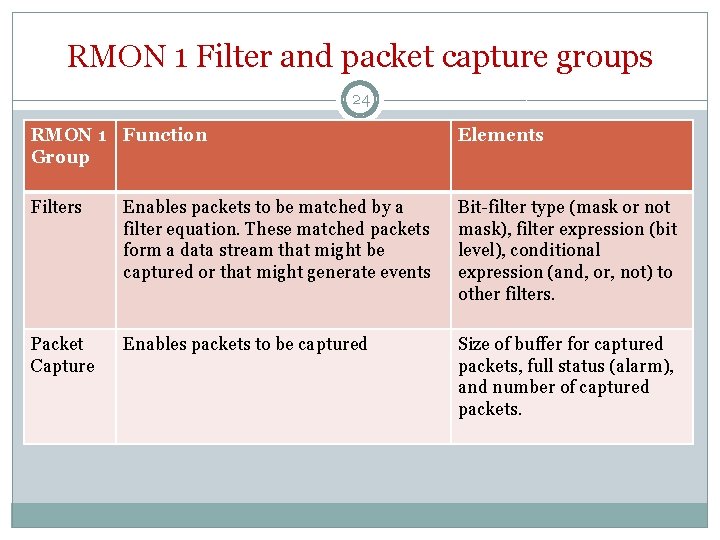
RMON 1 Filter and packet capture groups 24 RMON 1 Function Group Elements Filters Enables packets to be matched by a filter equation. These matched packets form a data stream that might be captured or that might generate events Bit-filter type (mask or not mask), filter expression (bit level), conditional expression (and, or, not) to other filters. Packet Capture Enables packets to be captured Size of buffer for captured packets, full status (alarm), and number of captured packets.
RMON 1 Tables 25
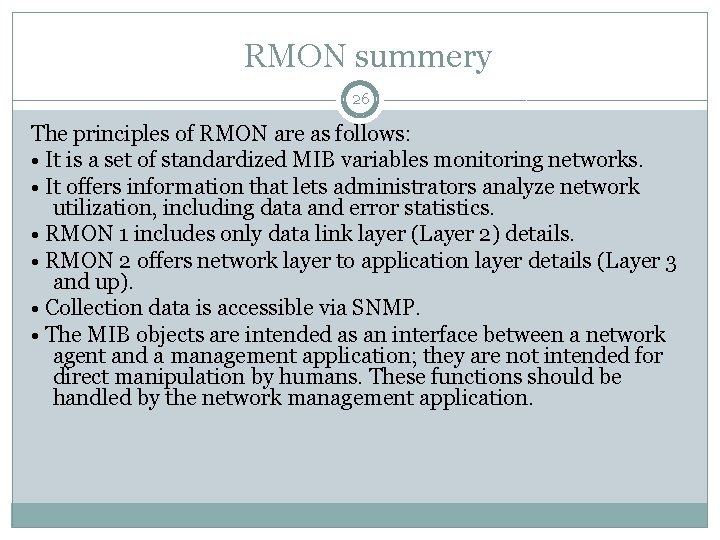
RMON summery 26 The principles of RMON are as follows: • It is a set of standardized MIB variables monitoring networks. • It offers information that lets administrators analyze network utilization, including data and error statistics. • RMON 1 includes only data link layer (Layer 2) details. • RMON 2 offers network layer to application layer details (Layer 3 and up). • Collection data is accessible via SNMP. • The MIB objects are intended as an interface between a network agent and a management application; they are not intended for direct manipulation by humans. These functions should be handled by the network management application.