
RMIM Research ethics 8 11 2016 Antti Rousi


- Slides: 40
RMIM Research ethics 8. 11. 2016 Antti Rousi Team leader, research and publishing support antti. m. rousi@aalto. fi 050 -3790670
The nature of the presentation • More focused towards practicalities of research • Less towards discussing the concepts of ethics or morals
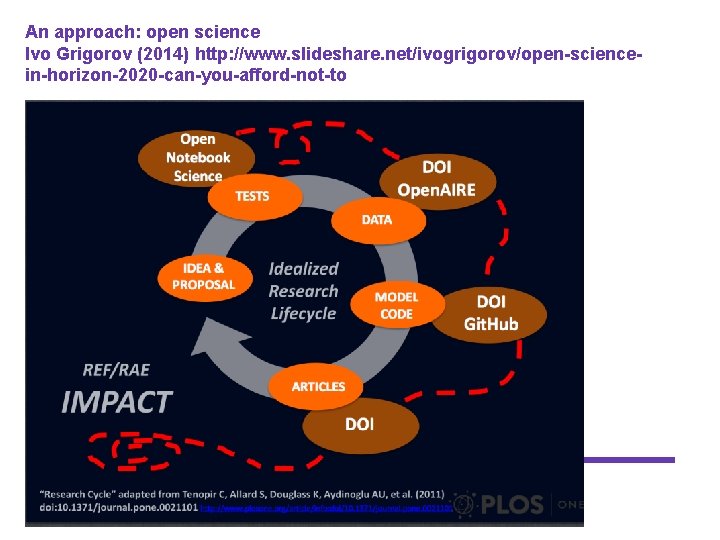
An approach: open science Ivo Grigorov (2014) http: //www. slideshare. net/ivogrigorov/open-sciencein-horizon-2020 -can-you-afford-not-to
An approach: open science • Ministry of education ”Finland to become the leading country in openness of science and research by the year 2017” http: //openscience. fi/about • Horizon 2020: http: //ec. europa. eu/research/participants/data/ref/h 2020/grants _manual/hi/oa_pilot/h 2020 -hi-oa-data-mgt_en. pdf • Open data as a merit: http: //www. tenk. fi/sites/tenk. fi/files/CV_english_270613. pdf • Research funders: http: //www. aka. fi/en-GB/A/Funding-andguidance/How-to-apply/Guidelines/Publishing-open-accessand-making-data-available-/ • Competitive advantage? Increased output? Desirable skillsets? • What are thresholds of e. g. publishing open data?
Research ethics training elsewhere Case: Purdue University - The Human Research Protection Program • IRB – Institutional Review Board https: //www. irb. purdue. edu/approval. php “Will the activity be disseminated via thesis, conference or meeting, submission to or publication in a journal, or an internet posting? Will the activity be listed as a scholarly or scientific activity on your vita? If you answered “yes” to either of these questions, your activity should be reviewed as research by the IRB. ” • Required training: Collaborative Institutional Training Initiative (CITI) https: //www. irb. purdue. edu/edu. php ”Purdue University requires all individuals involved in the conduct of human subjects research to complete basic level (initial) human subject protections training (CITI) and to recertify every 5 years. ”
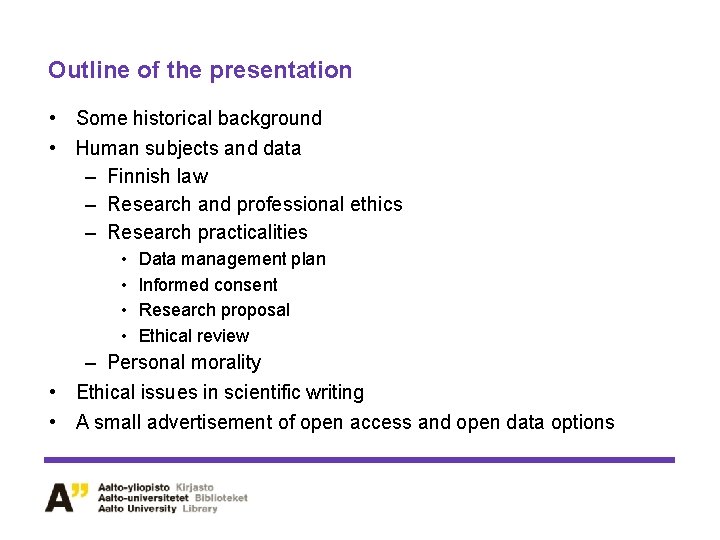
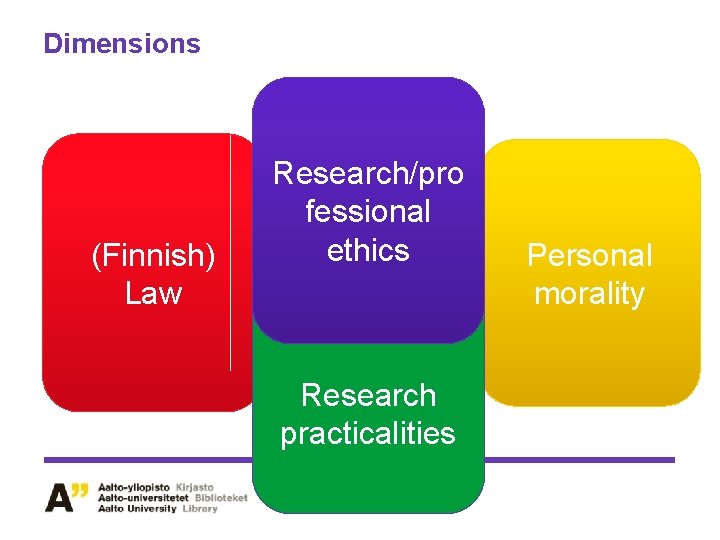
Outline of the presentation • Some historical background • Human subjects and data – Finnish law – Research and professional ethics – Research practicalities • • Data management plan Informed consent Research proposal Ethical review – Personal morality • Ethical issues in scientific writing • A small advertisement of open access and open data options
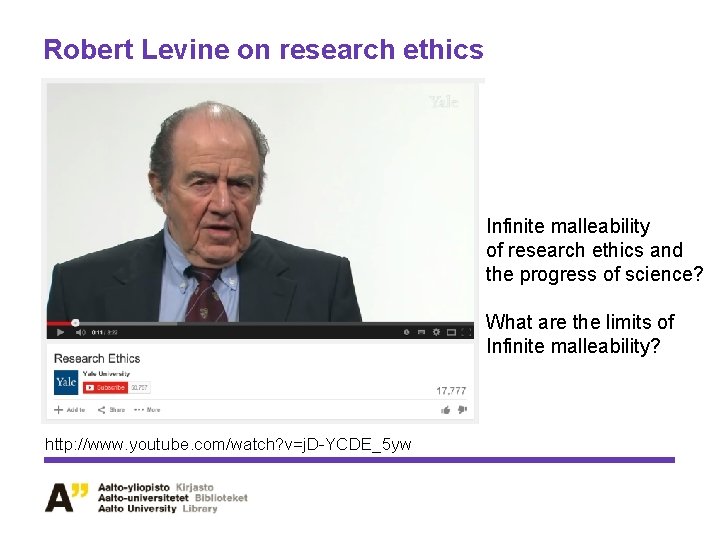
Robert Levine on research ethics Infinite malleability of research ethics and the progress of science? What are the limits of Infinite malleability? http: //www. youtube. com/watch? v=j. D-YCDE_5 yw
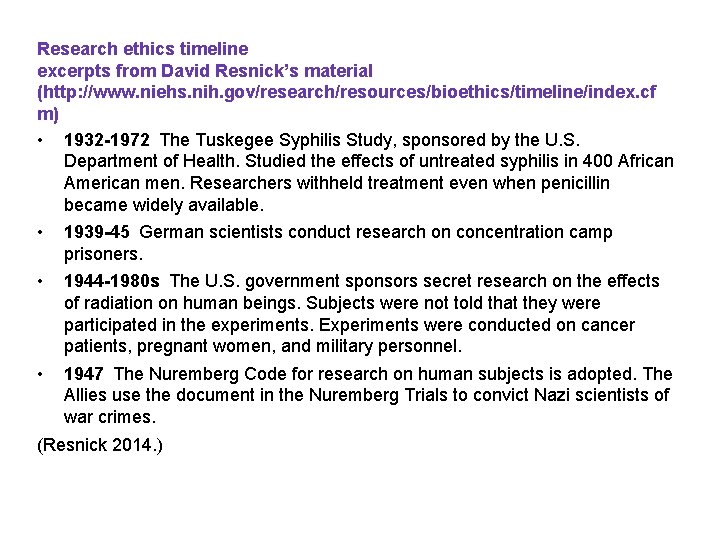
Research ethics timeline excerpts from David Resnick’s material (http: //www. niehs. nih. gov/research/resources/bioethics/timeline/index. cf m) • 1932 -1972 The Tuskegee Syphilis Study, sponsored by the U. S. Department of Health. Studied the effects of untreated syphilis in 400 African American men. Researchers withheld treatment even when penicillin became widely available. • 1939 -45 German scientists conduct research on concentration camp prisoners. • 1944 -1980 s The U. S. government sponsors secret research on the effects of radiation on human beings. Subjects were not told that they were participated in the experiments. Experiments were conducted on cancer patients, pregnant women, and military personnel. • 1947 The Nuremberg Code for research on human subjects is adopted. The Allies use the document in the Nuremberg Trials to convict Nazi scientists of war crimes. (Resnick 2014. )
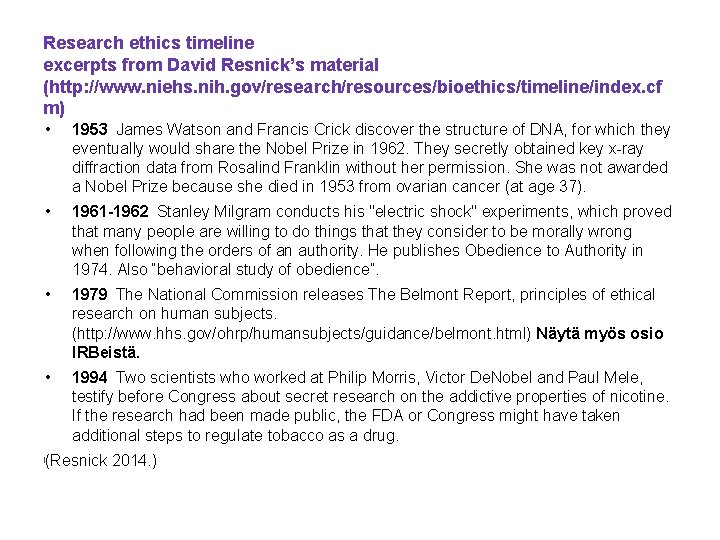
Research ethics timeline excerpts from David Resnick’s material (http: //www. niehs. nih. gov/research/resources/bioethics/timeline/index. cf m) • 1953 James Watson and Francis Crick discover the structure of DNA, for which they eventually would share the Nobel Prize in 1962. They secretly obtained key x-ray diffraction data from Rosalind Franklin without her permission. She was not awarded a Nobel Prize because she died in 1953 from ovarian cancer (at age 37). • 1961 -1962 Stanley Milgram conducts his "electric shock" experiments, which proved that many people are willing to do things that they consider to be morally wrong when following the orders of an authority. He publishes Obedience to Authority in 1974. Also “behavioral study of obedience”. • 1979 The National Commission releases The Belmont Report, principles of ethical research on human subjects. (http: //www. hhs. gov/ohrp/humansubjects/guidance/belmont. html) Näytä myös osio IRBeistä. • 1994 Two scientists who worked at Philip Morris, Victor De. Nobel and Paul Mele, testify before Congress about secret research on the addictive properties of nicotine. If the research had been made public, the FDA or Congress might have taken additional steps to regulate tobacco as a drug. (Resnick 2014. )
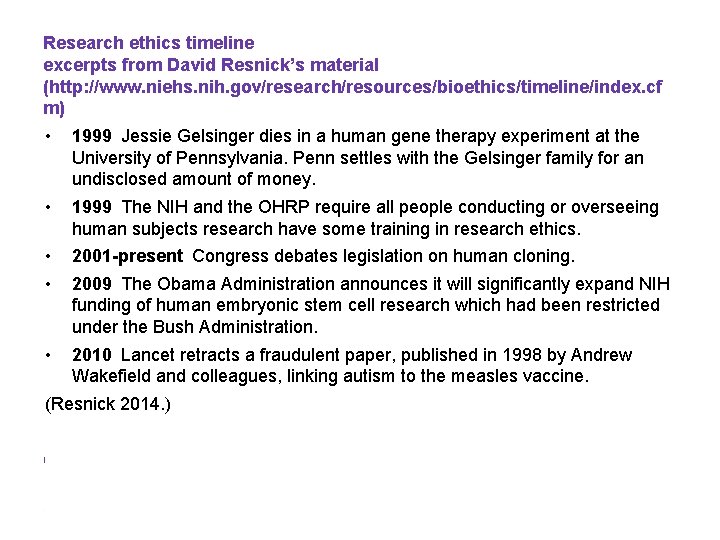
Research ethics timeline excerpts from David Resnick’s material (http: //www. niehs. nih. gov/research/resources/bioethics/timeline/index. cf m) • 1999 Jessie Gelsinger dies in a human gene therapy experiment at the University of Pennsylvania. Penn settles with the Gelsinger family for an undisclosed amount of money. • 1999 The NIH and the OHRP require all people conducting or overseeing human subjects research have some training in research ethics. • • 2001 -present Congress debates legislation on human cloning. • 2010 Lancet retracts a fraudulent paper, published in 1998 by Andrew Wakefield and colleagues, linking autism to the measles vaccine. 2009 The Obama Administration announces it will significantly expand NIH funding of human embryonic stem cell research which had been restricted under the Bush Administration. (Resnick 2014. )
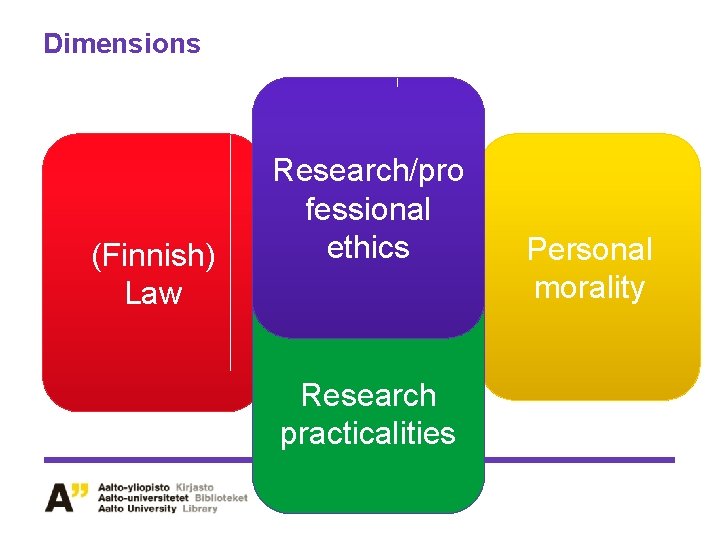
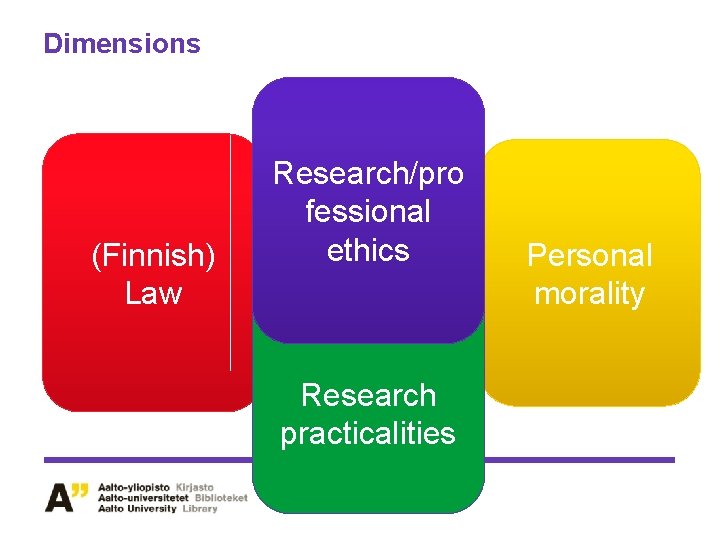
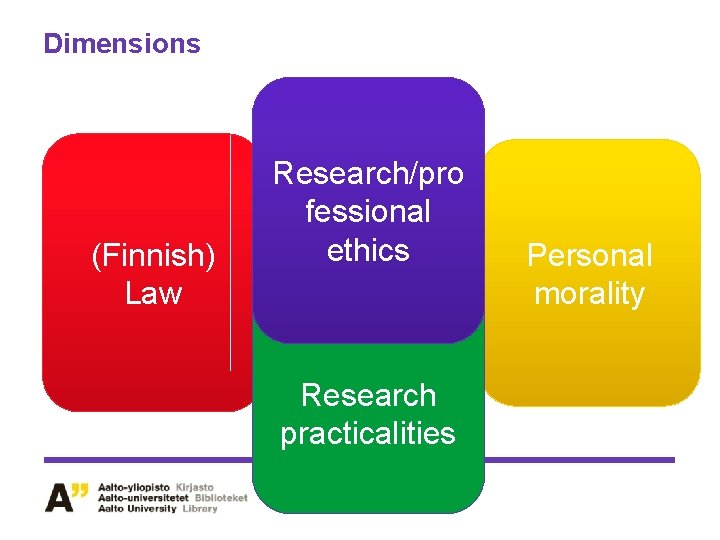
Dimensions (Finnish) Law Research/pro fessional ethics Research practicalities Personal morality
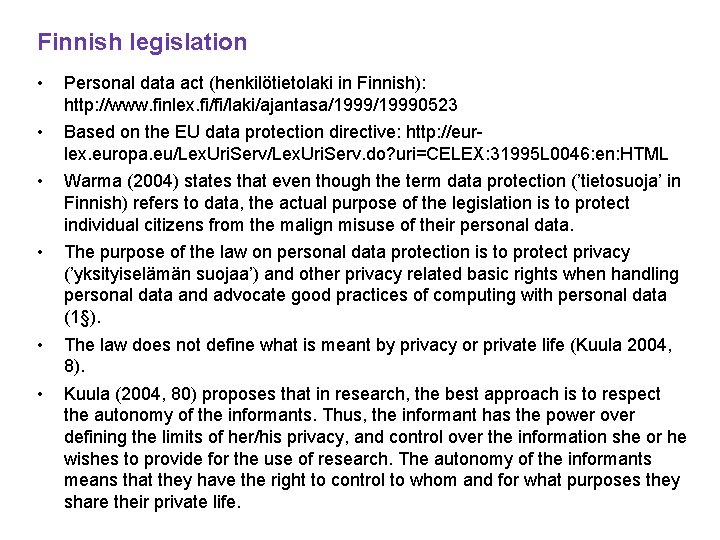
Finnish legislation • Personal data act (henkilötietolaki in Finnish): http: //www. finlex. fi/fi/laki/ajantasa/19990523 • Based on the EU data protection directive: http: //eurlex. europa. eu/Lex. Uri. Serv. do? uri=CELEX: 31995 L 0046: en: HTML • Warma (2004) states that even though the term data protection (’tietosuoja’ in Finnish) refers to data, the actual purpose of the legislation is to protect individual citizens from the malign misuse of their personal data. • The purpose of the law on personal data protection is to protect privacy (’yksityiselämän suojaa’) and other privacy related basic rights when handling personal data and advocate good practices of computing with personal data (1§). • The law does not define what is meant by privacy or private life (Kuula 2004, 8). • Kuula (2004, 80) proposes that in research, the best approach is to respect the autonomy of the informants. Thus, the informant has the power over defining the limits of her/his privacy, and control over the information she or he wishes to provide for the use of research. The autonomy of the informants means that they have the right to control to whom and for what purposes they share their private life.
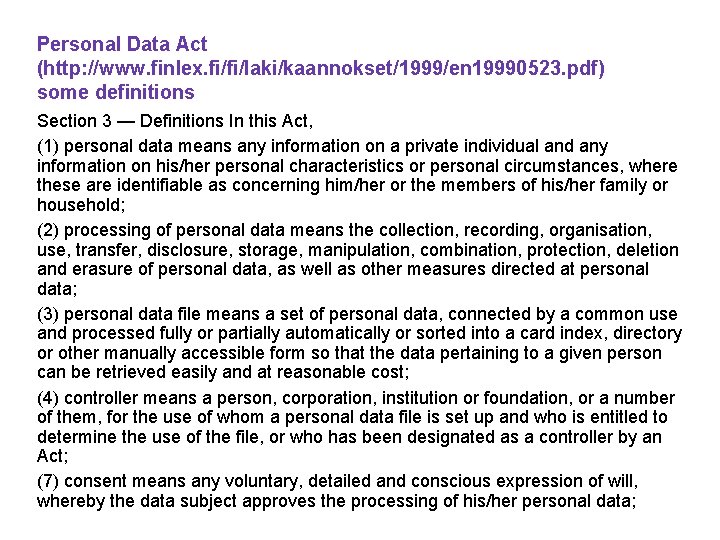
Personal Data Act (http: //www. finlex. fi/fi/laki/kaannokset/1999/en 19990523. pdf) some definitions Section 3 — Definitions In this Act, (1) personal data means any information on a private individual and any information on his/her personal characteristics or personal circumstances, where these are identifiable as concerning him/her or the members of his/her family or household; (2) processing of personal data means the collection, recording, organisation, use, transfer, disclosure, storage, manipulation, combination, protection, deletion and erasure of personal data, as well as other measures directed at personal data; (3) personal data file means a set of personal data, connected by a common use and processed fully or partially automatically or sorted into a card index, directory or other manually accessible form so that the data pertaining to a given person can be retrieved easily and at reasonable cost; (4) controller means a person, corporation, institution or foundation, or a number of them, for the use of whom a personal data file is set up and who is entitled to determine the use of the file, or who has been designated as a controller by an Act; (7) consent means any voluntary, detailed and conscious expression of will, whereby the data subject approves the processing of his/her personal data;
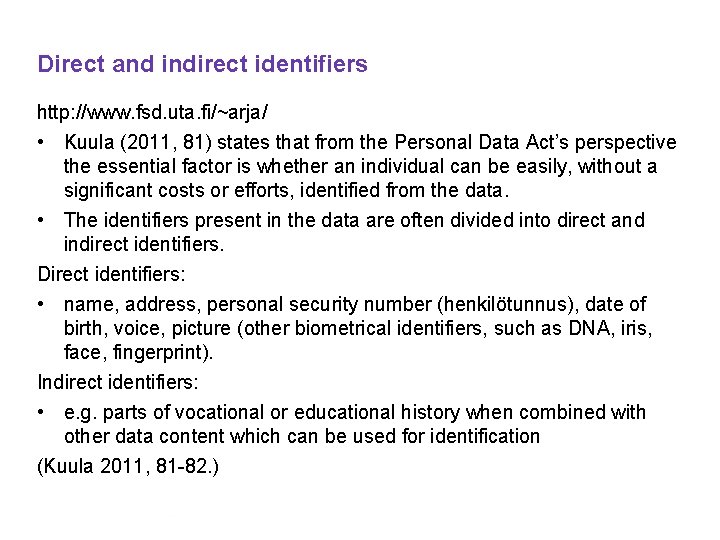
Direct and indirect identifiers http: //www. fsd. uta. fi/~arja/ • Kuula (2011, 81) states that from the Personal Data Act’s perspective the essential factor is whether an individual can be easily, without a significant costs or efforts, identified from the data. • The identifiers present in the data are often divided into direct and indirect identifiers. Direct identifiers: • name, address, personal security number (henkilötunnus), date of birth, voice, picture (other biometrical identifiers, such as DNA, iris, face, fingerprint). Indirect identifiers: • e. g. parts of vocational or educational history when combined with other data content which can be used for identification (Kuula 2011, 81 -82. )
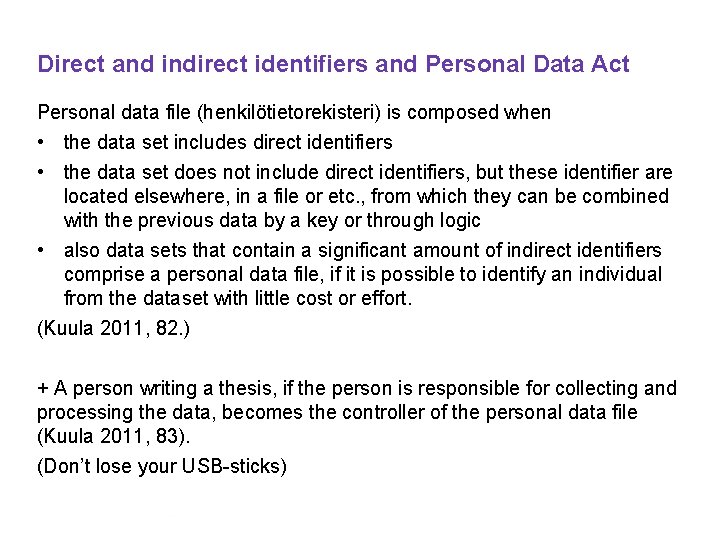
Direct and indirect identifiers and Personal Data Act Personal data file (henkilötietorekisteri) is composed when • the data set includes direct identifiers • the data set does not include direct identifiers, but these identifier are located elsewhere, in a file or etc. , from which they can be combined with the previous data by a key or through logic • also data sets that contain a significant amount of indirect identifiers comprise a personal data file, if it is possible to identify an individual from the dataset with little cost or effort. (Kuula 2011, 82. ) + A person writing a thesis, if the person is responsible for collecting and processing the data, becomes the controller of the personal data file (Kuula 2011, 83). (Don’t lose your USB-sticks)
Is this troublesome? No. As said, the Personal Data Act’s purpose is to make the rules clearer for everybody, not to prohibit the collection of personal data. http: //www. finlex. fi/fi/laki/ajantasa/19990523#L 2 P 6
Dimensions (Finnish) Law Research/pro fessional ethics Research practicalities Personal morality
Finnish Advisory Board on Research Integrity Ethical principles of research in the humanities http: //www. tenk. fi/en/ethical-review-human-sciences/ethicalprinciples Ethical principles of research in the humanities and social and behavioral sciences are divided into three areas: 1. Respecting the autonomy of research subjects 2. Avoiding harm and 3. Privacy and data protection.
Respecting the autonomy of research subjects ” 1. 1 Voluntary participation • Participation in research should be voluntary and based on informed consent. An exception from the principle of voluntary consent can be made when research is conducted on published and public information and archived materials. […] • Research subjects can give consent orally or in writing, or their behaviour can otherwise be interpreted to mean that they have given consent to participate. For example, assenting to a polite request for an interview or responding to a questionnaire or request for a written response indicates that the subject has consented to be studied. […] 1. 4 Information for subjects • The information that must be provided to research subjects depends on the nature of data collection methods. In studies based on observation, interviews or questionnaires, subjects must be told what the study is about and what participating in the study means in concrete terms and how long it will take. […] 1. 5 Exceptions from informed consent: an ethical review must be requested from the ethics committee”
Avoiding harm “ 2. 1 Avoiding mental harm • Avoiding mental harm includes treating subjects with respect and reporting findings in a respectful way in research publications. • A researcher must make sure that the principle of voluntary participation is also observed in situations where there is interaction with subjects. A subject's annoyance, embarrassment, fearfulness or physical fatigue can be sufficient grounds for the researcher to discontinue the study as far as the subject is concerned, even if the subject does not expressly refuse to continue. […] Unnecessary mental strain can be avoided by testing in advance how much time subjects' participation will take. […] 2. 2 Avoiding financial and social harm • Research publications can have harmful consequences for subjects. The risk of harm is greatest if results are presented judgmentally, in a prejudiced way or disrespectfully. Harm can also be caused by publishing results giving a negative picture that are not based on comprehensive data or the systematic analysis of data. […]”
Privacy and data protection ”The protection of privacy is a right protected by the Constitution of Finland. It is also an established and important principle in research ethics. Data protection forms the most important area of privacy protection regarding the collection and processing of research data and the publication of results. Research ethics principles concerning the protection of privacy fall into three categories: 1. protecting research data and confidentiality, 2. storing or disposing of research data and 3. research publications. The goal is to find a balance between confidentiality and the openness of science and research. ”
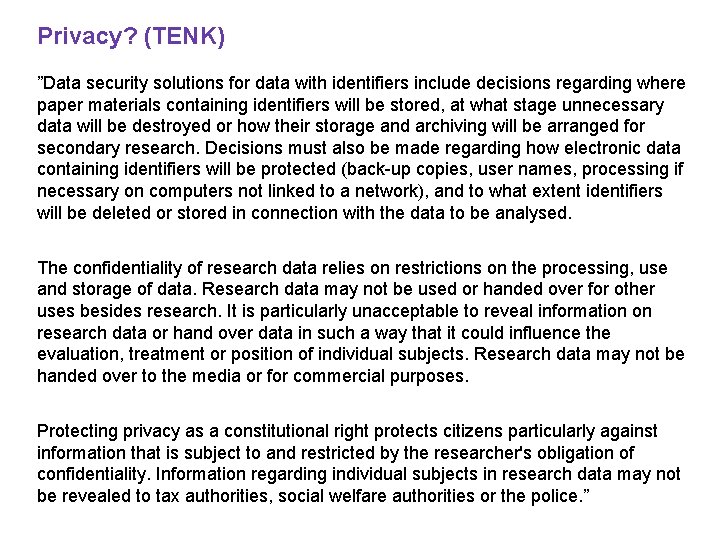
Privacy? (TENK) ”Data security solutions for data with identifiers include decisions regarding where paper materials containing identifiers will be stored, at what stage unnecessary data will be destroyed or how their storage and archiving will be arranged for secondary research. Decisions must also be made regarding how electronic data containing identifiers will be protected (back-up copies, user names, processing if necessary on computers not linked to a network), and to what extent identifiers will be deleted or stored in connection with the data to be analysed. The confidentiality of research data relies on restrictions on the processing, use and storage of data. Research data may not be used or handed over for other uses besides research. It is particularly unacceptable to reveal information on research data or hand over data in such a way that it could influence the evaluation, treatment or position of individual subjects. Research data may not be handed over to the media or for commercial purposes. Protecting privacy as a constitutional right protects citizens particularly against information that is subject to and restricted by the researcher's obligation of confidentiality. Information regarding individual subjects in research data may not be revealed to tax authorities, social welfare authorities or the police. ”
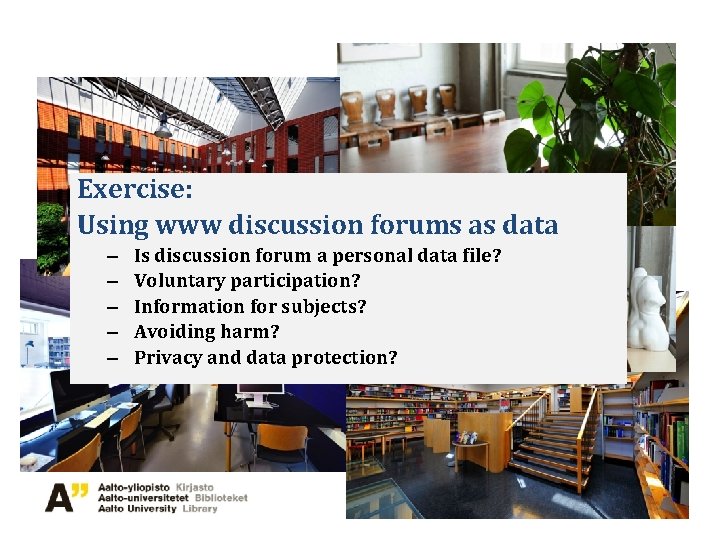
Exercise: Using www discussion forums as data – – – Is discussion forum a personal data file? Voluntary participation? Information for subjects? Avoiding harm? Privacy and data protection?
Dimensions (Finnish) Law Research/pro fessional ethics Research practicalities Personal morality
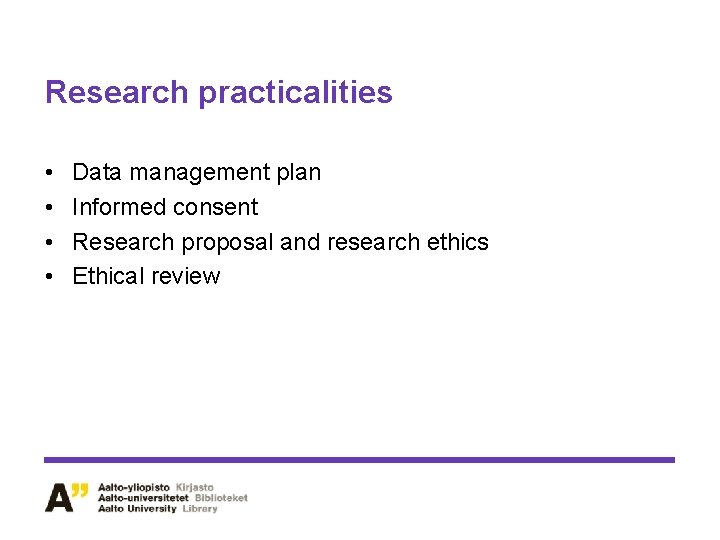
Research practicalities • • Data management plan Informed consent Research proposal and research ethics Ethical review
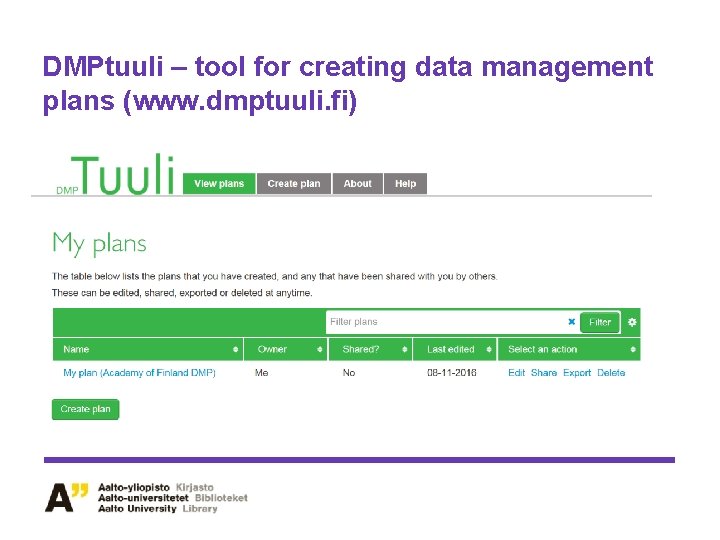
Data management plan FSD: “A data management plan describes how research data will be collected, how the data will be used and stored during the research project, and how its reuse will be enabled and long-term preservation ensured after the original research is completed. ” See a template from here: http: //www. fsd. uta. fi/en/data_management_planning/
Informed consent FSD’s checklist: http: //www. fsd. uta. fi/en/informing_guidelines/index. html • Contact information of the responsible researcher/research team • Purpose of the research • Voluntary nature of participation • Protection of privacy and confidentiality • Use, preservation and disposal of data • Use of other information sources Examples: http: //www. fsd. uta. fi/en/informing_guidelines/index. html
Informed consent – methods of delivery Signed written consent is required when: • Data from external sources (different registers, etc. ) are combined to subjects under study • The data includes sensitive information* and is preserved for further studies with identifiers included. (Kuula 2011, 119. ) *= According to Personal Data Act: Personal data are deemed to be sensitive, if they relate to or are intended to relate to: (1) race or ethnic origin; (2) the social, political or religious affiliation or trade-union membership of a person; (3) a criminal act, punishment or other criminal sanction; (4) the state of health, illness or handicap of a person or the treatment or other comparable measures directed at the person; (5) the sexual preferences or sex life of a person; or (6) the social welfare needs of a person or the benefits, support or other social welfare assistance received by the person. (http: //www. finlex. fi/fi/laki/kaannokset/1999/en 19990523. pdf)
Informed consent – methods of delivery Informed consent information given in written form and the consent of the subjects is required (this is a recommendation) when • data is gathered directly from the subjects and it is recorded as such (e. g. interviews, group interviews, discussions, surveys, etc. ) Orally given informed consent information and the consent of the subjects is required (this is a recommendation) when • no identifiers are collected, e. g. by not recording the interview and by not including any identifier related information. Discretionary acquiring of informed consent or no acquiring of informed consent (this is a recommendation) when • • observation in public places (discretionary acquiring) examining media products or publications (no acquiring) studying archived data (no informing of the subjects) studying information published on the WWW (discretionary acquiring). (Kuula 2011, 119 -120. )
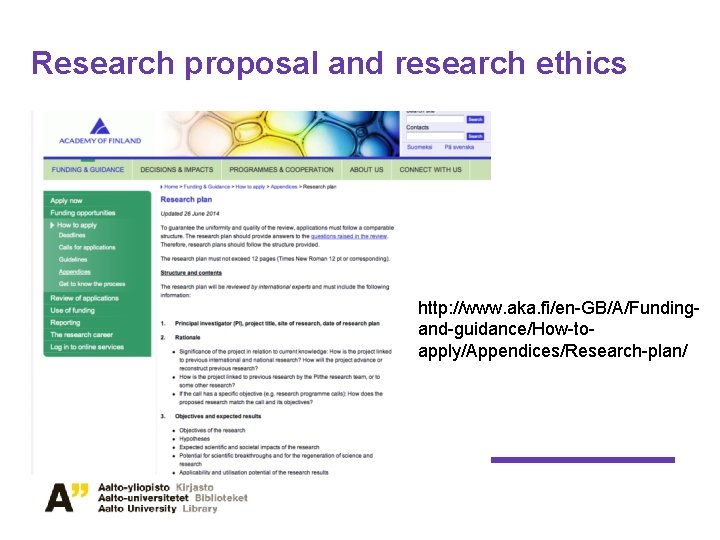
Research proposal and research ethics http: //www. aka. fi/en-GB/A/Fundingand-guidance/How-toapply/Appendices/Research-plan/
DMPtuuli – tool for creating data management plans (www. dmptuuli. fi)
Ethical ex-ante review in Aalto University https: //inside. aalto. fi/display/About. Aalto/Research+Et hics+Committee Legal advice anna. johansson@aalto. fi
Dimensions (Finnish) Law Research/pro fessional ethics Research practicalities Personal morality
Assignment • Does your dissertation project benefit from a data management plan? If so, why? Or why not? Is data management planning a concern of research ethics? If so, why? Or why not? • Do you work with human subjects? If so, draft a preliminary version on how you will inform your research participants (note, that you are responsible for the proper methods of acquiring informed consent in your dissertation project). If you do not work with human subjects, spend more time with question number 3. • Have you already encountered questions or made decisions in your dissertation project that you consider research ethical? If so, what were they and how did you solve them? Where do you think lies the most important research ethical dimensions of your project?
Ethical issues in scientific writing
Misconduct in science (http: //www. tenk. fi/en/responsibleconduct-research-guidelines/violations-responsibleconduct-research) Research misconduct is further divided into the following four subcategories: • Fabrication refers to reporting invented observations to the research community. • Falsification (misrepresentation) refers to modifying and presenting original observations deliberately so that the results based on those observations are distorted. • Plagiarism, or unacknowledged borrowing, refers to representing another person’s material as one’s own without appropriate references. This includes research plans, manuscripts, articles, other texts or parts of them, visual materials, or translations. Plagiarism includes direct copying as well as adapted copying • Misappropriation refers to the unlawful presentation of another person’s result, idea, plan, observation or data as one’s own research.
Disregard for the responsible conduct of research (http: //www. tenk. fi/en/responsible-conduct-researchguidelines/violations-responsible-conduct-research) • denigrating the role of other researchers in publications, such as neglecting to mention them, and referring to earlier research results inadequately or inappropriately; • reporting research results and methods in a careless manner, resulting in misleading claims; • publishing the same research results multiple times ostensibly as new and novel results (redundant publication, also referred to as selfplagiarism); • misleading the research community in other ways.
Communication: the essence of science (Garvey 1979) e. g. results from Gottfredson’s (1978) study: c. 600 editors, associated editors, consulting editors or issue consultants of 9 psychological journals were asked to differentiate between the traits of “clearly outstanding” and “clearly inferior” published articles. A list of “do nots” • scientists do not misinterpret other viewpoints, literature or data • they do not misinterpret their results • they do not hide the issue being investigated in the introduction • they do not make unjustified assumptions • they do not use lofty scientific jargon when plain English will do
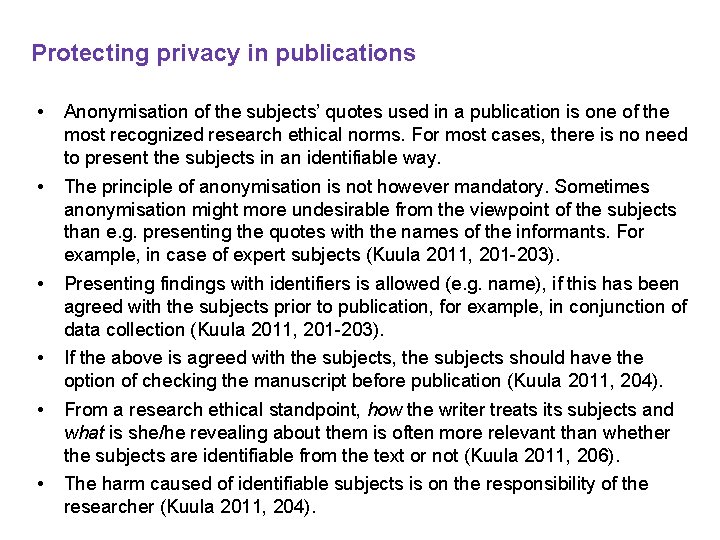
Protecting privacy in publications • Anonymisation of the subjects’ quotes used in a publication is one of the most recognized research ethical norms. For most cases, there is no need to present the subjects in an identifiable way. • The principle of anonymisation is not however mandatory. Sometimes anonymisation might more undesirable from the viewpoint of the subjects than e. g. presenting the quotes with the names of the informants. For example, in case of expert subjects (Kuula 2011, 201 -203). • Presenting findings with identifiers is allowed (e. g. name), if this has been agreed with the subjects prior to publication, for example, in conjunction of data collection (Kuula 2011, 201 -203). • If the above is agreed with the subjects, the subjects should have the option of checking the manuscript before publication (Kuula 2011, 204). • From a research ethical standpoint, how the writer treats its subjects and what is she/he revealing about them is often more relevant than whether the subjects are identifiable from the text or not (Kuula 2011, 206). • The harm caused of identifiable subjects is on the responsibility of the researcher (Kuula 2011, 204).
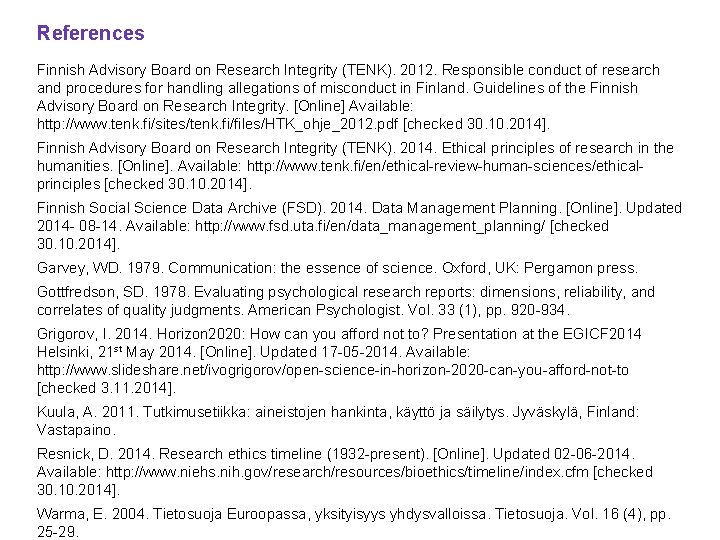
References Finnish Advisory Board on Research Integrity (TENK). 2012. Responsible conduct of research and procedures for handling allegations of misconduct in Finland. Guidelines of the Finnish Advisory Board on Research Integrity. [Online] Available: http: //www. tenk. fi/sites/tenk. fi/files/HTK_ohje_2012. pdf [checked 30. 10. 2014]. Finnish Advisory Board on Research Integrity (TENK). 2014. Ethical principles of research in the humanities. [Online]. Available: http: //www. tenk. fi/en/ethical-review-human-sciences/ethicalprinciples [checked 30. 10. 2014]. Finnish Social Science Data Archive (FSD). 2014. Data Management Planning. [Online]. Updated 2014 - 08 -14. Available: http: //www. fsd. uta. fi/en/data_management_planning/ [checked 30. 10. 2014]. Garvey, WD. 1979. Communication: the essence of science. Oxford, UK: Pergamon press. Gottfredson, SD. 1978. Evaluating psychological research reports: dimensions, reliability, and correlates of quality judgments. American Psychologist. Vol. 33 (1), pp. 920 -934. Grigorov, I. 2014. Horizon 2020: How can you afford not to? Presentation at the EGICF 2014 Helsinki, 21 st May 2014. [Online]. Updated 17 -05 -2014. Available: http: //www. slideshare. net/ivogrigorov/open-science-in-horizon-2020 -can-you-afford-not-to [checked 3. 11. 2014]. Kuula, A. 2011. Tutkimusetiikka: aineistojen hankinta, käyttö ja säilytys. Jyväskylä, Finland: Vastapaino. Resnick, D. 2014. Research ethics timeline (1932 -present). [Online]. Updated 02 -06 -2014. Available: http: //www. niehs. nih. gov/research/resources/bioethics/timeline/index. cfm [checked 30. 10. 2014]. Warma, E. 2004. Tietosuoja Euroopassa, yksityisyys yhdysvalloissa. Tietosuoja. Vol. 16 (4), pp. 25 -29.