
RIVER DYNASTIES IN CHINA The walls of Chinas


- Slides: 22
RIVER DYNASTIES IN CHINA
The walls of China’s first cities were built 4, 000 years ago. This was at least 1, 000 years after the walls of Ur, the great pyramids of Egypt, and the planned cities of the Indus Valley were built. Unlike the other three river valley civilizations, the civilization that began along one of China’s river systems continues to thrive today.
Geography of China • Natural barriers isolated China. To China’s east lay the Yellow Sea, the East China Sea, and the Pacific Ocean. Mountain ranges and deserts dominate about two thirds of China’s landmass. In west China lay the Taklimakan Desert and the Icy 15, 000 foot Plateau of Tibet. To the southwest are the Himalayas. And to the north is the Gobi Desert.
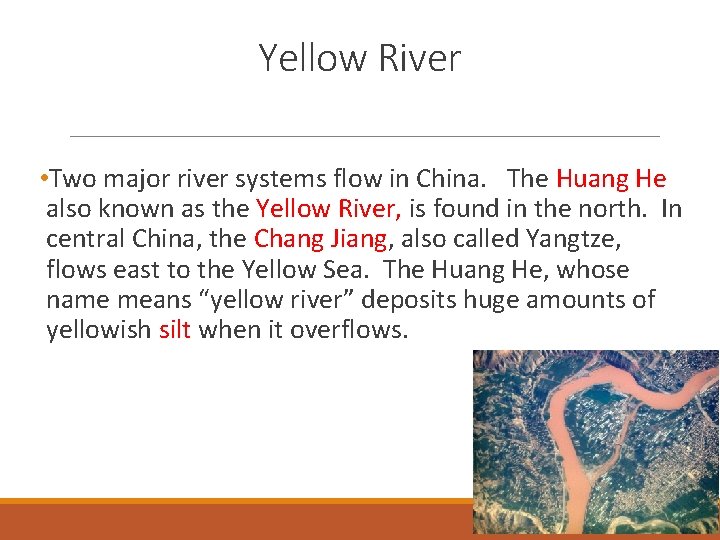
Yellow River • Two major river systems flow in China. The Huang He also known as the Yellow River, is found in the north. In central China, the Chang Jiang, also called Yangtze, flows east to the Yellow Sea. The Huang He, whose name means “yellow river” deposits huge amounts of yellowish silt when it overflows.
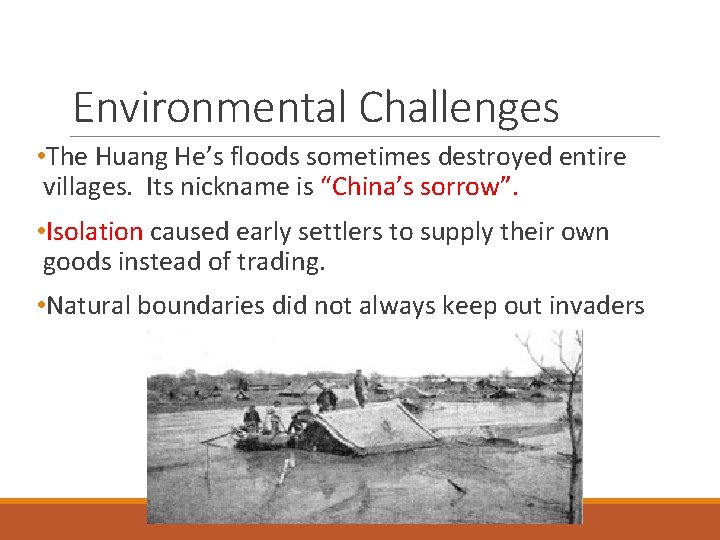
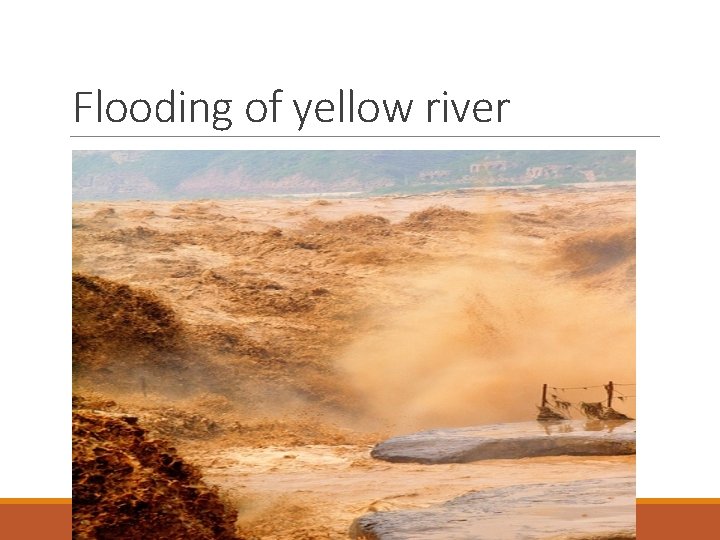
Environmental Challenges • The Huang He’s floods sometimes destroyed entire villages. Its nickname is “China’s sorrow”. • Isolation caused early settlers to supply their own goods instead of trading. • Natural boundaries did not always keep out invaders
Flooding of yellow river
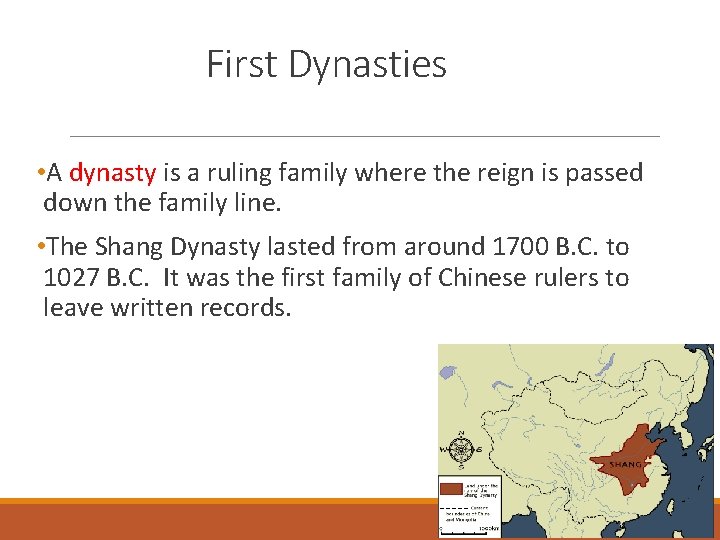
First Dynasties • A dynasty is a ruling family where the reign is passed down the family line. • The Shang Dynasty lasted from around 1700 B. C. to 1027 B. C. It was the first family of Chinese rulers to leave written records.
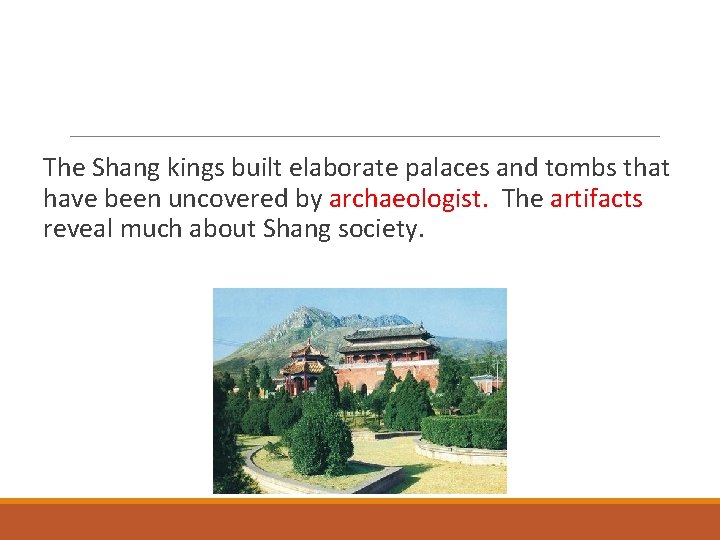
The Shang kings built elaborate palaces and tombs that have been uncovered by archaeologist. The artifacts reveal much about Shang society.
Early Cities • Unlike the cities of the Indus Valley or the Fertile Crescent, the Shang built mainly with wood. Upper class lived in timber-framed houses with walls of clay and straw. The peasants and crafts people lived in huts outside the city. • The Shang surrounded their cities with massive walls for protection.
Chinese Culture • In the Chinese view, people who lived outside of Chinese civilizations were barbarians. Because the Chinese saw their country as the center of the civilized world, their own name for China was Middle Kingdom. (Ethnocentrism).
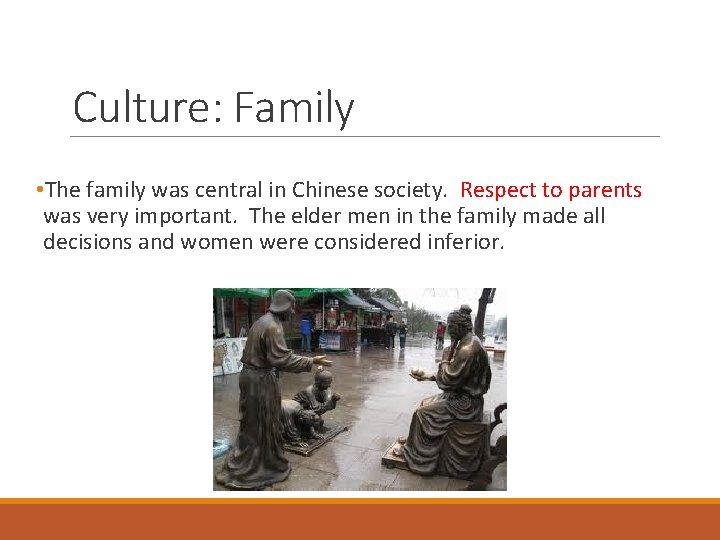
Culture: Family • The family was central in Chinese society. Respect to parents was very important. The elder men in the family made all decisions and women were considered inferior.
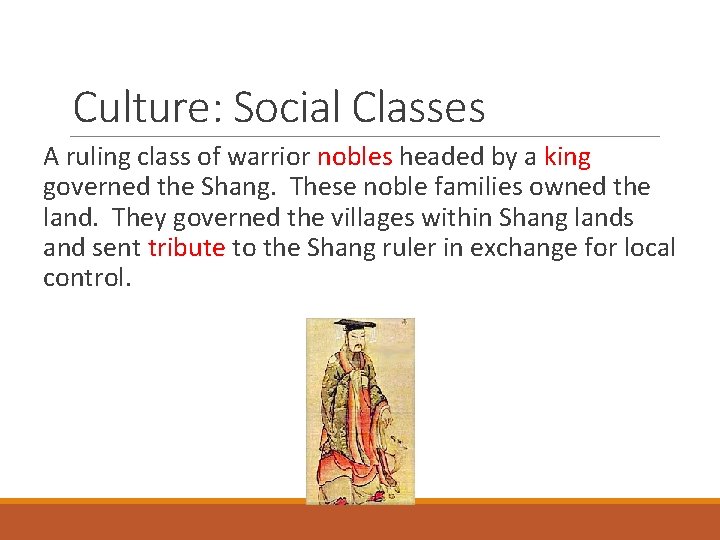
Culture: Social Classes A ruling class of warrior nobles headed by a king governed the Shang. These noble families owned the land. They governed the villages within Shang lands and sent tribute to the Shang ruler in exchange for local control.
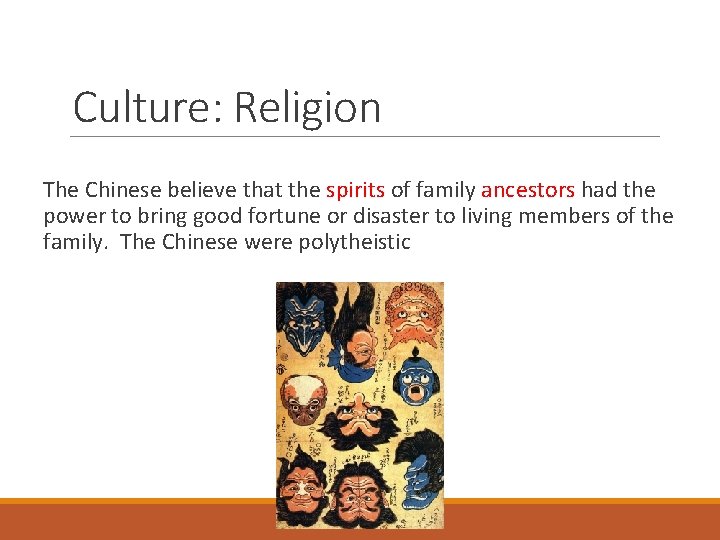
Culture: Religion The Chinese believe that the spirits of family ancestors had the power to bring good fortune or disaster to living members of the family. The Chinese were polytheistic
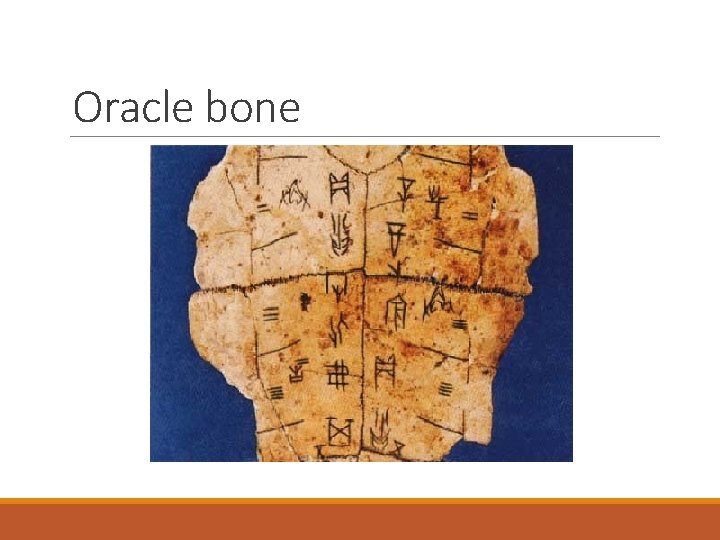
Religion Continued Kings consulted gods through the use of oracle bones, animal bones, and tortoise shells on which priest had scratched questions the gods. After inscribing the question on the bone, a priest applied a hot poker to it, which cracked it. The priest then interpreted the cracks to see how the gods answered.
Oracle bone
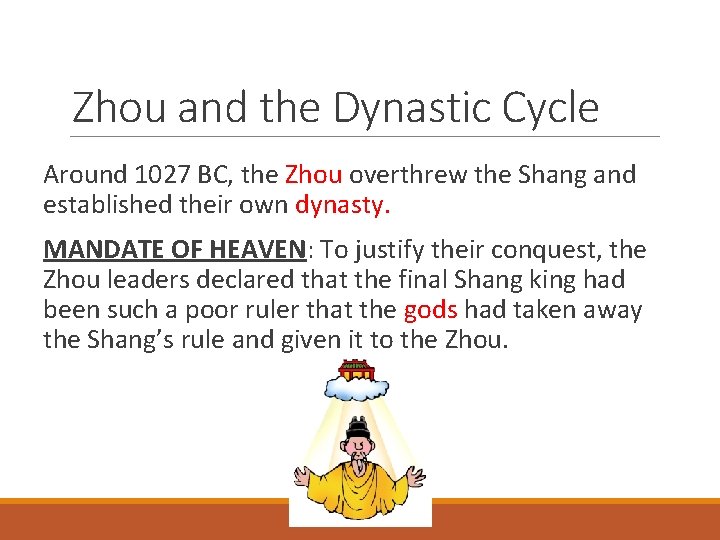
Zhou and the Dynastic Cycle Around 1027 BC, the Zhou overthrew the Shang and established their own dynasty. MANDATE OF HEAVEN: To justify their conquest, the Zhou leaders declared that the final Shang king had been such a poor ruler that the gods had taken away the Shang’s rule and given it to the Zhou.
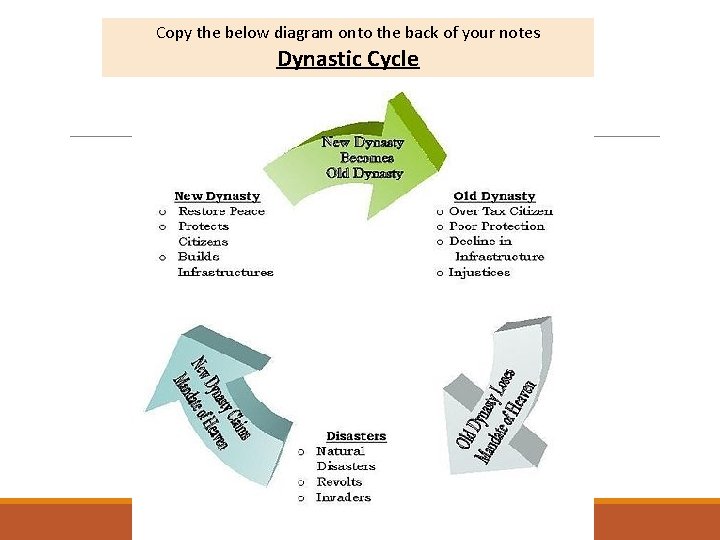
A just ruler had divine approval, known as the Mandate of Heaven. A cruel king could lose the Mandate of Heaven and lose the right to rule. Floods and riots may be signs that ancestral spirits were displeased with a king’s rule. Historians describe the rise, decline, and replacement of dynasties as the dynastic cycle.
Copy the below diagram onto the back of your notes Dynastic Cycle
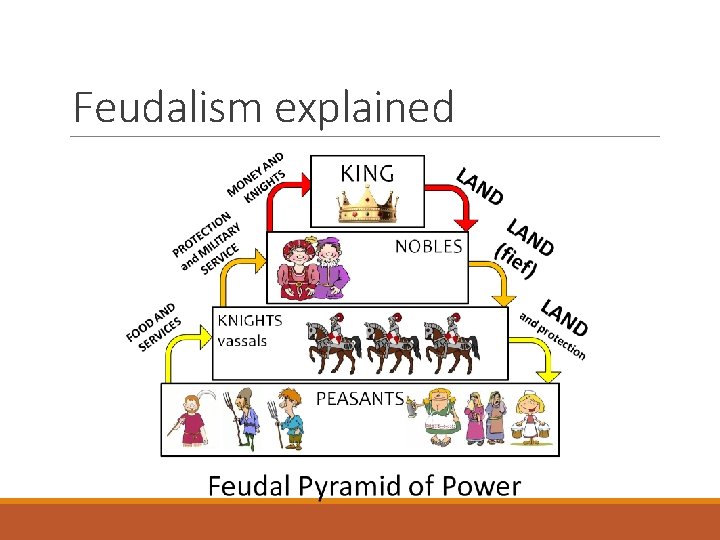
Control Through Feudalism The Zhou controlled lands that stretched far beyond the Huang He in the north to the Chang Jiang in the south. To govern this vast area, it gave control over different regions to members of the royal family and trusted other nobles. This established a system called feudalism.
Feudalism in China Feudalism is a political system in which nobles, or lords, are granted the use of lands legally belonging to the king. In return, the nobles owed loyalty and military service to the king and protection to the people who live on their estates.
Feudalism explained
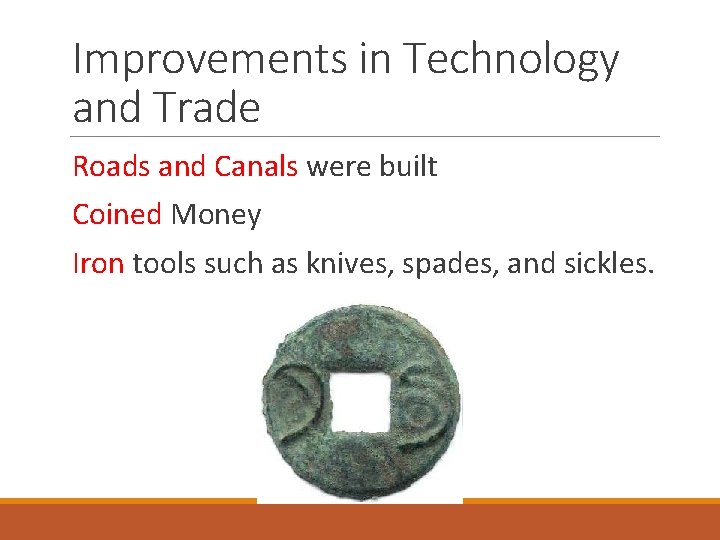
Improvements in Technology and Trade Roads and Canals were built Coined Money Iron tools such as knives, spades, and sickles.