
Rivalry tends to increase when there is downward
- Slides: 11
Rivalry tends to increase when • there is downward pressure on price • there are high exit barriers • demand for the product is growing slowly or not at all
Rivalry tends to increase when • competitors become more equal in size and capability • when customers’ switching costs are low • one or more competitors is not satisfied with its position
Barriers to entry • high customer loyalty (high switching costs to customers) • economies of scale • learning/experience curve
Barriers to entry • resource requirements (money, access to supplies, distribution, etc. ) • regulations, tariffs, trade restrictions internationally, local content • access to specialized resource
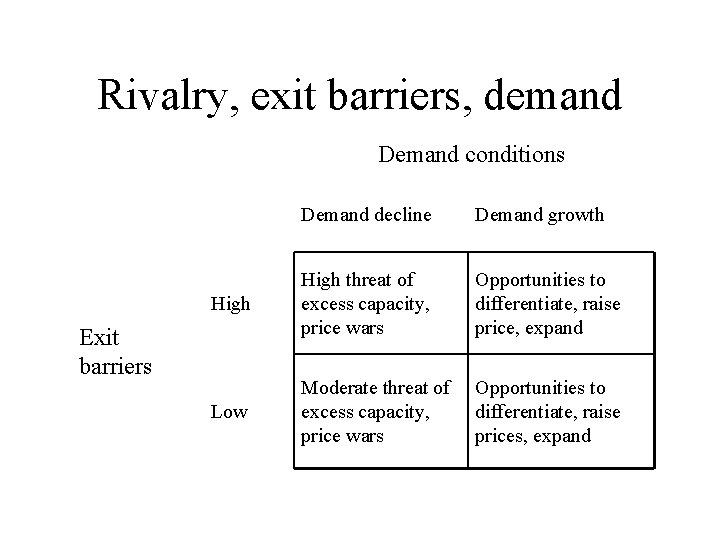
Rivalry, exit barriers, demand Demand conditions Demand decline Demand growth High threat of excess capacity, price wars Opportunities to differentiate, raise price, expand Low Moderate threat of excess capacity, price wars Opportunities to differentiate, raise prices, expand Exit barriers
Product life cycle • understand competitor dynamics • understand buyer behavior • predict future
Industry life cycle • beginning industry • fragmented industry • consolidated industry
INDUSTRY ATTRACTIVENESS
WEIGHT: RELATIVE IMPORTANCE OF EACH TO COMPANY RATING: ATTRACTIVENESS OF FACTOR TO COMPANY OR “STATE” OF FACTOR IN INDUSTRY
IMPORTANT POINTS: 1. DETERMINE THE FACTORS (AGREE? ) FIRST CATEGORY SECOND CATEGORY CHANGES IN CATEGORY? 2. JUDGE WEIGHTS (AGREE? ) 3. JUDGE RATING (AGREE? )
INDUSTRY FACTORS • • GROWTH RATE MARKET DIVERSITY PRICING COMPETITIVE STRUCTURE INFLATION CYCLICALITY LIFE CYCLE (PRODUCT, INDUSTRY)