
RIT HOT WHEELZ FORMULA SAE ELECTRIC THERMAL MANAGEMENT
- Slides: 1
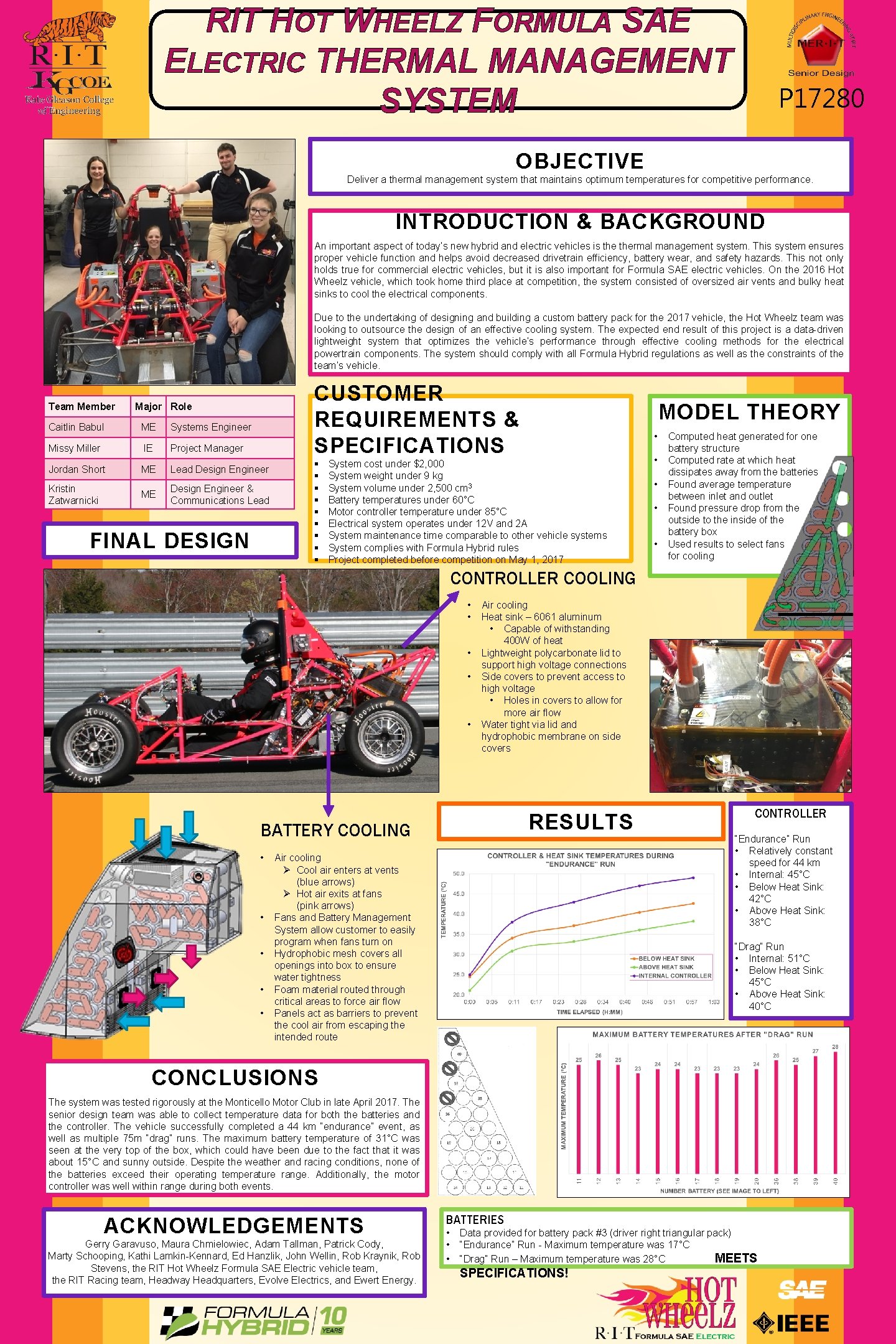
RIT HOT WHEELZ FORMULA SAE ELECTRIC THERMAL MANAGEMENT SYSTEM P 17280 OBJECTIVE Deliver a thermal management system that maintains optimum temperatures for competitive performance. INTRODUCTION & BACKGROUND An important aspect of today’s new hybrid and electric vehicles is thermal management system. This system ensures proper vehicle function and helps avoid decreased drivetrain efficiency, battery wear, and safety hazards. This not only holds true for commercial electric vehicles, but it is also important for Formula SAE electric vehicles. On the 2016 Hot Wheelz vehicle, which took home third place at competition, the system consisted of oversized air vents and bulky heat sinks to cool the electrical components. Due to the undertaking of designing and building a custom battery pack for the 2017 vehicle, the Hot Wheelz team was looking to outsource the design of an effective cooling system. The expected end result of this project is a data-driven lightweight system that optimizes the vehicle’s performance through effective cooling methods for the electrical powertrain components. The system should comply with all Formula Hybrid regulations as well as the constraints of the team’s vehicle. Team Member CUSTOMER REQUIREMENTS & SPECIFICATIONS Major Role Caitlin Babul ME Systems Engineer Missy Miller IE Project Manager Jordan Short ME Lead Design Engineer ME Design Engineer & Communications Lead Kristin Zatwarnicki FINAL DESIGN § § § § § MODEL THEORY • System cost under $2, 000 System weight under 9 kg System volume under 2, 500 cm 3 Battery temperatures under 60°C Motor controller temperature under 85°C Electrical system operates under 12 V and 2 A System maintenance time comparable to other vehicle systems System complies with Formula Hybrid rules Project completed before competition on May 1, 2017 • • Computed heat generated for one battery structure Computed rate at which heat dissipates away from the batteries Found average temperature between inlet and outlet Found pressure drop from the outside to the inside of the battery box Used results to select fans for cooling CONTROLLER COOLING • • • Air cooling Heat sink – 6061 aluminum • Capable of withstanding 400 W of heat Lightweight polycarbonate lid to support high voltage connections Side covers to prevent access to high voltage • Holes in covers to allow for more air flow Water tight via lid and hydrophobic membrane on side covers RESULTS BATTERY COOLING • • • Air cooling Ø Cool air enters at vents (blue arrows) Ø Hot air exits at fans (pink arrows) Fans and Battery Management System allow customer to easily program when fans turn on Hydrophobic mesh covers all openings into box to ensure water tightness Foam material routed through critical areas to force air flow Panels act as barriers to prevent the cool air from escaping the intended route CONTROLLER “Endurance” Run • Relatively constant speed for 44 km • Internal: 45°C • Below Heat Sink: 42°C • Above Heat Sink: 38°C “Drag” Run • Internal: 51°C • Below Heat Sink: 45°C • Above Heat Sink: 40°C MEETS SPECIFICATIONS! CONCLUSIONS The system was tested rigorously at the Monticello Motor Club in late April 2017. The senior design team was able to collect temperature data for both the batteries and the controller. The vehicle successfully completed a 44 km “endurance” event, as well as multiple 75 m “drag” runs. The maximum battery temperature of 31°C was seen at the very top of the box, which could have been due to the fact that it was about 15°C and sunny outside. Despite the weather and racing conditions, none of the batteries exceed their operating temperature range. Additionally, the motor controller was well within range during both events. ACKNOWLEDGEMENTS Gerry Garavuso, Maura Chmielowiec, Adam Tallman, Patrick Cody, Marty Schooping, Kathi Lamkin-Kennard, Ed Hanzlik, John Wellin, Rob Kraynik, Rob Stevens, the RIT Hot Wheelz Formula SAE Electric vehicle team, the RIT Racing team, Headway Headquarters, Evolve Electrics, and Ewert Energy. BATTERIES • • • Data provided for battery pack #3 (driver right triangular pack) “Endurance” Run - Maximum temperature was 17°C “Drag” Run – Maximum temperature was 28°C MEETS SPECIFICATIONS!