
Risky Choice Shyam Sunder Yale University Indian Institute






- Slides: 90
Risky Choice Shyam Sunder, Yale University Indian Institute of Management Bengaluru, January 16, 2018
Partly based on: Daniel Friedman, R. Mark Isaac, Duncan James, and Shyam Sunder. 2014. Risky Curves: On the empirical failure of expected utility. London: Routledge. • Deal with the broad economics challenge of understanding, explaining, and predicting risky choice by curved utility functions • Follow Markowitz: “Utility function is just a device for explaining and predicting responses to choices involving risk. ” • Harry Markowitz (Quoted in Rosett, 1967, p. 157) • Predictive content (out of sample, and out of context) is essential to value of a theory • No science, economics included, can be based on theories without documented predictive power (out-of-sample) • Need unambiguous definitions and methods of measurement Sunder: Risky Choice 2
History • D. Bernoulli (1738) ---Von Neumann Morgenstern (1943): curved utility (Bernoulli) functions to understand choice under risk combined with dispersion of outcomes as a measure of risk • This idea (EUT) is widely accepted in the field; theorists devise new parameterized curves (e. g. , CPT); experimenters devise protocols to elicit data and estimate the parameters • Meager empirical harvest: little stability in parameters outside the fitted context; power to predict out of sample poor-to-nonexistent; no convincing victories over naïve alternatives; surprisingly little insight into phenomena outside the lab (insurance, security, labor, forex markets, gambling, business cycles, etc. ) • Very quick reviews (research through 1960; measuring individual risk preferences; aggregate level evidence from the field) • Raise doubts; not sure of way forward, some possibilities • Alternative meanings/measures of risk • After Stigler/Becker 1978, look for explanatory power in decision makers’ opportunity sets, real options, and net pay-offs, instead of in unobserved curved Bernoulli functions • Current work in evolution, learning theory, neuroeconomics, and physiology may reveal new possibilities, but too early yet Sunder: Risky Choice 3
Research Through 1960 s • D. Bernoulli’s “Exposition of a New Theory on the Measurement of Risk” (1738): E (log x), not E (x), to explain St. Petersburg paradox (but not gambling) • Jevons (1871) links Bernoulli to decreasing marginal utility, but he and Marshall had difficulty explaining gambling • Soon the ordinal paradigm took over, in which changes in marginal utility were undefined • John Von Neumann and Oskar Morgenstern’s challenge: Theory of Games and Economic Behavior (1943 [1953]) axiomatization; more general; and empirical procedure to estimate Bernoulli function from choice data over lotteries and certain prospects • Since then, neoclassical ordinal and VNM’s cardinal utility have co-existed in graduate seminars in economics through mutual non-recognition (F&S denied derivability of their utility curve from riskless choices, p. 464) Sunder: Risky Choice 4
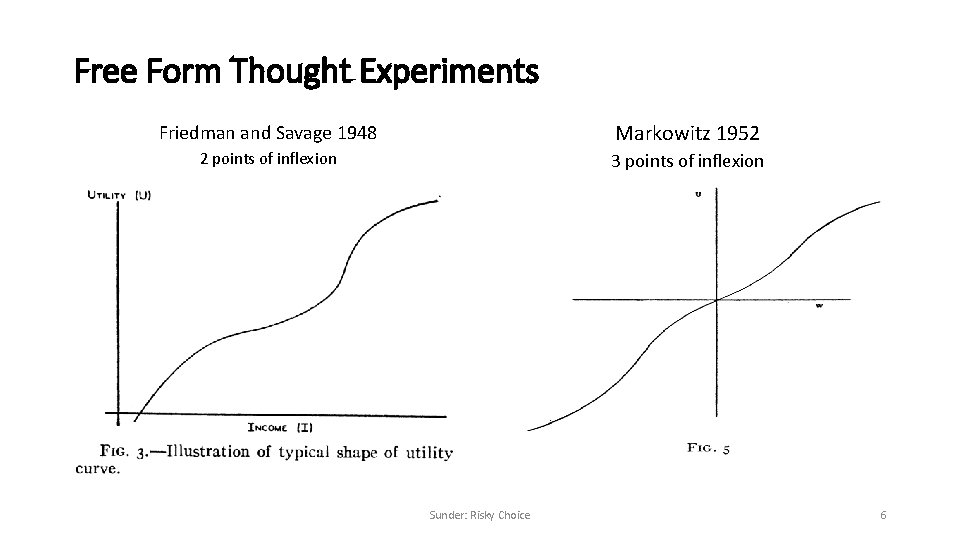
Measuring Individual Risk Preferences • Unambiguous definitions and methods of measurement at the heart of sciences • Seven decades of attempts to furnish empirical content to VNM theory include: • • Free form thought experiments of Friedman and Savage 1948, and Markowitz 1952); Both rejected Bernoulli’s proposal Sunder: Risky Choice 5
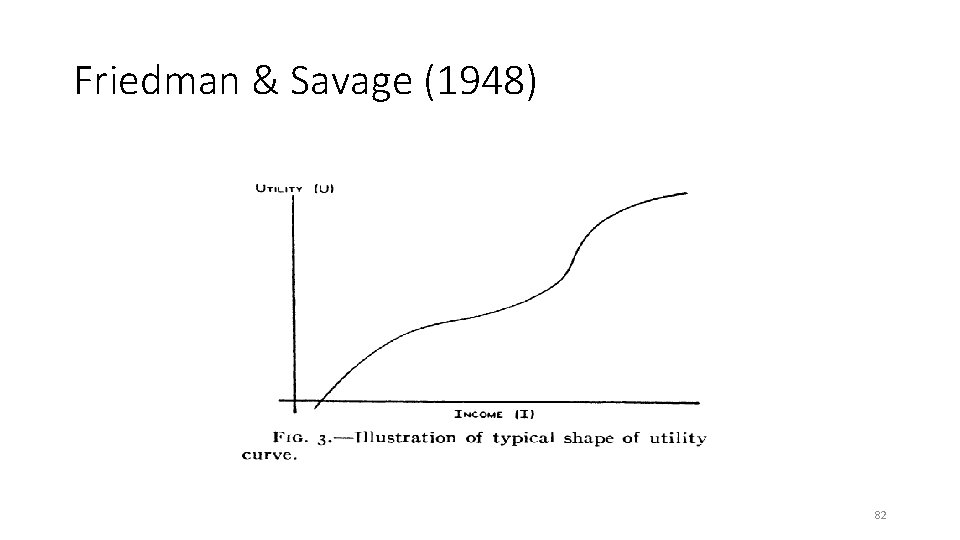
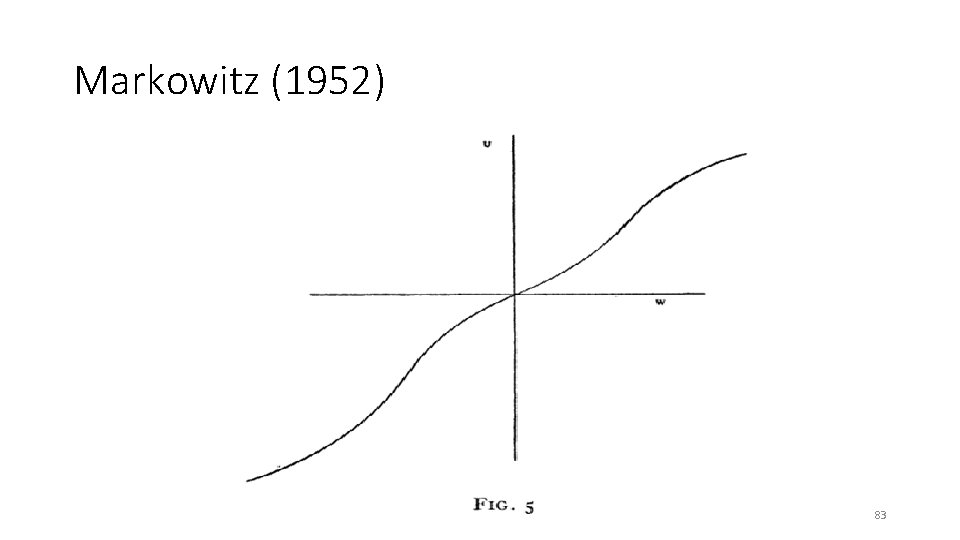
Free Form Thought Experiments Friedman and Savage 1948 Markowitz 1952 2 points of inflexion 3 points of inflexion Sunder: Risky Choice 6
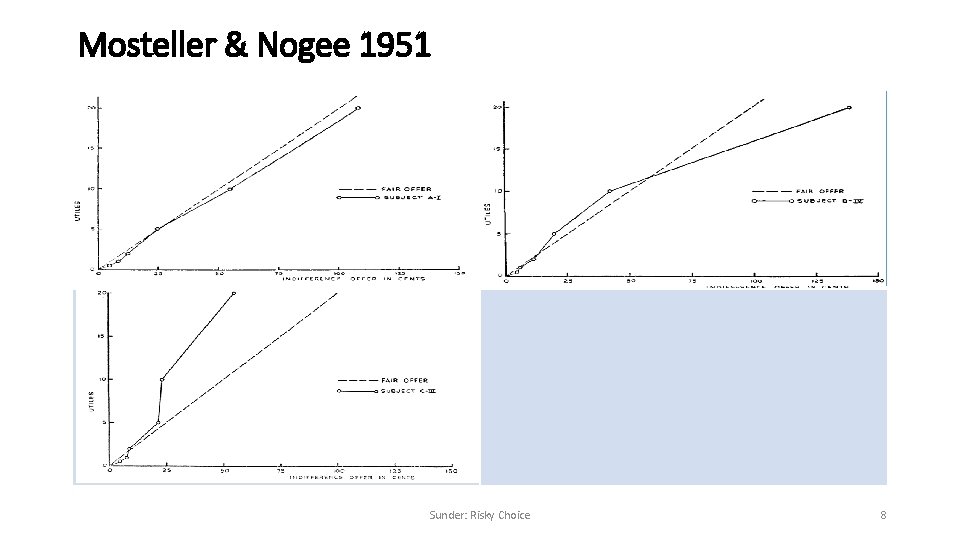
Empirical Task of Mapping Utilities • Mosteller and Nogee (1951): elicited data from payoff-motivated choice experiments over sample “poker” hands to construct Bernoulli/VNM utility functions (no statistical estimation) • Their conclusions: • • • Max EU not unreasonable; Inconsistency in behavior relative to VNM; Meager support for Friedman & Savage; Harvard students “conservative” (i. e. , concave); National Guard subjects “extravagant” (i. e. , convex) Sunder: Risky Choice 7
Mosteller & Nogee 1951 Sunder: Risky Choice 8
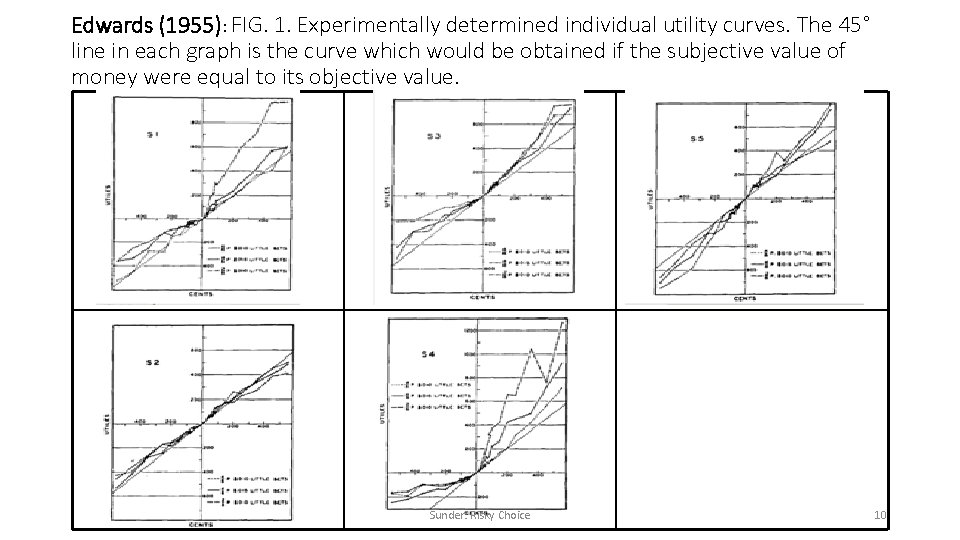
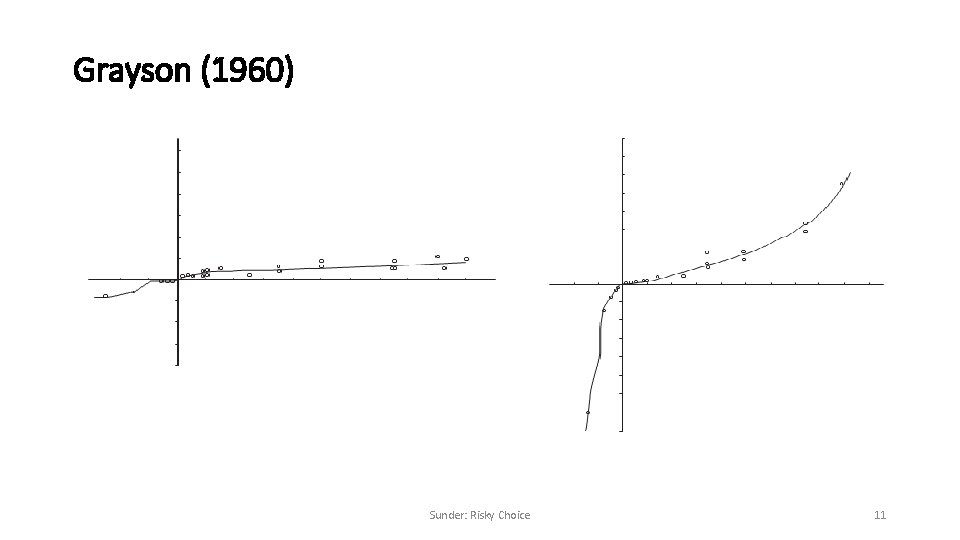
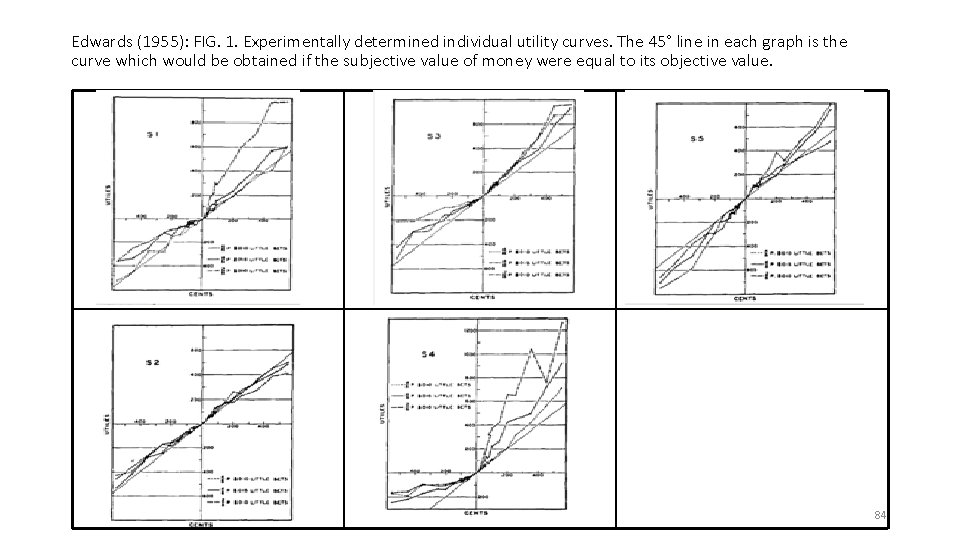
Empirical Task of Mapping Utilities • Ward Edwards (1955): “Another model, which assumes that Ss choose so as to maximize expected utility, failed to predict choices successfully. ” (p. 214) • Grayson (1960): “Drilling decisions by oil and gas operators” (Howard Raiffa’s graduate student Empirical Failure of EU 9
Edwards (1955): FIG. 1. Experimentally determined individual utility curves. The 45° line in each graph is the curve which would be obtained if the subjective value of money were equal to its objective value. Sunder: Risky Choice 10
Grayson (1960) Sunder: Risky Choice 11
Parametrized Utility Functions: Pratt; Diamond, Rothschild, and Stiglitz (1964 -74) • Pratt; Diamond, Rothschild, and Stiglitz during this decade, EUT with dispersion-based measures of risk (e. g. , variance and Arrow-Pratt) were in the driver’s seat • Pure vs. speculative risk distinction of insurance theory and industry fell into disuse • Explosion of interest in EU with analysis of parameterized utility function, and giving empirical content to the VNM program through elicitation of choices over risky lotteries • To what extent did these elicitations yield dependable estimates of a person’s propensity to choose under risk? Sunder: Risky Choice 12
Examples of Parametric Estimation from Lab and Field Experiments: Absolute (ARA) and Relative (RRA) Risk Aversion • Certainty equivalent (Dillon and Scandizzo 1978) • Lottery choice from menu (Binswanger 1980) • Auctions • Becker-De. Groot-Marschak procedure • Holt-Laury procedure • Pie Chart procedures • Physiological measurements • Payment methods • BDM vs. auctions • Small and large stakes • Problem solving ability • Perception of institutions • Heuristics Sunder: Risky Choice 13
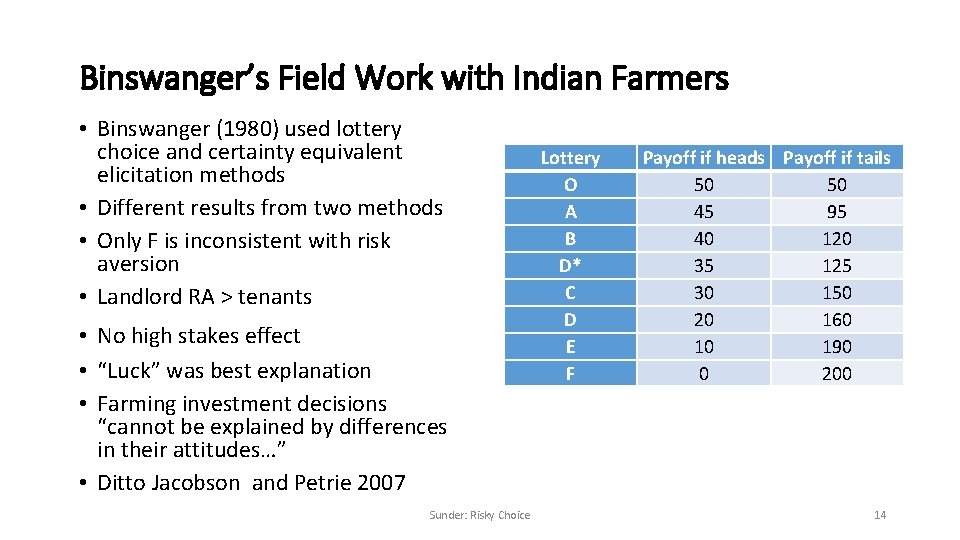
Binswanger’s Field Work with Indian Farmers • Binswanger (1980) used lottery choice and certainty equivalent elicitation methods • Different results from two methods • Only F is inconsistent with risk aversion • Landlord RA > tenants • No high stakes effect • “Luck” was best explanation • Farming investment decisions “cannot be explained by differences in their attitudes…” • Ditto Jacobson and Petrie 2007 Sunder: Risky Choice Lottery O A B D* C D E F Payoff if heads Payoff if tails 50 50 45 95 40 120 35 125 30 150 20 160 10 190 0 200 14
Auctions • Vickrey (1961) independent value first price sealed bid auction: empirical work yields overbidding relative to risk neutral prediction • CRRAM (Cox et al. 1988): modification to allow for risk aversion as explanation of overbidding: mixed results • Kagel and Levin (1993): third price sealed bid auction to estimate coefficient of relative risk aversion: risk aversion with n = 5; risk seeking for n = 10 Sunder: Risky Choice 15
Becker-De. Groot-Marschak (1964) Procedure • A special case of second-price auction pitting a lotteryendowed single subject (who submits an ask) against a robotic bidder generating random bids • If bid exceeds the ask, subject sells at the bid price • Otherwise, subject plays the lottery • Harrison (1986), James (2011), Kachelmeier and Shehata (1992): different implementations and institutions yield estimated coefficients that imply risk aversion or risk seeking behavior Sunder: Risky Choice 16
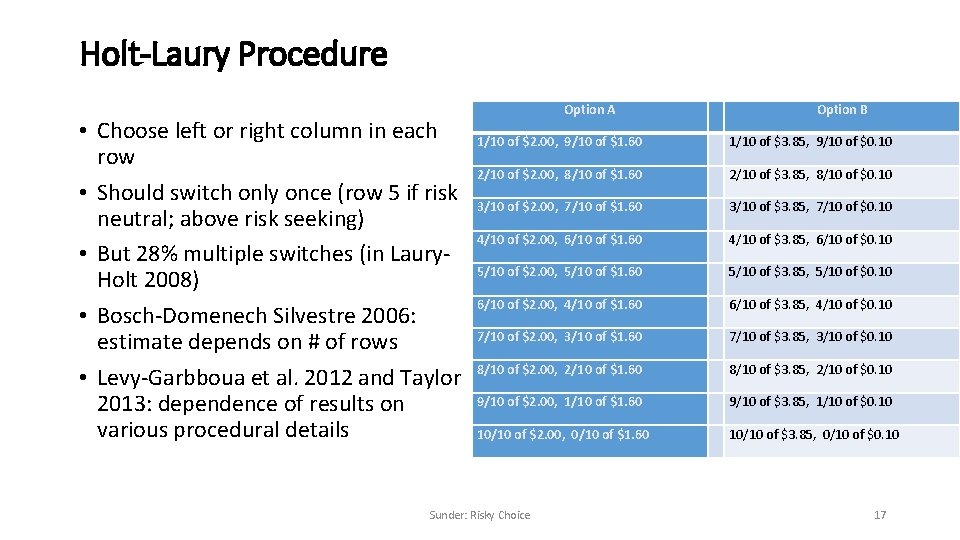
Holt-Laury Procedure • Choose left or right column in each row • Should switch only once (row 5 if risk neutral; above risk seeking) • But 28% multiple switches (in Laury. Holt 2008) • Bosch-Domenech Silvestre 2006: estimate depends on # of rows • Levy-Garbboua et al. 2012 and Taylor 2013: dependence of results on various procedural details Option A Option B 1/10 of $2. 00, 9/10 of $1. 60 1/10 of $3. 85, 9/10 of $0. 10 2/10 of $2. 00, 8/10 of $1. 60 2/10 of $3. 85, 8/10 of $0. 10 3/10 of $2. 00, 7/10 of $1. 60 3/10 of $3. 85, 7/10 of $0. 10 4/10 of $2. 00, 6/10 of $1. 60 4/10 of $3. 85, 6/10 of $0. 10 5/10 of $2. 00, 5/10 of $1. 60 5/10 of $3. 85, 5/10 of $0. 10 6/10 of $2. 00, 4/10 of $1. 60 6/10 of $3. 85, 4/10 of $0. 10 7/10 of $2. 00, 3/10 of $1. 60 7/10 of $3. 85, 3/10 of $0. 10 8/10 of $2. 00, 2/10 of $1. 60 8/10 of $3. 85, 2/10 of $0. 10 9/10 of $2. 00, 1/10 of $1. 60 9/10 of $3. 85, 1/10 of $0. 10 10/10 of $2. 00, 0/10 of $1. 60 10/10 of $3. 85, 0/10 of $0. 10 Sunder: Risky Choice 17
Pie Chart Procedures • Lotteries shown as pie charts, more transparent and intuitive • Inconsistent results from Becker-De. Groot-Marschak and pie chart procedures Lichtenstein and Slovic (1971); Grether and Plott (1979) • Hey and Orne (1994): Inconsistent choices • Results depend on the number of pie charts presented to subjects; Engle-Warnick et al. (2006) Sunder: Risky Choice 18
Physiological Measurements: Hormones • Harlow and Brown (1990): bidding behavior related to enzyme MAO for men, not women • Sapienza et al. (2009): relationship between Holt-Laury estimates and salivary testosterone levels is highly conditional on gender and background hormone levels • Mixed results from various other studies of risky choice and various hormones (cortisol, estradiol, progestorone), often mutually inconsistent • Effect of pre-natal exposure to testosterone revealed in 2 D: 4 D ratio: inconsistent results • Biometric data tends to vary with time, raising new questions about interpretation of preferences and their stability and usefulness for prediction Sunder: Risky Choice 19
Payment Methods • Frustration with obtaining consistent measurements of risk attitudes from observational data drew attention to details of how subjects are paid • Monetary, consumable, hypothetical? • Paid for all rounds or randomly selected subset of rounds • Single or multiple rounds • Paid each round, or paid sum at the end • Payment in public or private • Whole literature on payments methods influencing the estimates • Generally, everything seems to matter some of the time; no general results Sunder: Risky Choice 20
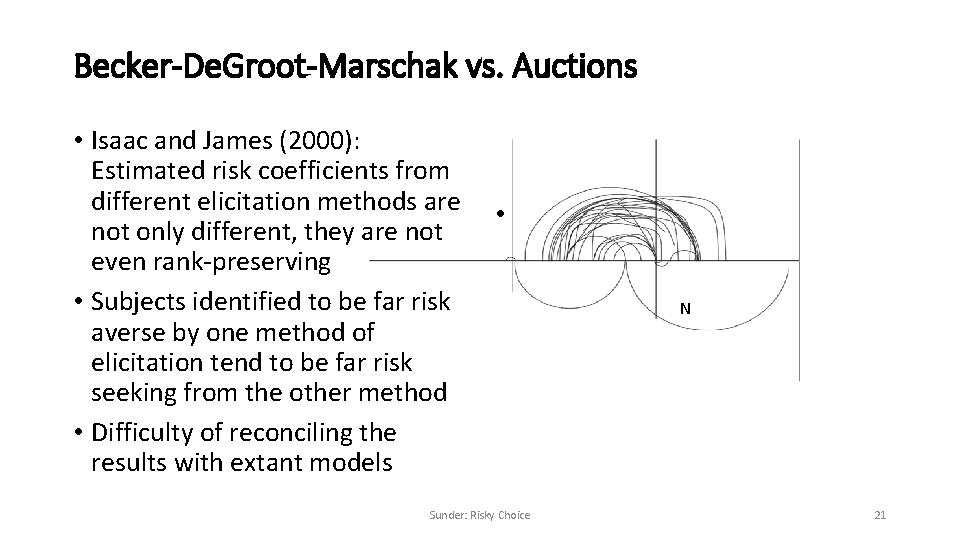
Becker-De. Groot-Marschak vs. Auctions • Isaac and James (2000): Estimated risk coefficients from different elicitation methods are • not only different, they are not even rank-preserving • Subjects identified to be far risk averse by one method of elicitation tend to be far risk seeking from the other method • Difficulty of reconciling the results with extant models Sunder: Risky Choice N 21
Math/Problem Solving Ability • Frederick (2005): could problem solving skills and learning during the task affect the estimates? • Higher CRT scores related to lower risk aversion • Differences in numeracy could be the common cause of the variability of risk coefficients estimated from observed choice data Sunder: Risky Choice 22
Subject Perception of Institution • The choice of the format in which the data and the task are presented to the subjects alter the estimated risk coefficients Sunder: Risky Choice 23
Where Are We Now? • Different ways of eliciting risk parameters in cash-motivated controlled economics experiments yield different results • Little evidence that EU (and its variations), based on elicited preferences, predict individual choice better than naïve alternatives • Estimation procedures applied to any choice data necessarily yield a risk coefficient; but exhibit little stability outside contexts • Perhaps the failure to find stable results with predictive content is the result • But all is not lost yet. • Let us look if Bernoulli functions may help us understand aggregate phenomena and furnish some consilience across macro domains Sunder: Risky Choice 24
Are Aggregate Level Phenomena in the Field Explained/Predicted Better by Curved Bernoulli Functions? Must not rule this out without examining the data. • Health, medicine, sports, illicit drugs • Gambling • Engineering • Insurance • Real estate • Bond markets • Stock markets • Uncovered interest rate parity • Equity premium • Aggregate model calibrations • Labor markets • Social/unemployment insurance • Central bank reserves Sunder: Risky Choice 25
Health and medicine, illicit drugs • Dispersion meaning of risk almost absent; risk factors for: • Drug addiction: family history of addiction, being male, having another psychological problem, peer pressure, lack of family involvement, anxiety, depression, loneliness, and taking a highly addictive drug • Heart disease: old, male, family history of heart disease, postmenopausal, non-Caucasian race, smoking, high level of low density lipoprotein, hypertension, obesity, diabetes, high level of C-reactive protein, sedentary lifestyle, and stress • No mention of expectation of a Bernoulli function, or dispersion of outcomes Sunder: Risky Choice 26
Engineering • NASA: Engineering Reliability Analysis quantifies system risks through a combination of probabilistic analyses, physics-based simulations of key risk factors, and failure timing and propagation models. ERA develops dynamic, integrated risk models to not only quantify the probabilities of individual failures, but also to learn about the specific systems, identify the driving risk factors, and guide designers toward the most effective strategies for reducing risk. • No mention of dispersion measure of risk Sunder: Risky Choice 27
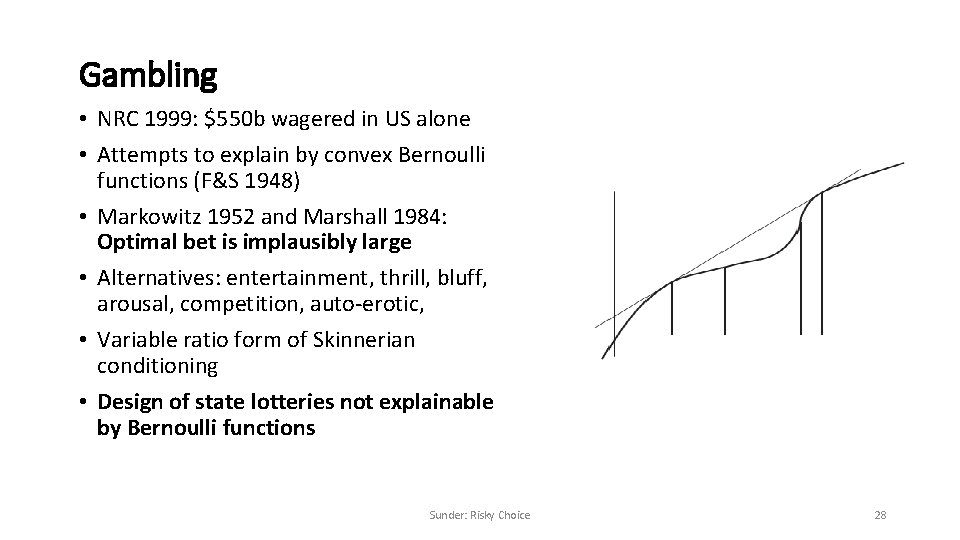
Gambling • NRC 1999: $550 b wagered in US alone • Attempts to explain by convex Bernoulli functions (F&S 1948) • Markowitz 1952 and Marshall 1984: Optimal bet is implausibly large • Alternatives: entertainment, thrill, bluff, arousal, competition, auto-erotic, • Variable ratio form of Skinnerian conditioning • Design of state lotteries not explainable by Bernoulli functions Sunder: Risky Choice 28
Insurance • Industry size in 2011: $4. 6 t in premiums; best case for risk aversion • Almost all have negative actuarial value to policy holders; textbook example of widespread aversion to risk; but • Marketing emphasizes loss/harm/injury, not dispersion risk • Other explanations: policy as a put option, cuts costs of contingency planning • Some versions of EUT specify convexity in losses; inconsistent with insurance • Lack of universality of insurance suggests social learning, marketing, and legal requirements may play roles • Einav et al. (2012): correlations among individual risk attitudes obtained from various domains of insurance vary widely (0. 06 -0. 55); but their subjective ordinal measures of risk unrelated to Arrow-Pratt Sunder: Risky Choice 29
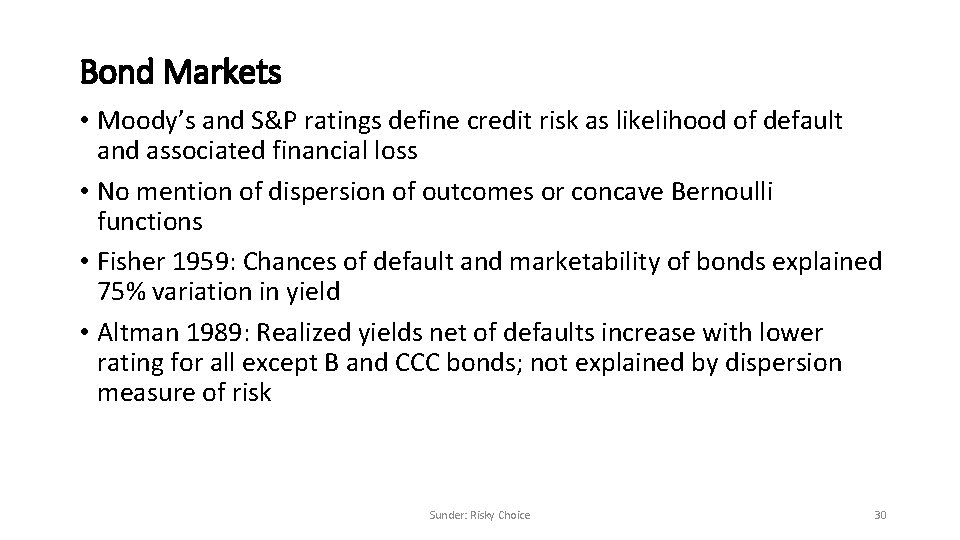
Bond Markets • Moody’s and S&P ratings define credit risk as likelihood of default and associated financial loss • No mention of dispersion of outcomes or concave Bernoulli functions • Fisher 1959: Chances of default and marketability of bonds explained 75% variation in yield • Altman 1989: Realized yields net of defaults increase with lower rating for all except B and CCC bonds; not explained by dispersion measure of risk Sunder: Risky Choice 30
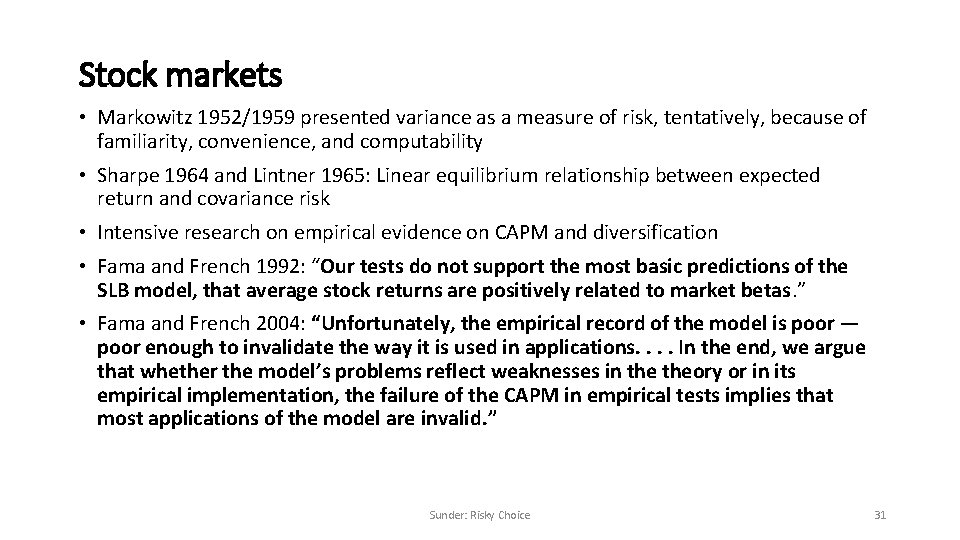
Stock markets • Markowitz 1952/1959 presented variance as a measure of risk, tentatively, because of familiarity, convenience, and computability • Sharpe 1964 and Lintner 1965: Linear equilibrium relationship between expected return and covariance risk • Intensive research on empirical evidence on CAPM and diversification • Fama and French 1992: “Our tests do not support the most basic predictions of the SLB model, that average stock returns are positively related to market betas. ” • Fama and French 2004: “Unfortunately, the empirical record of the model is poor — poor enough to invalidate the way it is used in applications. . In the end, we argue that whether the model’s problems reflect weaknesses in theory or in its empirical implementation, the failure of the CAPM in empirical tests implies that most applications of the model are invalid. ” Sunder: Risky Choice 31
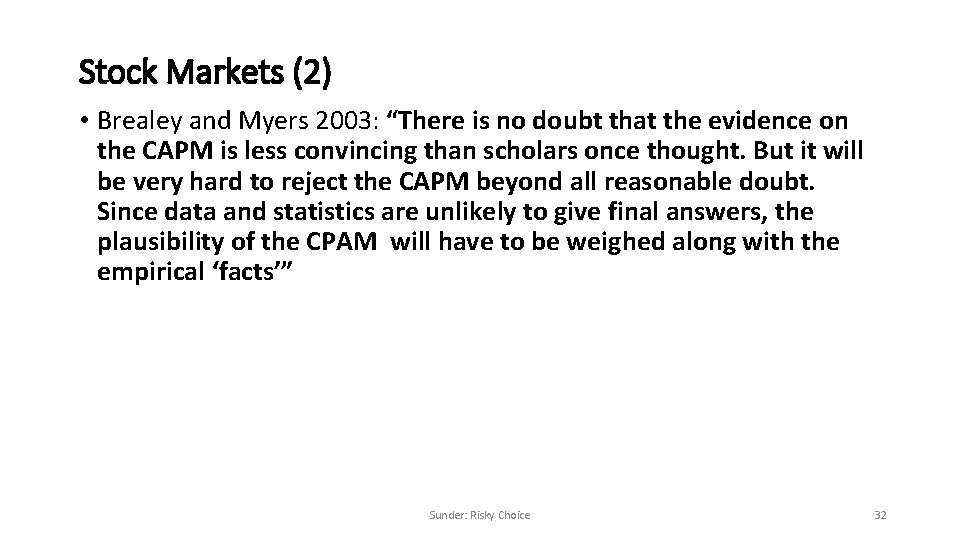
Stock Markets (2) • Brealey and Myers 2003: “There is no doubt that the evidence on the CAPM is less convincing than scholars once thought. But it will be very hard to reject the CAPM beyond all reasonable doubt. Since data and statistics are unlikely to give final answers, the plausibility of the CPAM will have to be weighed along with the empirical ‘facts’” Sunder: Risky Choice 32
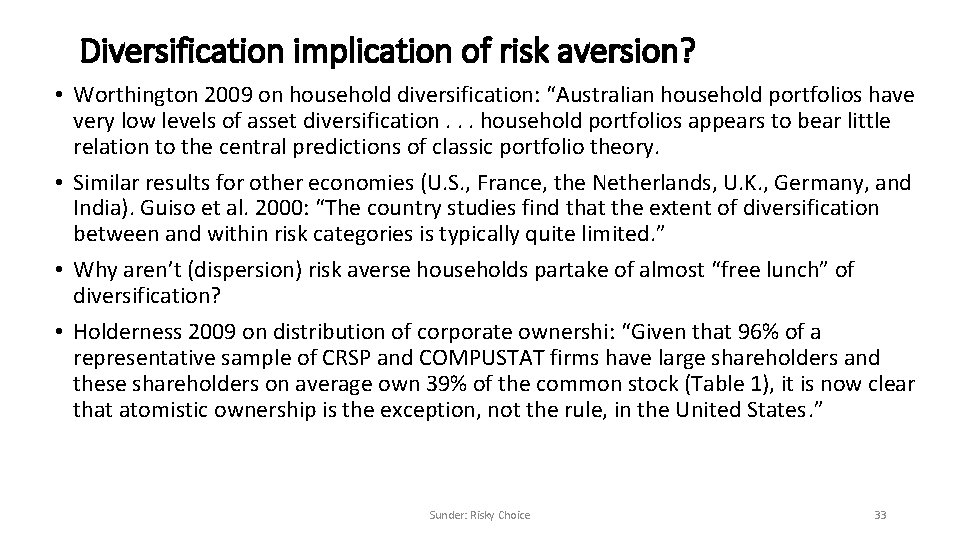
Diversification implication of risk aversion? • Worthington 2009 on household diversification: “Australian household portfolios have very low levels of asset diversification. . . household portfolios appears to bear little relation to the central predictions of classic portfolio theory. • Similar results for other economies (U. S. , France, the Netherlands, U. K. , Germany, and India). Guiso et al. 2000: “The country studies find that the extent of diversification between and within risk categories is typically quite limited. ” • Why aren’t (dispersion) risk averse households partake of almost “free lunch” of diversification? • Holderness 2009 on distribution of corporate ownershi: “Given that 96% of a representative sample of CRSP and COMPUSTAT firms have large shareholders and these shareholders on average own 39% of the common stock (Table 1), it is now clear that atomistic ownership is the exception, not the rule, in the United States. ” Sunder: Risky Choice 33
Uncovered interest parity • Li et al. 2012: “Uncovered interest parity (UIP) is one of the most important theoretical relations used in analytical work in both international finance and macroeconomics. It is also a key assumption in many of the models of exchange rate determination. ” • Exch. Rate Appreciation = a + b*Interest. Differential + error • Where a =0 and b = 1 and error has mean zero. • Froot and Thaler 1990 meta study: most estimates of b have wrong sign, average = - 0. 88! • Li et al. 2012: data from 10 countries, mixed results; estimates vary widely by currency pairs and over time • Concave Bernoulli functions have not helped resolve the puzzle; “…hard to explain the failure of UIP even using a sophisticated measure of risk” (p. 168). Sunder: Risky Choice 34
Equity Premium Puzzle • Difficulties in reconciling empirical estimates of the market risk premium PM = E(RM) – Rf with its theoretical determinants • Mehra and Prescott 1985: assuming plausible levels of CRRA, risk premium should be 0. 4%; • But, over 1889 -1978 realized risk premium was about 15 times (6%) • Fernandez et al. 2012 survey: 2223 answers from US ranged over 1. 5 -15%; mean 5. 5% • After reviewing dozens of attempts over quarter century to resolve the puzzle, Mehra 2008 states: “The puzzle cannot be dismissed lightly because much of our economic intuition is based on the very class of models that fall short so dramatically when confronted with financial data. It underscores the failure of paradigms central to financial and economic modeling to capture the characteristic that appears to make stocks comparatively riskier. ” (emphasis added). • Down in the Wall Street world of traders and financiers, Investopedia dispenses this wisdom: “Equity premium puzzle is a mystery to financial academics. ” Sunder: Risky Choice 35
Aggregate model calibrations • Besides equity premium puzzle, calibrated models of aggregate consumption are used in labor and business cycle theory • Kydland Prescott 1982 and Mehra and Prescott 1985 and use 1 < r < 2, rule out assuming extreme risk aversion • Kydland Prescott 1991 tighten to r = 2 • Ljungqvist and Sargent 2004: r < 2 or 3 • Resolving the EPP requires r > 10 • Chetty 2006: 33 sets of wage and income elasticities imply r in range 0. 15 -1. 78, mean 0. 71. “… Hence, one interpretation of the result is that it provides new evidence against canonical expected utility theory as a descriptive model of choice uncertainty” • Unemployment insurance puzzle: r =2 CRRA consumption model yields 0 -20% of wage compared to 50% observed in the field (Baily 1978 and Gruber 1997) • Central banks’ international reserve levels yield r = 2 (CRRA) for Latin America, about 10 for Asia Sunder: Risky Choice 36
Aggregate Level Evidence From the Field • The hope that curved Bernoulli functions, combined with dispersion concept of risk, might yield insights into a variety of socio-economic phenomena in the field waits to be fulfilled • Surprisingly little aggregate level insights or consilience across domains populated by the same agents: credit, insurance, corporate equity, real estate, currency markets, gambling, labor, and business cycles • Academic literature often assumes such functions, but attempts to tie the resulting models to data often lead to wildly different, and mutually inconsistent, implied innate preferences in specified populations. • These empirical inconveniences now carry optimistic labels such as “the interest parity puzzle” suggesting that, one day, solutions may be found without abandoning the paradigm based on Bernoulli functions Sunder: Risky Choice 37
What is next? • Parameter r for the same population has to vary from 0. 15 to 14 (by about two orders of magnitude) to explain observations in various domains of our lives • Possible ways forward: • Alternative meanings/measures of risk • Looking for explanatory power in decision makers’ obseravable opportunity sets, real options, and net pay-offs, instead of in unobserved curved Bernoulli functions • Current work in evolution, learning theory, and neuroeconomics Sunder: Risky Choice 38
Phlogiston: Science can get trapped in its own eddy currents! • Greeks; Becher (1635– 1682); Stahl (1660– 1734) • Invisible compressible fluid; able to organize disparate physical phenomena better than alchemists’ earth, air, fire, water • Generated some puzzles of its own: context-dependent mass • Proponents of phlogiston added free parameters, even negative mass to account for the data • Phlogiston theory did not disappear when • It created puzzles instead of explanations, or • Its supporters failed to isolate phlogiston in the laboratory • Phlogiston vanished from respectable science only, when Lavoisier’s powerful oxidation/reduction theory emerged in the late 1780 s • Even “Priestley and Cavendish, on whose work much of the new theory was based, clung to the phlogiston theory to the end of their lives. ” Sunder: Risky Choice 39
Could Bernoulli Functions be like Phlogiston? • At least since 1940 s, risky choice explained by Bernoulli functions • To many, aversion to “dispersion” seems a self-evident truth • But they have not yet delivered the empirical goods (not yet isolated in lab or field; puzzles proliferate) • Controversies on way to measure attitudes to risk • Decades of intensive search by theorists and empiricists in economics, game theory, psychology, sociology, anthropology, and other disciplines: no evidence that attitudes to risk modeled by Bernoulli functions can help predict risky choices out of sample • Nor helped us gain a better understanding of aggregate phenomena in stock, bond, insurance, real estate, labor or forex markets, or about medicine, engineering, or gambling • But it will survive until we have something better Sunder: Risky Choice 40
“It is a veritable Proteus that changes its form every instant. ” • Antoine Lavoisier (speaking of phlogiston, quoted in Mc. Kenzie [1960], p. 91) “Thus, finally, the necessity is stressed of discovering the way in which investors conceptualize risk. ” • Susan Lepper, concluding her paper in Hester and Tobin, eds. (1967) Sunder: Risky Choice 41
Attitudes to Risk • Depends on which meaning you have in mind • Harm/injury/loss: can anyone be risk-loving? • Dispersion meaning: aversion as well as love for risk is possible • Evidence on attitudes to dispersion risk Sunder: Risky Choice 42
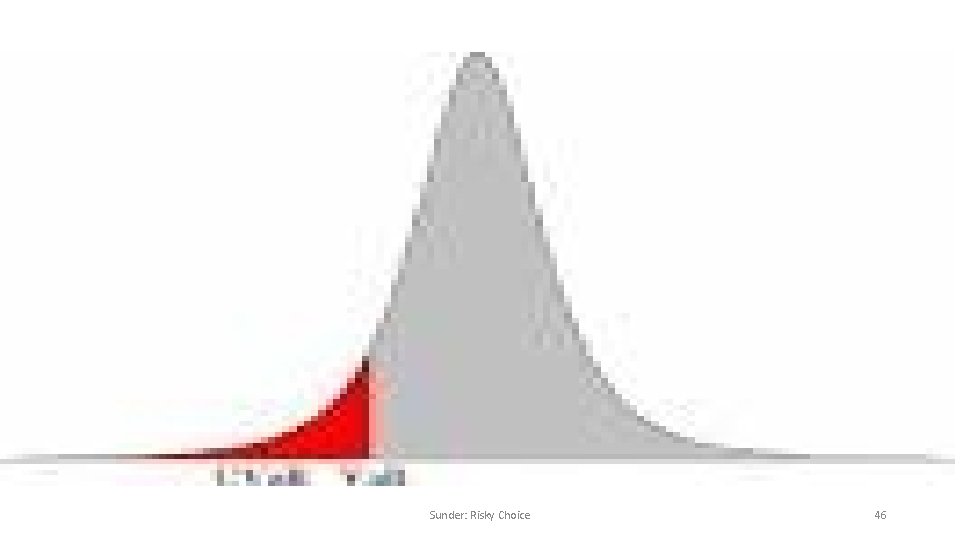
Common Sense Meaning of Risk • Possibility of harm, injury, failure, loss, or danger • In summary, risk means the possibility of something bad • In context of a probability distribution, risk refers to the part of the distribution below the mean, or below zero • Part of the probability distribution above the mean or above zero is not included in this meaning of risk Sunder: Risky Choice 43
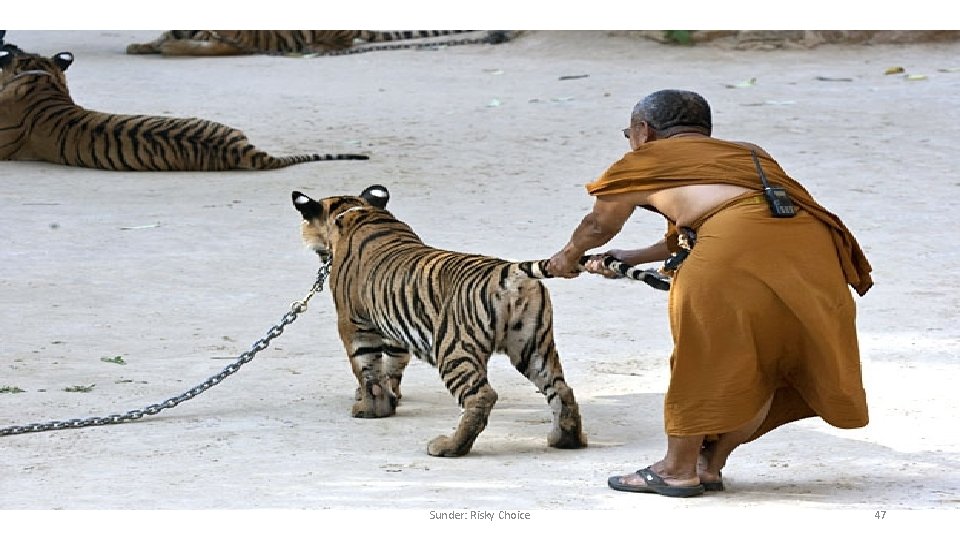
Risk as Hazard: Possibility of Harm or Loss • Possibility of undesirable outcome(s); used in • • Engineering (component failure) Medicine (heart disease) Public health (epidemic) Sports (injury) Environment (drinking water contamination) Regulation (fraud) Credit (default, liquidity) Insurance (accident, fire, death, etc. ) • Probability of a negative outcome, the magnitude/consequences of potential negative outcome, or the negative outcome itself Sunder: Risky Choice 44
Sunder: Risky Choice 45
Sunder: Risky Choice 46
Sunder: Risky Choice 47
Dispersion Meaning of Risk • Dispersion of a probability distribution is a measure of how far apart or dispersed the outcomes are. • Variance is one measure of dispersion (also, standard deviation, etc. ) • Which bet is more risky in this sense? • Win $1 or lose $1 on a coin toss • Win $10 or lose $10 on a coin toss • Second has higher dispersion, and is therefore more risky in the dispersion sense • Introduced by Daniel Bernoulli (1738) and Markowitz (1952) Sunder: Risky Choice 48
Risk as Dispersion of Outcomes (Equity Financial Economics) • Dispersion of outcomes, as in Markowitz’ portfolio theory (variance) • Capital asset pricing model (beta/covariance) • June 6, 2012 search of SSRN. com database of 345, 529 research papers • The word “risk” appears in the titles of 11, 144 (3. 3%) of all papers • Of the ten most frequently downloaded of these finance papers, six use the hazard meaning of risk, three use the dispersion meaning, and one uses both. Sunder: Risky Choice 49
Sunder: Risky Choice 50
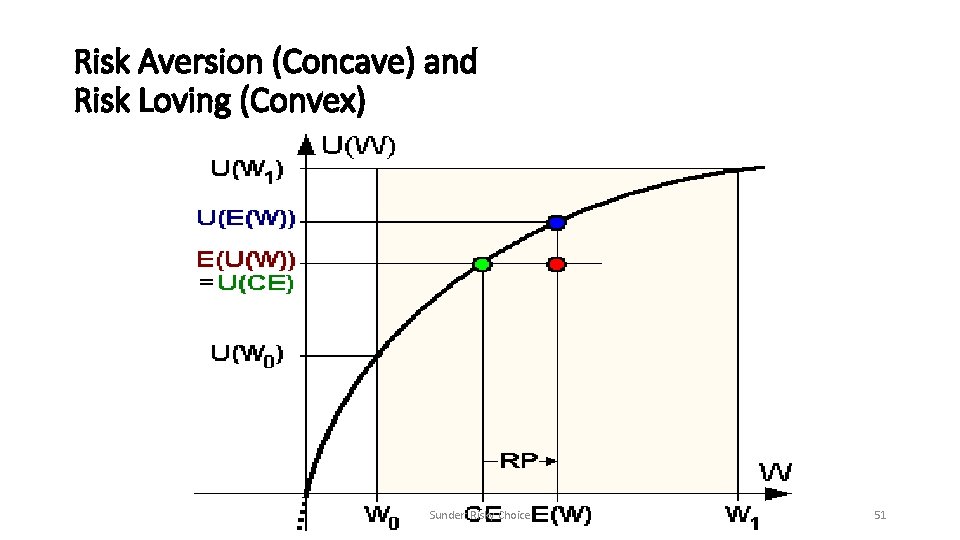
Risk Aversion (Concave) and Risk Loving (Convex) Sunder: Risky Choice 51
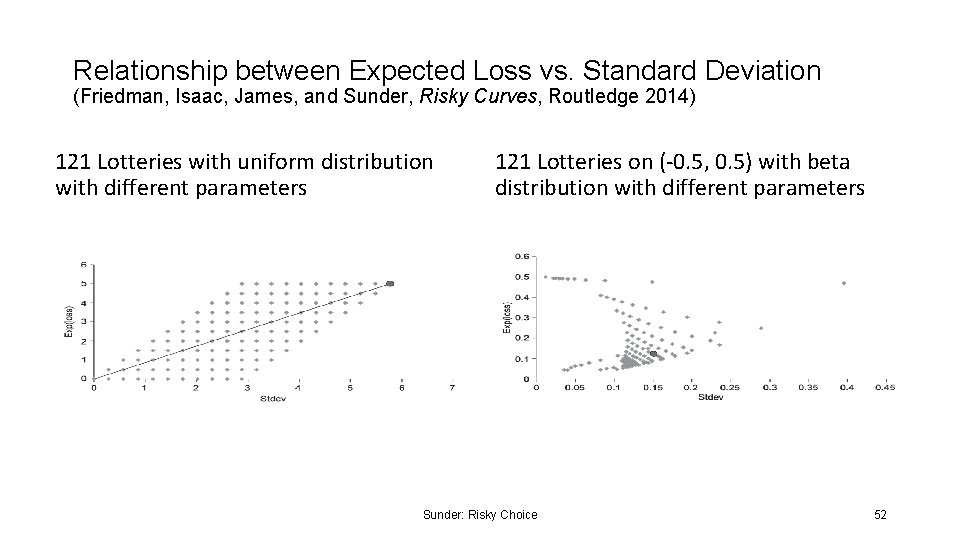
Relationship between Expected Loss vs. Standard Deviation (Friedman, Isaac, James, and Sunder, Risky Curves, Routledge 2014) 121 Lotteries with uniform distribution with different parameters 121 Lotteries on (-0. 5, 0. 5) with beta distribution with different parameters Sunder: Risky Choice 52
Risk Concepts in Aspects of Human Experience • • • Health Medicine Illicit drugs Gambling Engineering Accounting and auditing Insurance Bond markets Stock markets Uncovered interest rate parity Equity premium Regulation (e. g. , of industry and banks) Sunder: Risky Choice 53
Health: Risk Factors for Heart disease (in the United States) • Old, male, family history of heart disease, post-menopausal, non. Caucasian race, smoking, high level of low density lipoprotein, hypertension, obesity, diabetes, high level of C-reactive protein, sedentary lifestyle, and stress • Risk in context of health is used in its common sense meaning • It is difficult to find examples where the dispersion of outcomes is used for risk in health related contexts Sunder: Risky Choice 54
Medicine: Risks of Statins to treat High Cholesterol (FDA) • • Liver injury Memory loss Diabetes Muscle damage • Risk in context of medicine is almost always used in its common sense meaning • It is difficult to find examples where the dispersion of outcomes is used for risk in medicine related contexts Sunder: Risky Choice 55
Illicit Drugs: Risk Factors for Addiction • • • Family history of addiction, Being male, Having another psychological problem, Peer pressure, Lack of family involvement, Anxiety, Depression, Loneliness, and Taking a highly addictive drug Risk in context of illicit drugs is used in its common sense meaning It is difficult to find examples where the dispersion of outcomes is used for risk drug related contexts Sunder: Risky Choice 56
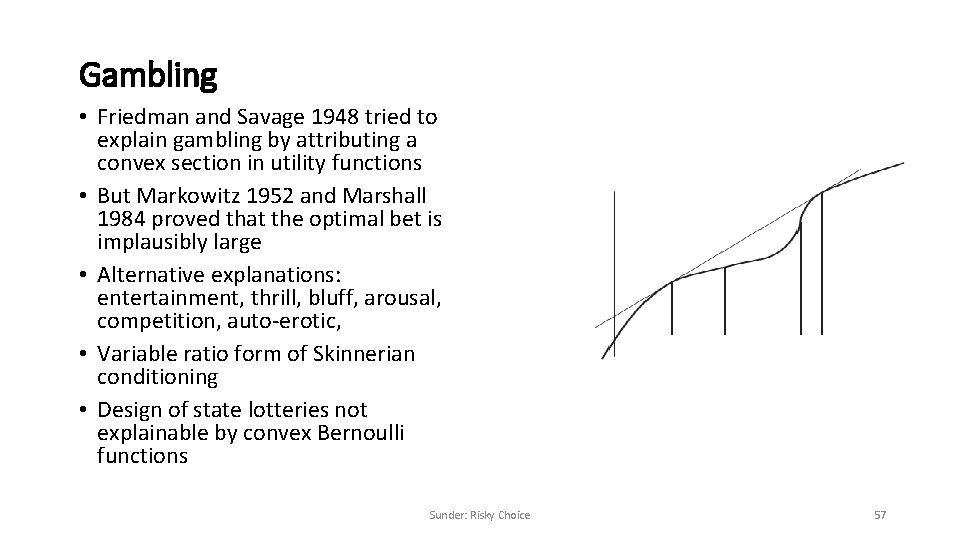
Gambling • Friedman and Savage 1948 tried to explain gambling by attributing a convex section in utility functions • But Markowitz 1952 and Marshall 1984 proved that the optimal bet is implausibly large • Alternative explanations: entertainment, thrill, bluff, arousal, competition, auto-erotic, • Variable ratio form of Skinnerian conditioning • Design of state lotteries not explainable by convex Bernoulli functions Sunder: Risky Choice 57
Engineering • NASA: Engineering Reliability Analysis quantifies system risks through a combination of probabilistic analyses, physics-based simulations of key risk factors, and failure timing and propagation models. ERA develops dynamic, integrated risk models to not only quantify the probabilities of individual failures, but also to learn about the specific systems, identify the driving risk factors, and guide designers toward the most effective strategies for reducing risk. • No mention of dispersion measure of risk, only failure or breakdown Sunder: Risky Choice 58
Health and medicine, illicit drugs • Dispersion meaning of risk almost absent; risk factors for: • Drug addiction: family history of addiction, being male, having another psychological problem, peer pressure, lack of family involvement, anxiety, depression, loneliness, and taking a highly addictive drug • Heart disease: old, male, family history of heart disease, post-menopausal, non. Caucasian race, smoking, high level of low density lipoprotein, hypertension, obesity, diabetes, high level of C-reactive protein, sedentary lifestyle, and stress • No mention of expectation of a Bernoulli function, or dispersion of outcomes Sunder: Risky Choice 59
Measuring Risk • Variance or standard deviation • Lower semi-variance (Markowitz considered it but dropped it, tentatively, for reasons of familiarity, convenience, and computability of portfolios) • Probability of a loss • Value at risk (Va. R at x%) • Expected loss • Measures based on third and higher moments--prudence, temperance, and beyond • Given the difficulty of dealing with the first two moments, the higher moments appear unlikely to add much at this point Sunder: Risky Choice 60
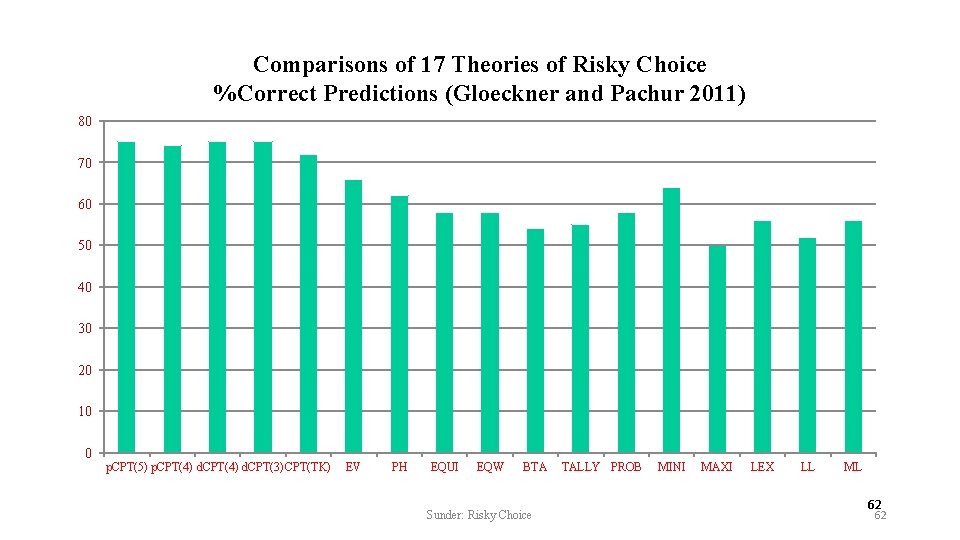
Alternatives? • Not Prospect Theory, just another variant for EU, with free parameters; the value function predicts that people are risk seeking in the loss domain, e. g. , would not purchase insurance even at moderately subsidized prices; more free parameters added for probability curve w • This flexibility (supplemented with an unmodeled phase of editing and adjustment) allows prospect theory to rationalize risky-choice data in sample. No evidence on out-of-sample prediction ability in new tasks • Even in-sample, improvement is small (Gloekner and Pachur (2012, Figure 2, 29); after including a standard penalty (such as Akaike or Schwartz–Bayes) for the number of free parameters, often a one-parameter version of expected utility, or even (parameter free) expected value maximization is better: e. g. , Hey and Orme (1994), Harless and Camerer (1994), and • No evidence on out-of-sample, out of context predictive power Sunder: Risky Choice 61
Comparisons of 17 Theories of Risky Choice %Correct Predictions (Gloeckner and Pachur 2011) 80 70 60 50 40 30 20 10 0 p. CPT(5) p. CPT(4) d. CPT(3) CPT(TK) EV PH EQUI EQW BTA Sunder: Risky Choice TALLY PROB MINI MAXI LEX LL ML 62 62
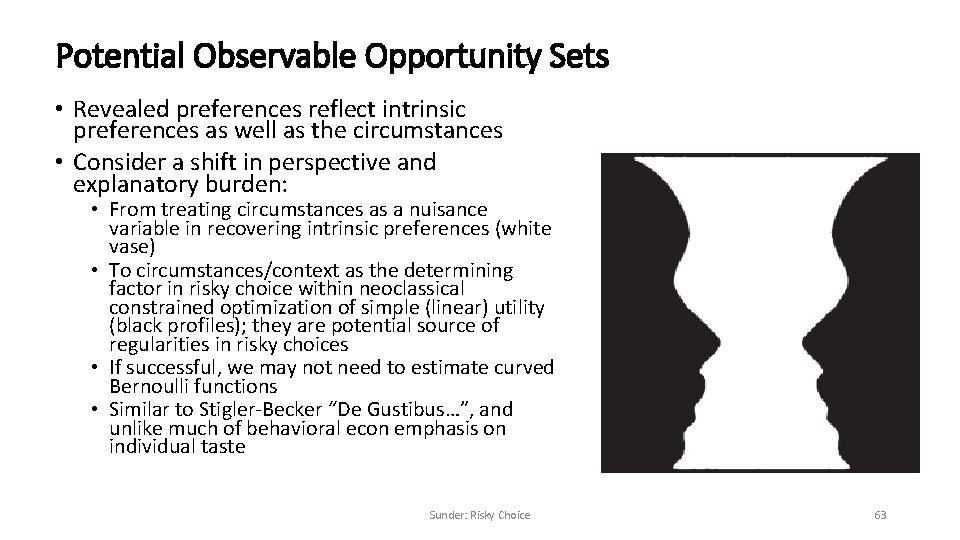
Potential Observable Opportunity Sets • Revealed preferences reflect intrinsic preferences as well as the circumstances • Consider a shift in perspective and explanatory burden: • From treating circumstances as a nuisance variable in recovering intrinsic preferences (white vase) • To circumstances/context as the determining factor in risky choice within neoclassical constrained optimization of simple (linear) utility (black profiles); they are potential source of regularities in risky choices • If successful, we may not need to estimate curved Bernoulli functions • Similar to Stigler-Becker “De Gustibus…”, and unlike much of behavioral econ emphasis on individual taste Sunder: Risky Choice 63
Context as an Opportunity Set • Stigler and Becker (1977): suggest holding preferences constant across people and time and focus on how contexts (opportunity sets) affect what we observe • Risk aversion and risk preference is the first in their list of future applications, and that agenda can now be implemented • Risks change opportunity sets of DMs in observable ways, yielding testable predictions (versus unobservable BFs and probability weights) • Rich applications of real options (Dixit and Pindyck 1994) Sunder: Risky Choice 64
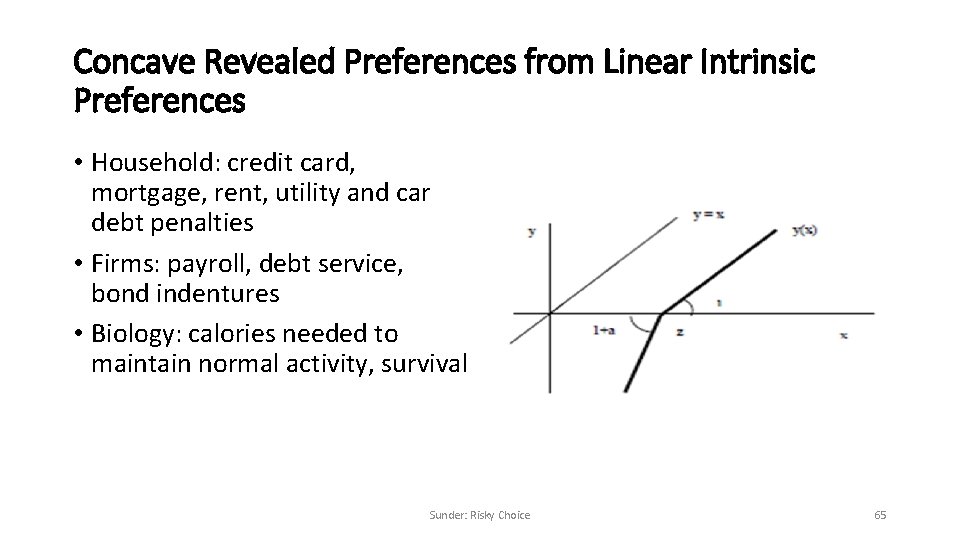
Concave Revealed Preferences from Linear Intrinsic Preferences • Household: credit card, mortgage, rent, utility and car debt penalties • Firms: payroll, debt service, bond indentures • Biology: calories needed to maintain normal activity, survival Sunder: Risky Choice 65
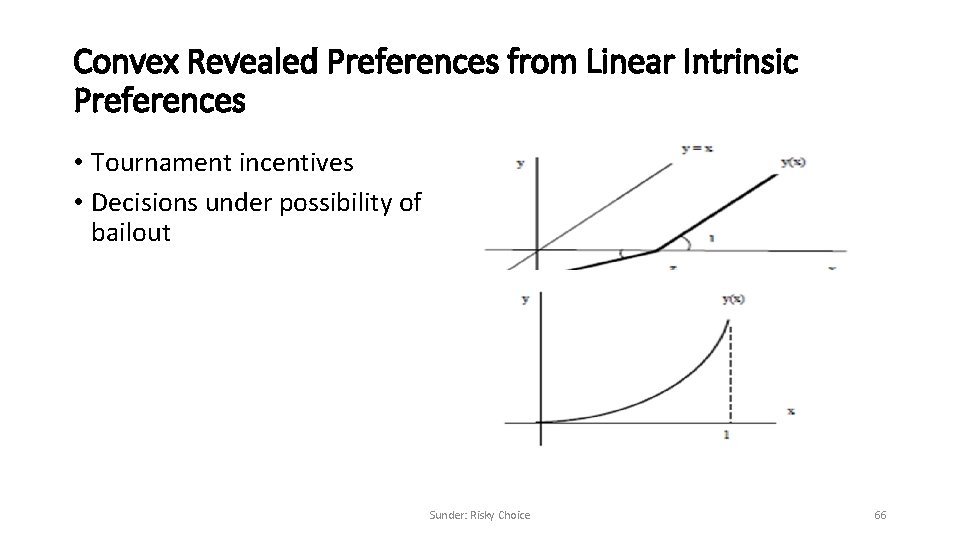
Convex Revealed Preferences from Linear Intrinsic Preferences • Tournament incentives • Decisions under possibility of bailout Sunder: Risky Choice 66
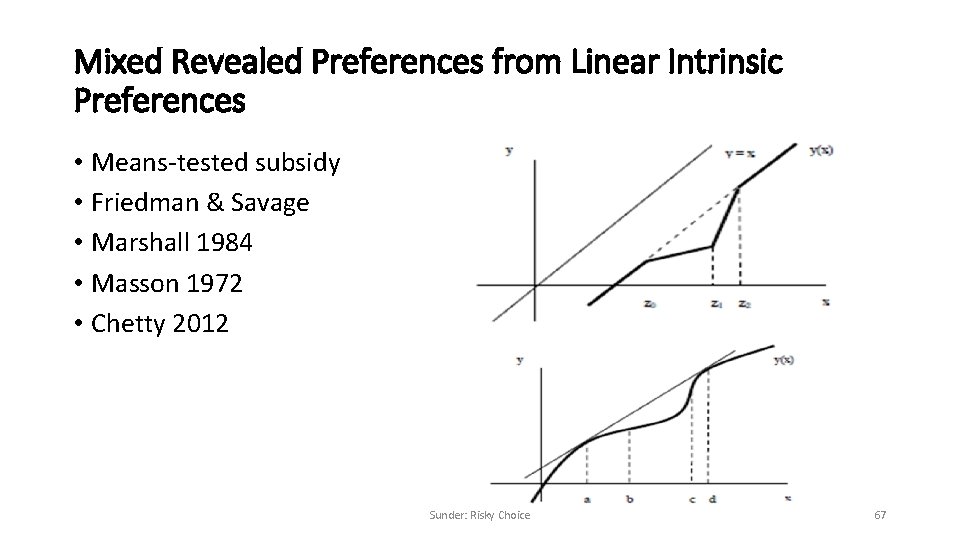
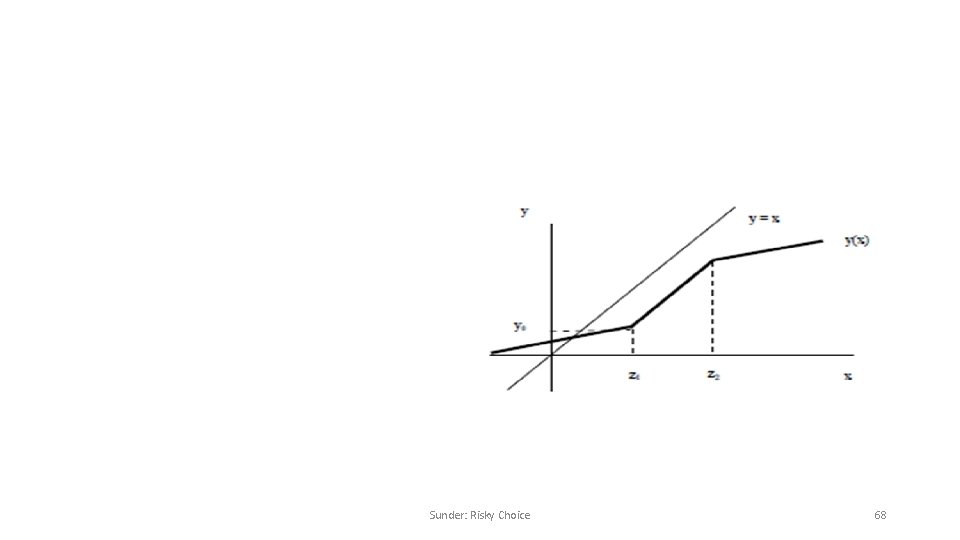
Mixed Revealed Preferences from Linear Intrinsic Preferences • Means-tested subsidy • Friedman & Savage • Marshall 1984 • Masson 1972 • Chetty 2012 Sunder: Risky Choice 67
Sunder: Risky Choice 68
Real Options • Insurance: Other explanations: policy as a put option, cuts costs of contingency planning • Real estate: But higher uncertainty also increases the option value from waiting to sink typically irreversible construction costs • Bulan et al. 2009: analysis of 1214 condominium projects in Vancouver Canada during 1979 -98 finds that empirical evidence supports the risk-neutral predictions of real options theory. • We should explore how far linear utility of net payoffs combined with careful analysis of opportunity sets and embedded real options will take us. • Perhaps farther than curved but unobservable BFs have Sunder: Risky Choice 69
Limitations and Prospects • Observable opportunity set approach will not explain framing and protocol effects; more is needed • This is all about Savage’s small world; but we evolved in the large world where alternatives, consequences and probabilities are often not known; Robson and Samuelson 2011: endow with a goal (feeling full) utility function and learning process • Effective actions in a large world: heuristics (Simon, Newell; Gigerenzer: fast and frugal, gaze for baseball); • Adaptive heuristics may help explain framing and protocol Sunder: Risky Choice 70
Brain Science • Many studies on neurological responses to stimuli to study risky choices of humans and animals (e. g. , Preuschoff et al. ’s “Markowitz in the Brain” 2008) • Interpretations are disputed; possibility of protocol effects, caution for now Sunder: Risky Choice 71
Linking Theory and Observation • Consequences of unsupported widely-held belief in explanatory/predictive usefulness of Bernoulli functions has consequences • Efforts to find new curved Bernoulli functions • Insufficient careful attention to opportunity sets of decision makers • Increasingly complex theory without benefit of better explanatory power • Prospects for a better theory to replace curved functions • Within orthodox economics, seek explanatory power in potentially observable opportunity sets instead of unobservable preferences (considering bankruptcy, taxes, penalties and other frictions); real options; risk as exposure to harm • Possibilities of combining process-based understanding of risky choice: brain science and heurstics (Gigrenzer) with opportunity set focused decision theory Sunder: Risky Choice 72
To Conclude • Revisit concepts, measurement, human perception, and attitudes towards risk • Two primary concepts of risk • • Possibility of harm or loss Dispersion of outcomes They overlap partially Depending on the context to distinguish between the two works some times, but can also create confusion • Insurance literature and practice • Pure risk • Speculative risk • Analysis of choice under risk in economics, accounting, and finance needs more careful empirical foundations that dependence on dispersion concept Sunder: Risky Choice 73
Thank You! Shyam. sunder@yale. edu Faculty. som. yale. edu/shyamsunder/research. html
Fire: Circa 1750 CE • Everyone knew fire to be an element • In the preceding century, the precise scientific term phlogiston had replaced the vague term for the third of the four elements: fire. • Johann Joachim Becher (1667): the element, later called phlogiston, was contained within combustible materials; released during combustion, leaving calx behind. • What is the mass of phlogiston? E. g. , burning wood produced ashes: • But empirical problems arose with metals (mercury and magnesium): • m. Hg = m. Calx + mp , and the calx weighs more than the metal… • Imagine theme for an 18 th century chemistry conference: • How many varieties of phlogiston (with positive and negative mass)? • And not: what does it mean to have an element of matter with negative mass? Risky Curves 75 75
Risk Preferences: Circa 2000 CE • Everyone knows that people have risk preferences. • In recent decades, more precise scientific labels have come into vogue: expected utility theory and the Bernoulli function. • Measuring the curvature so we can predict behavior in novel risky situations has proved to be elusive • Portfolio choice etc. usually suggest concave functions • But gambling suggests convexity, … • Extreme differences on the degree of curvature inferred from data (equity risk premium puzzle, Mehra and Prescott) • Possibility of segmented Bernoulli functions with different curvatures, reference points, and kinks, distortions of probability, etc. • Can we sort out how many varieties of segments and curvatures? • More fundamentally, • Does “risk preference” actually explain observed choice behavior under risk? • Or does it merely summarize the observations? Risky Curves 76 76
Which Risk? • There at least two distinct concepts of “risk” • dispersion of outcomes (since Markowitz) • possibility of harm (common parlance) • In economics literature on risk preferences, the first of these two meanings dominates • Although the second meanings slips in, in many contexts (credit, bond ratings, insurance, health, engineering, internal controls, etc. ) 77
What is this Person’s Bernoulli function? • Operates two portfolios: • Portfolio X: consists only of short maturity Government securities and insured CDs. • Portfolio Y: consists only of deep out of money call options on oil futures. • Both are held by the same person! • She manages X for her great uncle (fiduciary). • She holds Y in a national contest (competition) Risky Curves 78 78
Is the Bernoulli function u an intrinsic personal characteristic? • Estimation from choice data is a mechanical process: entering observations into an estimation algorithm necessarily yields a u. • Existence of an estimated u says nothing about its validity: • How well can u predict the out-of-sample choice data? • For a given person or population, how generalizable is u to new tasks and new contexts? Risky Curves 79 79
Degrees of Freedom • The parameter space for increasing Bernoulli functions is infinite dimensional (we have unlimited flexibility) • If we impose CRRA or CARA restriction • use 1 df, (2 if multiple families allowed) • Friedman and Savage, and Markowitz, use at least 4 df • Prospect theory uses at least 5 df: • location of reference point, derivatives on each side, curvatures on each side • Many more df used when you consider probability distortions Risky Curves 80 80
The Best Case: u is Universal • E. g. , binocular vision or bipedal motion • Bernoulli (1768), Friedman and Savage (1948) and Markowitz (1952) had hoped so. • Bernoulli proposed a simple log function • The other two proposed rather complex functions: 3 -4 segments alternately convex and concave. • But empirics said otherwise, e. g. , Ward Edwards (1953, 1955) found interpersonal differences, and little resemblance to these proposals. • No universal alternative u has been found to improve on the explanatory power of a straight line u. Risky Curves 81 81
Friedman & Savage (1948) 82
Markowitz (1952) 83
Edwards (1955): FIG. 1. Experimentally determined individual utility curves. The 45° line in each graph is the curve which would be obtained if the subjective value of money were equal to its objective value. 84
Fall Back Position #1 Human population could consist of a few basic risk types • • • Binswanger (1980, 1981, 1982) study of 380 farmers in India is the most cited support, but it doesn’t hold up. • • • Such as blood types: O, A, B, etc. Stable after measurement: doesn’t change. Lottery outcomes significant relative to farmer incomes Lottery choices didn’t predict farming decisions. Luck was the only significant explanatory variable in lottery choices! So far, evidence is unkind to the idea that human population consists of individuals of a given set of risk types (like blood types). Risky Curves 85 85
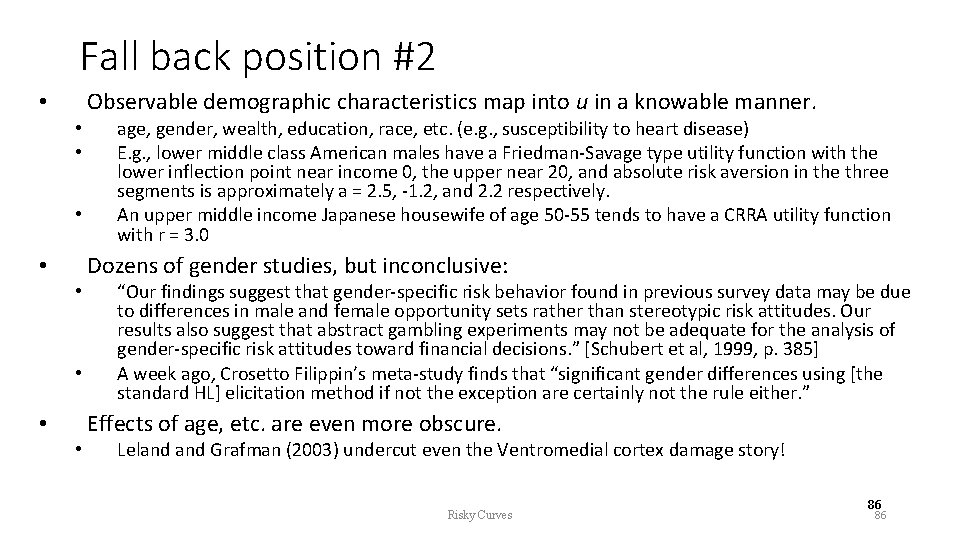
Fall back position #2 Observable demographic characteristics map into u in a knowable manner. • • age, gender, wealth, education, race, etc. (e. g. , susceptibility to heart disease) E. g. , lower middle class American males have a Friedman-Savage type utility function with the lower inflection point near income 0, the upper near 20, and absolute risk aversion in the three segments is approximately a = 2. 5, -1. 2, and 2. 2 respectively. An upper middle income Japanese housewife of age 50 -55 tends to have a CRRA utility function with r = 3. 0 Dozens of gender studies, but inconclusive: • • • “Our findings suggest that gender-specific risk behavior found in previous survey data may be due to differences in male and female opportunity sets rather than stereotypic risk attitudes. Our results also suggest that abstract gambling experiments may not be adequate for the analysis of gender-specific risk attitudes toward financial decisions. ” [Schubert et al, 1999, p. 385] A week ago, Crosetto Filippin’s meta-study finds that “significant gender differences using [the standard HL] elicitation method if not the exception are certainly not the rule either. ” Effects of age, etc. are even more obscure. • • Leland Grafman (2003) undercut even the Ventromedial cortex damage story! Risky Curves 86 86
Binswanger and Sillers Field Studies • Binswanger found that wealth, schooling, age, and caste were all insignificant • Sillers (1980) field study with Filipino farmers: • “This chapter briefly describes an attempt to use household risk preferences, as measured in the experimental game sequence, to test the impact of household risk aversion on the rate of fertilizer applied to the dry season rice crop. This effort failed to produce a satisfactory test of the importance of this relationship or its direction…” • Neither Binswanger nor Sillers could explain farmers’ decisions in familiar tasks using risk preferences inferred from their experimental tasks • Our partial screening of the literature has not yet revealed a validated evidence on how the curvature of utility functions might be systematically related to some observable human characteristics 87
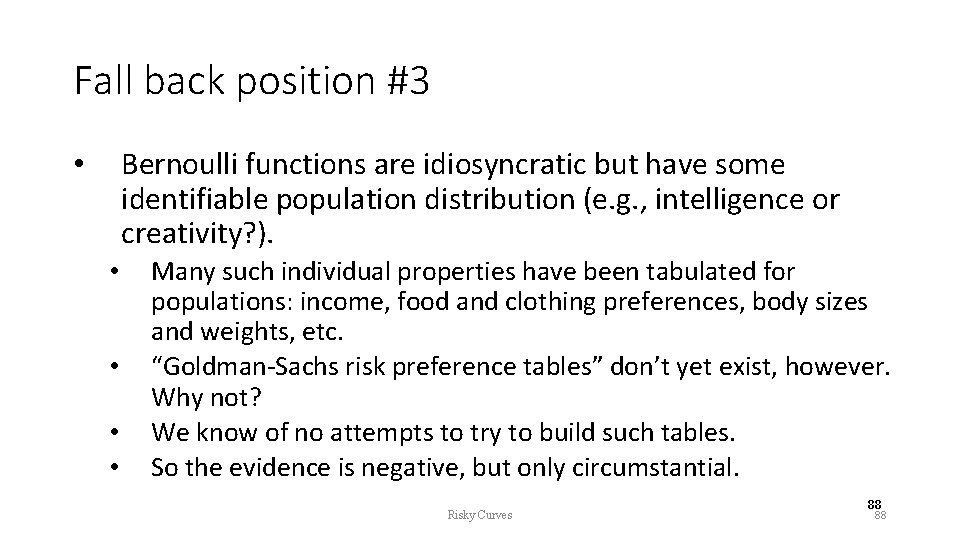
Fall back position #3 Bernoulli functions are idiosyncratic but have some identifiable population distribution (e. g. , intelligence or creativity? ). • • • Many such individual properties have been tabulated for populations: income, food and clothing preferences, body sizes and weights, etc. “Goldman-Sachs risk preference tables” don’t yet exist, however. Why not? We know of no attempts to try to build such tables. So the evidence is negative, but only circumstantial. Risky Curves 88 88
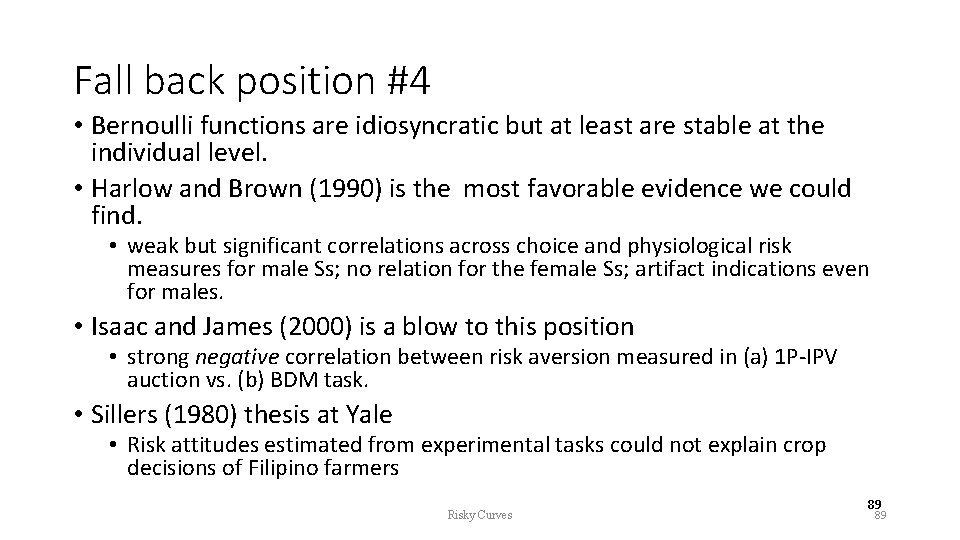
Fall back position #4 • Bernoulli functions are idiosyncratic but at least are stable at the individual level. • Harlow and Brown (1990) is the most favorable evidence we could find. • weak but significant correlations across choice and physiological risk measures for male Ss; no relation for the female Ss; artifact indications even for males. • Isaac and James (2000) is a blow to this position • strong negative correlation between risk aversion measured in (a) 1 P-IPV auction vs. (b) BDM task. • Sillers (1980) thesis at Yale • Risk attitudes estimated from experimental tasks could not explain crop decisions of Filipino farmers Risky Curves 89 89
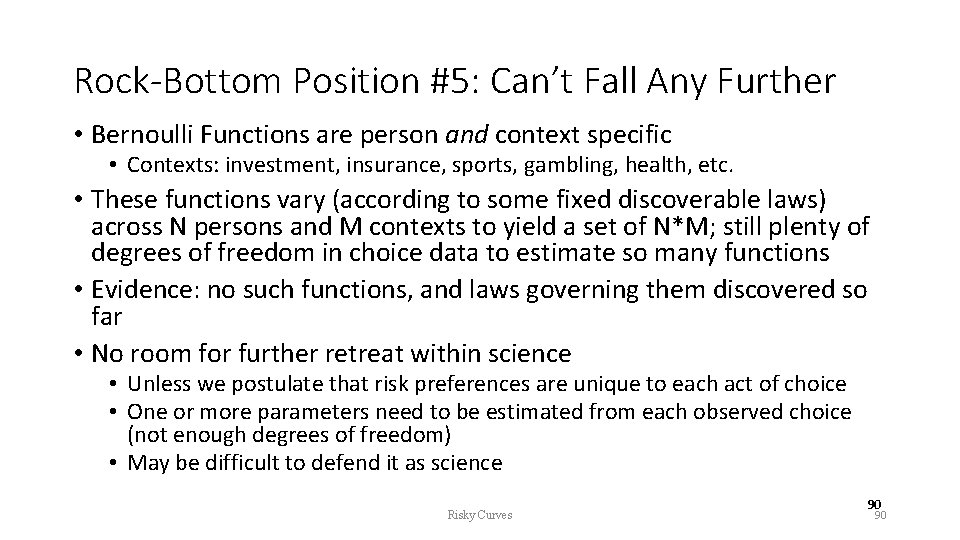
Rock-Bottom Position #5: Can’t Fall Any Further • Bernoulli Functions are person and context specific • Contexts: investment, insurance, sports, gambling, health, etc. • These functions vary (according to some fixed discoverable laws) across N persons and M contexts to yield a set of N*M; still plenty of degrees of freedom in choice data to estimate so many functions • Evidence: no such functions, and laws governing them discovered so far • No room for further retreat within science • Unless we postulate that risk preferences are unique to each act of choice • One or more parameters need to be estimated from each observed choice (not enough degrees of freedom) • May be difficult to defend it as science Risky Curves 90 90